The Journal of Threatened Taxa (JoTT) is dedicated to building evidence for conservation globally by publishing peer-reviewed articles online every month at a reasonably rapid rate at www.threatenedtaxa.org. All articles published in JoTT are registered under Creative Commons Attribution 4.0 International License unless otherwise mentioned. JoTT allows allows unrestricted use, reproduction, and distribution of articles in any medium by providing adequate credit to the author(s) and the source of publication.
www.threatenedtaxa.org
ISSN 0974-7907 (Online) | ISSN 0974-7893 (Print) Building evidence for conservation globally
Journal of Threatened Taxa
For Focus, Scope, Aims, Policies, and Guidelines visit https://threatenedtaxa.org/index.php/JoTT/about/editorialPolicies#custom-0 For Article Submission Guidelines, visit https://threatenedtaxa.org/index.php/JoTT/about/submissions#onlineSubmissions For Policies against Scientific Misconduct, visit https://threatenedtaxa.org/index.php/JoTT/about/editorialPolicies#custom-2
For reprints, contact <[email protected]>
Communication
Growth rate of captive Gharials Gavialis gangeticus
(Gmelin, 1789) (Reptilia: Crocodylia: Gavialidae) in
Chitwan National Park, Nepal
Bed Bahadur Khadka & Ashish Bashya
26 December 2019 | Vol. 11 | No. 15 | Pages:14998–15003 DOI: 10.11609/jott.5491.11.15.14998-15003
Partner
Member
Threatened Taxa
Publisher & Host
PLATINUMOPEN ACCESS
Communica
tion
DOI: https://doi.org/10.11609/jott.5491.11.15.14998-15003
Editor: Raju Vyas, Vadodara, Gujarat, India. Date of publication: 26 December 2019 (online & print)
Manuscript details: #5491 | Received 24 October 2019 | Final received 05 December 2019 | Finally accepted 09 December 2019
Citation: Khadka, B.B. & A. Bashyal (2019). Growth rate of captive Gharials Gavialis gangeticus (Gmelin, 1789) (Reptilia: Crocodylia: Gavialidae) in Chitwan National Park, Nepal. Journal of Threatened Taxa 11(15): 14998–15003. https://doi.org/10.11609/jott.5491.11.15.14998-15003
Copyright: © Khadka & Bashyal 2019. Creative Commons Attribution 4.0 International License. JoTT allows unrestricted use, reproduction, and distribution of this article in any medium by adequate credit to the author(s) and the source of publication.
Funding: None.
Competing interests: The authors declare no competing interests.
Author details: Bed Bahadur Khadka is an Assistant Conservation Officer and In-charge of Gharial Conservation and Breeding Center at Chitwan National Park. He
has wide experience in wetland and freshwater ecology and has been studying Gharials for last 15 years. Ashish Bashyal is a co-founder of Biodiversity Conservancy Nepal—a non-profit dedicated to wildlife conservation in Nepal. He has been studying genetics and ecology of crocodilians including Gharials since 2009.
Author contribution: BK and AB conceptualized and designed the study. BK collected data and AB performed data analysis. BK and AB prepared the manuscript.
Acknowledgements: We thank Department of National Parks and Wildlife Conservation, Chitwan National Park and staffs of the GCBC for their co-operation. We
are grateful to Charlie Manolis and anonymous reviewers for improving the quality of this manuscript.
Growth rate of captive Gharials Gavialis gangeticus
(Gmelin, 1789) (Reptilia: Crocodylia: Gavialidae) in
Chitwan National Park, Nepal
Bed Bahadur Khadka 1 & Ashish Bashyal 2
1 Gharial Conservation and Breeding Center, Chitwan National Park, Kasara, Chitwan, Nepal. 2 Biodiversity Conservancy Nepal, Manigram, Rupandehi 32903, Nepal. 1 [email protected], 2 [email protected] (corresponding author)
Abstract: Gharials Gavialis gangeticus have been reared in ex situ facilities in the Gharial Conservation and Breeding Center (GCBC) in Chitwan National Park of Nepal since the 1980s. There remains a paucity of detailed information concerning their growth rates, particularly with respect to season. We randomly selected 20 gharials (45 months old) in the GCBC, tagged them, and recorded total length (TL) and weight over three warm (April–September) and two cold (October–March) seasons between 01 April 2013 and 30 September 2015. We also recorded amounts of fish consumed by these gharials every month over the 30-month period. On average per season, the gharials grew by 9.48±3.63 cm (1.58cm/month) in length and gained 2.61±1.14 kg (0.43kg/month). Growth rates were significantly higher during warm seasons. The highest increase in both length (mean= 21.2±8.61 cm) and weight (mean =5.59±2.12 kg) occurred during the first warm season (April 2013–September 2013) of the study, and annual growth rate was also highest during the first year. Our data indicated strong correlation between mean length and body weight. A total of 2,103.9kg fish was consumed by 20 gharials over 30 months, for a mean consumption of 3.5kg fish per individual per month. Mean fish consumption was also significantly higher during warm (96.99±37.35 kg) versus cold (29.83±17.09 kg) seasons. Survival rate was 100%. Our findings establish baseline data for growth and feeding rates of captive gharials that will be useful in making management decisions in captive breeding and rearing facilities.
Keywords: Captive breeding, feeding, hatchlings, Narayani River, Rapti River, total length.
Abbreviations: GCBC—Gharial Conservation and Breeding Center | NP–National Park | TL–Total length.
ISSN 0974-7907 (Online) ISSN 0974-7893 (Print)
Growth rate of captive Gharials Khadka & Bashyal
Journal of Threatened Taxa | www.threatenedtaxa.org | 26 December 2019 | 11(15): 14998–15003 14999
INTRODUCTION
Gharials Gavialis gangeticus are Critically Endangered crocodilians currently distributed in among 14 widely-spaced locations in India and Nepal (Lang et al. 2019). In Nepal this species occurs in the Karnali and Babai rivers in Bardia National Park (NP) and the Narayani and Rapti rivers in Chitwan NP (Fig. 1). Major threats are habitat destruction and alteration, water extraction, construction of dams and barrages, mortality in fishing nets and pollution (Lang et al. 2019). Gharial populations were reduced by more than 90% throughout their range, including Nepal, between 1930 and 1980 (Stevenson & Whitaker 2010). In response to this crisis, the Government of Nepal initiated an ex situ conservation program in Chitwan NP by establishing the Gharial Conservation and Breeding Center (GCBC) in 1978 (Fig. 1). The main goal of the GCBC has been to reinforce and maintain viable populations of gharials in situ(Maskey 1989; Khadka 2010). Scientific information on every aspect of captive breeding, incubating and rearing is critical to ensure efficient conservation programs (Maskey 1989; Ballouard et al. 2010). Although updated information is available on some aspects of nesting and reproduction of gharials in the GCBC (Ballouard et al. 2010; Khadka 2010, 2013), there is a knowledge gap concerning growth and feeding rates of captive animals
in Nepal. Historic information on survival, growth and feeding of hatchlings was reported by Maskey (1989), but there is no recent information available. To address this knowledge gap and inform management actions, we investigated and established baseline on growth and feeding rates of captive gharials in GCBC (Images 1 & 2).
MATERIALS AND METHODS
Study Area
This study was conducted at GCBC facilities in Chitwan NP (27.400–27.813 0N and 83.880–84.830 0E; datum= WGS84; Fig. 1). Chitwan NP covers an area
of 953km2 and is located in Chitwan and Nawalparasi districts in south-central Nepal. It has a sub-tropical climate that can be broadly divided into three seasons: warm (March–May), monsoon (June–September), and cold (October–February) (Maskey 1989). Chitwan NP is drained by two major rivers (the Narayani and the Rapti), in which both Gharials and Mugger Crocodiles
Crocodylus palustris occur.
Methods
GCBC collects Gharial eggs from the Narayani and Rapti rivers annually for incubation in semi-natural conditions. Hatchlings are reared for up to five years
Figure 1. Map of Chitwan National Park showing location of the Gharial Conservation and Breeding Center.
Growth rate of captive Gharials Khadka & Bashyal
Journal of Threatened Taxa | www.threatenedtaxa.org | 26 December 2019 | 11(15): 14998–15003 15001
until they attain around 1.5 m total length (TL; distance from anterior tip of the snout to the posterior tip of the tail), and eventually released into various rivers within their geographic range. GCBC has released 1,465 Gharials between 1981 and March 2019 in the Narayani, Rapti, Karnali, Babai, and Koshi rivers (Bed Dhakal, pers. comm. 06.vii.2019).
We randomly selected 20 Gharials which had hatched between the first and second week of June 2009, and tagged them with uniquely numbered plastic cattle tags attached to one of the vertical tail scutes. Since our objective was not to estimate growth rates between sexes, we did not identify sex of these Gharials. Gharials were thus 45 months old when the study started on 01 April 2013. We reared the selected Gharials together in a separate enclosure of 9 x 7 m. The enclosure was bedded with sand, and contained a pond (6m long, 3m wide and 1.25m deep) and did not have any shade. For the purposes of this study, and taking into account the effect of temperature on crocodilian metabolism, we divided 12 month-periods into two seasons—warm (April–September) and cold (October– March). Fish, primarily comprised of Oreochromis spp.,
Puntius spp., Cirrhinus mrigala, and Gudusia chapra was fed to the experimental group for the duration of the study (01 April 2013–30 September 2015). The amount of fish offered to the group was based on decades of experience of rearing Gharials in GCBC. The amount of fish fed out was weighed, and amount that was uneaten was deduced to estimate amount of fish consumed by Gharials. We determined average fish consumption over a month by dividing the weight of consumed fish in that month by total number of Gharials. In April and September each year, we measured TL using a flexible measuring tape to the nearest cm, and recorded body weight using a spring balance to the nearest gram.
We performed data analysis using Deducer package (Fellows 2012) in R (R Core Team 2018) and presented mean values along with standard deviation. We performed paired t-test and student’s t-test wherever applicable to test for statistical significance. We also performed linear regression analysis to test for association between TL and weight of Gharials. We prepared the map on ArcGIS 10.3.
RESULTS
At the start of the study (01 April 2013) Gharials ranged 140–167 cm in TL (mean= 150.3±8.09 cm) and 5.6–10.5 kg in weight (mean= 7.49±1.35 kg) (Table 1; Fig.
Table 1. Mean total length and weight of 20 Gharials recorded with respect to warm and cold seasons from April 2013–September 2015.
Date of
measurement
Total length (cm) Weight (kg)
Mean Range Mean Range
01.iv.2013 150.3±8.09 140–167 7.49±1.35 5.6–10.5 30.ix.2013 171.5±10.01 156–189 13.07±3.12 9–20
01.iv.2014 174.1±11.17 158–194 13.65±3.62 8.5–22 30.ix.2014 182.65±15.76 159–208 16.6±4.23 10–25 01.iv.2015 184.35±14.77 163–208 15.8±5.02 8.5–27.5 30.ix.2015 197.7±18.15 169–229 20.55±6.29 11.5–30
Figure 2. Mean total length and weight of 20 Gharials recorded with respect to warm and cold seasons from April 2013–September 2015. Bars represent standard deviation.
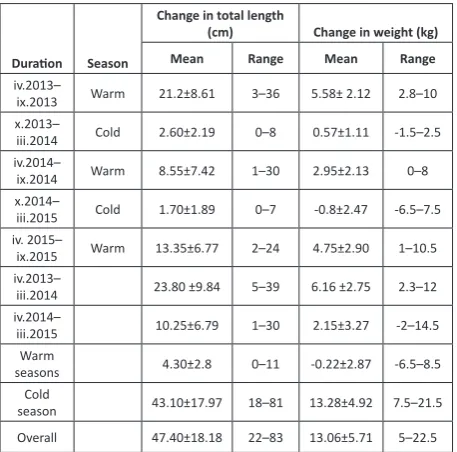
2). Considering mean TL of 43.71cm and mean weight of 100g of 100 one-month old Gharial hatchlings (Bed Khadka unpub.), they had thus grown around 96.29– 123.29 cm in TL (mean= 106.59 cm) and 5.5–10.4 kg in weight (mean= 7.39 kg) since hatching, equivalent to mean growth rates of around 2.13–2.73 cm/month (mean= 2.36 cm/month) and 0.12–0.22 kg/month (mean= 0.16 kg/month) in TL and weight, respectively. Similarly, by the end of the study (30 September 2015) Gharials ranged from 169–229 cm in TL (mean= 197.7±18.15 cm) and 11.5–30 kg in weight (mean= 20.55±6.29 kg) (Table 1; Fig. 2) and they had thus grown around 29–62 cm in TL (mean= 47.40±18.18 cm) and 5.9–19.5 kg in weight (mean= 13.06±5.71 kg) in 30 months duration (Table 2), equivalent to mean growth rates of around 1.58 cm/month and 0.43 kg/month in TL and weight, respectively.
Table 2. Mean change in total length and weight of 20 Gharials with respect to warm and cold seasons from April 2013–September 2015.
Duration Season
Change in total length
(cm) Change in weight (kg) Mean Range Mean Range
iv.2013–
ix.2013 Warm 21.2±8.61 3–36 5.58± 2.12 2.8–10 x.2013–
iii.2014 Cold 2.60±2.19 0–8 0.57±1.11 -1.5–2.5 iv.2014–
ix.2014 Warm 8.55±7.42 1–30 2.95±2.13 0–8 x.2014–
iii.2015 Cold 1.70±1.89 0–7 -0.8±2.47 -6.5–7.5 iv. 2015–
ix.2015 Warm 13.35±6.77 2–24 4.75±2.90 1–10.5 iv.2013–
iii.2014 23.80 ±9.84 5–39 6.16 ±2.75 2.3–12 iv.2014–
iii.2015 10.25±6.79 1–30 2.15±3.27 -2–14.5 Warm
seasons 4.30±2.8 0–11 -0.22±2.87 -6.5–8.5 Cold
season 43.10±17.97 18–81 13.28±4.92 7.5–21.5 Overall 47.40±18.18 22–83 13.06±5.71 5–22.5
Table 3. Amount of fish consumed by 20 Gharials in warm and cold seasons from April 2013–September 2015.
Duration Season
Fish consumed(kg)
Total Mean per month Range N* iv.2013–ix.2013 Warm 525.9 87.65±38.65 32.4–138 6
x.2013–iii.2014 Cold 161.5 26.91±23.42 8.5–64 6
iv.2014–ix.2014 Warm 522.5 87.08±34.06 41.5–145 6
x.2014–iii.2015 Cold 196.5 32.75±8.58 24.5–45.5 6
iv. 2015–ix.2015 Warm 697.5 116.25±37.71 69.5–162.5 6
Cold seasons 358 29.83±17.09 8.5– 64 12
Warm seasons 1745.9 96.99±37.35 32.4–162.5 18
Overall 2103.9 70.13±45.26 8.5–162.5 30
*Number of months
average, Gharials grew by 9.48±3.63 cm per season (Table 2) and mean increase in TL was higher during warm than cold season (One tailed t-test; t= 9.53, df = 19, P<0.001). On average, Gharials gained weight by 2.61±1.14 kg per season (Table 2) and gained more weight during warm than cold season (One-tailed t-test; t= 10.64, df= 19, P<0.001). Our data also allowed annual growth to be calculated for at least two different 12-month periods (Table 2), each including one warm and one cold season. The annual growth rate was 1.98 cm/month and 0.51 kg/month for length and weight respectively for 2013– 2014. Similarly, annual growth rate was 0.85 cm/month and 0.17 kg/month for length and weight respectively
for 2014–2015. Mean change in TL of Gharials either increased or remained constant between seasons, while mean change in weight decreased in some Gharials during cold seasons (Table 2). There was a strong correlation between mean TL and body weight (r2 = 0.95;
F1, 18 = 327.1, P<0.001). Twenty Gharials consumed a total
of 2,103.9kg fish over 30 months period with a mean of 3.5kg fish consumed per Gharial per month (Table 3). Mean fish consumption was significantly higher (One tailed t-test; t=6.65, df= 25.47, P<0.001) for warm than cold periods; fish consumption during warm season was more than threefold higher than for cold. While Gharials exhibited considerable variation in their growth, survival rate was 100% throughout the duration of the study.
DISCUSSION
Growth rate of captive Gharials Khadka & Bashyal
Journal of Threatened Taxa | www.threatenedtaxa.org | 26 December 2019 | 11(15): 14998–15003 15003
Various studies have suggested that growth rate in crocodilians can vary among species as well as within the same species from different geographical regions, age groups and sex (Thorbjarnarson 1988; Gorzula & Seijas 1989; Saalfeld et al. 2008; Barrios-Quiroz et al. 2012; Balaguera-Reina et al. 2015). We estimated growth rate in TL between 0.73–2.76 cm/month (mean= 1.58 cm/ month) for Gharials. Growth rate in TL of Spectacled Caimans Caiman crocodilus was reported between 2–2.6 cm/month during the first year of life (Gorzula & Seijas 1989). Growth rate in TL of American Crocodile
Crocodylus acutus hatchlings in wild was reported to vary between Haiti (3.9 cm/month) (Thorbjarnarson 1988) and in Panama (0.9–4.8 cm/month) (Balaguera-Reina et al. 2015). Similarly, growth rate in TL of American Alligators Alligator mississippiensis was also reported to vary between 2.7 cm/month (for individuals with TL<50 cm when captured) and 2.3 cm/month (for individuals with TL between 50–125 cm when captured) in wild (Saalfeld et al. 2008). Growth rate is also observed to vary between different age groups in Gharials in captivity (Bed Khadka Unpub.; Maskey 1989). One month old Gharial hatchlings (mean TL= 43.71±1.40 cm; range=40.1–47 cm; n=100) showed mean growth rate of 2.7cm/month over the period of 109 days (Bed Khadka Unpub.) which was higher than the mean growth rate reported in this study. It should, however, also be noted that growth rates in crocodilians are typically higher in captivity than in wild. Relation between temperature and growth rate is reported in other species of crocodilians as well. For instance, Joanen & McNease (1987) showed that growth rates in American Alligators could be doubled by optimizing temperature throughout the year. Similarly, Webb et al. (1978) showed that growth rate in Saltwater Crocodiles Crocodylus porosus was higher in the wet-hot season than in the dry-cold season in Australia and growth rate decreased as body size increased.
Gharials are reared in captive facilities across Nepal and India and held at zoos throughout the world. Our findings establish baseline growth and feeding rates for captive Gharials. Such information will be helpful in optimizing feeding and rearing practice for Gharials in captivity.
REFERENCES
Balaguera-Reina, S. A., M. Venegas-Anaya, O.I. Sanjur, H.A. Lessios & L.D. Densmore (2015). Reproductive ecology and hatchling growth
rates of the American Crocodile (Crocodylus acutus) on Coiba Island,
Panama. South American Journal of Herpetology 10: 10–23. Ballouard, J.M., P. Priol, J. Oison, A. Ciliberti & A. Cadi (2010). Does
reintroduction stabilize the population of the critically endangered
Gharial (Gavialis gangeticus) in Chitwan National Park, Nepal?
Aquatic Conservation: Marine and Freshwater Ecosystems 20: 756–
761.
Barrios-Quiroz, G., G. Casas-Andreu & A.H. Escobedo-Galván (2012). Sexual size dimorphism and allometric growth of Morelet’s
crocodiles in captivity. Zoological Science 29(3): 198–204.
https://doi.org/10.2108/zsj.29.198
Fellows, I. (2012). Deducer: A Data Analysis GUI for R. Journal of
Statistical Software 49(8): 1-15. http://www.jstatsoft.org/v49/i08/
Gorzula, S. & A.E. Seijas (1989). The Common Caiman, pp. 44–61. In:
Crocodiles: their ecology, management and the conservation. IUCN,
Gland, Switzerland, 308pp.
Joanen, T. & L. McNease (1987). Alligator farming research in
Louisiana, USA, pp. 329–340. In: Webb G.J.W., S.C. Manolis & P.J. Whitehead (eds.). Wildlife Management: Crocodiles and Alligators.
Surrey Beatty & Sons, Sydney, Australia, 552pp.
Khadka, B.B. (2010). Gharial hatching status in 2010, Chitwan National
Park, Nepal. Crocodile Specialist Group Newsletter 29(3): 16–17.
Khadka, B.B. (2013). Effect of weather on hatching success of Gharial in
Chitwan National Park. Crocodile Specialist Group Newsletter 32(4):
5–7.
Lang, J.W., S. Chowfin & J.P. Ross (2019). Gavialis gangeticus. The IUCN Red List of Threatened Species 2019: e.T8966A3148543;
https://doi.org/10.2305/IUCN.UK.2019-1.RLTS.T8966A3148543.en Maskey, T.M. (1989). Movement and survival of captive-reared
gharials, Gavialis gangeticus, in the Narayani river, Nepal. Ph.D. Dissertation, University of Florida, USA, xiv+187pp.
R Core Team (2018). R: A language and environment for statistical computing. R Foundation for Statistical Computing, Vienna, Austria.
Saalfeld, D.T., K.K. Webb, W.C. Conway, G.E. Calkins & J.P. Duguay (2008). Growth and Condition of American Alligators (Alligator
mississippiensis) in an Inland Wetland of East Texas. Southeastern
Naturalist 7(3): 541–550.
https://doi.org/10.1656/1528-7092-7.3.541
Stevenson, C. & R. Whitaker (2010). Indian Gharial Gavialis gangeticus,
pp. 139–143. In: Manolis, S.C. & C. Stevenson (eds). Crocodiles:
Status Survey and Conservation Action Plan. Crocodile Specialist
Group, Australia, 143pp.
Thorbjarnarson, J. B. (1988). The status and ecology of the American
crocodile in Haiti. Bulletin of the Florida State Museum, Biological
Sciences 33: 1–86.
Webb, G.J.W., H. Messel, J. Crawford & M.J. Yerbury (1978). Growth rates of Crocodylus porosus (Reptilia: Crocodilia) from Arnhem Land, Northern Australia. Australian Wildlife Research 5: 385–399. https://dx.doi.org/10.1071/WR9780385
ISSN 0974-7907 (Online) | ISSN 0974-7893 (Print)
December 2019 | Vol. 11 | No. 15 | Pages: 14927–15090 Date of Publication: 26 December 2019 (Online & Print)
DOI: 10.11609/jott.2019.11.15.14927-15090
www.threatenedtaxa.org
publishing peer-reviewed articles online every month at a reasonably rapid rate at www.threatenedtaxa.org. All articles published in JoTT are registered under Creative Commons Attribution 4.0 International License
unless otherwise mentioned. JoTT allows allows unrestricted use, reproduction, and distribution of articles in any medium by providing adequate credit to the author(s) and the source of publication.
Peer Commentary
Observations on the ex situ management of the Sumatran Rhinoceros
Dicerorhinus sumatrensis (Mammalia: Perissodactyla: Rhinocerotidae):
present status and desiderata for conservation
– Francesco Nardelli, Pp. 14927–14941
Communications
Revisiting genetic structure of Wild Buffaloes Bubalus arnee Kerr, 1792 (Mammalia: Artiodactyla: Bovidae) in Koshi Tappu Wildlife Reserve, Nepal: an assessment for translocation programs
– Ram C. Kandel, Ram C. Poudel, Amir Sadaula, Prakriti Kandel, Kamal P. Gairhe, Chiranjibi P. Pokheral, Siddhartha B. Bajracharya, Mukesh K. Chalise & Ghan Shyam Solanki, Pp. 14942–14954
A review on status of mammals in Meghalaya, India
– Adrian Wansaindor Lyngdoh, Honnavalli Nagaraj Kumara, P.V. Karunakaran & Santhanakrishnan Babu, Pp. 14955–14970
A comparative analysis of hair morphology of wild and domestic ungulate prey species of Leopard Panthera pardus fusca (Mammalia: Carnivora: Felidae) from Goa, India
– Bipin S. Phal Desai, Avelyno H. D’Costa & S.K. Shyama, Pp. 14971–14978
Understanding people’s perception and attitudes towards mammalian fauna using qualitative data: a case study in Barail Wildlife Sanctuary, India
– Amir Sohail Choudhury, Rofik Ahmed Barbhuiya & Parthankar Choudhury, Pp. 14979–14988
An assessment of bird communities across Ujjani and its five satellite wetlands in Solapur District of Maharashtra, India
– Shraddha Prabhakar Karikar, Subhash Vitthal Mali, Kulkarni Prasad & Aphale Priti, Pp. 14989–14997
Growth rate of captive Gharials Gavialis gangeticus (Gmelin, 1789) (Reptilia: Crocodylia: Gavialidae) in Chitwan National Park, Nepal
– Bed Bahadur Khadka & Ashish Bashyal, Pp. 14998–15003
Amphibian abnormalities and threats in pristine ecosystems in Sri Lanka
– G.K.V.P.T. Silva, W.A.D. Mahaulpatha & Anslem de Silva, Pp. 15004–15014
Diversity and distribution of orchids of Goa, Western Ghats, India
– Jeewan Singh Jalal, Pp. 15015–15042
Short Communications
Efficacy of oxyclozanide and levamisole treatment on the gastrointestinal parasites in captive Lions Panthera leo
– Dhareppa Ganager, Gotakanapura Sanjeevamurthy Mamatha, Asoor
Muralidhara, Nagappa Lakkundi Jaya & Beechagondahalli Papanna Shivashankar, Pp. 15043–15046
First record in 129 years of the Tamil Treebrown Lethe drypetis todara Moore, 1881 (Lepidoptera: Nymphalidae: Satyrinae) from Odisha, India by fruit-baiting
– Anirban Mahata, Sudheer Kumar Jena & Sharat Kumar Palita, Pp. 15047– 15052
A review of the leafhopper tribe Agalliini (Hemiptera: Cicadellidae: Megophthalminae) with a revised key to the known Pakistani genera and species
– Hassan Naveed, Kamran Sohail, Waqar Islam & Yalin Zhang, Pp. 15053– 15060
The windowpane oyster family Placunidae Rafinesque, 1815 with additional description of Placuna quadrangula (Philipsson, 1788) from India
– Rocktim Ramen Das, Vijay Kumar Deepak Samuel, Goutham Sambath, Pandian Krishnan, Purvaja Ramachandran & Ramesh Ramachandran, Pp. 15061–15067
Notes
Recent records of the rare Mountain Tortoiseshell Aglais rizana (Moore, 1872) (Lepidoptera: Nymphalidae) in the upper Garhwal, western Himalaya, India, after 100 years
– Arun Pratap Singh & Tribhuwan Singh, Pp. 15068–15071
First report of Dicranocentroides indica (Handschin, 1929) (Collembola: Paronellidae) from Odisha, India
– Ashirwad Tripathy, Pp. 15072–15073
Additions to the knowledge of darkling beetles (Coleoptera: Tenebrionidae) from the Indo-Burma Biodiversity Hotspot, Meghalaya, India
– Vishwanath Dattatray Hegde, Pp. 15074–15078
Bhutan Asiabell Codonopsis bhutanica Ludlow (Asterales: campanulaceae): a new addition to the Indian flora
– Samiran Panday, Vikas Kumar, Sudhansu Sekhar Dash, Bipin Kumar Sinha & Paramjit Singh, Pp. 15079–15082
Gentiana urnula Harry Sm. (Gentianaceae), a new record for the flora of
Arunachal Pradesh, India
– Khilendra Singh Kanwal, Umeshkumar Lalchand Tiwari, Lod Yama & Mahendra Singh Lodhi, Pp. 15083–15086
Carex phacota, Spreng. (Cyperaceae): a new record for the central
Western Ghats of Karnataka, India
– E.S.K. Udupa, H.U. Abhijit & K.G. Bhat, Pp. 15087–15088
Book review
Compendium of Traded Indian Medicinal Plants
– Reviewed by A. Rajasekaran, Pp. 15089–15090