The Journal of Threatened Taxa (JoTT) is dedicated to building evidence for conservation globally by publishing peer-reviewed articles online every month at a reasonably rapid rate at www.threatenedtaxa.org. All articles published in JoTT are registered under Creative Commons Attribution 4.0 International License unless otherwise mentioned. JoTT allows allows unrestricted use, reproduction, and distribution of articles in any medium by providing adequate credit to the author(s) and the source of publication.
www.threatenedtaxa.org
ISSN 0974-7907 (Online) | ISSN 0974-7893 (Print) Building evidence for conservation globally
Journal of Threatened Taxa
For Focus, Scope, Aims, Policies, and Guidelines visit https://threatenedtaxa.org/index.php/JoTT/about/editorialPolicies#custom-0 For Article Submission Guidelines, visit https://threatenedtaxa.org/index.php/JoTT/about/submissions#onlineSubmissions For Policies against Scientific Misconduct, visit https://threatenedtaxa.org/index.php/JoTT/about/editorialPolicies#custom-2 For reprints, contact <[email protected]>
Communication
Bone fractures in roadkill Northern Tamandua
Tamandua mexicana (Mammalia: Pilosa: Myrmecophagidae)
in Costa Rica
Randall Arguedas, Elisa C. López & Lizbeth Ovares
26 November 2019 | Vol. 11 | No. 14 | Pages: 14802–14807 DOI: 10.11609/jott.4956.11.14.14802-14807
Partner
Member
Threatened Taxa
Publisher & Host
PLATINUMOPEN ACCESS
Communica
tion
DOI:https://doi.org/10.11609/jott.4956.11.14.14802-14807
Editor: Wendy Collinson-Jonker, Endangered Wildlife Trust, Gauteng, South Africa. Date of publication: 26 November 2019 (online & print) Manuscript details: #4956 | Received 18 March 2019 | Final received 02 November 2019 | Finally accepted 05 November 2019
Citation:Arguedas, R., E.C. Lopez & L. Ovares (2019). Bone fractures in roadkill Northern Tamandua Tamandua mexicana (Mammalia: Pilosa: Myrmecophagidae) in Costa Rica. Journal of Threatened Taxa 11(14): 14802–14807. https://doi.org/10.11609/jott.4956.11.14.14802-14807
Copyright: © Arguedas et al. 2019. Creative Commons Attribution 4.0 International License. JoTT allows unrestricted use, reproduction, and distribution of this article in any medium by adequate credit to the author(s) and the source of publication.
Funding: Authors used their own resources for this project. Competing interests: The authors declare no competing interests.
Author details: Randall Arguedas—Zoo and wildlife veterinarian and Master of Science degree on Conservation Medicine. Head veterinarian at the Zoológico
Nacional Simón Bolívar. Professor of Zoo and wildlife medicine and surgery at Universidad Técnica Nacional. Research interests are mainly on baseline physiology, anatomy and diseases of wild vertebrates. Elisa C. López—Veterinarian and general manager at Totláli Ecological Park and legal representative of the National Registry of Scientific and Technological Institutions and Companies (RENIECYT). Currently working on the “Etnobiological Garden” research at the Totláli Ecological Park. Lizbeth Ovares—Tropical biologist. Head of the Environmental Education Department at the Zoológico Nacional Simón Bolívar. Research interests are in wildlife urban ecology and human interactions with wildlife.
Author contribution: RA—conceived and designed the study, took the X-rays, analyzed and interpreted data and wrote the paper. ECL—helped in the study design,
field, took the X-rays, edited the X-ray images. LO—analyzed and interpreted data, wrote the paper.
Acknowledgements: Dr. Alejandro Gómez, Dr. Ricardo García, and Dr. Natalia Pérez, for facilitating all the x-rays. All the staff from Vías Amigables con la Vida
Silvestre Costa Rica.
Bone fractures in roadkill Northern Tamandua
Tamandua mexicana (Mammalia: Pilosa: Myrmecophagidae)
in Costa Rica
Randall Arguedas 1 , Elisa C. López 2 & Lizbeth Ovares 3
1,3 Zoológico Nacional Simón Bolívar, Barrio Amón, Calle 13, San José 11594-1000, Costa Rica. 2 Parque Ecológico Totláli, Guerrero s/n, San Pablo Tejalpa, Zumpahuacán, Estado de México 51986, México. 1 [email protected] (corresponding author), 2 [email protected], 3 [email protected]
Abstract: Northern Tamandua Tamandua mexicana is one of the most common roadkill species encountered on Costa Rican highways. Ten roadkill Northern Tamanduas were collected along different roads in Costa Rica and moved to a veterinary facility where appendicular radiologic studies were undertaken. The number of fractures present in each individual varied from zero to five (mean=2.6), with only one animal sustaining no fractures at all. Most fractures were present in the humerus (31%), followed by the ulna and ilium (both 19%), whilst the cranial portion of the body represented the highest number of fractures (61%). These data can contribute, not only to establishing causes of animal-road-mortalities, but also to the future understanding and decision-making of clinical actions for animals injured on the roads.
Keywords: Anteater,car accidents, radiology, roadways, wildlife mortality.
Resume: El tamandúa norteño Tamandua mexicana es una de las especies que más comunes que se encuentran atropelladas en las carreteras de Costa Rica. Se recolectaron diez tamandúas atropellados a lo largo de diferentes caminos en Costa Rica y se trasladaron a una clínica veterinaria donde se realizaron estudios radiológicos apendiculares. El número de fracturas presentes en cada individuo varió de cero a cinco (media = 2.6), y solo un animal no sufrió fracturas del todo. La mayoría de las fracturas estaban presentes en el húmero (31%), seguidas por la ulna y el ilion (ambos 19%); la porción craneal del cuerpo representaba el mayor número de fracturas (61%). Estos datos pueden contribuir, no solo al establecimiento de causas de mortalidad de animales en el camino, sino también a la comprensión y toma de decisiones futuras de acciones médicas para animales que son heridos en carreteras
ISSN 0974-7907 (Online) ISSN 0974-7893 (Print)
Bone fractures in roadkill Northern Tamandua Arguedas et al.
Journal of Threatened Taxa | www.threatenedtaxa.org | 26 November 2019 | 11(14): 14802–14807 14803 INTRODUCTION
Highways are significant factors of wildlife mortality; they interfere with natural migration routes and are responsible for habitat fragmentation, which is one of the main causes of bio diversity loss (De la Ossa-V & Galván-Guevara 2015). A further negative impact of roads is the resulting collision with a vehicle, namely, roadkill.
Studies have shown that roadkill seriously decreases animal populations and can even result in local extinctions creating a risk factor for xenarthran persistence, even to non-threatened species (Ribeiro et al. 2017). Among Costa Rican wildlife species, the Common Opossum Didelphis marsupialis and a species
of anteater Tamandua mexicana (Image 1) dominate roadkill numbers (Monge-Nágera 2018b).
Monge-Nágera (2018a) found that T. mexicana was the most common roadkill species (n=73), followed by the Common Oppossum (n=66) from data gathered over a four year period (2014–2018). Furthermore, 13 additional T. mexicana individuals were detected as roadkill over a one-year period (48 sample efforts) on a 94.9km road (n=7.3 anteater/km) (Artavia et al. 2015) whilst a further seven individuals of T. mexicana were
found on a 100-km section of road over an eight-month period in 2008 (Carvajal Alfaro & Díaz Quesada 2016).
T. mexicana had higher numbers of roadkill during
the dry season (December to April) than the wet season (May to November) in Costa Rica and Colombia (Nadjar & De la Ossa 2013; Monge-Nágera 2018a) possibly because ants are scarcer in dryer habitats than when it is wet, causing anteater species to travel further in search
of food. This may result in them crossing roads more
frequently and becoming roadkill although this is just speculation since the seasonal behavior of T. mexicana is
poorly known (Nadjar & De la Ossa 2013; Monge-Nágera 2018a) and further study of their behaviour is needed (Monge-Nágera 2017, 2018a).
Descriptive epidemiological studies of wildlife are an important source of information about natural and non-natural hazards to wildlife populations (Molina-López et al. 2011) and consequently, studies that investigate the causes of mortality have become an important source for ecosystem health monitoring (Molina-López et al. 2011). One of the most common findings in animals hit by automobiles is the appendicular fractures (Minar et al. 2013) which can be surgically treated if an injured animal is taken to a rescue center. Understanding the normal
Image 1. Northern Tamandua Tamandua mexicana at Aranjuez, Pitahaya, Puntarenas Province, Costa Rica.
bone radiographic appearance as well as the location of the fracture is vital in assisting the treatment of injured animals. Furthermore, increased public awareness of the number of wildlife injured or killed on Costa Rican roads may have contributed to the mitigation methods being applied.
T. mexicana is a species of a medium-sized anteater ranging from southern Mexico to northwestern Andes
in South America and lives in diverse forest ecosystems
(Navarrete & Ortega 2011). It is classified as “Least Concern” by the IUCN due to its wide distribution, and presumably, large population, however, the current population trend is unknown (Ortega et al. 2014), although it is represented in protected areas, as well as in anthropogenic ecosystems (Navarrete & Ortega. 2011). Usually solitary by nature, T. mexicana ranges
often overlap with that of neighboring T. mexicana.
Females give birth to a single offspring once a year, with the pups becoming independent after one year (Wainwright 2007; Navarrete & Ortega. 2011). Head and body length ranges from between 470–770 mm, with a tail length between 402–672 mm; weight ranges from 2–7 kg (Nowak 1991; Wainwright 2007). T. mexicana
is both diurnal and nocturnal foraging in trees and on
the ground, feeding predominantly on termite genera:
(Armitermes, Calcaritermes, Coptotermes, Leucotermes, Microcerotermes, and Nasutitermes; Navarrete &
Ortega 2011) and ant genera (Camponotus, Azteca,and
Crematogaster; Navarrete & Ortega 2011)
The purpose of this communication is to use roadkill
T. mexicana as tools to demonstrate the location and frequency of bone fractures resulting from an impact with a vehicle. This information can be a valuable reference in future medical and surgical procedures at
rescue centers.
METHODS
Ten roadkill of T. mexicana were collected between April to July 2016, on different roads in Costa Rica. For each individual, the date and time of collection, geographic coordinates and the person responsible for collecting them were recorded. We believe that two of the animals were at least one year old. The remaining
eight individuals consisted of mature animals based on
closed epiphyseal growth plates. Based on the presence of the reproductive organs, we were able to sex three
of the T. Mexicana confirming there were two females and one male; three of the carcasses had no organs, whilst the remaining four individuals were unclear due
to damage to the abdominal cavitiy.
The 10 T. Mexicana (all deceased) were transferred to a veterinary establishments where appendicular radiology studies were carried out using an Ultra 12040HF (Diagnostic Imaging Systems®) X-ray unit with a CR2000 Plus Scanner and CR200 Navigator Software (Diagnostic Imaging Systems®). Lateral (L) and anteroposterior (AP) orthogonal views of the four extremities were taken. Each animal received six radiographs, with AP projections of the forelimbs and hind limbs performed on both limbs at the same time. Each affected bone, in all animals, had only one fracture, which made further classification easier. For two of the animals, x-rays of the hind legs could not be done due to extensive damage to the legs. For the remaining eight, x-rays of the forelimbs (including the scapula, humerus, radius/ulna, carpus, metacarpals, and phalanges) and x-rays of the hind limbs (including the ilium, ischium, pubis, femur, tibia and fibula, tarsals, metatarsals and phalanges) were all taken.
RESULTS
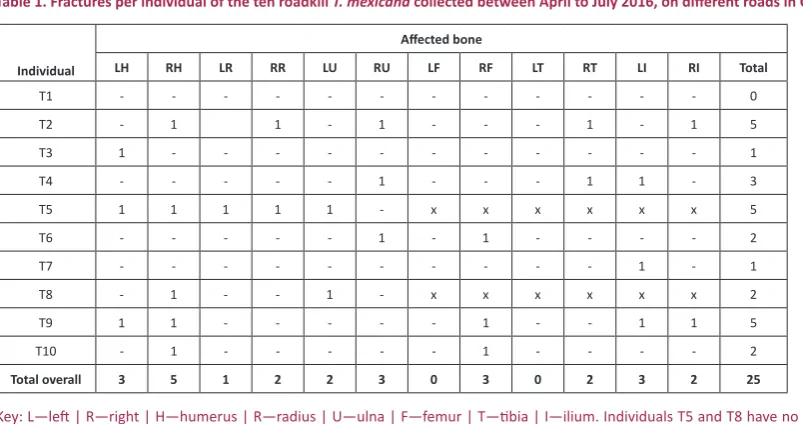
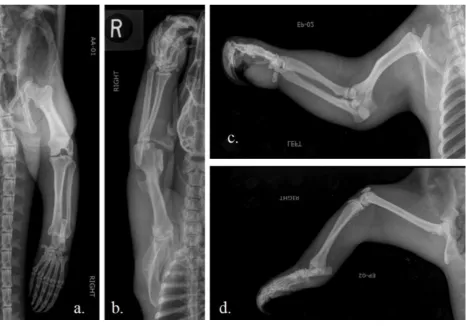
Of the 10 roadkill, a total of 54 radiographs were taken (Figures 1 & 2). Two individuals had open epiphyseal growth lines indicating that they were juveniles and still growing. The number of fractures present in each individual varied from zero to five (mean=2.6); only one animal did not present any fractures, while three of them had a total of five fractures in different bones (Table 1). Sixty-one percent of the fractures occurred in the cranial portion of the body with the majority observed in the humerus (31%) followed by the ulna (19%) and then the radius (11%). The remaining 39% were present in the caudal portion of the body with the majority observed in the ilial (19%), followed by the femur (12%) and then tibia/fibula (8%); no fractures were observed in the scapula, ischium, pubis, carpal/tarsal, metacarpal/tarsal and phalanges.
DISCUSSION
There are few studies that utilize road-killed animals as a beneficial tool for learning, specifically for evaluating fractures on animal-roadkill species. Most studies that
evaluate roadkill-animal-fractures mainly focus on
domestic animals (for example, dogs and cats) (Minar et al. 2013; Martínez-Hernández et al. 2017). Despite cats having a similar head and body length (that is, ~460mm)
Bone fractures in roadkill Northern Tamandua Arguedas et al.
Journal of Threatened Taxa | www.threatenedtaxa.org | 26 November 2019 | 11(14): 14802–14807 14805
Table 1. Fractures per individual of the ten roadkill T. mexicana collected between April to July 2016, on different roads in Costa Rica.
Individual
Affected bone
LH RH LR RR LU RU LF RF LT RT LI RI Total
T1 - - - 0
T2 - 1 1 - 1 - - - 1 - 1 5
T3 1 - - - 1
T4 - - - 1 - - - 1 1 - 3
T5 1 1 1 1 1 - x x x x x x 5
T6 - - - 1 - 1 - - - - 2
T7 - - - 1 - 1
T8 - 1 - - 1 - x x x x x x 2
T9 1 1 - - - 1 - - 1 1 5
T10 - 1 - - - 1 - - - - 2
Total overall 3 5 1 2 2 3 0 3 0 2 3 2 25
Key: L—left | R—right | H—humerus | R—radius | U—ulna | F—femur | T—tibia | I—ilium. Individuals T5 and T8 have no hind limb x-rays (x) | -—means no fractures | X—means the individuals did not have the limb.
Figure 1. Selected x-rays of fractures in different bones from the ten roadkill T. mexicana collected between April and July 2016, on different roads in Costa Rica. Anteroposterior and lateral projections are represented. a—diaphyseal radio-ulnar fracture | b—distal ilial fracture | c—
Figure 2. Four X-rays of complete T. mexicana normal extremities. Anteroposterior (AP) and lateral projections (L) are represented. a—AP projection of the pelvic limb | b—AP projection of the thoracic limb | c—L projection of the thoracic limb | d—L projection of the pelvic limb.
percentage of fractures were found in the cranial portion
of the T. mexicana whilst the most commonly affected bones in cats were found in the caudal portion (such as, the femur (28.2%) and pelvis (24.8%). The same contrast was also noticed with dogs with more fractures observed in the pelvis (15.8%), the femur (14.8%) and the tibia (14.8%) (Phillips 1979). Reasons for a higher percentage of fractures found in the cranial portion of
the T. mexicana is likely due to a combination of dense roadside habitat and the anatomy of xenarthrans whose plantigrade locomotion, coupled with short limbs, provides low agility and relatively slow locomotion (Ribeiro et al. 2017). They emerge from the forest onto the road, providing a driver with limited visibility ad reaction time, and are often immediately hit by a vehicle in the frontal lateral position (Ribeiro et al. 2017).
Other reasons for xenarthrans being vulnerable to roadkill are their poor vision, which may mean they simply do not see approaching vehicles (Ribeiro et al. 2017). Furthermore, speeding vehicles and poor driver visibility (particularly in areas with dense roadside vegetation) may also influence roadkill occurrence (Collinson et al. 2019).
Similar findings for fractures found on roadkill and comparable with T. mexicana is a study undertaken in
North America, where an average of four fractures per individual in Virginia opossums Didelphis virginuanus
were observed (Mead & Patterson 2009). This species is a medium-sized mammal, with head and body length ranging from 325 to 500 mm, weighing between 2–5.5 kg (Novakl 1991) and thus similar to the T. mexicana.
Bone fractures in roadkill Northern Tamandua Arguedas et al.
Journal of Threatened Taxa | www.threatenedtaxa.org | 26 November 2019 | 11(14): 14802–14807 14807
CONCLUSION
We found little literature evaluating long bone
radiology in T. mexicana, therefore the data from our
study which provides examples (and images) of normal appendicular x-rays plus the anatomic bone fracture location of trauma, can be used as a reference for further medical or biological studies, specifically at rescue and rehabilitation centers. Veterinarians can use epidemiological information to better understand
surgical treatment of T. mexicana (and other species of similar size and behaviour), particularly for injured
individuals that can then be rehabilitated and released
back into the wild.
REFERENCES
Alfaro, V.C. & F.D. Quesada (2016). Registro de mamíferos silvestres atropellados y hábitat asociados en el cantón de La Fortuna, San Carlos, Costa Rica. Biocenosis May 17(1–2): 30.
Artavia, A., M. Jiménez, A. Martínez-Salinas, E. Pomareda, D. Araya-Gamboa & E. Arévalo-Huezo (2015). Registro de mamíferos silvestres en la sección de la ampliación de la Ruta 32, Limón, Costa Rica. Brenesia 83(84): 37–46.
Collinson, W.J., D.M. Parker,R.T. Bernard,B.K. Reilly & H.T. Davies-Mostert (2019). Factors influencing the spatial patterns of vertebrate roadkill in South Africa: The Greater Mapungubwe Transfrontier Conservation Area as a case study. African Journal of Ecology May: 1–13. https://doi.org/10.1111/aje.12628
Cross, A.R. (2012). Fracture biology and biomechanics, pp. 595–571. In: Tobias K. & S. Johnston (eds). Veterinary Surgery Small Animal, Vol 1. Saunders, Missouri, 1196pp.
De La Ossa, J. & S. Galván-Guevara (2015). Registro de mortalidad de fauna silvestre por colisión vehicular en la carretera Toluviejo– ciénaga La Caimanera, Sucre, Colombia. Biota Colombiana 16(1):
67–77. https://doi.org/10.15517/rbt.v66i2.33404 Threatened Taxa
Martínez-Hernández, A.G., I.A. Quijano-Hernández, J. Del-Ángel-Caraza & M.A. Barbosa-Mireles (2017). Análisis de 71 casos de traumatismo en perros. Revista Electrónica de Veterinaria 18(2): 1–7.
Mead, A.J. & D.B. Patterson (2009). Skeletal lesions in a population of Virginia opossums (Didelphisvirginiana) from Baldwin county, Georgia. Journal of Wildlife Diseases 45(2): 325–32. https://doi.
org/10.7589/0090-3558-45.2.325
Minar, M., Y. Hwang, M. Park, S. Kim, C. Oh, S. Choi & G. Kim (2013). Retrospective study on fractures in dogs. Journal of Biomedical Research 14(3): 140–4. https://doi.org/10.12729/jbr.2013.14.3.140
Molina-López, R.A, J. Casal & L. Darwich (2011). Causes of morbidity in wild raptor populations admitted at a wildlife rehabilitation centre in Spain from 1995–2007: a long term retrospective studyPLoS One
6(9): e24603. https://doi.org/10.1371/journal.pone.0024603
Monge-Nájera J. (2018a). What can we learn about wildlife killed by vehicles from a citizen science project?. A comparison of scientific and amateur tropical roadkill records. UNED Research Journal 10(1): 57–60. https://doi.org/10.22458/urj.v10i1.2041
Monge-Nájera J. (2018b). Road kills in tropical ecosystems: a review with recommendations for mitigation and for new research. Revista de Biología Tropical 66(2): 722–738. https://doi.org/10.15517/RBT.
V66I2.33404
Navarrete, D. & J. Ortega (2011). Tamandua mexicana (Pilosa: Myrmecophagidae). Mammalian Species 43(1): 56–63. https://doi.
org/10.1644/874.1
Novak, R.M. (1991). Walker´sMammals of the World, 5th Edition, Vol. I
& II. The John Hopkins University Press, Baltimore, 642pp & 1629pp. Ortega Reyes, J., D.G. Tirira, M. Arteaga & F. Miranda (2014).Tamandua
mexicana. The IUCN Red List of Threatened Species 2014:e. T21349A47442649. Downloaded on 11 September 2019. https:// doi.org/10.2305/IUCN.UK.20141.RLTS.T21349A47442649.en
Phillips, I.R. (1979). A survey of bone fractures in the dog and cat.
Journal of Small Animal Practice 20(11): 661–74. https://doi.
org/10.1111/j.1748-5827.1979.tb06679.x
Ribeiro, P., J.E. Silveira Miranda & D. Rodrigues de Araújo (2017). The effect of roadkills on the persistence of xenarthran populations: the case of the Brazilian Cerrado.Edentata 18: 51–61.
ISSN 0974-7907 (Online) | ISSN 0974-7893 (Print)
November 2019 | Vol. 11 | No. 14 | Pages: 14787–14926 Date of Publication: 26 November 2019 (Online & Print)
DOI: 10.11609/jott.2019.11.14.14787-14926
www.threatenedtaxa.org
publishing peer-reviewed articles online every month at a reasonably rapid rate at www.threatenedtaxa.org.
All articles published in JoTT are registered under Creative Commons Attribution 4.0 International License
unless otherwise mentioned. JoTT allows allows unrestricted use, reproduction, and distribution of articles in any medium by providing adequate credit to the author(s) and the source of publication.
Announcement
The Sally Walker Conservation Fund -- an appeal for support
– P. 14787
Communications
Complementary bat (Mammalia: Chiroptera) survey techniques uncover two new country records for Nigeria
– Iroro Tanshi, Anthony Ekata Ogbeibu & Paul Jeremy James Bates, Pp. 14788–14801
Bone fractures in roadkill Northern Tamandua Tamandua mexicana (Mammalia: Pilosa: Myrmecophagidae) in Costa Rica
– Randall Arguedas, Elisa C. López & Lizbeth Ovares, Pp. 14802–14807
Barilius torsai (Teleostei: Cypriniformes: Cyprinidae), a new freshwater fish
from the Brahmaputra drainage, India
– Kavita Kumari, Manas Hoshalli Munivenkatappa, Archana Sinha, Simanku Borah & Basanta Kumar Das, Pp. 14808–14815
Butterfly diversity throughout Midnapore urban area in West Bengal, India
– Surjyo Jyoti Biswas, Debarun Patra, Soumyajit Roy, Santosh Kumar Giri, Suman Paul & Asif Hossain, Pp. 14816–14826
Plant and fungi diversity of Devi Pindiyan Valley in Trikuta Hills of northwestern Himalaya, India
– Sajan Thakur, Harish Chander Dutt, Bikarma Singh, Yash Pal Sharma, Nawang Tashi, Rajender Singh Charak, Geeta Sharma, Om Prakash Vidyarthi, Tasir Iqbal, Bishander Singh & Kewal Kumar, Pp. 14827–14844
A checklist of rust fungi from Himachal Pradesh, India
– Ajay Kumar Gautam & Shubhi Avasthi, Pp. 14845–14861
The distribution of blue-green algae (Cyanobacteria) from the paddy fields of Patan and Karad tehsils of Satara District, Maharashtra, India
– Sharada Jagannath Ghadage & Vaneeta Chandrashekhar Karande, Pp. 14862–14869
Short Communications
Cordia diffusaK.C. Jacob, the Kovai Manjack (Boraginaceae):a highly
threatened steno-endemic species from Coimbatore City, Tamil Nadu, India
– S. Arumugam, K. Sampath Kumar, B. Karthik & V. Ravichandran, Pp. 14870– 14875
New distribution records in the orchid flora of Tripura, India
– Arjun Adit, Monika Koul & Rajesh Tandon, Pp. 14876–14885
Notes on the extended distribution of Humboldtia bourdillonii (Fabales: Fabaceae), an Endangered tree legume in the Western Ghats, India
– Anoop P. Balan, A.J. Robi & S.V. Predeep, Pp. 14886–14890
Notes
Vertebrate prey handling in the Indian Grey Hornbill Ocyceros birostris (Aves: Bucerotiformes: Bucerotidae)
– James A. Fitzsimons, Pp. 14891–14894
Impact of cyclone Fani on the breeding success of sandbar-nesting birds along the Mahanadi River in Odisha, India
– Subrat Debata, Pp. 14895–14898
First record of the micromoth Ethmia lineatonotella (Moore, 1867) (Lepidoptera: Depressariidae: Ethmiinae) from Bhutan
– Jatishwor Singh Irungbam & Meenakshi Jatishwor Irungbam, Pp. 14899–14901
Additional distribution records of the rare Nepal Comma
Polygonia c-album agnicula (Moore, 1872) (Insecta: Lepidoptera:
Nymphalidae) from Rara National Park, Nepal
– Sanej Prasad Suwal, Biraj Shrestha, Binita Pandey, Bibek Shrestha, Prithivi Lal
Nepali, Kaashi Chandra Rokaya& Bimal Raj Shrestha, Pp. 14902–14905
A new distribution record of the gall midge Octodiplosis bispina Sharma (Diptera: Cecidomyiidae) from the Western Ghats of Tamil Nadu, India
– Duraikannu Vasanthakumar, Radheshyam Murlidhar Sharma & Palanisamy Senthilkumar, Pp. 14906–14907
New recruitment of staghorn corals in the Gulf of Mannar - the emergence of a resilient coral reef
– Koushik Sadhukhan, Ramesh Chatragadda, T. Shanmugaraj & M.V. Ramana Murthy, Pp. 14908–14911
New records of coral diseases in the Persian Gulf
– Parviz Tavakoli-Kolour & Sanaz Hazraty-Kari, Pp. 14912–134913
Crepidium aphyllum (Orchidaceae), a new record from Bhutan
– Kinley Rabgay & Pankaj Kumar, Pp. 14914–14916
Rediscovery, after over a century, of the endemic climbing vine
Argyreia lawii (Convolvulaceae) from the Western Ghats of India
– Pramod R. Lawand, Rajaram V. Gurav & Vinod B. Shimpale, Pp. 14917–14920
Linostoma decandrum (Roxb. ) Wall. ex Endl. (Thymelaeaceae):
an addition to the flora of Andaman Islands, India
– L. Rasingam & K. Karthigeyan, Pp. 14921–14922
On the floral biology and pollination of a rare Twining Liana
Sarcolobus carinatus Wall. (Asclepiadoideae: Apocynaceae) in
Coringa Mangrove Forest, Andhra Pradesh, India
– A.J. Solomon Raju, Pp. 14923–14926