The Journal of Threatened Taxa is dedicated to building evidence for conservation globally by publishing peer-reviewed articles online every month at a reasonably rapid rate at www.threatenedtaxa.org. All articles published in JoTT are registered under Creative Commons Attribution 4.0 International License unless otherwise mentioned. JoTT allows unrestricted use of articles in any medium, reproduction, and distribution by providing adequate credit to the authors and the source of publication.
OPEN ACCESS
www.threatenedtaxa.org
ISSN 0974-7907 (Online) | ISSN 0974-7893 (Print) Building evidence for conservation globally
Journal of Threatened Taxa
For Focus, Scope, Aims, Policies and Guidelines visit http://threatenedtaxa.org/index.php/JoTT/about/editorialPolicies#custom-0 For Article Submission Guidelines visit http://threatenedtaxa.org/index.php/JoTT/about/submissions#onlineSubmissions For Policies against Scientific Misconduct visit http://threatenedtaxa.org/index.php/JoTT/about/editorialPolicies#custom-2 For reprints contact <[email protected]>
Communication
Comparison of beach profiles conducive for turtle nesting
in Andaman
Subramanian Narayani, Sasidharan Venu & Andrea Joan D’Silva
26 September 2018 | Vol. 10 | No. 10 | Pages: 12337-12343 10.11609/jott.3373.10.10.12337-12343
Threatened Taxa
Member
Partners
12337
Communica
tion
DOI:https://doi.org/10.11609/jott.3373.10.10.12337-12343
Editor: B.C. Choudhury, Wildlife Trust of India, Noida, India. Date of publication: 26 September 2018 (online & print)
Manuscript details: Ms # 3765 | Received 25 February 2017 | Final received 30 August 2018 | Finally accepted 15 September 2018
Citation:Narayani, S., S. Venu & A.J. D’Silva (2018). Comparison of beach profiles conducive for turtle nesting in Andaman. Journal of Threatened Taxa 10(10): 12337–12343; https://doi.org/10.11609/jott.3373.10.10.12337-12343
Copyright: © Narayani et al. 2018. Creative Commons Attribution 4.0 International License. JoTT allows unrestricted use of this article in any medium, reproduction and distribution by providing adequate credit to the authors and the source of publication.
Funding: None.
Competing interests: The authors declare no competing interests.
Author Details: Dr. S. Narayani has completed her PhD from Pondicherry University on the feeding ecomorphology of reef fishes from Andaman. She is interested
in fisheries ecology, conservation biology and behavioural ecology. Dr. S. Venu is currently working as Assistant Professor in the Department of Ocean Studies and Marine Biology, School of Life Sciences, Pondicherry University at Port Blair Campus. Present research interests include fish taxonomy & molecular phylogeny, fishery biology & ecomorphology, coral reef resilience, fishing technology & landings. Ms. Andrea Joan D’Silva has completed MSc in Marine Biology from Pondicherry University in Andaman Campus. She is interested in conservation biology and conservation education. She is now working in the education sector.
Author Contributions: SN assisted in field surveys and prepared the manuscript. SV conceived and designed the work and finalised the drafts. AJD’S carried out the
field surveys and assisted in the manuscript writing.
Comparison of beach profiles conducive for turtle nesting in
Andaman
Subramanian Narayani 1 , Sasidharan Venu 2 & Andrea Joan D’Silva 3
1,2,3 Department of Ocean Studies and Marine Biology, Pondicherry University, Post Bag No. 1, Brookshabad Campus, Chakkargaon Post, Port Blair, Andaman & Nicobar 744112, India
1 [email protected] (corresponding author), 2 [email protected], 3 [email protected]
ISSN 0974-7907 (Online) ISSN 0974-7893 (Print)
OPEN ACCESS
Journal of Threatened Taxa | www.threatenedtaxa.org | 26 September 2018 | 10(10): 12337–12343
Abstract: The present study was undertaken to compare beach characteristics associated with turtle nesting in the Andaman group of islands. Karmatang, Kalipur, Ramnagar, Chidiyatapu, Carbyn’s Cove, and Wandoor were chosen as study sites. Beach slope, sand grain
characteristics, and general vegetation patterns were analysed. The angle of inclination of the beach slope ranged from 2.06 to 8.3 degrees. Beaches with a higher angle had a comparatively higher number of nesting sites. The study shows that a single factor does not make a beach more conducive for nesting. Chidiyatapu has the widest beach but lacks other features and so it is not a preferred nesting site. The grain size of sand in Wandoor is highly favourable, but the intertidal region is not long and there are streams that can drown the nests. Karmatang has a long beach and a higher slope angle. Ramnagar has a moderate beach length and a high slope angle. The dominant grains at both the beaches were found to be granules. The absence of streams and artificial light, fewer number of anthropogenic activities, lack of obstacles, the presence of bordering vegetation, and a conducive beach slope with granular sand grains make Ramnagar, Karmatang, and Kalipur ideal for turtle nesting.
Keywords: Sand grain, beach slope, intertidal, ecology, beach angle, turtle nesting, Andaman.
Journal of Threatened Taxa | www.threatenedtaxa.org | 26 September 2018 | 10(10): 12337–12343
Comparison of beach profiles conducive for turtle nesting Narayani et al.
12338
INTRODUCTION
Among the many species that appeared as part of the modern marine turtle families in the Cretaceous (Lutz & Musick 1996), only seven species remain today. Among these, one is endangered, three are vulnerable, two are critically endangered and one is listed as data deficient (Nicholas 2001; IUCN 2018). Five species are reported from India and four species are reported from Andaman & Nicobar Islands (Murugan 2010). Selection of a good nesting site is an important stage for oviparous animals, especially in those species that do not provide parental care (Morales-Mavil et al. 2016). Minimizing female mortality and maximizing offspring fitness are the driving forces for site selection by female turtles for nesting (Spencer 2002).
The Andaman & Nicobar archipelago is located in the Bay of Bengal between 6.750o–13.750o N &
92.000o–94.300o E, extends over 800km, and consists of
islands, islets, and rocky outcrops with a coastline stretch of 1962km. Four species of marine turtles occur in the Andaman & Nicobar Islands: Leatherback Dermochelys coriacea, Hawksbill Eretmochelys imbricata, Green
Turtle Chelonia mydas, and Olive Ridley Lepidochelys
olivacea. These turtles are protected under Schedule I of the Indian Wildlife (Protection) Act, 1972. The ban on hunting and harvesting of turtles was enforced in 1977, but the indigenous groups of the Andaman & Nicobar Islands are exempt from the Act as marine turtles have been their source of food for centuries (Bhaskar 1984). The surveys and studies conducted in the Andaman & Nicobar Islands have recorded India’s best nesting beaches for Leatherback, Hawksbill, and Green turtles (Andrews et al. 2006). The present study was undertaken to review the status of marine turtles in Andaman and to compare the beach characteristics associated with turtle nesting.
MATERIALS AND METHODS
The study was conducted during February–March
2014.
Study area
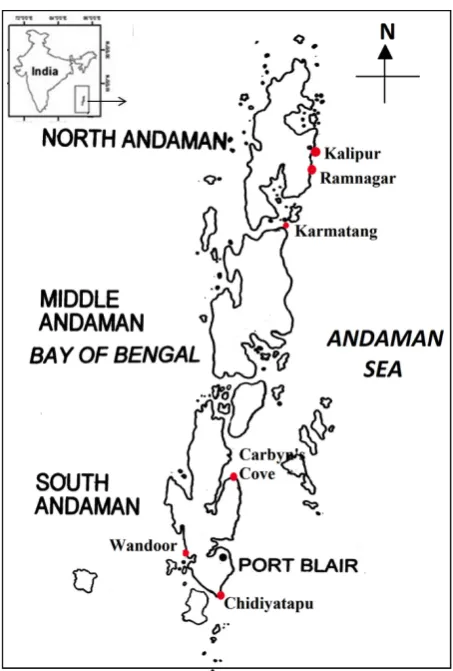
Six stations in the Andaman Islands were selected as study sites for this work. Karmatang Beach at 12.9130N &
92.8960E is a bay located in Mayabunder, North Andaman
(Fig. 1). It is a sandy beach that is dark-coloured, giving the water a very turbid look. Good vegetation, with a mix of shrubs and trees, lines the beach. Ramnagar is
situated in Diglipur, North Andaman, and is located at
13.0750N & 93.0280E. This sandy beach is 15km away
from Kalighat. It is surrounded by palm and coconut trees and coastal shrubs. Comparatively, it has stronger waves than the other study stations. Kalipur is located in Diglipur, North Andaman, and it is the only beach in the world where four species of turtles come to nest.
Its coordinates are 13.2350N & 93.8960E and it is 18km
from Diglipur. It has a combination of sand and rocks. Chidiyatapu houses the Munda Pahar Beach, which is 2.5km from Chidiyatapu Beach. Its geographical
coordinates are 11.4900N & 92.7080E. The beach has a
combination of sand and rocks and has small freshwater sources. Carbyn’s Coveis a bay that is on the southeast of South Andaman. It is located at 11.4900N & 92.7000E.
It is a sandy beach with rocks flanking its sides. There is an estuary adjoining it that supports a healthy mangrove vegetation. Wandoor is a marine national park located 29km from the city of Port Blair and is situated in the
Bay of Bengal. It is located at 11.6090N & 92.6750E.
It is a white sandy beach with two small freshwater inlets. It has a good surrounding vegetation of shrubs,
Journal of Threatened Taxa | www.threatenedtaxa.org | 26 September 2018 | 10(10): 12337–12343
Comparison of beach profiles conducive for turtle nesting Narayani et al
12339 mangroves, and woody trees.
The slope of the beach
The slope of the beach was estimated by employing the method described by Varela-Acevedo et al. (2009) using Auto Level, DSZ2 (manufactured by Suzhou FOIF Co. Ltd.). The distance between the scale and the telescope was calculated. The values of distance against height were plotted on a graph to obtain the beach profile.
The angle of inclination
By finding the slope of the land, the height of the land was found at certain distances. Using the values of height and distance in the trigonometric formula tan ѳ, the value for the angle of inclination was obtained.
Grain size analysis
The grain size of the sand on the beach was analysed following Varela-Acevedo et al. (2009). Using a corer of length 12.7cm and a width of 5.08cm, sand samples were obtained from the part of the beach that is higher than the tide mark. None of these parts were in the dune area as there are no dunes in Andaman. The collected samples were placed in sample bags for analysis. The grains were mixed well and sprinkled onto a slide with a layer of oil to adhere to the grains. The grains were then viewed under a polarising microscope that was fixed with a graduated ocular lens. The diameter of each grain was measured individually in divisions and converted to millimetres. In each sand sample, diameters of 170 grains were measured. Size class intervals and their corresponding frequencies were made and the results were depicted graphically. The class interval with the highest frequency was taken as the representative of the sand at that corresponding sampling site. The sand grains were classified based on Wentworth (1922).
Extrinsic parameters
By comparing the vegetation at each of the six sites, the amount of vegetation at each site was classified as high, medium, or low. The presence of obstacles like trees was noted by visual examination. Anthropogenic activities/ influences like manmade structures, vehicles, shacks, and pollution were taken into account through comparison among the study stations. Techniques for identifying key parameters and estimating their values were followed from Varela-Acevedo et al. (2009). The transformed data of extrinsic parameters and the presence of turtle nests reported from literature (Andrews 2006; Murugan 2010) were used to perform principal component analysis and to generate a plot in PRIMER E-V6 package (Clark & Warwick 2001).
RESULTS
Extrinsic parameters
The extrinsic parameters are given in Table 1.
Beach slopes
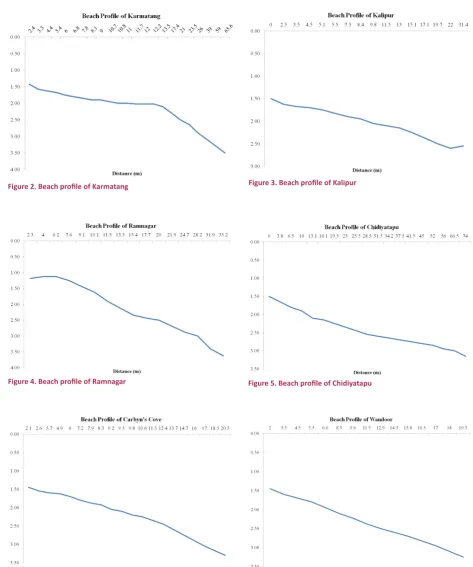
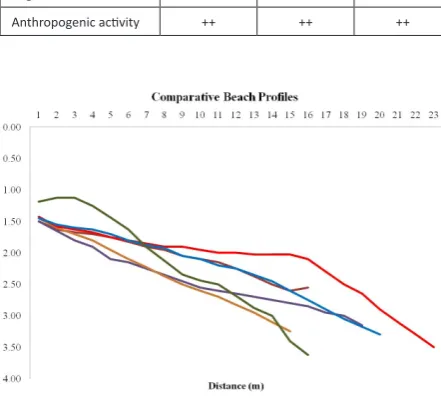
Karmatang has a relatively flat reef slope (Fig. 2) with a minor dip at 2.4m and a major dip at 13.5m. The profile of Kalipur (Fig. 3) is very undulating with only one major visible rise at 31.4m. Ramnagar has a major rise at 7m and another at 12m (Fig. 4). The profile of Chidiyatapu (Fig. 5) shows that it has a number of indentations that can be difficult for turtles to navigate. From the profile of Carbyn’s Cove (Fig. 6), it can be seen that there is only one major dip at 7m but otherwise, the land is relatively flat. In the case of Wandoor Beach (Fig. 7), there is a rise at 5.5m and a minor dip at 11.5m, but otherwise, the land is without many undulations. Chidiyatapu is the widest beach while Wandoor is the narrowest (Fig. 8).
Table 1. Extrinsic parameters in the study sites
Parameters Karmatang Kalipur Ramnagar Chidiyatapu Carbyn’s Cove Wandoor
Intertidal (m) 53.6 32.9 21.3 73.5 15.6 14.9
Vegetation High High High High Low Moderate
Streams through the beach Nil Nil Nil 2 Nil 2
Creek Nil 1 Nil Nil 1 Nil
Obstacles on the beach Nil Nil Nil Yes Nil Yes
Presence of nearby islands Nil Nil Nil Nil 2 Nil
Presence of reefs Yes Yes Yes Yes Yes Yes
Anthropogenic activities Low Low Low Moderate High Moderate
Journal of Threatened Taxa | www.threatenedtaxa.org | 26 September 2018 | 10(10): 12337–12343
Comparison of beach profiles conducive for turtle nesting Narayani et al.
12340
The angle of the slope
The slope angles of the study stations are presented in Table 1.
Figure 4. Beach profile of Ramnagar Figure 5. Beach profile of Chidiyatapu
Figure 6. Beach profile of Carbyn’s Cove
Figure 7. Beach profile of Wandoor
Sand grain analysis
Journal of Threatened Taxa | www.threatenedtaxa.org | 26 September 2018 | 10(10): 12337–12343
Comparison of beach profiles conducive for turtle nesting Narayani et al
12341 the middle-size category. In Carbyn’s Cove and Wandoor,
the sand grains were small in general. According to the classification of sand grains by Wentworth (1922), Karmatang and Kalipur have very coarse grains, Chidiyatapu and Wandoor have granules, and Carbyn’s Cove has pebbles (Table 2). Overall, the majority of grains were in the size range 2–4 mm. Wandoor and Karmatang had a more or less equitable distribution of sand grain sizes. There were proportionally more larger grains in Carbyn’s cove and more smaller grains in Kalipur.
Table 2. Grouping of grains based on size classification by Wentworth (1922)
Karmatang Kalipur Ramnagar Chidiyatapu Carbyn Wandoor Classification
0–1 0 1 0 0 0 0 Coarse sand
1.0–2.0 76 112 17 12 2 36 Very coarse sand
2.1–4 75 55 106 142 28 78 Granules
4.1–16 19 2 47 16 124 56 Pebbles
>16.1 0 0 0 0 16 0 Gravel
Table 3. Effect of extrinsic parameters (++ very favourable, +favourable, - not favourable)
Site Karmatang Kalipur Ramnagar Chidiyatapu Carbyn’s Cove Wandoor
Sand grains + ++ ++ - - ++
Beach width + + + ++ -
-Stream/ creek + + + - +
-Presence of obstacles + + + - -
-Artificial light + + + + - +
Vegetation ++ ++ ++ ++ - +
Anthropogenic activity ++ ++ ++ + - +
Figure 8. Comparison of beach profiles
Effect of extrinsic parameters
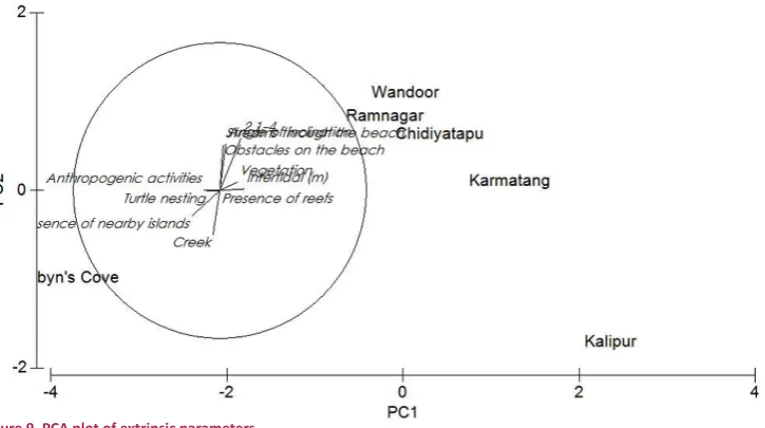
With all the parameters mentioned above, Table 3 (++ very favourable, +favourable, - not favourable) provides a comparison of the study areas to show the effect of the analysed parameters on turtle nesting. The principal component analysis (Fig. 9) revealed that the absence of anthropogenic activities and nearby islands and the absence of creeks were closely associated with turtle nesting in the stations. The first two principal components accounted for 82% of the total variation. It is acknowledged here that if the specific number of nests in each area is included in the analysis, these results may vary. This is especially true of regions like Chidiyatapu and Wandoor for which results are only available from pre-Tsunami surveys.
Discussion
Journal of Threatened Taxa | www.threatenedtaxa.org | 26 September 2018 | 10(10): 12337–12343
Comparison of beach profiles conducive for turtle nesting Narayani et al.
12342
Figure 9. PCA plot of extrinsic parameters
noted as the desired features for site selection for turtle nesting (Wood & Bjorndal 2000; Morales-Mavil 2016).
The location of the nest in the tidal zone is crucial as the eggs must neither be flooded and eroded nor be exposed to land predators (Whitmore & Dutton 1985; Blamires & Guinea 1998). Hatchlings must be able to find the sea and the nest must not have visual obstructions that prevent the same (Godfrey & Barreto 1995). This shows that Wandoor, with the smallest beach width among all study stations, is not favourable for turtle nesting.
Debris on the beach prevents successful nesting and causes a phenomenon called as ‘false crawl’ where the females emerge from the water but do not deposit an egg clutch (Fujisaki & Lamont 2016). Artificial lighting too has been reported to disrupt patterns of nesting females (Weishampel et al. 2016).
Large angled beaches are preferred by turtles as water cannot move up the slope as easily and hence the nests are relatively safer from flooding (Godley et al. 1993). Ramnagar and Karmatang beaches have the steepest profile and larger angles, and so they are very favourable for turtle nesting. Ramnagar has the highest dominance of granules, which seem to be the ideal grain size as supported by the results from Hughes et al. (2009) that show that real nest contains medium sand or larger grains. Though Chidiyatapu has the widest beach, other factors are not very favourable and this leads to only sporadic nesting. Wandoor has the required grain size but the lack of intertidal width and the presence of streams in the beach are deterring factors. Considering all the features studied, the absence of streams,
absence of artificial light, a significantly lesser number of anthropogenic activities, lack of obstacles, and the presence of bordering vegetation make Karmatang, Kalipur, and Ramnagar very conducive for turtle nesting. It has been reported that a total of 99 nesting sites belonging to four species of turtles were seen in Ramnagar, Karmatang, and Carbyn’s Cove (Andrews 2006). While it could be deduced from the present study that Kalighat is a beach conducive for turtle nesting, the evidence for turtle nesting in this beach is mainly anecdotal. Unfortunately, data from the literature for these stations is sporadic. It is acknowledged here that a comprehensive list of sea turtle nests in these stations could be useful in comparing predicted conduciveness and actual preference. It is hereby recommended that the number of nests along each beach in these stations is to be quantified to empirically ascertain nesting preferences of turtles in this region.
The spatial and temporal consistency of turtle nesting behaviour are of basic importance to conservation efforts as they can be used to interpret scales of behavioural patterns in relation to environmental parameters. This can be used to regulate human activities in the beaches where turtles nest regularly (Weishampel et al. 2016).
Journal of Threatened Taxa | www.threatenedtaxa.org | 26 September 2018 | 10(10): 12337–12343
Comparison of beach profiles conducive for turtle nesting Narayani et al
12343 & Nicobar are meagre. Further research can point out
the salient features of turtle nesting behaviour in these regions and they can be used for the conservation of these marine reptiles.
CONCLUSION
Turtles have been part of Andaman’s history since the 1800s. Their constant association with these waters and their homing in annually provides the best evidence that the beaches in Andaman do meet the turtles’ requirements. This study shows that a single factor does not make a beach a better nesting site. It is shown from this study that there is a significant lack of literature pertaining to the reproductive biology of turtles in these islands. The results from further studies can be a backbone for planning developmental activities and developing infrastructure for these beaches in the
future.
REFERENCES
Andrews, H.V., A. Tripathy, S. Aghue, S. Glen, J. Saw & K. Naveen (2006). The status of sea turtle populations in the Andaman and
Nicobar Islands of India. In: K. Shanker & H.V. Andrews (eds).
Towards an Integrated and Collaborative Sea Turtle Conservation in
India: a UNEP/CMS-IOSEA Project of Priority Research Areas.Center
for Herpetology/Madras Crocodile Bank Trust., Chennai. 92 pp.
Bhaskar, S. (1984). Distribution and status of sea turtles in India, pp21–
35. In: Silas, E.G. (ed.). Proceedings of the Workshop on Sea Turtle
Conservation. CMFRI, Cochin, Special Publication No. 18, 120pp.
Bhasker, S. (1979). Sea turtle survey in the Andamans and Nicobars. Hamadryad 4(3): 2–26.
Blamires, S.J. & M.L. Guinea (1998). Implications of nest site selection
on egg predation at the sea turtle rookery at Fog Bay, pp22–24. In: Kennett R., A. Webb, G. Duff, M.L. Guinea & G.J.E. Hill (eds.).
Proceedings of the Marine Turtle Conservation and Management
in Northern Australia Workshop. Centre for Indigenous and Natural
Resources, Centre for Tropical Wetlands Management, Darwin, 89 pp.
Bouchard, S.S. & K.A. Bjorndal (2000). Sea turtles as biological
transporters of nutrients and energy from marine to terrestrial ecosystems. Ecology 81: 2305–2313.
Clarke, K.R. & R.M. Warwick (2001). Change in marine communities:
an approach to statistical analysis and interpretation, 2nd edition.
PRIMER-E, Plymouth, 172pp.
Dattatri, S. (1984). Threats to sea turtles in India- exploitation and
habitat perturbations, pp.59–66. In: Silas, E.G. (ed.). Proceedings
of the Workshop on Sea Turtle Conservation.CMFRI, Cochin, Special
Publication No. 18, 120pp.
Fujisaki, I. & M.M. Lamont (2016). The effects of large beach debris
on nesting sea turtles. Journal of Experimental Marine Biology and Ecology 482: 33–37.
Godfrey, M.H. & R. Barreto (1995). Beach vegetation and sea-finding
orientation of turtle hatchlings. Biological Conservation 74: 29–32.
Godley, B.J., A.C. Broderick, S. Blackwood, L. Collins, K. Glover, C. McAldowie, D. McCulloch & J. McLeod (1993). 1991 survey of marine turtles nesting in Trinidad and Tobago. Marine Turtle
Newsletter 61: 15–18.
Hughes, G.N., W.F. Greaves & J.D. Litzgus (2009). Nest selection
by Wood Turtles (Glyptemys insculpta) in a thermally limited environment. Northeastern Naturalist 16(3): 321-338.
IUCN (2018). The IUCN Red list of Threatened Species. Version
2018-1. http://www.iucnredlist.org Electronic version accessed on 18.9.2017.
Kar, C.S. & M.C. Dash (1984). Mass nesting beaches of the olive ridley Lepidochelys olivacea (Eschscholtz, 1829) in Orissa and behavior during an arribada, pp.36–48. In: Silas, E.G. (ed.). Proceedings of
the Workshop on Sea Turtle Conservation. CMFRI, Cochin, Special
Publication No. 18, 120pp.
Lutz, P.L. & J.A. Musick (eds.) (1996).The Biology of Sea Turtles. CRC Press, USA, 448pp.
Mohan, L.R.S. (1986). Observations on the ecology of the nest and
on some aspects of reproductive behaviour of the Ridley Turtle
Lepidochelys olivacea from Calicut Coast. Indian Journal of Fisheries
33(1): 39–44.
Morales-Mavil, J.E., L.A. Contreras-Vega, A. Serrano, J. Cobos-Silva & L. Zavaleta-Lizárraga (2016). Spatial-temporal distribution of
Kemp’s Ridley Turtles (Lepidochelys kempi) and Green Turtles (Chelonia mydas) nests in a beach of the north of Veracruz, Mexico, pp.33–53. In: Patterson, C. (ed.) Sea Turtles: Ecology, Behavior and
Conservation. Nova Publishers, New York, 147 pp.
Murugan, A. (2010). The past and present scenario of sea turtles
in India: an overview of possibility for recurrence of history.
Proceedings of the 5th International Symposium on SEASTAR2000
and Asian Bio-logging Science (The 9th SEASTAR2000 workshop):
33–35; https://repository.kulib.kyoto-u.ac.jp/dspace/bitstream/24 33/107339/1/9thSeastar_33.pdf
Nicholas, M. (2001). Light pollution and marine turtle hatchlings: the
straw that breaks the camel’s back? George Wright Forum 18(4): 77–82.
Spencer, R-J. (2002). Experimentally testing nest site selection: fitness
trade-offs and predation risk in turtles. Ecology 83(8): 2136–2144;
https://doi.org/10.1890/0012-9658(2002)083[2136:ETNSSF]2.0. CO;2
Switzer, P.V. (1993). Site fidelity in predictable and unpredictable
habitats. Evolutionary Ecology 7(6): 533–555.
Varela-Acevedo, E., K.L. Eckert, S.A. Eckert, G. Cambers & J.A. Horrocks (2009). Sea turtle nesting beach characterization manual,
pp.46–97. In: Examining the Effects of Changing Coastline Processes
on Hawksbilll Sea Turtle (Eretmochelys imbricata) Nesting Habitat.
Master’s Project, Nicholas School of the Environment and Earth Sciences, Duke University. Beaufort, North Carolina USA, 97pp.
Weishampel, J.F., D.A. Bagley, L.M. Ehrhart & B.L. Rodenbeck (2003).
Spatiotemporal patterns of annual sea turtle nesting behaviors along an East Central Florida beach. Biological Conservation 110: 295–303.
Weishampel, Z.A., W-H. Cheng & J.F. Weishampel (2016). Sea turtle nesting patterns in Florida vis-à-vis satellite-derived measures of artificial lighting. Remote Sensing in Ecology and Conservation 2(1): 59–72; http://doi.org/10.1002/rse2.12
Wentworth, C.K. (1922). A scale of grade and class terms for clastic
sediments. The Journal of Geology 30(5): 377–392.
Whitmore, C.P. & P.H. Dutton (1985). Infertility, embryonic mortality
and nest-site selection in leatherback and green sea turtles in Suriname. Biological Conservation 34(3): 251–272.
Wood, D.W. & K.A. Bjorndal (2000). Relation of temperature, moisture,
salinity, and slope to nest site selection in Loggerhead Sea Turtles.
Copeia 2000(1): 119–128.
Wyneken, J., T.J. Burke, M. Salmon & D.K. Pederson (1988). Egg failure in natural and relocated sea turtle nests. Journal of Herpetology
22(1): 88–96.
ISSN 0974-7907 (Online); ISSN 0974-7893 (Print)
September 2018 | Vol. 10 | No. 10 | Pages: 12299–12442 Date of Publication: 26 September 2018 (Online & Print)
DOI: 10.11609/jott.2018.10.10.12299-12442
www.threatenedtaxa.org
The Journal of Threatened Taxa is dedicated to building evidence for conservation globally by publishing peer-reviewed articles online every month at a reasonably rapid rate at www.threatenedtaxa.org. All articles published in JoTT are registered under Creative Commons Attribution 4.0 International License
unless otherwise mentioned. JoTT allows unrestricted use of articles in any medium, reproduction, and distribution by providing adequate credit to the authors and the source of publication.
OPEN ACCESS
Communications
Urban biodiversity: an insight into the terrestrial vertebrate diversity of
Guwahati, India
-- Jayaditya Purkayastha, Pp. 12299–12316
Status of raptors in the Moyar River Valley, Western Ghats, India
-- N.R. Anoop, S. Babu, S. Bharathidasan & R. Nagarajan, Pp. 12317–12327
Species composition and abundance estimates of reptiles in selected agroecosystems in southern Western Ghats, India
-- Abhirami Mini Jayakumar & Paingamadathil Ommer Nameer, Pp. 12328–12336
Comparison of beach profiles conducive for turtle nesting in Andaman
-- Subramanian Narayani, Sasidharan Venu & Andrea Joan D’Silva, Pp. 12337 –12343
Short Communications
A new record of the rare Hardwicke’s Woolly Bat Kerivoula hardwickii (Horsefield, 1824) (Mammalia: Chiroptera: Vespertilionidae) after 23 years
from a lowland rainforest of Sri Lanka
-- Dinesh Gabadage, Gayan Edirisinghe, Madhava Botejue, Kalika Perera, Thilina Surasinghe & Suranjan Karunarathna, Pp. 12344–12349
Alarming population status of the Grizzled Giant Squirrel Ratufa macroura (Mammalia: Rodentia: Sciuridae) in Chinnar Wildlife Sanctuary,
the Western Ghats, India
-- Kiran Thomas & Paingamadathil Ommer Nameer, Pp. 12350–12356
Distribution and population status of Sambar Rusa unicolor (Mammalia:
Cetartiodactyla: Cervidae) from Aravalli landscape with a note on its first record from Aravalli Hills of Haryana, India
-- Paridhi Jain, Anchal Bhasin, Gautam Talukdar & Bilal Habib, Pp. 12357–12362
Delayed peracute capture myopathy in a Himalayan Ibex Capra sibirica (Mammalia: Cetartiodactyla: Bovidae)
-- Umar Nazir Zahid, Latief Mohammad Dar, Umar Amin, Showkat Ahmad Shah, Rashid Yahya Naqash, Dil Mohammed Makhdoomi, Shayuaib Ahmad Kamil & Intesar Suhail, Pp. 12363–12367
Checklist of the avifauna of Sagareshwar Wildlife Sanctuary, Maharashtra, India
-- Sharad Datt Apte, Vijay Bhagwan Tuljapurkar & Girish Avinash Jathar, Pp. 12368–12375
The rediscovery of Rurk’s Cat Skink Ristella rurkii Gray, 1839 (Reptilia: Ristellidae) with remarks on distribution and natural history
-- Sumaithangi Rajagopalan Ganesh, Pp. 12376–12381
Dietary assessment of five species of anuran tadpoles from northern Odisha,
India
-- Syed Asrafuzzaman, Susmita Mahapatra, Jasmin Rout & Gunanidhi Sahoo, Pp. 12382–12388
Inventory of prong-gilled mayflies (Ephemeroptera: Leptophlebiidae) of India
with records of endemic taxa
-- C. Selvakumar, Kailash Chandra & K.G. Sivaramakrishnan, Pp. 12389–12406
First record of a coreid bug Anhomoeusfusiformis Hsiao
(Hemiptera: Heteroptera: Coreidae: Coreinae: Anhomoeini) from India -- Sadashiv V. More & Hemant V. Ghate, Pp. 12407–12412
The gilled mushroom Amanita spissacea (Amanitaceae): a new report for India -- Hmar Lalrinawmi, John Zothanzama, Benjamin W. Held,
Josiah M.C. Vabeikhokhei, Zohmangaiha & Robert A. Blanchette, Pp. 12413–12417
Notes
Foraging habits of the Red Fox Vulpes vulpes (Mammalia: Carnivora: Canidae)
in the Himalaya, India
-- Aishwarya Maheshwari, Pp. 12418–12421
First record of Yellow-Rumped Flycatcher Ficedula zanthopygia (Hay, 1845)
(Aves: Passeriformes: Muscicapidae) in eastern India -- Manaranjan Das & Subrat Debata, Pp. 12422–12424
Additional field records provide further resolution of the distribution of the Water Monitor Varanus salvator (Squamata: Varanidae) in northwestern
Myanmar
-- Steven G. Platt, Myo Min Win & Thomas R. Rainwater, Pp. 12425–12428
The first record of The Blue Admiral Kaniska canace Linnaeus, 1763 (Nymphalidae: Lepidoptera) from Bangladesh
-- Amit Kumer Neogi, Md Jayedul Islam, Md Shalauddin, Anik Chandra Mondal & Safayat Hossain, Pp. 12429–12431
First record of Hislopia malayensis Annandale, 1916 (Bryozoa: Gymnolaemata)
from freshwaters of India
-- Ananta Dnyanoba Harkal & Satish Sumanrao Mokashe, Pp. 12432–12433
An extended distribution record of Western Ghats species Litsea oleoides (Meissn.) Hook.f. (Lauraceae) from Matheran, Maharashtra, India
-- Radha Veach & Gurumurthi Hegde, Pp. 12434–12438
Notes on Jasminum andamanicum N.P. Balakr. & N.G. Nair (Oleaceae) from Andaman & Nicobar Islands, India
-- P. Murugan & K. Karthigeyan, Pp. 12439–12441
Miscellaneous
National Biodiversity Authority
Threatened Taxa