43 |
P a g e
Asian Journal of Pharmaceutical Science & Technology
e-ISSN: 2248 – 9185
www.ajpst.com
Print ISSN: 2248 – 9177FORMULATION AND EVALUATION OF MOUTH DISSOLVING
TABLETS OF ZOLMITRIPTAN
Vaishali B. Morade
*, Vandana R. Daga, Prashant R. Malpure
Department of Pharmaceutics, S.G.S.S’s Loknete Dr. J.D.Pawar College of Pharmacy, Manur, Kalwan, Maharashtra, India.
ABSTRACT
The objective of present study was to formulate mouth dissolving tablets of Zolmitriptan. Zolmitriptan is a 5-HT receptor agonist. It is used in the treatment of migraine. Six different formulations of Zolmitriptan mouth dissolving tablets were prepared by using direct compression technique by using different concentrations of AC-Di-Sol, Avicel P H 101 and
strlac.Tablets were evaluated for different precompression and post compression parameters of tablets were carried out and the results satisfies according to the pharmacopoeia specifications. Other parameters such as drug-excipients compatibility were also evaluated through IR and DSC study.IR and DSC studies revelled that there is no interaction between drug and different excipients used in formulation. Formulation F6 was selected as optimised formulation showing better dissolution results at 35 minutes.
Key words: Zolmitriptan, mouth dissolving tablets, Ac-Di-Sol, Antimigraine.
INTRODUCTION
Oral drug delivery has been known for decades as the most widely utilized route of administration among all the routes that have been explored for the systemic delivery of drugs via various pharmaceutical products of different dosage forms. The more sophisticated delivery system, the greater is the complexity of these various disciplines involved in the design and optimization of the system.
Tablets and hard gelatin capsules constitute a major portion of drug delivery systems that are currently available. However, many patient groups such as the elderly, children, and patients who are mentally retarded, uncooperative, nauseated or on reduced liquid-intake / diets have difficulties swallowing these dosage forms. Those who are travelling or have little access to water are similarly affected. For these reasons; tablets which can rapidly dissolve or disintegrate in the oral cavity have attracted a great deal of attention. Rapidly dissolving or disintegrating tablets are not only indicated for people who have swallowing difficulties, but also are ideal for active people [1, 2].
The growing importance of mouth dissolving tablet was underlined recently when European Pharmacopoeia adopted the term "Orodispersible Tablet" as a tablet that to be placed in the mouth where it disperses rapidly before swallowing. Suitable drug candidates for such systems include neuroleptics, cardiovascular agents, analgesics,
anti-allergic and drugs for erectile dysfunction [3]
To overcome this weakness, scientist have developed innovative drug delivery system known as fast dissolving "melt in mouth" or mouth dissolve (MD) tablet. These are novel type of tablet that disintegrate dissolve/disperse in saliva [4].
There are two different types of dispersible tablet. One dosage form disintegrates instantaneously in the mouth, to be swallowed without the need for drinking water, while other tablet formulation can readily be disperse in water, to form dispersion, easy to ingest by the patient.
MDT is a solid dosage form that dissolves or disintegrates within a minute in the oral cavity without the need of water and has a pleasant taste. MDT is also known as orally disintegrating tablet, fast-dissolving tablet, fast-melting tablet, mouth melting tablet or fast-disintegrating tablet[5].
Orally disintegrating tablets are also called as orodispersible tablet, quick disintegrating tabltes, mouth dissolving tablets, fast dissolving tablets, rapid dissolving tablets, porous tablets and rapimelt.
United State Food and Drug Administration (FDA) defined MDT as "a solid dosage form containing medicinal substance or active ingredients which disintegrate rapidly usually within a matter of second when placed upon the tongue. The disintegration time for MDTs ranges from several seconds to about a minute [6-9].
44 |
P a g e
Therefore, in the present study an attempt will be made to formulate mouth dissolving tablet of Zolmitriptan by direct compression method using different concentration of superdisintegrants like Avicel pH 101, Starlac and Crosscarmellose sodium (Ac-Di-Sol) with a view to obtain rapid disintegration when taken orally, permitting a rapid onset of action during acute migraine attack.
MATERIALS AND METHODS Materials
The excipients croscarmellose sodium, microcrystalline cellulose, magnesium stearate, peppermint was obtained as gift sample from Maxheal Pharmaceuticals Pvt. Ltd, MIDC, Satpur, Nasik.
Methods
Analytical Method for Estimation of Zolmitriptan:
Identification of drug was carried out by IR (Model ALPHA Bruker ECO-ATR) Standardization of the drug was carried out by using UV visible spectrophotometer (LABINDIA UV 3000+).
PRE-COMPRESSION PARAMETERS Angle of repose
Angle of repose is defined as the maximum angle possible between the surface of a pile of the powder and horizontal plane. The frictional force in a loose powder or granules can be measured by angle of repose.
Tan θ = h / r θ = tan-1 (h/r)
Where, θ is the angle of repose
h is height of pile
r is radius of the base of pile
Different ranges of flow ability in terms of angle of repose are given below Method
A funnel was filled to the brim and the test sample was allowed to flow smoothly through the orifice under gravity. From the cone formed on a graph sheet was taken to measure the area of pile, thereby evaluating the flow ability of the granules. Height of the pile was also measured.
Bulk Density
Bulk density is defined as the mass of a powder divided by the bulk volume. The bulk density of a powder depends primarily on particle size distribution, particle shape, and the tendency of the particles to adhere to one another.
Method
Both loose bulk density (LBD) and tapped bulk density (TBD) were determined. A quantity of accurately weighed powder (bulk) from each formula, previously shaken to break any agglomerates formed was introduced into a 25 ml measuring cylinder. After the initial volume was observed, the cylinder was allowed to fall under its own
weight onto a hard surface from the height of 2.5 cm at 2 sec interval. The taping was continued until no further change in volume was noted. LBD and TBD were calculated using following formula;
Tapped Density
The measuring cylinder containing a known mass of blend was tapped for a fixed time. The minimum volume (Vt) occupied in the cylinder and the weight (M) of the blend was measured. The tapped density (pt) was calculated using the following formula
Hausner Ratio
Hausner ratio is an indirect index of ease of power flow. It is calculated by the following formula.
Where ρt is tapped density and ρd is bulk density. Lower
Hausner ratio (<1.25) indicates better flow properties than higher ones (>1.25).
Carr's compressibility index
The compressibility index of the granules was determined by Carr's compressibility index. (%) Carr's Index can be calculated by using the following formula
DRUG EXCIPIENTS INTERACTION STUDIES IR Studies
IR spectra for pure drug and formulations were recorded in an infrared (IR) spectrophotometer (Model: Shimadzu) (Fig.) show the identical peak with excipients. There is no interaction with excipients.
DSC STUDIES
Differential scanning calorimetry (DSC) studies of drug-excipients mixtures were performed using a detector to determine the drug excipients compatibility study. Thermograms of pure Zolmitriptan showed sharp endothermic peak at136.37°C.Similar peaks were obtained in the prepared drug-excipients mixtures at 151 °C. (Fig.). this clearly indicated the nil drug excipients interaction.
Preparation of Mouth Dissolving Tablet by Direct Compression Technique.
45 |
P a g e
Mouth dissolving tablet of Zolmitriptan were prepared by direct compression method according to the formula given in Table 3.
All the ingredients were passed through 60 mesh sieve separately. The drug and microcrystalline cellulose was mixed by small portion of both each time and blending it to get a uniform mixture kept aside. Then the ingredients were weighed and mixed in geometrical order and tablets were compressed of 8mm sizes flat round punch to get tablet using Multi Station rotary punch tablet compression machine.
EVALUATION OF TABLETS
1. Hardness 2. Friability 3. Weight variation. 4. Uniformity of thickness. 5. Drug content uniformity. 6. Wetting time.
7. Water absorption ratio. 8. In vitro disintegration time. 9. In vitro dissolution studies. 10. Stability studies [10, 11].
Hardness test
Tablets require a certain amount of strength, or hardness and resistance to friability, to withstand mechanical shocks of handling in manufacture, packaging and shipping. The hardness of the tablets was determined using Monsanto Hardness tester. It is expressed in Kg/cm. Three tablets were randomly picked from each formulation and the mean and standard deviation values were calculated.
Friability test
It is the phenomenon whereby tablet surfaces are damaged and/or show evidence of lamination or breakage when subjected to mechanical shock or attrition. The friability of tablets was determined by using Electro lab, USP EF 2 friabilator. It is expressed in percentage (%). Four tablets were initially weighed (W initial) and transferred into
friabilator. The friabilator was operated at 25 rpm for 4 minutes or run up to 100 revolutions. The tablets were weighed again. The percentage friability was then calculated by,
% Friability of tablets less than 1% is considered acceptable.
Weight Variation Test
The tablets were selected randomly from each formulation and weighed individually to check for weight variation. The U.S Pharmacopoeia allows a little variation in the weight of a tablet. The following percentage deviation in weight variation is allowed.
Uniformity of Thickness
The crown thickness of individual tablet may be measured with a Vernier Calliper, which permits accurate measurements and provides information on the variation between tablets. Other technique employed in production control involves placing 5 or 10 tablets in a holding tray, where their total crown thickness may be measured with a sliding calliper scale. The tablet thickness was measured using screw gauge.
Drug Content Uniformity
Four tablets weighted and crushed in a mortar then weighed powder contain equivalent to 10 mg of drug was taken and dissolved in 100 ml 0.1M HCL from this solution 1 ml of solution was diluted to 10 ml 0.1 M HCL again 1 ml solution from this diluted up to 10 ml with 0.1 M HCL and assayed for drug content at 237.5 nm.
Wetting Time
The method was applied to measure tablet wetting time. A piece of tissue paper folded twice was placed in a small Petri dish (I.D. = 6.5 cm) containing 10 ml of water, a tablet was placed on the paper, and the time for complete wetting was measured. Three trials for each batch were performed and standard deviation was also determined.
Water Absorption Ratio
A piece of tissue paper folded twice was placed in a small Petri dish containing 6 ml of water. A tablet was put on the paper and time required for complete wetting was measured. The wetted tablet was then weighed. Water absorption ratio, R was determined using following equation,
Where, Wb - weight of tablet before absorption Wa - weight of tablet after absorption
Three tablets from each formulation were performed and standard deviation was also determined.
In vitro Disintegration Time
The process of breakdown of a tablet into smaller particles is called as disintegration. The in-vitro disintegration time of a tablet was determined using disintegration test apparatus as per I.P specifications.
In vitro Dissolution Studies
46 |
P a g e
In vitro Drug Release Studies DetailsApparatus used : USP apparatus II dissolution test apparatus
Dissolution medium : 6.8 pH phosphate buffer solution.
Dissolution medium volume : 900 mL Temperature : 37±0.5°C Speed of basket paddle : 50 rpm Sampling intervals : 5 min Sample withdraw : 5 mL Absorbance measured : 225nm
Stability Studies
Stability of a drug has been defined as the ability of a particular formulation, in a specific container, to remain within its physical, chemical, therapeutic and toxicological specifications.
The purpose of stability testing is to provide evidence on how the quality of a drug substance or drug product varies with time under the influence of a variety of environmental factors such as temperature, humidity an light and enables recommended storage conditions, re-test periods and shelf lives to be established. ICH specifies the length of study and storage conditions:
Long term testing 25°C ± 2°C / 60 % RH ± 5 % for 12 months
Accelerated testing 40°C ±2 °C / 75 % RH ± 5 % for 6 months
In the present study, stability studies were carried out at 40°C / 75 % RH for a specific time period up to three months for the selected formulations.
RESULTS
Results of Pre-Compression Parameter for Prepared Tablet by Direct Compression Method
Powder ready for compression containing drug and various excipients were subjected for pre-compression parameter to study flow property of granules to achieve uniformity of tablet weight. Results of all the pre-formulation parameter are given in Table 6.
Results of post compression tablet prepared by direct compression method
Hardness
The hardness of all the tablets prepared by both
methods was maintained within the 2.5±0.264 kg/cm2
to4.0±0.251 kg/cm2. The mean hardness test results are
tabulated in Table 7.
Friability test
The friability was found in all designed formulations in the range 0.20±0.065 to0.90±0.072to be well within the approved range (< l %) .The friability study results were tabulated in Table 7.
Thickness
The mean thickness was (n=3) almost uniform in all the formulations and values ranged from3.28±0.155 mm to 3.47±0.265mm. The results of thickness for tablets were shown in Table 7.
In vitro dispersion time
The in vitro dispersion time is measured by the time taken to undergo uniform dispersion. Rapid dispersion within several minutes was observed in all the formulations. The in-vitro dispersion data is tabulated in the Table 7.
Weight variation test
The weight variation was found in all designed formulations in the range 100.12±0.405 to 100.28±0.475mg. The mean weight variation test results are tabulated in Table 8.
Wetting time
The results of wetting time are shown in Table 8. The wetting time of Zolmitriptan tablets prepared by direct compression was found to be in the range of40.59±0.675 and69.10±0.269 sec respectively, which facilitate the faster dispersion.
Water absorption ratio
The values of water absorption ratio shown in Table 8.
Drug Content
The drug content uniformity was performed for all the 6 formulations and results are tabulated in Table 8. Three trials from each batch were analyzed spectrophotometrically. The average value and standard deviations of all the formulations were calculated.
Table 1. Relation between Angle of Repose and Flow Properties
Angle of Repose(degrees) Flow
<25 Excellent
25-30 Good
30-40 Passable
47 |
P a g e
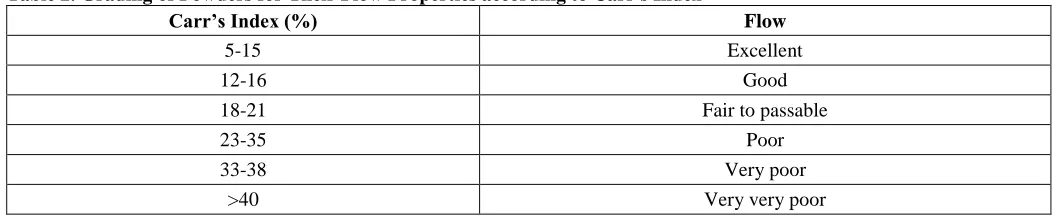
Table 2. Grading of Powders for Their Flow Properties according to Carr's Index10Carr’s Index (%) Flow
5-15 Excellent
12-16 Good
18-21 Fair to passable
23-35 Poor
33-38 Very poor
>40 Very very poor
Table 3. Formulation of Zolmitriptan Mouth Dissolving Tablet Prepared By Direct Compression Method
Table 4. Percentage Deviation in Weight Variation
Average weight of a tablet Percentage deviation
130 mg or less 10
More than 130 mg and less than 324 mg 7.5
324 mg or more 5
In all the formulations the tablet weight was more than 99 mg and less than 100 mg, hence 10% maximum difference allowed.
Table 5. Characterisation of pure drug (zolmitriptan)
PARAMETERS EXPERIMENTAL VALUE STANDARD VALUE
Nature Crystalline Crystalline
Colour White White
Odour Odourless Odourless
Solubility Soluble in 0.1 M HCL, Slightly soluble in water
Soluble in 0.1M HCL, Slightly soluble in water
Melting point 1400 C 1390-1410C
Table 6. PreCompression Parameters for Prepared Tablet by Direct Compression Method
Formulation Code
Parameters Bulk Density*
(g/cc)
Tapped Density*
(g/cc)
Angle of Repose* (Degree)
Carr’s Index*
(Percent)
Hausner’s Ratio*
F1 0.38±0.021 0.4545±0.003 28.60±0.013 15.55±0.172 1.18±0.025
F2 0.39±0.028 0.4594±0.007 28.17±0.01 13.33±0.215 1.15±0.0208
F3 0.38±0.015 0.4513±0.004 29.98±0.1562 15.55±0.208 1.18±0.0208
F4 0.387±0.015 0.4285±0.008 28.17±0.025 9.52±0.0255 1.10±0.013
F5 0.401±0.012 0.4521±0.002 29.03±0.035 11.11±0.145 1.12±0.012
F6 0.402±0.026 0.4604±0.005 28.29±0.035 13.04±0.111 1.15±0.0152
* Mean ± S.D., n=3 (All the values are the average of three determination)
Ingredients Formulation Code
F1 F2 F3 F4 F5 F6
Zolmitriptan 5 5 5 5 5 5
Ac-Di-Sol 2 2.5 3 2 2.5 3
Avicel pH 101 91.75 91.25 90.75 - - -
Starlac - - - 91.75 91.25 90.75
Aerosil 0.5 0.5 0.5 0.5 0.5 0.5
Magnesium stearate 0.5 0.5 0.5 0.5 0.5 0.5
Peppermint 0.25 0.25 0.25 0.25 0.25 0.25
48 |
P a g e
Table 7. Evaluation of Zolmitriptan MDT FormulationsFormulation code
Parameters Hardness*
(kg/cm2)
Friability*
(%)
Thickness*
(mm)
In vitro Dispersion time* (sec)
F1 3.0±0.254 0.50±0.05 3.36±0.030 19±1.00
F2 3.0±0.285 0.40±0.084 3.35±0.055 22±1.527
F3 3.5±0.136 0.20±0.065 3.43±0.015 15±1.510
F4 2.5±0.264 0.90±0.072 3.47±0.265 35±2.516
F5 4.0±0.251 0.30±0.076 3.28±0.155 30±1.023
F6 3.5±0.201 0.50±0.076 3.38±0.065 45±2.081
* Mean ± S.D., n=3 (All the values are the average of three determination)
Table 8. Evaluation of Zolmitriptan MDT formulations
Formulation Code
Parameters
Wetting Time*(sec) Water
Absorption Ratio*(%)
Percent Drug
Content* Weight Variation*
F1 69.1±0.269 51.95±1.571 97.62±0.582 100.28±0.475
F2 50.79±0.503 44.35±1.023 98.88±0.612 100.18±0.440
F3 58.71±0.518 48.33±0.675 100.4±0.632 100.28±0.447
F4 54.72±0.475 57.16±0.944 98.77±0.290 100.12±0.405
F5 50.89±0.320 63.86±0.490 99.30±0.172 100.18±0.472
F6 40.59±0.675 71.42±1.156 100.21±0.405 100.13±0.486
* Mean ± S.D., n=3 (All the values are the average of three determination)
Release profile of Zolmitriptan
Table 9. Release Profile of Zolmitriptan mouth dissolving tablets by direct compression method Time
Interval (Minutes)
F1* F2* F3* F4* F5* F6*
5 59.42%±0.01 60.05%±0.18 59.52%±0.02 54.57%±0.27 58.99%±0.12 64.99%±0.42
10 67.65%±0.35 68.56%±0.28 68.01%±0.49 62.78%±0.31 66.92%±0.42 74.00%±0.15
15 71.15%±0.26 72.73%±0.37 72.46%±0.19 66.22%±0.51 71.88%±0.30 77.19%±0.16
20 78.66%±0.33 80.25%±0.10 79.60%±0.28 73.40%±0.28 78.26%±0.25 84.47%±0.25
25 84.96%±0.48 87.07%±0.37 86.65%±0.10 79.78%±0.28 84.94%±0.35 92.19%±0.28
30 89.64%±0.20 91.53%±0.49 90.95%±0.31 89.17%±0.27 91.38%±0.31 97.52%±0.21
35 93.41%±0.33 95.67%±0.12 96.26%±0.24 92.03%±0.49 94.14%±0.51 99.17%±0.12
* Mean ± S.D., n=3 (All the values are the average of three determination)
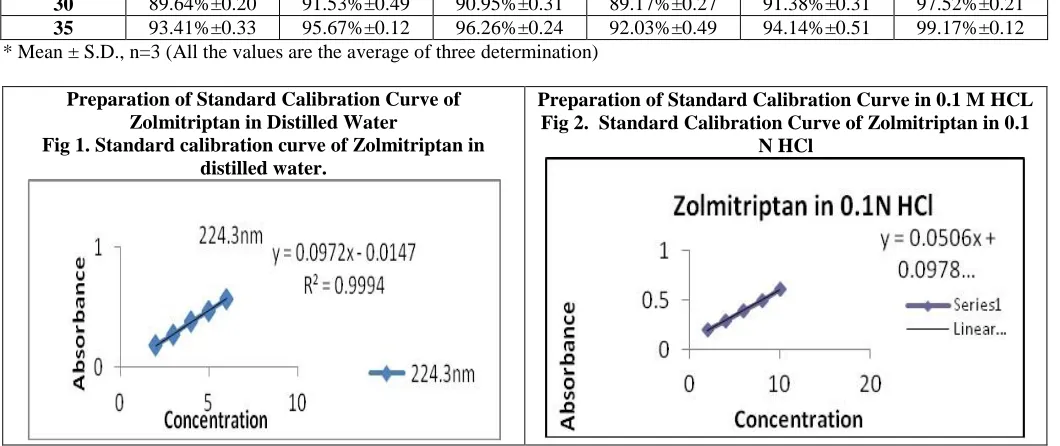
Preparation of Standard Calibration Curve of Zolmitriptan in Distilled Water
Fig 1. Standard calibration curve of Zolmitriptan in distilled water.
Preparation of Standard Calibration Curve in 0.1 M HCL Fig 2. Standard Calibration Curve of Zolmitriptan in 0.1
49 |
P a g e
Preparation of Standard Calibration Curve in phosphatebuffer pH 6.8
Fig 3. Standard calibration curve of Zolmitriptan in phosphate buffer pH6.8.
Fig 4. IR Spectra of Pure Drug
Fig 5. IR Spectra Drug and Avicel Fig 6. IR Spectra of Drug and starlac
Fig 7(a). DSC of Pure Drug (b). DSC of drug and Excipients
Fig 11. Release Profile of Zolmitriptan MDT by Direct Compression Method
50 |
P a g e
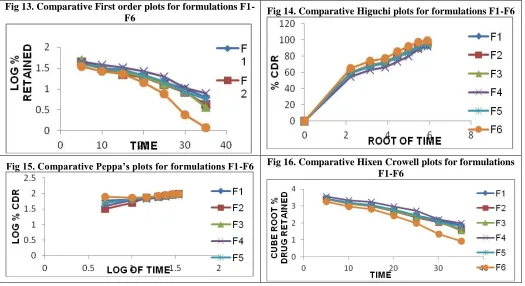
Fig 13. Comparative First order plots for formulationsF1-F6 Fig 14. Comparative Higuchi plots for formulations F1-F6
Fig 15. Comparative Peppa’s plots for formulations F1-F6 Fig 16. Comparative Hixen Crowell plots for formulations F1-F6
DISCUSSION
The intention of the development of present research is to study the effect of superdisintegrants on the dissolution rate of zolmitriptan.
In this study mouth dissolving tablets were prepared using Ac-Di-Sol, Avicel pH 101, starlac and evaluated for different parameters. Before going to formulation, the possibilities for drug-excipients interactions were studied using FTIR study and the results proved that there was no interaction between zolmitriptan and excipients. Then the tablets were prepared by direct compression method and evaluated for different parameters. The prepared tablets were studied for hardness, friability, weight variation and drug content and they were complied with Pharmacopoeial limits. Among all formulations, formulation F6 shows disintegration time of 45 seconds and drug release up to 99.17% at 35 minutes.
CONCLUSION
In the present work mouth dissolving tablets of Zolmitriptan were prepared by direct compression method using superdisintegrants such as croscarmellose sodium and
microcrystalline cellulose. All the tablets of Zolmitriptan were subjected to weight variation, hardness, friability, in vitro dispersion, drug polymer interaction, drug content uniformity, water absorption ratio, wetting time, and in vitro drug release.
Based on the disintegration time, formulation 6(F6) co-processed mixtures of Ac-Di-Sol and Starlac was found to be promising and showed a dispersion time of 45 sec, wetting time of 40.59sec.The in vitro drug release from fast dissolving tablets of Zolmitriptan prepared by direct compression methods were found to be 99.17% within 35 minute. The stability study shows that no significant changes in drug content after three month study.
ACKNOWLEDGMENT
The authors are thankful to Dr. Avish D. Maru, Principal Loknete Dr.J.D. Pawar College of pharmacy Manur, Kalwan, for making available all facilities to carry out research work successfully. Authors are also thankful to the Maxheal Pharmaceutical (India) Ltd., Satpur, Nashik for providing gift sample of Excipients.
REFERENCES
1. Waheeda N, Choudhry ZS, Yeakuty MJ, Kadir MF. Mouth Dissolving Tablets A Unique dosage form curtailed For Special Purpose .A Review. IOSR Journal of Pharmacy and Biological Sciences, 6(5), 2013, 53-61.
2. Ashish P, Harsoliya MS, Pahang JK, Shruti S.A Review formulation of mouth dissolving tablet. International Journal of Pharmaceutical and Clinicalscience, 2011, 1-8.
51 |
P a g e
4. Panda N, Reddy AV, Subba Reddy GV, Panda KC. Formulation design and In-vitro evaluation of Zolmitriptan immediate release tablets using primogel and Ac-Di-Sol. J Pharm. Sci. and Res, 7(8), 2015, 545-553
5. Prajapati ST, Patel MV, Patel CN. Preparation and evaluation of sublingual Tablets of Zolmitriptan. International Journal of Pharmaceutical Investigation, 4(1), 2014, 27-31
6. Indian Pharmacopoeia, 2014, Government of India, Ministry of Health &Family Welfare, 257-259. 7. http://www.drugs.com/availability/generic-zomig-zmt.html
8. Gohel MC. A review of coprocessed directly compressible excipients. J Pharm Pharm Sci, 8(1), 2005, 76-93.
9. Martindale, The complete Drug Reference, 32nd edition, edited by Katbleen Parfitt, published by Pharmaceutical press, 452,
1474-1475.
10. Liberman H, Lachman L. The Theory and Practice of Industrial Pharmacy, third edition, 1991, 293-303.