[Otieno* 6(8): August, 2019] ISSN 2349-4506
Impact Factor: 3.799
G
lobal
J
ournal of
E
ngineering
S
cience and
R
esearch
M
anagement
GRAPHS WHOSE AUTOMORPHISM GROUPS CONTAIN THE ALTERNATING
GROUPS
Hosea Odhiambo Otieno*, Fredrick Odondo Olum
*
Mathematics Department, Kenyatta University, Kenya
DOI: 10.5281/zenodo.3372509
KEYWORDS: Schurs Algorithm, Automorphisms, Alternating group.
ABSTRACT
There have been many investigations on the combinatorial structures and invariants over the group actions on the subsets of its elements. Automorphism groups from Graphs containing the cyclic and dihedral groups,
Cn and Dn respectively have been constructed using Schur’s Algorithm. In this paper, we seek to extend the
work to graphs whose automorphism groups contain the Alternating group An. We plan to construct the graphs
whose automorphism groups contain the Alternating group An. To construct these graphs, we will engage
Schur’s algorithm. We will first consider cases for 𝓃 = 3, 4, 𝐴𝑛𝑑 5, which will in turn help us make generalizations for any value of 𝓃, the degree of the group in study. The process will involve, establishing the transitivity of the Alternating group An first, finding the adjacency matrices and then constructing the said
graphs. We then determine a formula for calculating the number of graphs whose automorphism groups contain the Alternating group An. Through this study we have yielded important concepts and results in the
field of group theory. We present the results of our findings from our workings as lemmas, graphs, and or tables where applicable.
INTRODUCTION
Here we focus on necessary definitions and theorems that are useful in the course of our project.
Group actions of different groups have resulted in various properties. G (a group) partitions a given X (a set it acts upon), it resulting in subsets referred to as orbits. Overtime, the orbits’ numbers have been counted significantly using the Cauchy- Frobenius Lemma;
| OrbG(x) |= |G: StabG(x) |.
A Mathematician by the name Schur came up with an algorithm we may use to determine the graphs whose groups of automorphism contain a transitive group G. It is this algorithm we intend to review and employ in our project.
Definition 1: In Sn, we may form a group of order 𝑛!
2 known as the alternating group from the set of all
permutations that are even.
Definition 2: 𝐺 (A group ) acts on 𝑋(a set ) transitively if there’s only one orbit on 𝑋. Equivalently, it acts transitively if ∀ 𝑥, 𝑦 ∈ 𝑋 ∃ 𝑔 ∈ 𝐺 𝑠. 𝑡 𝑔𝑥 = 𝑦.
Theorem 1: For 𝐺, a group acting on 𝑋(𝑎 𝑠𝑒𝑡) and 𝑥 ∈ 𝑋,|𝑂𝑟𝑏𝐺(𝑥)| = |𝐺: 𝑆𝑡𝑎𝑏𝐺(𝑥)|,
Definition 3: Suppose 𝐺 is a transitive group on 𝑋, 𝐺𝑥the stabilizer of the point 𝑥 ∈ 𝑋. We refer to orbits ∆ 0=
{ 𝑥 }, ∆ 1, ∆ 2, …, ∆ 𝑘−1 of 𝐺𝑥 on 𝑋 as sub-orbits of 𝐺.
Theorem 2: For any 𝐺, a group which acts on a finite set 𝑋, the cardinality of 𝐺- orbits is given by 1
|𝐺|∑𝑔∈𝐺|𝐹𝑖𝑥 (𝑔)| in 𝑋
Definition 4
Assume 𝐺 acts on 𝑋 transitively; ∆ is orbit of 𝐺𝑥 on a set 𝑋.
[Otieno* 6(8): August, 2019] ISSN 2349-4506
Impact Factor: 3.799
G
lobal
J
ournal of
E
ngineering
S
cience and
R
esearch
M
anagement
and ||||is self-paired If .
GxThe transitive constituent of Gonforms a permutation group obtained when you restrict the elements of
Gxto
Definition 5: (𝑔) = |𝐹𝑖𝑥(𝑔)| ∀ 𝑔 ∈ 𝐺 , defines Character (𝜋) for the permutation representation of a group 𝐺 on a set 𝑋.
Theorem 3: Consider definition 5, cardinality of self-paired sub-orbits of 𝐺 is calculated as follows: 𝑛𝜋=
1
|𝐺 | ∑ 𝜋(𝑔
2)
𝑔∈𝐺 , 𝑔 ∈ 𝐺. [5]
Definition 6: An n x n matrix gained from permuting the columns of an n x n identity matrix 𝐼𝑛 is referred to as
a permutation matrix.
Definition 7: Suppose V is a set of points known as vertices while E isset of vertices in twos not in any definite order (edges). A diagram with the sets V and E is called a graph denoted 𝒢(V, E) or sometimes 𝒢(given no uncertainty on 𝑉 and or 𝐸) .
Definition 8: Suppose 𝒢 is a graph. A permutation 𝛼 of the vertex set of 𝒢, 𝒱(𝒢) is an automorphism of 𝒢 if ∀ 𝓊, 𝓋 ∈ 𝒱(𝒢);
{𝓊, 𝓋} ∈ 𝐸(𝒢) iff {𝛼(𝓊), 𝛼(𝓋)} ∈ 𝐸(𝒢)
Definition 9: Automorphism group of 𝒢 denoted Aut (𝒢) is all automorphisms’ set in graph 𝒢, considering the compositions (of functions). Ideally, it forms a sub-group of Sn on 𝒱(𝒢).
Definition 10: Given 𝒢 as a graph with n vertices labeled 1 up to n, an adjacency matrix 𝐴(𝒢) is the matrix defined by 𝐴(𝒢) = (𝑎𝑖𝑗), 𝑖, 𝑗 = 1, 2, 3, … , 𝑛 s.t;
𝑎𝑖𝑗 = {0; 𝑜𝑡ℎ𝑒𝑟𝑤𝑖𝑠𝑒 1; 𝑖𝑓 ∃ 𝑎𝑛 𝑒𝑑𝑔𝑒 𝑏𝑒𝑡𝑤𝑒𝑒𝑛 𝑡ℎ𝑒 𝑣𝑒𝑟𝑡𝑖𝑐𝑒𝑠 𝑖 𝑎𝑛𝑑 𝑗
Definition 11: An n x n matrix whose entries is +1 or -1 and with mutually orthogonal rows is a Hadamard matrix.
MATERIALS AND METHODS
Literature Review“Sabidussi [12]”, found that for connected graphs their products is also connected and for a disconnected graph, the product thereof with any graph is disconnected while studying graph products. “Bouwer [3]” shows that if 𝐺 is any given permutation group that’s finite then exists infinitely several undirected and directed graphs which aren’t isomorphic and whose groups of automorphisms has 𝐺 as it’s sub direct component.
A classification of all groups of permutations G having a sub orbit ∆ length 4 where we have that Gx≅ A4 or Gx
≅ S4 is faithful was done by Quirin, [11]. Leon [9] describes an algorithm for computing the automorphism group
of a Hadamard matrix. He shows how to modify the algorithm for determining the equivalence of any two Hadamard matrices.
The algorithm yields the order of the automorphism group, the orbits of the automorphism groups on the rows and columns of the matrix and a set of permutations generating the automorphism group. Servatius, [13] on his study of graph groups, improves on a result by other Mathematicians who had looked into graph algebras with a finding that two graph algebras are isomorphic if and only if their graphs are isomorphic.
[Otieno* 6(8): August, 2019] ISSN 2349-4506
Impact Factor: 3.799
G
lobal
J
ournal of
E
ngineering
S
cience and
R
esearch
M
anagement
Cameron, [6] does a survey on finite graphs’ automorphisms, especially the symmetry of the typical graphs. He dealt mainly with identifying automorphism groups as either abstract or permutation groups. He comes up a number of key findings among them being that a graph and its complement have the same automorphism group. He further discusses a finding by Frucht, [8] that all groups are also groups’ automorphisms of a graph.
Chao, [7] used an algorithm developed from Schur’s theorem to determine the graphs whose automorphism groups contain transitive groups. Olum, [10] used the concept to determine a formula for finding the tally of graphs whose automorphism groups contain given finite cyclic and dihedral groups. We expand this to alternating groups.
Schur’s Algorithm Reflection
Schur’s algorithm is constituted as below;
i. Consider a transitive permutation group G acting on n elements say {1, 2, 3… n} and G1 the stabilizer
of 1, then the orbits of G1 are given as;
∆ 1= { 1 }, ∆ 2, ∆ 3, …, ∆ 𝑘.
ii. Associate each ∆ 𝑚 with an n x n matrix as
𝐵(∆ 𝑚) = (𝑏𝑖𝑗), 𝑖, 𝑗 = 1, 2, 3, … , 𝑛 s.t;
𝑏𝑖𝑗 = {
1; 𝑖𝑓 ∃ 𝑎 𝑔 ∈ 𝐺 𝑎𝑛𝑑 𝑥 ∈ ∆ 𝑚 𝑤ℎ𝑒𝑟𝑒 𝑔 1 = 𝑗 𝑎𝑛𝑑 𝑔𝑥 = 𝑖
0; 𝑜𝑡ℎ𝑒𝑟𝑤𝑖𝑠𝑒
iii. 𝐵(∆ 𝑚) Is a symmetric matrix iff ∆ 𝑚is self-paired. The Identity matrix, 𝐼𝑛 is clearly observed as 𝐵(∆ 1),
hence we only have to find 𝐵(∆ 𝑖) for 𝑖 = 2, 3, … , 𝑘.
iv. Consider each 𝐵(∆ 𝑖) for 𝑖 = 2, 3, … , 𝑘 separately. If 𝐵(∆ 𝑖) is a symmetric matrix, a graph 𝑋𝑖can be
constructed whose adjacency matrix is given by 𝐴(𝑋𝑖) = 𝐵(∆ 𝑖).
v. We ignore 𝐵(∆ 𝑖) for a moment if asymmetric.
vi. Now, proceed to sum 𝐵(∆ 𝑖) + 𝐵(∆ 𝑗), 𝑖 ≠ 𝑗, 𝑖, 𝑗 = 2, 3, … , 𝑘 .
vii. Construct the graph for the sum if symmetric and ignore briefly if asymmetric.
viii. We then repeat the process of addition to find all the possible sums for 3, 4… k-1 different 𝐵(∆ 𝑖)
matrices.
ix. We use every symmetric matrix from the results as adjacency matrices to construct respective graphs. x. Finally, the null graphs are constructed with n vertices.
This process gives all the automorphism groups from Graphs containing the transitive group G
RESULTS AND DISCUSSION
Transitivity of the alternating, An groupLet 𝒢 be an alternating group An acting on a set 𝑋 = {1, 2, 3, … , n} .
Given ℊ ∈ 𝒢 and 𝓍 ∈ 𝑋 , each element 𝓍 ∈ 𝑋 is fixed by exactly | 𝒢 |
𝑛 = (𝑛−1)!
2 .
⟹ | StabG 𝓍 | =
(𝑛−1)!
2 ∀ 𝓍 ∈ 𝒳,
⟹ ∑𝓍∈𝑋| StabG 𝓍 |=
𝑛! 2.
| 𝒢 |=𝑛!
2 , since 𝒢 is an alternating group of degree n.
⟹ | orbG 𝓍 | = 1.
⟹𝒢 acts transitively 𝑋.
Formulae: Lemma 1:
Suppose 𝒢 is the alternating group of degree n, the number of regular graphs whose groups of automorphisms contain 𝒢 is 2; i.e
N (𝒢) = 2 (1)
Proof
In general, the Stabilizer of 1 is given by:
[Otieno* 6(8): August, 2019] ISSN 2349-4506
Impact Factor: 3.799
G
lobal
J
ournal of
E
ngineering
S
cience and
R
esearch
M
anagement
| 𝒢1 | =(𝑛−1)! 2
For 𝑛 = 3, The orbits of 𝒢1 are: ∆1= { 1 } , ∆2= { 2 } , ∆3= { 3 }
Hence, Using Schur’s algorithm, we have that;
B (∆2) + B (∆3) = (
0 1 1 1 0 1 1 1 0 )
Setting A (𝑋1) = B (∆1) and A (𝑋2) = B (∆2) + B (∆3) as adjacency matrices for the graphs 𝑋1 and 𝑋2 respectively.
A (𝑋1) = B (∆1) = (
1 0 0 0 1 0 0 0 1 )
A (𝑋2) = B (∆2) + B (∆3) = (
0 1 1 1 0 1 1 1 0 )
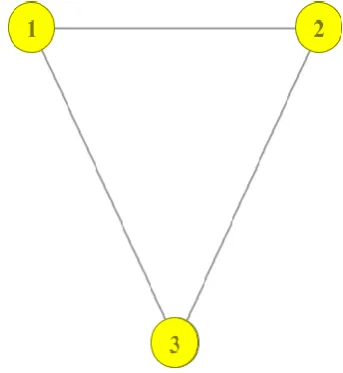
Two graphs may be constructed with 𝑋1 and 𝑋2 being a null graph and a complete graph respectively of 3 vertices.
Figure:
Figure 1 (a) 𝑿𝟏 Figure 1 (b) 𝑿𝟐
For 𝑛 > 3, The orbits of 𝒢1 are ∆1= { 1 } , ∆2= { 2, 3, 4, … , 𝑛}
Hence, Using Schur’s algorithm, we establish B (∆2), as below;
B (∆2) =
(
0 1 1 1 … … … 1 1 0 1 1 … … … 1 1 1 0 1 … … … 1 1 1 1 0 … … … 1 … … … … … … … … … … … … … … … … 1 1 1 1 … … 0 1 1 1 1 1 … … … 0)
[Otieno* 6(8): August, 2019] ISSN 2349-4506
Impact Factor: 3.799
G
lobal
J
ournal of
E
ngineering
S
cience and
R
esearch
M
anagement
A (𝑋1) = B (∆1) =
(
1 0 0 0 … … … 0 0 1 0 0 … … … 0 0 0 1 0 … … … 0 0 0 0 1 … … … 0 … … … … … … … … … … … … … … … … 0 0 0 0 … … 1 0 0 0 0 0 … … … 1)
A (𝑋2) = B (∆2) =
(
0 1 1 1 … … … 1 1 0 1 1 … … … 1 1 1 0 1 … … … 1 1 1 1 0 … … … 1 … … … … … … … … … … … … … … … … 1 1 1 1 … … 0 1 1 1 1 1 … … … 0)
Two graphs may be constructed with 𝑋1 and 𝑋2 being a null graph and a complete graph respectively of n vertices.
∎ Alternative Proof for 𝒏 > 𝟑
In general, the Stabilizer of 1 is given by:
𝒢1= { 1, (234), (235),…….., (n-2 n n-1), … , (n-3 n)(n-2 n-1)} such that ;
| 𝒢1 | = (𝑛−1)!
2
For 𝑛 > 3, the orbits of 𝒢1 are ∆1= { 1 } , ∆2= { 2, 3, 4, … , 𝑛}
⟹ There are 2 orbits for the stabilizer of 1.
Clearly, the 2 orbits of 𝒢1are self-paired by definition 4.
This implies that the matrices associated with the sub-orbits of 𝒢 are symmetric.
But the number of graphs whose groups of automorphisms contain 𝒢 is equal to the total number of symmetric matrices by Schur’s algorithm, then;
The number of graphs whose groups of automorphisms contain 𝒢 = 2.
The identity matrix yields the null graph while the other symmetric matrix yields a complete graph ∎
Example
Taking 𝒢 = 𝐴15, find the number of regular graphs whose groups of automorphism contains 𝒢 and construct the
graphs.
Solution
Follows from the above lemma 1;
The orbits of 𝐴9 are ∆1= { 1 } , ∆2= { 2, 3, 4,5,6,7,8,9,10,11,12,13,14,15}
The 2 orbits are self- paired and hence they form symmetric matrices.
[Otieno* 6(8): August, 2019] ISSN 2349-4506
Impact Factor: 3.799
G
lobal
J
ournal of
E
ngineering
S
cience and
R
esearch
M
anagement
Figure:
Figure 2 (a) 𝑿𝟏 Figure 2 (b) 𝑿𝟐
CONCLUSION
We have employed Schur’s algorithm in this project to construct graphs whose groups of automorphisms contains the Alternating groups. We have as well calculated the number of graphs whose automorphism groups contains the Alternating group.
We have shown our results as above and given examples of constructed graphs in Figure 1 & 2. The main result from our study has been expressed in lemma 1. Lemma 1 shows that in determining the number of graphs whose automorphism groups contain the Alternating group, the answer is always 2 being the null and complete graphs. Obviously the 2 graphs represent the Symmetric group.
ACKNOWLEDGEMENTS
Glory, honor and thanksgiving are to God for enabling me accomplish this work.
To my wife and sons, I am very much indebted for your unending support and encouragement.
REFERENCES
1. Armstrong, M. A. (2013). Actions, Orbits, and Stabilizers In: Groups and Symmetry. Springer Science & Business Media: 91-97.
2. Babai, L., Goodman, A. J., & Lovász, L. (1991). Graphs with given automorphism group and few edge
orbits. European Journal of Combinatorics, 12(3), 185-203.
3. Bouwer, I. Z. (1969). Section graphs for finite permutation groups. Journal of Combinatorial
Theory, 6(4), 378-386.
4. Burnside, W. (1911). Theory of Groups of Finite Order. Cambridge University Press, Cambridge. Dover reprint 1955.
5. Cameron, P.J (1973). Primitive groups with most sub orbits doubly transitive. Geometriae Dedicata 1: 434-446.
6. Cameron, P. J. (2004). Automorphisms of graphs. Topics in algebraic graph theory, 102, 137-155.
7. Chao, C. Y. (1965). On groups and graphs. Transactions of the American Mathematical Society, 118,
488-497.
8. Frucht, R. (1939). Production of graphs with given abstract group. Compositio Mathematica, 6, 239-250.
9. Leon, J. S. (1979). An algorithm for computing the automorphism group of a Hadamard matrix. Journal of Combinatorial Theory, Series A, 27(3), 289-306.
10. Olum, F. O. (2018). Suborbital graphs of the groups 𝐶𝑛, 𝐷𝑛and 𝑈𝑝 and graphs whose automorphism
[Otieno* 6(8): August, 2019] ISSN 2349-4506
Impact Factor: 3.799
G
lobal
J
ournal of
E
ngineering
S
cience and
R
esearch
M
anagement
11. Quirin, W. L. (1971). Primitive permutation groups with small orbitals. Mathematische
Zeitschrift, 122(3), 267-274.
12. Sabidussi, G. (1957). Graphs with given group and given graph-theoretical properties. Canadian journal
of mathematics, 9, 515-525.
13. Servatius, H. (1989). Automorphisms of graph groups. Journal of Algebra, 126(1), 34-60.
14. Sims, C. C. (1967). Graphs and finite permutation groups. Mathematische Zeitschrift, 95(1), 76-86.