abrn.asia journal
Volume 1, Issue 1 (January 2016), PP 1-7
REVIEW PAPER OPEN ACCESS
Author et al© 2016 This article is distributed under the terms of the Creative Commons Attribution 4.0 International License (http://creativecommons.org/licenses/by/4.0/), which permits unrestricted use, distribution, and reproduction in any medium provided you give appropriate credit to the original author(s) and the source, provide a link to the Creative Commons license, and indicate if changes were made.
The Effect of Social Media Sales Promotion towards Customer
Purchase Decision
Alif Huazam
Othman Yeop Abdullah Graduate School of Business (OYAGSB), University Utara Malaysia(UUM),0600,Sintok, Kedah Darulaman, Malaysia
1. Introduction:
In todays’ emerging markets where products are not bind by the geographical lines anymore. The borderless market as we seen today has make way for social media to rise to the occasion. By adoption of social media tools in everyday’ s life combined with the aggressive sales and promotion that we see today has increased sales revenue for some marketers. Consumer behavior must be studied in order to predict future trends of future shopping. The importance of online shopping in social media coupled with sales and promotion will be studied here in the awakening of the new trend towards consumer purchasing decision. On another note, the marketing style of current and future sales promotion will also be emphasized. The question is does the social media sales promotions effecting consumer purchase decision. This paper will dwell on this question and find the right answer.
2. Literature review:
Promotion is one of the techniques to attract consumers to purchase more or try a product or service. Severe outcomes of promotion included sales increased, quantify of stock used and attract new consumers. For example, price promotion refers to temporary price reduction which offers to consumers. The characteristic is the retailer would label a specific percentage or cash saving for the products or services. Previous studies indicated that a sudden increase of sales would experience by retailers because of price-conscious of consumers (Banks & Moorthy, 1999; Kopalle & Mela, 1999; Smith & Sinha, 2000; Gilbert & Jackaria, 2002). According to (Blackwell, Miniard &
Abstract:
Sales promotions are a key marketing tool in communication programs. Sales promotion comprises a wide variety of promotional tools designed to achieve short-term objectives (Huff et al., 1999). Monetary promotions, such as price discounts and coupons, are the most common form of sales promotions used by organizations. However, non-monetary promotions, such as free gifts, free samples, sweepstakes and contests, are gaining popularity given the negative effects of frequent discounts. Nowadays emerging promotions includes social media. Social media are fundamentally changing the way we communicate, collaborate, consume, and create. They represent one of the most transformative impacts of information technology on business, both within and outside firm boundaries. This study purportedly designed to stimulate innovative investigations of the relationship between social media and consumer purchase decision. In this paper we outline a broad research agenda for understanding the relationships among sales promotion and social media with consumer purchasing decision. We hope that the flexible framework we outline will help guide future research and develop a cumulative research tradition in this area.
Engel, 2001), price discounts played significant roles in influencing consumer product trial behavior by which indirectly attract new consumer. Meanwhile, social media has quickly emerged as a new area of inquiry for both practitioners and researchers suggesting the potential impacts of social media and social networking technologies and services in shaping commercial channels on and off the Internet. We would start by providing a brief overview of social commerce research and practice in light of the wide attention it has drawn in the industry.
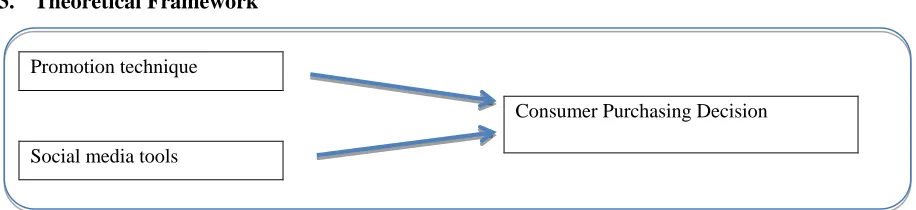
3. Theoretical Framework
Figure 1: Theoretical Framework
3.1. Consumer purchasing decision
While making purchase decisions, consumers are often unable to evaluate all available alternatives in great depth and, thus, tend to use two-stage processes to reach their decisions. At the first stage, consumers typically screen a large set of available products and identify a subset of the most promising alternatives. Subsequently, they evaluate the latter in more depth, perform relative comparisons across products on important attributes, and make a purchase decision. Given the different tasks to be performed in such a two-stage process, interactive tools that provide support to consumers in the following respects are particularly valuable in which is the initial screening of available products to determine which ones are worth considering further, and the in-depth comparison of selected products before making the actual purchase decision. This is often the case in terms of consumer selection of buying power.
There are many factors that influence consumer purchasing decision that includes the buyer’s characteristics, psychological factors, social and cultural factors. The family has the very important role and influence in the buying behavior of the consumers that includes parents, husband, wife and children. Social factors that influenced the consumer buying behavior include reference groups, immediate family members, relatives, role in the society and social status. Cultural factors comprise of set of values and ideologies of a particular community or group of individuals. Whatever a person sees from his/her childhood becomes his/her culture that includes their habits, beliefs, and principles what they have developed. These social, cultural and marketing factors affect the buying behavior of the consumers and hence it is very important for the marketers to study these factors. Few papers had been found that furthered the discussion.
From the research of Anselmsson Johan (2006), this paper was developed and validates a conceptualization of shopping mall satisfaction based on field studies in Sweden. They had observed that customer satisfaction with a shopping centre may be viewed as an individual’s emotional reaction to personal evaluation of the total set of experiences encountered at the shopping centre. Also, customer interactions with shopping centre establishments involve a variety of different activities. Interestingly in the view of another research paper of Bromley Rosemary D. F. & Matthews David L (2007), where they researched specially for those wheelchair customers who were unable to discuss earlier about their shopping experience in various shopping malls and super market. So, this paper was again a searching of customer satisfaction but in separate segment or demographic area. Meanwhile according to B. Kamaladevi (2010), survival of fittest & fastest is the mantra of today’s business game. To compete successfully in this business era, the retailer must focus on the customer’s buying experience. To manage a customer’s experience, retailers should understand what “customer experience” actually means. In conclusion there are some fundamental points in which customer experience management is not simply an old idea in a new wrapper.
3.2. Promotion Technique
There are several promotional techniques that have been popular throughout the generations. We would explore on the proven promotional techniques that has been used which had an adverse effect on consumer buying decision. Promotion technique of "buy-one-get-one-free" is one of the types of bonus packs in which the consumers are offered the additional product at the ordinary price but are in an enhanced package. Consumer would be easily
Promotion technique
Social media tools
persuaded to buy products’ as there is no extra cost need and more valuable perceived by consumers (Sinha & Smith, 2000). Besides, this promotion technique would beneficial to retailers in speed up the stock clearance compared to price promotions (Li, Sun & Wang, 2007).
The introduction of games such as sweepstakes (known locally as 'lucky draws') is use by supermarkets to attract consumer that influences purchase decision. Consumers participate in these games for reasons such as the perceived value of the prize, or perceived fun and interest (Ward & Hill, 1991). This particular sales promotion technique has received rather limited research attention, but so-called sweepstakes and games are a very popular form of sales promotion in Malaysia. Sweepstakes and lucky draws permeate not only shopping life in Malaysia, but also social life, with lucky draws being held at most social gatherings. Out of the non-monetary promotional techniques, gifts or premiums are becoming increasingly important in promotional strategies (Raghubir, 2005; Banerjee, 2009; Palazo ́n & Delgado, 2009). A gift or premium is a product or service offered free, or at a relatively low price, in return for the purchase of one or many products or services (d’Astous & Landreville, 2003). Surprisingly, while gift promotions are widely used in marketing, academic research into this subject is limited (d’Astous and Landreville, 2003; Bodur and Grohmann, 2005; Prendergast et al., 2008). As such, manufacturers tend to make decisions about gift promotions on the basis of experience and intuition (Hiam, 2000; d’Astous and Landreville, 2003). This marketing technique does attract more attention due to the promise of getting additional product other than they wanted to buy.
3.3. Social Media Tools
Since the marketing power and market penetration of social media has become a trend due to possibility of
people that the social media can touch. The definition of social media is “the relationships that exist between
network of people” (Walter & Riviera, 2004). In the last ten years, the online world has changed dramatically. Thanks to the invention of social media, young men and women now exchange ideas, feelings, personal information, pictures and videos at a truly astonishing rate. The positive aspect of online communities is that youths can utilize them for academic assistance and support (Lusk, 2010). Due to the ability of social media to enhance connections by making them easily accessible, social media can yield many benefits for the young, including providing a virtual space for them to explore their interests or problems with similar individuals, academic support, while strengthening online communication skills and knowledge. In social media, there are a lot of social networking tools that are available for the businesses and individuals to use as a medium for them to participate. Facebook, Twitter, YouTube and Bloggers are the four popular social media tools used by people worldwide. Each of the tools has its own function in conducting e-commerce.
Nowadays, almost everyone who goes online will have his/her own Facebook account. Facebook is a new face of e-commerce in the twenty-first century by providing new value of services to Internet users to express
themselves and network with others (Laudon KC & Traver CG, 2010). On the other hand, Facebook is equipped
with an application to let companies to create their own fan page and personalized profile on the website for their customers to post any comment on their pages. Moreover, it also allows companies to post advertisements and they can easily upload photos and videos on their website pages. By using Facebook, companies and individuals can upload the image of their products or services with full description on it. Then, customers can purchase the products they need by just commenting on the comment box or inbox. Final confirmations about selling the products or services will be sent to the customers through the Facebook inbox. Customers will be given a bank account number for payment purposes. This is the way by which businesses and individuals use Facebook to conduct their e-commerce. In the country of Malaysia, Facebook has become a social media trendsetter that transcends the social network of young and old. Those who didn’t follow this social media trend are labeled as an outcast of technology.
Twitter is another social media tool used by most people nowadays. It has become a place where companies conduct e-commerce, send information to customers and create communities with the customers and to sell goods and services for individuals (McIntyre DA, 2009). It contains comments, observations, opinions of the audiences, and the search engine that mines those tweet patterns. With a Twitter account, companies can quickly react and respond to the customers’ needs and rebut any unnecessary comments.
around the world, businesses can also react and respond immediately to the comments and create customers’ satisfaction and loyalty. However, it also can be a marketing media that can tarnish an image as comments are updated live. This would potentially drop the sales revenue of a product and damage companies images within seconds.
Blog is a place where Internet users blog about their interests or anything that they would like to talk. It is another famous type of social media tool among Internet users. It is a web log where blog are the online diaries or journal that are presented on the web pages, and it is one of the cheapest and easiest way to use as a social media approach. It can help businesses and individuals to understand more about their existing and potential customers by inviting them to share their thoughts and inform them regarding the latest update about the company and products or even promotions. Moreover, businesses and individuals can always upload photos on the blog to let customers view the products online and buy them if they want. Blog are more popular and efficient to use in e-commerce because the content of the blog are highly relevant and customers can choose which blog to read. This will decrease the customers’ feeling of being annoyed because they have the power to choose what they want to read. Besides that, it can also help e-commerce by increasing companies’ products and services visibility and information regarding products and services can be reached quickly to the targeted customers. Bloggers will surely enhance the growth of e-commerce especially among young consumers who are techno savvy.
The increased popularity of social media sites, such as LinkedIn, Facebook, and Twitter, has opened opportunities for new business models of electronic commerce, often referred to as social commerce (SC). Social commerce involves using Web 2.0 social media technologies to support online interactions and user contributions to assist in the acquisition of products and services. The social media environment provides a new platform for innovation as well as raises a variety of new and challenging research issues that require new theories. For instance, co-creation has become a major trend and word of mouth has played an increasingly important role in online shopping. Social media is a subset of Web 2.0, and the social media revolution in the use of the Web is making social commerce a new extension of e-commerce and promises to become a most challenging research field in the coming decade. Companies such as Facebook, LinkedIn, Groupon, and Twitter are setting new records in their growth and valuation, mainly due to their innovative e-commerce business models. The paper by Olbrich and Holsing, 2013 focuses on how social shopping features in a shopping Web site affect purchasing behavior. More specifically, the paper classifies Web site features into general, direct, and social shopping and then analyzes the predictability of these features with the actual purchase using clickstream data. Through the analysis of over 2.7 million data items, the researchers found that tagging and high ratings have a positive impact on user click-outs. In contrast, the more lists and styles used, the less likely the user is to click out, although lists and styles seem to enhance the site’s stickiness and exploration. Moreover, the more direct shopping features are used, the less likely the user is to click out.
4. Conclusion:
In conclusion, this research has helped to elucidate the response of consumers to the sales promotion activities most commonly used. Specifically, the study has generated a comparison of the different buying behaviors induced by one particular promotional tools and social media tools in inducing one particular buying behavior. This latter comparison in particular should help marketers appreciate which tool is relatively more effective in influencing consumer purchase behavior. Price discounts, extra free product offers were found to be the most effective for encouraging brand switching, purchase acceleration and additional spending. On the other hand, sweepstakes and games were found to be relatively less effective in inducing the behaviors. While social media success was much being supported by the uptake of younger generations and the ease of not living home, the uptrend of these youngsters in using social media as a medium of influencing consumer purchase behavior has been significantly well perceived.
References
Ali Akbar Balaghar, M. Majidazar and M. Niromand(2012),Evaluation of Effectiveness of Sales Promotional Tools on Sales Volume (Case Study: Iran Tractor Manufacturing Complex (ITMC)),Middle-East Journal of Scientific Research,11(4), 470-480
Andrew T. Stephen, Jeff Galak (2012),The Effects of Traditional and Social Earned Media on Sales: A Study of a Microlending Marketplace. Journal of Marketing Research, 49(5), 624-639
Christy Ashley and Tracy Tute (2015), Creative Strategies in Social Media Marketing: An Exploratory Study of Branded Social Content and Consumer Engagement, Psychology & Marketing, 32(1), 15-25
David Yoon Kin Tong Kim Piew Lai Xue Fa Tong (2012),"Ladies' purchase intention during retail shoes sales promotions", International Journal of Retail & Distribution Management, 40(2), 90 – 108
Dr.Sukhmani,Dr.Shaveta Gupta and S.Neha Kalra(2012),Role of Promotion Mix in Mounting the Sales of Various FMCG Companies in Rural Markets,International Journal of Marketing,Financial Services and Management Research,1(3),31-37
Enrique Manzur Sergio Olavarrieta Pedro Hidalgo-Campos Pablo Farías
(2013),"Store price promotion strategies: an empirical study from Chile", Academia Revista Latinoamericana de Administración, 26(3), 356 – 372
Evans D. (2008). Social media marketing: an hour a day. Wiley Publisher: Indianapolis,IN
Farshid Movaghar Moghaddam and Amir. Foroughi(2012), The Influence of Marketing Strategy Elements on Market Share of Firms,International Journal of Fundamental Physocology & Social Sciences, 2(1), 19 – 24 Feng Shen (2014),"Perceived fit and deal framing: the moderating effect of perceived fit on sales promotions in line
and brand extensions", Journal of Product & Brand Management, 23(4/5) 295 – 303
Forsythe, S. M., & Shi, B. (2003). Consumer patronage and risk perceptions in Internet shopping. Journal of Business Research, 56(11), 867–875.
Gong, W., Stump, R. L., & Maddox, L. M. (2013). Factors influencing consumers’ online shopping in China. Journal of Asia Business Studies, 7(3), 214–230.
Hayan Dib and Mokhles Alnazer (2013), The Impact of Sales Promotion on Perceived Transaction Value and Purchase Intentions: The Moderating Role of Promotional Benefit Level, International Journal of Economy, Management and Social Sciences, 2(9), 731-736
Hindu J. Amin and Ahmed L. Ala(2014),The Role of Advertisement and Sales Promotion in Student’s Choice of Service Providers,International Journal of Sciences: Basic and Applied Research, 15(1),450-463
Junio Andreti, Nabila H Zhafira, Sheila S Akmal and Suresh Kumar(2013),The Analysis of Product, Price, Place, Promotion and Service Quality on Customers’ Buying Decision of Convenience Store: A Survey of Young Adult in Bekasi, West Java, Indonesia,International Journal of Advances in Management and Economics,2(6),72-78
L. Richard Ye and Hao-hong Zhang(2014),Sales Promotion and Purchasing Intention: Applying the Technology Acceptance Model in Consumer-to-Consumer Marketplaces,International Journal of Business, Humanities and Technology,4(3),1-5
Laudon KC., & Traver CG(2010). E-commerce: business, technology, society. 6th ed. Prentice Hall: Upper Saddle River, NJ.
Madhurima Gupta and Dr. Deepali Singh(2013), Perceptual Study of Relative Effectiveness of Tools and Techniques Used in Sales Promotion,American International Journal of Research in Humanities, Arts and Social Sciences,30-35
McIntyre DA(2009). The Future of Twitter. TIME [Internet]. Available from: http://www.time.com/time/specials/packages/article/0,28804,1901188_1901207,00.html
Palazon, M. and Delgdo, E. (2009), Effectiveness of price discounts and premium promotions, Psychology and Marketing, 26 (12), 1108-1129
Peter Hultén Vladimir Vanyushyn (2014), Promotion and shoppers' impulse purchases: the example of clothes, Journal of Consumer Marketing, 31(2), 94 - 102
Qing Yao Rong Chen Ping Zhao (2013), Precise versus imprecise promotional rewards at small probabilities, European Journal of Marketing, 47 (5/6), 1006 – 1021
Ripon Kumar Chakrabortty, Md. Mosharraf Hossain, Md. Farhad Hasan Azad and Md. Jakirul Islam (2013), Analysing the Effects of Sales Promotion and Advertising on Consumer’s Purchase Behaviour, World Journal of Social Sciences, 3(4),183 – 194