Iranian Rehabilitation Journal, Vol. 8, No. 11, 2010
Original Article
Stigma in Iranian down Syndrome
Sahel Hemmati, MD.; Farin Solemani, MD.
Reza Seyednour, MD
1.; Asghar Dadkhah, PhD.
University of Social welfare and Rehabilitation Sciences, Tehran, Iran
Objectives: Stigma is a negative value. Many behaviors are to ward Stigmatized people. Down syndrome
is one of conditions with Stigma. The aim of this study is to determine the sources of labeling in iranian Down syndrome.
Method: The View of 105 Down syndrome families concerning stigma were conducted. All of Down
syndrome was under 50 years.
Results: A fair proportion of Down syndrome families perceived that stigma had a negative effect from
social. Causes of stigma are different. Stigma due social interaction, Media and health professionals are significant than others.
Conclusion: The diagnostic label of Down syndrome may render the person and his family vulnerable to
stigmatization. The most causes of stigma were determined; therefore, in the destigmatization programs, they must be attended. Stigma must be detected, too.
Key words: Stigma, Labeling, Down syndrome, Destigmatization Submitted: 5 Feb 2010
Accepted: 02 March 2010
Introduction
Stigma is the negative evaluation of a person as tainted or discredited on the basis of disability. Such prejudice has major social, economic and psychological consequences for stigmatized people. (1) Reviews of the literature suggest that the community reacts adversely to wards stigmatized people. (2)
Down syndrome is a genetic, chrosomal state, which manifested by physical characteristic. (3) It is one of tenth stigmatized item in the world. (4) Mongoloid was once an acceptable label for people with DS that is no longer used by professionals, but is often used by Layman. (5) Some of researches had showed discrimination, social stigmatization and insurability in Down syndrome families. They experienced increased stress, increased time demands, and changes in roles. (6) Their level of psychological and physiological distresses were lower than levels reported by families of children with other disabilities. (7) Manchester DS Cohort did report a decrease in perceived satisfaction with life. (8) This was associated with a decrease in actual and perceived satisfaction with social support.
(9) Since 1970s with changes have occurred in the Philosophy of care for children withDS. (10) And destigmatization program was induced in developing countries. (11) According this, taking special attention to DS was performed and for having educational, vocational and other opportunities for better life, at first information is needed. . (12) Now disability and special needs is a normal part of life and is not a stigma. (13) Hence degree and type of stigmatization varies according to prevailing cultural norms, (14) therefore we decided to determine causes of stigma in iranian Down Syndromes.
Material & Methods:
1- Before his (her) birth, I know Mongol (Persian word).
2- To warn me for my Down syndrome birth was terrible.
3- Health professionals didn’t have sympathy (in the first days of his Birth).
4- Health professionals had sympathy With me (in the first days of his birth).
5- After my child birth my coming and going to the family was restricted.
6- My Down Syndromes child acceptance was difficult for me.
7- Down Syndromes child acceptance was difficult for my husband (spouse).
8- Professionals have negative attitude to him/her so I prefer not to visit them.
9- Health professionals didn’t decided correct plan for him/her.
10-I feel rehabilitation professionals don’t have appropriate visit and examination.
11-Rehabilitation sessions get me anxious/agitated. 12-In rehabilitation sessions, families face negative
attitude.
13-I like to be only with DS families or peers. 14-Naming "handicapped" for Down Syndromes
annoys me.
15-In friends' parties, I am ashamed to take my Down syndrome child with me.
16-In family parties, I am ashamed to take my Down Syndromes child with me.
17-My friends have restricted their come and go with me after my child birth.
18-My friends have negative attitude to my Down syndrome child.
19-My families have negative attitude to my Down syndrome child.
20-My neighbors have negative attitude to my Down syndrome child.
21-In public places negative social attitudes have distressed us.
22-In public places negative social attitudes have annoyed us.
23-I avoid my Down syndrome child to contact with other children.
24-I avoid from my Down syndrome child to contact with individuals.
25-I feel anxiety and restlessness in every party for my Down syndrome child.
26-His/her physical appearance still is a problem for me.
27-I am I annoyed for ethical and social law about Down syndrome.
28-I am ashamed when health professionals ask about my Down syndrome child.
29-Our familial (parents and in-laws) interaction is now better than before birth
30-My husband has negative feeling with me related to marital relationship.
31-My children relations are appropriate with my Down syndrome child.
32-We don't have any problem in our family with my Down syndrome child.
33-In movies which make fool of Down syndrome children, I feel annoyed.
34-When I hear the word "Mongol" in TV or cinema, distresses me.
35-Contents of Down syndrome in
magazines/papers make me distressed.
36-Down syndrome photos in billboard for charity institutions, distresses me.
37-I feel anxiety when he (she) is in public places. 38-When Down syndrome child is with other
special children, I feel distressed.
39-I don’t like to discus about DS in families parties.
Then rehabilitation professionals (speech & occupational therapists – Physiotherapist social worker- psychologist) who have worked with Down syndrome families, some of other Down syndrome families had studied Questionnaire and found that some of areas must be added or deleted. At last, it was a Questioner with 39 items, at last for its reliability 10 Down syndrome families filled it, and results were appropriate. All of items scored 0 – 2, 2 showed stigma from this item is high, 1 showed intermediate and 0 showed no stigma.
120 Down syndrome parents were ready to participate for this study, but at the end 105 parents filled and participated. Down syndrome families were chosen in this method:
Iranian down Syndrome Association (N.G.O) Rehabilitation clinics (4); two of them were university clinics in the down town and center in Tehran. Other Clinics were of private.
Ages of DS were from birth until 50 years. One of parents must filled questioner. We explain that in this questioner stigma and its area must be detected. Personal, demographical and related information were there, too.
used in all analyses. In ethical terms, the following issues were considered:
There was no enforcement what so ever for participating in the study.
Questioners were without name and family.
Some items haven’t been answered.
Results:
In this study we assessed 105 down syndromes from birth until 50 years, they were 60 boys and 45 girls. (They didn't live only in Tehran) All of them divided to 3 groups their ages. Less than 5 years, 5 – 10 years and over 10 years.59% were in the first
group
٠
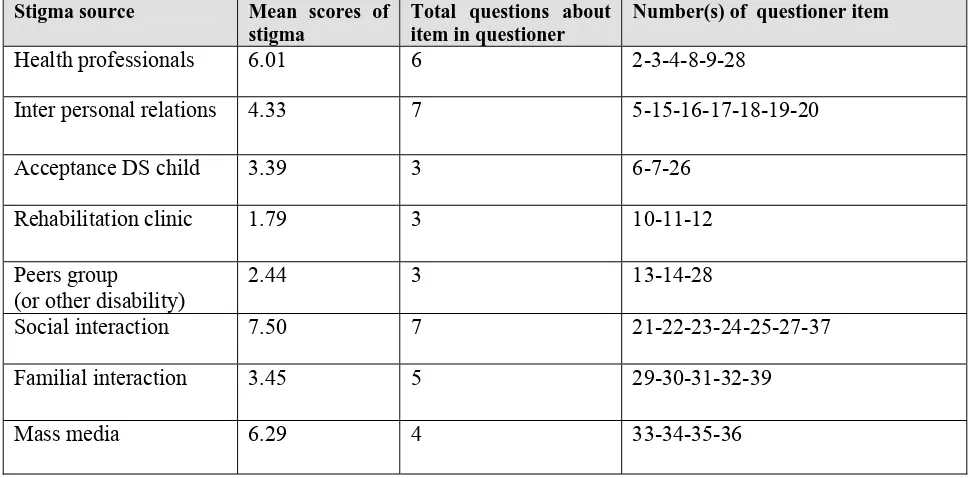
21.9% was in second, 17.1% were over 10 years and 1.9% didn’t answer. Therefore most of DS children in our study are less than 5 years.Destigmatization programs must be noticed to this ages. 60of DS were boys, 41were girls and 4 of them were no detected. F test in ANOVA showed 0.02 between DS boys and girls stigma which showed it is no difference. In Table – 1 source (areas) of stigma were detected. Stigma from social interaction is the first; mass media and therapeutic specialist (Health professionals) are the next sources.Table 1. Source of stigma on DS
Number(s) of questioner item Total questions about
item in questioner Mean scores of
stigma Stigma source
2-3-4-8-9-28 6
6.01 Health professionals
5-15-16-17-18-19-20 7
4.33 Inter personal relations
6-7-26 3
3.39 Acceptance DS child
10-11-12 3
1.79 Rehabilitation clinic
13-14-28 3
2.44 Peers group
(or other disability)
21-22-23-24-25-27-37 7
7.50 Social interaction
29-30-31-32-39 5
3.45 Familial interaction
33-34-35-36 4
6.29 Mass media
The meaning value of scores in stigma questioner Table-2 showed mean difference between stigma scores relation to zero with T- test is meaningful.
Table 2. Difference between scores of stigma
Test Value = 0
t df
Meaningful value
Mean Difference
95% Confidence Interval of the Difference
Lower Upper
Stigma scores
classification 28.166 104 .000 2.8857 2.6825 3.0889
Table – 3 showed difference between mothers or fathers in DS stigma, mothers experienced higher scale in stigma for their children. Our study showed parents' relation is better than before .33.3% had
Table 3. Stigma scores in parents by their sex
number mean Standard deviation
father 14 31.5000 13.81053
mother 76 39.4737 13.81053
No response 15 26.8000 13.81053
total 105 36.6000 15.24013
Table – 4 shows parents cooperation in research. Traditional word itself is a stigma with negative attitude. 58.1% families realize (Mongol or Mongoloid) is a stigma from birth.
88% of families realized professionals told them birth of Down syndrome is very catastrophic and they experienced shock. Unfortunately families had
in sufficient information in Down syndrome from professionals; they were confused for many days after DS birth. 80.9% of families reported pity observation in social.
96.2% were very annoyed and distress for DS ethic and citizenship laws and their dependent life.
Table 4. Parents' cooperation for research
sex number
%
father 14 13.3
mother 76 72.4
No response 15 14.3
total 105 100.0
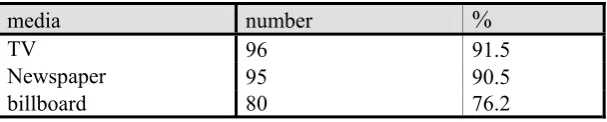
Social interaction, mass media and stigma from professionals were the higher scores. Table- 5 shows the concern of families about stigma Down syndrome, especiality negative and disabling image from mass media.T.V is the most important stigma
source in society ( 91.5%). 76.2% realized Isolation Down syndrome from another and being only with other special needs persons in social is a negative image of Down syndrome. Reliability coefficients for this questioner showed with Alfa kronbach 0, 93.
Table 5. Perceived contribution by mass media to Down syndrome
media number
%
TV 96 91.5
Newspaper 95 90.5
billboard 80 76.2
Discussion
The term stigma refers to any persistent trait of an individual or group which evokes negative or punitive responses. Perception of negative difference (deviance) and their evocation of adverse social responses (stigma) 15 DS is a genetic syndrome, these persons have characteristic features with special needs.16 Social scientists have tried to shed light on the causes of stigma. 2 one fundamental problem is that psychological understanding of disability and difference is with negative attitude.17 Therefore social interaction in this research showed to be the most important cause in stigma (with mean
In this research T.V with 91.6%, newspaper and Billboard with 90.5% and 76.2% are the causes of stigma. The mean number for this cause of stigma was 6.29 .Therefore media is a cause of stigma in Iranian culture like another research. First at all in destigmatization programs media must be considered.
Many medical professionals can not image that a person with a disability could lead a satisfied life.22 New attitude in this area enhance care of DS and improve their social skills and quality of life.23 Mongoloid was once an acceptable label for Down syndrome: The stigma used by professionals, but is often used by laymen. Mongoloid label is racism discrimination, too. 5 In this study 58.1% of families know Mongoloid label. Health Professionals often use it; they don’t help for changing public attitude and social acceptance. 24 Families don’t like it; negative feeling always is with Mongoloid label. Therefore Mongoloid label must be deleted. Interpersonal relationship is a cause of stigma that relates to social attitude. Stereotyped thinking about mental retardation and Down syndrome to cause isolation and leads to prejudice.25 people experience ambivalent feeling to wards stigmatized person and seek to avoid having stigma spread to them by avoiding close association with a disabled person. It is important to note that although disabled people or their family knows of their stigma, they can refuse to internalize the negative societal attitudes towards them in their self – valuation. 2- 14 we showed that only 17% haven’t major problems in social and mostly realized damaged social interaction. 33.3% after Down syndrome birth completely and 26.7% partial don’t like contact with people. Education to people for understanding DS is nesseccery. Parental blame in family for Down syndrome can be seen.26 but we find that 50.5% parents don’t blame or feel hum nation. Friends, neighbors and another people who know Down syndrome change attitudes and thinking. 9.5% have problem with their friends. Birth of Down syndrome is with warm and sincerity.27-32But in our study results is different 30.5% marital relationship were worsen, 3.8% no difference and 7.6 no answered.25.7% of marital relations is a few better and 32.4% were completely better.
Coping style with Down syndrome child and acceptance of parental role for them is a problem and need adjustment.27 – 28Our research showed 60% families had difficulty for Down syndrome acceptance. Down syndrome has a typical face;
acceptance of it mostly is difficult.2956.2% of research's families showed difficulty in it. After late 1970,s important challenges had been in DS rising, focused in integrated education from kinder garden until school. This process help social education, public awareness, acceptance all of disabilities in social, increased self esteem for Down syndrome and their families, at last it is in the way of destigmatization.30 Being Down syndrome itself still is social stigma.(29 – 31-32) 76.2% families in our study experience difficulty in social acceptance with a great stigma. This numbers showed that, like developed countries; we need better programs for integrated education. Fortunately rehabilitation professionals can make better communication with Down syndrome families.34.3% of Down syndrome families feel few negative attitude from them. This is a good result that showed rehabilitation professionals had better trained for disabilities acceptance than other specialists. In our study, we showed stigma in Down syndrome is great and specific destigmatization program is necessary.
References
1- King M, Dinos S, Show J. The stigma scale: development of a standardized measure of the stigma of mental illness. British journal of psychiatry 2007, 190,248-254
2- Lai Y M, CPH Hong , CY I chee, Stigma of Mental Illness, Singapore Med J2000,Vol 42(3),111 -114
3- Cunningham, C.Early intervention in Down syndrome. In G.Hosking&G Murphy (Eds) .Preventation of mental handicap: A world view, London :Royal Society of Medicine Services,1987
4- Davis T.W, MorrisA.A comparative quantification of stigma ,Social work and social science Review,1(2)1989-90,109-122
5- Thomas. C.A.Labeling and stigma, Neuro Behavioral Treatment Systems,LLC, 2005,www.tclc.com/pr09.htm 6- Van Riper Marcia .Living with Down syndrome: The
Family Experience. Down Syndrome Quarterly, 1999, volume 4, number 1 ,p :17-9
7- Sloper P & Turner S .Risk and resilience factors in the adaptation of parents of children with severe physical disability. Journal of child psychology and psychiatry, 1993,34, p : 158 -167
8- Cunningham C.Understanding Down syndrome: An introduction for parents. Cambridge, MA: Brookline Books.1996.
9- Cunningham C. Families of children with Down syndrome. Down syndrome Research & Practice ,1998,4,p:87- 95 10- www.downsnet.org/library/dsrp/families/default.asp. 11- www.cbc.ca/news/story/1999/09/29/bc_down990929.html 12- Bielder Rosangela Berman .Brazil: Reducing Stigma
through public education. Disability World.2003, Issue no 9, July – august 2003.
14- Byrne Peter .Stigma of mental illness: changing minds, changing behavior, British journal of psychiatry ,1999, 174,1-2
15- Goff man E.Stigma: Notes on the management of spoiled identity. Prentice – Hall, Englewood Cliffs,Nj.1963 16- Cahill B.M. & Gidden, L.M. Influence of child diagnosis
on family and parental functioning: Down syndrome vs. other disabilities. American Journal on Mental Retardation, 1996,101, p:149 – 160
17- Stein HF. Rehabilitation and chronic illness in American culture .J.Psychol.Anthr 1979;2,p:153-76
18- Phillips MJ.Damaged goods: oral narratives of the experience of disability in American culture. Social Science & Medicine 1990,30 ,p:849-57
19- Birnbaum A. On managing a courtesy stigma. Journal of health and social behavior,1970,88,p:196-206
20- http/www.disabilityworld.org/06-08-03/brazil.shtml
21- Atkinson L,Chisholm V et al. Cognitive coping ,affective distress, and maternal sensitivity : mothers of children with DS,Developmental psychology,1994,31,p:668 -676 22- Corrigan, Patrick W: Don’t call me Nuts! Coping with the
stigma of mental illness,Lundin; Tinley Park, Illinois, Recovery Press, 2001, part A
23- Smith dr.New attitude enhance care of adults with Down Syndrome, American family physicians ,2001,sep 15 24- Jain R. Thomasma DC.etal.Down syndrome :still a social
stigma.Am J Perinatol,2002 Feb;19(2),p:99-108
25- Wilker.L.Wasow.M, etal.Chronic sorrow revisited: parent vs. professional depiction of the adjustment of parents of mentally retarded children .American journal of orthopsychiatry,1981,37,p:63-70
26- Hall.S, Bobrow.M&Marteaun.T.Parents attribution of blame for the birth of a child with Down syndrome: pilot study. psychology &health,1997,12,p:579-587
27- Atkinson. L, Chisholm.V, etal, Cognitive coping, affective distress, and maternal sensitivity: Mothers of children with Down syndrome. Developmental Psychology, 1994, 31, p:668-676
28- Fisman.S, Wolf.L, etal.Risk and protective factors affecting the adjustment of sibling of children with chronic disabilities. Journal of the American Academy of child &Adolescent psychiatry,1995,35,p:1532-1541
29- Murphy .A &Pueschel.S.Early intervention with families of newborns with Down's syndrome. Maternal child nursing Journal,1975,4,p:1 -7
30- Sander.J.L&Morgan.S.Family stress and adjustment as perceived by parents of children with autism or Down syndrome : implication for intervention .Child &family behavior therapy ,1997,19,p:15-32
31- Parker Steven, Zuckerman Barry, etal. Developmental and behavioral pediatrics, Down syndrome .Lippincott Williams &Wilkins, second edition,2004,p:167 – 170