Do the Patterns of Attachment Affect Resilience in Adolescents?
Rizky Septiani
[email protected] Faculty of Clinical Psychology Gunadarma University Margonda Raya No. 100 Depok 16424
ABSTRACT One important factor that supports the formation of resilience is an attachment. The attachment which is divided into three patterns, namely secure attachment, anxious attachment,
Available online at www.ijrp.org
International Journal of Research Publications
Volume-43, Issue-1,December 2019
Accepted and Published Manuscript
Do the Patterns of Attachment Affect Resilience in Adolescents?
Rizky Septiani
PII : Rizky Septiani.100431122019873 DOI: 100431122019873
Web: http://ijrp.org/paper-detail/874
To appear in: International Journal of Research Publication (IJRP.ORG) Received date: 25 Dec 2019
Accepted date: 28 Dec 2019 Published date: 01 Jan 2020
Please cite this article as: Rizky Septiani , Do the Patterns of Attachment Affect Resilience in Adolescents? , International Journal of Research Publication (Volume: 43, Issue: 1), http://ijrp.org/paper-detail/874
This is a PDF file of an unedited manuscript that has been accepted for publication. As a service to our customers we are providing this final version of the manuscript.
Do the Patterns of
Attachment Affect
Resilience in Adolescents?
Rizky Septiani
[email protected] Faculty of Clinical Psychology
Gunadarma University
Margonda Raya No. 100 Depok 16424
ABSTRACT
One important factor that
supports the formation of resilience is an attachment. The attachment which is divided into three patterns, namely secure attachment, anxious attachment,
Rizky Septiani / International Journal of Research Publications (IJRP.ORG)
and avoidant attachment greatly affect the high and low resilience of individuals, especially adolescents. This study aims to examine differences in resilience in adolescents based on
the patterns of attachment.
Respondents in this study were
adolescents with ages ranging from 18 to 22 years. This study uses a
quantitative method by taking
respondents using accidental sampling technique. The number of respondents was 131 people. The hypothesis testing in this study uses one way ANOVA technique. Based on the results of the analysis conducted, there is a very significant difference in adolescent resilience based on the pattern of
Rizky Septiani / International Journal of Research Publications (IJRP.ORG)
attachments with a significance level of
0,000. Teenagers with secure
attachment have higher resilience compared to adolescents with anxious attachments and adolescents with avoidant attachments.
Keywords : Resilience, Attachment, Secure, Anxious, Avoidant, Adolescent
© 2018 Published by IJRP.ORG. Selection and/or peer-review under responsibility of International
Journal of Research Publications (IJRP.ORG)
Rizky Septiani / International Journal of Research Publications (IJRP.ORG)
INTRODUCTION
Lately there have been many cases
involving teenagers, including suicides
due to stress facing national exams or
because they have not passed national
examinations, suicides due to poor
family financial conditions, falling into
abuse of narcotics, alcoholic beverages,
brawls, and free sex because of parental
divorce or because it is ignored by their
parents. The large number of cases that
occur in adolescents reinforces Rutter's
(in Howard and Johnson, 2000)
Rizky Septiani / International Journal of Research Publications (IJRP.ORG)
translation that identified adolescents
have a much greater risk factor (at risk)
for developing antisocial behavior,
abuse of alcoholic beverages and drugs,
experiencing unwanted pregnancies in
early age, dropping out of school, and
being a perpetrator of violence and
victims of violence.
But not all teenagers fix problems
like the one above. There are also many
teenagers who succeed in achieving
achievements that avoid the challenges
that come up. For example, a student
named AB who graduated from the UGM
Rizky Septiani / International Journal of Research Publications (IJRP.ORG)
medical school with a GPA of 3.51.
After all, work as a pedicab driver and
leave it as a scavenger, make AB
discouraged. With help and support from
the whole, Despite financial constraints,
AB successfully completed his studies
efficiently (Anonim, 2011). Some of the
examples above are examples of
teenagers who are able to rise and
succeed despite escaping various
difficulties. That ability is called
resilience.
Resilience is defined as "the
process of, capacity for, or outcome of
Rizky Septiani / International Journal of Research Publications (IJRP.ORG)
successful adaptation despite
challenging or threatening
circumstances" (Masten, Best, and
Garmezy, in Blaustein and Kinniburgh,
2010). Besides that, according to Kaplan
(2005) resilience is "a person's ability
to achieve success despite having faced
situations, being abused or neglected,
witnessing violence, or living poverty
-that could lead to negative outcomes
such as delinquency."
The development of the resilience
construct has taken place in the field of
psychiatry, as a psychoanalytic construct
Rizky Septiani / International Journal of Research Publications (IJRP.ORG)
(Wagnild and Young, 1993). The study of
resilience initially appeared more due to
accident factors than intentions
(Grotberg, 1997; Staudinger, Marsiske,
and Baltes, 1993 in Spaulding, 2009).
Studies in the field initially relied on
pathological models, with researchers
examining maladaptation in children
with the aim of identifying risk factors
(risk factors) that contribute to
observable negative results. It was found
that not all children who are at risk (at
risk) follow negative life trajectory
predictions, so researchers are
Rizky Septiani / International Journal of Research Publications (IJRP.ORG)
beginning to look for factors and traits
that change the outlook for children who
have 'toughness' (invulnerable) (Werner,
Bierman, French, and Garmezy, in
Spaulding, 2009). Various studies
carried out increasingly identified
various factors regarding this
'invulnerable' study so that the term was
slowly converted into resilience and
became a sign of the birth of a new area
in terms of theory and research in the
field of psychology (Ramirez, 2007).
A preliminary study of resilience
seeks to develop a list of factors that
Rizky Septiani / International Journal of Research Publications (IJRP.ORG)
will change risks and protect children
and adolescents from symptoms of
biological and ecological risks
(Spaulding, 2009). Factors that can
protect the symptoms of biological and
ecological risks are referred to as
protective factors (protective factors).
Protective factors can be defined as
attributes or specific situations needed
during the resilience process (Dyer and
McGuinness, in Earvolino-Ramirez,
2007)
According to Oeppen and Vaupel
(in Fergus and Zimmerman, 2005),
Rizky Septiani / International Journal of Research Publications (IJRP.ORG)
protective factors that can help
adolescents avoid the negative effects of
risk can be assets (assets) or can also be
resources (resources). Assets (assets)
are positive factors that are inside an
individual, such as competence, coping
skills, and self-efficacy. Resources are
also positive factors that help
adolescents overcome risk, but these
resources are external factors in
individuals. Resources that include
parental support, guidance from adults,
or the community that enhances positive
adolescent development. Resources
Rizky Septiani / International Journal of Research Publications (IJRP.ORG)
emphasize the influence of the social
environment on adolescent health and
development, help place the theory of
resilience in a more ecological context,
and move away from conceptualizing
resilience as static individual traits.
Within protective factors there are
five factors that can affect resilience,
namely; individual characteristics
(Individual Characteristics), cohesion
and family support (family support and
cohesion), external support systems
(external support systems) (Werner and
Smith in Atwool, 2006), attachments
Rizky Septiani / International Journal of Research Publications (IJRP.ORG)
(Mancini and Bonanno, 2009), and
culture (Ungar in Atwool, 2006).
From various factors that influence
the resilience above, such as individual
characteristics, family support and
cohesion, external support systems,
attachments, and culture, the authors are
interested in using attachment factors as
variables that will be examined in this
study because after research, there have
not been much research one strata of
psychology that examines resilience with
attachments. Therefore, the author
decided to examine these two variables.
Rizky Septiani / International Journal of Research Publications (IJRP.ORG)
Attachment dynamics, which
describes the effect of early caregiving
experiences on relationships as adults
(Mancini and Bonanno, 2009) is an
eternal emotional bond characterized by
a tendency to seek and maintain
closeness to certain figures, especially
during stressful situations (Bowlby in
Colin, 1991). This particular figure is
called an attachment figure. Attachment
figures are primary carers where the
child shapes his attachment to the figure,
and even this figure cares and loves the
child continuously, and they have a close
Rizky Septiani / International Journal of Research Publications (IJRP.ORG)
relationship, for example, the mother
(Prior and Glaser, 2006).
Since the age of around 18 months,
children have developed different
patterns of attachment to their attachment
figures (Prior and Glaser, 2006). The
patterns of attachment initially identified
by Ainsworth (in Svanberg, 1998).
There are three patterns, namely: secure,
ambivalent (anxious) and avoidant.
There are additional categories that have
been identified by Main, Kaplan, and
Cassidy (in Atwool, 2006), who use the
term "disorganized" to describe a
Rizky Septiani / International Journal of Research Publications (IJRP.ORG)
sample of children "at-risk" which was
initially categorized as secure because it
does not match the other two attachment
patterns. But after further investigation it
turned out that it was not suitable for the
secure category, so it was included in
the new category, namely disorganized/
disoriented.
Secure attachments to others that
are relatively easy to form, close to
others and feel comfortable in others
(Hazan and Shaver in Li 2008). Secure
attachments indicate that the child has a
sense of trust that the figure attachment
Rizky Septiani / International Journal of Research Publications (IJRP.ORG)
will give him comfort, the need for
closeness, and a sensitive, friendly and
gentle response (Prior and Glaser,
2006). Adolescents who in their
childhood form a pattern of secure
attachment with their attachments, when
adolescents will become trustworthy,
friendly, and able to provide support
when desired (Atwool, 2006). This
secure pattern is the most powerful
pattern for promoting resilience because
of children support and protection from
their surrounding environment, look at
the world so that when faced with
Rizky Septiani / International Journal of Research Publications (IJRP.ORG)
problems, they can handle them well.
This explanation is explained by Fonagy,
Steele, Steele, Higgitt, and Target (in
Fergusson and Horwood, 2003) that
secure attachment is the foundation in
resilience.
Avoidant attachments are
characterized as children who have
caregivers who are unresponsive, give
no love, and are full of rejection in
parenting. Adolescents who in their
childhood are cared for by avoidant
attachment patterns, when they are going
to be self-withdrawal, always look
Rizky Septiani / International Journal of Research Publications (IJRP.ORG)
depressed, but sometimes will emit
explosive anger (Atwool, 2006).
Whereas ambivalent attachments are
characterized as children who have
inconsistent, untrustworthy, and very
boring caregivers in care (Cassidy, in
Li, 2008). Adolescents who in their
childhood formed an ambivalent
attachment pattern with their attachment
figures most would really want to
interact/interact with their peers and
other adults, but because of fear of
rejection, it will avoid the form of
relationships offered (Atwool, 2006). In
Rizky Septiani / International Journal of Research Publications (IJRP.ORG)
avoidant and ambivalent patterns,
because of the lack of optimal support
from the surrounding environment,
making this individual view the
surrounding environment less positively,
so that the process of resilience in these
attachment patterns is less well
developed.
Furthermore disorganized/
disoriented attachment is one of the
attachment patterns where parents or
caregivers are a source of stress and
fear from these infants, so that when the
parents or caregiver are around them,
Rizky Septiani / International Journal of Research Publications (IJRP.ORG)
they exhibit unpredictable strange
behavior and they seem to lose "an
effective proximity-seeking strategy"
(Main in Howe, Brandon, Hinings,
Schofield, 1999). According to the
longitudinal study of Allen, Hauser, and
Bormen-Spurrell (in Atwool, 2006)
significantly that the increase in the
number of adolescents who suffer from
psychopathology and become
perpetrators or criminal victims turns
out that in their childhood they formed a
disorganized attachment pattern with
their attachment figures.
Rizky Septiani / International Journal of Research Publications (IJRP.ORG)
The disorganized pattern is the
most vulnerable pattern because
disorganized teenagers have difficulty in
feeling and managing a relationship
emotionally (Atwool, 2006). So that
children / adolescents in this pattern
cannot process resilience well in
themselves and can be said to belong to
a nonresilient group of individuals. The
explanation of the relationship of the
attachment pattern is in line with
Bowlby's statement (in Svanberg, 2008),
namely:“….pathway followed by each
developing individual and the extent to
Rizky Septiani / International Journal of Research Publications (IJRP.ORG)
which he or she become resilient to
stressful life events is determined to a
very significant degree by the pattern
of attachment developed during the
early years”. Bowlby statement
explained that the success or failure of a
person in achieving resilience is
determined by the pattern of attachment
that develops early on.
Studies of differences in
attachment and resilience have been
carried out before by Caldwell and
Shaver (2012) in California. Caldwell
and Shaver examined whether patterns
Rizky Septiani / International Journal of Research Publications (IJRP.ORG)
of attachment are related to emotional
cognition patterns and whether they
affect a person's resilience, with a
sample of adults becoming students and
staff working at the University of
California. They say that people who
have a secure attachment pattern shows
high resilience, are associated with good
emotional cognition functions. Whereas
people who have an insecure attachment
pattern (in this study the pattern of
attachments used are avoidant and
anxiety / ambivalent patterns) shows
lower resilience and poor cognitive and
Rizky Septiani / International Journal of Research Publications (IJRP.ORG)
emotional functions. Based on the results
of the study above, it can be concluded
that individuals with secure attachment
have a high level of resilience, whereas
individuals with avoidant attachment and
anxiety / ambivalent attachments have
lower levels of resilience. This
description is in line with Bowlby's
statement (Svanberg, 2008) which states
that the success of a person in achieving
resilience is determined by the pattern of
attachment that has developed early and
also Fonagy, et al (in Fergusson and
Horwood, 2003) that secure attachment
Rizky Septiani / International Journal of Research Publications (IJRP.ORG)
is the foundation in resilience.
Referring to the description above,
it can be concluded that there are
differences in resilience based on the
patterns of attachment. Therefore,
through this study, the authors are
interested in examining whether there
are differences in the level of resilience
based on patterns of attachment in
adolescents.
RESEARCH METHOD
This study uses a quantitative
approach. The respondents of this study
were adolescents, especially late
Rizky Septiani / International Journal of Research Publications (IJRP.ORG)
adolescents. The characteristics of the
respondents in this study were
adolescents aged 18 to 22 years with a
minimum level of education at high
school. The sample in this study
amounted to 131 people. The sampling
technique used is the accidental
sampling technique. Accidental sampling
is a technique where the researcher takes
the respondent as a sample based on
chance, that is, anyone who accidentally
meets with the researcher and has the
intended criteria by the researcher to be
sampled.
Rizky Septiani / International Journal of Research Publications (IJRP.ORG)
The researcher used two scales
from two variables. Resilience was
measured using the 14-Item Resilience
Scale (RS-14) compiled by Wagnild &
Young (2009) based on the five
dimensions of resilience proposed by
Wagnild & Young (1993). The 14-Item
Resilience Scale (RS-14) consists of
two subfactors, namely personal
competence and acceptance of self and
life factors. A number of personal
competence factors measure the
dimensions of perseverance and
self-reliance, while the elements of the
Rizky Septiani / International Journal of Research Publications (IJRP.ORG)
acceptance of self and life measure the
dimensions of meaningfulness,
equanimity, existential aloneness. This
scale of resilience uses the Likert scale
preparation technique from strongly
disagree to strongly agree. The
reliability of this scale is 0.93
Attachment is measured by using
the Revised Adult Attachment Scale
(Close Relationship Version) compiled
by Collins (1996) based on the three
dimensions proposed by Hazan and
Shaver (1987), namely close, depend,
and anxiety. This attachment scale uses a
Rizky Septiani / International Journal of Research Publications (IJRP.ORG)
Likert scale preparation technique from
very appropriate to very inappropriate.
This is subsided to three subscales,
namely Close, Depend, and Anxiety. The
reliability for each scale are 0,69 for
Close, 0,75 for Depend, and 0,72 for
Anxiety. The data analysis in this study
used a one-way ANOVA test using SPSS
statistical computer program.
RESULT AND DISCUSSION
Based on the results of the research data
description can be elaborated on the
categorization of research variables.
Rizky Septiani / International Journal of Research Publications (IJRP.ORG)
Variable categorization used in
resilience variables is slightly different
from categorization on attachment
variables. In the resilience variable, the
categorization of respondents'
descriptions used was adapted from
categorization by Wagnild and Young
(2009). While attachment variables use
categorization based on a comparison of
mean hypothetical and empirical mean.
The following are the results of the
percentage of respondents mean empiric
on the scale of resilience.
Table 1. Percentage of
Rizky Septiani / International Journal of Research Publications (IJRP.ORG)
Respondents in Resilience Categorization
No
Respondent's Description Categorization
Range
1 Very Low 14 – 56
2 Low 57 – 64
3 Pretty Low 65 – 73
4 Pretty High 74 – 81
5 High 82 – 90
6 Very High 91 – 98
Total
And here is a table about the mean
Rizky Septiani / International Journal of Research Publications (IJRP.ORG)
empirical on the scale of resilience.
Table 2. Empirical Mean of Resilience scale
Descriptive Statistics
N Minimum
Resiliensi 131 18.00
Valid N
(listwise) 131
Next up is the result of the
calculation of the mean empirical,
hypothetical mean, as well as the
Rizky Septiani / International Journal of Research Publications (IJRP.ORG)
percentage and the classification of each
subscale into patterns of attachment
which can be seen in the following table.
Table 3. Mean Empirical and Hypothetical Mean of Each Subscale
Subscale Mean
Empirical
Hypothetical Mean
Close 23,18 18
Depend 20,36 18
Anxiety 19,45 18
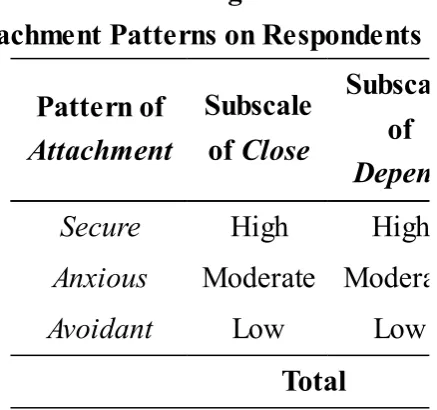
Furthermore, the percentage and
Rizky Septiani / International Journal of Research Publications (IJRP.ORG)
classification of each subscale into the
attachment pattern are shown in the
following table.
Table 4. Categorization of Attachment Patterns on Respondents
Pattern of
Attachment
Subscale
of Close
Subscale of
Depend
Secure High High
Anxious Moderate Moderate
Avoidant Low Low
Total
Rizky Septiani / International Journal of Research Publications (IJRP.ORG)
Then, below is the number of
respondents who have been classified in
each category in resilience and also the
pattern of attachments. Following is the
distribution table.
Table 5. The number of respondents in the categorization of resilience and
Attachment Patterns Resilience
scale category
Patterns of Attachment Secure Anxious Avoidant
Very Low 1 5 5
Low 3 5 7
Rizky Septiani / International Journal of Research Publications (IJRP.ORG)
Pretty Low 10 9 15
Pretty
High 44
-High 22 1
Very High 4
-Total 84 20 27
Based on the above table, from 84
respondents who patterned secure
attachment, the 70 respondents who fit
into the category of resilience quite high
up to very high. While 20 respondents
who patterned anxious attachment, only
Rizky Septiani / International Journal of Research Publications (IJRP.ORG)
one respondent who fit into the category
of resilience quite high up to very high,
and of the 27 respondents who patterned
avoidant attachment, no respondents who
fit into the category of resilience quite
high up to very high.
DISCUSSION
The results showed that the
research hypothesis is accepted. The
analysis shows that there is a very
significant difference in the resilience of
adolescents based on patterns of
attachment, with a significance of 0.000
Rizky Septiani / International Journal of Research Publications (IJRP.ORG)
(ρ <0.01).
Furthermore, the results of this
study indicate that out of 84 respondents
who have secure attachment patterns,
there are 70 respondents who fall into
the very high to very high resilience
category. While 20 respondents who
patterned anxious attachment, only one
respondent who fit into the category of
resilience quite high up to very high, and
of the 27 respondents who patterned
avoidant attachment, no respondents who
fit into the category of resilience quite
high up to very high. It can be seen that
Rizky Septiani / International Journal of Research Publications (IJRP.ORG)
the majority of respondents who are in
the high enough to very high resilience
category are respondents with secure
attachment patterns, while the majority
of respondents are anxious and avoidant
patterns in the category of low to very
low resilience.
This means that respondents who
have secure attachment patterns have a
high level of resilience, while
respondents who pattern anxious
attachment and avoidant attachments tend
to be at a low level of resilience. This is
consistent with the statement Bowlby
Rizky Septiani / International Journal of Research Publications (IJRP.ORG)
who explained that the success or failure
of a person in achieving resilience is
determined by the level on the pattern of
attachment that develops early on
(Svanberg, 2008) and also the statement
by Fonagy et al who said that secure
attachment is the foundation for
resilience (in Fergusson, 2003).
Then, based on the empirical mean
calculation on the scale of resilience, the
average respondent included in the
category is quite low. This shows that
the average teenage respondent has a
fairly low level of resilience. However,
Rizky Septiani / International Journal of Research Publications (IJRP.ORG)
based on the total score on the scale of
the resilience of each respondent, it can
be seen that the highest number of
respondents are at a level of resilience
to the categorization is pretty high.
This shows that although
adolescence is a stormy and stressful
period, as described by Hall, it was
suggested that adolescence is considered
a "storm-and-stress" which describes
adolescence as a tumultuous period
filled with conflict and mood swings (in
Santrock, 2011) but there are still quite a
number of respondents who have good
Rizky Septiani / International Journal of Research Publications (IJRP.ORG)
resilience so they can arouse themselves
and prevent respondents from
experiencing the deterioration of the
conflicts that are being experienced.
Furthermore, to find out the pattern
of attachments can be seen in the
dimensions or subscales that determine
the attachment pattern in these
respondents. Based on the empirical
mean in each subscale, it is known that
the research respondents have close
levels which are included in the high
category. Whereas in the dependent
subscale the research respondents
Rizky Septiani / International Journal of Research Publications (IJRP.ORG)
belong to the medium category. And on
the subscale of anxiety the research
respondents were in the moderate
category.
This shows that the respondents,
especially the late adolescents, have a
good closeness to the people around
them but are not too dependent on others
and the level of anxiety about various
things that are experienced is not
extreme. Furthermore, the results of the
study show that the most dominant
attachment pattern is in the secure
attachment pattern with the number of
Rizky Septiani / International Journal of Research Publications (IJRP.ORG)
respondents as much as 64.12%, while
15.27% is owned by the anxious
attachment pattern, and 20.61% is
owned by the avoidant attachment
pattern.
This shows that there is still quite
a lot of respondents as early nurtured by
using patterns of secure attachment and
it's good for the development of the
respondents because, as described by
Howe (2005) that individuals who have
secure attachments can behave in an
open and flexible in a relationship, feel
secure (safe) when expressing the needs
Rizky Septiani / International Journal of Research Publications (IJRP.ORG)
of its attachment to others, communicate
honestly and accurately, as well as
reflect the thoughts, feelings, and
behaviors they are objectively and
wisely.
CONCLUSIONS
Based on the results of the study, it
is known that the hypothesis proposed in
this study is accepted, meaning that there
is a very significant difference in the
resilience of adolescents based on the
pattern of attachments. This shows that
respondents with secure attachment
patterns have a higher level of resilience
Rizky Septiani / International Journal of Research Publications (IJRP.ORG)
than respondents who pattern anxious
attachments and avoidant attachments.
SUGGESTION
The results of this study note that
there are significant differences between
resilience with attachments patterned
secure, anxious, and avoidant in late
adolescents. Therefore, it is important
for teens to improve resilience in
themselves and keeping in touch with
family, friends, and the surrounding
environment in order to become a better
individual. It is better for teenagers to
Rizky Septiani / International Journal of Research Publications (IJRP.ORG)
know themselves better and see the
potential that exists within themselves so
that even if they are in an environment
that is less supportive and confronted
with complicated conflicts, the teenager
can stay up and not get worse.
For subsequent researchers who
want to investigate the resilience of
adolescents can research about things
that might have an influence on such
variables as cultural factors or
characteristics of the individual. In
addition, further research may be able to
use different research subjects, for
Rizky Septiani / International Journal of Research Publications (IJRP.ORG)
example on adult subjects, or on parents
of research subjects or can also be
specific to adolescents who have certain
problems, such as victims of
earthquakes, tsunamis, in other words
the use of subjects can be more specified
in further research.
REFERENCES
Anonim. (2011, September 12). Agung
Bhaktiyar, Dokter Putra Tukang
Becak. Retrieved June 14, 2013,
from Suara Merdeka:
http://suaramerdeka.com/
Atwool, N. (2006). Attachment and
Rizky Septiani / International Journal of Research Publications (IJRP.ORG)
Resilience: Implications for
Children in Care. Child Care in
Practice, 12(4), 315-330.
Azwar, S. (2008). Tes Prestasi : Fungsi
dan pengembangan pengukuran
prestasi belajar. Yogyakarta:
Pustaka Belajar.
Blaustein, M. E., & Kinniburgh, K. M.
(2010). Treating Traumatic Stress
in Children and Adolescents : How to Foster Resilience through Attachment, Self-Regulation, and
Competency. New York: The
Guilford Press.
Caldwell, J. G. (2012). Exploring the
Cognitive-Emotional Pathways
Rizky Septiani / International Journal of Research Publications (IJRP.ORG)
between Adult Attachment and
Ego-Resiliency. Journal of
Individual Differences Research,
10(3), 141-152.
Colin, V. L. (1991). Infant Attachment:
What We Know Now. Health and
Human Services Assistant. United States: Nancy Low & Associates, Inc.
Earvolino-Ramirez, M. (2007).
Resilience: A Concept Analysis.
Nursing Forum, 42(2).
Fergus, S., & Zimmerman, M. A. (2005).
Adolescent Resilience: A
Framework for Understanding
Healthy Development in the Face
Rizky Septiani / International Journal of Research Publications (IJRP.ORG)
of Risk. Public Health, 26, 399-419.
Fergusson, D. M., & Horwood, L. J. (2003). Resilience To Childhood Adversity : Results Of A 21 Year
Study. In S. S. Luthar, Resilience
and Vulnerability: Adaptation in
the Context of Childhood
Adversities (pp. 130-155).
Cambridge: Cambridge University Press.
Hazan, C., & Shaver, P. (1987). Romantic Love Conceptualized as
an Attachment Process. Journal of
Personality and Social
Psychology, 52(3), 511-524.
Rizky Septiani / International Journal of Research Publications (IJRP.ORG)
Howard, S., & Johnson, B. (2000).
Resilient and Non-Resilient
Behaviour in Adolescents.
Canberra: Australian Institute of Criminology.
Howe, D., Brandon, M., Hinings, D., &
Schofield, G. (1999). Attachment
Theory, Child Maltreatment and Family Support : A Practice and
Assessment Model. London:
Macmillan Press.
Kaplan, H. B. (2005). Understanding the Concept of Resilience. In S. Goldstein, & R. B. Brooks,
Handbook of Resilience in
Children (pp. 39-47). New York:
Kluwer Academic/Plenum
Rizky Septiani / International Journal of Research Publications (IJRP.ORG)
Publishers.
Kumpfer, K. L. (1999). Factors and
Processes Contributing to
Resilience : The resilience
framework. In M. D. Glantz, & J.
L. Johnson, Resilience and
Development: Positive Life
Adaptations (pp. 179-224). New
York: KluwerAcademic/Pienum
Publishers.
Li, M.-H. (2008). Relationships among stress coping, secure attachment, and the trait of resilience among
taiwanese college students.
College Student Journal, 42(2),
312-325.
Rizky Septiani / International Journal of Research Publications (IJRP.ORG)
Mairean, C., & Turliuc, M. N. (2011). Research Review : Risk and resilience in children, the role of
social support. National Network
for Professionals in Preventing
Child Abuse and Neglect(30),
16-29.
Mallon. (2010). Early attachment and
the building of resilience : the theoretical basis of bereavement counseling.
Mancini, A. D., & Bonanno, G. A. (2009). Predictors and Parameters of Resilience to Loss: Toward an Individual Differences Model.
Journal of Personality, 77(6),
1805-1832.
Rizky Septiani / International Journal of Research Publications (IJRP.ORG)
Prior, V., & Glaser, D. (2006). Understanding attachment and attachment disorders : theory,
evidence, and practice. London:
Jessica Kingsley Publishers.
Santrock, J. W. (2011). Life Span
Development (13th ed.). Dallas:
McGraw Hill.
Spaulding , L. S. (2009). Education will be our mother : An exploration of resilience mechanisms relating to the educational persistence of
sudanese refugees. Dissertation.
Svanberg, P. O. (1998). Attachment,
resilience and prevention. Journal
of Mental Health, 7(6), 543-578.
Rizky Septiani / International Journal of Research Publications (IJRP.ORG)
Wagnild, M. G., & Young, M. H. (1993). Development and psychometric evaluation of the resilience scale. Journal of Nursing Measurement,
1(2), 165-178.
Rizky Septiani / International Journal of Research Publications (IJRP.ORG)