GREEN CLOUD COMPUTING: STRATEGIES TO REDUCE THE ENVIRONMENTAL
IMPACT OF CLOUD COMPUTING
Arvind Kumar Solomon
Department of Computer Science, Christ University, Karnataka, India
A R T I C L E I N F O
INTRODUCTION
Cloud computing is a new paradigm in the computing world. The word cloud means internet. Cloud computing is a technology in which on-demand services are provided to the customers over the internet. Cloud computing has changed the way companies work. Instead of investing in the infrastructure, the customers can make use of the cloud services in which the services are rent on a pay-as-you-go model
2015). Due to the benefits of cloud computing, many companies across the globe are shifting their business to cloud platform. Since many companies are shifting to the cloud there is a requirement for more data centers to handle their requests. More data centers mean more power is required to power them and more carbon is generated.
Cloud Computing Service Models
Cloud Computing offers many types of services but the most prominent ones are Software as a Service, Infrastructure as a Service and Platform as a Service.
Software as a Service: Unlike traditional computing where the software is stored on a user's device, here the clients access the software applications that are stored in the cloud.
International Journal of Current Advanced Research
ISSN: O: 2319-6475, ISSN: P: 2319-6505,
Available Online at www.journalijcar.org
Volume 6; Issue 11; November 2017; Page No.
DOI: http://dx.doi.org/10.24327/ijcar.2017.
Article History:
Received 20th August, 2017 Received in revised form 29th September, 2017
Accepted 30th October, 2017 Published online 28th November, 2017
Key words:
Cloud Computing; Green Cloud; Virtualization; Containers; Renewable Energy; Energy Efficiency;
Copyright©2017 Arvind Kumar Solomon and Monisha Singh
License, which permits unrestricted use, distribution, and reproduction in any medium, provided the original work is properly
*Corresponding author: Arvind Kumar Solomon
Department of Computer Science, Christ Universit Karnataka, India
GREEN CLOUD COMPUTING: STRATEGIES TO REDUCE THE ENVIRONMENTAL
IMPACT OF CLOUD COMPUTING
Arvind Kumar Solomon and Monisha Singh
Department of Computer Science, Christ University, Karnataka, India
A B S T R A C T
The recent trend in the computing technology has forced many companies to shift to cloud computing. Due to the increase in business, the data generated is also increasing day by day. All the data that is generated are stored in remote servers called data centers. According to the International Data Co-Operation, there are around 8 million data centers around the world. These data centers are consumers of a large amount of electricity. These data centers pollute the air by emitting a large amount of carbon dioxide. They also generate a lot of heat, so there is a requirement for a large number of cooling syste cool the data centers which in turn consume a large amount of electricity. This has a negative effect on our environment and it also increases the operational costs. These issues have now become a major concern for cloud service providers. The enviro
of these data centers have now become a challenge for many cloud service providers. Companies like Apple, Facebook have already started implementing methods to reduce the carbon footprint. The ultimate aim of green cloud computing is to red
effects of data centers on the environment as well as the operational costs. In this research firstly, the importance and the need of green cloud is discussed. Secondly, the proposed techniques and the proposed green cloud framework are di
Cloud computing is a new paradigm in the computing world. The word cloud means internet. Cloud computing is a demand services are provided to the ing has changed the way companies work. Instead of investing in the infrastructure, the customers can make use of the cloud services in which the go model (Shaik et al., 2015). Due to the benefits of cloud computing, many companies across the globe are shifting their business to cloud platform. Since many companies are shifting to the cloud there is a requirement for more data centers to handle their requests. More data centers mean more power is required to power them
Cloud Computing offers many types of services but the most prominent ones are Software as a Service, Infrastructure as a
Unlike traditional computing where the software is stored on a user's device, here the clients access the software applications that are stored in the cloud.
These applications are made available over the internet.The users can use the software applications directly without downloading them.
Infrastructure as a Service:
hardware, storage and infrastructure. I
investing a huge amount of money in hardware, they can make use of virtualized computing resources that are provided by various cloud service providers.
Platform as a Service: These provide tools to run and build the software. In this, the user can build, test and deploy the software in an easier and efficient way. The user can make use of these services over the internet.
Cloud Computing Deployment Models
Deployment models refer to the way in which the cloud has been deployed. There are basically four types of deployment models. Public Cloud, Private Cloud, Hybrid Cloud and Community Cloud.
Public Cloud: In this, the cloud services are open to the general public. Many users come under this category. The cloud services are provided by the cloud service providers. The cloud is deployed at the premises of the cloud service provider. The cloud service provider is responsible for the maintenance of the cloud. Public cloud consists of a lot of users. Security is a matter of concern in Public Clouds.
International Journal of Current Advanced Research
6505, Impact Factor: SJIF: 5.995
www.journalijcar.org
2017; Page No. 7253-7258
http://dx.doi.org/10.24327/ijcar.2017.7258.1110
umar Solomon and Monisha Singh. This is an open access article distributed under the Creative Commons Attribution License, which permits unrestricted use, distribution, and reproduction in any medium, provided the original work is properly
Arvind Kumar Solomon
Department of Computer Science, Christ University,
GREEN CLOUD COMPUTING: STRATEGIES TO REDUCE THE ENVIRONMENTAL
Department of Computer Science, Christ University, Karnataka, India
The recent trend in the computing technology has forced many companies to shift to cloud to the increase in business, the data generated is also increasing day by day. All the data that is generated are stored in remote servers called data centers. Operation, there are around 8 million data centers d the world. These data centers are consumers of a large amount of electricity. These data centers pollute the air by emitting a large amount of carbon dioxide. They also generate a lot of heat, so there is a requirement for a large number of cooling systems to cool the data centers which in turn consume a large amount of electricity. This has a negative effect on our environment and it also increases the operational costs. These issues have now become a major concern for cloud service providers. The environmental impacts of these data centers have now become a challenge for many cloud service providers. Companies like Apple, Facebook have already started implementing methods to reduce the carbon footprint. The ultimate aim of green cloud computing is to reduce the negative effects of data centers on the environment as well as the operational costs. In this research firstly, the importance and the need of green cloud is discussed. Secondly, the proposed techniques and the proposed green cloud framework are discussed.
These applications are made available over the internet.The users can use the software applications directly without
These services are related to hardware, storage and infrastructure. Instead of the companies investing a huge amount of money in hardware, they can make use of virtualized computing resources that are provided by various cloud service providers.
These provide tools to run and build the software. In this, the user can build, test and deploy the software in an easier and efficient way. The user can make use of these services over the internet.
Cloud Computing Deployment Models
efer to the way in which the cloud has been deployed. There are basically four types of deployment models. Public Cloud, Private Cloud, Hybrid Cloud and
In this, the cloud services are open to the general public. Many users come under this category. The cloud services are provided by the cloud service providers. The cloud is deployed at the premises of the cloud service provider. r is responsible for the maintenance of the cloud. Public cloud consists of a lot of users. Security is a matter of concern in Public Clouds.
Research Article
Green Cloud Computing: Strategies To Reduce The Environmental Impact
Private Cloud: It is a more secure version. This is provisioned for a single organization. In this, the cloud dat
accessed only by the authorized users. In this the data is secure and it provides more control over the data.
Hybrid Cloud: This is a combination of two or more types of clouds. They are combined based on some common requirement of the organization. In this, the sensitive operations are performed on the private cloud. Less sensitive operations are performed on the public cloud.
Community Cloud: In these, two or more organizations that have similar requirements share a cloud. It is less expensive it is a multi-tenant model and the cost is shared among the organizations.
Dirty Data
The internet has changed the way we live. The online population has grown rapidly in the recent years. The online population is nearly half of the world's population
expected to be 3.6 billion by 2017. The internet data is predicted to be tripled from 2012-2017. The internet data is growing at 20 percent per year (Sanjeev Thakur
Many companies have shifted their business to the online platform. This has caused a rapid growth in cloud computing.
Moving to the cloud platform is beneficial in a way, but at the same time, there are a lot of drawbacks. Cloud computing provides its services through data centers. Data centers are the remote servers through which the cloud service providers provide cloud services to their customers. These data centers consume the majority of the electricity supplied and emit a lot of carbon dioxide (Sanjeev Thakur et al., 2016).
increase in the online population the requirement for more data centers is increasing at a rapid pace. The US is the largest consumer of data center electricity (Pierre Delforge, 2014). 2013, the data centers in the US have consumed about 7 percent of the total electricity. Data centers generate a lot of heat. Hence more amount of electricity is consumed by the cooling systems to cool the data centers. The cooling systems consume 40 percent to 50 percent of the electricity supplied (Huigui et al.,2016). By 2020 the electricity
expected to increase by 60 percent as the online population is steadily increasing. It is predicted that by 2019, 86 percent of the workload data will be moved to the cloud(G. Rubyga, 2016).
All the activities that we do online generate dat
click generates data. Streaming videos online generate more data. All these data that are generated are stored in data centers. Every search that we make in Google releases about 0.2g carbon (Clark D, 2011). The internet community is growing day by day. For every second 8 users are added to the online population (Pingdom Royal, 2017).
service providers make use of many data centers around the world to provide on-demand services.
These data centers must be powered on all the t irrespective of whether they are being used or not. If the data centers go off for a minute it may cause huge business loss to the customers. To handle these conditions without causing much impact on our environment we make use of green cloud computing methods. Green IT, is a development and proposal of new computing models that are used to make the IT resources more efficient both in terms of cost and power (G.Rubyga, 2016). It refers to the attempts to maximize the use
Green Cloud Computing: Strategies To Reduce The Environmental Impact of Cloud Computing
It is a more secure version. This is provisioned for a single organization. In this, the cloud data can be accessed only by the authorized users. In this the data is secure
This is a combination of two or more types of clouds. They are combined based on some common on. In this, the sensitive operations are performed on the private cloud. Less sensitive operations are performed on the public cloud.
In these, two or more organizations that have similar requirements share a cloud. It is less expensive as tenant model and the cost is shared among the
The internet has changed the way we live. The online population has grown rapidly in the recent years. The online population is nearly half of the world's population and it is expected to be 3.6 billion by 2017. The internet data is 2017. The internet data is (Sanjeev Thakur et al., 2016). Many companies have shifted their business to the online . This has caused a rapid growth in cloud computing.
Moving to the cloud platform is beneficial in a way, but at the same time, there are a lot of drawbacks. Cloud computing provides its services through data centers. Data centers are the through which the cloud service providers provide cloud services to their customers. These data centers consume the majority of the electricity supplied and emit a lot ., 2016). Due to the ation the requirement for more data centers is increasing at a rapid pace. The US is the largest (Pierre Delforge, 2014). In 2013, the data centers in the US have consumed about 7 enters generate a lot of heat. Hence more amount of electricity is consumed by the cooling systems to cool the data centers. The cooling systems consume 40 percent to 50 percent of the electricity supplied By 2020 the electricity requirement is expected to increase by 60 percent as the online population is steadily increasing. It is predicted that by 2019, 86 percent of the workload data will be moved to the cloud(G. Rubyga,
All the activities that we do online generate data. Every single click generates data. Streaming videos online generate more data. All these data that are generated are stored in data centers. Every search that we make in Google releases about (Clark D, 2011). The internet community is g day by day. For every second 8 users are added to the 2017). Leading cloud service providers make use of many data centers around the
These data centers must be powered on all the time irrespective of whether they are being used or not. If the data centers go off for a minute it may cause huge business loss to the customers. To handle these conditions without causing much impact on our environment we make use of green cloud methods. Green IT, is a development and proposal of new computing models that are used to make the IT resources more efficient both in terms of cost and power It refers to the attempts to maximize the use
of power consumption and energy the cost and carbon emission.
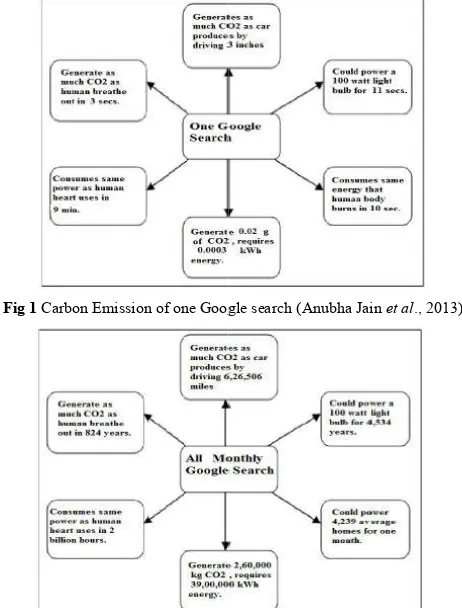
Google is one of the most used search engines around the world. It has become a part of human life. People from all age groups use it to get answers to various questions. Little attention is paid to the energy consumed and the carbon emitted for every Google search. The below Fig.1 shows the amount of electricity consumed and carbon emitted by one Google Search. The Fig. 2 shows the same for one month. (Anubha Jain et al.,2013).
Fig 1 Carbon Emission of one Google search
Fig 2 Carbon Emission of monthly Google Search (Anubha Jain
Green computing refers to environmentally sustainable computing. Green computing attempts to reduce the cost power consumption of IT system and maximize energy efficiency during the system's lifetime
The main purpose of green computing is to investigate new computer systems, computing model and applications with the low-cost and low-power-consumption and promote the sustainable development of economy and society (Mudasir, 2017).
Related Work
Sanjeev Thakur et al.[2], in their paper predict that by 2020 the carbon emissions will increase by 20%. The majority of the contributors to this are data centers. This paper discusses the possible solutions that can be adapted to reduce the carbon footprint on the environment and hence reduce the pollution. In this paper, the authors discuss about Green Broker. The Green Broker is a middleware
of the cloud service providers using the various Green Metrics. It chooses the best service provider when the requests are made.
Huigui Rong et al.[4], in their paper address the problems of growing data. The data has been
Cloud Computing
of power consumption and energy efficiency and to minimize the cost and carbon emission.
Google is one of the most used search engines around the world. It has become a part of human life. People from all age groups use it to get answers to various questions. Little tion is paid to the energy consumed and the carbon emitted for every Google search. The below Fig.1 shows the amount of electricity consumed and carbon emitted by one Google Search. The Fig. 2 shows the same for one month.
Carbon Emission of one Google search (Anubha Jain et al., 2013)
Carbon Emission of monthly Google Search (Anubha Jain et al.,2013)
Green computing refers to environmentally sustainable computing. Green computing attempts to reduce the cost and power consumption of IT system and maximize energy efficiency during the system's lifetime (Qilin Li et al., 2011). The main purpose of green computing is to investigate new computer systems, computing model and applications with the consumption and promote the sustainable development of economy and society (Mudasir,
.[2], in their paper predict that by 2020 the carbon emissions will increase by 20%. The majority of the his are data centers. This paper discusses the possible solutions that can be adapted to reduce the carbon footprint on the environment and hence reduce the pollution. In this paper, the authors discuss about Green Broker. The Green Broker is a middleware which calculates the efficiency of the cloud service providers using the various Green Metrics. It chooses the best service provider when the requests are
This leads to the requirement of more number of data centers. The authors analyze the energy consumption of various devices in a data center. Around 40 percent to 50 percent of the energy is consumed by the cooling devices. Only 40 percent of the energy is used for data processing work. The authors propose various energy saving techniques to maximize the data center efficiency and minimize the environmental impact.
Rubyga. G et al.[5], in their work disclose that the data is increasing at a rapid pace. Due to the increase in data, the number of data centers has also increased. This has increased the electricity consumption and the carbon footprint. In this paper, the authors discuss the various metrics and the strategies used to make cloud computing eco-friendly. In this paper, the authors also talk about the various algorithms that can be used to make efficient use of the resources.
Anubha Jain et al.[8], has stated that many companies are now moving toward the cloud. This has increased the number of data centers required to process the requests. More data centers require more power and more power generates more heat. To cool these systems there is a requirement of more cooling systems which in turn consume a lot of electricity. This paper suggests various methods to make efficient use of power in the data centers. It also throws light on the various metrics available to measure the performance of cloud computing. Energy efficient processors and energy efficient storage can reduce the energy consumption. By using dynamic voltage scaling and dynamic frequency scaling the power consumption can be optimized. In this, the voltage is decreased or increased based on the requirement of the program or device. In energy efficient storage, solid-state storage is used replacing the hard disks. Hard disks have moving components whereas solid-state storage has no moving components hence the power consumed is less.
Bharti Wadhwa et al.[11], have said that Cloud computing is growing popular due to its ease of ease. It also cuts the operational costs to a great extent. On the other hand cloud computing is not environment-friendly. This paper presents the work of many authors who have proposed methods to reduce the carbon footprint. This paper also throws light on virtualization which helps in energy efficiency. It states that using virtualization the resources can be used more efficiently.
Shahinaz R. Hussein et al[12]., in their work have stated that due to the major drift of companies toward cloud computing, there is an increase in the number of data centers. This increase has caused a slight environment imbalance. This has led to more electricity consumption and it has also increased the carbon footprint. The energy consumption of a data center is not affected only by the hardware components but it is also dependent on the resource utilization. In this paper, the authors propose a fuzzy based logic that improves the power consumption by 40%. The fuzzy logic is used for VM allocation and selection.
Yashwant Singh Patel et al.[13], in their paper address the problems like shortage of energy due to the increase in the number of data centers. This paper gives a brief introduction to Green IT. It also states out the reasons why we need Green IT. This paper also sheds light on the areas in which Green IT can be applied. In this paper, the authors have done a yearly study on the areas of application of Green IT.
Chonglin Gu et al.[14], propose a framework for green cloud. The main objective is to reduce energy consumption and reduce operational costs. This paper addresses three questions. How many servers a data center should have, how many solar panels and wind turbines a data center should have and what capacity the energy storage device should be. The authors also tell that the location and the availability of renewable energy sources play a major role in green cloud computing. Deploying larger energy storage devices will reduce the operational costs and the energy consumption to a large extent.
Yuvapriya Ponnusamy et al.[15], in their work have stated that the main motive of Green Cloud Computing is to reduce the energy consumption and the operational costs. The authors propose a green cloud framework in the existing cloud architecture. Resource provisioning and allocation algorithm are the techniques that have been included in the framework.
Weisong Shi et al.[16], in this paper the authors give an introduction to edge computing. They also state the benefits of edge computing. They state that edge computing offers better data security, privacy and it also saves bandwidth cost and increases the battery life of the devices. They also perform case studies for cloud offloading and mention the various opportunities in edge computing.
Lijun Xu1 et al.[17], in this paper the authors address the issue of energy consumption in the datacenters. The authors propose a virtual datacenter management framework that makes the minimum use of energy. By making use of this framework the carbon emission has been reduced and the energy consumption is minimized.
B.Gayathri[18], discusses the various drawbacks of cloud computing, with energy consumption being a major drawback. The author proposes an algorithm which is used to switch off the servers when they are not in use.
EXISTING METHODOLOGY
As discussed earlier the data centers consume a lot of electricity. The main source of this electricity is coal and fossil fuels. This leads to the emission of carbon. Already the world is facing environmental threats from various sources, now the increasing demand for data centers is adding to the problems. Little attention is paid to the environmental factors.Another issue is heat generation. The systems generate a lot of heat. This heat is just let off into the environment. It adds to global warming. Excessive heating may wear out the devices. So, there is a requirement for a large number of cooling systems. These cooling systems consume about 50 percent of the electricity supplied. This eventually leads to an increase in the carbon footprint.
Cloud computing processes the requests of the users through virtualization. It is a process in which the resources can be used by multiple users at the same time. This is achieved by using the virtualization software. Virtual machines require more number of resources to process the requests of the user. The start time and stop time of virtual machines are considerably large. This eventually leads to more power consumption.
Proposed Methods
Green Cloud Computing: Strategies To Reduce The Environmental Impact
Containerization
Cloud computing provides its services through virtualization. Virtualization makes use of more resources to provide services to the end user. The solution to this is containers.
are a new trend in cloud computing. Many companies like Google, Microsoft and Facebook have already adopted containers. Containerization is an OS level virtualization in which applications can berun without launching the entire virtual machine (Wong W, 2016).Containers provide an easy to deploy model when compared with virtualization. In virtual machines, an entire Operating System has to be installed. Containers, on the other hand, require very few resources. They do not require the entire OS, instead, they need only the necessary libraries and software. In containerization the containers share the same OS, hence they can be more efficient than virtual machines. Containers use less memory. Containers can be created faster (Tozzi, 2016). The reso
one virtual machine is equivalent to the resources required by 3 containers. Another advantage of containers is portability. They can be shared among the similar OS types and executed without making any changes in the code. Moving to cont has many benefits. It improves the memory efficiency and storage efficiency. When compared with virtual machines, containers have better performance characteristics.
Working
Virtual Machines: The main components of a virtual machine are infrastructure, host operating system, hypervisors, guest operating system, libraries and the applications. The infrastructure could be a server in a data center. On top of the infrastructure, the host operating system is present. Then we have the hypervisors. Hypervisors are responsible to implement the virtual machines. Above the hypervisors the guest operating system is present. The guest operating system is controlled by the hypervisor. If we have to implement 5 applications then we have to run 5 guest operating
This consumes a lot of memory. Each guest operating system requires its own set of libraries and binaries. These are the packages that have to be present with respect to the language being used. The final layer on top of all of these is the application. Each application runs in a separate guest operating system(Preethi, 2016).
Containers: The main components of a container are infrastructure, host operating system, docker daemon, libraries and the applications. Similar to the virtual machines the infrastructure is a server in a data center. On top of the infrastructure, the host operating system is present. Then we have the docker daemon. These are used to manage the containers. Next, we have the binaries and libraries. Unlike virtual machines where each guest operating system requires a separate set of binaries and libraries, here the binaries and libraries are built into a special package called images. The final layer is the application. Each application is managed by the docker daemon and each application will reside in its own docker image. The libraries, binaries and the applications are packed and stored in the docker image(Preethi, 2016).
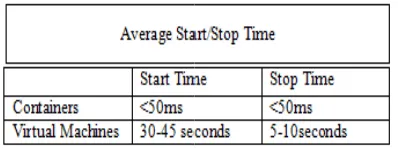
On comparing the starting time of containers and virtual machines, the following results were found.
less power and fewer resources are utilized.
Green Cloud Computing: Strategies To Reduce The Environmental Impact of Cloud Computing
Cloud computing provides its services through virtualization. Virtualization makes use of more resources to provide services to the end user. The solution to this is containers. Containers are a new trend in cloud computing. Many companies like Google, Microsoft and Facebook have already adopted containers. Containerization is an OS level virtualization in which applications can berun without launching the entire Wong W, 2016).Containers provide an easy to deploy model when compared with virtualization. In virtual machines, an entire Operating System has to be installed. Containers, on the other hand, require very few resources.
instead, they need only the necessary libraries and software. In containerization the containers share the same OS, hence they can be more efficient than virtual machines. Containers use less memory. Containers (Tozzi, 2016). The resources required by one virtual machine is equivalent to the resources required by 3 containers. Another advantage of containers is portability. They can be shared among the similar OS types and executed without making any changes in the code. Moving to containers has many benefits. It improves the memory efficiency and storage efficiency. When compared with virtual machines, containers have better performance characteristics.
Virtual Machines: The main components of a virtual machine ture, host operating system, hypervisors, guest operating system, libraries and the applications. The infrastructure could be a server in a data center. On top of the infrastructure, the host operating system is present. Then we visors are responsible to implement the virtual machines. Above the hypervisors the guest operating system is present. The guest operating system is controlled by the hypervisor. If we have to implement 5 applications then we have to run 5 guest operating systems. This consumes a lot of memory. Each guest operating system requires its own set of libraries and binaries. These are the packages that have to be present with respect to the language being used. The final layer on top of all of these is the ation. Each application runs in a separate guest operating
The main components of a container are infrastructure, host operating system, docker daemon, libraries and the applications. Similar to the virtual machines the infrastructure is a server in a data center. On top of the infrastructure, the host operating system is present. Then we have the docker daemon. These are used to manage the containers. Next, we have the binaries and libraries. Unlike e each guest operating system requires a separate set of binaries and libraries, here the binaries and libraries are built into a special package called images. The final layer is the application. Each application is managed by pplication will reside in its own docker image. The libraries, binaries and the applications are packed and stored in the docker image(Preethi, 2016).
On comparing the starting time of containers and virtual machines, the following results were found. Less time means
Fig 3 Start/Stop time of containers and virtual machines
Documentation,2017)
Renewable Energy
The type of fuel used to generate electricity for data centers is responsible for the carbon footprint.Majority of the data centers around the world are powered by coal, natural gas and nuclear energy. These data centers must be powered on throughout the year. These are responsible for the carbon emissions. The amount of carbon generated is equal to the product of electricity consumed and the energy source emission factor. By using nuclear energy the carbon footprint can be reduced. But nuclear energy is ve
The only solution to this problem can be shifting to renewable sources of energy. Major companies like Apple, Google and Facebook have already started using renewable energy to power their data centers. According to the report given by Greenpeace 2017, Apple is using 100% renewable energy. This has increased their profit margin significantly. Wind energy and solar energy are the most important sources of energy. These sources are dependent on the location because they depend on the wind speed and the intensity of sunlight.
Location
The location of the data center plays a very important role in energy consumption.The temperature of the location plays a vital role. If the data center is located in a very hot place then more amount of electricity is required to cool the data center. If the data center is located near a hydroelectricity plant then more renewable energy can be used as a source of power. Building a data center in a cold region requires no cooling. The heat generated by these systems can be used to heat the rooms in the office. Similarly, building data centers in places that have high wind speed can be beneficial.Wind energy is cheap and it can be used as a source of energy.
Edge Computing
Edge computing is a type of computing in processed at the edge of the network
resource between a cloud data source and the data center.Since the data stored in the cloud is increasing, the speed of data transportation is decreasing. In edge computing, t
processed at the edge of the network and the results are provided to the user. Now the world is moving towards IoT. Hence more data will be produced and it will add on the network pressure. Thus the processing times increase.
In edge computing the data is more secure as the movement of the data between the device and the data center is less.In edge computing, the data is processed at the edge, so this provides faster response time. In edge computing, the resources are shared in a horizontal fashion. This requires fewer resources hence less energy is consumed.
energy is used for the transmission of the data from the server to the client. In edge computing, the transmission energy is saved as the data is processed loca
Cloud Computing
Start/Stop time of containers and virtual machines (Docker Documentation,2017)
The type of fuel used to generate electricity for data centers is responsible for the carbon footprint.Majority of the data centers around the world are powered by coal, natural gas and nuclear energy. These data centers must be powered on ear. These are responsible for the carbon emissions. The amount of carbon generated is equal to the product of electricity consumed and the energy source emission factor. By using nuclear energy the carbon footprint can be reduced. But nuclear energy is very expensive.
The only solution to this problem can be shifting to renewable sources of energy. Major companies like Apple, Google and Facebook have already started using renewable energy to power their data centers. According to the report given by npeace 2017, Apple is using 100% renewable energy. This has increased their profit margin significantly. Wind energy and solar energy are the most important sources of energy. These sources are dependent on the location because
d and the intensity of sunlight.
The location of the data center plays a very important role in energy consumption.The temperature of the location plays a vital role. If the data center is located in a very hot place then ity is required to cool the data center. If the data center is located near a hydroelectricity plant then more renewable energy can be used as a source of power. Building a data center in a cold region requires no cooling. The ms can be used to heat the rooms in the office. Similarly, building data centers in places that have high wind speed can be beneficial.Wind energy is cheap and it can be used as a source of energy.
Edge computing is a type of computing in which the data is processed at the edge of the network [16]. Edge is a computing resource between a cloud data source and the data center.Since the data stored in the cloud is increasing, the speed of data transportation is decreasing. In edge computing, the data is processed at the edge of the network and the results are provided to the user. Now the world is moving towards IoT. Hence more data will be produced and it will add on the network pressure. Thus the processing times increase.
Cloudlet
Another concept closely related to edge computing is cloudlet. A cloudlet is a scaled-down data center that is present at the edge of the network. These are used in augmented reality games because cloudlets have a faster response time and better resource provisioning. By making use of cloudlets the energy consumption can be reduced by 30 percent to 40 percent (Zhengyuan, 2015).
Thermoelectric Generator
Data centers generate a lot of heat. Many companies use this heat in a useful way. Certain companies use this heat to warm their rooms whereas others use this to heat the swimming pools. This heat can be put to use in a better way. Thermoelectric generators convert heat into electricity directly. This way the heat generated in a data center can be used to power the devices.
Proposed Framework
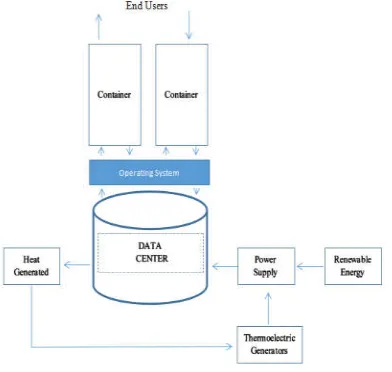
From the above discussions, we find that reducing carbon emission and electricity consumption are the main motives of green cloud. Utilizing resources effectively and efficiently is another important aspect. The data centers must be powered on all the time. This requires a continuous supply of electricity. As discussed earlier, the cooling systems consume 50 percent of the electricity supply. In this paper, we propose a framework to make use of renewable energy. In this framework, containers are used instead of virtual machines to make more efficient use of the resources.
Fig 4 Proposed Green Cloud Framework
The proposed framework mainly focuses on energy consumption and the better usage of resources. The source of energy supply in the proposed model is renewable energy. They can be solar or wind energy. These are clean sources which do not emit carbon. Thus the carbon emitted by data centers can be reduced by using renewable sources
Data centers generate a lot of heat. This heat can be converted to electricity by using thermoelectric generators.
In this framework, we have implemented containers instead of virtual machines. Containers have a quicker start/stop time when compared to virtual machines. This saves energy. Moreover, containers make better use of resources. Containers are better in resource and memory sharing.
Another concept closely related to edge computing is cloudlet. down data center that is present at the edge of the network. These are used in augmented reality onse time and better resource provisioning. By making use of cloudlets the energy consumption can be reduced by 30 percent to 40 percent
Data centers generate a lot of heat. Many companies use this useful way. Certain companies use this heat to warm their rooms whereas others use this to heat the swimming pools. This heat can be put to use in a better way. Thermoelectric generators convert heat into electricity directly. n a data center can be used to
From the above discussions, we find that reducing carbon emission and electricity consumption are the main motives of green cloud. Utilizing resources effectively and efficiently is ther important aspect. The data centers must be powered on all the time. This requires a continuous supply of electricity. As discussed earlier, the cooling systems consume 50 percent In this paper, we propose a use of renewable energy. In this framework, containers are used instead of virtual machines to
Proposed Green Cloud Framework
The proposed framework mainly focuses on energy usage of resources. The source of energy supply in the proposed model is renewable energy. They can be solar or wind energy. These are clean sources which do not emit carbon. Thus the carbon emitted by data centers can be reduced by using renewable sources of energy. Data centers generate a lot of heat. This heat can be converted to electricity by using thermoelectric generators.
In this framework, we have implemented containers instead of virtual machines. Containers have a quicker start/stop time mpared to virtual machines. This saves energy. Moreover, containers make better use of resources. Containers
CONCLUSION
The data generated is increasing at a rapid pace. This requires more number of data centers to handle the requests. Data centers are responsible for carbon emission and heat generation. In this paper, various methods are proposed to improve the energy efficiency of data centers and reduce the carbon emission. Techniques like virtualization and
are discussed. A framework that makes use of cloud containers and renewable energy is proposed. The world is already facing the problems of global warming due to pollution from various resources. The main of this paper is to reduce the negative impact of cloud computing on our environment.
References
1. Shaik Khaja Mohiddin1 and Dr.Suresh Babu Yalavarthi,"Research Challenges in the Emerging trends of Cloud Computing",
Advances in Computer Science and Technology
No.1, pp. 01-07, 2015
2. Sanjeev Thakur and Ankur Chaurasia, "Towards green cloud computing: Impact of Carbon Footprint on Environment", Cloud System and Big Data Engineering 6th International Conference. IEEE, pp. 209
3. Pierre Delforge (2014, August 26) America's Data Centers Consuming
Growing Amounts of Energy.[online] Available:https://www.nrdc.org/experts/pierre
delforge/new-study-americas and-wasting-growing-amounts 4. Huigui Rong, Haomin Zhang, S
Chunhua Hu, "Optimizing energy consumption for data centers ", Renewable and Sustainable Energy Reviews 58, pp. 674-691,2016
5. G. Rubyga,Ponsy R. K. Sathia Bhama,"A Survey of Computing Strategies for Green Cloud", Second International Conference on Science Technology Engineering and Management.
6. Clark, D. (2017, September 8). Google discloses carbon footprint for the first time. [online] the Guardian. Available:https://www.theguardian.com/environment/2 011/sep/08/google-carbon
7. Pingdom Royal. (2017). Almost 8 new Internet users added worldwide every second (infographic)
Royal. [online] Available:
http://royal.pingdom.com/2012/02/16/almost internet-users-added-worldwide
infographic/
8. Anubha Jain, Manoj Mishra, Sateesh Kumar Peddoju and Nitin Jain," Energy efficient computing
cloud computing", International Conference on Energy Efficient Technologies for Sustainability
Nagercoil, pp. 978-982,2013 9. Qilin Li and Mingtian Zhou,
Evolution of Green Computing", IEEE/ACM International Conference on Green Computing and Communications, pp. 230
10. Mudasir M Kirmani,"Integrated approach for efficient mobile application development using Cloud Computing and Green SDLC: A Study",
Journal of Advanced Research in Computer Science
Volume 8, No. 5,2017
The data generated is increasing at a rapid pace. This requires s to handle the requests. Data centers are responsible for carbon emission and heat generation. In this paper, various methods are proposed to improve the energy efficiency of data centers and reduce the carbon emission. Techniques like virtualization and containers are discussed. A framework that makes use of cloud containers and renewable energy is proposed. The world is already facing the problems of global warming due to pollution from various resources. The main of this paper is to reduce the negative impact of cloud computing on our environment.
Shaik Khaja Mohiddin1 and Dr.Suresh Babu Yalavarthi,"Research Challenges in the Emerging trends of Cloud Computing", International Journal of Advances in Computer Science and Technology, Vol.4,
Sanjeev Thakur and Ankur Chaurasia, "Towards green cloud computing: Impact of Carbon Footprint on Environment", Cloud System and Big Data Engineering 6th International Conference. IEEE, pp. 209-213,2016 Pierre Delforge (2014, August 26).New Study: America's Data Centers Consuming -and Wasting -- Growing Amounts of Energy.[online]
Available:https://www.nrdc.org/experts/pierre- americas-data-centers-consuming-amounts-energy
Huigui Rong, Haomin Zhang, Sheng Xiao, Canbing Li, "Optimizing energy consumption for data centers ", Renewable and Sustainable Energy Reviews
G. Rubyga,Ponsy R. K. Sathia Bhama,"A Survey of Computing Strategies for Green Cloud", Second Conference on Science Technology Engineering and Management. IEEE,2016
Clark, D. (2017, September 8). Google discloses carbon footprint for the first time. [online] the Guardian. Available:https://www.theguardian.com/environment/2
carbon-footprint
Pingdom Royal. (2017). Almost 8 new Internet users added worldwide every second (infographic) - Pingdom
Royal. [online] Available:
http://royal.pingdom.com/2012/02/16/almost-8-new-
worldwide-every-second-in, Manoj Mishra, Sateesh Kumar Peddoju and Nitin Jain," Energy efficient computing- Green
International Conference on Energy Efficient Technologies for Sustainability (ICEETS) ,
982,2013
Qilin Li and Mingtian Zhou, "The Survey and Future Evolution of Green Computing", IEEE/ACM International Conference on Green Computing and Communications, pp. 230-233,2011
Green Cloud Computing: Strategies To Reduce The Environmental Impact of Cloud Computing
11. Bharti Wadhwa and Amandeep Verma,"Energy saving approaches for Green Cloud Computing: A review", Proc. of Recent Advances in Engineering and Computational Sciences, pp. 1-6, March 2014
12. Shahinaz R. Hussein, Yousra Alkabani and Hoda K. Mohamed,"Green cloud computing: Datacenters power management policies and algorithms", Computer Engineering & Systems (ICCES) 9th International Conference, pp. 421-426,2014
13. Yashwant Singh Patel, Neetesh Mehrotra and Swapnil Soner,"Green cloud computing: A review on Green IT areas for cloud computing environment", International Conference on Futuristic Trends on Computational Analysis and Knowledge Management,2015
14. Chonglin Gu, Zhenlong Li, Chunyan Liu and Hejiao Huang, "Planning for green cloud data centers using sustainable energy", IEEE Symposium on Computers and Communication, 2016
15. Yuvapriya Ponnusam and S Sasikumar,"Application of Green Cloud Computing for Efficient Resource Energy Management in Data Centres", International Journal of Computer Science and Information Technologies, Vol. 3, 2012
16. Weisong Shi, Jie Cao, Quan Zhang, Youhuizi Li and Lanyu Xu,"Edge Computing: Vision and Challenges", IEEE Internet of Things, Vol. 3 no. 5 pp. 637-646, 2016.
17. Lijun Xu, Chunlin Li, Layuan Li, Yanpei Liu, Zhiyong Yang and Yunchang Liu,"A virtual data center deployment model based on the green cloud computing", IEEE/ACIS 13th International Conference on Computer and Information Science,2014
18. B. Gayathri,"Green Cloud Computing", IET Chennai 3rd International Conference on Sustainable Energy and Intelligent Systems (SEISCON), p. 114 - 118,2012 19. Wong, W. (2016, July 16). What's the Difference
Between Containers and Virtual Machines? [online] Available:http://www.electronicdesign.com/dev- tools/what-s-difference-between-containers-and-virtual-machines
20. Tozzi, C. (2016, November 30). Docker vs. Virtual Machines: Understanding the Performance Differences. [online] Available: http://mspmentor.net/technologies/
docker-vs-virtual-machines-understanding-performance-differences.
21. Preethi Kasireddy(2016,March 4).A Beginner-Friendly Introduction to Containers, VMs and Docker.[online] Available:https://medium.freecodecamp.org/a-beginner- friendly-introduction-to-containers-vms-and-docker-79a9e3e119b
22. Docker Documentation. (2017). Runtime metrics. [online] Available: https://docs.docker.com/engine/ admin/runmetrics/
23. Pavel Mach and Zdenek Becvar,"Mobile Edge Computing: A Survey on Architecture and Computation Offloading", IEEE Communications Surveys Tutorials, no. 99 pp. 1-1 2017.
24. Zhengyuan Pang et al.,”A Survey of Cloudlet based Mobile Computing”, International Conference on Cloud Computing and Big Data,2015
How to cite this article:
Arvind Kumar Solomon and Monisha Singh (2017) 'Green Cloud Computing: Strategies To Reduce The Environmental Impact of Cloud Computing ', International Journal of Current Advanced Research, 06(11), pp. 7253-7258.
DOI: http://dx.doi.org/10.24327/ijcar.2017.7258.1110