On the Mark and Markaracter Tables of Finite Groups
MODJTABA GHORBANI
Department of Mathematics, Faculty of Science, Shahid RajaeeTeacher Training University, Tehran, 16785136, I. R. Iran
Correspondence should be addressed to M. GHORBANI (Email: [email protected]) Received 22 April 2016; Accepted 26 May 2016
ACADEMIC EDITOR:ALI REZA ASHRAFI
ABSTRACT. Let G be a finite group and C(G) be the family of representative conjugacy classes of subgroups of G . The matrix whose H,K-entry is the number offixed points of the set
G/K under the action of H is called the table of marks of G where H,K run through all elements in C(G). Shinsaku Fujita for the first time introduced the term “markaracter” to discuss marks for permutation representations and characters for linear representations in a common basis. In this paper, we compute these tables for some classes of finite groups.
KEYWORDS group action • automorphism group • mark table • markaracter table
1.
I
NTRODUCTIONA graph is a collection of points and lines connecting them. Let us to call these points and lines by vertices and edges, respectively. Two vertices x and y are adjacent, if e = uv be an edge of graph. A graph whose all pairs of vertices are connected by a path is called a connected graph. A simple graph is a graph without loop and parallel edges. The vertex and edge-sets of graph G are represented by V(G) and E(G), respectively.
1 2
3 4 5 6
Figure 1. The molecular graph of benzene.
The symmetry of a molecule has a significant role in the analysis of the molecular structures and spectroscopy of molecules. This means that most often chemists like to classify the molecules according to their symmetry. The elements of symmetry are points, lines, planes and the collection of symmetry elements always form a group called point group. A geometrical figure is said to be symmetrical if there exists permutations which permute its parts while leaving the object as a whole unchanged. An isometry of this kind is called a symmetry.
Groups are often used to describe symmetries of objects. One goal of Group Theory is how the symmetry of a molecule is related to its physical properties and provides a method to determine the relevant physical information of the molecule. In other words, the symmetry of a molecule provides many important physical aspects and this is what makes group theory so powerful.
In general, a group <G, *> is a set of elements with a binary operation "*" which satisfy in three following properties:
1. Associative law, that is for every three elements a,b,cG, we have
a*(b*c) = (a*b)*c.
2. There is an identity element, e, so that a*e = e*a= a for any a
belonging to the group.
3. Every element has its inverse as the member of the group i.e., if aG, then a-1G.
If a*b = e it means that a is the inverse of b and vise versa. For the sake of simplicity, we usually omit the operation "*" and we use ab instead of a*b. The order of a group is defined as the number of members of elements present in the group. The symmetries of a given object form a group called the symmetry group of the object. Obviously, every symmetry group is a subgroup of the group of all isometries.
The group G is cyclic if it can be generated by a single element. In this case we say that G has one generator. In other words, if G be a cyclic group, then there is an element g
with x being all members of the group. Hence, for every element xG, the conjugacy class
xG is as follows:
xG = {gxg-1: gG}.
Example 1. Consider the molecular graph of benzene in Figure 1. Here, we compute its symmetry group. This molecule has the structure of a hexagon with a carbon atom at each corner. Evidently, the simplest symmetry of this molecule is a clock-wise rotation ρ
through the angle π/3= 60o. A six-fold repetition of this rotation brings each vertex back to its original position so ρ satisfies the operator equation ρ6 = e. This relation implies that the set {ρ, …, ρ6= e } compose a group called the rotational symmetry group of a hexagon, or a cyclic group of order 6 and commonly denoted by Z6. The order of a finite group is the number of elements it contains. The element ρ is said to be a generator of Z6, because the entire group can be generated from ρ by the group operation. The group Z6 is completely determined by the condition ρ6 = e and any such condition on the generators of a group is called a relation of the group. A set of relations which completely determine a group is called a presentation of the group. For Z6 the presentation consists of the single relation ρ6 =
e. The symmetry group of benzene has also another generator δ that is a rotation by π
radians about an axis passing through the center of a regular hexagon and vertices 1, 4. Hence, one can easily see that all elements of symmetry group of benzene are as follows:
{ρ, ρ2,ρ3,ρ4, ρ5, ρ6=1, δρ,δρ2,δρ3,δρ4, δρ5, δ}.
Let X = {1,2,…,n}, a permutation group on X is a group G whose elements are permutations of X, e.g. bijective functions from X to X and whose group operation is the composition of permutations in G. The group of all permutations of X is the symmetric group of X denoted by SX or Sn, where X is finite. By this notation, a finite permutation
group is a subgroup of the symmetric group Sn.
Consider the molecular graph H2O of water molecule as depicted in Figure 2, the function
) 2 , 1 ( 3 1 2
3 2 1
= f
is a symmetry element of this graph.
1 2
3
Let G be a group and X a non-empty set. An action of G on X is denoted by (G|X) and X is called a G-set. It induces a group homomorphism from G into the symmetric group SX on X, where (g)x = gx for all xX. The orbit of x will be denoted by Gx and defines as the set of all (g)x, gG. The set of all G-orbits will be denoted by
G\\X={Gx|xX}. In the current study, we compute some properties of mark and markaracter tables. In the second and the third sections of the article, we present some elementary properties of these tables and we compute the markaracter tables of product groups in terms of Kronecker product. In the fourth section, we propose a formula for computing the full automorphism group of a graph via the mark table of its symmetry group. In section four, we also compute the symmetry group of some well-known molecular graphs.
2.
M
AINR
ESULTS ANDD
ISCUSSIONThe concept of the table of marks of a finite group was introduced by one of the pioneers of finite groups, William Burnside in the second edition of his classical book [1]. This table describes a characterization of the permutation representations of a group G by certain numbers of fixed points and in some detail the partially ordered set of all conjugacy classes of subgroups of G. Hence it provides a very compact description of the subgroup lattice of
G, see [2] for details. Suppose the set of fixed points of the subgroup U in the action of G
on X is
X
Fix U xX : x.u x; u U . Then the ijth entry of mark table of G is as follows:
| / ( ) |ij G Gj i
M G Fix G .
Let also U and V be subgroups of G and vG
V U,
| {U g :gG U, g V } |, thus we have:Lemma 1. [2] |FixG/V(U)| = [G:V]vG(V,U)/vG(G,U).
Theorem 2. Let G be a finite group and G1, G2, … ,Gs be all non-conjugated subgroups of
G in which |G1| ≤ |G2| ≤ … ≤ |Gs|. Then the matrix M(G) is a lower triangular matrix and for
all 1 ≤ i,j ≤ s, Mij|M1j.
Proof. By using definition of the markaracter table the first claim can be proved and for the second claim, use Lemma 1.
In particular, if Gj be a normal subgroup of G (1 ≤ j ≤ s),then
| | / | |
. 0
j i j
ij
G G G G
M otherwise
Proof. By using definition of the mark table, we have:
1 1 1 |{ : , . } | |{ : , } | |{ : , } | |{ : } | .
ii i i i i
i i i i
i i i
i i i
M gG x G x gG gG
gG x G g xgG G
gG x G x gG g
gG G gG g
On the other hand, similar to the proof of Lemma 1, one can see that
1
:
ij j i j
M gG G g G g .
Since Gj is normal then, g-1Gjg = Gj. This completes the proof.
Let the finite group G act on a finite set X = {x1, x2, …,xk}. The permutation
representation ( )G is a set of permutations ηg on X, each of which is associated with an
element gG so that ( )G and G are homomorphic and ηgηg' = ηgg' for any g,g'G. Let H
be a subgroup of G. It is a well-known fact that the set of cosets of H in G provides a partition of G as G Hg1Hg2 Hgm, where g1 = I, the identity element of G and
giG. The set of {g1, g2, …,gm } is called a transversal. Consider the set of cosets
{Hg1,Hg2,…,Hgm}. Following Shinsaku Fujita [3], for any gG, the set of permutations,
1 2 g 1 2 ... = ... m m
Hg Hg Hg
Hg g Hg g Hg g
,
constructs a permutation representation of G, which is called a coset representation of G by
H and notified as (G H/ ). The degree of (G H/ ) is m = [G:H], where |G| is the number of elements in G. Obviously, the coset representation (G H/ )I s transitive, i.e. has one orbit.
The Burnside’s theorem states that any permutation representation ( )G of a finite group G acting on X can be reduced into transitive CRs in accord with equation
1
( ) s ( / ),
i i i
G α G G
wherein the multiplicity i is a non- negative integer obtained by
solving equations
Here j is the number of fixed points of Gj in ( )G named mark of Gj, and the
symbol Mij denotes the mark of Gj in (G G/ i). Following Burnside, the matrix M(G) =
[Mij] is called the table of mark or mark table of G. The matrix MC(G) obtained from M(G) in which we select rows and columns corresponding to the cyclic subgroups of G is called the markaracter table of G. Shinsaku Fujita in some of his leading papers [4-14], introduced the term markaracter to discuss marks for permutation representations and characters for linear representations in a common basis.
Throughout this paper our notation is standard and taken mainly from [15, 16]. We encourage the reader to consult papers by Balasubramanian [16,17], Kerber [18] and Pfeiffer [2] and references therein for background material as well as basic computational techniques, see also [1921].
3.
C
OMPUTING MARKARACTER TABLE OF SOME GROUPSIn this section we obtain some results about markaracter tables. Let p be a prime number and q be a positive integer such that q|p-1 . Define the group Fp,q to be presented by
Fp,q= <a,b, ap=bq=1 , b-1ab=au>
where u is an element of order q in multiplicative group Z*p. It is easy to see that Fp,q is a
non-abelian group of order pq .
Theorem 4. (Lagrange's Theorem) For any finite group G, the order of every subgroup H
of G divides the order of G.
Let G be a group with mark table M(G) with non-conjugate subgroups G1, G2, …,
Gn. Since M(G) is a lower triangular matrix, it is non-singular and so det(M(G)) ≠ 0. On the
other hand, according to Lemma 3, one can see that
n
i
i i G n
i
ii N G G
M G
M
1 1
]. : ) ( [ ))
( det(
If det(M(G)) = p, then one can prove that G is isomorphic with cyclic group Zp. Let G be a group of order n, if G has only one subgroup H (up to isomorphism), then regarding [G:H] = n/m, H is normal subgroup of G of order m. Hence, M22 = n/m and so det(M(G)) =
n2/m. If m is not prime, then according to Lagrange’s Theorem, H and so G has a subgroup of order a prime p that divides |H|, a contradiction. Hence, both m and n/m are primes and so |G| = pq, where p,q are prime numbers. Again by Lagrange’s Theorem, we can prove easily that p=q and so |G| = p2. Because H is normal subgroup of order p, G is isomorphic with cyclic group Zp2 and so det(M(G)) = p
3. Thus, we proved the following theorem.
ii) There is no group with det(M(G)) = pq. iii) det(M(G)) = p3 if and only if G Zp2.
iv) There is no group with det(M(G)) = p4.
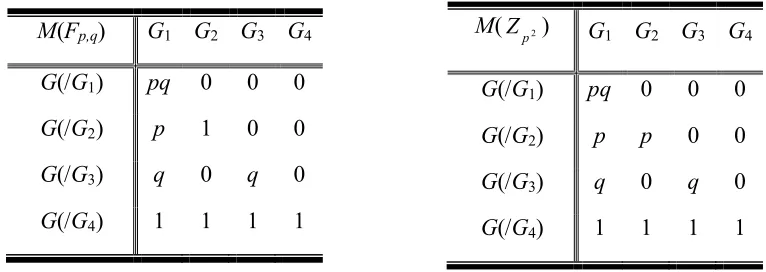
Theorem 6. The table of marks of group Fp,q is as reported in Table 1. Moreover, det(M(G)) = pq2 if and only if G Fp,q and det(M(G)) = p2q2if and only ifGZp2.
Proof. It is easy to see that all non-conjugate subgroups of G= Fp,q are G1 = (), G2 = Q, G3 = P and G4 = G, in which |Q| = q and |P| = p. By Sylow theorem one can see that PG. So, by using Lemma 3, we have M12 = p, M22 = 1 and M32 = M42 = 0. On the other hand,
Q G , because G is non-abelian, hence M23 = M43 = 0 and M13 = M33 = 0.
M(Fp,q) G1 G2 G3 G4
G(/G1) pq 0 0 0
G(/G2) p 1 0 0
G(/G3) q 0 q 0
G(/G4) 1 1 1 1
M(Zp2) G1 G2 G3 G4
G(/G1) pq 0 0 0
G(/G2) p p 0 0
G(/G3) q 0 q 0
G(/G4) 1 1 1 1
Table 1.(a) The table of marks of group Fp,q and (b) The table of marks of group Zp2.
Fujita in some of his papers computed the markaracter table of cyclic groups. Here, we demonstrate how to compute the markaracter table of some abelian groups.
Theorem 7. Let G and H be groups acting on sets X and Y, respectively. Then |FixXY(UV)| = |FixX(U)| |FixY(V)|,
where U ≤ G, V ≤ H and FixX(U) = {xX | xg = x; gU}.
Proof. We have:
|FixXY(U V)| = |{(x,y) | (x,y)(g,h) = (x,y); (g,h) UV}|
= |{(x,y) | (xg,yh) = (x,y); (g,h) UV}|
= |{(x,y) | xg = x&yh = y; gU&hV}|
= |{(x,y) | xFixX(U) &yFixY(V)}|
Corollary 8 [22]. Let G and H be groups of co-prime orders acting on sets X and Y, respectively. If MC(G) = [aij] and MC(H) = [bij], then MC(G H) = [crs], where
s j r j b s i r i a rs
c and Gir HjrG(/GisHjs) are the rth column and sth row of MC(G H),
respectively.
For any two arbitrary matrices A and B, we have the direct product or Kronecker product AB defined as
11 12 1
1 2
.
n
m m mn
a B a B a B
a B a B a B
Note that if A is m-by-n and B is p-by-r then AB is an mp-by-nr matrix. This multiplication is not usually commutative. It is an easy task to show that in Corollary 8,
M(GH) is the Kronecker product M(G) M(H). We now apply Lemma 3 to find another method for computing this table. To simplify our argument, in the following example, we only compute the mark table of a cyclic group of order pnqm.
Example 2. Let G be a cyclic group of order pnqm. It is a well-known fact that G is isomorphic to HK in which H and K are subgroups of G of order pn and qm, respectively. Suppose H1, H2, …,Hn+1 and K1, K2, …, Km+1 are all subgroups of H and K, respectively. One can see that MC(H) = [aij] and MC(K) = [bij], where
1
0
n j ij
p j i
a otherwise and 1 . 0 m j ij
q j i
b otherwise
Then MC(HK) = [crs], in which
1 1 , . 0 s
r m j
n j
r r s s
rs
p q j i j i
c otherwise
The dihedral group D2n is the symmetry group of an n-sided regular polygon for n> 1.
These groups are one of the most important classes of finite groups currently applicable in chemistry. For example D6, D8, D5 and D12 point groups are dihedral groups. One group presentation for D2n is <x, y | x2 = yn = 1, (xy)n = 1>.
Theorem 9 [22]. Suppose G = D2n is the dihedral group of order 2n. Then
1 = G1, <b> = G2, <ab> = G3, <an/2> = G4, 5 5, v
a G
6
6, v
a G
…, 1
2 t
v
t a a G
are all cyclic non-conjugate subgroups of Dn such that vi divides n and t is the number of
divisors of n. Moreover the markaracter table of G is as reported in Table 2.
Proof. Suppose MC(G) = [aij] is markaracter table of D2n. We first assume n is even. Then
the conjugacy classes of D2n are
{1}, {an/2}, {ar,a-r} (1 ≤ r ≤ n/2), {asb | 0 ≤ s ≤ n1 & 2 | s }, {asb | 0 ≤ s ≤ n1 & 2∤ s}. Hence up to conjugacy there are three subgroups of order 2, G2 = <b>, G3 = <ab>,
G4 = <an/2> and t = d(n) cyclic subgroups whose orders divide n, say G5, …, Gt+2 = <a>. By using Lemma 3, aij = |{Gig | Gjg-1Gig}| and so aii |NG(Gi)|/|Gi|. Clearly, NG(<b>) =
{1, b, n/2,
a a bn/ 2
}, NG(<an/2>) = G and NG(<ab>) = {1, ab, an/2, a1n/ 2b}. So a22 = a33 = 2 and a44 = n. Suppose j | n. By an elementary fact in finite groups o(aj) = n/j. Since every subgroup of <a> is normal in G, aij = 2n/(n/j) = 2j. If vj | vi then GjGi and so aij = 2j, as
desired. We now assume that n is odd. Then the conjugacy classes of D2n are {1}, {ar,a-r}
(1 ≤ r ≤ (n-1)/2), {asb | 0 ≤ s ≤ n-1} and up to conjugacy there is one only subgroup of order 2 and d(n) cyclic subgroups whose orders divide n. Now a similar argument as above, complete the proof.
M(D2n) G1 G2 G3 G4 Gi = < i v
a > (5 i t +2)
G/<> 2n 0 0 0 0
G/G2 N 2 0 0 0
G/G3 N 0 2 0 0
G/G4 N 0 0 n 0
G/Gi (5it+2) 2j 0 0
Table 2(a). The markaracter table of D2n, where n is even.
M(D2n) G1 G2 Gj = <xi> (3 jt+2)
G/<> 2n 0 0
G/G2 n 1 0
G/Gj(3j t+2) 2j 0
where
2 |
2
0
j n
j v
Otherwise
and 2 | .
0
j i
j v v
Otherwise
4.
A
PPLICATION INC
HEMISTRYA bijection σ on vertices set of graph Γ is named an automorphism of graph, if it preserves the edge set. In other words, σ is an automorphism if e = uv is an edge, then σ(e) = σ(u)σ(v) is an edge of E. Let Aut(Γ) = {α: V→V, α is bijection}, then Aut(Γ) under the composition of mappings forms a group.
The adjacency matrix A(Γ) of graph Γwith vertex set V (Γ)= {v1, v2, . . . , vn} is the n × n symmetric matrix [aij] such that aij= 1 if vi and vj are adjacent and 0, otherwise. The
Euclidean matrix of a chemical graph to find its symmetry. Here the Euclidean matrix of a molecular graph Г is a matrix D(Г) = [dij], where for ij, dij is the Euclidean distance
between the nuclei i and j. In this matrix dii can be taken as zero if all the nuclei are
equivalent. Otherwise, one may introduce different weights for different nuclei. Suppose
is a permutation on n atoms of the molecule under consideration. Then the permutation matrix P is defines as P = [xij], where xij = 1 if i = (j) and 0 otherwise. It is easy to see
that PP = P, for any two permutations and on n objects, and so the set of all nn
permutation matrices is a group isomorphic to the symmetric group Snon n symbols. For
computing the symmetry of a molecule, it is sufficient to solve the matrix equation PtEP =
E, where E is the Euclidean matrix of the molecule under consideration and P varies on the set of all permutation matrices with the same dimension as E.
By having the markaracter table of symmetry group of a graph, we can compute the full automorphism group of underlying graph by an algebraic way. Consider the following example. The full automorphism group of a graph is one of the most important problem in graph theory and this is the first attempt to solve this problem by using the mark table.
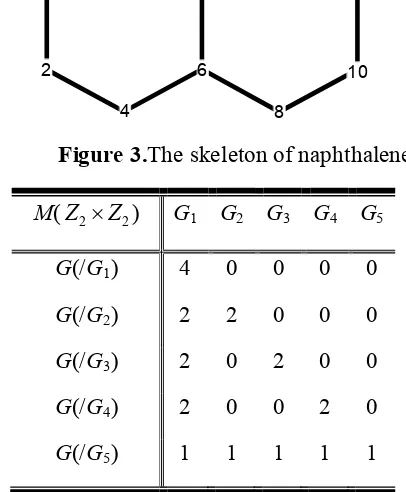
Example 3. Consider the skeleton of naphthalene, Figure 3. The generators of its symmetry group are and , where = (1, 9)(2, 10)(3, 7)(4, 8) and = (1, 2)(3, 4)(5, 6)(7, 8)(9, 10). The subgroups of G are G1 = <()>, G2 = <>, G3 = <>, G4 = <> and G5 = G. This group is isomorphic with Z2Z2, where Z2 is a group of order 2. Since every group of order 4 is
abelian and then Z2Z2, by using Corollary 4, for any subgroup Gi of Z2Z2, Mij = 0 or |
2 2
Z Z |/|Gi|. But for the pure subgroup H of Z2Z2, |H| = 2. This implies the entries of mark table are 1, 2 and 4. By Theorem 2, M11 = 4 and Mi1 = 0 for 2 ≤ i≤ 4. Also M4j = 1 for
M12 = M22 = 2 and M32 = M42 = 0. Using again Corollary 4, it is easy to see that M13 = M33 = 2 and M23 = M43 = 0. In Tables 1 and 2, the mark table and markaracter table of this group are computed. On the other hand, the number of (µj) of fixed points are obtained by a
geometrical examination of Eq.(1):
1 2 3 4 5
G G G G G
4 0 0 0 0 2 2 0 0 0
(10,2,0,0,0) = ( , , , , ) 2 0 2 0 0
2 0 0 2 0 1 1 1 1 1
.
So, by solving these equations we have
5 4 3 1
G G G 0, G 2,
2
G 1
and
1 2
2 (/ ) (/ )
G
P G G G G . This implies sub-orbits of X areX11={1, 2, 9, 10}, X21={5, 6},
X12={3, 4, 7, 8}.
1
2
3
4
5
6
7
8
9
10
Figure 3.The skeleton of naphthalene.
M(Z2Z2) G1 G2 G3 G4 G5
G(/G1) 4 0 0 0 0
G(/G2) 2 2 0 0 0
G(/G3) 2 0 2 0 0
G(/G4) 2 0 0 2 0
G(/G5) 1 1 1 1 1
MC(Z2Z2) G1 G2 G3 G4
G(/G1) 4 0 0 0
G(/G2) 2 2 0 0
G(/G3) 2 0 2 0
G(/G4) 2 0 0 2
Table 4. Markaracter table of the point group Z2Z2.
Using a similar discussion, the generators of the point group of antheracene skeleton (Figure 4) are δ and γ, where
= (1, 13)(2, 14)(3, 11)(4, 12)(5, 9)(6, 10),
= (1, 2)(3, 4)(5, 6)(7, 8) (9, 10)(11, 12)(13, 14).
The subgroups of G are G1 = <()>, G2 = <>, G3 = <>, G4 = <> and G5 = G. Also, the mark table and markaracter table of this group are the same of naphthalene. Similarly, one can see that the sub-orbits of X are X11={1,2,13,14}, X21={7,8}, X22 = {5,6,9,10} and X12={3,4,11,12}.
1
2
3
4
5
6
7
8
9
10
11
12
13
14
Figure 4.The skeleton of antheracene.
In generally, consider the graph of benzenoid chain with exactly n hexagons, Figure 5. Its point group is isomorphic with group Z2Z2 generated by α and β where
(1,3)(2, 4) (4 4, 4 2)(4 3, 4 1),
(1, 2)(3, 4) (4 1, 4 )(4 1, 4 2).
n n n n
n n n n
This implies the mark table and markaracter table of a benzenoid chain with exactly
1
2 3
4 5
6
7
8
... ...
1 2 n
Figure 5. The skeleton of a benzenoid chain with n hexagons.
R
EFERENCES1. W. Burnside, Theory of Groups of Finite Order, The University Press, Cambridge, 1897.
2. G. Pfeiffer, The subgroups of M24, or how to compute the table of marks of a finite group, Exp. Math. 6 (3) (1997) 247270.
3. S. Fujita, Markaracter tables and Q-conjugacy character tables for cyclic groups. An application to combinatorial enumeration, Bull. Chem. Soc. Jpn. 71 (1998) 15871596.
4. S. Fujita, Maturity of finite groups. An application to combinatorial enumeration of isomers, Bull. Chem. Soc. Jpn. 71 (1998) 20712080.
5. S. Fujita, Inherent automorphism and Q-conjugacy character tables of finite groups, An application to combinatorial enumeration of isomers, Bull. Chem. Soc. Jpn. 71 (1998) 23092321.
6. S. Fujita, Combinatorial enumeration of graphs, three-dimensional structures, and chemical compounds, Mathematical Chemistry Monographs: MCM 15, Kragujevac, 2013.
7. S. Fujita, Subduction of Q-conjugacy representations and characteristic monomials for combinatorial enumeration, Theor. Chem. Acc. 99 (1998) 224230.
8. S. Fujita, Systematic enumeration of ferrocene derivatives by unit-subduced-cycle-index method and characteristic-monomial method, Bull. Chem. Soc. Jpn. 72 (1999) 24092416.
9. S. Fujita, A simple method for enumeration of non-rigid isomers. An application of characteristic monomials, Bull. Chem. Soc. Jpn. 72 (1999) 24032407.
10.S. Fujita, Möbius function and characteristic monomials for combinatorial
enumeration, Theor. Chem. Acc. 101 (1999) 409420.
12.S. Fujita, The unit-subduced-cycle-index methods and the characteristic-monomial method. Their relationship as group-theoretical tools for chemical combinatorics, J. Math. Chem. 30(3) (2001) 249270.
13.S. Fujita, Symmetry and Combinatorial Enumeration in Chemistry, Springer-Verlag, Berlin-Heidelberg, 1991.
14.S. Fujita, Diagrammatical Approach to Molecular Symmetry and Enumeration of Stereoisomers, Mathematical Chemistry Monographs: MCM 4, Kragujevac, 2007. 15.. N. Trinajstic, Chemical Graph Theory, CRC Press, Boca Raton, FL., 1992.
16.K. Balasubramanian, “Combinatorics and Spectroscopy” in Chemical Group Theory.
Techniques and Applications, Gordon and Breach Publications, Amsterdam,1995. 17.K. Balasubramanian, Recent applications of group theory to chemical physics in
conceptual quantum chemistry: Models and applications, Croat. Chim. Acta 57 (1984) 1465–1492.
18.A. Kerber, Enumeration under finite group action, basic tools, results and methods,
MATCH Commun. Math. Comput. Chem. 46 (2002) 151198.
19.S. El-Basil, Prolegomenon on Theory and Applications of Tables of Marks, MATCH
Commun. Math. Comput. Chem. 46 (2002) 723.
20.M. Ghorbani, Enumeration of hetero fullerenes: a survey, MATCH Commun. Math.
Comput. Chem. 68 (2012) 381–414.
21.M. Ghorbani, Remarks on markaracter table of fullerene graphs, J. Comput. Theor. Nanosci. 11 (2014) 363379.
22.A. R. Ashrafi and M. Ghorbani, A note on markaracter tables of finite groups,