How to Optimize a Firewall
E. Gajendran1 Dr. K P Yadav2
1Research Scholar, Sunrise University, Alwar, Rajasthan
2Director, MIET, Greater Noida(UP)
ABSTR ACT
This pape represents a general frame work for rule based firewall optimization . We give a pr ecise formulation of firewall op timization as an integer pro gramming pro blem and show that our fram ework produc es optimal reordered rule sets th at are semantically equivalent to the origi nal rule set. Our framework considers the complex intera ctions among the rules in firew all configurations and relies on a novel pa rtitioning of the packet space defined by th e rules themselves . For validation, we emplo y this framew ork on real fir ewall rule se ts for a quantitative evalua ion of existing heuristic approaches.
Key Word s- Firewall optimization, ACL optimization, ACL partitioning.
Introdu ction
A firewall is a security guard placed at the point o entry bet een a private network an d the outside Internet su ch that all incoming and outgoing packet have to pa ss through it.
A packet can be viewed as a tuple with a finit number of fields such as IP address, destination number IP address, source portnumber, destination port number, and protocol type.
A general framework for evaluatin optimization techniques for rule-based firewalls fi rst divides the packet spa ce into partitions where all the packets in any given partition match the same s et of firewall rules. For each partition, the framewor calculates the cost for the firewall to p rocess all the packets in the partition b ased on traffic profile. Then, using thes partitions, the framework generates t e dependency of all the rules in the firewall.
forwards/drops the packet if it i desired/undesired (filtering).
The key component of a firewall configuration is the access co trol list (AC L). An ACL consists of an ordered list of rules, each with a predicate that describes which packets are matched by this rule and the action to be taken on matched pack ets.
A packet is compared with each rule uccessively in the sequen ce until the first matching rule is found, and the action for this ru e is taken on the packet.
Let’s con sider a simple
though realistic example which will explain
th
application of the given
framework. The ro uter shown in the figure m diates all communication among the private networ k, the demilitarized zone (DMZ), and t he Internet. For this network, we assume the following required poli cy:
(R1) Communication sessions initiating fro m the Internet are onl y allowed f or http and smtp connections to the DMZ servers;
Figure 1 ACL to enforce the req ired policy for n/w
(R2) Communication sessions initiating fro m the priva te network a re not allowed to the Internet. Instead, users mus t make exter nal requests t rough the proxy server in DMZ;
(R4)
Due to the p ervasiveness of
worms, any inter-
network communication to data base servers
is not allow ed. This requirement takes e
priority over t first three
____________________ ___________ __________ ___________ ____________________ _________
Here in t his example,
we have used simple ACL language. A single
rule
begins with th e action (allow or
deny),
ollowed by the predicate ag ainst which to check
pac ets.
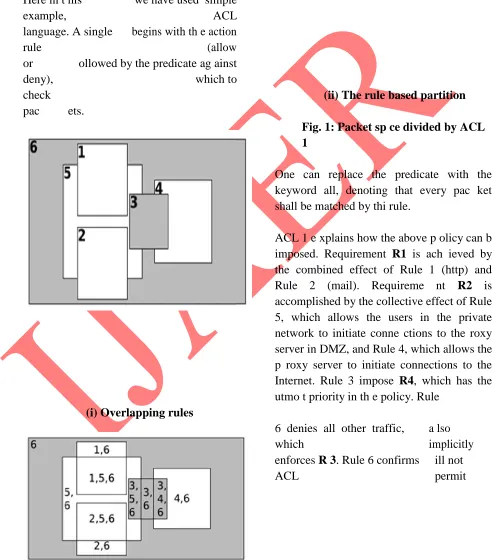
(i) Overlapping rules
(ii) The rule based partition
Fig. 1: Packet sp ce divided by ACL 1
One can replace the predicate with the keyword all, denoting that every pac ket shall be matched by thi rule.
ACL 1 e xplains how the above p olicy can b imposed. Requirement R1 is ach ieved by the combined effect of Rule 1 (http) and Rule 2 (mail). Requireme nt R2 is accomplished by the collective effect of Rule 5, which allows the users in the private network to initiate conne ctions to the roxy server in DMZ, and Rule 4, which allows the p roxy server to initiate connections to the Internet. Rule 3 impose R4, which has the utmo t priority in the policy. Rule
6 denies all other traffic, which
a lso implicitly enforces R3. Rule 6 confirms
ACL
any traffic acciden tally and is t he default behaviour of most firewall pr oducts.
Optimization F ramework
Fram ework consis ts of several steps: partitioning, profiling, dependen cy generation, and optimization.
a) Partitioning: is used to divide the packet space into disjoint blocks accordin g to the given ACL.
b) Profiling : measures the weights of blockswithin the partition.
c) Dependency eneration: ex amines the pa rtition and rules to create a set of constraints on the positions of r ules to admit only semantically equivalent rule reordering.
d) Optimization : step uses information fromprevious step to produce an integer program whose solutions yield sem antically equi valent, optimal rule reordering.
Rule-Based Partitioning O f Packet S pace
The (disjoint) blocks of the partition are created such that for any two ackets within a single bloc k, the same set of rules from the ACL 1 matches those two packets. This facil itates the correct optimization of firew all rule config urations in two key ways:
a) Since all pack ets within a bl ck will be matched by the same rule in any reord ering of the ACL, checking for correct block ac tion is sufficie nt.
b) Cost assignment can be attri uted to block rather than rul es, thus making cost calculation independent o the choice of rule ordering.
To explain rule-ba sed partitioni ng, we first p ove it on A CL 1. Figure 1(i) shows rectangles that d enote the rules of the ACL. Light rectangles denot rules that have allow act ions, while da rk rectangles denote rules that have deny actions. Notice that, rec tangle havi ng the entire figure represents Rule 6 (deny all).
Two rectangles ov erlap when the packets matc hed by
the two
corresp onding
rule s
intersect. Rule 6 intersect
s
with all
the other
rules, it mu st be positioned after all the other rules with an allow
action. Rule 5 has the most inte esting relatio ships:
it intersects with Rules 1, 2, 3, a nd 6. We can educe
that Rules 1, 2, and 5 can
be placed in any order relative to one
another, while Rule 3 mu st be place d before Rules 4
Algo rithm 1 produces a partition of the
of matchin g rules. The algorithm works by iterating over the rules in the rule sequence.
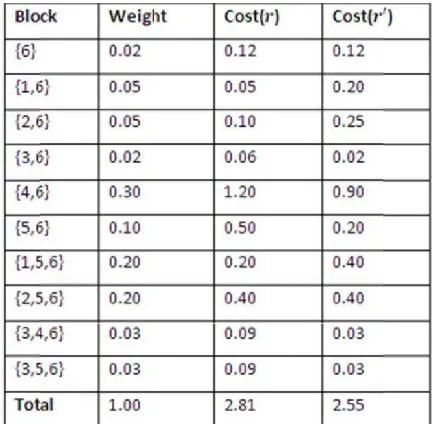
Table 1 Wei ghts for the b locks in ACL
Partition Profiling an d Rule Cost
A good metric for ACL cost is the expected time to process a single packe t. Naturally, with a lowe packet pro cessing time, the firewall can accomplish higher throughput.
To measure the likely time, we need some typical distrib utions, i.e., probability mas functions over all pack ts in the packet space. Fo mathematical expression p acket spa ce as P; the ACL as r; the packet as X; and the tr affic profile a profile, a apping from packets to pro abilities.
wher e the cost to process a pack et, cost (r, s), is the num ber of rules th at are checked against s. Assuming that ri is the first m atching rule for packet s, we have cost (r, s) = i.
Noti ce
tha t
wit
h rule-based
partitions, th first matching rule
for
ll packets in
block is alik e. This allow
s us
to re write the
ex ected cost s the following:
Figure 3An A CL demonst rating complex dependencies
____________________ ___________ __________ ___________ ____________________ _________
produce a single weigh t. Notice that these weight factors depend only on the traffic profile and ar independe nt of any rule rder. This lea ves us with:
It is compulsory for t he traffic pro filing tool to dynamical ly monitor the traffic and update the traffic profile as needed. Assu me that the administrato selects a distribution n of the packet t pace such tha t the weights are determin ed to be as shown in Table I.
Assume th at
is the initial ACL. The
cost for each block is
s
own in the third column of the table. Th
final colu
mn shows a differe nt
permutation of th AC
L, , wher
e the rules are
reordered a
. This
orderin g
retains the same meaning
,
ut has a lower cost.
Depende ncy Gener ation
Dependen cies between the relative po sitions of two rules is that overla , but with dif ferent actions. For examp le, we noted in
ACL 1 that Rules 3 and 5 intersect and have diffe ent actions, so Rule 3 must be placed before Rule 5 in any valid re ordering.
A dependency must n t be betwee n a rule pair. Instead, it should be bet ween a rule i and a block’ matching ules that have a different a tion from that of rule i. We denote th ese dependen cies using th following format: i ⊏{j,k,...,l}. Such a dependency requires that rule i must f ollow the earliest rule o f {j,k,...,l}.
Algorithm 2 shows how these constraints can b generated. It generates a dependency wheneve r there is a lock with conflicting rules (lines 2–4). Fo r these conflicting blocks, a dependency is generated for each rule with a different action from the first matching rule (lines 3–4 . The constrai nt requires that in any reo rdered ACL, the rule must be positioned after at least one of the matching rules with the same action (lin e 5).
For ACL 1 , the depende cies are given by:
Afte r checking the cost of all permutations given the weights listed in Table I, the permutatio
is found to be an opti mal solution.
Con clusion
A general
frame ork for eval uating optim zation tech
iques
for rul e-based firew lls first divides the packet space into p artitions where all the pac kets in any given partitio n match the s ame set of firewall rules. For each part ition, the fram ework calculates the cost for the firewall to process a ll the packets in the partition based on traffic profil . Then, using these partitions, the fra ework gener ates the depen dency of al l the rules in th e firewall.
It i worth underlining that the methods and algor ithms present ed in this paper are not restri cted to the d esign and an alysis of firew all policies. ather, they can be appli d to other rule based syste ms as well.
Ref erences
Chen-Nee Chuah, and Hao Chen, “A G eneral
Framework for Benchmarking
Firewa ll Optimization Techniques’’, IEEE TRANSACTI
ONS ON
NETWOR
K AND
SERVICE M ANAGEMEN T,
VOL. 5, O. 4,
DECEMBER 2008.
[2] Alex X. Liu, Mohamed G . Gouda, “Firewall Policy Queries’’, IEEE TRANSACTIONS ON PARALLEL AND DISTRI BUTED SYS EMS, VOL. 20, NO. 6, JUNE 2009 .
[3] Alex X. Liu, Mohamed G . Gouda, “D iverse Firewall Design”, IEEE RANSACTIONS ON PARALLEL AND DISTRI BUTED SYS EMS, VOL. 19, NO. 9, SEPTEMBER 2008
[4] Ehab Al-Shaer, Hazem Ham ed, Raouf Bo utaba, and Masum H asan, “Confli ct Classificati n and Analysis of D istributed Firewall Policies”, IEEE
JOURNAL ON
SELEC
TED AREA S IN COMMUNIC
ATIONS,
V
OL. 23, NO . 10, OCTOBER 20
05.
[5]
Ehab S. Al-Shaer
an
d Hazem H.
9/04.CF3G IEEE.
[6]
Alex X. Liu, Mohamed G. Gouda, “Co mplete
Redundanc y
__________________________________________________________________________ _______
TCAMs”, IEEE TRANSACTIONS ON
PARALLEL AND DISTRIBUTED SYSTEMS, VOL. 21, NO. 4, APRIL 2010