169
Journal of Economics and Behavioral Studies (ISSN: 2220-6140) Vol. 8, No. 5, pp. 169-183, October 2016
Influence of Small Business Ethics on Buying Decisions of Customers: A case of Indigenous Owned Fast-Food Outlets in Zimbabwe
Patient Rambe, *Takawira Munyaradzi Ndofirepi Central University of Technology, Bloemfontein, South Africa
[email protected], *[email protected]
Abstract: While the prevalence of ethical consumerism has pressured small businesses to embrace ethical behaviour, in ethically precarious business conditions the relentless pursuit for profit by small businesses may compel them to compromise their moral values. As such, a tacit struggle may persist between such businesses’ strategic orientations (e.g. profitability, improved performance) and demands of ethically conscious consumers. Drawing on ethics theory, this study explored the influence of the ethical conduct of small fast food outlets on buying intentions of customers. A survey was conducted on 116 probabilistically sampled customers of an indigenous owned fast-food outlet in two cities in Zimbabwe. Findings suggest that customers considered ethical conduct of business ventures when making their purchase decisions although it was unclear whether ethical consumers persistently maintained their buying decisions (i.e. purchasing ethically made products). Ethical business practices, however, remained an enduring feature of enterprises striving to optimise their profit motives.
Keywords: Ethical values, fast food outlets, buying decisions, survey approach
1. Introduction
Business ethics in Zimbabwe: In view of the heated controversy that surrounds business ethics, perhaps, a safe point of departure is to define ethics as a precursor to understanding business ethics. Harris et al. (2011) conceive ethics as the moral values or principles that guide human behaviour. They delineate what is right or wrong for an individual or an organisation (Ferrell & Fraedrich, 2014). For Jones (1991, p. 367) “An ethical decision is a decision that is both legally and morally acceptable to the larger community. Conversely, an unethical decision is a decision that is either illegal or morally unacceptable to the larger community.” While ethics has resonance with legitimate conduct, what is acceptable to the larger community is relative to particular contexts and imprecise as it is dependent on individual moral prescriptions and judgements. To the extent that ethics are at the heart of the decision making process of an organisation, they contribute directly to the firm’s image and reputation, which exert an influence on whether other organisations will deal with an organisation or not (Lii & Lee, 2012). Where ethics are unclear, an atmosphere of distrust between and organisation and stakeholders is created (Mullins et al., 2008, Longenecker et al., 2013) because stakeholders often prefer to work with firms with ethical values (King & McDonnell, 2012). It is not clear how ethical values within a corporate context affect customers’ perceptions and buying behaviour (Sebastiani et al., 2013) in economically distressed contexts, and hence the rationale for this study. This obscurity derives from the fact that ethically procured and manufactured goods/ services tend to attract premium prices than those procured and manufactured through unethical means (Jokinen, 2011). The irony is that in economically hard hit countries like Zimbabwe, where consumers tend to be cash strapped, even ethically sensitive consumers may be the tempted to suspend their ethical sensitivity by purchasing goods which were unethically produced or manufactured.
170
price controls to regulate the then galloping six digit inflation in 2008, and welfarist programmes such as the Basic Commodity Supply Intervention (BACOSI) facility compounded the problem. The BACOSI facility provided production targets-linked financial support to primary, secondary and tertiary producers and suppliers to improve their production capacity utilisation and rendered goods at affordable, but “economically viable” prices, and these financial incentives were administered through local banks at concessionary interest rates (Reserve Bank of Zimbabwe, 2007). However, there was no evidence to suggest that concessionary lending would curtail predatory pricing by small businesses/suppliers such as fast food businesses or guarantee affordable pricing of commodities. Another policy shift that could be linked directly to political clientelism and profiteering is the indigenisation policy, in which online commentators expressed wariness about opportunistic political elements seeking to grab productive companies (Magure, 2012) including those in the fast food industry. Magure (2012) elaborates that the continuation of user charges on health, education and utility services in the post Economic Structural Adjustment Programme (ESAP) has escalated the profiteering motive of emerging businesses such as fast food businesses and masked predatory tactics under the guise of cost recovery.
From an operational perspective, Mawere (2011, p. 45) debunks the ‘myth of amoral business’ in Zimbabwe perpetuated by the view that “business is for business only.” Rebutting the end justified the means mantra; he exhorts small businesses such as fast food businesses to uphold the moral compass for their benefit and that of their stakeholders. A handful of literature demanding ethical sensitivity in small businesses including those in the food industry all point to the necessity of robust research into moral business and ethical consumer behaviour (Masaka 2011; Industrial Psychology Consultants 2012). However, the application of moral principles in the fast food industry remains inconsistent and ambivalent due to: their survivalist orientation, steep competition from established rivals, threats of product substitution, and limited barriers to entry for new smaller entrants in the market (Mkono, 2012).
Research Problem: In emerging volatile economies, stiff competition and fast-paced changes present ethical dilemmas to entrepreneurial business ventures seeking to maximise profits and survive at all cost (Longenecker, Petty, Palich & Hoy, 2013). As such, fast food enterprises may be tempted to ignore warnings of subversion of ethical practices in pursuit of profits (Brizek, 2014). Thus is despite the hailed ethical, societal, and environmental benefits of adopting ethical practices such as: reputation of the business for customers and suppliers, goodwill from the communities where the business operates and reduction of integrity risks for the business (IBE Briefing, 2007; CIMA 2014) small firms’ temptation to breach the ethical code in pursuit of profit is ever lingering in economically distressed economies where genuine raw materials are expensive to acquire and customers are cash strapped to purchase fast foods persistently.
In resilient economies reeling under economic recession or stagnation under-hand deals and subversion of moral uprightness may reign supreme, while the business-related benefits of moral conduct such as: increased employee loyalty, higher commitment and morale, lower staff turnover, attraction of ‘high-quality’ staff and open, innovative culture (IBE Briefing, 2007) may be sacrificed. Such moral degeneration may persist notwithstanding convergence of literature on the significance of ethical behaviour in business sustainability (Jenkins, 1996; Holme, 2008; Carroll & Burchholtz, 2014). The pursuit for firm survival in the face of business rivalry and the temptation to profiteer from customers’ imperfect information on fair pricing may undermine Holme’s (2008) exhortation of firms to pursue economic objectives, common good, positive stakeholder opinion and caring for the environment concurrently as a basis for improving sustainability. Thus is notwithstanding the fact that business sustainability relies heavily on the capacity of firms to pursue honesty, reliability and fairness relentlessly when dealing with stakeholders (Carroll & Burchholtz, 2014) because stakeholders (especially customers) are the focal point of the implementation of business strategy and improved performance (Jenkins, 1996). More so, a business environment where ethical consumers are growing in numbers makes external demands on business more explicit and impacts on business profitability and performance positively (Mullins et al., 2008; Holme, 2008).
171
shape their purchasing behaviour. The findings suggest that consumers emphasise trust in addition to price and design as part of ethical consumerism since it is difficult for them to evaluate how jewellery price is determined. More so, consumers are willing to make extra efforts to get ethically made jewellery (Jokinen, 2011). While there is a growing body of literature on the influence of ethical conduct of businesses on the buying decisions of customers in the developed world (Bray et al., 2011; Jokinen, 2011; White et al., 2012; Carrington et al., 2014), little is known about the nexus between emerging small businesses’ ethics and consumer buying behaviour in emerging African economies. For instance, there is a lack of conclusive empirical evidence that consumers will pay more for socially responsible products or services (Cotte & Trudel, 2009). While research evidence suggests that the number of ethical consumers most interested in ethically produced products is growing across the world (Globescan, 2007), ethical consumers may not be willing to reward firms for their ethical sustainability actions with price premiums or increased purchases (Cotte & Trudel, 2009) as they buy responsible products only if “quality, performance, and price are equal” (Deloitte Consulting Ltd, 2008). More so, in developing African economies, ethical ambivalence (i.e. buying from unethical businesses) among ethical consumers cannot be discounted due to the paucity of consumer rights groups, inconsistent ethical business policy frameworks and fragile, incoherent regulatory institutions. By the same token, where business ethical frameworks are weak, unethical practices like predatory pricing and unethical sourcing by small businesses is common.
As such, there is scope to explore the business ethics-consumer behaviour relationship in emerging African economies. To understand this complex problem, the study explored how consumers of fast food products conceive the ethical conduct of resilient, fast food outlets in Zimbabwe-which are ethically challenged entities due to: their difficulty in sourcing genuinely manufactured raw materials, the prevalence of counterfeit raw materials at affordable prices, stiff competition from rival food outlets and illiquid economic environment. The interest in the purchase decisions of consumers is also premised on the generally cheaper food stuffs that emerging food outlets sell to consumers compared to established food outlets, which make the former’s food stuffs appealing to most cash strapped Zimbabwean customers. The study, therefore, sought to address the following main question:
What is the extent to which consumers of fast foods in Zimbabwe consider the ethical conduct of fast food outlets towards their stakeholders when making purchasing decisions?
The following sub-questions are proposed:
Does the consumer’s gender influence their consideration of the food outlet’s ethics when making buying decisions?
Does the consumer’s age influence their consideration of the food outlet’s ethics when making buying decisions?
Does the consumer’s educational background influence their consideration of the food outlet’s ethics when making buying decisions?
Does the consumer’s occupation influence their consideration of the food outlet’s ethics when making buying decisions?
The paper is structured as follows: existing literature on ethics, ethics and the business context and ethical consumerism are examined first. This is followed by the research methodology used in the study. Findings are then discussed. Finally, conclusions, practical implications and recommendations for future research are suggested.
2. Literature Review
172
although the pursuit for profit through expediency and possibly unethical behaviour (Harris et al., 2011) remains an alternative discourse. In fact, where expediency is the only viable option for a firm’s competitive advantage over its rivals, the strategic business philosophy of the end (e.g. profit maximisation and market expansion) justifies the means normally leads to the downplaying of sustainability concerns like good ethical conduct. Millar et al. (2012) argue that the dilemma of giving into temptations to ‘cut corners’ is apparent for most SMMEs such as those in fast food industry– that exploit information asymmetries in innovation to support misleading claims about specific capabilities and to exploit reputation created unjustifiably.
The drive to indulge in self-serving behaviour is stronger amongst entrepreneurs in fledgling stages of business (Vyakarnam et al., 1997) typical of those in distressed economies like Zimbabwe’s. New start-ups tend to exhibit an inherent inclination towards compromising their own values in order to succeed at any cost (Fisscher & Nijhof, 2005; Millar et al., 2012) due to their survivalist orientation, steep competition from established businesses and limited acquaintance with legal parameters. Thelen and Zhuplev’s (2002) comparative analysis of Russian and U.S. undergraduate student attitudes towards application of ethical issues in managing Russian small firms engaged in business transactions with U.S. firms revealed interesting results. When confronted with business ethical dilemmas, Russians failed to recognise significant differences between various business alternatives notwithstanding the severity of these alternatives for resolving business problems. They also preferred more forceful alternatives, resorting to business practices that would be considered unethical in the US. The study attributed the differences in ethical business decision making to the transitional nature of the Russian economy at the time (Thelen & Zhuplev, 2002). While the aforementioned SMME studies were conducted in developed countries, little is known about the impact of ethical business behaviour on customer purchasing decisions in developing economies.
Contemporary literature has interrogated personal motivation for engagement in unethical behaviour (e.g. Wu & Joardar, 2012; Longenecker et al., 2013) and entrepreneurs’ attitudes towards ethical conduct (Christensen et al., 2008) but not perceptions of business stakeholders towards the ethical conduct of entrepreneurs and their implications for purchase decisions of these stakeholders, which is the focus of this study. With regard to motivations for ethical malpractice, Longenecker et al., (2013) noted that since many entrepreneurs are often driven by self-centredness, conceit usually pushes them to violate norms of fairness and justice leading to unethical conduct. Commenting on the organisational climate of ethical misconduct and crime, Wu and Joardar (2012) attributed motivations of unethical behaviour to short term rewards and absence of harsh penalties for entrepreneurship-related crimes. Our study departs from this individual entrepreneur perspective on ethical conduct (what we coin an internal perspective) by examining the extent to which stakeholders’ (especially customers) buying decisions are shaped by ethical behaviour of small businesses (a stakeholders’ perspective). A stakeholder perspective is critical to sustainable business ethics given the dearth of literature on the relationship between business social responsibility in pursuit of ethical practices and stakeholder behaviours such as customer purchasing behaviour (Moeti, in press; Moyeen & Courvisanas, 2012). The decision making processes of stakeholders such as customers are critical to sustainable business ethics because when new venture creation and entrepreneurship are left to the vagaries of free market economics and neo-liberalism, they tend to gravitate towards self-centred practices. Zhang and Arvey (2009) argue that sometimes, the entrepreneurship of firms involves putting stakeholders’ resources at unreasonable risk in the hope of reaping economic benefits – hence entrepreneurship may inherently embraces elements of unethical behaviour. To this effect, stakeholders’ purchasing perspectives are critical to business pursuit of good ethical behaviour.
173
perceived association with/collusion with Israelis against the Palestinians (Mendes & Dyrenfurth, 2015). In the context of the fast food industry, ethical consumers may refrain from purchasing genetically modified products, and purchasing from food outlets that make false claims about the nutritional value of products/goods they sell. While consumer councils often require enterprises (e.g. large corporations and small businesses) to provide labels on the authentic nutritional value of their products, customers do not always have the capacity to ascertain the veracity of these labels as this requires consumers to work like nutritionists or food scientists. Millar et al. (2012) argue that entrepreneurs develop tools and techniques which will help them to communicate what they wish about their products– and to conceal what they wish to hide. Their strategies may include misrepresentation in their relations with stakeholders, manipulative exploitation of reputation and reputational networks.
Another dimension to the ethics debate is that consuming ethically manufactured products comes with a cost trade-off (Young et al., 2010). Usually, fair-trade products are more costly than non-fair-trade products (Didier & Lucie, 2008). Such a scenario comes as a challenge to consumers who have to decide whether to consume ethically made products and incur additional costs or to purchase unethically produced products at lower products but in the process compromise their integrity. Identifying with Didier and Lucie (2008), we wondered whether consumers exercise ethical buying behaviour consistently in the real world. We also questioned whether consumers may embrace ethical values yet eventually buy unethical products. This is particularly critical for consumers in developing countries where little is known about the nexus between customer purchase decisions and SMME ethical behaviour. Devinney et al. (2010, p. 11) question the feasibility of ethical consumerism and propose consumer social responsibility as an alternative. Consumer social responsibility is the “conscious and deliberate choice to make consumption choices based on personal and moral beliefs” (Devinney et al., 2010, p. 11). The preference for social responsibility suggests deliberate selfless decisions made in recognition of the social, economic and environmental benefits of the society rather than the individual per se. Yet literature highlights with concern the disjuncture between ethical intentions and actual ethical consumption behaviour (Chatzidakis et al., 2007; Szimgin et al., 2009; Devinney et al., 2010). The concern is that ethically minded consumers do not buy ethical products always. In view of this disparity between aspirations and reality, the study breaches this gap in research by exploring the extent to which fast-food consumers in resilient, emerging economies consider ethical conduct of fast-food outlets in making their purchasing decisions.
The influence of demographic factors on ethical consumption behaviour: Studies on the morality of consumption decisions have attempted to examine the relationship between demographic profiles and ethical buying preference measures, albeit their intricacy. While there is a general consensus on the influence of demographic factors on ethical decision making, the nature of this influence remains shrouded in mystery as both positive and somewhat contradictory results have been reported in literature (Starr, 2009; Hudson et al., 2012; Seppanen, 2013; Kavaliauske & Ubartaite, 2014)
174
Gender of the consumer: Gender variances in ethical perceptions have been observed in several studies across the globe (Tan, 2002; Starr, 2009; Hudson et al., 2012). Females have been observed to show acute ethical awareness and intentions as compared to males (Tan, 2002). Holding other factors constant, women are believed to derive more intrinsic value from ethical consumption when compared to man. Another explanation for the higher tendency for women to consume ethically is that they are more often responsible for family shopping duties than their male counterparts (Starr, 2009), hence their comparably higher exposure to information about ethical products and business enterprises than their male counterparts. In an experimental methodology based study conducted by Hudson et al. (2012), 200 students at a large public university in the United States were required to choose between “conventional” coffee for $5.00 per half-pound, and fair trade coffee for $7.00 per half-pound. Of the total population, 64% chose the fair trade coffee, signifying a resilient readiness to pay a higher price for products with social benefits. Though as it may, there is no reason believe that the results of such a study conducted in developed countries with higher ethical consumer awareness can obtain in a developing country such as Zimbabwe, where ethical consumerism is hardly debated in public for a due to the consumers’ pressing needs for survival.
Consumer’s level of education: Consumers’ educational background influences their ethical consumption as it potentially exposes them to ethics information through the education process (Starr, 2009). Discounting for other factors such as access to communication media, nature of networks and age of consumers, it would be assumed that consumers with higher levels of education are likely to exercise more ethical consumption than those without such education as higher education can impact the acquisition and processing of ethics consumption information. Newholm and Shaw’s (2007) study on factors influencing consumer behaviour emphasised the consumer’s level of education as a critical factor that influences ethical purchasing decisions as it facilitates exposure and processing of consumer brand information.
Occupation of the consumer: Through the effect occupation has on a consumer’s income level, occupation affects one’s willingness to consume ethically (Seppanen, 2013). Since ethical products and services tend to be more expensive as compared to their substitutes or comparable products not produced with ethical, environmental or social effect issues in mind, the purchase of ethical products may be costly and is seen as a luxury (White et al., 2012). As such, it would be expected that people with high income occupations buy ethical products as they have more spending power than those with low income jobs. Perhaps, this income-purchase decision relation casts light into how price levels influence ethical consumption decisions. A study conducted by Uusitalo and Oksanen (2004) on the views of Finnish consumers about ethics in trade reveals that one of the most important obstacles to ethical consumption was high prices of ethical products.
Theoretical Framework: Some authors (Jones, 1991; Rex & Sprunt, 2006) provide three contrasting models of ethical decision making that emphasise the moral code of the individual, the situated context of decision making including the range of moral choices that individuals possess in their decision making. Rest’s Model of the Ethical Decision Making (EDM) process emphasises the sequence for individual EDM and behaviour: recognise the moral issue; make a moral judgment; resolve to place moral concerns ahead of other concerns (Establish Moral Intent) and act on the moral concerns (Engage in Moral Behaviour). Trevino’s (1986) ‘Person-Situation Interactionist Model’ considers the range of interacting factors (personal factors such as moral development, individual moderators (ego strength, field dependence, locus of control) and contextual factors such as immediate job context, organisational culture and work characteristics) implicated in ethical behaviour of individuals rather that the decision making process itself. Since the size and lean reporting structures of SMMEs may blur the vivid expression of the elements of organisational culture in the model such as normative structure, referent others, obedience to authority and responsibility for consequences, Trevino’s (1986) model may be difficult to apply to SMMEs.
175
predatory or unfair pricing of products/goods/commodities, unethical supplies of products/goods/commodities, the immoral standing of unethical purchasing). Subsequently, consumers make subjective judgements about the extent to which businesses make ethical decisions in their acquisition (sourcing), marketing, branding, nutritional value and pricing of commodities. This is followed by the prioritisation of moral concerns (e.g. deciding to purchase a more expensive, ethically sourced, manufactured, displayed and priced product than a cheaper unethically sourced, manufactured, displayed and priced product. This leads to final purchase or refrain from purchasing of product depending on the fulfilment of moral parameters and prescriptions.
3. Methodology
The study adopted a positivist paradigm, which holds that research must be limited to what can be observed and measured. The research design used was descriptive, cross sectional and quantitative. According to Leedy and Omrod (2010, p. 182), the research design “involves either identifying the characteristics of an observed phenomenon or exploring possible correlations among two or more phenomena.” Quantitative designs examine phenomenon in their current state and are ideal for exploring answers to the “who, what, when, how and why” questions. In this study, the objective of the study was to ascertain the extent to which consumers of fast food products in Zimbabwe considered the ethical conduct of these fast food outlets towards their stakeholders when making their purchasing buying decisions. The sub-objectives of the study were to determine whether customer demographics (gender, age, occupation and level of education of respondents) also shaped their perceptions of food outlets’ ethical behaviour when making purchase decisions.
Pilot survey: The questionnaire used in this study was pretested using a sample of 20 students at Kwekwe Polytechnic in Zimbabwe. Data for the actual study was collected over one month using the telephone survey method. The telephonic surveys involved the actual customers of the two food outlets involved.
Sampling method and data collection: The target population consisted of customers of branches of an indigenous owned fast-food outlet in Gweru and Kwekwe cities in the Midlands region in Zimbabwe. Given the difficulty of demarcating precisely the customer base of these fast food outlets, developing a defined sampling frame proved to be complex. A sampling frame was established using coupons submitted by customers for a sweepstakes competition. The coupons contained customer details like name, residential address and phone number. A total of 1650 were collected from participating customers from the two branches. These were then used as a sampling frame for this study. Respondents were selected randomly by picking any coupon submitted and then making a telephone call to the number on the coupon. The researchers then inquired about the willingness of respondents participate voluntarily in the study. If they acceded, the researchers would then proceed to ask questions from the questionnaire and complete the questionnaire on behalf of the respondent. According to Saunders et al. (2009), a minimum sample size of 30 respondents is adequate for making valid statistical inferences and generalisations of the sample to the entire population. While this is acceptable, 200 phone calls were made in order to cater for non-responses. Of this number, 116 customers volunteered to participate in the survey, representing a response rate of 58 %.
Ethical issues: Permission to conduct the study was sought from branch managers of the outlet prior to the study. Each respondent was informed of the purpose of the study, participation in this study was voluntary and that respondents were free to withdraw from the study without any threats of sanctions. Participants were guaranteed of their anonymity by informing them that their responses would be reported in aggregate form to protect their individual identities. No financial incentive was given to participants to entice their participation in the study.
Measurement
176
ethical perceptions of respondents. Responses were sub-divided on a seven-point Likert-scale, ranging from “disagree completely” (1) to “agree completely” (7). A total tally for each construct was found by averaging the response to the applicable items. Table 1 below shows the Cronbach coefficient of each sub-dimension.
Table 1: Reliability test results
Sub-dimension No. of items Cronbach's alpha
Customer consideration of ethical behaviour of retailer
towards all stakeholders 5 0.792
A composite score was then calculated for the responses to the five statements measuring the level of ethical perception of customers.
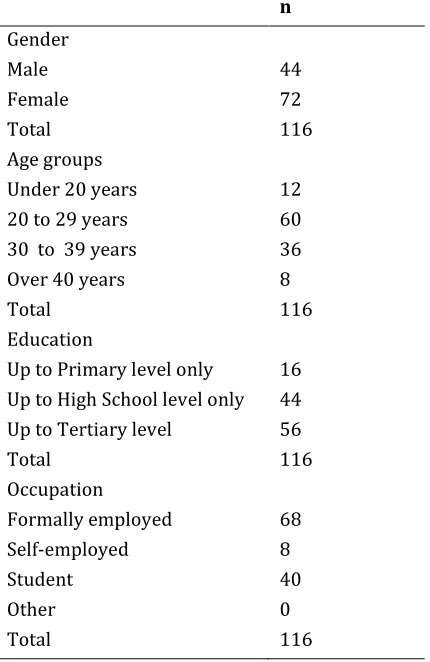
Data presentation-Demographic variables: Table 2 provides a demographic profile of the respondents who took part in the study. Females dominated the selected sample with 63.8 % and the majority of the respondents fell in the 20 to 29 age group. Many of the respondents had tertiary education and were formally employed.
Table 2: Socio-demographic profiles of respondents n
Gender
Male 44
Female 72
Total 116
Age groups
Under 20 years 12
20 to 29 years 60
30 to 39 years 36
Over 40 years 8
Total 116
Education
Up to Primary level only 16 Up to High School level only 44 Up to Tertiary level 56
Total 116
Occupation
Formally employed 68
Self-employed 8
Student 40
Other 0
Total 116
177
4. Data AnalysisData obtained from 116 usable questionnaires was captured in Statistical Packages for the Social Sciences (SPSS 16) software for quantitative analysis. Descriptive statistics, an independent samples T-test and One Way ANOVA were employed to ascertain the perceptions of customers towards food outlets’ ethical behaviour and whether any variations in such perceptions was influenced by demographic factors. In addition, customers were assessed for their level of preparedness to alter their purchasing behaviour in line with their perception of ethical conduct of food outlets. Ethical perceptions are deduced as the aggregate of five items whose composite score is shown as a mean in Table 3 to 7.
Customers’ consideration of ethical behaviour of fast food outlets towards their stakeholders: As a starting point, the findings of the study generally suggest that the majority of respondents were ethically aware and paid attention to the ethical behaviour of food outlets when making purchasing decisions. This is illustrated in Table 3
Table 3 Descriptive statistics for Total Customer Consideration of Ethical Behaviour Score
M SD n
Total Customer Consideration of Ethical Behaviour Score 24.48 5.67 116
The mean statistic of 24.48 is relatively high when compared to the maximum possible statistic of 30.
Customer consideration of ethical behaviour of food outlets towards all stakeholders and gender of respondents: An independent samples t-test was conducted to examine whether the mean composite score for customer consideration of ethical behaviour of food outlets towards all stakeholders was significantly different between the male and female categories of gender. Prior to the analysis, the assumptions of normality and homogeneity of variance were assessed. A Shapiro-Wilk test was conducted to determine whether the composite scores could have been produced by a normal distribution. The results of the Shapiro-Wilk test were significant, W = 0.74, p < .001. This suggests that the composite score is unlikely to have been produced by a normal distribution, thus normality cannot be assumed. However, the mean of any random variable would be approximately normally distributed as sample size increases according to the Central Limit Theorem (CLT). Therefore, with a sufficiently large sample size (n > 100), deviations from normality would have little effect on the results. Levene's test for equality of variance was also applied to assess whether the homogeneity of variance assumption was met. The homogeneity of variance assumption requires the variance of the dependent variable to be approximately equal in each group, represented by each combination of factor levels in the independent variables. The result of Levene's test was significant, F (1, 114) = 4.70, p = .032, indicating that the assumption of homogeneity of variance was violated. Consequently, the results may not be reliable or generalizable. Since equal variances cannot be assumed, Welch's t-test was used instead of the Student's t-test, which is more reliable when the two samples have unequal variances and unequal sample sizes. The result of the independent samples t-test was significant, t (61.66) = -2.91, p = .005, suggesting that the mean of composite score was significantly different between the male and female categories. The mean of composite score in the Male category of Gender was significantly lower than the mean of the composite score in the Female category. Table 2 presents the results of the independent samples t -test. Table 4 presents the results of the test.
Table 4: Independent Samples t-Test for the Difference between Composite ethical considerations scores for (Male) and (Female)
Male Female
Variable M SD M SD T p d
Composite ethical consideration
Score 22.36 7.05 25.78 4.17 -2.91 .005 0.59
Note. Degrees of Freedom for the t-statistic = 61.66. d represents Cohen's d.
178
of food outlets towards all stakeholders score shows variations across the age groups that participated in the study. Table 5a shows that the younger participants (Under 20 years) scored lower than the older ones (20 to 29 years and over 40 years) suggesting an age-based variation in ethical perception of customers.
Table 5a: Descriptive statistics for age group differences
Age group M SD n
Under 20 years 23.33 2.74 12
20 to 29 Years 25.47 4.37 60
30 to 39 years 22.33 7.74 36
40 years and above 28.50 1.60 8
Table 5b shows that the distinctions in the total consideration of ethical behaviour score across age groups are statistically significant as shown by the p-value of 0.008.
Table 5b: ANOVA table for age-based differences
Variable df SS MS F p η2
Age group 3 369.37 123.12 4.15 .008 0.10
Residuals 112 3323.60 29.68
Post-hoc Comparisons: To further examine the differences among the variables, t-tests were calculated between each pair of measurements. A Bonferroni p-value correction was used to adjust for multiple testing. The mean value of 20 to 29 years (M = 25.47, SD = 4.37) was significantly greater than 30 to 39 years (M = 22.33, SD = 7.74). The mean value of 30 to 39 years (M = 22.33, SD = 7.74) was significantly less than 40 years and above (M = 28.50, SD = 1.60). No other significant differences were found.
Customer consideration of ethical behaviour of food outlets towards all stakeholders and respondents’ level of education: The results presented in Table 6a show a clear distinction between mean scores on customer consideration of ethical behaviour of food outlets variable across participants of different educational backgrounds. Participants exposed to higher levels of education had significantly higher mean scores compared to those exposed to lower levels of education.
Table 6a: Descriptive statistics for educational background based differences
Education M SD n
Up to high school level 25.09 5.33 44
Up to college level 26.43 2.74 56
Primary level only 16 6.73 16
The variations in mean scores on the basis of level of education are statistically significant at the 95% level of confidence, where the p-value of 0.000 is less than 0.05 as shown in Table 6b.
Table 6b: Anova statistics for educational background based differences
Variable df SS MS F p η2
Education 2 1379.61 689.81 33.69 < .001 0.37
Residuals 113 2313.35 20.47
Post-hoc Comparisons: To further examine the differences among the variables, t-tests were calculated between each pair of measurements. A Bonferroni p-value correction was used to adjust for multiple testing. The mean value of up to college level (M = 26.43, SD = 2.74) was significantly greater than Primary level only (M = 16.00, SD = 6.73). The mean value of up to high school level (M = 25.09, SD = 5.33) was significantly greater than primary level only (M = 16.00, SD = 6.73). No other significant differences were found.
179
Table 7a: Descriptive statistics for occupation based differences
Occupation M SD n
Formally employed 24.29 5.77 68
Self-employed 24 5.35 8
Student 24.90 5.67 40
Further analysis of the above results using ANOVA shows that the minor differences in the mean scores are also statistically insignificant as indicated by the p-value of 0.843, which is greater than 0.05 as shown in Table 7b. Since the overall model was not significant, post-hoc testing was not conducted, as it would not contribute additional information to the analysis.
Table 7b: Anova statistics for occupation-based differences
Variable df SS MS F p η2
Occupation 2 11.25 5.62 0.17 .842 0.00
Residuals 113 3681.72 32.58
Discussion of Findings: The findings demonstrate that females are more ethically perceptive as compared to males. The results are in sync with observations from other ethics-based studies which concluded that females are more ethically conscious as compared to males. Eweje and Brunton’s (2010), study on a sample of 655 business students in New Zealand found females to be more ethically perceptive as compared to males. This view buttresses Tan’s (2002) claim that females show acute ethical awareness and intentions as compared to males. However, the finding somewhat contradicts Steele et al. (2011) observation that gender-based distinctions in ethical views do occur albeit inconsistently. The findings also revealed that younger participants scored lower than the older ones on ethical sensitivity suggesting an age-based variation in ethical perception of customers, even though the variations were not marked. This findings contradicts Kavaliauske and Ubartaite’s (2014) study that revealed that younger consumers (26-30 and 31-35 age groups) who were more ethically aware than older consumers preferred to buy organic products more than the 41 to 45 years age group consumers. However, even though they scored lowest than all age groups, the 20 to 39 age group’s purchase behaviour did not seem to be inconsistent with those observed among other age groups, suggesting that they may be another factor apart from age that is influencing the mean score variation. In connection with this, Tan (2002), and Solomon and O’Brien (1990) observed that demographical factors like gender, age and educational background had a moderate impact on ethical consumer decisions.
The results also demonstrated that participants exposed to higher levels of education had significantly higher mean scores compared to those with lower levels of education. This demonstrates that respondents with higher academic attainments tend to be more ethically sensitive than those with lower educational attainments. This finding resonates with Newholm and Shaw’s (2007) findings that consumer’s level of education is a critical factor that influences ethical purchasing decisions as it facilitates exposure and processing of consumer brand information. The finding also affirms Starr’s (2009) claim that consumers’ educational background influences their ethical consumption as they are exposed to ethics information through the education process. If this understanding on the influence of education on purchasing behaviour were to shape consumers’ actual ethical purchasing, then such customers would be keen to purchase from ethical businesses. While mainstream literature associates consumer ethical sensitivity and critical consumerism with advanced Western nations due to high literacy rates, our study also demonstrates the prevalence of ethically sensitive consumers in emerging, distressed economies- environments considered to lack consumer ethical consciousness (Creyer, 1997; Vivi & Yothmontree, 2002). However, it can be argued that sustenance of ethically conscious productivity and performance rides on the conversion of customers’ ethically sensitive intentions into ethically informed purchase decisions.
180
The implication is that owners, managers and employees of fast food outlets, regardless of the target customers’ income group, should show ethical concern towards all stakeholders in conducting their business in case they face a customer backlash if they act otherwise. Overall, most respondents indicated that they were pleased to discover that a firm which they bought from acted ethically to all stakeholders. Many customers would choose to buy from an ethical outlet as compared to unethical ones demonstrating the ethical sensitivity of stakeholders (i.e. customers). The overwhelming reception of good ethical practices as a precondition for purchase signifies the central place of ethical conduct in broader stakeholder management discourse (White et al., 2012). Consistent with the Ethical Decision Making (EDM) Process (see Jones 1991; Rex & Sprunt, 2006), customers act on their moral concerns (of buying ethically acquired products/goods/services), logically recognise the morality (of businesses buying from ethical suppliers); make moral judgments about these ethical practices and make a determination to prioritise this moral concern (of buying ethically sourced products/goods) ahead of other concerns. Therefore, it is important for enterprises in the fast-food industry to maintain an ethical reputation if they were to get positive endorsement from their patrons. Yet having awareness, favourable attitudes or even intention does not indicate future ethical actions (Rex and Sprunt, 2006, Jackson, 2005). Bonsu and Zwick (1997)’s study of Ghanaian consumers indicated that consumers were prone to suspending their ethical principles if the outcome would be to their advantage.
5. Conclusion
The primary objective of the study was to ascertain the extent to which consumers of fast foods in Zimbabwe considered as critical the ethical conduct of fast food outlets towards customers when making buying decisions. The results of the study suggested that a majority of the respondents in the study indicated they considered the ethical standing of fast food outlets they patronised when making their purchasing decisions. Our results are consistent with the findings of Shen et al. (2012) claim that consumer purchasing behaviour is subject to their perceptions of a company in terms of its reputation in the industry, and influence their support of what they believed to be ethical business practices. It also emerged from the study that they were statistically significant variations in terms of ethical considerations amongst the customers on the basis of respondents’ gender, age and educational background. However, consumers’ occupation was not a significant underlying factor in shaping ethical perceptions of the fast food outlets. In spite of this customers’ overwhelming intent to make ethical purchasing decisions, what was not obvious is whether customers fulfilled their intentions with actual purchase actions. This uncertainty is supported by Titus and Bradford (1996) who noted that consumers may notice the moral aspects of a purchasing scenario but still ignore these ethical aspects when making their final purchase decisions. As such, what is less common is ethical consumers’ willingness to pay premium prices than their willingness to change their behavior (towards the socially conscious choice) (Cotte & Trudel, 2009). This is because they often appear to expect the socially better choice to be of the same quality and price—it does not appear that they will understand the trade-off functionality (Cotte & Trudel, 2009). While our findings reported the possible linkage between business ethics and consumer purchase decisions, it did not confirm whether a statistically significant relationship really existed between them. Hence, further studies are necessary to establish the significance of this relationship.
181
Limitations and Areas for Future Research: One of the limitations of the study is that it was undertaken at only two branches of a fast-food small enterprise situated in two cities in Zimbabwe. Therefore, the extent of generalisability of the findings across the general fast-food industry is constrained. Though as it may, the rigorous analysis and the decent sample size employed make the study relatively credible contribution to ethical research literature. The authors exhort other researchers to build on the current study by utilizing more robust methodologies and more comprehensive sample compositions. The use of larger sample sizes drawn from Zimbabwean fast-food outlets of different sizes can enhance the generalisability of findings from the study. Apart from the preceding, this project was a snapshot of the ethical situation within business enterprises. A longitudinal study exploring how customers respond to the business’ variations in ethical behavior over time through ethical purchases can shed more light on the relationship between business ethics and consumer purchase decisions.
References
Bonsu, S. K. & Zwick, D. (2007). Exploring consumer ethics in Ghana, West Africa. International Journal of Consumer Studies, (3), 648–655.
Bowie, N. E. (1999). Business ethics: A Kantian perspective. Malden, MA: Blackwell Publishers.
Bray, J., Johns, N. & Kilburn, D. (2011). An exploratory study into the factors impeding ethical consumption. Journal of Business Ethics, 98(4), 597-608.
Brizek, M. G. (2014). Explaining corporate entrepreneurship: a contemporary literature Investigation. Journal of Management & Marketing Research, 14, 1-13.
Carrington, M. J., Neville, B. A. & Whitwell, G. J. (2014). Lost in translation: Exploring the ethical consumer intention–behavior gap. Journal of Business Research, 67(1), 2759- 2767.
Carroll, A. & Buchholtz, A. (2014). Business and society: Ethics, sustainability, and stakeholder management. Mason, Ohio: Cengage Learning.
Carrigan, M., Szmigin, I. & Wright, J. (2004). Shopping for a better world? An interpretive study of the potential for ethical consumption within the older market. Journal of Consumer Marketing, 21(6), 401-417.
Chatzidakis, A., Hibbert, S. & Smith, A. (2006). Ethically Concerned, yet Unethically Behaved: Towards an Updated Understanding of Consumers’ (Un)ethical Decision Making. Advances in Consumer Research, 33, 693-698.
Christensen, S. L., Schwartz, R. G. & Hoss, M. A. K. (2008). Ethical entrepreneurs: a study of perceptions. International Journal of Entrepreneurship and Small Business, 6(1), 114-132.
Cotte, J. & Trudel, R. (2009). Socially conscious consumerism—a systematic review of the body of knowledge. Network for Business Sustainability Knowledge Project Series. URL http://nbs. net/wp-content/uploads/NBS_Consumerism_SR_Researcher. pdf (accessed on 26 July 2012).
Creyer, E. H. (1997). The influence of firm behavior on purchase intention: Does consumer really care about business ethics? Journal of Consumer Marketing, 14(6), 421-432.
Deloitte Consulting LLP. (2008). Finding the green in today's shoppers. The Association of Food, Beverage and Consumer Products Categories.
Devinney, T. M., Auger, P. & Eckhardt, G. M. (2010). The Myth of the Ethical Consumer Hardback with DV. Cambridge: Cambridge University Press.
Didier, T. & Lucie, S. (2008). Measuring consumer's willingness to pay for organic and Fair Trade products. International Journal of Consumer Studies, 32(5), 479-490.
Epstein, M. J. & Buhovac, A. R. (2014). Making sustainability work: Best practices in managing and measuring corporate social, environmental, and economic impacts. California: Berrett-Koehler Publishers. Eweje, G. & Brunton, M. (2010). Ethical perceptions of business students in a New Zealand university: do
gender, age and work experience matter? Business Ethics: A European Review, 19(1), 95-111. Ferrell, O. C. & Fraedrich, J. (2014). Business ethics: Ethical decision making & cases. Ohio: Cengage learning. Fisscher, O. & Nijhof, A. (2005). Implications of Business Ethics for Quality Management. Total Quality
Management Magazine, 17, 150–60.
Globescan. (2007). Corporate Social Responsibility Monitor
(June).www.globescan.com/pdf/CSRReviewAutumn07.pdf
182
Holme, C. (2008). Do ethics matter? Industrial and Commercial Training, 40(5), 248-252. IBE Briefing No 6. (2007). Business Ethics for SMEs, London.
Industrial Psychology Consultants. (2012). Business Ethics, Who Is Business Ethics? Research Report On Business Ethics In Zimbabwe. Industrial Psychology Consultants, Harare.
Jackson, T. (2005). Motivating Sustainable Consumption a review of evidence on consumer behaviour and behavioural change. GUILDFORD Surrey: Centre for Environmental Strategy, University of Surrey. Jenkins, M. (1996). Making sense of customers: an evaluation of the role of the customer in the subjective
strategies of senior managers. Journal of Strategic Marketing, 4(2), 95-115.
Jokinen, H. (2011). Consumer Perceptions and Behaviour in Respect to Ethical, Social, and Environmental Matters in Jewellery Business. Master Thesis. Department of International Business, Aalto University School of Economics.
Jones, T. M. (1991). Ethical decision making by individuals in organizations: An issue contingent model. Academy of Management Review, 16, 366–395.
Kavaliauske, M. & Ubartaite, S. (2014). Ethical behaviour: factors influencing intention to buy organic products in Lithuania. Economics and Management, 19(1), 72-83.
King, B. & McDonnell, M. H. (2012). Good firms, good targets: The relationship between corporate social responsibility, reputation, and activist targeting. In: K. Tsutsui and A.
Kitzmueller, M. & Shimshack, J. (2012). Economic perspectives on corporate social responsibility. Journal of Economic Literature, 2, 51-84.
Lii, Y. S. & Lee, M. (2012). Doing right leads to doing well: When the type of CSR and reputation interact to affect consumer evaluations of the firm. Journal of Business Ethics, 105(1), 69-81.
Longenecker, J., Petty, J., Palich, L. & Hoy, F. (2013). Small business management. Cengage Learning.
Magure, B. (2012). Foreign investment, black economic empowerment and militarised patronage politics in Zimbabwe. Journal of Contemporary African Studies, 30(1), 67-82.
Masaka, D. (2007). Whistle blowing in the Context of Zimbabwe’s Economic Crisis, Electronic Journal of Business Ethics and Organization Studies, 12(2), 32-9.
Masaka, D. (2011). Virtue ethics as a corrective to malpractices in Zimbabwe’s economy. Journal of Business Ethics Education, 10, 47-60.
Mawere, M. (2011). Moral degeneration in contemporary Zimbabwean business practices. African Books Collective.
Millar, C., Udalov, Y. & Hartley M. (2012). The Ethical Dilemma of Information Asymmetry in Innovation: Reputation, Investors and Noise in the Innovation. Creativity and Innovation Management, 21(2), 224-237.
Mkono, M. (2012). Slow food versus fast food: A Zimbabwean case study of hotelier perspectives. Tourism and Hospitality Research, 12(3), 147-154.
Moeti, M. E. (In press). Relationship between Corporate Social Responsibility (CSR) and Sustainability of SMMEs in South Africa: Towards the best model for the tourism and hospitality sector in the Free State. Department of Business Support Studies, Central University of Technology.
Moyeen, A. & Courvisanos, J. (2012). Corporate social responsibility in Regional small and medium-sized enterprises in Australia. The Australian Journal of Regional Studies, 18(3), 364-91.
Mullins, J. W., Walker, O. C. & Boyd, H. (2008). Marketing Management: A strategic decision making approach. 6th Edition, McGraw-Hill Companies-Inc.
Newholm, T. & Shaw, D. (2007). Studying the ethical consumer: A review of research. Journal of Consumer Behaviour, 6(5), 253-270
Mendes, P. & Dyrenfurth, N. (2015). Boycotting Israel is wrong: The progressive path to peace between Palestinians and Israelis. New South, May 1.
Newholm, T. & Shaw, D. (2007). Studying the ethical consumer: A review of research. Journal of Consumer Behaviour, 6(5), 253-270.
Reserve Bank of Zimbabwe. (2007). Mid-year Monetary Policy Statement. Issued in terms of the Reserve Bank of Zimbabwe Chapter 22:15, Section 46, Reserve Bank of Zimbabwe, 1 October, 2007.
Rex, J. & Sprunt, A. (2006). Entrepreneurs and Ethical Decision Making - Is There a Fit? Swinburne University of Technology Accessed online: www.anzmac.org/conference_archive/2006/.../Rex_Judy.pdf Date: 20 March 2016.
183
Sebastiani, R., Montagnini, F. & Dalli, D. (2013). Ethical consumption and new business models in the food industry. Evidence from the Italy case. Journal of business ethics, 114(3), 473-488.
Seppänen, E. (2013). The effect of business ethics on buying behaviour. Unpublished Thesis, Helsinki Metropolia University of Applied Sciences-Finland.
Shen, B., Wang, Y., Lo, C. K. Y. & Shum, M. (2012).The impact of ethical fashion on consumer purchase behaviour. Journal of Fashion Marketing and Management: An International Journal, 16(2), 234 – 245. Starr, M. A. (2009). The social economics of ethical consumption: Theoretical considerations and empirical
evidence. The Journal of Socio-Economics, 38(6), 916-925.
Steele, N., Branson, L. & Martin, R. (2011). The moral minority: impact of gender education, work experience and age on moral development in business students. International Journal of Education Research, (6)1, 38-49.
Szmigin, I., Carrigan, M. & McEachern, M. G. (2009). The conscious consumer: Taking a flexible approach to ethical behaviour. International Journal of Consumer Studies, 33(2), 224-231.
Solomon, S. L. & O’Brien, J. A. (1990). The effect of demographic factors on attitude towards software piracy. Journal of Information Systems, 30, 40-46.
Tan, B. (2002). Understanding consumer ethical decision making with respect to purchase of pirated software. Journal of Consumer Marketing, 19(2), 96 – 111.
Thelen, S. & Zhuplev, A. (2002) Comparing Attitude towards Ethical Dilemmas in Small Business. Journal of East-West Business, 7(4), 29-54.
Titus, P. A. & Bradford, J. L. (1996). Reflections on consumer sophistication and its impact on ethical business practice. Journal of Consumer Affairs, 30(1), 170-194.
Trevino, L. K. (1986). Ethical decision making in organisations: A person-situation interactionist model. Academy of Management Review, 11(3), 601-617.
Trudel, R. & Cotte, J. (2009). Does it pay to be good. MIT Sloan Management Review, 50(2), 61-68.
Uusitalo, O. & Oksanen, R. (2004). Ethical consumerism: a view from Finland. International Journal of Consumer Studies, 28(3), 214-221.
Vivi, V. & Yothmontree, S. (2002). The impact of ethical considerations in purchase behaviour: A propadeutic to further research. ABAC Journal, 22(3), 1-15.
Vorster, J. M. (2006). Christian attitude in business. Verbum Et Ecclesia JRG, 27(3), 1110-1132
Vyakarnam, S., Bailey, A., Myers, A. & Burnett, D. (1997). Towards an understanding of ethical behaviour in small firms. Journal of Business Ethics, 16(15), 1625-1636.
White, K., MacDonnell, R. & Ellard, J. H. (2012). Belief in a just world: Consumer intentions and behaviours toward ethical products. Journal of Marketing, 76(1), 103-118.
Wu, S. & Joardar, A. (2012). The Effect of Cognition, Institutions, and Long Term Orientation on Entrepreneurial Ethical Behavior: China vs. US. Frontiers of Business Research in China, 6(4), 496-507. Zhang, Z. & Arvey, R. D. (2009). Rule breaking in adolescence and entrepreneurial status: An empirical