Defect Detection and Classification in Fabric
using Image Processing Technique
Shalaka S. Patil Dr. V. T. Gaikwad
PG Student Professor
Department of Electronics and Telecommunication Engineering
Department of Electronics and Telecommunication Engineering
Sipna COET, Amravati, India Sipna COET, Amravati, India
Abstract
We cannot imagine a world without textile. Quality control is an important feature in the textile industry. This paper proposes an approach to recognize fabric defects in textile industry for minimizing production cost and time since the work of inspectors is very tedious and consumes time and cost. Wastage reduction through accurate and early stage detection of defects in fabrics is also an important aspect of quality improvement. The investment in automated fabric defect detection is more than economical when reduction in labour cost and associated benefits are considered. The inspection of real fabric defects is particularly challenging due to the large number of fabric defect classes which are characterized by their vagueness and ambiguity. So this is the automated online detection of weaving defects by computerized system based on image processing technique software which is an effective and accurate approach to automatic defect detection.
Keywords: Image Processing, Defect detection, Quality Control, Fabric defect
_______________________________________________________________________________________________________
I. INTRODUCTION
Obviously fabric inspection has an importance to prevent the risk of delivering inferior quality product. Generally fabric defect is any abnormality in the Fabric that hinders its acceptability by the consumer. Fabric is produced with interlacement of warp and weft yarn or loop formation of yarn. Inefficiencies in industrial process are costly in terms of time, money and consumer satisfaction. The global economic pressures have gradually led business to ask more of it in order to become more competitive. As a result, intelligent visual inspection systems to ensure high quality of products in production lines are in increasing demand. Quality is an important aspect in the production of textile fabrics. Fabric quality is consisting of two components, i.e., fabric properties and fabric defects. Fabric property depends on the raw material, construction parameters and processing methods. Whereas a fabric defect can occur right from raw material selection to finishing stage, because of improper input parameters with respect to material, machine and man. Any variation to the knitting process needs to be investigated and corrected.
Image processing plays an important role in detection of fabric fault. Since images are defined over two dimensions. Digital image processing may be modelled in the form of multidimensional systems. Image processing is a method to convert an image into digital form and perform some operations on it, in order to get an enhanced image or to extract some useful information from it. It is a type of signal dispensation in which input is image, like video frame or photograph and output may be image or characteristics associated with that image. Usually Image Processing system includes treating images as two dimensional signals while applying already set signal processing methods to them.
Background of Fabric Defect Inspection System
Around seven cover billion people are currently live on in the world and all the people use clothes to their bodies. Therefore, textile industry becomes very large and an important sector. Fabrics are the raw materials of textile industry and they have very sensitive structure. Consequently, quality is very important parameter for textile, so good quality products is a key issue for increasing rate of profit and customer satisfaction, as a result the industry‘s competitive edge is expanded in the global market [1].If defects in the fabrics are not discovered before the garment manufacturing process, significant financial losses can adversely affects both dealers and manufacturers. For example, if damages in patterns of the fabric are, due to human absence, not discovered prior to manufacturing the fabric, as a result considerable loss of time, money and distrust between dealers and manufacturers can occur. In addition, defected fabrics lose 55 − 65% value against non-defected fabrics [1]. This is a very great loss for manufacturers. For this reason, the inspection of fabric defects is necessary and important for the textile industry.
Importance of Fabric Defect
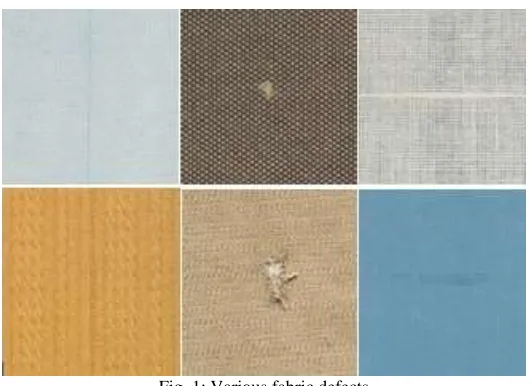
Fig. 1: Various fabric defects
List of fabric defects and reasons of defects occurrence: Double Ends
Two ends yarns are abreast weaved without weft yarns between them. It is caused by fault in warp weaving. Weaving machine skip to weaving the weft direction threats, so two or more ends yarns becomes side by side.
Knots
Knots regions are connecting together ends of the yarns. The regions are shown as fluffy parts. The reason of these defects is, the broken or finished yarns are floated for maintaining the continuity of weaving process.
Slubs
Regional defects that are bring deterioration on structural symmetry between yarns. It is caused by an extra piece of yarn that is woven into fabric. These defects are composed due to the structural disorders of fibres.
End-Out
A warp thread is absent in the fabric for a short or long distance. Burl
It is caused by incorrect picking or if the weaver restarted the loom after any stoppage without adapting the position for the new insertion.
Hole
A fabric area free of both of warp and weft threads. It is a mechanical fault caused by a broken machine part.
II. PROPOSED WORK
Automated Fabric Inspection
A fabric defect is any abnormality in the fabric that hinders its acceptability by the consumer. The textile processing does not eliminate variability incurred during different steps in textile manufacturing. As materials flow from one stage of processing to another, components of variability are added and the final product may involve a cumulative variability that is much higher than the variability of the input fibers and thus it cause a defect in the fabric. The main factors that lead to fabric defects are failure of opening and cleaning the machines that completely eliminate contaminants and trash particles, and it may leads to spinning, weaving and knitting related defects. So the fabric inspection has to identify all types of defects with minimum effort.
The wavelet transform provides a solid and unified mathematical framework for the analysis and characterization of an image at different scales. It provides both time and frequency information, and can be successfully applied for textile defect detection. Fabric defect detection based on wavelet transform performs better with less computation than the traditional statistical texture analysis approaches in identifying defects. Fault detection positioning and classification of the faults occur in the weaving machine during weaving by using the principle of image processing, an automatic fabric evaluation system, which enables computerized defect detection – analysis of weaved fabrics. Wastage reduction through accurate and early stage detection of defects in fabrics is an important aspect of quality improvement.
Fig. 2.1: Automated fabric inspection system
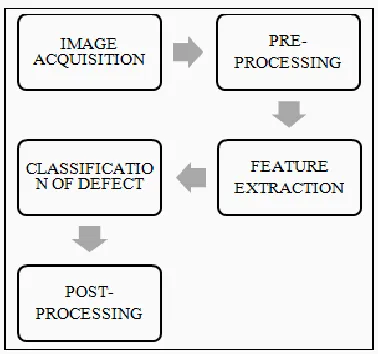
Image Acquisition
A line scan camera uses linear array photo sensors systems, so linear array photo sensors systems provides a higher resolution and can inspect a larger portion of an inspected product. The system has to be used to synchronize the camera scan rate with the transport velocity of the product.
Pre-processing
Pre-processing part is used to obtain useful information from captured fabric images by feature extraction techniques. Although fabric images are captured in high resolution, the images also include noises and other distortion.
Feature Extraction
The aim of feature extraction is to obtain useful information from an image. In the case of fabric defect detection, defected and non-defected texture are characterized and analysed. Features are very importance to most fabric defect detection systems because they possess a close relationship to the detection accuracy of the fabric defect detection method.
Detection /Classification
This part actually works like the fabric defect detector. In detection and classification section feature vectors are used to determine and classify the patterns to classes. In the detection of fabrics, since there are two classes considered: the normal fabric and the fabric defects.
Post-processing
Fabric defect identification is complete in detecting and classification process. The faults may lead to give incorrect decisions that cause disposal of more fabric and extra cost may occur on the manufacturing process to reduce the risk, a post-processor is needed after the detection
Wavelet Transform
Nowadays, wavelet transformation is one of the most popular candidates for the time-frequency-transformations. In conventional Fourier transform, we use sinusoids for basic functions. It can only provide the frequency information. Temporal information is lost in this transformation process. Conventional Fourier transform, wavelet transforms are based on small waves called wavelets. The wavelet analysis method is a time-frequency analysis method which selects the appropriate frequency band adaptively based on the characteristics of the signal. Then the frequency band matches the spectrum which improves the time-frequency resolution. The wavelet analysis method has an obvious effect on the removal of noise in the signal.
Fig. 3(a): Image of the Defected Fabric Given as Input to the System
Fig. 3(b): Output After Decomposing the Original Image in to the Gray Scale Image
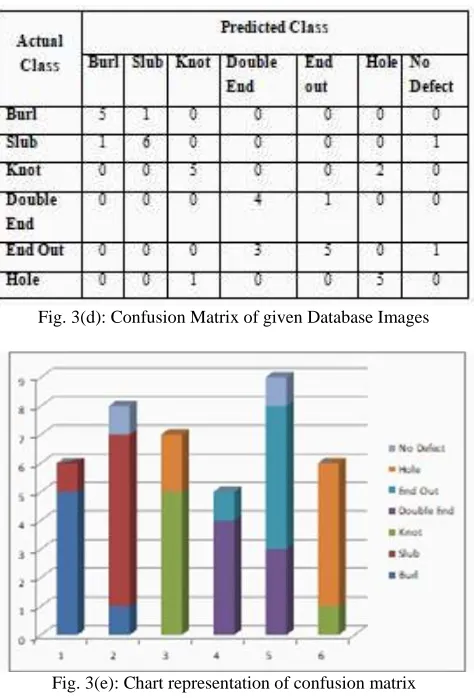
Fig. 3(d): Confusion Matrix of given Database Images
Fig. 3(e): Chart representation of confusion matrix
The use of the wavelet transform to develop an automated visual inspection method for defect detection on patterned fabric. In our research work, the various images of woven plain fabric are digitized with 512 X 512 pixels and stored in a computer as 8-bit grayscale data. Actually, the first pre-processing is implemented on the acquired fabric images to normalize them, to correct the inhomogeneous lighting conditions, to remove the noise and finally to convert the acquired digital (RGB) images to grayscale images. After this pre-processing step, our defect detection procedure is implemented for final evaluation. Moreover, a number of fabric images are firstly acquired to provide the reference (defect-free) image. During such implementation, the main defect detection parameters are set to their optimized values. It means that the fabric images are scanned by a random 1sub-image of sizes 50x50 and 60x60 pixels with 25x25 and 28x28 pixels scanning steps. From the detection results it is found that for defects like double-end, knot, slub, end-out, burl, hole, defect detection rate is to be considered as approximately constant. It means that the detection of these defects is accurate and has the lower detection errors.
IV. CONCLUSION
Textile industry is growing with a large momentum and there are many obstacles to reduce the profit. The manufacturers also deal with quality issues to increase their profit rates. The manual inspections systems reduce the quality of fabrics because of the human limited physiological nature. The interests to Fabric Defect Detection Systems (FDDS) are increasing day by day. The aim of our research is to design a high quality defect detection system. Fabrics are formed by thread groups that periodically woven. The resolution and the illumination are very important factors in fabric inspection systems. The resolution of fabrics directly affects the result of fabric inspection system. It is relatively hard to get true features from low resolution and unclear fabric images. In such case the characteristic of the fabrics disappear, so it becomes difficult for the inspection systems to decide the defected regions.So to minimize the loss due to verity of defect occurring in the fabric, a manufacturer should try to minimize those defects by using automated systems like fabric fault detection. This system will be useful for the manufacturers as it will inform about the faulty fabric in advance. It will save the time and energy of manually testing the fabric quality.