Vol. 14, No. 2, 2017, 199-212
ISSN: 2320 –3242 (P), 2320 –3250 (online) Published on 11 December 2017
www.researchmathsci.org
DOI: http://dx.doi.org/10.22457/ijfma.v14n2a4
199
International Journal of
Non-Linear Arithmetic Operations on Interval Valued
Trapezoidal Fuzzy Numbers
D.Stephen Dinagar1 and M.Manvizhi2
P.G. and Research Department of Mathematics TBML College, Porayar - 609307, India.
1e-mail: [email protected]; 2e-mail: [email protected]
Received 2 November 2017; accepted 10 December 2017
Abstract. Fuzzy numbers have been introduced by Zadeh in order to deal with imprecise
numerical quantities in a practical way. In this paper, some types of interval valued trapezoidal fuzzy numbers (IVTrFNs) and some non-linear arithmetic operations on interval valued trapezoidal fuzzy numbers have been proposed. Also relevant numerical illustrations are included to justify the above said notions.
Keywords: Fuzzy number, Interval valued trapezoidal fuzzy number, Non-linear
arithmetic operations.
AMS Mathematics Subject Classification (2010): 03E72
1. Introduction
The concept of fuzzy set was introduced by Zadeh in 1965[10]. A fuzzy set is characterized by a membership function, whose values are crisp number in [0,1]. The concept of fuzzy number is a special version of fuzzy set, which is defined on the set of real numbers. Kauffmann and Gupta [3] studied the concept on fuzzy arithmetic. Dubois and Prade [2] presented some operations on fuzzy numbers. Mizumoto and Tanaka [4] discussed some properties of fuzzy numbers. Rezvani [5-7] studied the concept of multiplication operation on trapezoidal fuzzy numbers and presented the graded mean representation with triangular fuzzy numbers. Also a new method for ranking of generalized trapezoidal fuzzy numbers using perimeters was presented by her.
Basal [1] presented some non-linear arithmetic operations on triangular fuzzy number and Vahidi and Rezvani [9] presented some non-linear arithmetic operations on trapezoidal fuzzy numbers. Dinagar and Abirami introduced the concept of more generalized interval valued fuzzy numbers and their arithmetic operations under the ranking function.
In this paper, we have studied the concept of interval valued trapezoidal fuzzy number (IVTrFNs), and some non-linear arithmetic operations on IVTrFNs.
D.Stephen Dinagar and M.Manvizhi
200
arithmetic operations on IVTrFNs. In section 4, relevant numerical illustrations are presented. Finally in section 5, conclusion is also included.
2. Interval valued trapezoidal fuzzy numbers Definition 2.1. Fuzzy number
A fuzzy set defined on the set of real numbers R is said to be a fuzzy number if its membership function has the following characteristics:
(i) is normal, (ii) is a convex set,
(iii) The support of is closed and bounded.
Definition 2.2. Interval valued trapezoidal fuzzy numbers (IVTrFNs)
An interval valued trapezoidal fuzzy number (IVTrFN) on R is given by
= , , , and ≤ for all . And it is denoted by
A
IVTr ~
= , , where = , , , and = , , , are the trapezoidal fuzzy numbers. It is also noted that ≤,≤, ≤, ≤, ≤ .
The membership function of interval valued trapezoidal fuzzy number is defined by : x → 0,1 has the following characteristic function:
=
! " " " " # " " " "
$ −
− , ≤ ≤
−
− , ≤ ≤ 1, ≤ ≤ &' ≤ ≤
−
−
,
≤ ≤
−
− ,
≤ ≤
0, ()ℎ+,-./+
0
2.4. The proposed ranking function
An efficient for comparing the fuzzy number is by the use of ranking function defined as
R:F(R) → R, where F(R) is a set of fuzzy numbers defined on a set of real number where
a natural order exists.
For IVTr A~= , ∈ F(R), then the ranking function R:F(R) → R is defined as R( A
IVTr ~
)=(+ + + + + + + )/8. Also we define orders on F(R) by
R ( A
IVTr ~
) ≥R ( B
IVTr ~
) if and only if IVTr A~
R
≥ IVTrB~,
R ( A
IVTr ~
) =R ( B
IVTr ~
) if and only if IVTr A
~ R =IVTrB
~
and R ( A
IVTr ~
) ≤R ( B
IVTr ~
) if and only if IVTr A
~ R ≤ IVTrB
~
201
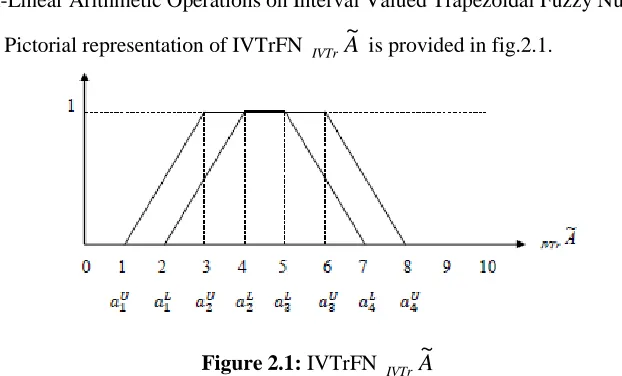
Pictorial representation of IVTrFN IVTrA~ is provided in fig.2.1.
Figure 2.1: IVTrFN IVTrA
~
2.6. Arithmetic operations on interval valued trapezoidal fuzzy numbers (IVTrFNs)
Let IVTr A
~
= , , , , , , , and IVTrB
~
= 4, 4, 4, 4 , 4, 4, 4, 4
(i) Addition for IVTrFNs:
A
IVTr ~
+IVTrB
~
=+ 4, + 4, + 4, + 4 , + 4, + 4, +
4, + 4
(ii) Subtraction for IVTrFNs:
A
IVTr ~
−IVTrB~=− 4, − 4, − 4, − 4 , − 4, − 4, −
4, − 4
(iii) Scalar multiplication for IVTrFNs:
If k ≥ 0 and k є R then k( A
IVTr ~
) = 5, 5, 5, 5 , 5, 5, 5, 5 and if k < 0 and k є R then k(IVTrA~) = 5, 5 , 5, 5, 5, 5, 5, 5
(iv) Multiplication for IVTrFNs:
If R( B
IVTr ~
)=(4+ 4+ 4+ 4+ 4+ 4+ 4+ 4)/8.
A
IVTr ~
× IVTrB
~
= [( R ( B
IVTr ~
), R ( B
IVTr ~
), R ( B
IVTr ~
), R ( B
IVTr ~
)), (R ( B
IVTr ~
), R ( B
IVTr ~
), ,R ( B
IVTr ~
), R ( B
IVTr ~
))], when R ( B
IVTr ~
)≥0
A
IVTr ~
× IVTrB~= [(R ( B
IVTr ~
), R ( B
IVTr ~
), R ( B
IVTr ~
), R ( B
IVTr ~
)), (R ( B
IVTr ~
), R ( B
IVTr ~
), R ( B
IVTr ~
), R ( B
IVTr ~
))], when R ( B
IVTr ~
)<0
(v) Division for IVTrFNs:
Whenever R ( B
IVTr ~
D.Stephen Dinagar and M.Manvizhi
202 If R ( B
IVTr ~
)>0, then
A
IVTr ~
B
IVTr
~ = [(/R (IVTrB ~
), /R ( B
IVTr ~
), /R ( B
IVTr ~
), /R ( B
IVTr ~
)), (/R ( B
IVTr ~
),
/R ( B
IVTr ~
), /R ( B
IVTr ~
), /R ( B
IVTr ~
))] If R ( B
IVTr ~
)<0, then
A
IVTr ~
B
IVTr
~ = [(/R (IVTrB ~
), /R ( B
IVTr ~
), /R ( B
IVTr ~
), /R ( B
IVTr ~
)), (/R ( B
IVTr ~
),
/R ( B
IVTr ~
), /R ( B
IVTr ~
), /R ( B
IVTr ~
))]
Definition 2.7. Zero interval valued trapezoidal fuzzy number
If IVTrA
~
= [(0,0,0,0), (0,0,0,0)], then IVTr A
~
is said to be a zero interval valued trapezoidal fuzzy number. It is denoted byIVTr
0
.Definition 2.8. Zero-equivalent interval valued trapezoidal fuzzy number
An interval valued trapezoidal fuzzy number is said to be a zero equivalent interval valued trapezoidal fuzzy number if R ( A
IVTr ~
) = 0. It is denoted byIVTr0~.
Definition 2.9. Unit interval valued trapezoidal fuzzy number
If IVTrA
~
= [(1,1,1,1), (1,1,1,1)], then IVTrA
~
is said to be an unit interval valued trapezoidal fuzzy number. It is denoted byIVTr
1
.Definition 2.10. Unit-equivalent interval valued trapezoidal fuzzy number
An interval valued trapezoidal fuzzy number is said to be an unit-equivalent interval valued trapezoidal fuzzy number if R ( A
IVTr ~
) = 1. It is denoted byIVTr1~.
Definition 2.11. Inverse interval valued trapezoidal fuzzy number
If IVTrA~be an interval valued trapezoidal fuzzy number and IVTr A~≠IVTr~0. Then its
inverse interval valued trapezoidal fuzzy number is defined by IVTrA~:= 1
~ IVTr
A
IVTr
~ . Definition 2.12. Positive interval valued trapezoidal fuzzy number
An interval valued trapezoidal fuzzy number is said to be a positive interval valued trapezoidal fuzzy number if R ( A
IVTr ~
) > 0.
203
An interval valued trapezoidal fuzzy number is said to be a negative interval valued trapezoidal fuzzy number if R ( A
IVTr ~
) < 0.
3. Non-linear arithmetic operations on interval valued trapezoidal fuzzy numbers 3.1. Modulus of an IVTrFN
Let IVTr A
~
= , , , , , , , be an IVTrFN. Then its modulus is given by ;IVTr A
~
; = <, , , , , , , <
=
[
(
) (
)
]
( )
(
) (
)
[
]
( )
< − − − − − − − − ≥ 0. ~ if , , , , , , , , 0, ~ if , , , , , , , , 1 2 3 4 1 2 3 4 4 3 2 1 4 3 2 1 A a a a a a a a a A a a a a a a a a IVTr U U U U L L L L IVTr U U U U L L L L R R3.2. Square root of an IVTrFN
Whenever R ( A
IVTr ~
) > 0, the square root of an IVTrFN
A
IVTr ~
=, , , , , , , is defined by
A IVTr ~ = = > > > > > > > > > > > > > ? @ A A A B CDE
( )
IVTrA~R
, CFE
( )
IVTr A~R
, CGE
( )
IVTrA~R
, CHE
( )
IVTrA~R I J J J K , @ A A A B CDL
( )
IVTrA~ R
, CFL
( )
IVTrA~ R
, CGL
( )
IVTrA~ R
, CHL
( )
IVTrA~ R I J J J K M N N N N N N N N N N N N N O
3.3. Exponentiation of a positive IVTrFN
By using the multiplication of two IVTrFNs, we define the exponentiation of an IVTrFN. Let IVTr A~= , , , , , , , be a positive IVTrFN.
When n ≥ 0,
PIVTrA~QR=
STUR
( )
IVTrA~ VR:
, UR
( )
IVTrA~ VR:
, UR
( )
IVTrA~ VR:
, UR
( )
IVTrA~ VR: W ,0
0 TU
( )
IVTrA ~R V
R:
, U
( )
IVTrA~
R V
R:
, U
( )
IVTrA~
R V
R:
, U
( )
IVTrA~
R V
R: WX. When n < 0,
PIVTrA
~
QR=
= > > ?
@
B CDE
T
( )
IVTrA~ R WDYZ
, CFE
T
( )
IVTrA~
R WDYZ
, CGE
T
( )
IVTrA~
R WDYZ
, CHE
T
( )
IVTrA~ R WDYZ
D.Stephen Dinagar and M.Manvizhi
204 0
@
B CDL
T
( )
IVTrA~
R W
DYZ, CF
L
T
( )
IVTrA~
R W
DYZ, CG
L
T
( )
IVTrA~
R W
DYZ, CH
L
T
( )
IVTrA~
R W
DYZ
I K M N N O
.
3.4. Exponentiation of a negative IVTrFN
Let IVTr A
~
= , , , , , , , be a negative IVTrFN. When n (≥ 1 is odd,
PIVTrA
~
QR=
[UP
( )
IVTrA ~R QR:, P
( )
A IVTr~
R QR:, P
( )
A IVTr~
R QR:, P
( )
A IVTr~
R QR:V ,0
0UP
( )
IVTrA ~R QR:, P
( )
A IVTr~
R QR:, P
( )
A IVTr~
R QR:, P
( )
A IVTr~
R QR:V\.
When n (≥ 1) is even,
PIVTrA~QR=
[UP
( )
IVTr A ~R QR:, PR
( )
IVTrA~ QR:, PR( )
IVTrA~ QR:, PR( )
IVTrA~ QR:V ,0
0UP
( )
IVTrA ~R QR:, PR
( )
IVTrA~ QR:, PR( )
IVTrA~ QR:, PR( )
IVTrA~ QR:V\.3.5. Exponential of a positive IVTrFN
We intend to formulate the exponential of an IVTrFN using the Taylor series expansion method. Since the Taylor series expansion of exponential of a real number is given by, +]=1+!]+]!F+ ⋯ , −∞ < < ∞.
For 1 =IVTr
1
and = IVTrA~= , , , , , , , be a positive IVTrFN, we have+IVTr A ~
= a @
B1 +
( )
IVTrA~R T+
( )
IVTrA~ R
− 1W , 1 +
( )
IVTrA~R T+
( )
IVTrA~ R
− 1W , 1
+
( )
IVTrA~
R T+
( )
IVTrA~R
− 1W , 1 +
( )
IVTrA~
R T+
( )
IVTrA~R
205
0 @
B1 +
( )
IVTrA~
R T+
( )
IVTrA~R
− 1W , 1 +
( )
IVTrA~R T+
( )
IVTrA~R
− 1W ,
1 +
( )
IVTrA~
R T+
( )
IVTrA~ R
− 1W , 1 +
( )
AIVTr ~
R T+
( )
IVTrA~ R
− 1Wbc.
3.6. Exponential of a negative IVTrFN
Replacing 1 by IVTr
1
and x by IVTr A~
= , , , , , , , be a negative IVTrFN in above equation, we have
+:IVTr A ~
= a @
B1 +
( )
IVTrA~
R T+
( )
IVTrA~ R
− 1W , 1
+
( )
IVTrA~
R T+
( )
IVTrA~ R
− 1W , 1 +
( )
AIVTr ~
R T+
( )
IVTrA~ R
− 1W , 1
+
( )
IVTrA~R T+
( )
IVTrA~R
− 1Wb0 0 @ B1
+
( )
IVTrA~R T+
( )
IVTrA~ R
− 1W , 1 +
( )
AIVTr ~
R T+
( )
IVTrA~ R
− 1W ,
1 +
( )
IVTrA~
R T+
( )
IVTrA~R
− 1W , 1 +
( )
IVTrA~
R T+
( )
IVTrA~R
− 1Wbc.
3.7. Inverse exponential of a positive IVTrFN
Using the definition of exponential of an positive IVTrFN, we have
+:IVTr A ~
= ae1 + CDE
( )
IVTrA~R T+
:
( )
IVTrA~ R
− 1W , 1 + CFE
( )
IVTrA~R T+
:
( )
IVTrA~ R
−
1 , 1 + CGE
( )
IVTrA~R T+
:
( )
IVTrA~ R
− 1W , 1 + CHE
( )
IVTrA~R T+
:
( )
IVTrA~ R
D.Stephen Dinagar and M.Manvizhi
206
CDL
( )
IVTrA~
R T+
:R
( )
IVTrA~− 1W , 1 + CFL
( )
IVTrA~
R T+
:R
( )
IVTrA~− 1W , 1 +
CGL
( )
IVTrA~
R T+
:
( )
IVTrA~ R
− 1W , 1 + CHL
( )
IVTrA~
R T+
:
( )
IVTrA~ R
− 1Wbc.
3.8. Inverse exponential of a negative IVTrFN
Using the definition of exponential of a positive IVTrFN, we have
+:IVTr A ~
= a @
B1 +
( )
IVTrA~
R T+
:R
( )
IVTrA~− 1W , 1
+
( )
IVTrA~
R T+
:R
( )
IVTrA~− 1W , 1 +
( )
IVTrA~
R T+
:R
( )
IVTrA~− 1W , 1
+
( )
IVTrA~R T+
:
( )
IVTrA~ R
− 1Wb0,0 @ B1
+
( )
IVTrA~
R T+
:R
( )
IVTrA~− 1W , 1 +
( )
IVTrA~
R T+
:R
( )
IVTrA~ − 1W ,1 +
( )
IVTrA~
R T+
:R
( )
IVTrA~− 1W , 1
+
( )
IVTrA~
R T+
:
( )
IVTrA~ R
− 1Wbc.
3.9. Properties on exponential of an IVTrFN
(i) +IVTr A
~
×+IVTrB ~
R
= +IVTr A ~
fIVTrB
~
.
(ii) g
A
IVTr ~
gIVTrB ~ R=+
A
IVTr ~
:IVTrB~
.
(iii)T+IVTr A ~
W
h
R
= +iIVTr A ~
207 (iv)T+IVTrA
~
W
gIVTrB ~
R
= +IVTrA ~
×IVTrB~
.
3.10. Logarithm of a positive IVTrFN
We intend to formulate the logarithm of an IVTrFN using the Taylor series expansion method.
Since the Taylor series expansion of logarithm of a real number is given by,
j(kg = −1 %]: F2]: G% ⋯ , 9 0. …… … ….(2)
For 1 =IVTr
1
and IVTrA~= , , , , , , , be a positive IVTrFN, we havej(kgPIVTrA ~
Q =
= > > > > > > > > ?
@ A B
% 1
mnopqIVTrA ~ r
( )
IVTrA~
R :, % 1
mnopqIVTrA ~ r
( )
IVTrA~
R :, % 1
mnopqIVTrA ~ r
( )
IVTrA~
R :, %
mnopqIVTrA ~ r
( )
IVTrA~
R :
I J K,
e% 1
mnopIVTrA ~
( )
IVTrA~R :,
% 1 mnopIVTrA ~
( )
IVTrA~R :,
% 1 mnopIVTrA ~
( )
IVTrA~R :,
% 1 mnopIVTrA ~
( )
IVTrA~R :bMN
N N N N N N N O
3.12. Properties on logarithm of an IVTrFN
(i) j(kgPIVTrA
~
7 IVTrB
~
Q =R j(kgPIVTrA ~
Q 2 j(kgPIVTrB ~
Q.
(ii)
mnopTIVTrA ~ W
mnopTIVTrB ~
W =R j(kgP
A
IVTr ~
Q % j(kgPIVTrB ~
Q.
(iii) smnopT
A
IVTr ~
W
R
= .
3.13. Positive solution of nth root of IVTrFN
If IVTrA~=, , , , , , , be a positive IVTrFN. Then the nth (n > 0) root of IVTrA
~
is defined by,
A
D.Stephen Dinagar and M.Manvizhi
208
tIVTrA
~
Z
=
STP
( )
IVTrA ~R Q
DYZ Z
, P
( )
IVTrA ~R Q
DYZ Z
, P
( )
IVTrA ~R Q
DYZ Z
, P
( )
IVTrA ~R Q
DYZ Z
W ,0
0 TP
( )
IVTrA ~R Q
DYZ Z
, P
( )
IVTrA ~R Q
DYZ Z
, P
( )
IVTrA ~R Q
DYZ Z
, P
( )
IVTrA ~R Q
DYZ Z
WX.
3.14. Formula for hIVTrA
~
, where a ≥ 1≥ 1 ≥ 1≥ 1
Let IVTr A ~
= +mnopCIVTr A
~
=+IVTr A ~
mnopC
= +uCD EmnopC,CFE mnopC,CGE mnopC,CHEmnopCv ,uCDLmnopC,CFL mnopC,CGL mnopC,CHL mnopCv
When IVTr A~is a positive IVTrFN, since from the definition of exponential of a positive IVTrFN, we get
IVTr A ~
= a @
B1 +
( )
IVTrA~R T+
( )
IVTrA~ R mnopC
− 1W , 1
+
( )
IVTrA~
R T+
( )
IVTrA~ R mnopC
− 1W ,
1 +
( )
IVTrA~
R T+
( )
IVTrA~R mnopC
− 1W , 1
+
( )
IVTrA~R T+
( )
IVTrA~ R mnopC
− 1Wb0 0 @ B1
+
( )
IVTrA~R T+
( )
IVTrA~ R mnopC
− 1W , 1
+
( )
IVTrA~
R T+
( )
IVTrA~ R mnopC
− 1W ,
1 +
( )
IVTrA~R T+
( )
IVTrA~R mnopC
− 1W , 1
+
( )
IVTrA~
R T+
( )
IVTrA~R mnopC
209
When IVTrA~is a negative IVTrFN, since from the definition of exponential of a negative IVTrFN, we get
IVTrA ~
= a @
B1 +
( )
IVTrA~R T+
( )
IVTrA~ R mnopC
− 1W , 1
+
( )
IVTrA~R T+
( )
IVTrA~ R mnopC
− 1W ,
1 +
( )
IVTrA~
R T+
( )
IVTrA~ R mnopC
− 1W , 1
+
( )
IVTrA~
R T+
( )
IVTrA~ R mnopC
− 1Wb0
0 @
B1 +
( )
IVTrA~R T+
( )
IVTrA~ R mnopC
− 1W , 1 +
( )
AIVTr ~
R T+
( )
IVTrA~ R mnopC
− 1W ,
1 +
( )
IVTrA~R T+
( )
IVTrA~ R mnopC
− 1W , 1
+
( )
IVTrA~R T+
( )
IVTrA~ R mnopC
− 1Wbc.
3.15. Formula for IVTr A~ B IVTr
~
, where IVTrA~ be a positive IVTrFN
If IVTrB
~
D.Stephen Dinagar and M.Manvizhi
210
A
IVTr
~ IVTrB ~ = = > > > > > > > > > > ? @ A A A A A A A A B
1 + 4
(
IVTr B~)
R @A
A B
+
( )
IVTrA~
R
(
A)
IVTr e ~ log R − 1 I J J K
, 1 + 4
(
IVTr B)
~ R @ A A B+
( )
IVTrA~
R
(
A)
IVTr e ~ log R − 1 I J J K ,
1 + 4
(
IVTr B~)
R@ A A B
+
( )
IVTrA~
R
(
A)
IVTr e ~ log R − 1 I J J K
, 1 + 4
(
IVTr B~)
R@ A A B
+
( )
IVTrA~
R
(
A)
IVTr e ~ log R − 1 I J J K I J J J J J J J J K 0, 0 @ A A A A A A A A B
1 + 4
(
IVTr B)
~ R @ A A B+
( )
IVTrA~
R
(
A)
IVTr e ~ log R − 1 I J J K
,1 + 4
(
IVTr B)
~ R @ A A B+
( )
IVTrA~
R
(
A)
IVTr e ~ log R − 1 I J J K ,
1 + 4
(
IVTr B)
~ R @ A A B+
( )
IVTr A~
R
(
A)
IVTr e ~ log R − 1 I J J K
, 1 + 4
(
IVTr B)
~ R @ A A B+
( )
IVTrA~
R
(
A)
IVTr e ~ log R − 1 I J J K I J J J J J J J J K M N N N N N N N N N N O .
If IVTrB~ be a negative IVTrFN, then
A
IVTr
~ IVTrB ~ = = > > > > > > > > > > ? @ A A A A A A A A B
1 + 4
(
IVTr B~)
R@ A A B
+
( )
IVTrA~
R
(
A)
IVTr e ~ log R − 1 I J J K
, 1 + 4
(
IVTr B~)
R@ A A B
+
( )
IVTrA~
R
(
A)
IVTr e ~ log R − 1 I J J K ,
1 + 4
(
IVTr B)
~ R @ A A B+
( )
IVTrA~
R
(
A)
IVTr e ~ log R − 1 I J J K
, 1 + 4
(
IVTr B)
~ R @ A A B+
( )
IVTrA~
R
(
A)
IVTr e ~ log R − 1 I J J K I J J J J J J J J K 0 , 0 @ A A A A A A A A B
1 + 4
(
IVTr B)
~ R @ A A B+
( )
IVTrA~
R
(
A)
IVTr e ~ log R − 1 I J J K
,1 + 4
(
IVTr B)
~ R @ A A B+
( )
IVTrA~
R
(
A)
IVTr e ~ log R − 1 I J J K ,
1 + 4
(
IVTr B)
~ R @ A A B+
( )
IVTr A~
R
(
A)
IVTr e ~ log R − 1 I J J K
, 1 + 4
(
IVTr B)
~ R @ A A B+
( )
IVTrA~
R
(
A)
IVTr e ~ log R − 1 I J J K I J J J J J J J J K M N N N N N N N N N N O . 3.16. Properties
(i) IVTr A
~ 1
~ IVTr
R
= IVTr A
~ .
(ii) IVTr A
~ 0
~ IVTr
R
= IVTr1~.
(iii)IVTr A
~ IVTrB ~
R
= q 1
~ IVTr
r
:IVTrB
~
A
211 (iv)UIVTrA
~:w
V:w=R IVTrA
~ .
4. Numerical illustrations
(i) Consider x|−7, −6, −3,1, −8, −6, −5,2|.
Let IVTrA~ = −7, −6, −3,1, −8, −6, −5,2, R
( )
IVTrA~ = −4.Then, ;IVTrA
~
; = (−1,3,6,7), (−2,5,6,8)
t;IVTrA~; = : ,, 3,, −1,, 3,4.
(ii) Consider +(,,,),(:,,,). Then, +(,,,),(:,,,)
≈ ≈≈
≈(1,13.7237,20.0856,39.1711), (−5.3618,7.3618,32.8092,51.8948).
(iii) Consider (1,2,5,7), (2,4,5,6)(,,,),(,,,). Then,
(1,2,5,7), (2,4,5,6)(,,,),(,,,)
≈ (128.5,256,319.75,383.5), (64.75,192.25,319.75,383.5).
5. Conclusion
In this paper, we discussed some types of interval valued trapezoidal fuzzy numbers and introduced some non-linear arithmetic operations like modulus, square root, exponentiation etc., of interval valued trapezoidal fuzzy numbers. By using these operations, the fuzzy transcendental equations corresponding to interval valued trapezoidal fuzzy numbers and their solutions may be utilized in future.
REFERENCES
1. A.Bansal, Some non linear arithmetic operations on triangular fuzzy numbers (m,a,b), Advances in Fuzzy Mathematics, 5 (2) (2010)147-156.
2. D.Dubois and H. Prade, Operation on fuzzy number, International Journal of
Fuzzy Systems, 9 (1978) 613–626.
3. A.Kauffmann and M.M.Gupta, Introduction to Fuzzy Arithmetic: Theory and Applications, New York: Van Nostrand Reinhold, (1991).
4. M.Mizumoto and K.Tanaka, Some properties of fuzzy numbers, in Advances in Fuzzy Set Theory and Applications (M. M. Gupta, R. K. Ragade, and R. R. Yager, Eds.), North-Holland, Amsterdam, (1979) 153-164.
5. S.Rezvani, Graded mean representation method with triangular fuzzy number,
World Applied Sciences Journal, 11 (7) (2010) 871-876.
6. S.Rezvani, Multiplication operation on trapezoidal fuzzy numbers, Journal of
Physical Sciences, 15 (2011)17-26.
7. S.Rezvani, A new approach ranking of exponential trapezoidal fuzzy numbers,
Journal of Physical Sciences, 16 (2012) 45-57.
8. D.S.Dinagar and D.Abirami, On critical path in project scheduling using topsis ranking of more generalized interval valued fuzzy numbers, Malaya Journal of
D.Stephen Dinagar and M.Manvizhi
212
9. J.Vahidi and S. Rezvani, Arithmetic operations on trapezoidal fuzzy numbers,
Journal Nonlinear Analysis and Application, 2013 (2013) 1–8.