Vol. 3, 2013, 86-92
ISSN: 2320 –3242 (P), 2320 –3250 (online) Published on 30 December 2013
www.researchmathsci.org
86
International Journal of
Wiener Index of Some Graphs in the Context of
Switching Operation
K. Thilakam1 and A. Sumathi2
1
Associate Professor, PG and Research Dept. of Mathematics, Seethalakshmi Ramaswami College, Tiruchirappalli – 620 002, India 2
Assistant Professor, Dept. of Mathematics, Seethalakshmi Ramaswami College, Tiruchirappalli – 620 002, [email protected]
Received 11 December 2013; accepted 26 December 2013
Abstract. A topological representation of a molecule is called molecular graph. A molecular graph is a collection of points representing the atoms in the molecule and set of lines representing the covalent bonds. These points are named vertices and the lines are named edges in graph theory language. One of the most widely known topological descriptors is Wiener index. It is named after chemist Harold Wiener who introduced in the year 1947. The Wiener index W (G) is a distance-based topological invariant much used in the study of the structure-property and the structure-activity relationships of various classes of biochemically interesting compounds. It is defined by the sum of the distances between all (ordered) pairs of vertices of G. In this paper, we find the Wiener index of switching the consecutive vertices in a cycle, path graphs.
Keywords: Adjacency Matrix, Wiener Index, MATLAB
AMS Mathematics Subject Classification (2010): 05C12, 05C85 1. Introduction
The Wiener index W(G) is a distance-based topological invariant much used in the study of the structure-property and the structure-activity relationships of various classes of biochemically interesting compounds introduced by Harold Wiener in 1947 for predicting boiling points b.p of alkanes based on the formula
γ β
α + +
= (3)
.p W w
b
whereα,β,γare empirical constants, and w(3) is called path number [1,9]. It is defined as the half sum of the distances between all pairs of vertices of G.
∑
∈ = G v u v u d G W , ) , ( 2 1 ) (where d(u,v) is the number of edges in a shortest path connecting the vertices u and v in G.
Notation: [1,10]
∑
∑
∑
< < ∈ = = = j i j i v u G v u u u d v u d v u d G
W ( , ) ( , ) ( , )
2 1 ) (
Wiener Index of Some Graphs in the Context of switching Operation
87 2. Definitions and preliminaries
Ournotationisstandardandmainlytakenfromstandardbooksofgraphtheory.In this paper, we consider finite, nontrivial, simple and undirected graphs. For a graph G, we denote by V(G) and E(G), its vertex and edge sets, respectively [2,3,4].
Let G = G(V;E) be a finite, simple graph. For a vertex v∈V, theoperation of switching at v transforms G to a new graph Gv by deleting alledges adjacent to v, and adding all potential edges from v to vertices notpreviously connected. This operation is known as vertex switching, nodeswitching, or Seidel Switching. It was originally introduced by J.H. van Lint and J.J. Seidel in 1966 as a tool to study equilateral point sets in elliptic spaces [5,8].
In 1973, J.J. Seidel was discussed about switching in ‘A survey of two-graphs’ as the operation of switching is an elegant example of a graph transformation, where the global transformation of a graph is achieved by applying local transformations to the vertices. The elegance stems from the fact that the local transformations are group actions, and hence basic techniques of group theory can be applied in developing the theory of switching. For a finite undirected graph G = (V;E) and a subset σ⊆ V , the switch of G by σ is defined as the graph G σ = (V;E’), which is obtained from G by removing all edges between σ and its complement V - σ and adding as edges all non-edges between σ and V - σ. The switching class [G] determined (generated) by G consists of all switches G σ for subsets σ⊆V [6].
In this paper, In particular we consider σbe the set of {1,2,….t} consecutive verticesand σ⊂V. In this article, we have given MATLAB Program for computing Adjacency matrix of switching the consecutive vertices in a Cycle Cn and Path Pn. This article is the continuation of the work [7] in which we had given MATLAB Program for computing Wiener index.
3. Switching the vertices in a cycle Cn
Lemma3.1. Let G be a cycle with n vertices and switching any one of its vertices then
1
4,5 3 6.
Proof: Let v1,v2, …,vn be the successive vertices of Cn and Gv denotes graph obtained by switching one of the vertex v of G= Cn. Without loss of generality, let the switched vertex be v1. We note that ( )
1
v
G
V = n and ( )
1
v
G
E =2n-5.It follows immediately from the basic definition of W(G).
Figure 1: Switching a arbitrary vertex in C5
K. Thilakam and A. Sumathi
88
Theorem 3.2. Let G be a cycle with n vertices and switching t consecutive vertices then W(
i
v
G ) = n2-(n-1)t+t2-5 for 1≤ t ≤ n-5, for all n≥6 = n2-3n+6 for t = n-4, for all n≥5 = (n-1)2 for t =n-3, for all n≥4.
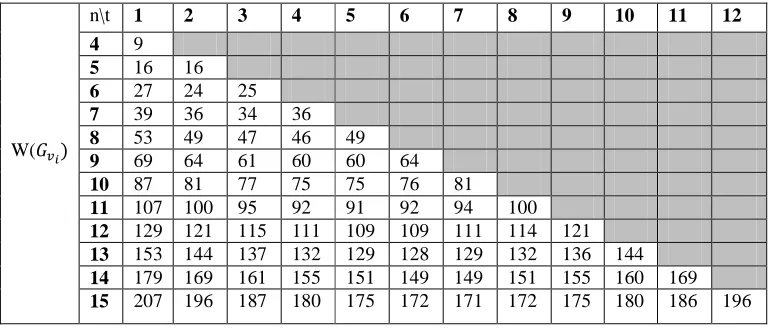
Switching of t consecutive vertices in a cycle Cn,where 4≤n≤15 and 1≤t≤n-3.
Table 1: Programme for Finding Wiener index of a cycle Cn, by switching t consecutive vertices
MATLAB programme:
n= input('Cycle with vertices n=');
t= input('No. of consecutive switching vertices t='); A=[];
W(
n\t 1 2 3 4 5 6 7 8 9 10 11 12
4 9
5 16 16
6 27 24 25
7 39 36 34 36
8 53 49 47 46 49
9 69 64 61 60 60 64
10 87 81 77 75 75 76 81
11 107 100 95 92 91 92 94 100
12 129 121 115 111 109 109 111 114 121
13 153 144 137 132 129 128 129 132 136 144
14 179 169 161 155 151 149 149 151 155 160 169
15 207 196 187 180 175 172 171 172 175 180 186 196
Figure 2: Switching two consecutive vertices in C8
Wiener Index of Some Graphs in the Context of switching Operation
89 if n>=3&&t<=n-3
for j=t+2:n-1 for k=1:t for i=t+1:n-1
A(i,i+1)=1;A(i+1,i)=1; end
A(k,j)=1;A(j,k)=1; end
end A;
G = sparse(A); disp('Distance matrix')
DM = graphallshortestpaths(G,'directed',false) M=sum(sum(DM));
fprintf('Wiener index of switching, W = %d \n' , M/2) elseif n==3||t>(n-3)
disp('Switching does not exist') end
4. Switching the vertices in a path Pn
Lemma 4.1. Let G be a path with n vertices and switching one of its end vertices then W(Gv) = (n-1)
2
for n = 3 = n(n-2) for n ≥ 4
Proof: Let v1,v2, …,vn be the successive vertices of Pn and Gv denotes the graph obtained by switching of any one of its end vertex v of G= Pn. Without loss of generality, let the switched vertex be v1.
We note that ( )
1
v
G
V = n and ( )
1
v
G
E =n+1. It follows immediately from the basic definition of W(G).
Figure 4: Switching a end vertex in P4
Now we see, switching of t consecutive vertices in a Path.We note that in a Path with n vertices, maximum possibility of switching vertices be n-2. If it exceeds n-2, the graph tends to disconnected.
K. Thilakam and A. Sumathi
90 W(
i
v
G ) = n2–n+ t(1-n)+t2-2,1≤t≤n-3,n≥5 = n(n-2)for t = n-3 for all n=4. = (n-1)2 for t = n-2 for all n≥3.
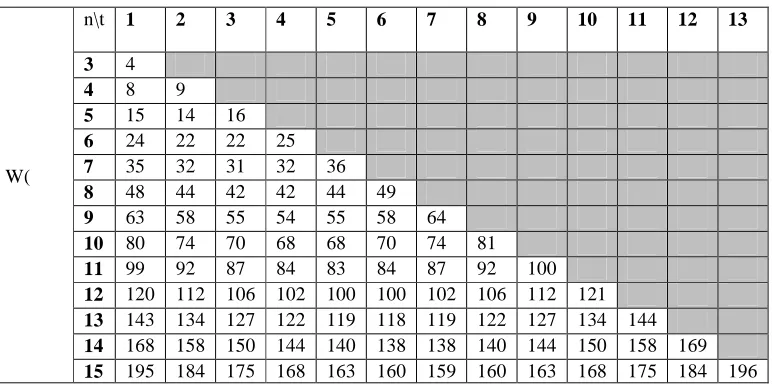
Table 2: The above table illustrates Switching of t consecutive vertices in a path Pn, Where 3≤ n ≤ 15 and 1≤ t ≤ n-2
W(
n\t 1 2 3 4 5 6 7 8 9 10 11 12 13
3 4
4 8 9
5 15 14 16
6 24 22 22 25
7 35 32 31 32 36
8 48 44 42 42 44 49
9 63 58 55 54 55 58 64
10 80 74 70 68 68 70 74 81
11 99 92 87 84 83 84 87 92 100
12 120 112 106 102 100 100 102 106 112 121 13 143 134 127 122 119 118 119 122 127 134 144 14 168 158 150 144 140 138 138 140 144 150 158 169 15 195 184 175 168 163 160 159 160 163 168 175 184 196
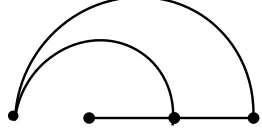
Figure 5: Switching 2 consecutive vertices in P5,
Wiener Index of Some Graphs in the Context of switching Operation
91
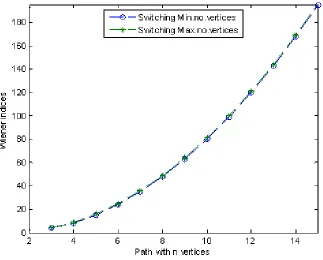
Figure 7: Comparison of Wiener index of cycle with respect to switching vertices
K. Thilakam and A. Sumathi
92 5. Conclusion
In this paper, we have determined the Wiener index of switching a particular vertex, consecutivevertices in a cycle, pathgraphsand compared the maximum and minimum Wiener indices with respect to the switching vertices in MATLAB Approach.
REFERENCES
1. Ante Graovac and TomazPisanski, On the Wiener index of a graph, Journal of Mathematical Chemistry, 8 (1991) 53-62.
2. R.Balakrishnan and K.Renganathan, A Text Book of Graph Theory, Springer-Verlag, New York, 2000.
3. I.Gutman and O.E.Polansky, Mathematical Concepts in Organic Chemistry, Springer-Verlag, Berlin, 1986.
4. F. Harary, Graph Theory, Addison –Wesley, Reading, MA, 1971.
5. J. Hage, T. Harju and E. Welzl, Euler graphs, triangle-free graphs and bipartite graphs in switching classes, Fundamenta Informaticae, 58(1) (2003) 23–37.
6. J.J.Seidel, A survey of two-graphs, Colloquio Internazionalesulle Teorie Combinatorie (Rome, 1973) Accad. Naz. Lincei, Rome, 1976, pp. 481–511. Attidei Convegni Lincei, No. 17
7. K.Thilakam and A.Sumathi, How to Compute the Wiener index of a graph using MATLAB, Intern. J. Applied Mathematics and Statistical Sciences, 2(5) (2013) 143-148.
8. S.K.Vaidya and N.B.Vyas, Antimagic labeling in the context of switching of a vertex, Annals of Pure and Applied Mathematics, 2(1) (2012) 33-39.
9. H.Wiener, Structural determination of paraffin boiling points, J.Am chem. Soc., 6 (1947) 17-20.