An Effective Data Distribution using Resource
Allocation in CR Networks through Balanced
Queue
B. Shivashankar M. Selvakumar
Student Student
Department of ComputerScience & Engineering Department of ComputerScience & Engineering Knowledge Institute of Technology, Salem Knowledge Institute of Technology, Salem
E.Mohanraj Mr.T. Karthikeyan
Student Assistant Professor
Department of ComputerScience & Engineering Department of ComputerScience & Engineering Knowledge Institute of Technology, Salem Knowledge Institute of Technology, Salem
Abstract
Cognitive Radio (CR) is an emerging technology for future wireless communication and technology. In the existing system, there is a multiple allocation over all the bands and also there is a crisis for spectrum availability, therefore a new approach for spectrum licensing is needed. Hence the optimal solution for the above case is cognitive radio. the resource-allocation problem in multihop CR networks is modeled as a multicommodity flow problem. To solve this problem, the queue-balancing flow control method is proposed. Considering the characteristics of CR, we adopt the queue-balancing to multihop CR networks with varying link capacity and dynamic spectrum conditions. Using the queue-balancing framework, we analyzed distributed resource allocation. The data rate, power, and channel allocation are determined by the local queue size and adjusted to reflect the status of channels and the throughput requirement on each link. The optimal rate control for each session on a link is derived first. Power allocation at nodes is divided into two levels, which are the power allocation between links and the water-filling power allocation for the channels within a link. Coordination between links for channel allocation is achieved by exchanging some control messages between neighboring nodes according to the estimated channel-holding utilities for each channel on a link. We also proposed a time based scheme in order to change the spectrum dynamically to avoid data stagnation.
Keywords: Resource Allocation, Queue Balancing, Throughput
_______________________________________________________________________________________________________
I.
I
NTRODUCTIONCognitive Radio (CR) is an emerging technology for future wireless communication and technology.
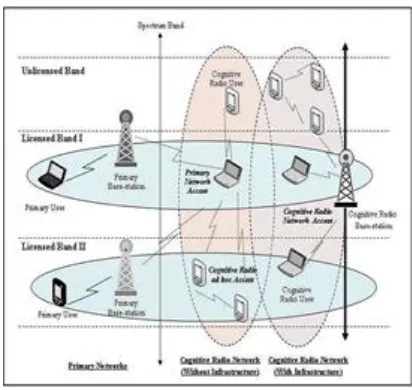
Cognitive Radio was first introduced by J.Mitola and it is defined as follows: An intelligent wireless communication system that is aware of its surrounding environment (i.e., outside world), and uses the methodology of understanding-by-building to learn from the environment and adapt its internal states to statistical variations in the incoming RF stimuli by making corresponding changes in certain operating parameters in real-time. The main functions of a cognitive radio can be listed as:
Spectrum Sensing: A.
As the first and most important function of a cognitive radio, it is the process of detecting unused portions of spectrum in order to use them opportunistically.
Spectrum management: B.
Once the spectrum holes are detected, the cognitive radio must then have the ability to choose the channel that suits its communication requirements.
Spectrum mobility: C.
Since the the cognitive radios are given lower priority, they should be able to suspend their communication in case a licensed user comes back and seamlessly move onto another vacant channel.
Spectrum sharing: D.
Fig. 1: Basic Cognitive Radio Architecture
II.
M
OTIVATIONSignificant underutilization of the radio spectrum. Basically Cognitive Radio solves the spectrum underutilization problem in a tightly inter-coupled pair of ways:
Sense the radio environment to detect spectrum holes in terms of both time and location.
Control employment of the spectrum holes by secondary users efficiently, subject to the constraint: The total power in each spectrum hole does not exceed a prescribed limit.
In this paper, we propose a distributed resource-allocation scheme that meets end-to-end (E2E) throughput demands for multiple sessions in multihop CR networks. For cognitive radio, the proposed scheme considers the power mask for each channel and can adapt itself to account for the spectrum dynamics according to the spectrum condition and the current link transmission requirement. Applying the queue-balancing method in CR networks, the original problem of meeting the throughput demands is transformed to a new optimization problem of decreasing the potential function of the queue length. The flow control, power allocation, and channel allocation are considered jointly to balance the queue sizes. The proposed distributed scheme is also suitable for asynchronous scenarios in which not all the network nodes have to execute the scheme at the same time. The main contributions of this paper are summarized as follows.
It extends the queue-balancing flow control from wired and wireless networks to CR networks, especially asynchronous CR networks, in which link capacities are dictated by not only dynamic resource allocation, but also the primary users’ activities.
It proposes a node-level resource-allocation scheme deployed in each node based only on local information available to the node. The data rate, transmit power, and channel allocation are determined by the current queue size and adjusted to account for the status of channels and the throughput requirement on each link.
It investigates the network-level performance. The proposed scheme makes a significant performance improvement, especially in the presence of a large number of primary users. The resultant parameter configurations guarantee the network stability if the network has large enough capacity to satisfy the throughput requirements of all sessions. The performance of the proposed scheme in asynchronous scenarios is analyzed. The cases of spectrum dynamics and insufficient network capacity are also considered.
III.
S
YSTEM MODELThe multihop CR network under consideration is assumed to consist of a set of nodes V and a set of links L. Let and denote the transmitter and receiver of link, respectively. Each node is equipped with two radio interfaces, one for transmitting data and the other for receiving data. OFDM is assumed to have been deployed in the network, so multiple channels can be used in each interface. In order to reduce the complexity of resource allocation, several subcarriers are combined to be a ―channel.‖ Note that the resource allocation and flow control in this paper are only for data transmission, not for control information. We assume that there are some other dedicated channels deployed for exchanging control information. Because of equipment’s limited capability, each node has a power constraint, so the total power on all the channels transmitting from node should not exceed pi
Based on the Shannon capacity formula, the capacity of link I can be written as
To protect the communication of the primary nodes, the transmit power of CR nodes should be restricted as
The maximum transmit power of node i on channel k is
If there is no primary user nearby, the CR nodes can transmit with as much power as they can if some primary users are discovered via spectrum sensing, the CR nodes should transmit with the power less than a certain threshold to avoid an unacceptable level of interference to the primary receivers.
IV.
Q
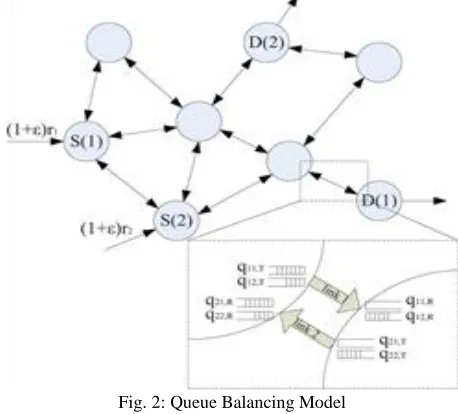
UEUE BALANCING MODELBased on queue-balancing network flow control that is ideally suited for handling dynamically changing spectrum availability in CR networks, we propose a distributed scheme (installed and operational in each node) for optimal resource allocation without exchanging spectrum dynamics information between remote nodes
We adopt the queue-balancing flow control, which does not choose paths for each commodity, but pushes the data from sources to the corresponding destinations by using ―queue potential.‖ Because of the queuing system, we attempt to satisfy only the throughput requirement.
The data need to be pumped into the network at a rate higher than the required rate. Therefore, the data enters the network. If the queue of some source is beyond a limit, which is the maximum allowed queue size, the overtop data is stored at another special overflow buffer.
Fig. 2: Queue Balancing Model
V.
P
OWER ALLOCATIONFor CR networks, each node has the power mask on every channel to protect primary users, and the status of channels in a licensed spectrum may change because of the primary users’ activities, which is known as spectrum dynamics. These characteristics of CR networks introduce new challenges in resource allocation.
To protect the communication of the primary nodes, the transmit power of CR nodes should be restricted based on certain threshold value. If there is no primary user nearby, the CR nodes can transmit with as much power as they can. The maximum allowed power for node on channel because of the equipment’s limited capability. If some primary users are discovered via spectrum sensing, the CR nodes should transmit with the power less than a certain threshold to avoid an unacceptable level of interference to the primary receivers.
VI.
D
ISTRIBUTED CHANNEL ALLOCATIONInterference Free Channel Allocation: A.
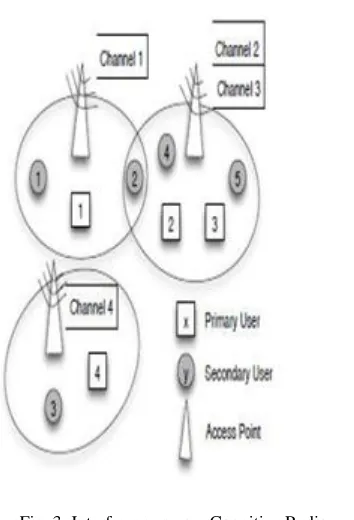
In order to allocate channels efficiently, we first estimate the potential change as a result of adding or subtracting a channel on each link. By having the transmitter nodes adjust the power allocation adaptively, we can improve the potential decrease. It is difficult to calculate the exact improvement of the potential decrease because the channel allocation on other links of this node may also change.
Fig. 3: Interference aware Cognitive Radio
The allocation of a channel on a particular link means that other links cannot use this channel. Although this channel may achieve different performance levels on all the interfering links because of different power masks, the utility divided and can give an estimation of potential change in terms of the average of all the interfering links.
Coordination between Links: B.
The coordinated channel access problem between CRs by formulating it as a joint power/rate control and channel assignment optimization problem. Given the available channels at different CRs, we need to specify for each CR which channels it should transmit on and what powers and rates it should use on these channels.
Allocation of a single channel can be modeled as a weighted independent set problem, which is NP-complete [21]. Therefore, we propose a greedy channel-allocation protocol, achieving suboptimality.
We define three types of messages —INFO, REQ, OCCUPY—
That contains the information of channel index, link index, and the corresponding channel-allocation utility: INFO: used to exchange the channel-allocation utility between nearby nodes;
REQ: request for the channel allocation if the channel-allocation utility is larger than when the channel is allocated to other nodes;
OCCUPY: to notify nearby nodes of the channel occupation.
For simplicity, the messages can be sent to the nodes within two times of the interfering range from node, such that all the nodes in N can receive the messages.
Algorithm: C.
VII.
N
ODE BASED DISTRIBUTIONBased on the above analysis, we propose a node-based distributed algorithm for joint flow control, channel allocation, and power control in CR networks.
Step 1) Update the queue sizes at each node.
Step 2) Send the control information needed for resource allocation.
Step 3) Determine the resource allocation and exchange INFO and REQ, if necessary.
Step 4) Adjust the channel allocation strategy and determine the corresponding power and data rate for each session. Send OCCUPY for new channel occupation.
In Step 1, add to the queue sizes at the source nodes. At the destinations, decrease the queue sizes of the corresponding sessions to 0. Balance the queue sizes within each node for all of its sessions.
In Step 2, nodes transmit the control information to the nodes that transmit packets to it. The information includes the noise and the inference from other systems for each channel, the queue size of each session for receiver links, and the channel-quality feedback. In addition, the nodes need to transmit the link number and to the nodes N .
In Step 3, we restrict at most one REQ transmitted for each link because the channel occupation utilities are calculated by considering only one channel allocation change based on the current status, although channels are allocated individually as described in the last section. Channel is chosen if the difference between and the maximum utility of the received messages is the largest for all channels.
In Step 4, the channel allocation is determined according to INFO and REQ. Based on the allocated channels for each link, the optimal power allocation for the links and the rate control scheme within each link.
VIII.
C
ONCLUSIONspectrum dynamics can be adjusted only by using local queue information. The adaptation to the spectrum dynamics is also investigated.
R
EFERENCES[1] Wei Wang, Kang G. Shin, and Wenbo Wang, ―Distributed Resource Allocation Based on Queue Balancing in Multihop Cognitive Radio Networks,‖
IEEE/ACM TRANSACTIONS ON NETWORKING, VOL. 20, NO. 3, JUNE 2012.
[2] Huli Chung, Qinghai Yang ; Fenglin Fu ; Kyung Sup Kwak, K. ,Spectrum sharing with smooth supermodular game in cognitive radio networks,”
Hangzhou, IEEE/ACM Transactions , volume: 23 ,pp 543 - 547, 12-14 Oct. 2011.
[3] Akyildiz, I., Won-Yeol Lee ,Chowdhury, K. ,“Spectrum management in cognitive radio ad hoc networks,” Networking, IEEE/ACM Transactions ,
volume: 23 ,pp 6-12 , Aug 2009 .
[4] Peh .E.C.Y ,Yai Chang Laing ,Yang Liang Gung , “Optimization of Cooperative Sensing in Cognitive Radio Networks: A Sensing – Throughput Tradeoff
View,” IEEE Transaction , Volume 58, pp 5294 - 5299 , DEC 2008.
[5] Shung Lli , Zizhan Zheng ; Ekici, E. ; Shroff, N. ,‖ Maximizing system throughput by cooperative sensing in Cognitive Radio Networks ,” IEEE Transaction , Volume 58, pp 1575 - 1583, March 2012
[6] Caoxie Zhang ,Xinbing Wang , Jun Li ,“Cooperative Cognitive Radio with Priority Queueing Analysis,” Communications, ICC '09. IEEE International
Conference on, pp 1 - 5 , June 2009.
[7] Eriyilmaz .A ,Srikant .R , “Fair Resource Allocation in Wireless Networks using queue-length based Scheduling and congestion control ,” IEEE
Transaction , pp 4710 - 4718 , DEC 2008.
[8] Shanshan Wang , Junshan Zhang ; Lang Tong, “Delay Analysis for Cognitive Radio Networks with Random Access: A Fluid Queue View,” IEEE
Transaction , pp 1 - 9, May 2010.
[9] Bansal .G ,Hossain .M.J ,Bhargava .V.K , “Optimal and sub Optimal Power Allocation Schemes for OFDM – based Cognitive Radio Systems,” IEEE
Transaction , pp 410 - 421 , DEC 2008.
[10] Neely, M.J. ,Modiano, E. ; Rohrs, C.E. , “Dynamic power allocation and routing for time varying wireless networks,” Networking, IEEE/ACM
Transactions , volume: 1.1 ,pp 745 - 755 , April 2003.
[11] Girnyk, M.A. , Ming Xiao , Rasmussen, L.K. ,“Optimal power allocation in multi-hop cognitive radio networks,” Communications, IEEE Transactions ,
pp 472 - 476 , January 2012 .
[12] Wenchi Cheng ,Xi Zhang ,Hailin Zhang , “Full duplex spectrum sensing in non-time-slotted cognitive radio networks ,” MILITARY
COMMUNICATIONS CONFERENCE, pp 1029 - 1034 , Nov 2011 .
[13] Anh Hoang ,Ying-Chang Liang , Yonghong Zeng ,“Adaptive joint scheduling of spectrum sensing and data transmission in cognitive radio networks,”