The Open Journal of Occupational Therapy
The Open Journal of Occupational Therapy
Volume 7
Issue 4 Fall 2019 Article 14
October 2019
Facilitating the Creative Process Through Collaboration
Facilitating the Creative Process Through Collaboration
Jennifer K. Fortuna
Grand Valley State University - USA, [email protected]
Follow this and additional works at: https://scholarworks.wmich.edu/ojot
Part of the Occupational Therapy Commons, and the Painting Commons
Recommended Citation Recommended Citation
Fortuna, J. K. (2019). Facilitating the Creative Process Through Collaboration. The Open Journal of Occupational Therapy, 7(4), 1-5. https://doi.org/10.15453/2168-6408.1687
This document has been accepted for inclusion in The Open Journal of Occupational Therapy by the editors. Free, open access is provided by ScholarWorks at WMU. For more information, please contact
Abstract Abstract
Miles Parker Scharfenberg, an artist based in Richland, Michigan, provided the cover art for the Fall 2019 edition of The Open Journal of Occupational Therapy (OJOT). “Late Night Fireworks” is a 30” x 40” painting made from acrylic on canvas. Born 15 weeks premature, Miles’ multiple health impairments have made it difficult to engage in meaningful occupations, such as painting. With support from his mother, Carol; occupational therapy students; and members of the community; Miles creates colorful abstract expressionist paintings. Collaboration is part of his creative process. In this fifth anniversary issue of OJOT, Occupation and the Artist is following up with a past artist for the first time. Over the last five years, Miles has further developed his skill and abilities as a painter while discovering his potential as an artist.
Keywords Keywords
occupational therapist, occupational therapy, art, painting, collaboration, health, cerebral palsy
Credentials Display
Jennifer K. Fortuna, MS, OTRL
Copyright transfer agreements are not obtained by The Open Journal of Occupational Therapy (OJOT). Reprint permission for this Occupation and the Artist should be obtained from the corresponding author(s). Click here to view our open access statement regarding user rights and distribution of this Occupation and the Artist.
DOI: 10.15453/2168-6408.1687
This occupation and the artist is available in The Open Journal of Occupational Therapy:
1 Human beings have a biological need to be active. “The human spirit for activity is actualized, in a healthy way, through engagement in occupation: self-initiated, self-directed activity that is productive for the person (even if the product is fun) and contributes to others (Yerxa, 1998, p. 412). The profession of occupational therapy is founded on the relationship between health and engagement in meaningful occupation. Reilly (1962) hypothesized, “Man, through the use of his hands, as energized by mind and will, can influence the state of his own health” (p. 2). For individuals with multiple impairments, achieving health through participation in occupation often requires support from another person.
According to Yerxa (1998), “Humans can influence the state of their own health, provided that they are given the opportunity to develop the skills to do so” (p. 417). The occupational therapy process
facilitates health and well-being through a collaborative and client-centered approach to service
delivery. Health-promoting occupational therapy practice affords clients opportunities to discover their potential.
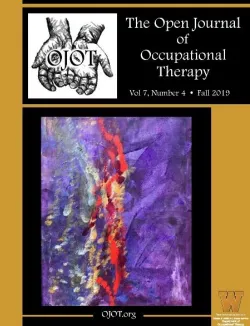
Miles Parker Scharfenberg, an artist based in Richland, MI, provided the cover art for the Fall 2019 edition of The Open Journal of Occupational Therapy (OJOT). “Late Night Fireworks” is a 30” x 40” painting made from acrylic on canvas (see Figure 1). Born 15 weeks premature, Miles’ multiple health impairments have made it difficult for him to engage in meaningful occupations, such as painting. With support from his mother, Carol; occupational therapy students; and members of the community; Miles creates colorful abstract expressionist paintings. Collaboration is part of his creative process. In this fifth anniversary issue of OJOT, Occupation and the Artist is following up with a past artist for the first time. Over the last five years, Miles has further developed his skill and abilities as a painter while discovering his potential as an artist.
Miles Scharfenberg is a young man with a curious and adventurous spirit. Born 15 weeks premature, Miles weighed less than two pounds. “I was devastated,” said his mother, Carol
Scharfenberg. “I did not believe he would live.” Miles was transferred to the neonatal intensive care unit (NICU), where he received a feeding tube, oxygen, and regular breathing treatments. “He was not about to give up, so I could not either,” said Carol. After 3 months in the NICU, Miles was discharged home. Still in a fragile state, he required numerous medical services and therapies. Prior to his first birthday, Miles endured seven eye surgeries and was fitted for hearing aids. He needed supplemental oxygen to breathe for the first 2 years of his life. Miles’ subsequent diagnoses included spastic quadriplegic cerebral palsy, bronchio-pulmonary dysplasia, hearing impairment, and retinopathy of prematurity resulting in legal blindness. Miles is nonverbal and communicates through gestures and noises. He uses
Figure 1. Cover art for OJOT, Vol 7, No 3, Fall 2019.
1 Fortuna: Facilitating the Creative Process Through Collaboration
2 a power wheelchair for mobility and can stand with a four-wheeled walker. With support from his care team, Miles lives life to the fullest. “Miles likes to go anywhere, and do anything,” said Carol.
Carol Scharfenberg is an occupational therapist with over 40 years of experience in mental health and pediatric settings. Prior to Miles’ birth, Carol served as part-time faculty for the Department of Occupational Therapy at Western Michigan University (WMU). After Miles’ arrival, she transitioned from clinical practice and academia into an administrative role. “Nurses and therapists came to our home several times per week for the first few years of Miles’ life,” she said. Miles required 24-hour care, so Carol stayed up with him through the night. “I would sleep when an aide came to the house in the morning,” she said. All of Miles’ aides were occupational therapy students. Carol began partnering with WMU’s occupational therapy program when Miles was 6 months old. “We were very lucky to have them,” she said.
Miles has always shown interest in functional activities. In her occupational therapy practice, Carol noted that people who are severely impaired often do not have opportunities to engage in creative art-based activities (Bathje, 2013). Carol believes creative arts and occupational therapy are a natural fit. “It is all about creating something meaningful,” she said. “When you come out with a final product at the end, it makes all the difference.” Art has always been a part of Carol’s life. Approximately 10 years ago, she decided to engage Miles in painting projects. She set up an accessible home art studio in her barn. Carol made sure the process was collaborative by creating opportunities for Miles to make his preferences known. “It is more important to engage in purposeful activity than busy work,” she said. “As soon as Miles started splashing colors on the canvas, he was thrilled. It was amazing!”
During the colder months, Carol moved their art projects indoors. “We painted watercolors at the coffee table, and with acrylics in the foyer at a large easel,” she said. Changing locations was also a means to challenge Miles’ physical abilities, including seated posture, reach, and upper extremity range-of-motion. Some of Miles’ first art projects were multi-media collages made from paint and torn paper. “One collage looked like zebra stripes, so we named it “Safari,” said Carol. The collage is still on exhibit in the permanent collection at Mary Free Bed Rehabilitation Hospital in Grand Rapids, MI. It was the first painting of many Miles has sold to the public. “Miles has sold several pieces to Mary Free Bed,” said Carol. “Much of their art is done by artists, many of whom have physical disabilities.”
Carol involves Miles in every step of the creative process, including painting and assembling the wooden frames and attaching the canvas with staples. “Power tools are his favorite,” she said. For Miles, participating in meaningful occupations requires a collaborative approach. Occupational therapy
intervention involves collaboration with clients to facilitate engagement in occupation related to health, well-being, and participation (American Occupational Therapy Association [AOTA], 2014).
“Collaboration is part of Miles’ creative process,” said Carol. “It allows him to participate.”
Carol partnered with the Department of Occupational Therapy at WMU to find students who could assist with Miles’ care. The occupational therapy students who have worked with Miles over the years have found their experiences equally as beneficial. Students Laura Wiencek and Hannah Reinhold have been caring for Miles several times per week for almost 2 years. “It is always very exciting
working with Miles,” said Laura. “Every time I am there, Miles is actively doing something.” Some of his favorite activities include spending time outside, riding in the convertible around the lake, and going out to a restaurant. At home, Laura and Hannah take Miles down a grassy hill to the lake on his electric scooter. With hand-over-hand assistance, Miles scoops handfuls of corn from a large storage container and throws it to feed the ducks. “He prefers to get involved over sitting back and observing,” said Carol.
2 https://scholarworks.wmich.edu/ojot/vol7/iss4/14
3 Laura enjoys picking Miles up from school to take him out to lunch. “Miles loves burgers and french fries,” she said.
Laura says working with Miles helped her gain skills in activity analysis, therapeutic-use-of-self, and adapting activities. “You learn a lot in the classroom, but until you have hands-on experience you have no idea what occupational therapy practice is really like,” she said. Laura has also learned valuable lessons about trial and error. “I realized that I had to stop planning and start reading the situation. Over-planning will only limit Miles,” she said. Laura says she has learned a lot from her mistakes. “It made me better,” she said. Hannah believes her experience working with Miles has helped her stand out from the competition when applying for the occupational therapy program and a competitive fieldwork placement. Hannah and Laura agree that spending time with Miles and Carol has benefitted them beyond gaining work experience. “Not only do we learn about occupational therapy, Carol teaches us life lessons, too,” said Laura.
In 2017, Miles was gifted a membership to the Kalamazoo Institute of the Arts (KIA) from Barbara Rider, occupational therapist and former Chair Emeritus of the Department of Occupational Therapy at WMU. It was Barbara who brought Carol into the program as part-time faculty. “Barbara has been a wonderful colleague and friend over the years,” said Carol. “She is my mother mentor.” Miles’ membership included special pricing on art classes at the Kirk Newman Art School, a community-based program housed at the KIA. The program offers over 300 art classes annually (KIA, 2019). Carol registered Miles for a 12-week painting class led by Kenneth Freed, artist and KIA faculty member. “Most of Ken’s students are regulars who return year after year,” said Carol. “In the beginning, none of us knew what to expect.”
Although Miles had been painting for several years, Carol was concerned he may disrupt the other students. “It was a leap,” said Carol. “I was not sure it would work.” Carol and Hannah
brainstormed everything that could go wrong. “When we arrived, everyone was wonderful,” said Carol. “Ken was so accommodating.” Two of Miles’ teachers from Gull Lake community school were also students in the class and they welcomed him. “They greeted him so warmly and so sweetly,” said Carol. “It was so unexpected.” Hannah believes having Ken involved, and the other students giving Miles encouragement, helped to facilitate his art process. “It was amazing how the existing students welcomed Miles and joked with him,” said Laura. The interaction was fun and beneficial for Miles. “It turned into a social activity,” said Carol.
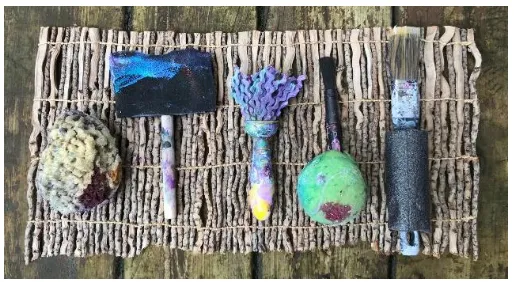
Miles paints with a variety of tools and brushes, including paint rollers, sponges, broom bristles, and a pallet knife. Laura and Hannah adapt the brushes for Miles to facilitate grasp (see Figure 2). “Without the built-up handles, Miles would not be
able to grip the brushes,” said Hannah. “Miles definitely wants to fit in,” said Laura. “If we adapt his brushes too much, he notices and does not want to use them anymore.”Laura and Hannah have learned to modify the brushes in new ways, but not too much so Miles does not feel too different. “You have to take the time to listen to him,” said Laura. “Most people would not think Miles is capable of being an artist,” said Hannah. “Miles knows what is going on. He has ways of
Figure 2. A sample of Miles Scharfenberg’s adapted tools and paint brushes.
3 Fortuna: Facilitating the Creative Process Through Collaboration
4 telling you what he needs.” For example, Miles will hand the brush back when he wants a different color of paint. “You have to take yourself out of the picture. When Miles is done, he will let you know,” said Carol.
The setup of Miles’ materials was also very intentional. “We wanted Miles to do as much as he could so positioning was very important,” said Hannah. “We learned how to set up his work station with everything laid out on the table. It was a lot of trial and error.” During class, Laura and Hannah
interjected as little as possible. They provided the tools and medium, but at the end of the day, Miles was the artist. “Everything on the canvas comes through him,” said Carol. “What are occupational therapists for, if not to help you be you?”
Hannah and Laura state Ken’s input has been helpful in adapting the painting process. For example, because of his severe visual impairment, Miles could see the canvas better when it was positioned upright on an easel. Functionally, it was easier for Miles to paint when the canvas was laid out flat on the table in front of him. “His range-of-motion was greater in this position,” said Carol. “Ken could see there was a benefit to each position.” When Miles finished painting a canvas too quickly, Ken suggested increasing the size. Most of the canvases Miles works with are 30” x 40” in size. “A large canvas allowed Miles to be playful with the tools, brushes and sponges,” said Laura. It also challenged Miles’ reach and upper extremity range-of-motion.
On one occasion, Miles was visited during class by Dr. Carla Chase, EdD, OTRL, professor and chair of the Department of Occupational Therapy at WMU. “I was amazed at Miles’ enthusiasm for painting, and the way he used his limited range of
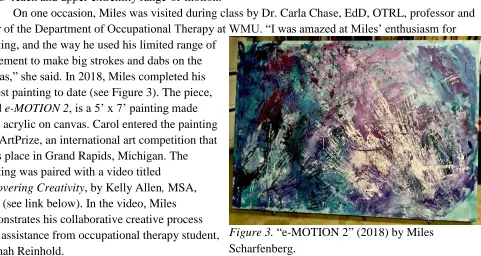
movement to make big strokes and dabs on the canvas,” she said. In 2018, Miles completed his largest painting to date (see Figure 3). The piece, titled e-MOTION 2, is a 5’ x 7’ painting made from acrylic on canvas. Carol entered the painting into ArtPrize, an international art competition that takes place in Grand Rapids, Michigan. The painting was paired with a video titled
Uncovering Creativity, by Kelly Allen, MSA, OTS (see link below). In the video, Miles demonstrates his collaborative creative process with assistance from occupational therapy student, Hannah Reinhold.
At the conclusion of ArtPrize, several of Miles’ paintings were displayed at Art Hop, a series of art exhibits organized by the Arts Council of Greater Kalamazoo. Miles’ venue was Public Media Network, a local public television station located in Kalamazoo, Michigan. Miles sold four paintings at Art Hop, earning money for his special needs trust. After the event, Carol donated the painting, e-Motion 2, to Public Media Network. “I have always thought this painting would be perfect for a photography studio,” she said. Carol attached handles and wheels to the frame to assist with transporting the canvas between studios. She is currently searching for the next venue to share Miles’ body of work.
In the last year, Miles’ vision has worsened significantly, making it difficult for him to paint. “When we first started painting with Miles, it was much easier,” said Carol. Over his lifetime, Miles has endured regular eye surgeries. Since his last surgery, Miles no longer wants to paint. “Miles lost all
Figure 3. “e-MOTION 2” (2018) by Miles Scharfenberg.
4 https://scholarworks.wmich.edu/ojot/vol7/iss4/14
5 vision in his right eye and has very little usable vision in his left eye,” said Carol. “Lately, he has been observing the world as if he is totally blind.” Carol believes it may be time for Miles to transition to activities that provide more tactile input. “He enjoys making collages from torn paper and snipping paper with scissors,” she said. Hannah and Laura have ideas for activities they would like to explore. “Miles enjoys hands-on projects,” said Hannah. “I think gardening may be a good fit for him.” Laura would like to introduce some form of woodworking. “Miles loves hammering wooden frames together for his canvas,” she said. Carol has also considered getting Miles into activities he previously enjoyed, such as horseback riding and swimming. “We still have to figure this out,” she said.
Miles Scharfenberg loves to participate in functional activities. “He wants to go somewhere. He wants to do things,” said Carol. A collaborative approach helped to facilitate Miles’ creative process. Profound visual impairment has made it difficult for Miles to continue engaging in the meaningful occupation of painting. “It was never about the art,” said Carol. “We wanted Miles to use his hands, eyes, and arms. We wanted purposeful activity.” With support from Carol and a team of occupational therapy students, Miles will develop new skills and discover his potential. Opportunities to explore new occupations will empower Miles to influence the state of his own health. Carol believes other people could benefit from the problem-solving Miles’ care team has done over the years. “We have learned to adapt the tools, the process, and the situation,” she said. “Sometimes the simplest things make all the difference.”
View Miles’ work in the OJOT Gallery:
https://scholarworks.wmich.edu/ojot_occupationandartist/27
Other resources:
Watch Miles’ Painting Process: Uncovering Creativity (5:47):
https://www.youtube.com/watch?v=jBQr5FLfLc0&feature=share&fbclid=IwAR2Mhhg2VHFkBWi YEizV6fAGlBkNVNBhJqhYeSN0DohOd9YgMrYHJzLJE3M
Visit Kenneth Freed’s website: http://kennethfreed.com/
References
American Occupational Therapy Association [AOTA]. (2014). Occupational therapy practice
framework: Domain and process. American
Journal of Occupational Therapy, 68(Suppl. 1), S1-S48.
Bathje, M. (2013). Expressing eMotions through participation in painting. The Open Journal of Occupational Therapy, 1(2), 1-5.
Kalamazoo Institute of Arts [KIA]. (2019). Kirk Newman Art School. Retrieved from
https://www.kiarts.org/page.php?menu_id=437
Reilly, M. (1962). Occupational therapy can be one of the great ideas of 20th century medicine. Eleanor Clarke Slagle lecture. American Occupational Therapy Association, 16,1-9.
Yerxa, E. J. (1998). Health and the human spirit for
occupation. American Journal of Occupational
Therapy, 52(6), 412-418.
5 Fortuna: Facilitating the Creative Process Through Collaboration