Vol. 3, 2015, 59-70
ISSN: 2349-0632 (P), 2349-0640 (online) Published 15 December 2015
www.researchmathsci.org
59
Analysis of Delayed Prey-Predator System with
Ratio-Dependent III Functional Response
V.Madhusudanan1 and S.Vijaya2
1
Department of Mathematics, S.A Engineering College Email: [email protected]
2
Department of Mathematics, Annamalai University, Tamilnadu Annamalainagar-608002, email: [email protected] Received 29 November 2015; Accepted 12 December 2015
Abstract. In this paper, we proposed and analyzed a prey-predator system with discrete time delay incorporating ratio-dependent III functional response. The equilibrium of proposed system are determined and behavior of the system is investigated around equilibrium. In the presence of delay, the condition for boundedness of the system is established. Choosing delay as a bifurcation parameter, the existence of Hopf bifurcation of the system has been investigated. We also show that increasing delay may cause bifurcations into periodic solutions. Some numerical simulation has been performed to substantiate our analytical findings. .
Keywords: Prey-Predator system, discrete time delay, Ratio dependent III functional response, Hopf bifurcation.
1. Introduction
The predator-prey model forms the building block of ecosystem. The dynamical behavior of predator and its prey exhibits a variety of pattern. It paves interest for many biologists and mathematicians to develop significant models for challenging situations. A system of differential or difference equation is used to formulate a predator-prey model mathematically. The key component in the predator-prey interaction is the functional response. Generally, functional response depends on prey density. If the functional response relies on the predator-prey ratio, then such a functional response is called ratio-dependent functional response.
V.Madhusudanan and S.Vijaya
60
2. Mathematical model
Mathematical model considered is based on the predator-prey system with Ratio dependent III functional response.
2 2 2 2
2 2
1 ( )
dX X X Y
rX
dT K mY X
dY X Y
Y
dT mY X
α
β
γ
= − − +
= −
+ (1)
where
r
is the intrinsic growth rate of prey,K
is the environmental carrying capacity of the prey,α
is the maxima relative increase of predation,m
is the half-saturation constant,β is the conversion factor.γ
is the death rate of predator.In order to minimize the number of parameters involved with the model system, it is extremely useful to write the system in non-dimensionalized form. For this purpose we introduce the variables X Y, and T as follows.
x X ,y aY
K K
→ → and
t
→
Tr
In terms of the non-dimensionalized variables the model system (1) become
(
)
2 2 22
2 2
1 ( )
dx
cx y
x
x
dt
y
x
dy
dx y
ey
dt
y
x
=
−
−
+
=
−
+
(2)where
, ,
c d e
r r
r m
α
β
γ
= = =
The non-negative initial conditions are associated with system (2)
x≥0,y≥0 (3) The objective of this paper is to perform a qualitative analysis on this ratio dependent III functional response in the system with discrete time delay. . The paper is organized as follows: In section 3 we present some positive invariance and boundedness results. In section 4 we obtain the existence of the equilibrium points of model (2) .In section 5, we investigate local behavior of the equilibrium points in absence of delay. In section 6 analysis of the model in presence of discrete delay is discussed. In section 7 Numerical simulations are used to illustrate some of our result.
3. Positive invariance and boundedness Preliminaries
Response
61
that population ever survives. Since the resources are limited, the boundedness may depict a natural suspension to growth.
Positive invariance
Theorem 1. The positive quadrant int(R+2) is invariant for system(2)
Proof: We prove that for all t∈[0, [, ( )Q x t >0, ( )y t >0.we show this by method of contradiction
Suppose, it is not true, there must exists one , tq , 0< <tq Q such that
∀t∈[0, [, ( )tq x t >0, ( )y t >0
And minimum of x t( ), ( )q y tq vanish.
From the system (2), we have
1 0
2 0
( ) (0) exp ( , )
( ) (0) exp ( , )
t
t
x t x G x y dt
y t y G x y dt
=
=
∫
∫
where
1 2 2
2
2 2 2
( , ) (1 )
( , ) ( )
cxy
G x y x
x y
dx
G x y e
x y
= − − +
= −
+
Since ( , )x y are defined and continuous on [0, ]tq there exists a L≥0 such that
[0, [q
t t
∀ ∈
1 0
2 0
( ) (0) exp ( , ) (0) exp( )
( ) (0) exp ( , ) (0) exp( )
t
q
t
q
x t x G x y dt x t L
y t y G x y dt y t L
= ≥ −
= ≥ −
∫
∫
It is clear that if limit t→tq we obtain
( ) (0) exp( )
( ) (0) exp( )
q q
q q
x t x t L
y t y t L
≥ −
≥ −
which contradicts the fact minimum of one x t( ), ( )q y tq vanish
There fore ∀t∈[0, [, ( )Q x t >0, ( )y t >0
This completes the proof.
V.Madhusudanan and S.Vijaya
62
4. Existence of equilibrium points
In this section we first determine the existence of fixed points of the differential equations (2) and then we investigate their stability by calculating the eigenvalues for the variational matrix (2) at each fixed point. To determine the fixed points, the equilibrium is the solution of pair of equation given below
2 2
(1 cxy ) 0
x x
y x
− − =
+ (4)
2 2 2
( dx ) 0
y e
y +x − = By simple computation of the above algebraic system, it was found that there are two non-negative fixed points
i) E1(1, 0) is axial fixed point is always exists, as the prey population grows to the carrying capacity in the absence of predation
ii) E x2( ,y ) ∗ ∗
is the positive equilibrium point exists in the interior of the first quadrant where x [d c e d( e)]
d
∗= − −
and y d ex e
∗ = − ∗
5. Local Stability analysis in absence of delay
In order to check the stability of the model (2), the variational matrix corresponding to each equilibrium point is calculated.
The variational matrix of equilibrium point at
E
1(1, 0)
is1 1
0
c E
d e
− −
= −
The eigenvalues of
E
1 are−
1
and d−e .Therefore the model system (2) is stable aroundE
1 ford <e for which, x−yplane is the stable. On the other hand the system is always unstable aroundE
1 if d >e which is, infact , a saddle point and whose stable manifold in x-direction and unstable in y direction ford >e Hence we state the following theorem.Theorem 3. The equilibrium pointE1is stable if d<e.
6. Analysis of delayed model
Response
63
realistic and importance models of population ecology should be taken into account with the time delay and the stability of an ecological systems with time delays has been studied by many authors[13-16,18-19]
In this section we analyze the model system (2) with delay
τ
(discrete time delay in predator response function).then the model system (2) takes the following form(
)
2 2 22
2 2
1 ( )
(
) (
)
((
)
(
)
dx
cx y
x
x
dt
y
x
dy
dx t
y t
e
dt
y
t
x t
τ
τ
τ
τ
=
−
−
+
−
−
=
−
− +
−
(5)With the initial densities
0( ) 1( ) 0, 0( ) 2( ) 0, r ([ , 0] ), ( , 0), 0
x
θ
=φ θ
> yθ
=φ θ
>φ
∈C −τ
→R+θ
∈ −τ
τ
> (6)Boundedness of the system with ττττ>0
Theorem 4. All solution of the system (5) are uniformly bounded with an ultimate
bound.
Proof: Define the function
) ( ) ( )
( y t
d c t
x
t = −τ +
ω
which on differentiation with respect to t dt dy d c t dt dx dt d + − = ( τ) ω = − − + − − − + − + − − − − − − − ( ) ) ( ) ( ) ( ) ( ) ( ) ( ) ( ) ( ( ) ( 1 )(
( 2 2
2 2 2 2 t ey t y t x t y t dx d c t y t x t y t x t x t x τ τ τ τ τ τ τ τ τ τ =
−
+
−
−
−
+
+
−
−
d
e
t
cy
t
x
t
x
t
y
d
c
t
x
(
τ
)
(
)
(
τ
)(
2
(
τ
))
(
)
1
≤ − + + − d e w 4 ) 1 ( 1 2 which yields
d
e
t
w
t4
)
1
(
1
)
(
sup
2lim
≤
+
−
∞ →
≡ M
Then there exists positive constant M>0 such that ω(t) < M for large t.
Local stability analysis in presence of delay
Now we direct our attention due to discuss of stability of system at E1.
V.Madhusudanan and S.Vijaya
64
− − −
= −
e de
c
E λτ
0 1
1
The characteristic equation of E1 is of the form
) (
) 1
(
λ
+λ
+e−de−λτ =0Here λ=-1 is a negative eigenvalue we now consider the equation
λ =
de
−λτ−
e
(7) If τ=0, and d<e, the equilibrium E1 is locally asymptotically stable. If substitute λ=iµ in(7) and equating real and imaginary parts, we obtain,
µτ
µ
=
−
d
sin
µτ
cos
d
e
=
(8) Eliminating τ from (8) we obtain2 2 2
e d − =
µ
(9) We know that (9) has positive root µ+ is d>e. Hence there is positive constant τ+ such thatτ>τ+, E1 becomes unstable.
The main purpose of this section to study the stability behavior of E x y2( ,∗ ∗) in the presence of discrete delay ( τ≠ 0). Now to prove the stability behavior ofE x y2( , )
∗ ∗
for the system (5), First we linearize the system (5) by using following transformation
11 12
21 22
( ) ( ) ( )
( ) ( ) ( )
u t a u t a v t
v t c u t
τ
c v tτ
′ = +
′ = − + −
where
2 2 2 2 2
2 2 2 2
3 2 2
2 2 2 2
11 2 12 2
21 2 22 2 22
( ) ( )
,
( ) ( )
2 2
, ,
( ) ( )
cx y x y cx x y
a x a
x y x y
dx y dx y
c c a e
x y x y
∗ ∗ ∗ ∗ ∗ ∗ ∗
∗
∗ ∗ ∗ ∗
∗ ∗ ∗ ∗
∗ ∗ ∗ ∗
− − −
= − + =
+ +
−
= = = −
+ +
The characteristic equation is
∆
( )
λ τ
,
=
(
λ
2+
l
1λ
+
l
2)
+
(
l
3λ
+
l e
4)
−λτ=
0
(10) where1 11 22, 2 11 22, 3 22, 4 22 11 12 21
l = − −a a l =a a l = −c l =c a −a c If
τ
=0 in (10) the characteristic equation becomes2
1 3 2 4
(l l ) (l l ) 0
λ
+ +λ
+ + = (11) The root of (11) is2
1 3 1 3 2 4
( ) ) 4( )
2
l l l l l l
λ
=− + ± + − + (12)
From (12), we have
λ
has negative real parts if and only ifl1+ >l3 0,l2+ >l4 0 (13)
Response
65
2
1 2 3 4
(−w +il w+l )+(il w+l )(cosw
τ
−isinwτ
)=0Equating real, imaginary parts we get
2
2 4cos 3 sin
w − =l l w
τ
+l w wτ
1 3
cos
4sin
l w
l w
w
τ
l
w
τ
−
=
−
Squaring and adding we get (14)
4 2 2 2 2 2
1 3 2 2 4
( 2 ) ( ) 0
w +w l −l − l + l −l =
We get the roots of (14) is
2 2 2 2 2 2 2
1 3 2 1 3 2 2 4
2 ( 2 ) ( 2 ) 4( )
2
l l l l l l l l
w =− − − + − − − − (15)
It follows
2 2 1 3 2
(l − −l 2 )l >0 and (l22−l42)>0 (16) are satisfied .Hence the equation does not have any positive solutions.
We conclude the following theorem
Theorem 4. If the conditions (13) and (16) are satisfied ,then all the roots of the equation
(10) have negative real parts for all
τ
≥0.Then the equilibrium E x y2( ∗, ∗)is stable forτ
≥0.Put w2 =
δ
then the equation (14) becomes2 2 2 2 2
1 3 2 2 4
(l l 2 )l (l l ) 0
δ
+δ
− − + − =If (l22 −l42)<0 holds then (14) has unique positive root
δ
0 then2 2 2 2 2 2 2
1 3 2 1 3 2 2 4
0
( 2 ) ( 2 ) 4( )
2
l l l l l l l l
δ
= − − − + − − − −The corresponding time delay is
2 1 4 1 3 0 2 4
0 2 2 2
0 3 0 4 0
( )
1 2
cos ( l l l w l l ) k ,k 0,1, 2...
w l w l w
π
τ
= − − − + =+ Differentiate (10) with respect to
τ
(
)
1
3 1
3 4 3 4
2
( )
l l
d
d l l e λτ l l
λ
λ
τ
τ
λ λ
λ λ
λ
−
−
+
= + −
+ +
=
(
)
2
2 3 4 3
2 2
3 4 3 4
( )
( )
l l l e l
l l e l l
λτ λτ
λ
λ
λ
τ
λ
λ
λ
λ
λ
−
−
− − + + −
+ +
=
(
)
2
3 2
2 2 2
3 4 3 4
( ) 1
( )
l l
l l e λτ l l
λ
λ
τ
λ
λ
−λ
λ
λ
λ
− − + −
V.Madhusudanan and S.Vijaya
66
(
)
2
2 4
2 2 2
1 2 3 4
( )
( )
l l
l l l l
λ
τ
λ λ
λ
λ
λ
λ
−
= − −
− + + +
Taking λ=iw0 in above equation, we get
( )
(
)
(
( )
)
0
1 2
0 2 4
2 2
2
0 0 3 0 4
0 0 1 0 2
( )
( )
( ) ( )
iw
iw l l
d i
d λ iw iw l iw l i l iw l w
λ
τ
τ
ω
− = − − = + + + − + +(
)
(
)
(
)
2 20 2 0 2 1 0
2 2 2
0 2 1 0
0 0 2 1 0
4 3 0 4
2
0 4 3 0 4 3 0 0
( ) ( ) ( ) . ( ) ( ) [ ( ) . ( ( )
w l w l i l w
w l i l w
w w l i l w
l il w
l i
w l il w l il w w
τ + − + = + − + − − − + + − Re 0 1 iw d d λ
λ
τ
− = =(
)
(
)
( )
4 2 0 2 2 2 2 20 0 2 1 0
w l
w w l l w
− − +
+ 2 24 2 2
0 4 3 0
( )
[ ]
l
w l l w
2
+
Thus we obtain
0 1 iw d Re d λ
λ
τ
− = > 0
Therefore transversality condition holds and hence hopf bifurcation occurs at
τ τ
=
0 This signifies that there exits at least or equal value with positive real part forτ τ
>
0Theorem 5. If E2exists with the condition (14) and
δ ω
= 02be positive root of (14), then there exists aτ τ
= 0∗ such that(i) E2 is locally asymptotically stable for 0
τ τ
0 ∗≤ < (ii) E2 is unstable for
τ τ
> 0∗(iii) The system (5) undergoes a Hopf –bifurcation around E2 at
τ τ
= 0∗τ
0 min∗ = 0 ( ) h
ω
where 2 1 4 1 3 0 2 40 2 2 2
0 3 0 4 0
(
)
1
2
(
)
cos (
l
l l w
l l
)
k
,
0,1, 2...
h
k
w
l w
l
w
π
ω
=
−−
−
+
=
+
and the minimum taken over all positive
ω
0such that2 0
δ ω
= is a solution of (14)Analysis of Global Stability
Response
67
Theorem 6. The positive equilibrium point E2 of non-delayed model system (2) is
globally asymptotically stable.
Proof: Let us consider the function
H (x, y) =
xy
1
Clearly H (x, y) is positive for both x > 0, y > 0
1 2 2
2
2 2 2
( , ) (1 )
( , ) ( )
cxy
G x y x x
x y
dx
G x y y e
x y
= − −
+
= −
+ Now
) ( )
( )
,
( 1 G2 H
y H G x y x
∂ ∂ + ∂
∂ = ∆
(
2 2) (
2 2 2)
2 22 2
2 2
1
y x
dxy
y x
x c
y x
c
y − + + + − +
− =
=
(
)
(
)
2 2
2 2
2 2 2 2
1 y x 2dxy
c
y x y x y
− − − −
+ +
(
)
+ + − − −
= 2
2 2
2
2 2
1
y x
dxy cx
cy
y
< 0
From the above equation, we note that ∆(x, y) does not change sign and is not identically zero in the interior of the positive quadrant we show that of x-y plane. In the following theorem E2 is globally asymptotically stable.
7. Numerical simulations
In this section, we present some numerical simulation result to validate our analytical findings. Let us consider the parameter of the system (2) as in appropriate units. In Fig.1(a) and Fig1(b),we take d=0.85,e=1.32,c=0.83,the Eigen values of E1are
1 1, 2 0.47
λ
= −λ
= − .In this case E1 is locally asymptotically stable. From Fig 1(a) we observe that the predator is driven to extinction, where as the prey approaches the carrying capacity.Fig1 (b) phase portrait is also tends to the boundary equilibrium point (1,0).In Fig 2(a) and Fig 2(b),we take d=1.55,e=1.32,c=2.3.In this case it satisfy the condition of theorem
2 2 2 2
1 3 1.3029,1 3 22 0.90146 0, 2 4 0.1634 0
l + =l l − −l l = > l −l = > .We conclude that
2( , )
V.Madhusudanan and S.Vijaya
68
1.55, 1.32, 0.6
d = e= c= the eigen values of delayed system is
λ
1= −1,λ
2 =0.23.In this case E1 is unstable and the value ofτ
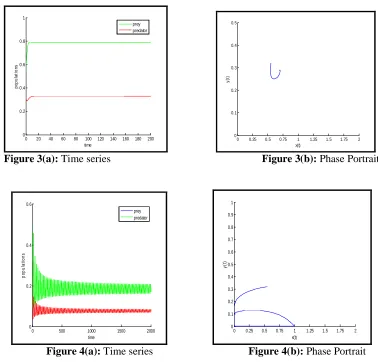
=0.613.In this case time series and phaseportrait of the system in Fig 3(a) and 3(b).If we take d=1.55,e=1.32,c=2.5,in this case prey and predator population shows periodic solutions see Fig 4(a) and phase portrait as shown in Fig 4(b).
0 20 40 60 80 100 120 140 160 180 200 0
0.2 0.4 0.6 0.8 1 1.2 1.4 1.6
time
p
o
p
u
la
ti
o
n
s
prey predator
0 0.25 0.5 0.75 1 1.25 1.5 1.75 2 0
0.1 0.2 0.3 0.4 0.5 0.6 0.7 0.8 0.9 1
x(t)
y
(t
)
Figure 1(a): Time series Figure 1(b): Phase Portrait
0 50 100 150 200 250 300 350 400 0
0.2 0.4 0.6 0.8 1
time
p
o
p
u
la
ti
o
n
s
prey predator
0 5 10 15 20 25 30 35 40 45 50 0
5 10 15 20
x(t)
y
(t
)
Response
69
0 20 40 60 80 100 120 140 160 180 200 0
0.2 0.4 0.6 0.8 1
time
p
o
p
u
la
ti
o
n
s
prey predator
0 0.25 0.5 0.75 1 1.25 1.5 1.75 2 0
0.1 0.2 0.3 0.4 0.5
x(t)
y
(t
)
Figure 3(a): Time series Figure 3(b): Phase Portrait
0 500 1000 1500 2000 0
0.2 0.4 0.6
time
p
o
p
u
la
ti
o
n
s
prey predator
0 0.25 0.5 0.75 1 1.25 1.5 1.75 2 0
0.1 0.2 0.3 0.4 0.5 0.6 0.7 0.8 0.9 1
x(t)
y
(t
)
Figure 4(a): Time series Figure 4(b): Phase Portrait
8. Conclusion
In this work, the local stability condition for various equilibrium points and the boundedness of the system with ratio-dependent III functional response is investigated in the absence of gestational delay. And the stability condition for the interior equilibrium points is analyzed in the presence of discrete time delay. It has been evident that the system undergoes Hopf bifurcation while choosing delay as bifurcation parameter. Also increasing the delay has caused bifurcation into periodic solution. Finally, numerical simulations have substantiated the analytical findings.
REFERENCES
1. A.F.Nindjin and M.A.Aziz Alauoui, Analysis of a predator–prey model with modified Leslie-Gower and Holling type II scheme, Non Linear Analysis: Real and World Application, 7 (2006) 1104-1118.
V.Madhusudanan and S.Vijaya
70
3. C.Jost, O.Arino and R.Arditi, About deterministic extinctionin ratio-dependent predator-prey models, Bull. Math. Biol., 61(1) (1999) 19-32.
4. D.Xiao and S.Ruan, Global dynamics of a ratio dependent predator-prey system, J. Math. Biol., 43(3) (2001) 268-290.
5. D.Kesh, A.K.Sarkar and A.B.Roy, Persistence of two prey-one predator system with ratio-dependent predator influence, Math. Appl. Sci., 23 (2000) 347-356.
6. G.Birkoff and G.C.Rota, Ordinary differential equations, Ginn (1982).
7. H.R.Akcakaya, R.Arditi and L.R.Ginzburg, Ratio-dependent predition: an abstraction that works, Ecology, 76 (1995) 995-1004.
8. J..F.Zhang and F.Huang, Non-linear dynamics of a delayed Leslie predator-prey model, Non linear Dynamics, 77 (2014) 1577-1588.
9. K.Gopalsamy, Stability and Oscilations in Delay Differential Equations of Population Dynamics, Kluwer Academic Publishers, Netherlands, 1992.
10. K.Wang and Y.L.Zhu, Permanence and Global asymptotic stability of delayed predator-prey model with Hassell-Varley type functional response, Bulletin of Iranian Mathematical Society, 37 (2011) 197-215.
11. P.Abrams, The fallacies of ratio-dependent predation, Ecology, 75(6) (1994) 1842-1850 .
12. P.J.Pal, P.K.Mandal and K.K.Hahiri, A delayed ratio dependent predator-prey model of interacting populations with Holling type III functional response, Nonlinear Dynamics, 76 (2014) 201-220.
13. R.Arditi and L.R.Ginzburg, Coupling in predator-prey dynamics: ratio dependence, J. Theor.Biol., 139 (1989) 311-326.
14. S.Gakkar and R.K.Naji, Chaos in three species ratio dependent food chain, Chaos, Solitons and Fractals,14 (2002) 771-778.
15. S.B.Hsu, T.W.Hwang and Y.Kuang, Rich dynamics of a ratio-dependent one prey- two predators model, J. Math. Biol., 43 (2001) 377-396.
16. S.Baek, W.Ko and I.Ahn, Coexistence of a one-prey two-predators model with ratio-dependent functional responses, Appl. Comput. Math., 219 (2012) 1897-1908. 17. S.L.Yuan and Y.L.Song, Stability and Hopfbifurcation in a delayed Leslie-Gower
predator-prey system, Journal of Mathematical Analysis and Applications, 259 (2001) 8-17.
18. Wenzhang, Haihong Liu, Bifurcating analysis for a leslie-Gower Predator-Prey System with time delay, International Journal of Non Linear Science, 15 (2013) 35-44.