Vol. 1, No. 2, 2012, 203-209
ISSN: 2279-087X (P), 2279-0888(online) Published on 16 November 2012
www.researchmathsci.org
203
An Alternative Method to Find Initial Basic Feasible
Solution of a Transportation Problem
M. A. Hakim
Department of Mathematics, Comilla University, Bangladesh.
Received 26 September2012; accepted 28 October 2012
Abstract.The paper solved the transportation problem with Vogel’s Approximation Method (VAM) is a special class of Linear Programming Problem. The importance of determining efficient solutions for large sized transportation problems is borne out by many practical problems in industries, the military, etc. With this motivation, a few variants of VAM incorporating the total opportunity cost (TOC) concept were investigated to obtain fast and efficient solutions. Computational experiments were carried out to evaluate these variants of VAM. The quality of solutions indicates that the basic version of the VAM coupled with total opportunity cost (called the VAM-TOC) yields a very efficient initial solution. Researchers determined the amounts transported from each source to each sink. Also researchers discussed how to satisfying the supply and demand restrictions, minimize the total transportation cost.
Keywords: Transportation problem, Vogel’s Approximation Method (VAM), Penalty and Transportation Cost.
AMS Mathematics Subject Classifications (2010): 90Bxx 1. Introduction
The Transportation Problem [1] is one of the most useful techniques in many branches in Pure and Applied Mathematics particularly an account of its importance in Linear Programming Problem. The transportation algorithm is based on the assumption that the model is balanced, meaning that the total demand equals the total supply. If the model is unbalanced [2,3], we can always augment it with a dummy source or a dummy destination to restore balance. There are sources and
204 generally given as
for all and
The objective of the model is to determine the unknowns that will minimize the total transportation cost while satisfying all the supply and demand restrictions.
2. Methodology
The study wasbased on the following Existing Methods
There is several well-known heuristics method in the transportation problem.
• Column Minimum Method (CMM)[4]
• Row Minimum Method (RMM)[5]
• Least Cost Method (LCM)[5]
• North West-Corner Method (NWCM)[5]
• Vogel’s Approximation Method (VAM)[5,6,7,8]
3. Findings and Discussion
Algorithm for Vogel’s Approximation Method (VAM)
VAM is not quite as simple as the Northwest Corner approach, but it facilitates a very good initial solution as a matter of fact, one that is often the optimal solution. Vogel’s approximation method tackles the problem of finding a good initial solution by taking into account the costs associated with each route alternative. This is something that the Northwest-corner rule did not do. To apply the VAM, Researchers first compute for each row and column the penalty faced if we should ship over the second best route instead of the least-cost route.
The Vogel approximation method is an iterative procedure for computing a basic feasible solution of the transportation problem.[9,10,11]
Problem
205
Step 2. Identify the boxes having minimum and next to minimum transportation cost in each column and write the difference (penalty) against the corresponding column.
Step 3. Identify the maximum penalty. If it is along the side of the table, make maximum allotment to the box having minimum cost of transportation in that row. If it is below the table, make maximum allotment to the box having minimum cost of transportation in that column.
Step 4. If the penalties corresponding to two or more rows or columns are equal, select the top most row and the extreme left column.
Step 5. No further consideration is required for the row or column which is satisfied. If both the row and column are satisfied at a time, delete only one of the two and the remaining row or column is assigned zero supply (or demand). Step 6. Calculate fresh penalty cost for the remaining sub-matrix as in step 1 and
allocate following the procedure of previous step. Continue the process until all rows and columns are satisfied.
Step 7. Compute total transportation cost for the feasible cost for the feasible allocations using the original balanced transportation cost matrix.
Algorithm for Proposed Method [12, 13, 14]
Step 1. Identify the boxes having maximum and minimum transportation cost in each row and write the difference (penalty) along the side of the table against the corresponding row.
Step 2. Identify the boxes having maximum and minimum transportation cost in each column and write the difference (penalty) against the corresponding column.
Step3. Identify the maximum penalty. If it is along the side of the table, make maximum allotment to the box having minimum cost of transportation in that row. If it is below the table, make maximum allotment to the box having minimum cost of transportation in that column.
Step 4. If the penalties corresponding to two or more rows or columns are equal, select the box where allocation is maximum.
Step 5. No further consideration is required for the row or column which is satisfied. If both the row and column are satisfied at a time, delete the two or column is assigned zero supply (or demand).
206
allocations using the original balanced transportation cost matrix.
4. Numerical Illustration [15]
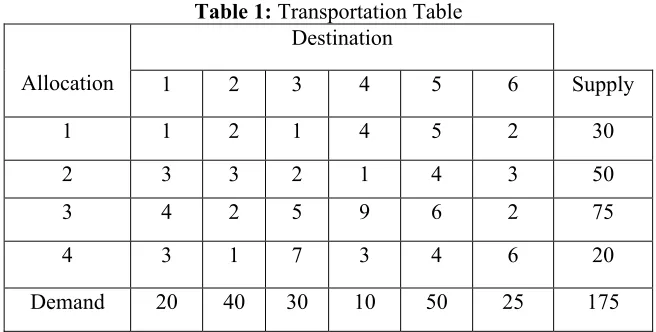
Consider the transportation problem presented in Table 1.
Table 1: Transportation Table
Allocation
Destination
1 2 3 4 5 6 Supply
1 1 2 1 4 5 2 30
2 3 3 2 1 4 3 50
3 4 2 5 9 6 2 75
4 3 1 7 3 4 6 20
Demand 20 40 30 10 50 25 175
Transportation costs per unit of production from particular four allocations to different six destinations are given in the above Table1.
Solution Applying Vogel’s Approximation Method
Table 2. VAM iterative Table
1 2 3 4 5 6 Supply Row penalty
1 1 2 1 4 5 2 30 (0) (0) (0) (1) --- ---
2 3 3 2 1 4 3 50 (1) (1) (1) (1) (1) (0)
3 4 2 5 9 6 2 75 (0) (0) (0) (0) (0) (0)
4 3 1 7 3 4 6 20 (2) --- --- --- --- ---
20
20
10
20 10 20
30 25
Problem
207
Demand 20 40 30 10 50 25
Column Penalty (2) (2) (2) --- --- --- (1) (0) (0) (0) (1) (1) (1) (1) (1) (1) (3) --- (2) (3) --- --- --- --- (0) (1) (1) (1) (2) (2) (0) (0) (0) (0) (1) ---
The Transportation table of the T. P. has 24 cells. The difference between the smallest and next to smallest costs in each row and each column are computed and displayed inside the parenthesis against the respective columns and rows. The maximum difference is 2 which occur in the 1st, 4th columns and 4th row. Select 4th row arbitrarily. The lowest cost of 4th row is . Allocate Min(20,40)=20 in the
cell (4,2) and diminish 40 by 20. Since the supply of allocation 4 is exhausted completely cross off 4th row. Calculate the row and column difference by same
technique in the reduced cost matrix and displayed in the table.
Result:
Total Transportation Cost by Vogel’s Approximation Method is given by
.
Solution Applying Proposed Approximation Method (PAM)
Table 3. PAM Iterative table
1 2 3 4 5 6 Supply Row penalty
1 1 2
1
4 5 2 30 (4) (4) --- --- --- ---
2 3 3 2
1 4
3 50 (3) (2) (1) (1) (1) (1)
3
4 2 5 9 6 2 75
(7) (4) (4) (4) (4) (2)
208 4 3
1
7 3 4 6 20 (6) (6) (5) --- --- --- Demand 20 40 30 10 50 25
Column Penalty (3) (3) (3) (1) (1) (1) (2) (2) (2) (1) --- --- (6) (6) --- --- --- --- (8) --- --- --- --- --- (2) (2) (2) (2) (2) (2) (4) (4) (4) (1) (1) ---
The difference between the maximum and next minimum costs in each row and each column are computed and displayed inside the parenthesis against the respective columns and rows. The maximum difference is 8 which occur in the 4th
columns. The lowest cost of 4th column is . Allocate Min(50,10)=10 in the cell (2,4) and diminish 50 by 10. Since the demand of Destination 4 is exhausted completely cross off 4th column. Calculate the row and column difference by same
technique in the reduced cost matrix and displayed in the table.
Result:
Total Transportation Cost by Proposed Approximation Method is given by
.
5. Conclusion
Here researchers developed a new algorithm for finding an initial basic feasible solution of the transportation problem. From example researchers found that Vogel’s Approximation Method and Proposed Approximation Method give the same result.
Acknowledgement: The author is very much grateful to the anonymous reviewers for their valuable suggestions for improvement of the presentation of the paper.
REFERENCES
1. Arsham, H and A.B.Kahn, A simplex-type algorithm for general transportation problems: An alternative to Stepping-Stone, Journal of Operational Research Society,40(6) (1989) 581-590.
Problem
209
3. Ramakrishnan, G.S., An improvement to Goyal's modified VAM for the unbalanced transportation problem, Journal of Operational Research Society,
39(6) (1988) 609-610.
4. Schrage, L., LINDO — An Optimization Modeling System, 4th edition. GA, USA: The Scientific Press (1991).
5. Reinfeld, N.V. and W.R. Vogel, Mathematical Programming, Prentice-Hall, Englewood Gliffs, New Jersey (1958).
6. Shimshak, D.G., J.A. Kaslik and T.D. Barclay, A modification of Vogel's approximation method through the use of heuristics, INEOR, 19 (1981) 259-263. 7. Mathirajan, M. and B. Meenakshi, Experimental Analysis of some Variants of
Vogel’s Approximation Method, Asia-Pacific Journal of Operational Research
21(4) (2004) 447-462.
8. Pandian, P. and G. Natarajan, A New Approach for solving Transportation Problems With Mixed Constraints, Journal of Physical Sciences,14 (2010) 53-61.
9. Dhose, E.D. and K.R. Morrison, Using transportation solutions for a facility location problem, Computers and Industrial Engineering, 31(1/2) (1996) 63-66.
10. Gass, S.I., On solving the transportation problem, Journal of Operational Research Society, 41(4) (1990) 291-297.
11. Glover, F., D Karney, D Klingman and A Napier, A computation study on start procedures, basis change criteria, and solution algorithms for transportation problems, Management Science, 20(5) (1974) 793-813.
12. Shajma, R.R.K. and K.D. Sharma, A new dual based procedure for the transportation problem, European Journal of Operational Research, 122 (2000) 611-624.
13. Ji, P and K.F. Ghu, A dual-matrix approach to the transportation problem. Asia-Pacific Journal of Operations Research, 19(1) (2002) 35-45.
14. Shafaat, A. and S.K. Goyal, Resolution of degeneracy in transportation problems, Journal of Operational Research Society, 39(4) (1988) 411-413. 15. P. K. Gupta and Man Mohan. (1993). Linear Programming and Theory of