A Differential Equation for Modeling Nesterov’s Accelerated
Gradient Method: Theory and Insights
Weijie Su [email protected]
Department of Statistics University of Pennsylvania Philadelphia, PA 19104, USA
Stephen Boyd [email protected]
Department of Electrical Engineering Stanford University
Stanford, CA 94305, USA
Emmanuel J. Cand`es [email protected]
Departments of Statistics and Mathematics Stanford University
Stanford, CA 94305, USA
Editor:Yoram Singer
Abstract
We derive a second-order ordinary differential equation (ODE) which is the limit of terov’s accelerated gradient method. This ODE exhibits approximate equivalence to Nes-terov’s scheme and thus can serve as a tool for analysis. We show that the continuous time ODE allows for a better understanding of Nesterov’s scheme. As a byproduct, we obtain a family of schemes with similar convergence rates. The ODE interpretation also suggests restarting Nesterov’s scheme leading to an algorithm, which can be rigorously proven to converge at a linear rate whenever the objective is strongly convex.
Keywords: Nesterov’s accelerated scheme, convex optimization, first-order methods, differential equation, restarting
1. Introduction
In many fields of machine learning, minimizing a convex function is at the core of efficient model estimation. In the simplest and most standard form, we are interested in solving
minimize f(x),
where f is a convex function, smooth or non-smooth, and x ∈ Rn is the variable. Since
Newton, numerous algorithms and methods have been proposed to solve the minimization problem, notably gradient and subgradient descent, Newton’s methods, trust region meth-ods, conjugate gradient methmeth-ods, and interior point methods (see e.g. Polyak, 1987; Boyd and Vandenberghe, 2004; Nocedal and Wright, 2006; Ruszczy´nski, 2006; Boyd et al., 2011; Shor, 2012; Beck, 2014, for expositions).
of accelerated first-order schemes. Perhaps the earliest first-order method for minimizing a convex function f is the gradient method, which dates back to Euler and Lagrange. Thirty years ago, however, in a seminal paper Nesterov proposed an accelerated gradient method (Nesterov, 1983), which may take the following form: starting withx0 andy0 =x0, inductively define
xk=yk−1−s∇f(yk−1)
yk=xk+ k−1
k+ 2(xk−xk−1).
(1)
For any fixed step size s ≤ 1/L, where L is the Lipschitz constant of ∇f, this scheme exhibits the convergence rate
f(xk)−f?≤O
kx0−x?k2
sk2
. (2)
Above, x? is any minimizer of f and f? = f(x?). It is well-known that this rate is op-timal among all methods having only information about the gradient of f at consecutive iterates (Nesterov, 2004). This is in contrast to vanilla gradient descent methods, which have the same computational complexity but can only achieve a rate of O(1/k). This improvement relies on the introduction of the momentum term xk−xk−1 as well as the particularly tuned coefficient (k−1)/(k+ 2)≈1−3/k. Since the introduction of Nesterov’s scheme, there has been much work on the development of first-order accelerated methods, see Nesterov (2004, 2005, 2013) for theoretical developments, and Tseng (2008) for a unified analysis of these ideas. Notable applications can be found in sparse linear regression (Beck and Teboulle, 2009; Qin and Goldfarb, 2012), compressed sensing (Becker et al., 2011) and, deep and recurrent neural networks (Sutskever et al., 2013).
In a different direction, there is a long history relating ordinary differential equation (ODEs) to optimization, see Helmke and Moore (1996), Schropp and Singer (2000), and Fiori (2005) for example. The connection between ODEs and numerical optimization is often established via taking step sizes to be very small so that the trajectory or solution path converges to a curve modeled by an ODE. The conciseness and well-established theory of ODEs provide deeper insights into optimization, which has led to many interesting findings. Notable examples include linear regression via solving differential equations induced by linearized Bregman iteration algorithm (Osher et al., 2014), a continuous-time Nesterov-like algorithm in the context of control design (D¨urr and Ebenbauer, 2012; D¨urr et al., 2012), and modeling design iterative optimization algorithms as nonlinear dynamical systems (Lessard et al., 2014).
In this work, we derive a second-order ODE which is the exact limit of Nesterov’s scheme by taking small step sizes in (1); to the best of our knowledge, this work is the first to use ODEs to model Nesterov’s scheme or its variants in this limit. One surprising fact in connection with this subject is that a first-order scheme is modeled by a second-order
ODE. This ODE takes the following form:
¨ X+3
tX˙ +∇f(X) = 0 (3)
¨
X ≡d2X/dt2 denotes the acceleration. The time parameter in this ODE is related to the step size in (1) via t≈k√s. Expectedly, it also enjoys inverse quadratic convergence rate as its discrete analog,
f(X(t))−f? ≤O
k
x0−x?k2
t2
.
Approximate equivalence between Nesterov’s scheme and the ODE is established later in various perspectives, rigorous and intuitive. In the main body of this paper, examples and case studies are provided to demonstrate that the homogeneous and conceptually simpler ODE can serve as a tool for understanding, analyzing and generalizing Nesterov’s scheme. In the following, two insights of Nesterov’s scheme are highlighted, the first one on oscillations in the trajectories of this scheme, and the second on the peculiar constant 3 appearing in the ODE.
1.1 From Overdamping to Underdamping
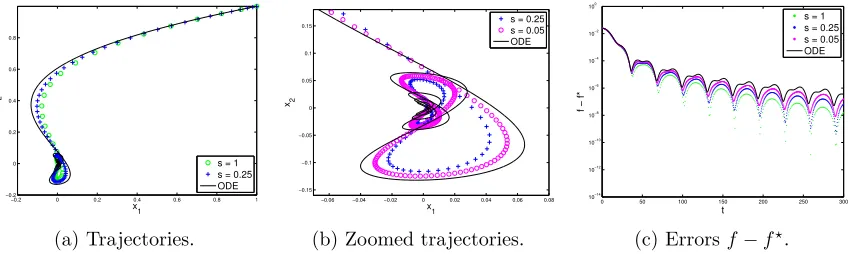
In general, Nesterov’s scheme is not monotone in the objective function value due to the introduction of the momentum term. Oscillations or overshoots along the trajectory of iterates approaching the minimizer are often observed when running Nesterov’s scheme. Figure 1 presents typical phenomena of this kind, where a two-dimensional convex function is minimized by Nesterov’s scheme. Viewing the ODE as a damping system, we obtain interpretations as follows.
Small t. In the beginning, the damping ratio 3/t is large. This leads the ODE to be an overdamped system, returning to the equilibrium without oscillating;
Large t. Ast increases, the ODE with a small 3/t behaves like an underdamped system, oscillating with the amplitude gradually decreasing to zero.
As depicted in Figure 1a, in the beginning the ODE curve moves smoothly towards the origin, the minimizerx?. The second interpretation “Large t’’ provides partial explanation for the oscillations observed in Nesterov’s scheme at later stage. Although our analysis extends farther, it is similar in spirit to that carried in O’Donoghue and Cand`es (2013). In particular, the zoomed Figure 1b presents some butterfly-like oscillations for both the scheme and ODE. There, we see that the trajectory constantly moves away from the origin and returns back later. Each overshoot in Figure 1b causes a bump in the function values, as shown in Figure 1c. We observe also from Figure 1c that the periodicity captured by the bumps are very close to that of the ODE solution. In passing, it is worth mentioning that the solution to the ODE in this case can be expressed via Bessel functions, hence enabling quantitative characterizations of these overshoots and bumps, which are given in full detail in Section 3.
1.2 A Phase Transition
The constant 3, derived from (k+ 2)−(k−1) in (3), is not haphazard. In fact, it is the smallest constant that guaranteesO(1/t2) convergence rate. Specifically, parameterized by a constant r, the generalized ODE
¨ X+ r
−0.2 0 0.2 0.4 0.6 0.8 1 −0.2
0 0.2 0.4 0.6 0.8
x 1 x2
s = 1 s = 0.25 ODE
(a) Trajectories.
−0.06 −0.04 −0.02 0 0.02 0.04 0.06 0.08
−0.15 −0.1 −0.05 0 0.05 0.1 0.15
x 1 x2
s = 0.25 s = 0.05
ODE
(b) Zoomed trajectories.
0 50 100 150 200 250 300
10−14
10−12
10−10
10−8
10−6
10−4
10−2
100
t
f − f*
s = 1 s = 0.25 s = 0.05 ODE
(c) Errorsf −f?.
Figure 1: Minimizing f = 2×10−2x21+ 5×10−3x22, starting from x0 = (1, 1). The black and solid curves correspond to the solution to the ODE. In (c), for the x-axis we use the identification between time and iterations,t=k√s.
can be translated into a generalized Nesterov’s scheme that is the same as the original (1) except for (k−1)/(k+ 2) being replaced by (k−1)/(k+r−1). Surprisingly, for both generalized ODEs and schemes, the inverse quadratic convergence is guaranteed if and only if r ≥ 3. This phase transition suggests there might be deep causes for acceleration among first-order methods. In particular, forr ≥3, the worst case constant in this inverse quadratic convergence rate is minimized at r= 3.
Figure 2 illustrates the growth of t2(f(X(t))−f?) and sk2(f(xk)−f?), respectively, for the generalized ODE and scheme with r = 1, where the objective function is simply f(x) = 12x2. Inverse quadratic convergence fails to be observed in both Figures 2a and 2b, where the scaled errors grow withtor iterations, for both the generalized ODE and scheme.
0 5 10 15 20 25 30 35 40 45 50
0 2 4 6 8 10 12 14 16
t t2(f − f*)
(a) Scaled errorst2(f(X(t))−f?).
0 500 1000 1500 2000 2500 3000 3500 4000 4500 5000 0
1 2 3 4 5 6 7 8 9 10
iterations
sk2(f − f*)
(b) Scaled errorssk2(f(x
k)−f?).
Figure 2: Minimizing f = 12x2 by the generalized ODE and scheme with r = 1, starting from x0 = 1. In (b), the step sizes= 10−4.
1.3 Outline and Notation
4, we discuss the effect of replacing the constant 3 in (3) by an arbitrary constant on the convergence rate. A new restarting scheme is suggested in Section 5, with linear convergence rate established and empirically observed.
Some standard notations used throughout the paper are collected here. We denote by
FL the class of convex functions f with L–Lipschitz continuous gradients defined on Rn,
i.e., f is convex, continuously differentiable, and satisfies
k∇f(x)− ∇f(y)k ≤Lkx−yk
for any x, y ∈ Rn, where k · k is the standard Euclidean norm and L >0 is the Lipschitz
constant. Next,Sµdenotes the class ofµ–strongly convex functionsfonRnwith continuous
gradients, i.e.,f is continuously differentiable andf(x)−µkxk2/2 is convex. We setS µ,L=
FL∩ Sµ.
2. Derivation
First, we sketch an informal derivation of the ODE (3). Assume f ∈ FL for L > 0. Combining the two equations of (1) and applying a rescaling gives
xk+1√−xk
s =
k−1 k+ 2
xk−xk−1 √
s −
√
s∇f(yk). (4)
Introduce the Ansatz xk ≈ X(k
√
s) for some smooth curve X(t) defined for t ≥ 0. Put k = t/√s. Then as the step size s goes to zero, X(t) ≈ xt/√
s = xk and X(t+
√
s) ≈
x(t+√
s)/√s=xk+1, and Taylor expansion gives (xk+1−xk)/
√
s= ˙X(t) +1 2
¨
X(t)√s+o(√s), (xk−xk−1)/ √
s= ˙X(t)−1
2 ¨
X(t)√s+o(√s)
and √s∇f(yk) =
√
s∇f(X(t)) +o(√s). Thus (4) can be written as
˙
X(t) +1 2
¨
X(t)√s+o(√s)
=
1−3 √
s t
˙
X(t)−1
2X¨(t)
√
s+o(√s)
−√s∇f(X(t)) +o(√s). (5)
By comparing the coefficients of√sin (5), we obtain
¨ X+3
tX˙ +∇f(X) = 0.
The first initial condition is X(0) =x0. Takingk= 1 in (4) yields (x2−x1)/
√
s=−√s∇f(y1) =o(1).
Hence, the second initial condition is simply ˙X(0) = 0 (vanishing initial velocity).
One popular alternative momentum coefficient is θk(θk−1−1−1), whereθk are iteratively defined as θk+1 =
q
θ4k+ 4θk2−θ2k
Teboulle, 2009). Simple analysis reveals that θk(θk−1−1−1) asymptotically equals 1−3/k+
O(1/k2), thus leading to the same ODE as (1).
Classical results in ODE theory do not directly imply the existence or uniqueness of the solution to this ODE because the coefficient 3/t is singular at t = 0. In addition, ∇f is typically not analytic atx0, which leads to the inapplicability of the power series method for studying singular ODEs. Nevertheless, the ODE is well posed: the strategy we employ for showing this constructs a series of ODEs approximating (3), and then chooses a convergent subsequence by some compactness arguments such as the Arzel´a-Ascoli theorem. Below, C2((0,∞);Rn) denotes the class of twice continuously differentiable maps from (0,∞) toRn;
similarly, C1([0,∞);Rn) denotes the class of continuously differentiable maps from [0,∞)
toRn.
Theorem 1 For anyf ∈ F∞:=∪L>0FLand anyx0 ∈Rn, the ODE (3)with initial
condi-tionsX(0) =x0,X˙(0) = 0has a unique global solutionX∈C2((0,∞);Rn)∩C1([0,∞);Rn).
The next theorem, in a rigorous way, guarantees the validity of the derivation of this ODE. The proofs of both theorems are deferred to the appendices.
Theorem 2 For any f ∈ F∞, as the step size s→ 0, Nesterov’s scheme (1) converges to
the ODE (3) in the sense that for all fixedT >0,
lim s→00≤maxk≤√T
s
xk−X k
√
s
= 0.
2.1 Simple Properties
We collect some elementary properties that are helpful in understanding the ODE.
Time Invariance. If we adopt a linear time transformation, ˜t=ctfor somec >0, by the chain rule it follows that
dX d˜t =
1 c
dX dt ,
d2X d˜t2 =
1 c2
d2X dt2 . This yields the ODE parameterized by ˜t,
d2X d˜t2 +
3 ˜ t
dX
d˜t +∇f(X)/c
2 = 0.
Also note that minimizingf /c2 is equivalent to minimizingf. Hence, the ODE is invariant under the time change. In fact, it is easy to see that time invariance holds if and only if the coefficient of ˙X has the formC/tfor some constantC.
Rotational Invariance. Nesterov’s scheme and other gradient-based schemes are in-variant under rotations. As expected, the ODE is also inin-variant under orthogonal trans-formation. To see this, let Y = QX for some orthogonal matrix Q. This leads to
˙
Y = QX,˙ Y¨ = QX¨ and ∇Yf = Q∇Xf. Hence, denoting by QT the transpose of Q, the ODE in the new coordinate system readsQTY¨ +3tQTY˙ +QT∇Yf = 0, which is of the same form as (3) once multiplying Qon both sides.
Taking the limitt→0 gives ¨X(0) =−∇f(x0)/4. Hence, for smalltwe have the asymptotic form:
X(t) =−∇f(x0)t 2
8 +x0+o(t 2).
This asymptotic expansion is consistent with the empirical observation that Nesterov’s scheme moves slowly in the beginning.
2.2 ODE for Composite Optimization
It is interesting and important to generalize the ODE to minimizing f in the composite form f(x) = g(x) +h(x), where the smooth part g ∈ FL and the non-smooth part h :
Rn → (−∞,∞] is a structured general convex function. Both Nesterov (2013) and Beck
and Teboulle (2009) obtainO(1/k2) convergence rate by employing the proximal structure of h. In analogy to the smooth case, an ODE for compositef is derived in the appendix.
3. Connections and Interpretations
In this section, we explore the approximate equivalence between the ODE and Nesterov’s scheme, and provide evidence that the ODE can serve as an amenable tool for interpreting and analyzing Nesterov’s scheme. The first subsection exhibits inverse quadratic conver-gence rate for the ODE solution, the next two address the oscillation phenomenon discussed in Section 1.1, and the last subsection is devoted to comparing Nesterov’s scheme with gra-dient descent from a numerical perspective.
3.1 Analogous Convergence Rate
The original result from Nesterov (1983) states that, for any f ∈ FL, the sequence {xk} given by (1) with step sizes≤1/Lsatisfies
f(xk)−f?≤ 2kx0−x
?k2
s(k+ 1)2 . (6)
Our next result indicates that the trajectory of (3) closely resembles the sequence{xk}in terms of the convergence rate to a minimizer x?. Compared with the discrete case, this proof is shorter and simpler.
Theorem 3 For any f ∈ F∞, let X(t) be the unique global solution to (3) with initial
conditions X(0) =x0,X˙(0) = 0. Then, for any t >0,
f(X(t))−f? ≤ 2kx0−x
?k2
t2 . (7)
Proof Consider the energy functional1 defined asE(t) =t2(f(X(t))−f?) + 2kX+tX/˙ 2−
x?k2, whose time derivative is ˙
E= 2t(f(X)−f?) +t2h∇f,X˙i+ 4
X+ t 2X˙ −x
?,3 2X˙ +
t 2X¨
.
1. We may also view this functional as the negative entropy. Similarly, for the gradient flow ˙X+∇f(X) = 0, an energy function of form Egradient(t) =t(f(X(t))−f?) +kX(t)−x?k2
/2 can be used to derive the boundf(X(t))−f?≤kx0−x?k2
Substituting 3 ˙X/2 +tX/¨ 2 with −t∇f(X)/2, the above equation gives
˙
E = 2t(f(X)−f?) + 4hX−x?,−t∇f(X)/2i= 2t(f(X)−f?)−2thX−x?,∇f(X)i ≤0,
where the inequality follows from the convexity of f. Hence by monotonicity of E and non-negativity of 2kX+tX/˙ 2−x?k2, the gap satisfies
f(X(t))−f?≤ E(t)
t2 ≤ E(0)
t2 =
2kx0−x?k2
t2 .
Making use of the approximation t ≈k√s, we observe that the convergence rate in (6) is essentially a discrete version of that in (7), providing yet another piece of evidence for the approximate equivalence between the ODE and the scheme.
We finish this subsection by showing that the number 2 appearing in the numerator of the error bound in (7) is optimal. Consider an arbitraryf ∈ F∞(R) such thatf(x) =xfor x≥0. Starting from somex0 >0, the solution to (3) isX(t) =x0−t2/8 before hitting the origin. Hence, t2(f(X(t))−f?) =t2(x0−t2/8) has a maximum 2x20 = 2|x0−0|2 achieved at t = 2√x0. Therefore, we cannot replace 2 by any smaller number, and we can expect that this tightness also applies to the discrete analog (6).
3.2 Quadratic f and Bessel Functions
For quadraticf, the ODE (3) admits a solution in closed form. This closed form solution turns out to be very useful in understanding the issues raised in the introduction.
Let f(x) = 12hx, Axi+hb, xi, whereA∈Rn×n is a positive semidefinite matrix and bis in the column space of A because otherwise this function can attain −∞. Then a simple translation in x can absorb the linear term hb, xi into the quadratic term. Since both the ODE and the scheme move within the affine space perpendicular to the kernel ofA, without loss of generality, we assume thatAis positive definite, admitting a spectral decomposition A=QTΛQ, where Λ is a diagonal matrix formed by the eigenvalues. ReplacingxwithQx, we assume f = 12hx,Λxi from now on. Now, the ODE for this function admits a simple decomposition of form
¨ Xi+
3
tX˙i+λiXi = 0, i= 1, . . . , n
withXi(0) =x0,i,X˙i(0) = 0. Introduce Yi(u) =uXi(u/
√
λi), which satisfies
u2Y¨i+uY˙i+ (u2−1)Yi = 0.
This is Bessel’s differential equation of order one. Since Yi vanishes at u= 0, we see that Yi is a constant multiple ofJ1, the Bessel function of the first kind of order one.2 It has an analytic expansion:
J1(u) = ∞
X
m=0
(−1)m (2m)!!(2m+ 2)!!u
2m+1,
2. Up to a constant multiplier,J1 is the unique solution to the Bessel’s differential equationu2J¨1+uJ˙1+
(u2−1)J1= 0 that is finite at the origin. In the analytic expansion ofJ1,m!! denotes the double factorial
which gives the asymptotic expansion
J1(u) = (1 +o(1))
u 2
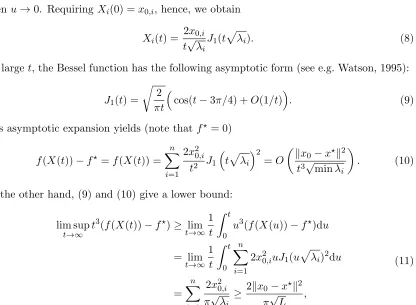
when u→0. RequiringXi(0) =x0,i, hence, we obtain Xi(t) = 2x0,i
t√λi J1(t
p
λi). (8)
For larget, the Bessel function has the following asymptotic form (see e.g. Watson, 1995):
J1(t) =
r
2 πt
cos(t−3π/4) +O(1/t)
. (9)
This asymptotic expansion yields (note that f?= 0)
f(X(t))−f?=f(X(t)) = n
X
i=1 2x20,i
t2 J1
tpλi
2
=O
k
x0−x?k2
t3√minλ i
. (10)
On the other hand, (9) and (10) give a lower bound:
lim sup t→∞
t3(f(X(t))−f?)≥ lim t→∞
1 t
Z t
0
u3(f(X(u))−f?)du
= lim t→∞
1 t
Z t
0 n
X
i=1
2x20,iuJ1(u
p
λi)2du
= n
X
i=1 2x20,i π√λi
≥ 2kx0−x
?k2
π√L ,
(11)
where L = kAk2 is the spectral norm of A. The first inequality follows by interpreting limt→∞ 1t
Rt
0u
3(f(X(u))−f?)du as the mean of u3(f(X(u))−f?) on (0,∞) in certain sense.
In view of (10), Nesterov’s scheme might possibly exhibit O(1/k3) convergence rate for strongly convex functions. This convergence rate is consistent with the second inequality in Theorem 6. In Section 4.3, we prove the O(1/t3) rate for a generalized version of (3). However, (11) rules out the possibility of a higher order convergence rate.
Recall that the function considered in Figure 1 is f(x) = 0.02x21 + 0.005x22, starting from x0 = (1, 1). As the step size s becomes smaller, the trajectory of Nesterov’s scheme converges to the solid curve represented via the Bessel function. While approaching the min-imizerx?, each trajectory displays the oscillation pattern, as well-captured by the zoomed Figure 1b. This prevents Nesterov’s scheme from achieving better convergence rate. The representation (8) offers excellent explanation as follows. Denote by T1, T2, respectively, the approximate periodicities of the first component|X1|in absolute value and the second |X2|. By (9), we getT1 =π/
√
λ1 = 5π and T2 =π/ √
λ2 = 10π. Hence, as the amplitude gradually decreases to zero, the functionf = 2x20,1J1(
√
λ1t)2/t2+ 2x20,2J1( √
3.3 Fluctuations of Strongly Convex f
The analysis carried out in the previous subsection only applies to convex quadratic func-tions. In this subsection, we extend the discussion to one-dimensional strongly convex functions. The Sturm-Picone theory (see e.g. Hinton, 2005) is extensively used all along the analysis.
Let f ∈ Sµ,L(R). Without loss of generality, assume f attains minimum at x? = 0.
Then, by definition µ ≤ f0(x)/x ≤ L for any x 6= 0. Denoting by X the solution to the ODE (3), we consider the self-adjoint equation,
(t3Y0)0+t
3f0(X(t))
X(t) Y = 0, (12)
which, apparently, admits a solutionY(t) =X(t). To apply the Sturm-Picone comparison theorem, consider
(t3Y0)0+µt3Y = 0
for a comparison. This equation admits a solution Ye(t) =J1(
√
µt)/t. Denote by ˜t1<˜t2< · · · all the positive roots of J1(t), which satisfy (see e .g. Watson, 1995)
3.8317 = ˜t1−˜t0 >˜t2−˜t3 >˜t3−˜t4>· · ·> π, where ˜t0 = 0. Then, it follows that the positive roots of Ye are ˜t1/
√
µ,t˜2/ √
µ, . . .. Since t3f0(X(t))/X(t)≥µt3, the Sturm-Picone comparison theorem asserts thatX(t) has a root in each interval [˜ti/
√
µ,˜ti+1/ √
µ].
To obtain a similar result in the opposite direction, consider
(t3Y0)0+Lt3Y = 0. (13) Applying the Sturm-Picone comparison theorem to (12) and (13), we ensure that between any two consecutive positive roots of X, there is at least one ˜ti/
√
L. Now, we summarize our findings in the following. Roughly speaking, this result concludes that the oscillation frequency of the ODE solution is betweenO(√µ) and O(√L).
Theorem 4 Denote by 0 < t1 < t2 < · · · all the roots of X(t)−x?. Then these roots
satisfy, for all i≥1,
t1 <
7.6635
√
µ , ti+1−ti <
7.6635
√
µ , ti+2−ti > π
√
L.
3.4 Nesterov’s Scheme Compared with Gradient Descent
The ansatz t ≈ k√s in relating the ODE and Nesterov’s scheme is formally confirmed in Theorem 2. Consequently, for any constant tc > 0, this implies that xk does not change much for a range of step sizessifk≈tc/
√
s. To empirically support this claim, we present an example in Figure 3a, where the scheme minimizes f(x) = ky−Axk2/2 +kxk
1 with
y = (4, 2, 0) and A(:,1) = (0, 2, 4), A(:,2) = (1, 1, 1) starting fromx0 = (2, 0) (here
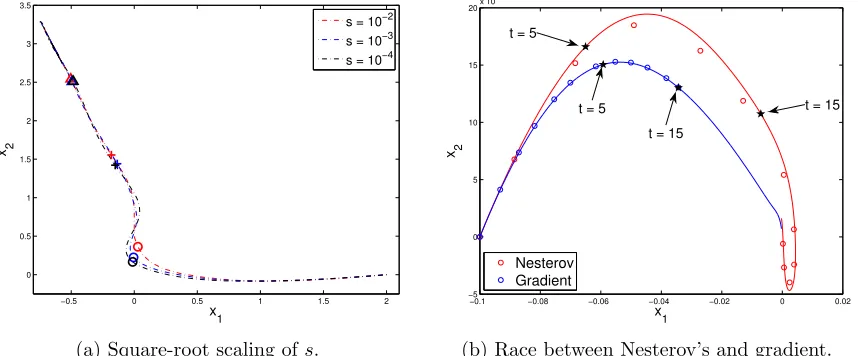
This interesting square-root scaling has the potential to shed light on the superiority of Nesterov’s scheme over gradient descent. Roughly speaking, each iteration in Nesterov’s scheme amounts to traveling√sin time along the integral curve of (3), whereas it is known that the simple gradient descent xk+1 = xk −s∇f(xk) moves s along the integral curve of ˙X +∇f(X) = 0. We expect that for small s Nesterov’s scheme moves more in each iteration since √s is much larger than s. Figure 3b illustrates and supports this claim, where the function minimized isf =|x1|3+ 5|x2|3+ 0.001(x1+x2)2 with step sizes= 0.05 (The coordinates are appropriately rotated to allow x0 and x? lie on the same horizontal line). The circles are the iterates fork = 1,10,20,30,45,60,90,120,150,190,250,300. For Nesterov’s scheme, the seventh circle has already passed t= 15, while for gradient descent the last point has merely arrived at t= 15.
−0.5 0 0.5 1 1.5 2
0 0.5 1 1.5 2 2.5 3 3.5
x 1
x 2
s = 10−2
s = 10−3
s = 10−4
(a) Square-root scaling ofs.
−0.1 −0.08 −0.06 −0.04 −0.02 0 0.02
−5 0 5 10 15 20x 10
−3
x 1 x2
Nesterov Gradient t = 5
t = 5 t = 15
t = 15
(b) Race between Nesterov’s and gradient.
Figure 3: In (a), the circles, crosses and triangles arexk evaluated atk=d1/
√
se,d2/√se
and d3/√se, respectively. In (b), the circles are iterations given by Nesterov’s scheme or gradient descent, depending on the color, and the stars areX(t) on the integral curves for t= 5,15.
A second look at Figure 3b suggests that Nesterov’s scheme allows a large deviation from its limit curve, as compared with gradient descent. This raises the question of the stable step size allowed for numerically solving the ODE (3) in the presence of accumulated errors. The finite difference approximation by the forward Euler method is
X(t+ ∆t)−2X(t) +X(t−∆t)
∆t2 +
3 t
X(t)−X(t−∆t)
∆t +∇f(X(t)) = 0, (14)
which is equivalent to
X(t+ ∆t) =2−3∆t
t
X(t)−∆t2∇f(X(t))−1−3∆t
t
X(t−∆t). (15)
the characteristic equation of this finite difference scheme is approximately
det
λ2−
2−∆t2∇2f −3∆t
t
λ+ 1− 3∆t
t
= 0. (16)
The numerical stability of (14) with respect to accumulated errors is equivalent to this: all the roots of (16) lie in the unit circle (see e.g. Leader, 2004). When∇2f LI
n (i.e.LIn−
∇2f is positive semidefinite), if ∆t/t small and ∆t < 2/√L, we see that all the roots of (16) lie in the unit circle. On the other hand, if ∆t >2/√L, (16) can possibly have a root λoutside the unit circle, causing numerical instability. Under our identification s= ∆t2, a step size ofs= 1/L in Nesterov’s scheme (1) is approximately equivalent to a step size of ∆t= 1/√L in the forward Euler method, which is stable for numerically integrating (14).
As a comparison, note that the finite difference scheme of the ODE ˙X(t)+∇f(X(t)) = 0, which models gradient descent with updates xk+1 =xk−s∇f(xk), has the characteristic equation det(λ−(1−∆t∇2f)) = 0. Thus, to guarantee −I
n 1−∆t∇2f In in worst case analysis, one can only choose ∆t ≤2/L for a fixed step size, which is much smaller than the step size 2/√L for (14) when∇f is very variable, i.e.,L is large.
4. The Magic Constant 3
Recall that the constant 3 appearing in the coefficient of ˙X in (3) originates from (k+ 2)−(k−1) = 3. This number leads to the momentum coefficient in (1) taking the form (k−1)/(k+ 2) = 1−3/k+O(1/k2). In this section, we demonstrate that 3 can be replaced by any larger number, while maintaining the O(1/k2) convergence rate. To begin with, let us consider the following ODE parameterized by a constant r:
¨ X+ r
tX˙ +∇f(X) = 0 (17)
with initial conditions X(0) = x0,X˙(0) = 0. The proof of Theorem 1, which seamlessly applies here, guarantees the existence and uniqueness of the solutionX to this ODE.
Interpreting the damping ratio r/t as a measure of friction3 in the damping system, our results say that more friction does not end the O(1/t2) and O(1/k2) convergence rate. On the other hand, in the lower friction setting, where r is smaller than 3, we can no longer expect inverse quadratic convergence rate, unless some additional structures off are imposed. We believe that this striking phase transition at 3 deserves more attention as an interesting research challenge.
4.1 High Friction
Here, we study the convergence rate of (17) with r >3 and f ∈ F∞. Compared with (3), this new ODE as a damping suffers from higher friction. Following the strategy adopted in the proof of Theorem 3, we consider a new energy functional defined as
E(t) = 2t 2
r−1(f(X(t))−f
?) + (r−1)
X(t) + t r−1
˙ X(t)−x?
2
.
3. In physics and engineering, damping may be modeled as a force proportional to velocity but opposite in direction, i.e. resisting motion; for instance, this force may be used as an approximation to the friction caused by drag. In our model, this force would be proportional to −r
tX˙ where ˙X is velocity and r t is
By studying the derivative of this functional, we get the following result.
Theorem 5 The solution X to (17) satisfies
f(X(t))−f? ≤ (r−1) 2kx
0−x?k2 2t2 ,
Z ∞
0
t(f(X(t))−f?)dt≤ (r−1) 2kx
0−x?k2 2(r−3) .
Proof Noting rX˙ +tX¨ =−t∇f(X), we get ˙E equal to
4t
r−1(f(X)−f
?) + 2t2
r−1h∇f,X˙i+ 2hX+ t
r−1X˙ −x
?, rX˙ +tX¨i
= 4t
r−1(f(X)−f
?)−2thX−x?,∇f(X)i ≤ −2(r−3)t
r−1 (f(X)−f
?), (18)
where the inequality follows from the convexity of f. Since f(X) ≥ f?, the last display implies thatE is non-increasing. Hence
2t2
r−1(f(X(t))−f
?)≤ E(t)≤ E(0) = (r−1)kx
0−x?k2,
yielding the first inequality of this theorem. To complete the proof, from (18) it follows that
Z ∞
0
2(r−3)t
r−1 (f(X)−f
?)dt≤ −
Z ∞
0 dE
dtdt=E(0)− E(∞)≤(r−1)kx0−x ?k2, as desired for establishing the second inequality.
The first inequality is the same as (7) for the ODE (3), except for a larger constant (r−1)2/2. The second inequality measures the error f(X(t))−f? in an average sense, and cannot be deduced from the first inequality.
Now, it is tempting to obtain such analogs for the discrete Nesterov’s scheme as well. Following the formulation of Beck and Teboulle (2009), we wish to minimize f in the composite form f(x) = g(x) +h(x), where g ∈ FL for some L > 0 and h is convex on Rn
possibly assuming extended value ∞. Define the proximal subgradient
Gs(x),
x−argminz kz−(x−s∇g(x))k2/(2s) +h(z)
s .
Parametrizing by a constant r, we propose the generalized Nesterov’s scheme,
xk =yk−1−sGs(yk−1)
yk=xk+
k−1
k+r−1(xk−xk−1),
(19)
starting from y0=x0. The discrete analog of Theorem 5 is below. Theorem 6 The sequence{xk} given by (19) with 0< s≤1/L satisfies
f(xk)−f? ≤
(r−1)2kx
0−x?k2 2s(k+r−2)2 ,
∞
X
k=1
(k+r−1)(f(xk)−f?)≤
(r−1)2kx
The first inequality suggests that the generalized Nesterov’s schemes still achieve O(1/k2) convergence rate. However, if the error bound satisfies f(xk0)−f? ≥c/k02 for some
arbi-trarily smallc >0 and a dense subsequence{k0}, i.e.,|{k0}∩{1, . . . , m}| ≥αmfor allm≥1 and some α >0, then the second inequality of the theorem would be violated. To see this, note that if it were the case, we would have (k0+r−1)(f(xk0)−f?)& 1
k0; the sum of the
harmonic series k10 over a dense subset of{1,2, . . .} is infinite. Hence, the second inequality
is not trivial because it implies the error bound is, in some sense,O(1/k2) suboptimal. Now we turn to the proof of this theorem. It is worth pointing out that, though based on the same idea, the proof below is much more complicated than that of Theorem 5. Proof Consider the discrete energy functional,
E(k) = 2(k+r−2) 2s
r−1 (f(xk)−f
?) + (r−1)kz
k−x?k2, wherezk= (k+r−1)yk/(r−1)−kxk/(r−1). If we have
E(k) +2s[(r−3)(k+r−2) + 1]
r−1 (f(xk−1)−f
?)≤ E(k−1), (20)
then it would immediately yield the desired results by summing (20) over k. That is, by recursively applying (20), we see
E(k) + k
X
i=1
2s[(r−3)(i+r−2) + 1]
r−1 (f(xi−1)−f ?)
≤ E(0) = 2(r−2) 2s
r−1 (f(x0)−f
?) + (r−1)kx
0−x?k2, which is equivalent to
E(k) + k−1
X
i=1
2s[(r−3)(i+r−1) + 1]
r−1 (f(xi)−f
?)≤(r−1)kx
0−x?k2. (21) Noting that the left-hand side of (21) is lower bounded by 2s(k+r−2)2(f(xk)−f?)/(r−1), we thus obtain the first inequality of the theorem. Since E(k) ≥ 0, the second inequality is verified via taking the limit k → ∞ in (21) and replacing (r −3)(i+r −1) + 1 by (r−3)(i+r−1).
We now establish (20). Fors≤1/L, we have the basic inequality,
f(y−sGs(y))≤f(x) +Gs(y)T(y−x)− s
2kGs(y)k
2, (22)
for any x and y. Note that yk−1 −sGs(yk−1) actually coincides with xk. Summing of (k−1)/(k+r−2)×(22) with x = xk−1, y = yk−1 and (r −1)/(k+r−2)×(22) with
x=x?, y=yk−1 gives
f(xk)≤ k−1
k+r−2f(xk−1) +
r−1 k+r−2f
?
+ r−1
k+r−2Gs(yk−1)
Tk+r−2 r−1 yk−1−
k−1
r−1xk−1−x ?−s
2kGs(yk−1)k 2 = k−1
k+r−2f(xk−1) +
r−1 k+r−2f
?+ (r−1)2 2s(k+r−2)2
kzk−1−x?k2− kzk−x?k2
where we usezk−1−s(k+r−2)Gs(yk−1)/(r−1) =zk. Rearranging the above inequality and multiplying by 2s(k+r−2)2/(r−1) gives the desired (20).
In closing, we would like to point out this new scheme is equivalent to setting θk = (r−1)/(k+r−1) and lettingθk(θk−1−1−1) replace the momentum coefficient (k−1)/(k+r−1). Then, the equal sign “ = ” in the updateθk+1= (
q
θk4+ 4θ2k−θk2)/2 has to be replaced by an inequality sign “≥”. In examining the proof of Theorem 1(b) in Tseng (2010), we can get an alternative proof of Theorem 6.
4.2 Low Friction
Now we turn to the case r < 3. Then, unfortunately, the energy functional approach for proving Theorem 5 is no longer valid, since the left-hand side of (18) is positive in general. In fact, there are counterexamples that fail the desired O(1/t2) or O(1/k2) convergence rate. We present such examples in continuous time. Equally, these examples would also violate theO(1/k2) convergence rate in the discrete schemes, and we forego the details.
Let f(x) = 12kxk2 andX be the solution to (17). Then,Y =tr−12 X satisfies
t2Y¨ +tY˙ + (t2−(r−1)2/4)Y = 0.
With the initial condition Y(t) ≈ tr−12 x0 for small t, the solution to the above Bessel
equation in a vector form of order (r−1)/2 isY(t) = 2r−12 Γ((r+ 1)/2)J(r−1)/2(t)x0. Thus,
X(t) = 2 r−1
2 Γ((r+ 1)/2)J(r−1)/2(t)
tr−12
x0. For larget, the Bessel functionJ(r−1)/2(t) =
p
2/(πt) cos(t−(r−1)π/4−π/4) +O(1/t)
. Hence,
f(X(t))−f?=O kx0−x?k2/tr
,
where the exponentris tight. This rules out the possibility of inverse quadratic convergence of the generalized ODE and scheme for all f ∈ FL if r < 2. An example with r = 1 is plotted in Figure 2.
Next, we consider the case 2≤r <3 and letf(x) =|x|(this also applies to multivariate f =kxk).4 Starting fromx0>0, we getX(t) =x0− t
2
2(1+r) fort≤
p
2(1 +r)x0. Requiring continuity of X and ˙X at the change point 0, we get
X(t) = t 2 2(1 +r) +
2(2(1 +r)x0)
r+1 2
(r2−1)tr−1 −
r+ 3 r−1x0 for p2(1 +r)x0 < t ≤
p
2c?(1 +r)x
0, where c? is the positive root other than 1 of (r− 1)c+ 4c−r−12 = r+ 3. Repeating this process solves for X. Note that t1−r is in the null
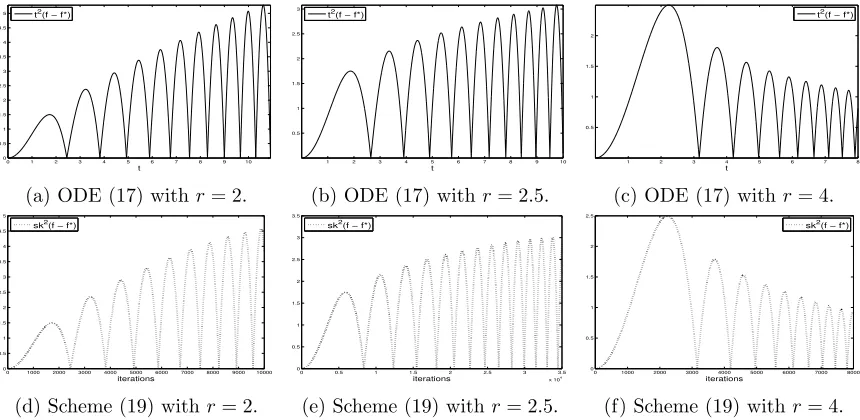
space of ¨X+rX/t˙ and satisfies t2×t1−r → ∞ ast → ∞. For illustration, Figure 4 plots t2(f(X(t))−f?) and sk2(f(xk)−f?) with r = 2,2.5, and r = 4 for comparison5. It is clearly that inverse quadratic convergence does not hold forr = 2,2.5, that is, (2) does not hold forr <3. Interestingly, in Figures 4a and 4d, the scaled errors at peaks grow linearly, whereas forr= 2.5, the growth rate, though positive as well, seems sublinear.
0 1 2 3 4 5 6 7 8 9 10
0 0.5 1 1.5 2 2.5 3 3.5 4 4.5 5
t t2
(f − f*)
(a) ODE (17) withr= 2.
1 2 3 4 5 6 7 8 9 10
0.5 1 1.5 2 2.5 3
t t2
(f − f*)
(b) ODE (17) withr= 2.5.
1 2 3 4 5 6 7 8
0.5 1 1.5 2
t
t2
(f − f*)
(c) ODE (17) withr= 4.
0 1000 2000 3000 4000 5000 6000 7000 8000 9000 10000
0 0.5 1 1.5 2 2.5 3 3.5 4 4.5 5
iterations sk2
(f − f*)
(d) Scheme (19) withr= 2.
0 0.5 1 1.5 2 2.5 3 3.5
x 104 0
0.5 1 1.5 2 2.5 3 3.5
iterations sk2
(f − f*)
(e) Scheme (19) withr= 2.5.
0 1000 2000 3000 4000 5000 6000 7000 8000 0
0.5 1 1.5 2 2.5
iterations
sk2 (f − f*)
(f) Scheme (19) with r= 4.
Figure 4: Scaled errors t2(f(X(t))−f?) and sk2(f(xk)−f?) of generalized ODEs and schemes for minimizing f =|x|. In (d), the step sizes= 10−6, in (e), s= 10−7, and in (f), s= 10−6.
However, if f possesses some additional property, inverse quadratic convergence is still guaranteed, as stated below. In that theorem, f is assumed to be a continuously differen-tiable convex function.
Theorem 7 Suppose 1 < r <3 and let X be a solution to the ODE (17). If (f −f?)r−12
is also convex, then
f(X(t))−f? ≤ (r−1) 2kx
0−x?k2 2t2 . Proof Since (f−f?)r−12 is convex, we obtain
(f(X(t))−f?)r−12 ≤ hX−x?,∇(f(X)−f?)
r−1
2 i= r−1
2 (f(X)−f
?)r−32 hX−x?,∇f(X)i,
which can be simplified to r−12 (f(X) −f?) ≤ hX −x?,∇f(X)i. This inequality com-bined with (18) leads to the monotonically decreasing of E(t) defined for Theorem 5. This completes the proof by noting f(X)−f? ≤ (r−1)E(t)/(2t2) ≤ (r−1)E(0)/(2t2) = (r−1)2kx0−x?k2/(2t2).
4.3 Strongly Convex f
Strong convexity is a desirable property for optimization. Making use of this property carefully suggests a generalized Nesterov’s scheme that achieves optimal linear convergence (Nesterov, 2004). In that case, even vanilla gradient descent has a linear convergence rate. Unfortunately, the example given in the previous subsection simply rules out such possibility for (1) and its generalizations (19). However, from a different perspective, this example suggests that O(t−r) convergence rate can be expected for (17). In the next theorem, we prove a slightly weaker statement of this kind, that is, a provableO(t−23r) convergence rate
is established for strongly convex functions. Bridging this gap may require new tools and more careful analysis.
Let f ∈ Sµ,L(Rn) and consider a new energy functional forα >2 defined as
E(t;α) =tα(f(X(t))−f?) +(2r−α) 2tα−2 8
X(t) +
2t
2r−αX˙ −x ?
2
.
When clear from the context,E(t;α) is simply denoted asE(t). For r >3, takingα= 2r/3 in the theorem stated below gives f(X(t))−f? .kx0−x?k2/t
2r
3 .
Theorem 8 For anyf ∈ Sµ,L(Rn), if2≤α≤2r/3 we get
f(X(t))−f? ≤ Ckx0−x
?k2
µα−22 tα
for anyt >0. Above, the constant C only depends on α and r.
Proof Note that ˙E(t;α) equals
αtα−1(f(X)−f?)−(2r−α)t
α−1
2 hX−x
?,∇f(X)i+(α−2)(2r−α)2tα−3
8 kX−x
?k2 +(α−2)(2r−α)t
α−2
4 hX, X˙ −x
?i. (23)
By the strong convexity of f, the second term of the right-hand side of (23) is bounded below as
(2r−α)tα−1
2 hX−x
?,∇f(X)i ≥ (2r−α)tα−1
2 (f(X)−f
?) +µ(2r−α)tα−1
4 kX−x ?k2. Substituting the last display into (23) with the awareness ofr≥3α/2 yields
˙
E ≤ −(2µ(2r−α)t
2−(α−2)(2r−α)2)tα−3
8 kX−x
?k2+(α−2)(2r−α)tα−2 8
dkX−x?k2 dt .
Hence, ift≥tα:=
p
(α−2)(2r−α)/(2µ), we obtain
˙
E(t)≤ (α−2)(2r−α)t
α−2 8
Integrating the last inequality on the interval (tα, t) gives
E(t)≤ E(tα) +(α−2)(2r−α)t α−2
8 kX(t)−x
?k2−(α−2)(2r−α)tαα−2
8 kX(tα)−x ?k2 −1
8
Z t
tα
(α−2)2(2r−α)uα−3kX(u)−x?k2du≤ E(tα) +
(α−2)(2r−α)tα−2
8 kX(t)−x ?k2
≤ E(tα) +
(α−2)(2r−α)tα−2
4µ (f(X(t))−f
?). (24)
Making use of (24), we apply induction on α to finish the proof. First, consider 2 < α≤4. Applying Theorem 5, from (24) we get that E(t) is upper bounded by
E(tα) +(α−2)(r−1)
2(2r−α)kx
0−x?k2
8µt4−α ≤ E(tα) +
(α−2)(r−1)2(2r−α)kx
0−x?k2 8µt4−α α
.
(25) Then, we bound E(tα) as follows.
E(tα)≤tαα(f(X(tα))−f?) +
(2r−α)2tαα−2 4
2r−2
2r−αX(tα) + 2tα
2r−αX˙(tα)−
2r−2 2r−αx
?
2
+(2r−α) 2tα−2
α 4
α−2
2r−αX(tα)− α−2 2r−αx
?
2
≤(r−1)2tαα−2kx0−x?k2+
(α−2)2(r−1)2kx0−x?k2 4µt4−α α
, (26)
where in the second inequality we use the decreasing property of the energy functional defined for Theorem 5. Combining (25) and (26), we have
E(t)≤(r−1)2tαα−2kx0−x?k2+
(α−2)(r−1)2(2r+α−4)kx0−x?k2 8µt4−α α
=O
kx0−x?k2
µα−22
.
For t ≥tα, it suffices to apply f(X(t))−f? ≤ E(t)/t3 to the last display. For t < tα, by Theorem 5,f(X(t))−f? is upper bounded by
(r−1)2kx0−x?k2
2t2 ≤
(r−1)2µα−22 [(α−2)(2r−α)/(2µ)]
α−2 2
2
kx0−x?k2
µα−22 tα
=O
kx0−x?k2
µα−22 tα
.
(27)
Next, suppose that the theorem is valid for some ˜α > 2. We show below that this theorem is still valid for α := ˜α+ 1 if still r ≥ 3α/2. By the assumption, (24) further induces
E(t)≤ E(tα) +
(α−2)(2r−α)tα−2 4µ
˜
Ckx0−x?k2
µα˜−22 tα˜
≤ E(tα) + ˜
for some constant ˜C only depending on ˜α andr. This inequality with (26) implies
E(t)≤(r−1)2tαα−2kx0−x?k2+
(α−2)2(r−1)2kx0−x?k2 4µt4−α α
+C˜(α−2)(2r−α)kx0−x ?k2 4µα−12 tα
=O
kx0−x?k2/µ
α−2 2
,
which verify the induction for t ≥ tα. As for t < tα, the validity of the induction follows from Theorem 5, similarly to (27). Thus, combining the base and induction steps, the proof is completed.
It should be pointed out that the constantC in the statement of Theorem 8 grows with the parameterr. Hence, simply increasingrdoes not guarantee to give a better error bound. While it is desirable to expect a discrete analogy of Theorem 8, i.e., O(1/kα) convergence rate for (19), a complete proof can be notoriously complicated. That said, we mimic the proof of Theorem 8 forα = 3 and succeed in obtaining aO(1/k3) convergence rate for the generalized Nesterov’s schemes, as summarized in the theorem below.
Theorem 9 Supposef is written asf =g+h, whereg∈ Sµ,Landhis convex with possible extended value∞. Then, the generalized Nesterov’s scheme (19) withr≥9/2 ands= 1/L
satisfies
f(xk)−f? ≤
CLkx0−x?k2
k2
p
L/µ
k ,
where C only depends on r.
This theorem states that the discrete scheme (19) enjoys the error boundO(1/k3) with-out any knowledge of the condition number L/µ. In particular, this bound is much better than that given in Theorem 6 ifkpL/µ. The strategy of the proof is fully inspired by that of Theorem 8, though it is much more complicated and thus deferred to the Appendix. The relevant energy functional E(k) for this Theorem 9 is equal to
s(2k+ 3r−5)(2k+ 2r−5)(4k+ 4r−9)
16 (f(xk)−f ?)
+ 2k+ 3r−5
16 k2(k+r−1)yk−(2k+ 1)xk−(2r−3)x
?k2. (28)
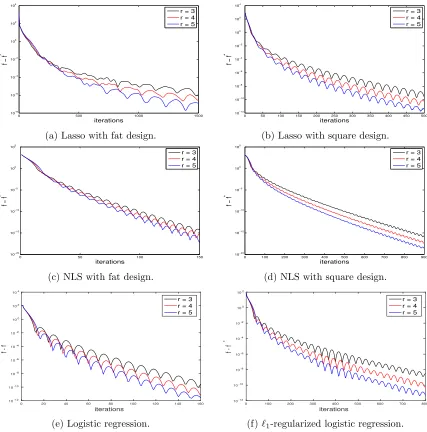
4.4 Numerical Examples
0 500 1000 1500 10−8
10−6 10−4 10−2 100 102 104
iterations
f − f
*
r = 3 r = 4 r = 5
(a) Lasso with fat design.
0 50 100 150 200 250 300 350 400 450 500
10−12 10−10 10−8 10−6 10−4 10−2 100 102 104
iterations
f − f
*
r = 3 r = 4 r = 5
(b) Lasso with square design.
0 50 100 150
10−20 10−15 10−10 10−5 100 105
iterations
f − f
*
r = 3 r = 4 r = 5
(c) NLS with fat design.
0 100 200 300 400 500 600 700 800 900 10−20
10−15
10−10
10−5
100
105
iterations
f − f
*
r = 3 r = 4 r = 5
(d) NLS with square design.
iterations
0 20 40 60 80 100 120 140 160
f - f
*
10-12 10-10 10-8 10-6 10-4 10-2 100 102 104
r = 3 r = 4 r = 5
(e) Logistic regression.
iterations
0 100 200 300 400 500 600 700 800
f - f
*
10-12 10-10 10-8 10-6 10-4 10-2 100 102
r = 3 r = 4 r = 5
(f)`1-regularized logistic regression.
Figure 5: Comparisons of generalized Nesterov’s schemes with different r.
Lasso with fat design. Minimizef(x) = 12kAx−bk2+λkxk
1, in which A a 100×500 random matrix with i.i.d. standard GaussianN(0,1) entries,bgenerated independently has i.i.d.N(0,25) entries, and the penalty λ= 4. The plot is Figure 5a.
Lasso with square design. Minimize f(x) = 12kAx−bk2+λkxk
1, where A a 500× 500 random matrix with i.i.d. standard Gaussian entries, b generated independently has i.i.d.N(0,9) entries, and the penalty λ= 4. The plot is Figure 5b.
Nonnegative least squares with sparse design. Minimize f(x) =kAx−bk2 subject tox0, in whichAis a 1000×10000 sparse matrix with nonzero probability 10% for each entry and b is given asb=Ax0+N(0, I1000). The nonzero entries ofA are independently Gaussian distributed before column normalization, andx0 has 100 nonzero entries that are all equal to 4. The plot is Figure 5d.
Logistic regression. Minimize Pn
i=1−yiaTi x+ log(1 + ea T
ix), in which A= (a1, . . . , an)T is a 500×100 matrix with i.i.d. N(0,1) entries. The labels yi∈ {0,1} are generated by the logistic model: P(Yi = 1) = 1/(1 + e−a
T
ix0), where x0 is a realization of i.i.d. N(0,1/100). The plot is Figure 5e.
`1-regularized logistic regression. Minimize Pn
i=1−yiaTi x+ log(1 + ea T
ix) +λkxk1, in which A = (a1, . . . , an)T is a 200×1000 matrix with i.i.d.N(0,1) entries and λ= 5. The labelsyi are generated similarly as in the previous example, except for the ground truthx0 here having 10 nonzero components given as i.i.d.N(0,225). The plot is Figure 5f.
5. Restarting
The example discussed in Section 4.2 demonstrates that Nesterov’s scheme and its gener-alizations (19) are not capable of fully exploiting strong convexity. That is, this example suggests evidence thatO(1/poly(k)) is the best rate achievable under strong convexity. In contrast, the vanilla gradient method achieves linear convergenceO((1−µ/L)k). This draw-back results from too much momentum introduced when the objective function is strongly convex. The derivative of a strongly convex function is generally more reliable than that of non-strongly convex functions. In the language of ODEs, at later stage a too small 3/t in (3) leads to a lack of friction, resulting in unnecessary overshoot along the trajectory.
Incorporating the optimal momentum coefficient √
L−√µ √
L+√µ (This is less than (k−1)/(k+ 2) when k is large), Nesterov’s scheme has convergence rate of O((1−p
µ/L)k) (Nesterov, 2004), which, however, requires knowledge of the condition number µ/L. While it is rel-atively easy to bound the Lipschitz constant L by the use of backtracking, estimating the strong convexity parameterµ, if not impossible, is very challenging.
Among many approaches to gain acceleration via adaptively estimating µ/L (see Nes-terov, 2013), O’Donoghue and Cand`es (2013) proposes a procedure termed as gradient restarting for Nesterov’s scheme in which (1) is restarted with x0 = y0 := xk whenever f(xk+1)> f(xk). In the language of ODEs, this restarting essentially keeps h∇f,X˙i nega-tive, and resets 3/t each time to prevent this coefficient from steadily decreasing along the trajectory. Although it has been empirically observed that this method significantly boosts convergence, there is no general theory characterizing the convergence rate.
5.1 A New Restarting Scheme
We first define the speed restarting time. For the ODE (3), we call
T =T(x0;f) = sup
(
t >0 :∀u∈(0, t), dkX˙(u)k
2 du >0
)
the speed restarting time. In words,T is the first time the velocitykX˙kdecreases. Back to the discrete scheme, it is the first time when we observe kxk+1−xkk<kxk−xk−1k. This definition itself does not directly imply that 0< T < ∞, which is proven later in Lemmas 13 and 25. Indeed, f(X(t)) is a decreasing function before timeT; fort≤T,
df(X(t))
dt =h∇f(X),X˙i=− 3 tkX˙k
2− 1 2
dkX˙k2 dt ≤0.
The speed restarted ODE is thus
¨
X(t) + 3 tsr
˙
X(t) +∇f(X(t)) = 0, (29)
wheretsris set to zero wheneverhX,˙ X¨i= 0 and between two consecutive restarts,tsrgrows just as t. That is, tsr =t−τ, where τ is the latest restart time. In particular, tsr = 0 at
t= 0. Letting Xsr be the solution to (29), we have the following observations.
• Xsr(t) is continuous fort≥0, withXsr(0) =x0; • Xsr(t) satisfies (3) for 0< t < T1:=T(x0;f). • Recursively defineTi+1=T
XsrPi
j=1Tj
;ffori≥1, andXe(t) :=Xsr
Pi
j=1Tj +t
satisfies the ODE (3), withXe(0) =Xsr
Pi
j=1Tj
, for 0< t < Ti+1.
The theorem below guarantees linear convergence of Xsr. This is a new result in the literature (O’Donoghue and Cand`es, 2013; Monteiro et al., 2012). The proof of Theorem 10 is based on Lemmas 12 and 13, where the first guarantees the ratef(Xsr)−f? decays by a constant factor for each restarting, and the second confirms that restartings are adequate. In these lemmas we all make a convention that the uninteresting case x0 =x? is excluded. Theorem 10 There exist positive constants c1 and c2, which only depend on the condition
number L/µ, such that for any f ∈ Sµ,L, we have
f(Xsr(t))−f? ≤ c1Lkx0−x
?k2
2 e
−c2t
√ L.
5.2 Proof of Linear Convergence
First, we collect some useful estimates. Denote by M(t) the supremum ofkX˙(u)k/uover u∈(0, t] and let
I(t) :=
Z t
0
u3(∇f(X(u))− ∇f(x0))du.
It is guaranteed that M defined above is finite, for example, see the proof of Lemma 18. The definition ofM gives a bound on the gradient of f,
k∇f(X(t))− ∇f(x0)k ≤L
Z t
0 ˙ X(u)du
≤L
Z t
0
ukX˙(u)k
u du≤
LM(t)t2 2 .
Hence, it is easy to see that I can also be bounded via M,
kI(t)k ≤
Z t
0
u3k∇f(X(u))− ∇f(x0)kdu≤
Z t
0
LM(u)u5 2 du≤
LM(t)t6 12 .
To fully facilitate these estimates, we need the following lemma that gives an upper bound of M, whose proof is deferred to the appendix.
Lemma 11 Fort <p12/L, we have
M(t)≤ k∇f(x0)k
4(1−Lt2/12).
Next we give a lemma which claims that the objective function decays by a constant through each speed restarting.
Lemma 12 There is a universal constant C >0 such that
f(X(T))−f? ≤
1−Cµ
L
(f(x0)−f?).
Proof By Lemma 11, for t <p12/L we have
˙
X(t) + t
4∇f(x0)
= 1
t3kI(t)k ≤
LM(t)t3 12 ≤
Lk∇f(x0)kt3 48(1−Lt2/12), which yields
0≤ t
4k∇f(x0)k −
Lk∇f(x0)kt3
48(1−Lt2/12) ≤ kX˙(t)k ≤
t
4k∇f(x0)k+
Lk∇f(x0)kt3
48(1−Lt2/12). (30) Hence, for 0< t <4/(5√L) we get
df(X) dt =−
3 tk
˙ Xk2−1
2 d dtk
˙
Xk2 ≤ −3
tk ˙ Xk2 ≤ −3
t
t
4k∇f(x0)k −
Lk∇f(x0)kt3 48(1−Lt2/12)
2
whereC1 >0 is an absolute constant and the second inequality follows from Lemma 25 in the appendix. Consequently,
fX(4/(5√L))−f(x0)≤
Z 4
5√L
0
−C1uk∇f(x0)k2du≤ −
Cµ
L (f(x0)−f ?),
whereC= 16C1/25 and in the last inequality we use theµ-strong convexity off. Thus we have
f
X
4
5√L
−f?≤
1− Cµ
L
(f(x0)−f?). To complete the proof, note thatf(X(T))≤f(X(4/(5√L))) by Lemma 25.
With each restarting reducing the error f−f? by a constant a factor, we still need the following lemma to ensure sufficiently many restartings.
Lemma 13 There is a universal constant C˜ such that
T ≤
4 exp
˜ CL/µ
5√L .
Proof For 4/(5√L) ≤ t≤ T, we have dfd(Xt ) ≤ −3
tkX˙(t)k
2 ≤ −3
tkX˙(4/(5
√
L))k2, which implies
f(X(T))−f(x0)≤ −
Z T
4 5√L
3 tk
˙
X(4/(5√L))k2dt=−3kX˙(4/(5√L))k2log5T √
L 4 .
Hence, we get an upper bound for T,
T ≤ 4
5√Lexp
f(x0)−f(X(T))
3kX˙(4/(5√L))k2
≤ 4
5√Lexp
f(x0)−f?
3kX˙(4/(5√L))k2
.
Plugging t = 4/(5√L) into (30) gives kX˙(4/(5√L))k ≥ √C1
Lk∇f(x0)k for some universal constantC1>0. Hence, from the last display we get
T ≤ 4
5√Lexp
L(f(x0)−f?) 3C12k∇f(x0)k2
≤ 4
5√Lexp L 6C12µ.
Now, we are ready to prove Theorem 10 by applying Lemmas 12 and 13.
Proof Note that Lemma 13 asserts, by time tat least m :=b5t√Le−CL/µ˜ /4c restartings have occurred for Xsr. Hence, recursively applying Lemma 12, we have
f(Xsr(t))−f? ≤f(Xsr(T1+· · ·+Tm))−f?
≤(1−Cµ/L) (f(Xsr(T1+· · ·+Tm−1))−f?) ≤ · · · ≤ · · ·
≤(1−Cµ/L)m(f(x0)−f?)≤e−Cµm/L(f(x0)−f?) ≤c1e−c2t
√ L(f(x
0)−f?)≤
c1Lkx0−x?k2
2 e
−c2t
wherec1 = exp(Cµ/L) andc2 = 5Cµe−Cµ/L˜ /(4L).
In closing, we remark that we believe that estimate in Lemma 12 is tight, while not for Lemma 13. Thus we conjecture that for a large class off ∈ Sµ,L, if not all,T =O(√L/µ). If this is true, the exponent constant c2 in Theorem 10 can be significantly improved. 5.3 Numerical Examples
Below we present a discrete analog to the restarted scheme. There, kmin is introduced to avoid having consecutive restarts that are too close. To compare the performance of the restarted scheme with the original (1), we conduct four simulation studies, including both smooth and non-smooth objective functions. Note that the computational costs of the restarted and non-restarted schemes are the same.
Algorithm 1 Speed Restarting Nesterov’s Scheme
input: x0 ∈Rn, y0=x0, x−1=x0,0< s≤1/L, kmax∈N+ and kmin∈N+ j ←1
for k= 1 to kmax do
xk←argminx(21skx−yk−1+s∇g(yk−1)k
2+h(x))
yk←xk+jj+2−1(xk−xk−1)
if kxk−xk−1k<kxk−1−xk−2kand j≥kmin then
j←1 else
j←j+ 1 end if end for
Quadratic. f(x) = 12xTAx+bTxis a strongly convex function, in whichA is a 500×500 random positive definite matrix and ba random vector. The eigenvalues of A are between 0.001 and 1. The vectorbis generated as i.i.d. Gaussian random variables with mean 0 and variance 25.
Log-sum-exp.
f(x) =ρlog
hXm
i=1
exp((aTi x−bi)/ρ)
i
,
where n= 50, m= 200, ρ= 20. The matrix A= (aij) is a random matrix with i.i.d. stan-dard Gaussian entries, andb= (bi) has i.i.d. Gaussian entries with mean 0 and variance 2. This function is not strongly convex.
Matrix completion. f(X) = 12kXobs−Mobsk2F+λkXk∗, in which the ground truthM is a rank-5 random matrix of size 300×300. The regularization parameter is set to λ= 0.05. The 5 singular values ofM are 1, . . . ,5. The observed set is independently sampled among the 300×300 entries so that 10% of the entries are actually observed.
Lasso in`1–constrained form with large sparse design. f(x) = 12kAx−bk2 s.t.kxk 1 ≤
0 200 400 600 800 1000 1200 1400 10−6 10−4 10−2 100 102 104 106 108 iterations
f − f
*
srN grN oN PG
(a) min 12xTAx+bx.
0 500 1000 1500
10−12 10−10 10−8 10−6 10−4 10−2 100 102 iterations
f − f
*
srN grN oN PG
(b) minρlog(Pm
i=1exp((a T
ix−bi)/ρ)).
0 20 40 60 80 100 120 140 160 180 200 10−12 10−10 10−8 10−6 10−4 10−2 100 102 iterations
f − f
*
srN grN oN PG
(c) min 12kXobs−Mobsk2F+λkXk∗.
0 100 200 300 400 500 600 700 800 900 1000 1100
10−10
10−5
100
105
iterations
f − f
*
srN grN oN PG
(d) min 12kAx−bk2 s.t.kxk
1≤C.
iterations
0 50 100 150 200 250 300
f - f
* 10-10 10-5 100 105 srN grN oN PG
(e) min 12kAx−bk2+Pp
i=1λi|x|(i).
iterations
0 200 400 600 800 1000 1200 1400 1600 1800 2000
f - f
* 10-10 10-5 100 105 srN grN oN PG
(f) min 12kAx−bk2+λkxk1.
iterations
0 20 40 60 80 100 120 140 160 180 200
f - f
* 10-12 10-10 10-8 10-6 10-4 10-2 100 102 srN grN oN PG
(g) min Pn
i=1−yiaTi x+ log(1 + ea T
ix) +λkxk1.
iterations
0 10 20 30 40 50 60 70 80 90 100
f - f
* 10-4 10-2 100 102 104 106 srN grN oN PG
(h) min Pn
i=1−yiaTi x+ log(1 + ea T ix).
entry andbis generated asb=Ax0+z. The nonzero entries ofAindependently follow the Gaussian distribution with mean 0 and variance 0.04. The signal x0 is a vector with 250 nonzeros andz is i.i.d. standard Gaussian noise. The parameter δ is set tokx0k1.
Sorted`1 penalized estimation. f(x) = 12kAx−bk2+Ppi=1λi|x|(i), where|x|(1)≥ · · · ≥ |x|(p) are the order statistics of |x|. This is a recently introduced testing and estimation procedure (Bogdan et al., 2015). The designA is a 1000×10000 Gaussian random matrix, and b is generated as b = Ax0 +z for 20-sparse x0 and Gaussian noise z. The penalty sequence is set to λi = 1.1Φ−1(1−0.05i/(2p)).
Lasso. f(x) =12kAx−bk2+λkxk
1, where Ais a 1000×500 random matrix andbis given asb=Ax0+zfor 20-sparse x0 and Gaussian noisez. We set λ= 1.5√2 logp.
`1-regularized logistic regression. f(x) =Pn
i=1−yiaTi x+ log(1 + ea T
ix) +λkxk1, where the setting is the same as in Figure 5f. The results are presented in Figure 6g.
Logistic regression with large sparse design. f(x) =Pn
i=1−yiaTi x+ log(1 + ea T ix), in whichA= (a1, . . . , an)T is a 107×20000 sparse random matrix with nonzero probability 0.1% for each entry, so there are roughly 2×10⁸ nonzero entries in total. To generate the labelsy, we setx0 to be i.i.d. N(0,1/4). The plot is Figure 6h.
In these examples, kmin is set to be 10 and the step sizes are fixed to be 1/L. If the objective is in composite form, the Lipschitz bound applies to the smooth part. Figure 6 presents the performance of the speed restarting scheme, the gradient restarting scheme, the original Nesterov’s scheme and the proximal gradient method. The objective functions include strongly convex, non-strongly convex and non-smooth functions, violating the as-sumptions in Theorem 10. Among all the examples, it is interesting to note that both speed restarting scheme empirically exhibit linear convergence by significantly reducing bumps in the objective values. This leaves us an open problem of whether there exists provable linear convergence rate for the gradient restarting scheme as in Theorem 10. It is also worth pointing out that compared with gradient restarting, the speed restarting scheme empirically exhibits more stable linear convergence rate.
6. Discussion
This paper introduces a second-order ODE and accompanying tools for characterizing Nes-terov’s accelerated gradient method. This ODE is applied to study variants of NesNes-terov’s scheme and is capable of interpreting some empirically observed phenomena, such as oscil-lations along the trajectories. Our approach suggests (1) a large family of generalized Nes-terov’s schemes that are all guaranteed to converge at the rateO(1/k2), and (2) a restarting scheme provably achieving a linear convergence rate whenever f is strongly convex.
In this paper, we often utilize ideas from continuous-time ODEs, and then apply these ideas to discrete schemes. The translation, however, involves parameter tuning and tedious calculations. This is the reason why a general theory mapping properties of ODEs into corresponding properties for discrete updates would be a welcome advance. Indeed, this would allow researchers to only study the simpler and more user-friendly ODEs.
mapping between the coefficients of momentum (e.g. (k−1)/(k+ 2)) and velocity (e.g. 3/t). The derivations of generalized Nesterov’s schemes and the speed restarting scheme are both motivated by trying a different velocity coefficient, in which the surprising phase transition at 3 is observed. Clearly, such alternatives are endless, and we expect this will lead to findings of many discrete accelerated schemes. In a different direction, a better understanding of the trajectory of the ODEs, such as curvature, has the potential to be helpful in deriving appropriate stopping criteria for termination, and choosing step size by backtracking.
Acknowledgments
W. S. was partially supported by a General Wang Yaowu Stanford Graduate Fellowship. S. B. was partially supported by DARPA XDATA. E. C. was partially supported by AFOSR under grant FA9550-09-1-0643, by NSF under grant CCF-0963835, and by the Math + X Award from the Simons Foundation. We would like to thank Carlos Sing-Long, Zhou Fan, and Xi Chen for helpful discussions about parts of this paper. We would also like to thank the associate editor and two reviewers for many constructive comments that improved the presentation of the paper.
Appendix A. Proof of Theorem 1
The proof is divided into two parts, namely, existence and uniqueness.
Lemma 14 For any f ∈ F∞ and any x0 ∈Rn, the ODE (3) has at least one solution X
in C2(0,∞)∩C1[0,∞).
Below, some preparatory lemmas are given before turning to the proof of this lemma. To begin with, for any δ >0 consider the smoothed ODE
¨
X+ 3
max(δ, t) ˙
X+∇f(X) = 0 (31)
withX(0) =x0,X˙(0) = 0. Denoting by Z= ˙X, then (31) is equivalent to d
dt
X Z
=
Z
− 3
max(δ,t)Z− ∇f(X)
withX(0) =x0, Z(0) = 0. As functions of (X, Z), bothZ and−3Z/max(δ, t)−∇f(X)) are max(1, L) + 3/δ-Lipschitz continuous. Hence by standard ODE theory, (31) has a unique global solution in C2[0,∞), denoted by X
δ. Note that ¨Xδ is also well defined at t = 0. Next, introduce Mδ(t) to be the supremum of kX˙δ(u)k/u over u ∈(0, t]. It is easy to see that Mδ(t) is finite becausekX˙δ(u)k/u= (kX˙δ(u)−X˙δ(0)k)/u=kX¨δ(0)k+o(1) for small u. We give an upper bound for Mδ(t) in the following lemma.
Lemma 15 Forδ <p6/L, we have
Mδ(δ)≤
The proof of Lemma 15 relies on a simple lemma.
Lemma 16 For any u >0, the following inequality holds
k∇f(Xδ(u))− ∇f(x0)k ≤ 1
2LMδ(u)u 2. Proof By Lipschitz continuity,
k∇f(Xδ(u))−∇f(x0)k ≤LkXδ(u)−x0k=
Z u
0 ˙ Xδ(v)dv
≤
Z u
0
vkX˙δ(v)k
v dv≤
1
2LMδ(u)u 2.
Next, we prove Lemma 15.
Proof For 0< t≤δ, the smoothed ODE takes the form
¨ Xδ+
3
δX˙δ+∇f(Xδ) = 0,
which yields
˙
Xδe3t/δ=−
Z t
0
∇f(Xδ(u))e3u/δdu=−∇f(x0)
Z t
0
e3u/δdu−
Z t
0
(∇f(Xδ(u))−∇f(x0))e3u/δdu. Hence, by Lemma 16
kX˙δ(t)k
t ≤
1 te
−3t/δk∇f(x 0)k
Z t
0
e3u/δdu+1 te
−3t/δ
Z t
0 1
2LMδ(u)u
2e3u/δdu
≤ k∇f(x0)k+
LMδ(δ)δ2
6 .
Taking the supremum ofkX˙δ(t)k/t over 0< t≤δ and rearranging the inequality give the desired result.
Next, we give an upper bound forMδ(t) when t > δ.
Lemma 17 Forδ <p6/L andδ < t <p12/L, we have
Mδ(t)≤
(5−Lδ2/6)k∇f(x0)k 4(1−Lδ2/6)(1−Lt2/12). Proof For t > δ, the smoothed ODE takes the form
¨ Xδ+
3 t
˙
Xδ+∇f(Xδ) = 0,
which is equivalent to
dt3X˙δ(t) dt =−t