43
International Journal of Engineering and Management Research, Vol. 2, Issue-5, October 2012
ISSN No.: 2250-0758
Pages: 43-48
www.ijemr.net
Output Distance Function to Measure Reduction of Bad Outputs of Police
Force
B. Sarojamma1, K. Ramesh Reddy2 , C. Subba Rami Reddy3and S.Venkata Raju4 1
Assistant Professor, Dept. of Statistics, S.V. University, Tirupati, Andhra Pradesh.
2
Assistant Professor, Dept. of Computer Science, Vikram Simhapuri University, Nellore District, Andhra Pradesh.
3
Professors, Dept. of Statistics, S.V. University, Tirupati, Andhra Pradesh.
4
44
ABSTRACT
Crime is an integral part of the society. Generally Police output concern with different crimes contains good outputs and bad outputs (or custodial crimes). Custodial crimes are committed by the police themselves by misfiring, lockup deaths etc. In this paper, the reduction of the bad outs and augmentation of the inputs are found by using the linear programming problem. Shephard’s output distance function has been is used for free disposability of out puts.
I.
INTRODUCTION
Crime is an integral part of the society. A number of socio-economic factors are believed to induce individuals to commit crimes. Number of theories (1-6) were proposed, tested, corrected and reformulated about crime. The activity based crime analysis as proposed by Gary S. Baker and Issac Earlich are path breaking.
The present study has little concern to socio– economic factors influencing criminal behavior. Neither it has any relevance to the psychic behavior of a criminal. The work refers to only one component of the criminal justice system viz., police who deals with IPC (Indian Penal Code) crimes. These people attempts to solve a variety of crimes which we have grouped as follows:
• Crime against women and children
• Violent crimes
• Property crimes
• Other IPC crimes
• Custodial crimes
The first four crime types are committed by offenders but the last one committed by police themselves. The objective of the present study is to appropriately postulate linear programming problems and obtain police efficiency distribution for such Indian states whose bad outputs are positive.
II.
METHODOLOGY
Concept of output sets
We identify n outputs of police, y1, y2 ……. Yn,
each is a percentage of charge sheeted crimes to total reported crimes of a category of crimes. These are good outputs. Lock up deaths, number dead or injured in police firing, rape or attempted rape cases in lock up represent bad outputs of police. One may assume that these outputs can be reduced by regulation.
Application of third degree methods on suspects also generates undesired output. A proxy for all undesired outputs is taken to be number of complaints per one hundred policemen. Thus, we may entertain only one undesired output ui,
uiЄ R
The desired and undesired outputs are jointly in the sense that u is a byproduct of the production of y = (y
+
1, y2 ……. Yn). For example, in an attempt to solve
crimes suspects are arrested and in the process of interrogation third degree methods are applied, leading to complaints against police personnel.
III. NULL JOINT PROPERTY
To understand the fact that the desired output
vector y0 Є , it is desired to understand output level
sets.
Weak disposability of output axiom
(y, x) Є P(x), o ≤ θ ≤ 1, (θx, θy) Є P(x)
(3.1)
Suppose the good and bad outputs are jointly produced. The axiom of weak disposability of outputs says that, if undesirable outputs are to be decreased, then the desirable outputs should also be decreased by some extent. The bad outputs can not be disposed off costless. To reduce bad outputs the investigative skills of police personnel have to be improved by means of training. Adoption of new technological innovations is very much desired to strengthen forensic labs. Corruption should also be brought down to reduce bad outputs.
One may state the hypothesis that the number of complaints lodged against police personnel includes corruption charges also.
A reduction of corruption increases police outputs as measured by proportion of charge sheets filed to the number of reported crimes committed in a category, thereby increasing the probability of capture and apprehension.
Reduction of bad outputs leads to the reduction of good outputs also. To complete investigation and file a charge against an offender requires more police hours if police personnel do not resort to the traditional investigative methods.
Consequently, the police outputs as measured by the proportion of charge sheets filed will decrease. Thus, to reduce undesirable outputs, the desirable outputs should also be decreased at the margin.
If we hold police inputs constant then elimination of undesirable outputs to some degree will occur at the margin through reallocation of police inputs away from the production of desirable outputs.
Strong disposability
( , ) Є P(x) ( , )
Also belong to P(x)
i.e., ( , ) Є P(x)
45
The point , A has the co-ordinates ( , )
The point, B has the co-ordinates ( ,θ
) , 0 1
Any point of the dotted region is such that,
,
Dotted region satisfies the property of strong disposability of outputs.
( ) Є dotted area
provided that 0 1
Strong disposability of outputs implies weak
disposability of outputs.
Strong disposability of outputs allows any outputs to be disposed of costlessly. However, in crime, to reduce undesirable outputs, number of police per one lakh population should be increased, transport and communication facilities have to be improved.
In Indian context, in particular in Andhra Pradesh, (a state of India) to which the investigator belongs, the police at bottom level work 16 hours on an average with merge transport facilities. Increased work load and pressure from higher officials would lead to generate more undesired outputs.
Thus, bad outputs cannot be disposed off freely as implied by the axiom of free disposability of outputs.
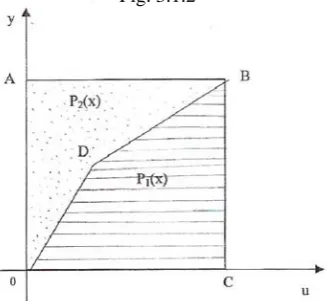
If there is joint production of desirable and regulated undesirable outputs, we may allow free disposability of outputs while constraining the desirable outputs weakly disposed of In the above figure,
Fig. 3.1.2
Undesirable output, u is measured along
horizontal axis
Desirable output, y is measured on vertical axis
The shaded region stands for the output set of
undesirable output u.
It satisfies the weak disposability of outputs.
(y, u) Є (x), it can be seen that θ(y, u) Є
(x) where 0 1
(x) fails to satisfy the strong disposability of
outputs.
( ) Є (x)
( ) ( )
But ( ) (x)
(x) fails to satisfy free disposability of
outputs
For technology represented by (x), u = 0 ⇒
y=0.
The output level set comprised of shaded and dotted
regions constitute (x). It satisfies the strong
disposability of outputs.
IV. POLICE OUTPUT SET–CONSTANT RETURNS TO SCALE–WEAK DISPOSABILITY OF PUTPUTS
We shall denote the output level set that admits constant returns to scale and weak disposability of outputs by,
(x)
(y, u) Є (x) ⇒
≥ y
= u
x
≥ 0
If returns to scale are constant
P (λ, x) = λP(x)
(x) satisfies constant returns to scale
Let u Є (λx)
GOOD AND BAD OUTPUTS
• The police of a state produces desirable as well
as undesirable outputs
• The good and bad outputs are null joint.
• Good outputs are freely disposed.
• Dispose of bad outputs are associated with
46
• In the presence of the good and bad outputs
efficiency is estimated solving goal
programming problems. We have,
G(x, y, u) = : ≥ y, = u,
x , ≥ 0, i=1,2,…….k}
(4.1)
• G(x, y, u): production possibility set.
• Y : vector of good outputs
• U: vector of bad outputs
• X: input vector
Equivalently, the technology may be expressed in outputs sets as follows:
= {u:
} (4.2)
Primary goal programming problem:
For the target state of police that employs an
input vector and produces a good output vector
and a bad output vector , we solve the following goal
programming problem:
Max
Subject to
(4.3)
Max = [ ( , , )]
-1
is observed police input vector of targeted
state.
is the observed bad output of police of
targeted state.
is the observed good output vector of police
of targeted state.
We solve as many linear programming
problems as there are states of police. For ith police state
we estimate the output distance function,
( , , )
Secondary goal programming problem:
In secondary goal programming problem we
treat the bad output of police as an input vector and
reduce radially maintaining the efficiency level of
primary goal programming intact.
Min δ
Subject to
(4.4)
≥
[ ( , , / )]-1
• Min λ = { [ ( , , / )]-1
, , ]}
•
-1
( , , )
• , [ ( , , )]-1 are held constants.
{ [ ( , , / )]-1 , , ]}-1
measures the radial reduction of bad outputs, while
[ ( , , )] measures the radial augmentation of
47
V.
EMPIRICAL INVESTIGATIONS
In all 28 police states, 10 of them have not experienced bad output, viz., custodial crimes. The states in which police officers have committed custodial crimes are
1. Andhra Pradesh (AP)
2. Arunachal Pradesh
3. Bihar
4. Chhattisgarh
5. Gujarat
6. Haryana
7. Karnataka
8. Kerala
9. Madhya Pradesh
10. Maharashtra
11. Meghalaya
12. Mizoram
13. Orissa
14. Punjab
15. Rajasthan
16. Tamil Nadu
17. Uttar Pradesh
18. West Bengal
Imposing null joint hypothesis, assuming that inputs and good outputs are freely disposable, but bad output is weakly disposable. To examine if bad output can be reduced, if so by what extant, we solved linear programming of the following type for each police state:
Min λ
Subject to
≤ (5.1)
≥
= λ ≥ 0
and are input and good output vectors of police state whose efficiency is under evaluation.
is scalar valued bad output, viz., custodial crimes. The linear programming problem formulated as above enquires
for possible reduction of custodial crimes in each of the decision making units.
Table-5. 1
S. No. DMU Min λ
1 Andhra Pradesh (AP) 0.1652
2 Arunachal Pradesh 0.0000
3 Bihar 0.4451
4 Chhattisgarh 0.8972
5 Gujarat 0.0868
6 Haryana 0.0000
7 Karnataka 1.0000
8 Kerala 1.0000
9 Madhya Pradesh 0.5035
10 Maharashtra 0.0365
11 Meghalaya 0.0000
12 Mizoram 0.0000
13 Orissa 1.0000
14 Punjab 0.3058
15 Rajasthan 0.1677
16 Tamil Nadu 1.0000
17 Uttar Pradesh 0.1408
18 West Bengal 0.0709
The objective function has attained unit values for the police sates, Karnataka, Kerala, Orissa and Tamil Nadu, implying that no bad output reduction is possible. Bad output of police can be reduced to zero level for the
48
If inputs and good outputs are freely disposed bad output can be reduced by 83 percent for the police state West Bengal.
Keeping inputs and good outputs at constant level bad output can be reduced by 91 percent in the police state Gujarat.
Bad output of police can be reduced by 96 and 86 percent to Maharashtra and Uttar Pradesh respectively.
Potential bad output reduction is 83 percent in Andhra Pradesh and Rajasthan, 69 percent in Punjab.
Custodial crimes can be reduced in Bihar by 54 percent and 51 percent in Madhya Pradesh, if bad output is weakly disposed, good outputs and inputs are freely disposed.
VI.
CONCLUSION
The present study distinguishes DEA outputs, as good and bad outputs. In the process of good output production it is inevitable that bad outputs are also produced. To reduce bad outputs to zero, the good outputs should also be reduced to the same level, the hypothesis of which is called “null joint”. A good programming problem is initiated to measure output oriented technical efficiency in two steps.
In the primal problem, the additional augmentation of good outputs is enquired assuming that inputs freely disposed (without any cost) but bad outputs are weakly disposed (with cost). Both the mathematical programming problems involved in goal programming are linear programming problems. In the former Goal programming problem additional good output augmentation is maximized. In the later Goal programming problem bad outputs are contracted.
In the presence of good and bad outputs, one may desire to look for augmentation of good outputs and reduction of bad outputs simultaneously. The ‘directional distance function’ is one such efficiency measure which has the Shephard’s efficiency measure as a special case. The linear programming problem that represents direct distance function optimize good and bad outputs in the direction of directional vector.
To formulate and solve the secondary goal programming problem for each of these 28 states it is mandatory that bad output should be positive.
Deletion of the police states whose bad output (number of custodial crimes) is zero leaves 18 police sates.
For the police of the 18 states for which bad output is positive both the primary and secondary linear programming problems are solved. The later problem solved is as follows:
Min λ Subject to ≤ ≥ = λ ≥ 0
Among the 18 decision making units four emerge to be output technical efficient. The peer analysis performed rank the efficient units as follows.
• Orissa
• Kerala
• Karnataka
• Tamil Nadu
None of these DMUs were efficient when the reference technology was provide by the police of all 28 states. Significant bad output reduction possible for the police of Orissa, Kerala, Karnataka and Tamil Nadu.
REFERENCES
[1] Alfred Blumstein and Richard Larson (1969), “Models of Total Criminal Justice System”, Operations Research, 199-231.
[2] E, K., (2001), “A Slacks-based measure of efficiency in data envelopment analysis”, European Journal of Operations Research, 130, 498-509.
[3] Government of India, (2003), “Crime in India”, Bureau of Police Research and Development.
[4] Michael, J. Ryan, (2004), “Goal Programming Problem, regulation and generalized economies of scale and scope”, European journal of operations research, 56-71.
[5] Sarojamma, B.(2006), “Variable Prediction in Crime-Data Envelopment Analysis”, Unpublished Ph.D., Thesis, S.V. University, Tirupati.
[6] Shephard, R.W, (1970), “The theory of Cost and Production Function”, Princeton University Press, Princeton.
[7] Wong, Y.H.B., and Beasley, J.E., (1990), “Restricting weight flexibility in Data Envelopment Analysis”. Journal of Operation Research Society, 41, 829-835.