INTRODUCTION
The explosive growth of Internet traffic is pushing the rapid development of high-speed broadband optical networks, such as dense wavelength-division multiplexing (DWDM) systems¹. In these optical networks, a variety of optical components such as wavelength-division multi/ demultiplexers (MUX/DEMUXs), erbium-doped fiber amplifiers (EDFAs), lasers, photodetectors2-4, and modulators are indispensable for constructing optical networks. Among others, arrayed waveguide grating (AWG)-type MUX/DEMUXs based on planar lightwave circuits (PLCs) have played an important role as a key optical component for DWDM. Meanwhile, in the midst of the telecom winter, many carriers are struggling to reduce per-bit cost. Therefore5-7, optical components are expected to
Characteristics of the fabrication materials based Arrayed
Waveguide grating (AWG) in Passive Optical Networks (PONs)
ABDEL–NASAR A. MOHAMMED
1,
AHMED NABIH ZAKI RASHED
2*and ABD EL–FATTAH A. SAAD
31,2,3Electronics and Electrical Communication Engineering Department, Faculty of Electronic Engineering, Menouf 32951, Menoufia University (Egypt).
(Received: February 12, 2009; Accepted: March 29, 2009)
ABSTRACT
In the present paper, we have investigated two characteristics of three different waveguides employed in arrayed waveguide grating (AWG) in passive optical networks (PON) where rates of variations are processed. Both the thermal and the spectral effects are taken into account. The waveguides are made of Lithium Niobate, germania-doped silica, and Polymethyl metha acrylate (PMMA) polymer. The thermal and spectral sensitivities of optical devices are also analyzed. In general, both qualitative and quantitative analysis of the temporal and spectral responses of AWG and sensitivity are parametrically processed over wide ranges of the set of affecting parameters.
Keywords: Arrayed Waveguide Grating (AWG), Lithium Niobate (LiNbO3-) material, Silica-doped material, Polymethyl-metha acrylate (PMMA) Polymer material.
Arrayed Waveguide Gratings (AWGs) have increasingly become more important in Wavelength Division Multiplexing (WDM) systems. An AWG in silicon-on-insulator (SOI) is of particular interest because of both its technological and material advantages12. The high index contrast in the SOI optical system results in a smaller device and better optical confinement within the waveguide as compared to low index contrast systems13. Also, the mature microelectronic fabrication technology can be easily transferred to most of the SOI photonic devices. The spectral response of a typical SOI AWG exhibits a Gaussian profile, which restricts the wavelength selectivity of the devices due to wavelength drift caused by the laser diode and the AWG. Therefore14, a flat spectral response is desirable to ease the wavelength selectivity of the WDM system. Var ious methods have been proposed and demonstrated in different material systems and each has its own advantages and disadvantages15. To date, with the explosive growth of end user demand for higher bandwidth, various types of passive optical networks (PONs) have been proposed. PON can be roughly divided into two categories such as time-division-multiplexing (TDM) and wavelength-division-multiplexing (WDM) methods16. Compared with TDM-PONs, WDM-PON systems allocate a separate wavelength to each subscriber, enabling the delivery of dedicated bandwidth per optical network unit (ONU). Moreover, this virtual point-to-point connection enables a large guaranteed bandwidth, protocol transparency, high quality of service, excellent security, bit-rate independence, and easy upgradeability. Especially, recent good progress on ather mal arrayed waveguide grating (AWG) and cost-effective colorless ONUs17 has empowered WDM-PON as an optimum solution for the access network. However, fiber link failure from the optical line terminal (OLT) to the ONU leads to the enormous loss of data. Thus, fault monitoring 18. and network protection19 are crucial issues in network operators for reliable network. To date, many methods have been proposed for network protection. In the ITU-T recommendation on PONs (G.983.1), duplicated network resources such as fiber links or ONUs are required20.
In the present study, both the thermal and
spectral variations of three waveguides made of different materials are deeply and parametrically investigated over wide range of the affecting parameters. Thermal sensitivity and spectral sensitivity are also of major interest in photonic integrated circuits (PIC).
Theoretical model and equations analysis Lithium niobate (LiNbO3) material
The investigation of both the thermal and spectral variations of the waveguide refractive index (n) require Sellmeier equation. The set of parameters required to completely characterize the temperature dependence of the refractive-index (n) is given below, Sellmeier equation is under the form 21.:
...(1)
where λ is the optical wavelength in ìm
and 2
0 2 T
T
H= − . T is the temperature of the material, K, and T0 is the reference temperature and is considered as 300 K. The set of parameters of Sellmeier equation coefficients (LiNbO3) are recast and dimensionally adjusted as below 21.: A1=5.35583, A2=4.629 × 10⁻⁷, A
3=0.100473, A4=3.862 × 10⁻⁸, A
5=0.20692, A6= -0.89 × 10 -8,
A7=100, A8=2.657 x 10⁻⁵, A
9=11.34927, and A10=0.01533. Equation (1) can be simplified as:
...(2)
where: A12=A1+A2H, A34=A3+A4H, A56=A5+A6H, and A78=A7+A8H.
Then, the differentiation of Eq. (2) w. r. t ë gives:
...(3)
...(4)
Germania doped silica (GeO2(x)+SiO2(1-x)) material
The refractive index of this waveguide is cast as 22.:
...(5)
The Sellemier coefficients as a function of temperature, and germania mole fraction, x, as follows:
B1= 0.691663+0.1107001* x, B2= (0.0684043+0.000568306 * x)2 * (T/T
0) 2, B
3= 0.4079426+0.31021588 * x,
B4= (0.1162414+0.03772465 * x)2 * (T/T 0)
2, B 5= 0.8974749-0.043311091 * x, and B6= (9.896161+1.94577 * x)2.
The differentiation of Eq. (5) w. r. t ë gives:
(
)
dn
n
d
λ
= −λ
...(6)Also, the differentiation of Eq. (5) w. r. t T yields:
...(7)
Polymethyl-metha acrylate (PMMA) polymer material
The refractive index of this waveguide is cast as 23.:
...(8)
The set of parameters of Sellmeier equation coefficients (PMMA) are recast below 23.:
C1=0.4963, C2= 0.0718 (T/T0), C3=0.6965, C4=0.1174 (T/T0), C5=0.3223, and C6=9.237. where T is the temperature of the material, and T0 is the reference temperature. The differentiation of Eq. (8) w. r. t λ gives:
( )
dn n
dλ= − λ ...(9)
Also, the differentiation of Eq. (8) w. r. t T yields:
...(10)
Sensitivities of waveguides
In fact, the thermal sensitivity STn of n w. r. t T is defined as follows:
...(11)
and the spectral sensitivity Sλn of n w. r. t λ is defined as follows:
..(12)
RESULTS AND DISCUSSION
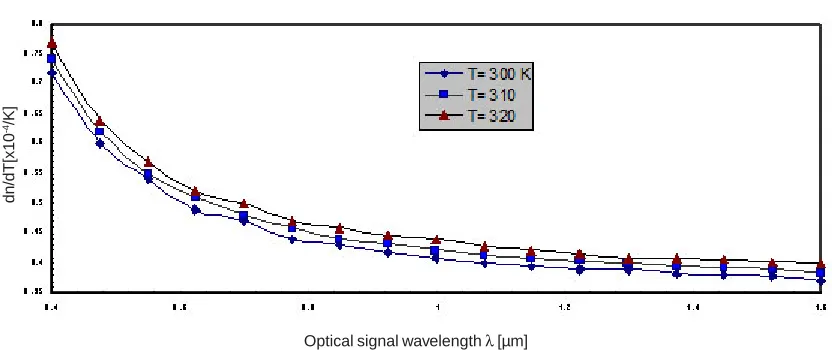
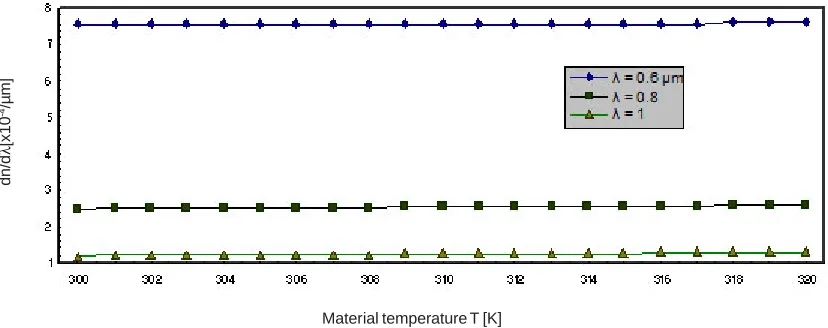
Thermal and spectral variations of n for the three waveguides are displayed in Figs. (1-6), these figures assure the following:
1. (dn/dT or dn/dλ) against the variations of (T or λ) at constant (λ or T) possesses either positive or negative correlations for three optical waveguides.
2. As the wavelength increases, (dn/dT or dn/ dλ) of LiNbO3 material decrease at constant T, and as the temperature increases, (dn/dT or dn/dλ) of LiNbO3 material increase at constant λ. This indicates its thermal stability of LiNbO3 material, dn/dT is constant at (T or λ).
Optical signal wavelength λ [µm]
dn/dT[x10
-4/K]
Fig. 3: Variation of dn/dT versus wavelength for PMMA material Optical signal wavelength λ [µm]
Fig. 2: Variation of dn/dT versus wavelength for Silica- doped material
dn/dT[x10
-4/K]
Optical signal wavelength λ [µm]
Fig. 1: Variation of dn/dT versus wavelength for LiNbO3 material
dn/dT[x10
Material temperature T [K]
dn/d
λ
[x10
-4/µm]
Fig. 4: Variation of dn/dλλλλλ versus temperature for LiNbO3 material
Material temperature T [K]
dn/d
λ
[x10
-4/µm]
Fig. 5: Variation of dn/dλλλλλ versus temperature for Silica-doped material
Material temperature T [K]
dn/d
λ
[x10
-4/µm]
Optical signal wavelength λ [µm]
Spectral senstivity × 10
-1
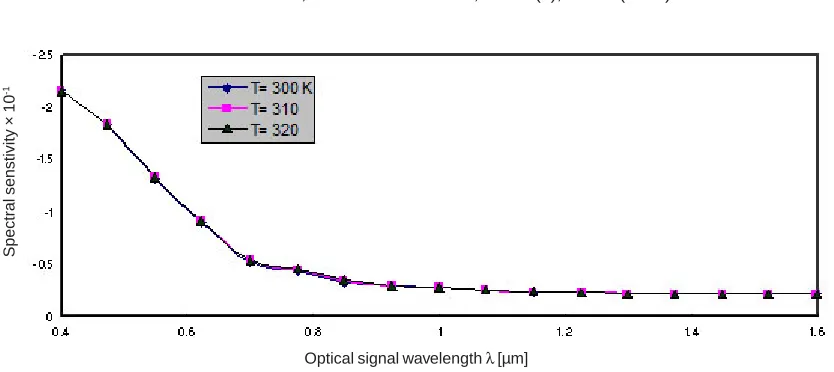
Fig. 7: Variation of spectral sensitivity versus wavelength for LiNbO3 material
Optical signal wavelength λ [µm]
Spectral senstivity × 10
-1
Fig. 8: Variation of spectral sensitivity versus wavelength for Silica-doped material
Optical signal wavelength λ [µm]
Spectral senstivity × 10
-1
Material temperature T [K]
Ther
mal senstivity × 10
-1
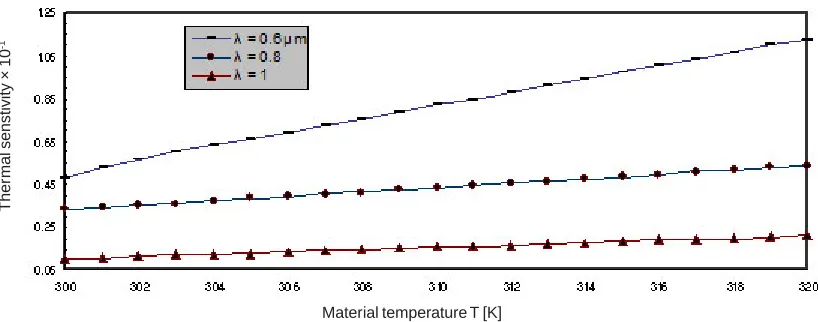
Fig. 10: Variation of thermal sensitivity versus temperature for LiNbO3 material
Material temperature T [K]
Ther
mal senstivity × 10
-1
Fig. 11: Variation of thermal sensitivity versus temperature for Silica-doped material
Material temperature T [K]
Ther
mal senstivity × 10
-1
increases, (dn/dT or dn/dλ) of Silica-doped material also increase at constant λ. This indicates its spectral stability of Silica-doped material, dn/dλ is constant at (T or λ). 4. As the wavelength increases, (dn/dT or dn/
dλ) of PMMA Polymer material decrease at constant T, and as the temperature increases, (dn/dT or dn/dλ) of PMMA Polymer material also decrease at constant λ.
Ther mal and spectral variations of n
T
S andSλn for the three waveguides are also displayed in Figs. (7-12), the following features can be concluded:
1. As the wavelength increases, both the thermal and spectral sensitivities of LiNbO3 material decrease at constant T, and as the temperature increases, the ther mal sensitivity of LiNbO3 material increase at constant λ.
2. As the wavelength increases, both the thermal and spectral sensitivities of
Silica-doped material increase at constant T, and as the temperature increases, also both the thermal and spectral sensitivities of Silica-doped material increase at constant λ. 3. As the wavelength increases, both the
thermal and spectral sensitivities of PMMA Polymer material decrease at constant T, and as the temperature increases, the thermal sensitivity of PMMA Polymer material increase at constant λ.
CONCLUSIONS
In a summar y, three passive optical waveguides employed in PON and made of either Lithium niobate, Silica-doped fiber, and PMMA polymer fiber are spectrally and ther mally investigated based on Sellmeier equation. Thermal and spectral sensitivities are also investigated. Positive correlations or negative correlations or both are found. In general, the three waveguides possess weak nonlinear correlations.
1. Y. Hibino, Recent Advances in High Density and Large Scale AWG Multi/Demultiplexers With Higher Index-Contrast Silica –Based PLCs. IEEE J. Selected Topics Quantum Elect, 8(3): 1090-1101 (2002).
2. M. C. Parker, and S. D. Walker, Design of Arrayed Waveguide Grating Using Hybrid Fourier Fresnel Transform Techniques. IEEE J. Selected Topics Quantum Elect, 5(2): 1379-1384 (1999).
3. P. Munoz, D. Pastor and J. Capmany, Analysis and Design of Arrayed Waveguide Gratings with MMI Couplers. Optics Express, 9(5): 328-330 (2001).
4. P. Munoz, D. Pastor and J. Capmany, Modelling and Design of Arrayed Waveguide Gratings. J. of Lightwave Technol., 20(2): 661-674 (2002).
5. K. Noguchi, Y. Koike, H. Tanobe, K. Harada, and M. Matsuoka, Field Trial of Full-Mesh WDM Network (AWG-STAR) in Metropolitan/ Local Area. J. of Lightwave Technol., 22(3):
329-337 (2004).
6. Hu, Sai. M.S.C.Ersoy, Design and Simulation of Novel Arrayed Waveguide Grating by Using the Method of Irregularly Sampled Zero Crossings. IEEE Quantum Electronics., 35(6): 1233-1249 (2002).
7. E-S. Kang, W-S. Kim, D-J. Kim, and B-S. Bae, Reducing the Thermal Dependence of Silica-Based Arrayed Waveguide Grating Using Inorganic-Organic Hybrid Materials. IEEE Photonics Technol. Letters, 16(1): 2625-2627 (2004).
8. B. Fondeur, A. L. Sala, H. Yamada, R. Brainard, E. Egan, S. Thekdi, N. Gopinathan, D. Nakamoto, and A. Vaidyanathan, Ultrawide AWG With Hyper-Gaussian Profile. IEEE Photonics Technol. Letters, 16(3): 2628-2630 (2004).
9. A-A. Saleh and J. M. Simmons, Evolution Toward the Next Generation Core Optical Network. J. of Lightwave Technol., 24(2): 3303-3320 (2006).
10. K. Suzuki, Y. Hida, T. Shibata, Y. Inone, H. Takahashi, and K. Okamoto, Silica-Based Arrayed Waveguide Gratings For the Visible Wavelength Range. NTT Techanical Review, 4(1): 48-51 (2006).
11. O. M. Matos, M. L. Calvo, P. Cheben, S. Janz, J. A. Rodrigo, D-X. Xu, and A. Delage, Arrayed Waveguide Grating Based on Group Index Modification. J. of Lightwave Technol., 24(5): 1551-1559 (2006).
12. K. Maru, Y. Abe, M. Ito, H. Ishikaura, S. Himi, H. Uetsuka, and T. Mizumoto, 2.5 %-Ä Silica-Based A thermal Arrayed Waveguide Grating Employing Spot Size Converter Based on Segmented Core. IEEE Photonics Technol. Letters, 17(2): 2325-2327 (2005).
13. Photeon Technologies, The Arrayed Waveguide Gratings, pp. 1-5, www.photeon. Com (2005).
14. H. Uetsuka, AWG Technologies for Dense WDM Applications. IEEE Quantum Electronics, 10(2): 393-402 (2004).
15. L. G. Deperalta, A. A. Bernussi, V. Gorbounor, and H. Temakin, Temperature Insensitive Refractive Arrayed Waveguide Grating Multiplexers. IEEE Photonics Technol. Letters, 16(6): 831-833 (2004.
16. M. K. Smit, Progress in AWG Design and Technology. IEEE Quantum Electronics,
18(2) : 1-5 (2005).
17. A. Gholipour, and R. F. Dana, NonUniform Arrayed Waveguide Gratings For Flat Top Passband Transfer Function. J. of Lightwave Technol., 25(1): 3678-3683 (2007).
18. H. C. Lu, and W. S. Wang, Cyclic Arrayed Waveguide Grating Devices With Flat Top Passband and Uniform Spectral Response. IEEE Photonics Technol. Letters, 20(3): 1-5 (2008).
19. D. Robertson, P. Niewczas, J. R. McDonald, Interrogation of a Dual Fiber Bragg Grating Sensor Using an Arrayed Waveguide Grating. IEEE Transaction On Instrumentation and Measurements, 56(9): 2641-2645 (2007). 20. M. Simmons, Survivable Passive Optical
Networks Based on Arrayed Waveguide Grating Architectures. J. of Lightwave Technol., 25(3): 3658-3669 (2007).
21. D. H. Jundt, Fabrication Techniques of Lithium Niobate Waveguides. Optics Letters, 22(1): 1553-1555 (1997).
22. W. Fleming, Dispersion in GeO2-SiO2 Glasses. Applied Optics, 23(24): 4486-4493 (1985).