Comparision between Accuracy and MSE, RMSE by using
Proposed Method with Imputation Technique
V.B. KAMBlE
1and S.N. DEShMuKh
21P.E.S. College of Engineering, Aurangabad. (M.S.), India.
2Dr. Babasaheb Ambedkar Marathwada University, Aurangabad. (M.S.) India.
Abstract
Presence of missing values in the dataset leads to difficult for data analysis in data mining task. In this research work, student dataset is taken contains marks of four different subjects in engineering college. Mean, Mode, Median Imputation were used to deal with challenges of incomplete data. By using MSE and RMSE on dataset using with proposed Method and imputation methods like Mean, Mode, and Median Imputation on the dataset and found out to be values of Mean Squared Error and Root Mean Squared Error for the dataset. Accuracy also found out to be using Proposed Method with Imputation Technique. Experimental observation it was found that, MSE and RMSE gradually decreases when size of the databases is gradually increases by using proposed Method. Also MSE and RMSE gradually increase when size of the databases is gradually increases by using simple imputation technique. Accuracy is also increases with increases size of the databases.
Oriental Journal of Computer Science and Technology
Journal Website: www.computerscijournal.org
Article history
Received: 21 November 2017
Accepted: 24 November 2017
Keywords
Incomplete data, Missing Values, Imputation, Mean Imputation, Median Imputation and Mode Imputation, M S E ( M e a n S q u a r e d Error), RMSE(Root Mean Squared Error )etc.
CONTACT V.B. Kamble [email protected] P.E.S. College of Engineering, Aurangabad. (M.S.), India. © 2017 The Author(s). Published by Techno Research Publishers
This is an Open Access article licensed under a Creative Commons Attribution-NonCommercial-ShareAlike 4.0 International License (https://creativecommons.org/licenses/by-nc-sa/4.0/ ), which permits unrestricted NonCommercial use, distribution, and reproduction in any medium, provided the original work is properly cited.
To link to this article: http://dx.doi.org/10.13005/ojcst/10.04.11
Introduction
Missing data imputation techniques can be used to improve the data quality. Missing data imputation techniques replace missing values of a dataset so that data analysis methods can be applied to
complete dataset1.
In this research work, student dataset is taken contains marks of four different subjects in engineering
that, MSE and RMSE gradually decreases when size of the databases is gradually increases by using proposed Method. Also MSE and RMSE gradually increase when size of the databases is gradually increases by using simple imputation technique. Accuracy is also increases with increases size of the databases.
The organization of the paper is Section1: Introduction Section 2: Literature Reviews, Section 3: Dataset Used, Section 4: Methodology, Section 5: Experimental Result and Analysis, Section 6: Conclusions
literature Reviews lit wise Deletion
This method deletes those instances with missing value for data analysis in the dataset. It is the most common method, it has two drawbacks: a) A substantially decreases the size of dataset available for the data analysis. b) Data are not always missing completely at random.
Mean/Mode Imputation (MMI)
By replacing a missing values with the mean or mode of all attribute which consists missing value. To reduce the influence of exceptional data, median can also be used. This is one of the most commonly used methods.
K-Nearest Neighbor Imputation (KNN)
This method uses k-nearest neighbor algorithms to estimate and replace missing data. The main advantages of this method are a) it can estimate both qualitative attributes and quantitative attributes; b) It is not necessary to build a predictive model for
each attribute with missing data2.
Median Substitution
Median Substitution is calculated by grouping up of data and finding average for the data. Median can be calculated by using the formula
Median = L + h/f (n/2-c) ...(1)
where L is the lower class boundary of median class h is the size of median class i.e. difference between
upper and lower class boundaries of median class f is the frequency of median class, c is previous cumulative frequency of the median class, n/2 is total no. of observations divided by 2
Standard Deviation
The standard deviation measures the spread of the data about the mean value. It is useful in comparing sets of data which may have the same mean but a different range. The Standard Deviation is given by the formula:
...(2)
Where{X1,X2,…,Xn} are the observed values of
the sample items and is the mean value of these observations, while the denominator N stands for
the size of the sample7.
Dataset used
In this work dataset having characteristics is given below.
Number of Instances: 5000,10,000,15,000,20,000 Number of Attributes: 05
(Record No., M1, ECE, EM, EE)
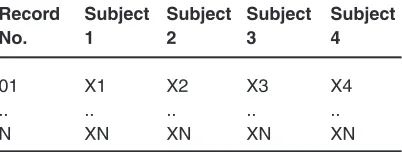
Dataset contains marks of four different subjects of engineering college. In dataset randomly distributed the missing values in each attribute to become the incomplete dataset. Record. No. in the Dataset is used are imaginary and generated for the data analysis purpose in data mining process. In dataset M1, ECE, EM, EE are the subject in engineering college and class test marks for each subject is out of twenty marks for each subject repectively.The structure of Dataset as shown in the Table No.1
Table No 1: Dataset
Record Subject Subject Subject Subject
No. 1 2 3 4
01 X1 X2 X3 X4
.. .. .. .. ..
Methodology
To found out accuracy by using proposed method with imputation technique like mean, mode and median for five thousand dataset, ten thousand dataset, fifteen thousand dataset and twenty thousand dataset.
To found out MSE (Mean Squared Error) for proposed method with mean imputation technique and simple mean imputation technique by using following equation:
...(1)
Where SSE = Sum of Squared Error N = No of Sample
To found out MSE (Mean Squared Error) for proposed method with mode imputation technique and simple mode imputation technique by using equation no.1.
To found out MSE (Mean Squared Error) for proposed method with median imputation technique and simple median imputation technique by using equation no.1.
To found out RMSE (Root Mean Squared Error) for proposed method with mean imputation technique and simple mean imputation technique by using following equation
...(2)
Where x i = predicted value xi = Observed value, N
= No of Sample
To found out RMSE (Root Mean Squared Error) for proposed method with mode imputation technique and simple mode imputation technique by using equation no.2
To found out RMSE (Root Mean Squared Error) for proposed method with median imputation technique
and simple median imputation technique by using equation no.2
Experimental Result and Analysis
For Experimental Result Student dataset is taken which contains marks of four different subjects of engineering college. Mean, Mode, Median Imputation were used to deal with challenges of incomplete data.
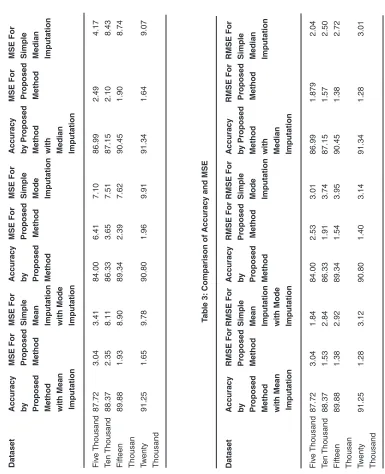
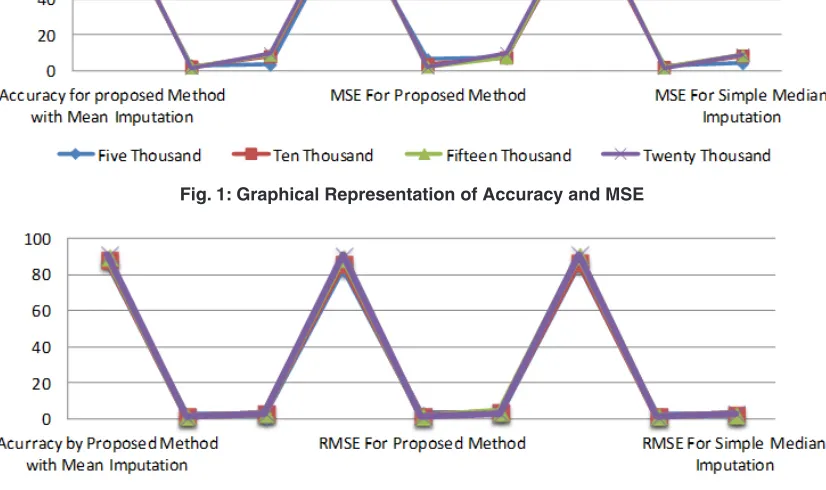
Using proposed method with imputation techniques like Mean, Mode, and Median Imputation on the student dataset and found out to be accuracy for five thousand, ten thousand, fifteen thousand and twenty thousand dataset respectively. Accuracy increase with increase in size of the dataset.
Similarly found out to be MSE by using Proposed Method with Imputation Technique like Mean, Mode, and Median Imputation.MSE decreases with increase in size of the dataset.
Found out to be MSE by using simple Imputation Technique like Mean, Mode, and Median Imputation. MSE increase with increase in size of the dataset.
Similarly found out to be RMSE by using Proposed Method with Imputation Technique like Mean, Mode, and Median Imputation. RMSE decreases with increase in size of the dataset.
Also found out to be RMSE by using simple Imputation Technique like Mean, Mode, and Median Imputation. RMSE increase with increase in size of the dataset.
Tab
le 2:
Comparison of Accurac
y and MSE
Dataset Accurac y MSE For MSE For Accurac y MSE For MSE For Accurac y MSE For MSE For by Pr oposed Simple by Pr oposed Simple by Pr oposed Pr oposed Simple Pr oposed Method Mean Pr oposed Method Mode Method Method Median Method Imputation Method Imputation with Imputation with Mean with Mode Median Imputation Imputation Imputation Fiv e Thousand 87.72 3.04 3.41 84.00 6.41 7.10 86.99 2.49 4.17 Ten Thousand 88.37 2.35 8.11 86.33 3.65 7.51 87.15 2.10 8.43 Fifteen 89.88 1.93 8.90 89.34 2.39 7.62 90.45 1.90 8.74
Thousan Twenty
91.25 1.65 9.78 90.80 1.96 9.91 91.34 1.64 9.07 Thousand Tab le 3:
Comparison of Accurac
y and MSE
Fig. 1: Graphical Representation of Accuracy and MSE
Fig. 2: Graphical Representations of Accuracy and RMSE Conclusions
In this research paper by using proposed method with imputation technique like Mean, Mode and Median Imputation on the student dataset and found out to be accuracy. Also found out to be MSE and RMSE on dataset using with proposed Method and imputation methods like Mean, Mode, and Median Imputation on the dataset. Experimental observation it is found that, MSE and RMSE gradually decreases when size of the databases is gradually increases by using proposed Method. Also MSE and RMSE
gradually increase when size of the databases is gradually increases by using simple imputation technique. Accuracy increase with increase in size of the dataset.
Acknowledgment
I wishes to thank my guide and Data Analytics Laboratory of Department of Computer Science and Information Technology, Dr. Babasaheb Ambedkar Marathwada University, Aurangabad.
References
1 Dinesh J. Prajapati, Jagruti h. Prajapati,
“handling Missing Values: Application to
University Data set”. Issue 1, Vol.
1(August-2011), ISSN 2249-6149
2 Shamsher Singh, Prof. Jagdish Prasad,
“Estimation of Missing Values in the Data Mining and comparison of Imputation
Methods”. Mathematical Jour nal of
Interdisciplinary Sciences Vol. 1, Issue 1,
3 Xiao Feng Zhu, Shichao Zhang, Senior Member, IEEE, Zhi Jin, Senior Member, IEEE, Zili Zhang, and Zhuoming Xu, “Missing Value Estimation for Mixed-Attribute Data Sets”.
IEEE Transactions on Knowledge And Data
Engineering, Vol. 23, No. 1, January 2011.
4 T.R.Sivapriya, V. Thavavel, A.R.Nadira Banu
Kamal, “Imputation and classification of Missing Data Using Least Square Support Vector Machines, A New Approach in
Dementia Diagnosis”, International Journal of
Advanced Research in Artificial Intelligence,
Vol.1, No.4, 2012
5 Yann-Yann Shieh, “Imputation Methods on
General Linear Mixed Models of Longitudinal Studies”, American Institutes for Research
6 Edgar AcuNa And Caroline Rodriguez,
“The Treatment Of Missing Values And Its Effect In The Classifier Accuracy Studies In Classification”, Data Analysis, And Knowledge Organization, 2004, Springer.Com
7 MS. R. Malarvizhi, Dr. Antony Thanamani,
“Comparision of Imputation Techniques after Classifying the Dataset Using KNN Classifier for the Imputation of Missing Data”,
International Journal of Computational Engineering Research (IJCER online.com)
ISSN 2250-3005, Janaury-2013
8 Anjana Sharma, Naina Mehta, Iti Sharma,
“Reasoning With Missing Values in Multi
Attribute Datasets”. International Journal of
Advanced Research in Computer Science
and Software Engineering, Volume 3, Issue5,
May 2013 ISSN: 2277 128X
9 Luai Al Shalabi, “A comparative study of
techniques to deal with missing data in data sets”, In Proceedings of the 4th International Multiconference on Computer Science and Information Technology CSIT 2006.
10 A. Pujari, “Data Mining Techniques”,
Universities Press, India, 2001.
11 Ragel, A. and Cremilleux, B., “MVC A
preprocessing method to deal with missing values”, In Proceedings of Knowledge Based Systems 1999, 285-291.
12 Chih-hung Wu, Chian-huei Wun,
hung-Ju Chou, “Using Association Rules for Completing Missing Data”, Fourth
International Conference on hybrid Intelligent Systems (hIS'04), 2004 pp.236-241.
13 Lakshminarayan K., harp S., Goldman, R.
and Samad, “Imputation of missing data using machine learning techniques, In Proceedings of the Second International Conference on Knowledge Discovery in Databases and Data Mining. T. 1996
14 Zhang, S.C., “Information Enhancement for
Data Mining”, IEEE Intelligent Systems, 2004,
Vol. 19(2): 12-13, (2004).
15 Qin, Y.S.,“Semi-parametric Optimization for
Missing Data Imputation”, Applied Intelligence,
2007, 27(1): 79-88.
16 Zhang, C.Q.,” An Imputation Method for
Missing Values”, PAKDD, LNAI, 4426, 2007: 1080-1087.
17 han J. and Kamber M., “Data Mining:
Concepts and Techniques”, Morgan Kaufmann Publishers, 2006, 2nd edition.
18 A. Dempster, N.M. Laird and D. Rubin,
“Maximum Likelihood from Incomplete Data
via the EM Algorithm”, J. Royal Statistical
Soc., vol. 39, pp. 1-38, 1977.
19 R. Little and D. Rubin, “Statistical Analysis
with Missing Data”, second ed. John Wiley and Sons, 2002.
20 D. Rubin, “Multiple Imputations for
Nonresponsive in Surveys”, Wiley, 1987.
21 J.R. Quinlan, “C4.5: Programs for Machine
Learning”. Morgan Kaufmann, 1993.
22 Q.h. Wang and R. Rao, “Empirical
Likelihood-Based Inference under Imputation for Missing
Response Data”, Annals of Statistics, vol. 30,
pp. 896-924, 2002.
23 S.C. Zhang, “Par imputation: From Imputation
and Null-Imputation to Partially Imputation”,
IEEE Intelligent Informatics Bull., vol. 9, no. 1, pp. 32-38, Nov. 2008.
24 V.B.Kamble, S.N.Deshmukh, “Comparison of
Percentage Error by using Imputation Method
On Mid Term Examination Data”, International
Journal of Innovations in Engineering
Research and Technology (IJIERT),Impact
Factor 2.77, Volume 2, Issue 12,2015
25 V.B.Kamble, S.N.Deshmukh,”Comparative
Proceedings on International Conference on Innovations and Technological Developments in Computer, Electronics and Mechanical Engineering, 28-29, December 2015, VACOE Ahmednagar.ISSN N0.2394-3696
26 V.B.Kamble, S.N.Deshmukh,” A Novel
hybrid Approach for Prediction of Missing
Values In Numeric Dataset” Global Journal
of Engineering Science and Research
Management, Impact Factor: 2.265, ISSN