International Journal of Sciences
Research Article
(ISSN 2305-3925)
Volume 2, Issue May 2013
http://www.ijSciences.com
Kuan Chen Tsai(Correspondence)
[email protected]
Assessing Creative Products by Experts
Kuan Chen Tsai
1
1
University of the Incarnate Word
Abstract: The product-orientated definition of creativity is widely acceptable because it is empirically objective
and adequately reliable. The objective of this study was oriented toward understanding experts’ perceptions of creativity evaluated by experts. The perceptional map indicates that two dimensions clearly existed in the assessment of creativity among six experts. It is speculated that these two dimensions might be related to technical and aesthetic factors. Overall, the homogeneity of six experts’ perceptions of creativity on 46 collages implies that the product approach to some extent is a valid assessment of creativity. However, it is clear that more research is needed in the application of expert judges on creative products.
Keywords: Creativity assessment, creative product, perceptional map, multidimensional scaling
Introduction
In defining creativity, the product approach is always viewed as a focal point (Runco, Plucker, & Lim, 2000-2001). The product-orientated definition of creativity is widely acceptable because it is empirically objective and adequately reliable. MacKinnon (1962), for example, provided a well-known product-orientated definition of creativity:
[Creativity] involves a response or an idea that is novel or at the very least statistically infrequent. But novelty or originality of thought or action, while a necessary aspect of creativity, is not sufficient. If a response is to lay claim to being part of the creative process, it must to some extent be adaptive to, or of reality. It must serve to solve a problem, fit a situation, or accomplish some recognizable goal. (p. 485)
One of the most famous product-oriented assessments of creativity is the Consensual Assessment Technique (CAT) was developed by Amabile (1982, 1996), and it was further extended by other researchers (Garoff & Besancon, 2008; Kaufman, Baer, & Cole, 2009). The initial development of CAT was not to specifically measure all-around creativity but to investigate the idea that task-motivation has an impact on creativity. It is assumed that “all participants can complete the tasks in some way and therefore that tasks used in CAT are fairly simple and do not need higher levels of expertise to solve them” (Kaufman, Lee, Baer, & Lee, 2007, p. 104). Kaufman et al. (2007) argued that “the CAT assesses the creativity of what might be called the garden-variety creative products” (p. 98). They further explained the CAT “focuses on creative performance, not creative thinking skills or other attributes that may be hypothesized to lead to creative performance” (p.
98). Kaufman et al. (2007) also believed that CAT ratings are valid for product- and performance-oriented creativity and that they are useful to understand either the domain-transcending or the domain-specific component of creativity. Generally, reliabilities among judges are quite satisfactory, ranging from .70 to .90 (Amabile, 1996).
The main idea of CAT is based on the thought that the best measure of creative artifacts comes from the collective judgment of experts in that field (Kaufman, Plucker, & Baer, 2008). As Kaufman, Baer, Cole, and Sexton, (2008) indicated, “in creativity assessment in the real world, it is common for panels of experts in a given domain to be asked to evaluate the creativity of some creative product or group of products” (p. 171). The main reason to employ expert judges is because as Amabile (1983) wrote, “it would be a mistake to conclude that everyone (or even every psychology graduate student) can be considered an appropriate judge” and “the best guideline is to use judges who have at least some formal training and experience in the target domain” (p. 72). Kaufman et al. (2009) also suggested that when using CAT for evaluating creativity, “it is probably safest to . . . use experts whenever possible” (p. 231).
http://www.ijSciences.com Volume 2, Issue May 2013
14
attributes, such as originality. Furthermore, thereare concerns about having expert judges judge the products. Runco (1995) described the problem of social judgment as “trustworthy. Judgments be they given by creators or observers, are subjective, and errors among judges are probably too systematic to cancel out one another” (p. 385). Runco, McCarthey, and Svenson (1994) raised the question of who are the most appropriate judges for evaluating creative products. They stated, “Part of the problem is that professionals may rely on high-level, esoteric, idiosyncratic standards” (p. 24). Thus, they did not support the idea that professionals serve as assessors of nonprofessional works.
The objective of this study was oriented toward understanding experts’ perceptions of creativity evaluated by experts. As a result, the application of multidimensional scaling was utilized to investigate the choice of experts that might expand considerably our knowledge of both the methodology and human perception of assessing creativity.
Method
Participants
A total of 46 adults were recruited to participate in this study. They were enrolled in four different classes at a southwest private university, with a mean age of 41.61 years (SD = 10.01, two values missing). The number of males (n = 22) and females (n = 24) were fairly equal. The demographic breakdown was as follows: one Asian, six African Americans, nine Caucasians, 27 Hispanics, and three from mixed backgrounds. The majority were undergraduates (27), with a mean GPA of 3.60 (SD = .33, 13 values missing).
Materials
Research has shown that an effective method of evaluating creativity in adults is through the task of collage making (Amabile, 1979,1982; Amabile, Hennessey, & Crossman, 1986; Simpson, 2009). In addition, Butler-Kisber and Poldma (2010), in their qualitative inquiry of using collage making in experiential research, found that collages serve as a useful visual representation that elicits unconscious thoughts and connects ideas. For the purpose of this study, the adult learners were asked to create a collage in order to understand their creative performance. Participants were given a set of precut construction paper shapes in various colors, a bottle of glue, and a blank white paper. The materials each participant received were identical. The time for this task was 20 minutes. The theme of the collage was “An Adult Learner in 2050.”
The participants were given the following instructions:
You are invited to create a collage. You will be provided a set of pre-cut construction paper shapes in a variety of colors, a bottle of glue, and a blank white paper. You need to tear the paper with your hands and use the glue to complete the collage. The reason is that we want you to play with the material and have fun. The inspiration of the collage is “An Adult Learner in 2050.” You will have 20 minutes to create your unique collage. Hope you enjoy this activity!
Evaluating Creativity
All the creative collages were evaluated following the CAT. The collages were rated for creativity by six experts in the domain: Three faculty members were from the fashion department, two were from the art department, and one had a background in art. All six experts worked independently of one another and had no knowledge of who created the collages. The judges knew that their evaluations were part of the study, but they were unaware of the research goals guiding this study. The theme of the collage that was given to the participants was explained to the judges, and they were informed that the participants were all adult students. The instruction (adapted from Baer, 1993, p. 103) were given to the judges in the grading sheet:
There is no one criterion in rating these collages in terms of creativity. The topic of the collage is ‘An adult learner in 2050.’ For the purpose of this study, the researcher will not provide any criteria for you; rather you are asked to rate the collages solely on the basis of your thoughtful-but-subjective opinions of their creative products. You are asked to rate creativity for the collage on a 5-point rating scale from 1(the lowest level of the dimension) to 5(the highest level of the dimension). Please circle the number on the grading sheet. Thank you.
Results
A Pearson correlation coefficient was calculated for the relationship among six experts’ evaluating creativity on collages. A moderate positive correlation was found between Expert 1 and Experts 2, 3, and 4, r (4) = .414, p < .001, r (4) = .490, p < .001, r (4) = .494, p < .001, respectively. Another moderate positive correlation was found between Expert 2 and Experts 3 and 4, r (4) = .572,
http://www.ijSciences.com Volume 2, Issue May 2013
15
Table 1: Intercorrelation Among Six ExpertsJudge 1 2 3 4 5 6
Expert 1 --
Expert 2 .414** --
Expert 3 .490** .572** --
Expert 4 .494** .295* .267 --
Expert 5 -.030 .173 .073 .114 --
Expert 6 .217 .235 .245 .554** -.012 --
* p < .05. ** p <.001.
For this analysis, preference data were used for a direct assessment of respondent sentiment toward collages. Furthermore, aggregate analysis was involved to provide an overall perspective on the entire sample in a single analysis, with conceptual maps representing the composite perceptions of all respondents. The choice of decompositional methods was employed because the experts only provided overall perceptions of creative products, thereby providing the most direct measure of similarity. Because the primary goal of this study was to understand the experts’ perceptions of creativity, the focus was placed on preferences data in the multidimensional scaling analysis.
Multidimensional Unfolding (PREFSCAL) in SPSS was run. With the dimensionality established
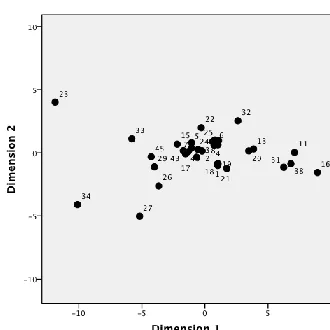
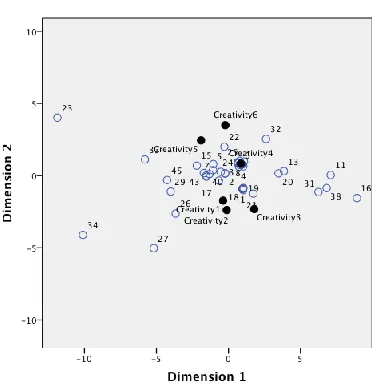
at two dimensions, Figure 1 shows the two-dimensional aggregate perceptual map of six experts. Pairs of judges considered highly similar based on their proximity are Creativity 1 and 2, and Creativity 5 and 6. Comparisons can also be made between these judges. Creativity 3 differs from 5 primarily on dimension I, whereas dimension II differentiates Creativity 4, 5, and 6 most clearly from Creativity 1, 2, and 3. All of these differences are reflected in their relative positions in the perceptual map. Figure 2 contains the distance of each collage in the perceptual map. It is clear that collages 23 and 34 show substantial differences on either dimension in comparison to other objects.
Figure 1. Perceptual map of six experts. Figure 2. Perceptual map of 46 collages.
The point-based ideal points were devalued directly by the proximity of collages to experts’ positions as shown in Figure 3. It portrays all of the respondents forming a general group somewhat clustered around the average, which indicates a general uniformity in perception of creativity. However,
differences in proximity for the group as a whole as well as for each expert can still be detected. In terms of the individual respondents, Expert 4 has a relatively close association with most collage objects.
http://www.ijSciences.com Volume 2, Issue May 2013
16
Figure 3. Map of ideal points.Discussion
This study was focused on assessing the dimensions of evaluation by experts on creative products that may be more subjective or affective in composition to be measured by conventional scales. Thus, a single overall perceptual map was created by combining the position of objects and subjects and showing the relative positions. The results provide insights into not only experts’ perceptions of creativity, but also the perceptions of others in the field.
The perceptional map indicates that two dimensions clearly existed in the assessment of creativity among six experts. It is speculated that these two dimensions might be related to technical and aesthetic factors. Even though the experts provided their overall perceptions of creativity, the results indicate that other possible factors may have affected their evaluations. According to the perceptional map, it is clear that the experts could be divided into two clusters. It is possible that one cluster reflects the technical perspective of products having more weight on assessing creativity, whereas another cluster reflects the more important aesthetic perspective on creativity. That is, for some judges good technical use of materials is important for manifesting creativity, while others perceive that balanced shapes, colors, and structures of collages that lead to pleasing holistic pictures is a confounding factor of creativity. This line of inquiry deems further investigation by differentiating this observation.
The assumption of the current study is grounded in the belief that a creative product is a better predictor of an individual’s creativity. As Besemer and Treffinger (1981) indicated, “Products are the tangible result of the creative process” (p. 159). And as Besemer and O’Quin (1986) believed, “if a human maker creates an object using natural creative abilities, the object should reflect the
creativeness of the maker” (p. 115). This study only employed one holistic dimension—creativity—as a criterion to assess creative products. However, there are other attributes that exist in creative products. Besemer and Treffinger (1981) recognized the challenges of assessing creative products and, as a result, proposed the Creative Product Analysis Matrix (CPAM). The CPAM utilizes three conceptual dimensions (novelty, resolution, and elaboration) and 14 criteria (germinal, original, transformational, adequate, appropriate, logical, useful, valuable, attractive, complex, elegant, expressive, organic, and well-crafted) to better evaluate creative products (p. 164). In conclusion, perceptual mapping provides a unique technique in showing the experts’ assessment of collages in terms of creativity. In this study, two dimensions related to perceptions of creativity among six experts were found. Overall, the homogeneity of six experts’ perceptions of creativity on 46 collages implies that the product approach to some extent is a valid assessment of creativity. However, it is clear that more research is needed in the application of expert judges on creative products.
References
Amabile, T. M. (1979). Effects of external evaluation on artistic creativity. Journal of Personality and Social Psychology, 37(2), 221-233.
Amabile, T. M. (1982). Social psychology of creativity: A consensual assessment technique. Journal of Personality and Social Psychology, 43(5), 997-1013. Amabile, T. M. (1983). The social psychology of creativity: A componential conceptualization. Journal of Personality and Social Psychology, 45(2), 357-376. Amabile, T. M. (1996). Creativity in context: Update to the
social psychology of creativity. Boulder, Colorado: Westview Press.
Amabile, T. M., Hennessey, B.A., & Crossman, B. S. (1986). Social influences on creativity: The effects of contracted-for rewards. Journal of Personality and Social Psychology, 50(1), 14-23.
task-http://www.ijSciences.com Volume 2, Issue May 2013
17
specific approach. Hillsdale, NJ: Lawrence Erlbaum Associates.
Besemer, S. P., & O’Quin, K. (1986). Analyzing creative products: Refinement and test of a judging instrument. The Journal of Creative Behavior, 20(2), 115-126. Besemer, S. P., & Treffinger, D. J. (1981). Analysis of creative
products: Review and synthesis. The Journal of Creative Behavior, 15(3), 158-178.
Butler-Kisber, L., & Poldma, T. (2010). The power of visual approaches in qualitative inquiry: The use of collage making and concept mapping in experiential research. Journal of Research Practice, 6(2), 1-17.
Garoff, X., & Besancon, M. (2008). Variability of creativity judgments. Learning and Individual Differences, 18(4), 367-371.
Hennessey, B. A., & Amabile, T. M. (1999). Consensual assessment. In M. A. Runco & S. R. Pritzker (Eds.), Encyclopedia of creativity (pp. 347-359). San Diego, CA: Academic Press.
Hocevar, D. (1981). Measurement of creativity: Review and critique. Journal of Personality Assessment, 45(5), 450-464.
Kaufman, J. C., Bear, J., & Cole, J. C. (2009). Expertise, domains, and the consensual assessment technique. The Journal of Creative Behavior, 43(4), 223- 233. Kaufman, J. C., Baer, J., Cole, J. C., & Sexton, J. D. (2008). A
comparison of expert and nonexpert raters using the consensual assessment technique. Creativity Research Journal, 20(2), 171-178. doi:10.1080/10400410802059929
Kaufman, J. C., Lee, J., Baer, J., & Lee, S. (2007). Captions, consistency, creativity and the consensual assessment technique: New evidence of reliability. Thinking Skills and Creativity, 2(2), 96-106.
Kaufman, J. C., Plucker, J. A., & Baer, J. (2008). Essentials of creativity assessment. Hoboken, NJ: John Wiley & Sons.
MacKinnon, D. W. (1962). The nature and nurture of creative talent. American Psychologist, 17(7), 484-495. Pearlman, C. (1983). Teachers as an informational resource in
identifying and rating student creativity. Education, 103(3), 215-222.
Runco, M. A. (1995). Insight for creativity, expression for impact. Creativity Research Journal, 8(4), 377-390. Runco, M. A., McCarthey, K. A., & Svenson, E. (1994).
Judgments of the creativity of artwork from students and professional artists. Journal of Psychology, 128(1), 23-31.
Runco, M. A., Plucker, J. A., & Lim, W. (2000-2001). Development and psychometric integrity of a measure of ideational behavior. Creativity Research Journal, 13 (3/4), 393-400.