Reviewable v1
Small Grant Proposal
Clinical roles of soluble ST2 for the outcomes of
cardiac valve operations
Robert Jeenchen Chen
‡ Cardiovascular Surgery, Taipei Tzuchi Hospital, Tzuchi University College of Medicine, Buddhist Tzuchi Medical Foundation, New Taipei City, Taiwan
§ Biochemistry & Molecular Biology, National Taiwan University College of Medicine, Taipei, Taiwan
Corresponding author: Robert Jeenchen Chen ([email protected])
Received: 14 Apr 2016 | Published: 21 Apr 2016
Citation: Chen R (2016) Clinical roles of soluble ST2 for the outcomes of cardiac valve operations. Research Ideas and Outcomes 2: e8849. doi: 10.3897/rio.2.e8849
Executive summary
Soluble ST2 is a novel cardiac biomarker that reflects cardiac injury and the response to treatment. Previous studies showed that ST2 has less confounding and more specific than NT-proBNP. ACCF/AHA has proposed 2013 Guidelines for the Management of Heart Failure that includes ST2 in the recommendations. In the research proposal, we will assess the clinical role of serum ST2 level in cardiac non-coronary valve surgical patients.
We will recruit 70 patients who undergo cardiac non-coronary valve operations. Serum levels of ST2 and NT-proBNP and troponin-T will be measured at preoperative baseline, postoperative 24 hours, and postoperative 5 to 10 days in the routine blood sampling. The endpoints include hospital mortality, all-cause mortality, unexpected ICU return, MACE, time to extubation, and total length of stay. We will also collect various preoperative, operative, and postoperative variables, such as EuroScore-II. Their relationships will be analyzed.
We expect to demonstrate the superior role of ST2 to NT-proBNP and other variables in risk stratification and outcome prediction and assessment in our cohort.
‡,§
Keywords
ST2, NT-proBNP, heart failure, troponin-T, biomarker
List of investigator groups
Cardiovascular Surgery, Cardiology, and Clinical Research, Taipei Tzuchi Hospital, New Taipei City, Taiwan;
Surgery, Tzuchi University College of Medicine, Hualian, Taiwan.
Third parties involved in the project
Health One Network Co., Ltd. New Taipei City Taiwan, (telephone: 886-2-22993688--x13; cellphone: 886-930142606); Critical Diagnostics.
Backgrounds
Soluble ST2 (sST2) is a novel biomarker (Dieplinger et al. 2009) of fibrosis (Moore and Januzzi 2010) that reflects cardiac dysfunction such as remodeling or post-injury scaring (Sanada et al. 2007, Weir et al. 2010, Willems et al. 2013, Díez 2008). According to previous research, its trending has superior signal-to-noise and clinical relevance for cardiac prognosis to conventional biomarkers for heart failure such as NT-proBNP (Weinberg et al. 2002, Pascual-Figal et al. 2011a, Santhanakrishnan et al. 2012). For valvular heart disease patients and their outcomes, we would like to investigate the association and predictive value of ST2 in cardiac surgical non-coronary valve patients.
Conventional biomarkers for assessing heart failure are BNP / NT-proBNP. But they have various confounders like age, BMI, and renal disease (Mueller and Dieplinger 2013). When heart perceives stress, their serum levels begin to rise and their random variations are high. Thus their role of monitoring heart failure prognosis may be unsatisfactory for physicians who need timely responses (Willems et al. 2013, Bayes-Genis et al. 2011, Rehman et al. 2008).
Soluble ST2 can reflect the process of cardiac remodeling and myocardial post-injury
Dieplinger 2013, Januzzi 2013). We can monitor ST2 serum level to predict disease occurrence (Chen et al. 2013) and make treatment plans as early as possible (Boisot et al. 2008, Manzano-Fernández et al. 2012). In addition ACCF/AHA has proposed the 2013 Guideline for the Management of Heart Failure that includes ST2 in the recommendations (Yancy et al. 2013). ST2 and NT-proBNP can work together for better sensitivity and specificity (Pascual-Figal et al. 2011a, Bayes-Genis et al. 2011, Sabatine et al. 2008).
As above, there are also various prior research studies that demonstrated the association of sST2 with acute and chronic heart failure (Mueller et al. 2008, Shah et al. 2009, Wojtczak-Soska et al. 2013, Daniels et al. 2010, Bhardwaj and Januzzi 2010, Henry-Okafor et al. 2012, Manzano-Fernández et al. 2011, Shah and Januzzi 2010, Weinberg 2003).
Aims
1. To stratify the operation risk of valvular heart patients by preop sST2 and other known preop variables;
2. To correlate the operation outcomes of valvular heart patients by postop sST and other known postop variables;
3. To compare sST2 and other known predictive variables.
Impact
Currently we can implement ST2 in the following scenarios:
1. Health checkup and outpatient screening (Wang et al. 2013);
2. Acute inpatients and routine assessments (Díez 2008, Aldous et al. 2012, Pascual-Figal et al. 2009);
3. Post-treatment and prognosis for the recovery evaluation, maybe as long as three to six months (Bayes-Genis et al. 2011, Lupón et al. 2013, Pascual-Figal et al. 2011b, Ky et al. 2011).
Methods
We will collect ST2, and other cardiac biomarkers at different time points of cardiac valve surgical patients and investigate their relationships with different outcome measures and also may compare the performance of these biomarkers on predicting various outcomes (Gaggin et al. 2014).
Design
Data collection overview
(1) Serum biomarker levels of ST2, NTproBNP, and troponin-T from blood sample drawing at the same time of clinical routine blood drawing: preop, postop 24-hour, postop 5-10 days; three time points.
(2) ST2 will be done by special kits sponsored by the vendor. NTproBNP and troponin-T will be measure in hospital central lab.
(3) Preop, op, postop, and outcome variables will be collected as the following details.
Expected Difficulties and Troubleshooting
Since the study does not alter routine clinical practice, little resistance from patients and family is anticipated. Thorough explanation of the informed consent will be helpful for recruiting participating patients.
Inadequate sample size or insufficient power to detect difference may be encountered. Since we have many dependent variables or outcome variables, we may select the some to present.
Procedures
Ethical Considerations
The research protocol will be evaluated by the institutional review board.
All participating patients will have thorough understanding of the study regarding the aims and potential risks as explained by the research staff members. They also sign the informed consensus personally or by a qualified proxy.
We have a conflict of interest to declare: the laboratory kits are partially sponsored by the local distributor, Health One Network Co., Ltd. New Taipei City Taiwan, (telephone: 886-2-22993688--x13; cellphone: 886-930142606).
Cohort definition
We will prospectively recruiting the valvular heart patients who are admitted for elective corrective operations in Far Eastern Memorial Hospital.
The exclusion criteria are: pregnant, combined concurrent major cardiac procedures such as coronary or aorta operations, non-elective settings such as urgent or emergency, refusal of participation by the patient or family due to any reason.
If the inclusion or exclusion of a case is in doubt, the decision is made by the consensus or majority of principal investigators (PI and co-PI).
Data collection
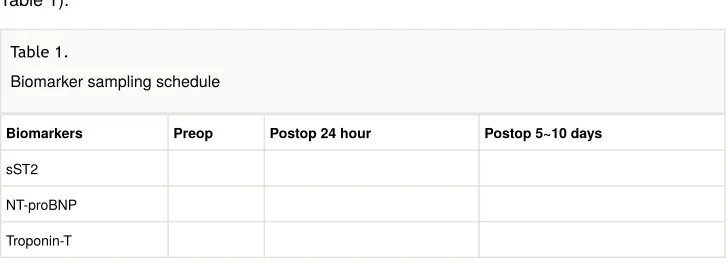
Each patient will have three serum samples collected before operation, 24 hours after operation, and around one week (from five to ten days) after operation. The blood drawing will be made concurrently with other laboratory tests as needed clinically. There is no extra blood drawing purely just for the study. For cardiac biomarkers, we will measure sST2, NT-proBNP, and troponin-T.
Our routine cardiac surgery database will also collect preop, op, and postop variables for all the patients, such as EuroScore-II. The outcome-related variables will include: time to extubation (TOE), intensive care unit (ICU) time, total length of stay (LOS), and hospital mortality.
The variables for each patients are listed but not limited as below:
Biomarkers (preop, postop 24 hour, postop 5-10 days): sST2, NT-proBNP, troponin-T ( Table 1).
Biomarkers Preop Postop 24 hour Postop 5~10 days
sST2 NT-proBNP Troponin-T
Preop: Birthday, date of operation, op diagnosis, last preop LVEF, last preop RVSP (SPAP), creatinine, dialysis or not, diabetes, hypertension, COPD;
Op: operation procedure, op time, ischemia time, pump time
Postop: time to extubation, ICU time, total LOS, unexpected ICU return, hospital mortality (also date), major adverse cardiac event (MACE) (also date), first postop LVEF, and first postop RVSP (SPAP).
Table 1.
Laboratory bench work
To measure sST2 serum levels, we will use the kits and protocols as advised by the vendor (Mueller and Dieplinger 2013). To measure NT-proBNP and troponin-T serum levels, we will send the samples to hospital central lab for result reporting since they have been our clinical routines.
Data Analysis
We plan to recruit 70 patients and measure three serum samples per case. There will be 210 laboratory tests. Due to budget limitation, we set the sample size to be 7, since we can only afford 210 laboratory tests. We set the alpha-level to be 0.05.
The outcome variables (dependent variables) will be the following and we will select more appropriate variables to present according to the interim analysis results. The primary endpoints include: hospital mortality, all-cause mortality, unexpected ICU return, and MACE. The secondary endpoints include: time to extubation, ICU time, and total LOS.
We will transform several variables to facilitate analysis. Renal function will be graded by GFR (glomerular filtration rate) as estimated by creatine-related formulae. Comorbidity such as diabetes or hypertension will be determined by clinical judgment. For biomarker analysis (sST2, NT-proBNP, troponin-T), in addition to absolute values, we will use relate values for better demonstrate the change from baseline and the trends. Relative serum level (RSL) is a dimensionless value defined as the ratio of serum level to the baseline (level divided by baseline).
For comparing scale or ordinal (quasi-scale) variables, we will use Mann-Whitney U test for two groups and Kruskall-Wallis test for three or more groups. For comparing nominal variables, we will use Fisher’s exact test. For comparing time-event variables, we will use log-rank test. For modeling predictions, we will choose appropriate statistical regression methods based upon dependent variables. For scale dependent variable, we will use linear or log-linear regression models depending the likelihood of normality violation. For binary dependent variables, we will use logistic regression model. For time-event variables, we will use Cox regression model. For evaluating biomarker performance on accuracy of classification, we will receiver operating characteristic (ROC) analysis. The truth variables will be one of the outcome variables and the classifier variables will be ordinal-ranged biomarker absolute level or RSL. The tentative optimal cutoff values for each biomarker may be proposed depending on the outcome variables or clinical scenarios.
The backbone for the results presentation will be: cohort background statistics, time trends of biomarkers, biomarker and predictors for the outcomes, and comparisons of biomarkers.
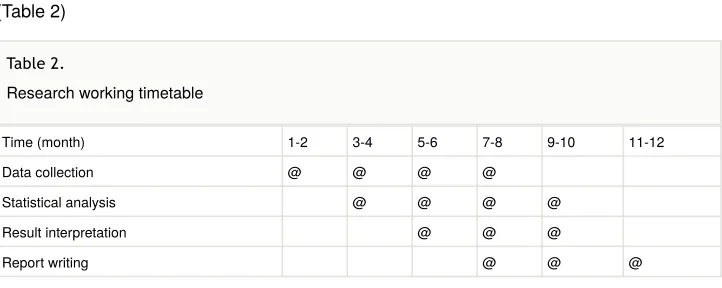
Timetable
(1) ST2 and other cardiac biomarker lab assay;
(2) Statistical analysis of the study;
(3) Interpretation and implement of the study results.
(Table 2)
Time (month) 1-2 3-4 5-6 7-8 9-10 11-12
Data collection @ @ @ @
Statistical analysis @ @ @ @
Result interpretation @ @ @
Report writing @ @ @
Acknowledgements
We would like to show our gratitude to the ST2 vendor, Critical Diagnostics, who provides scientific advice and offers the agreed quantity of free lab kits via our local distributor.
Funding program
Pending; maybe yearly university hospital research grant.
Project
University and hospital cardiovascular research project.
Call
Cardiovascular research call. Table 2.
Hosting institution
Taipei Tzuchi Hospital, Tzuchi University College of Medicine, Buddhist Tzuchi Medical Foundation.
Ethics and security
Consenting, safety, and data policy all comply to ICH (International Conference on Harmonisation) Good Clinical Practice (GCP). University and hospital institutional review board (IRB) will evaluate the approval.
Conflicts of interest
The research is partially sponsored by the local distributor who donates some of the laboratory kits, Health One Network Co., Ltd. New Taipei City Taiwan, (telephone: 886-2-22993688--x13; cellphone: 886-930142606).
References
• Aldous SJ, Richards AM, Troughton R, Than M (2012) ST2 Has Diagnostic and Prognostic Utility for All-Cause Mortality and Heart Failure in Patients Presenting to the Emergency Department With Chest Pain. Journal of Cardiac Failure 18 (4): 304‑310. [In English]. DOI: 10.1016/j.cardfail.2012.01.008
• Bayes-Genis A, de Antonio M, Galán A, Sanz H, Urrutia A, Cabanes R, Cano L, Gonzalez B, Diez C, Pascual T, Elosua R, Lupón J (2011) Combined use of high-sensitivity ST2 and NTproBNP to improve the prediction of death in heart failure. European Journal of Heart Failure 14 (1): 32‑38. [In English]. DOI: 10.1093/eurjhf/ hfr156
• Bhardwaj A, Januzzi JJL (2010) ST2: a novel biomarker for heart failure. Expert Review of Molecular Diagnostics 10 (4): 459‑464. DOI: 10.1586/erm.10.25
• Boisot S, Beede J, Isakson S, Chiu A, Clopton P, Januzzi J, Maisel AS, Fitzgerald RL (2008) Serial Sampling of ST2 Predicts 90-Day Mortality Following Destabilized Heart Failure. Journal of Cardiac Failure 14 (9): 732‑738. [In English]. DOI: 10.1016/ j.cardfail.2008.06.415
• Broch K, Ueland T, Nymo SH, Kjekshus J, Hulthe J, Muntendam P, McMurray JJ, Wikstrand J, Cleland JG, Aukrust P, Gullestad L (2012) Soluble ST2 is associated with adverse outcome in patients with heart failure of ischaemic aetiology. European Journal of Heart Failure 14 (3): 268‑277. [In English]. DOI: 10.1093/eurjhf/hfs006
• Chen LQ, de Lemos JA, Das SR, Ayers CR, Rohatgi A (2013) Soluble ST2 Is
• Daniels LB, Clopton P, Iqbal N, Tran K, Maisel AS (2010) Association of ST2 levels with cardiac structure and function and mortality in outpatients. American Heart Journal 160 (4): 721‑728. [In English]. DOI: 10.1016/j.ahj.2010.06.033
• Dieplinger B, Januzzi JJL, Steinmair M, Gabriel C, Poelz W, Haltmayer M, Mueller T (2009) Analytical and clinical evaluation of a novel high-sensitivity assay for
measurement of soluble ST2 in human plasma — The Presage™ ST2 assay. Clinica Chimica Acta 409: 33‑40. [In English]. DOI: 10.1016/j.cca.2009.08.010
• Díez J (2008) Serum soluble ST2 as a biochemical marker of acute heart failure: future areas of research. Journal of the American College of Cardiology 52 (18): 1466‑1467. [In English]. DOI: 10.1016/j.jacc.2008.07.045
• Gaggin HK, Szymonifka J, Bhardwaj A, Belcher A, De Berardinis B, Motiwala S, Wang TJ, Januzzi Jr. JL (2014) Head-to-Head Comparison of Serial Soluble ST2, Growth Differentiation Factor-15, and Highly-Sensitive Troponin T Measurements in Patients With Chronic Heart Failure. JACC: Heart Failure 2 (1): 65‑72. [In English]. DOI: 10.101 6/j.jchf.2013.10.005
• Henry-Okafor Q, Collins SP, Jenkins CA, Miller KF, Maron DJ, Naftilan AJ, Weintraub N, Fermann GJ, McPherson J, Menon S, Sawyer DB, Storrow AB (2012) Soluble ST2 as a Diagnostic and Prognostic Marker for Acute Heart Failure Syndromes. Open
Biomarkers Journal 2012 (5): 1‑8. [In English]. DOI: 10.2174/1875318301205010001 • Januzzi JL (2013) ST2 as a cardiovascular risk biomarker: from the bench to the
bedside. Journal of Cardiovascular Translational Research 6 (4): 493‑500. [In English]. DOI: 10.1007/s12265-013-9459-y
• Ky B, French B, McCloskey K, Rame JE, McIntosh E, Shahi P, Dries DL, Tang WHW, Wu AHB, Fang JC, Boxer R, Sweitzer NK, Levy WC, Goldberg LR, Jessup M, Cappola TP (2011) High-Sensitivity ST2 for Prediction of Adverse Outcomes in Chronic Heart Failure. Circulation: Heart Failure 4 (2): 180‑187. [In English]. DOI: 10.1161/ CIRCHEARTFAILURE.110.958223
• Lupón J, de Antonio M, Galán A, Vila J, Zamora E, Urrutia A, Bayes-Genis A (2013) Combined Use of the Novel Biomarkers High-Sensitivity Troponin T and ST2 for Heart Failure Risk Stratification vs Conventional Assessment. Mayo Clinic Proceedings 88 (3): 234‑243. [In English]. DOI: 10.1016/j.mayocp.2012.09.016
• Manzano-Fernández S, Mueller T, Pascual-Figal D, Truong QA, Januzzi JL (2011) Usefulness of soluble concentrations of interleukin family member ST2 as predictor of mortality in patients with acutely decompensated heart failure relative to left ventricular ejection fraction. American Journal of Cardiology 107 (2): 259‑267. [In English]. DOI: 1 0.1016/j.amjcard.2010.09.011
• Manzano-Fernández S, Januzzi JL, Pastor-Pérez FJ, Bonaque-González JC, Boronat-Garcia M, Pascual-Figal DA, Montalban-Larrea S, Navarro-Peñalver M, Andreu-Cayuelas JM, Valdés M (2012) Serial Monitoring of Soluble Interleukin Family Member ST2 in Patients with Acutely Decompensated Heart Failure. Cardiology 122 (3): 158‑166. [In English]. DOI: 10.1159/000338800
• Moore SA, Januzzi JL (2010) Found in translation soluble ST2 and heart disease. Journal of the American College of Cardiology 55 (3): 251‑253. [In English]. DOI: 10.10 16/j.jacc.2009.08.049
Expert Review of Molecular Diagnostics 13 (1): 13‑30. [In English]. DOI: 10.1586/ erm.12.128
• Mueller T, Dieplinger B, Gegenhuber A, Poelz W, Pacher R, Haltmayer M (2008) Increased plasma concentrations of soluble ST2 are predictive for 1-year mortality in patients with acute destabilized heart failure. Clinical Chemistry 54 (4): 752‑756. [In English]. DOI: 10.1373/clinchem.2007.096560
• Pascual-Figal DA, Manzano-Fernández S, Boronat M, Casas T, Garrido IP, Bonaque JC, Pastor-Perez F, Valdés M, Januzzi JL (2011) Soluble ST2, high-sensitivity troponin T- and N-terminal pro-B-type natriuretic peptide: complementary role for risk
stratification in acutely decompensated heart failure. European Journal of Heart Failure 13 (7): 718‑725. [In English]. DOI: 10.1093/eurjhf/hfr047
• Pascual-Figal DA, Ordoñez-Llanos J, Tornel PL, Vázquez R, Puig T, Valdés M, Cinca J, de Luna AB, Bayes-Genis A (2009) Soluble ST2 for Predicting Sudden Cardiac Death in Patients With Chronic Heart Failure and Left Ventricular Systolic Dysfunction. Journal of the American College of Cardiology 54 (23): 2174‑2179. DOI: 10.1016/
j.jacc.2009.07.041
• Pascual-Figal DA, Garrido IP, Blanco R, Minguela A, Lax A, Ordoñez-Llanos J, Bayes-Genis A, Valdés M, Moore SA, Januzzi JL (2011) Soluble ST2 is a marker for acute cardiac allograft rejection. European Journal of Heart Failure 92 (6): 2118‑2124. [In English]. DOI: 10.1016/j.athoracsur.2011.07.048
• Rehman SU, Mueller T, Januzzi JL (2008) Characteristics of the novel interleukin family biomarker ST2 in patients with acute heart failure. Journal of the American College of Cardiology 52 (18): 1458‑1465. [In English]. DOI: 10.1016/j.jacc.2008.07.042
• Sabatine MS, Morrow DA, Higgins LJ, MacGillivray C, Guo W, Bode C, Rifai N, Cannon CP, Gerszten RE, Lee RT (2008) Complementary roles for biomarkers of biomechanical strain ST2 and N-terminal prohormone B-type natriuretic peptide in patients with ST-elevation myocardial infarction. Circulation 117 (15): 1936‑1944. [In English]. DOI: 10.11 61/CIRCULATIONAHA.107.728022
• Sanada S, Hakuno D, Higgins LJ, Schreiter ER, McKenzie ANJ, Lee RT (2007) IL-33 and ST2 comprise a critical biomechanically induced and cardioprotective signaling system. Journal of Clinical Investigation 117 (6): 1538‑1549. [In English]. DOI: 10.1172/ JCI30634
• Santhanakrishnan R, Chong JPC, Ng TP, Ling LH, Sim D, Toh G Leong K, Shuan D Yeo P, Ong HY, Jaufeerally F, Wong R, Chai P, Low AF, Richards AM, Lam CSP (2012) Growth differentiation factor 15, ST2, high-sensitivity troponin T, and N-terminal pro brain natriuretic peptide in heart failure with preserved vs. reduced ejection fraction. European Journal of Heart Failure 14 (12): 1338‑1347. [In English]. DOI: 10.1093/eurjhf/ hfs130
• Schmitz J, Owyang A, Oldham E, Song Y, Murphy E, McClanahan TK, Zurawski G, Moshrefi M, Qin J, Li X, Gorman DM, Bazan JF, Kastelein RA (2005) IL-33, an Interleukin-1-like Cytokine that Signals via the IL-1 Receptor-Related Protein ST2 and Induces T Helper Type 2-Associated Cytokines. Immunity 23 (5): 479‑490. [In English]. DOI: 10.1016/j.immuni.2005.09.015
• Shah RV, Chen-Tournoux AA, Picard MH, van Kimmenade RRJ, Januzzi JL (2009) Serum levels of the interleukin-1 receptor family member ST2, cardiac structure and function, and long-term mortality in patients with acute dyspnea. Circulation: Heart Failure 2 (4): 311‑319. [In English]. DOI: 10.1161/CIRCHEARTFAILURE.108.833707 • Wang Y, Yu C, Chiu F, Tsai C, Lai L, Hwang J, Lin J (2013) Soluble ST2 as a Biomarker
for Detecting Stable Heart Failure With a Normal Ejection Fraction in Hypertensive Patients. Journal of Cardiac Failure 19 (3): 163‑168. [In English]. DOI: 10.1016/ j.cardfail.2013.01.010
• Weinberg EO (2003) Identification of Serum Soluble ST2 Receptor as a Novel Heart Failure Biomarker. Circulation 107 (5): 721‑726. [In English]. DOI: 10.1161/01.CIR.0000 047274.66749.FE
• Weinberg EO, Shimpo M, De Keulenaer GW, MacGillivray C, Tominaga S, Solomon SD, Rouleau J, Lee RT (2002) Expression and regulation of ST2, an interleukin-1 receptor family member, in cardiomyocytes and myocardial infarction. Circulation 106 (23): 2961‑2966. [In English]. DOI: 10.1161/01.CIR.0000038705.69871.D9
• Weir RAP, Miller AM, Murphy GEJ, Clements S, Steedman T, Connell JMC, McInnes IB, Dargie HJ, McMurray JJV (2010) Serum soluble ST2: a potential novel mediator in left ventricular and infarct remodeling after acute myocardial infarction. Journal of the American College of Cardiology 55 (3): 243‑250. [In English]. DOI: 10.1016/ j.jacc.2009.08.047
• Willems S, Sels J, Flier S, Versteeg D, Buhre WF, de Kleijn DPV, Hoefer IE, Pasterkamp G (2013) Temporal changes of soluble ST2 after cardiovascular interventions. European journal of clinical investigation 43 (2): 113‑120. [In English]. DOI: 10.1111/eci.12022 • Wojtczak-Soska K, Pietrucha T, Sakowicz A, Lelonek M (2013) Soluble ST2 protein in
chronic heart failure is independent of traditional factors. Archives of medical science : AMS 9 (1): 21‑26. [In English]. DOI: 10.5114/aoms.2013.33344
• Yancy CW, Jessup M, Bozkurt B, Butler J, Donald E Casey J, Drazner MH, Fonarow GC, Geraci SA, Horwich T, Januzzi JL, Johnson MR, Kasper EK, Levy WC, Masoudi FA, McBride PE, McMurray JJV, Mitchell JE, Peterson PN, Riegel B, Sam F, Stevenson LW, Tang WHW, Tsai EJ, Wilkoff BL (2013) 2013 ACCF/AHA Guideline for the
Management of Heart Failure A Report of the American College of Cardiology