www.ijper.org
Developing an Outcome-Based Pharmaceutical
Science Curriculum: an Evaluation Based on
Triangulation Method
Khor Poh Yen1, Mahendran Sekar1, Mohammed Tahir Ansari1
1Department of Pharmacy, Faculty Pharmacy and Health Sciences, Universiti Kuala Lumpur, Royal College of Medicine Perak.
ABSTRACT
Pharmacy education in Malaysia is aiming in producing and developing pharmacists who are clinical-based and competent in the tasks related to clinical pharmacy. Since a workforce that is well-trained to function in the industrial environment as well as laboratory skills-based is in great demand, the current supply of pharmacy graduates is no longer sufficient enough to support the fast-growing industrial needs. The objective of the research is to design and evaluate an outcome-based pharmaceutical science curriculum. The curriculum was designed by following the ‘design down’ process of OBE (Outcome-based Education) model. Through this model, broad outcomes were formulated first and cascaded down to the more specific outcomes later. The entire curriculum content, instructional method and assessment method were linked to the learning outcomes. The curriculum was then evaluated by the triangulation method, that is, by way of a focus group interview, market survey and documentation checking. The different information obtained from the feedback based on the triangulation method-based data collection approach had provided convincing evidence for the enhancement of the curriculum. Such an approach should be considered in the early stages of curriculum development as a quality screening step before the curriculum is offered to the market.
Key words: Learning Outcomes, Outcome-based Curriculum, Assessment, Pharmaceutical Science.
DOI: 10.5530/ijper.50.4.5
Correspondence:
Khor Poh Yen, Jalan Greentown, 30450 Ipoh, perak, Ph.no: (605) 2432635/2636
E-mail: [email protected]
INTRODUCTION
Pharmacy education in Malaysia plays an important role in producing and developing pharmacists who are clinical-based and competent in the tasks related to drug formulation, drugs design and dispensary. Since a workforce that is well-trained to func-tion in the industrial environment as well as laboratory skills-based are in great demand, the growth of the pharmaceutical industry, especially the ones that based on tradi-tional medicine manufacturing,1 is expected to generate the following job opportunities: 15,280 industry and industry-related employ-ment opportunities and 30,000 pharma-ceutical industry-related employment opportunities.2 The down side of the fact,
Submission Date : 23-06-2016 Revision Date : 31-08-2016 Accepted Date : 02-09-2016
METHODS
Outcome-based Models as Curriculum Development Guides
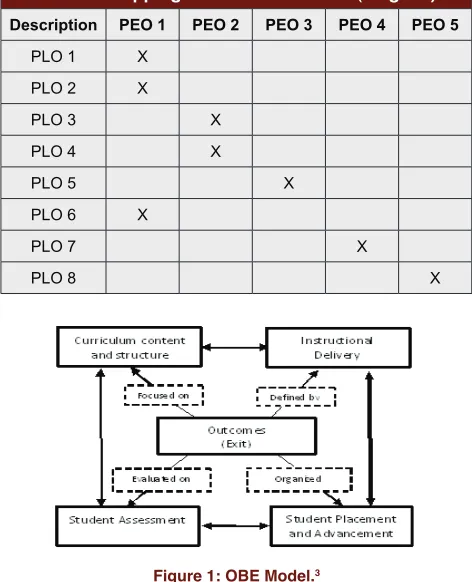
In this study, the development of an outcome-based pharmaceutical curriculum was guided by the OBE model (Figure 1).3 According to this model, the designing of the curriculum contents and structure, instructional/ delivery methods, assessment tools and student place-ment and advanceplace-ment must be anchored or referred to the exit outcomes. In addition, each of the compo-nents must be linked to each other (indicated by pointing arrow) (Figure 1).
We began with the curriculum development approach by following the ‘design down’ process,3,4 that is, we started from broad outcomes cascading down to the more specific outcomes. For example, we started with a broad diagnosis of Program Education Outcomes/ educational needs, and ended up with deriving the exit outcome / Program Learning Outcomes (PLO). The process is repeated for the Course Learning Outcomes (CLOs) and Lesson Learning Outcomes (LLOs). In this study, a number of stakeholders were involved in designing the curriculum to ensure that the curric-ulum is tailored to meet the current industrial needs.4 Nine faculty members from different field of expertise, namely pharmacognosy, pharmaceutics, pharmaceutical chemistry, biochemistry, pharmaceutical microbiology and pharmacology were invited to design the contents for the curriculum. Besides that, professionals who are well versed in the Malaysia higher education rules and regulations, Malaysian Pharmacy Board requirements as well as Accreditation regulations were also consulted. The curriculum development process was initiated in March 2013 and completed in February 2015. This curriculum development process was conducted in two stages: firstly the formulation of learning outcomes and secondly, the designing of the curriculum contents.
Stage 1: Formulation of Learning Outcomes
We first considered educational needs which are associ -ated with society needs. Content analysis on the aim/ learning outcome, program structure, specialization areas from government reports, statistical data and curriculum structure from various parts of the world was done. Brain storming sessions were held to formulate a program aim which is congruent to the vision and mission of the university.5
The outcome generated comprised of knowledge, skills and behaviour / attitudes / values domains and it speci-fies who / will do / how much / of what / by when related to pharmaceutical education.6, 7 For example, we
set the program aim as “to prepare graduates” (Who and When) with the “scientific disciplines” (What) that enhance the “discovery, development, formulation, approval, evaluation and marketing of pharmaceutical products” (knowledge and skills domain). We also took into account the issues that are related to “legal, social, ethical, health, safety and sustainability consideration” (behaviour / attitudes / values domain).
The Program Educational Outcomes (PEOs), which reflected the actual education needs and graduates’ competency in the pharmaceutical profession after three to five years of graduation, were then generated.6 Five PEOs were derived from the program aim. The first PEO emphasized knowledge and professional skills domain expected of learners: “to be knowledgeable, competent and innovative to contribute towards pharma-ceutical industry”. With such background, graduates should be able to work independently and with minimum supervision. In line with the university mission, one of the PEO was formulated as: “To produce graduates who are capable of embarking on marketing and techno pre-neurial activities”. Our aim is that with three to five years of experience gained from pharmaceutical industry, graduates should be able to get involved in the marketing and business of pharmaceutical products. The five PEOs generated are as follows:
1. To produce graduates who are knowledgeable, competent and innovative, which will contribute towards pharmaceutical industry;
2. To produce graduates who practices professionalism with ethics and social responsibility relevant to pharmaceutical activities;
3. To produce graduates who have interpersonal com-munication, effective leadership and teamwork skills to strengthen their role in pharmaceutical industry; 4. To produce graduates who are committed to
the process of lifelong learning and continuous improvement; and
1. Apply fundamental and advance pharmaceutical science knowledge in drug discovery and devel-opment, manufacturing as well as marketing and regulatory affairs of pharmaceutical and related products.
2. Perform appropriate scientific skills in drug dis -covery and development as well as formulation of pharmaceutical and related products.
3. Demonstrate an awareness and understanding of social issues and appreciate strategies towards phar-maceutical and related products development.
4. Demonstrate understanding of the societal, health, safety, legal and cultural issues and the consequent responsibilities relevant to pharmaceutical and related activities.
5. Communicate and function effectively as an indi-vidual and also as a member or leader in research, manufacturing, marketing of pharmaceutical and related products.
6. Apply scientific methods and critical thinking in resolving problems related to drug designing and development as well as formulation of pharmaceu-tical and related products.
7. Recognize the need for, and have the ability to engage in independent and lifelong learning.
8. Demonstrate awareness and understanding of management, marketing and techno preneurial competencies.
We also carried out the outcome mapping process by using Matrix of Program outcome and Exit Outcomes to ensure and verify that the PLOs are equally distributed and aligned with PEOs (Table 1).
Stage 2: Designing of the Curriculum Content
The next task was to design the content, course learning outcomes, learning activities and assessment. By refer-ring to the OBE model (Figure 1), a group of courses or contents was selected based on the defined PLO. Factors that based on significance, utility, validity, learn -ability and feasibility related to the pharmaceutical industry were used as the guideline for the course content selection. We emphasized that the content be organized, moving from simple subordinate com-ponents to complex comcom-ponents depicting the inter-relationships among the components. A total of 40 courses / subjects were designed and distributed into six semesters (S1 – S6). Dominant learning outcomes were mapped to the PLO (Table 2).
Elective components, which account for unplanned learning activities that may, in their own way, contribute to the expected learning outcomes, were offered to
allow learning choices to be made. Research projects and Industrial Training programs, which cover the content areas and at the same time, address core learning outcomes that are hard to facilitate in short courses such as problem solving, professionalism, lifelong learning/independent learning and time management, were offered to support the attainment of a particular PLO.
Along with the defined curriculum content, instruc -tional methods, which focus on the attainment of PEOs and assessment tools, were carefully selected to ensure learning opportunities match with the learning outcomes.10 In the instructional opportunities area, instead of face to face teaching time, which offers direct support to students, student learning time was cut to allow students to prepare before class.11 Academic load was counted by considering student learning time, and so time allocated was able to help students to meet the desired outcomes.8,12
The assessment and teaching methods, which were adopted, were made sure to reflect on the agreed learning outcomes so that decisions can be taken as to whether a student has or has not achieved the stated outcomes.10 A range of abilities were blended and applied to allow the acquiring of the basic knowledge and key skills in a range of subjects besides the development of appro-priate personal skills and attitude.10 A clear statement of learning outcomes is actually a welcome incentive
Table 1: Mapping of PLO versus PEO (Original) Description PEO 1 PEO 2 PEO 3 PEO 4 PEO 5
PLO 1 X
PLO 2 X
PLO 3 X
PLO 4 X
PLO 5 X
PLO 6 X
PLO 7 X
PLO 8 X
Table 2: Mapping of dominant learning outcomes to PLOs(Original)
No Courses PLOs
1 2 3 4 5 6 7 8
S1 Introductory Pharmaceutics X X X
S1 Biochemistry X X X X
S1 Pharmaceutical Organic Chemistry I X X X
S1 Human Anatomy and Physiology X X X X
S1 Pharmaceutical Microbiology X X X X
S2 Research Methodology X X X X
S2 Biostatistics X X X X X
S2 Pharmaceutical Organic Chemistry II X X
S2 Physical Pharmaceutics X X
S2 Pharmacognosy I X X X
S2 Pharmaceutical Analysis I X X
S2 Laboratory practical in pharmaceutical sciences I X X X
S3 Pharmaceutical Engineering X X X X
S3 Pharmacognosy II X X
S3 Pharmaceutical Technology I X X X X
S3 Pharmacology and Toxicology I X X X X X
S3 Pharmaceutical Medicinal Chemistry I X X
S3 Laboratory practical in pharmaceutical sciences II X X X
S4 Pharmaceutical Medicinal Chemistry II X X
S4 Chemistry of Natural Products X X
S4 Pharmacology and Toxicology II X X X
S4 Pharmaceutical Jurisprudence X X X
S4 Pharmaceutical Technology II X X X
S4 Pharmaceutical Analysis II X X
S4 Quality Control and Quality Assurance X
S4 Laboratory practical in pharmaceutical sciences III X X X
S5 Pharmaceutical production management and validation X X
S5 Bio-pharmaceutics and Pharmacokinetics X X X
S5 Research Project X X X X X X
S5 Laboratory practical in pharmaceutical sciences IV X X X
S5 Novel Drug Delivery System (Elective 1) X X
S5 Pharmaceutical Biotechnology (Elective 1) X X
S5 Computer-aided drug design (Elective 1) X X
S5 Herbal Drug Technology (Elective 1) X X
S5 Pharmaceutical Marketing (Elective 2) X X X X
S5 Pharmaceutical Packaging (Elective 2) X X X X
S5 Total Quality Management (Elective 2) X X X X
S5 Islamic Manufacturing Practice (Elective 2) X X X X
Table 3: Mapping of assessment tools versus dominant learning outcomes (original)
Assessment Tools 1 2 3 4 5 6 7 8
Assignment X X X
Group Discussion X X
Self and Peer Evaluation X X X
Written Exam (Quiz, Mid semester exam, Final Exam) X X X
Presentation X X
Practical Report / Practical Exam X X
Log book X X X
Industrial Training Assessment X X X X X X X X
Research proposal, thesis X X X X X X X X
Table 4: The focus group result after the evaluation of the curriculum (original)
Major Theme Discussion Points
Program Objectives • Program aim is appropriate and supports thevision and mission of the university and faculty. • Program Educational Outcomes (PEOs) support the programme aim.
• Program Learning Objectives (PLOs) are appropriate and covered the eight MQF domains. • It is suggested that the PLOs may need to be rephrased from “Pharmaceutical industry” to
“Pharmaceutical and related industry” as the graduates may enter non-pharmaceutical industry such as herbal, food and cosmetic industries
Content of the
curriculum • propose subjects covered relevant areas in pharmaceutical sciences, and the allocation of credit hour for each semester is appropriate. • To widen graduate’s career pathway and cater for the need of Malaysian industries, topics related to food
and cosmetic analysis, and pharmaceutical biotechnology may be incorporated into the curriculum. • The concept of Integrated Laboratory Practical is useful and appropriate for learning by undergraduates.
However, due care must be taken in its design to ensure seamless integration and relevance to practices in R & D and industry.
• Pharmaceutical excipient is recommended to be included for the subject Introductory Pharmaceutics. • Dry granule is recommended to be included for the subject Pharmaceutical Technology II.
• PICS topic has been suggested to be included in Pharmaceutical Jurisprudence / Herbal drug technology. • Pharmacognosy II & Chemistry Natural Products are similar. Therefore, the topics may be rearranged for
Pharmacognosy I, II & Chemistry of Natural Products to ensure continuity of the topics and subjects.
Career pathways • Graduates from this programme will compete for jobs with pharmacy and chemistry graduates in manufacturing industries. Suitable industries may include food and cosmetic manufacturing, in addition to the generic pharmaceutical industry.
• To prepare students for future employment and improve networking, undergraduates should be encouraged to register for student membership in the Malaysian Institute of Chemistry and other professional bodies.
The constraints in
the industrial training • The projected yearly intake is 50 – 80 students and it is pertinent that there are sufficient placements for industrial training in the final year in related industry. It is suggested that the committee is to liaise with
the Malaysian Organisation of Pharmaceutical Industries (MOPI) and other organisations to arrange for industry placements
to explore and improve the availability of assessment tools.13 Mapping of assessment tools and learning outcomes were done to verify assessment methods that were chosen were congruent with the desired outcome being measured (Table 3).
DATA COLLECTION
The data collection for this study was aimed at obtaining feedback in terms of the significance, utility, validity, learn ability and feasibility of the outcome-based curriculum developed in order to support the learning
outcomes of the program. Triangulation data collec-tion method was used not only to validate informacollec-tion obtained but also to get a broader view from various stakeholders. We obtained informed consent to partici-pate in this study from all participants. The Ethics Com-mittee of the university also approved the study.
Focus Group Interview to Evaluate the Curriculum
Table 5: Response of Market Survey Questionnaire
Variables Frequency %
Type of Organization
Locally owned 96 96
Foreign owned 4 4
Fulfillment of basic theory
Fully 94 94
Fairly 6 6
None 0 0
Relevance of concepts & principles to the present context
Yes 100 100
No 0 0
Course contents help to build a strong program
Yes 100 100
No 0 0
Average of all relevant subjects/topics
Yes 100 100
NO 0 0
Fulfillment of legal aspects
Fully 86 86
Partially 14 14
None 0 0
Market / industrial relevance
Fully 90 90
Partially 10 10
None 0 0
Sufficiency in terms of length of study
Yes 94 94
No 6 6
Duration of the practical
Yes 100 100
No 0 0
Suitable to work in your organization
Yes a 94 94
No 6 6
Number of posts that can be filled by graduates
1 – 3 posts 94 94
4 – 6 posts 3 3
7 – 9 posts 3 3
< RM 1500 0 0
Salary rangeb
RM 1500 – 2000 3 3
RM 2001 – 2500 94 94
Others 3 3
Sponsorship offered to further studies
Yes 20 20
No 80 80
Encourage staff to undergo this program
Yes 92 92
No 8 8
Program is able to produce the right kind of graduates for the employment market
Yes 100 100
No 0 0
b $ 1 = RM 3.2
Table 6: Document Analysis Results
Major Theme Discussion Points
Content • Add practical lab session for subject pharmaceutical organic chemistry. Pharmaceutical analysis subjects, pharmacognosy subjects
• Abolish laboratory subject which is offered to stand alone.
• Increase the credit hours for the semesters 1 and 6, but reduce credit hours for semesters 2, 3, 4, and 5 so that semester allocations are equally distributed.
Evaluation • The evaluation method should be clearly spelt out to students if there are any changes on it.
students. The ‘focus group approach’ was chosen because it is a powerful approach for exploring parti-cipants’ knowledge and experiences in relation to the topic of interest.14
Purposive sampling was employed in the selection of focus group respondents to ensure that the data obtained could reflect on the different needs and expec -tations on the curriculum.15 Four respondents were involved in the focus group discussion, and this met the recommended sample size necessary to generate enough different opinions to stimulate a discussion without participants competing for time to talk as well as to get in depth responses.14,16 The two respondents were professors specially invited from a public university in Malaysia, and another two were experienced industry-related people who are holding senior positions in selected pharmaceutical manufacturing companies in Malaysia.
to similar ideas. Once the labeling was done, the labels were grouped into categories.
To ensure validity of the focus group data, a draft of the summary was mailed to focus group participants for their review and approval.16 The participants were invited to provide any feedback that they may have over the telephone or in writing, and to confirm their approval of the draft document by way of e-mail, tele-phone, or fax.
Questionnaire using web-based survey
The questionnaire survey was intended to gain the potential employers’ perception on the relevancy of the course offered to meet the current industrial needs. The target population is all the pharmaceutical companies registered under the Malaysian Organization of Phar-maceutical Industries (MOPI). This is because all the major pharmaceutical manufacturers in Malaysia are members of MOPI.17
The survey was conducted by emailing a cover letter with the link to the questionnaire survey to respective persons of the companies who could provide valid responses. To increase the response return rate, we elec-tronically mailed out the original questionnaire and two weeks later, we followed up with a second questionnaire to those who did not respond.
Semi-close-ended questionnaire adopted from the new program market survey of University of Sarawak, Malaysia was used. The questionnaire consisted of eigh-teen close-ended questions followed with a request for additional responses in an open-ended question. The questionnaire was validated and reviewed earlier by the faculty members.
Document Analysis
The full sets of curriculum were then sent to the Malaysian Pharmacy Board through MQA for evaluation.
RESULTS
Focus Group Results
Table 4 shows the major themes that emerged as impor-tant areas for discussion. Specific learning techniques and future employment opportunities were the most frequently discussed topics in the group.
Market Survey Result
All100 respondents completed the questionnaire. Eighty one percent (81%) response rate was achieved in this study which met the minimum response rate of 50% as reported in many survey studies in leading. The result from the survey is presented in Table 5.
Document Analysis
The feedback document was obtained after six months. The feedback report covered all aspects of the program, institution autonomy, facilities, sufficiency of academia, and resources. However, only the feedback on the curriculum, which is related to this study, had been reported and summarized in Table 6.
DISCUSSION
The results obtained from the three methods revealed interesting findings and fulfilled the purposes of using the triangulation method to get a broader perspective in curriculum development and evaluation at the very early stage.
From the focus group discussion, it was noted that the major concern for the members was the employ-ment opportunities instead of the curriculum itself. The focus group members foresaw the possibility of the market saturation and competition for jobs from phar-macy graduates who are clinical-based and trained and the chemistry graduates. This is a precaution or early warning which should be seriously taken into consid-eration by any curriculum developer. In the current market worldwide, graduates are competing for jobs and unfortunately a lot of graduates are not working in their field of studies; this situation is happening not only to undergraduates but also to postgraduate students. Specialization in any particular area of studies (the niche area for this program is traditional herbs) is both a strength and weakness as far as the market saturation is concerned. Broader areas such as food and cosmetics, which are pharmaceutical-related, should be taken into consideration; however, this might also overlap with the graduates from the food technology department. The focus group suggested that, besides the industrial training exposure for employment opportunities, graduate students must also be exposed to professional bodies such as the Malaysian Chemistry Society by way of regis-tered membership to improve students’ future career. The market survey feedback from the employers, however, contradicted with responses from the focus group. The market survey showed that the curriculum developed was able to prepare graduates for employment and they can also be readily absorbed into the current industry. This is because the market survey reflected the current view of the market needs though this might not be considered or promised the sustainability of this program for future industrial employment opportunities.
were not highlighted in the focus group discussion. It was suggested that more practical sessions should be included in each subject. The main concern would be to enhance basic skills rather than relying on the job-training schemes.
CONCLUSION
Designing and developing a curriculum is a hugely challen ging task. The quality of the curriculum devel-oped always relies on the results obtained from the students’ feedback upon or after graduation. However, preliminary assessment on the newly-developed curric-ulum should be considered as important quality screening step before the curriculum is offered to the market.
CONFLICT OF INTEREST
Nil.
ACKNOWLEDGMENT
A heartfelt thanks and appreciation is conveyed to Prof. Dr. Mohd Syafiq bin Abdullah for his inspiration, encouragement and motivation. Without him, research-ers believe, the completion of this research paper would not have seen the light of the day.
REFERENCES
1. Ministry of International Trade and Industry. Malaysia Industry Master Plan. 3,2006-2020. Malaysia: 2010.
2. Pharmaceutical Association of Malaysia (PhAMA). Industry fact book. Malaysia: 2012.
3. Spady WG. Organizing for Results: The Basis of Authentic Restructuring and Reform. Educational Leadership. 1988;46(2):4-8.
4. Harden RM, Crosby JR, Davis MH. AMEE Guide No. 14: Outcome-based education: Part 1-An introduction to outcome-based education. Medical Teacher. 1999;21(1):7-14. http://dx.doi.org/10.1080/01421599979969 5. Harden RM, Crosby JR, Davis MH, Friedman M. AMEE Guide No. 14:
Outcome-based education: Part 5-From competency to meta-competency: a model for the specification of learning outcomes. Medical Teacher. 1999;21:546-52. http://dx.doi.org/10.1080/01421599978951 ; PMid:21281173
6. Bhise SB, Deshpande AM. Accreditation of Pharmacy Institutions: Design of Curriculum. Indian Journal of Pharmaceutical Education and Research. 2014;48(4):1-5. http://dx.doi.org/10.5530/ijper.48.4.1
7. Abate MA, Stamatakis MK, Haggett RR. Excellence in Curriculum Development and Assessment. 2003;67(3):1-22.
8. Malaysia Qualification Agency. Malaysian Qualifications Framework. Point of Reference and Joint Understanding of Higher Education Qualifications in Malaysia. Malaysia: 2011.
9. Ho SSS, Kember D, Lau CBS, Au Yeung MYM, Leung DYP, Chow MSS. An outcomes-based approach to curriculum development in pharmacy. American Journal of Pharmaceutical Education. 2009;73:14. http://dx.doi. org/10.5688/aj730114
10. Harden RM. Outcome-based education--the ostrich, the peacock and the beaver. Medical Teacher. 2007;29(7):666-71. http://dx.doi. org/10.1080/01421590701729948 ; PMid:18236254
11. Spady WG. Outcome-based education: Critical issues and answers. Arlington, V A: American Association of School Administrators. 1994. 12. Malaysian Qualifications Agency. Programme Standards: Medical and Health
Sciences. Petaling Jaya: The standard devision of Malayisan Qualifications agency; 2013.
13. Harden RM. Outcome-Based Education: the future is today. Medical Teacher. 2007;29(7):625-9. http://dx.doi.org/10.1080/01421590701729930; PMid:18236247
14. Kitzinger J. Qualitative research. Introducing focus groups. BMJ. 1995;311(7000):299-302. http://dx.doi.org/10.1136/bmj.311.7000.299 15. Ben-david MF. AMEE guide no . 14 : Outcome-based education : Part
3--assessment in outcome-based education. 1999;21(1):23-5.
16. Frasier PY, Slatt L, Kowlowitz V, Kollisch DO, Mintzer M. Fcous groups: A useful tool for curriculum evaluation. Family Medicine. 1997;29(7):500-7. PMid:9232413
17. The Malaysian Pharmaceutical Industries. Malaysia; 2016.
• design down’ process of OBE model is a good method to develop outcome-based curriculum. • Triangulation method of curriculum evaluation
should be considered as important quality screen-ing procedure on the newly-developed curriculum • Possibility of the market saturation and job com-petition of graduates should be seriously taken into consideration by any curriculum developer. • Market survey reflected the current view of the
market needs, but this might not be considered or promised the sustainability of this program for future industrial employment opportunities. • Practical sessions in the curriculum should be
included in each subject in order to enhance basic skills rather than relying on the job-training schemes.
Khor Poh Yen is working as a senior lecturer in Pharmacy Programme, Faculty of Pharmacy & Health Science in Universiti Kuala Lumpur, Royal College of Medicine Perak, Malaysia. She completed her Master in Education from Open Universiti Malaysia and Master in Science (Chemistry) from University of Malaya, Malaysia.