Measuring Web Impact Factors: A Webometric Study based on the
Analysis of Hyperlinks
Parthasarathi Mukhopadhyay Lecturer, Department of Library and Information Science Vidyasagar University, Midnapore, West Bengal (Mail ID: [email protected])
Abstract
Reports the result of webometric investigation at different levels of domain name system. This study is based on the analysis of hyperlinks. It includes calculation of web impact factor (Web If ) for ccTLDs of SAARC group of countries; sub-level domains related to education & research and registered under Indian ccTLD and hosts under IIT and IIM educational system in India.
0 Introduction
The publicly indexable WWW or simply web may be considered as a citation network where traditional information entities, and citations from them are replaced by web pages and hyperlinks respectively. Studies of the Web have been named webometrics by Almind and Ingwersen [1] or cybermetrics as in the electronic journal of that name [2]. Webometrics displays several similarities to informetric and scientometric studies and the application of common bibliometric methods. For instance, simplistic counts and content analysis of web pages are like traditional publication analysis; counts and analyses of outgoing links from web pages, here named outlinks, and of links pointing to web pages, called inlinks, can be seen as reference and citation analyses, respectively. Outlinks and inlinks are then similar to references and citations, respectively, in scientific articles. A simple model of relationship between web pages may be illustrated as below:
1 Web Structure
Before proceeding further, some concepts may be discussed briefly for better understanding of web structure
• Web page: These are basic unit of web resources. Web pages are HTML formatted document like objects that incorporate text, graphics, sound, animation and multimedia elements. Pages are connected to one another using hypertext links (hyperlinks)
• Web site:A web site is a collection of web pages. A web site can be accessed through its URL (Uniform Resource Locator e.g. http://www.csir.res.in)
• Home page: The Home page is the first or top page of any website. It acts as a table of contents to organize the site.
• Hyperlink: It is highlighted word, text, icon or graphic by clicking on which one can easily navigate to additional information on the same host server or one across the globe.
The WWW is hierarchical in structure. This hierarchy has its origin in the Domain Name System (DNS). The DNS translates the plain English address (e.g. iitkgp.ernet.in ) into corresponding IP address (e.g. 144.16.192.17 ). From the right hand side, the domain name structure has following hierarchy: Top level domain • Sub-level domain • Server/Computer domain. In the above example, the hierarchy is: .in (Top level domain for India) • .ernet (Sub-level domain under .in) • iitkgp (Specific computer/server at IIT, Kharagpur operating under top level domain .in and sublevel domain .ernet). The top level domain (TLD) may be grouped into three categories:-
The gTLDs are .com, .net, .org (Open category) and .gov, .edu, .mil (Restricted category). The iTLD .int is meant for international organizations like ITU, WIPO etc. The ccTLD is allotted for each country in accordence with two letter codes based on ISO-3166 (e.g. .in for India, .jp for Japan, .fr for France and so on). The ccTLD for India is .in as per ISO-3166.
2 Domain Name System of India
mindful of the interest of the Global Internet Community. The Internet Management Group (IMG), a committee formed by the Govt. of India, oversees the Internet domain name registration related activities for the IN ccTLD. This committee consists of members representing Bharat Sanchar Nigam Ltd (BSNL), Ministry of Information Technology (MIT), Videsh Sanchar Nigam Ltd (VSNL) and National Centre for Software Technology (NCST). NCST is the designated manager of the IN ccTLD. As a ccTLD Manager for IN, NCST is in charge with the operations and supervision of the DNS services for the IN domain name space. Following are the responsibilities handled by NCST in this regard.
• Registration and Assignment of domains to various organisations applying for a domain under .in
• Delegation of the domains allotted to the organisations within the appopriate sub-domain categories under .in
• Technical Administration and Maintenance of the dedicated primary nameserver operated for the top level
domain .in as well as the second level domains under .in
• Co-ordinate with sites running the secondary name servers for .in and the second level domains under .in
• Provide the WHOIS service which is an on-line search facility for people to find out whether a .in domain
name has been registered and, if so, by whom.
The .in country code is separated into sub categories, called Second Level Domains (SLD's). Organisatations should register the domain name within the appropriate SLD that corresponds to the type of the organisation/entity as outlined below.
Domain Category Who Can Apply
co.in For Registered Companies/Trademarks/Banks
firm.in For Proprietary Concerns/Partnership Firms/Shops/Liaison Offices
ac.in For Academic Community
res.in For Research Institutes
gov.in For Government Organisations
mil.in For Military Establishments
net.in For Internet Service Providers
in For Internet Service Providers
org.in For Non-profit Organisations
ind.in For Individuals
gen.in For General/Miscellaneous Purpose
There are other IN SLDs that have been delegated to the Internet Service Providers in India like ERNET India (for ernet.in), Department of Telecom Services(for dts.in), National Informatics Centre (for nic.in) etc.
3 Web as Global Publishing Platform
information scientists to perform an exploratory analysis of the intellectual structure of cyberspace [5]. Shortly after, Almind and Ingwersen [1] applied a variety of bibliometric-like methods to the Nordic portion of the Web in order to observe the kinds of page connections and define the typology of web pages actually found at national Nordic level. The methodology involved stratified sampling of web pages and download for local analysis purposes. Among the interesting findings the analyses revealed that each web page, capable of outlinking, on average provides 9 outlinks, a proportion which nowadays still holds in the exponentially growing Web space.
4 Webometrics and Web Impact Factor (Web-If)
Ingwersen [6] first reported the investigations into the feasibility and reliability of calculating Impact Factors for web sites, called Web Impact Factors (Web-If) in 1998. He followed the same method, adopted by ISI
(the Institute for Scientific Information, Philadelphia) for calculating Impact Factor (If). The Impact Factor
(If) is defined [7] as the ratio of number of citations received by source items in a particular year to the total
number of source items published over a fixed period of time in a particular periodical publication, say a journal. JCR (Journal Citation Reports) Impact Factors are computed considering the fixed period as two years. It means the Impact Factor (If) of a journal X for a particular year T is defined as the number of
citations received in year T by all documents published in X in the years T-1 and T-2; divided by the number of citable documents published in X in the years T-1 and T-2. In the same way, the Web Impact Factor (Web-If) may be defined as the ratio of number of links to the total number of web pages. Web-If is
essentially the number of pages linking to a site or area of Internet, divided by the number of pages in that site or area at a given point of times [6,8]. Therefore Web-If may be computed at three levels – top-level
domains, sub-level domains and host level domains or site-level domains. Web-If for all the above three
levels can be formulated as: -
Special Keywords Explanation Supported by
domain:domainname
Finds pages with specified domain. For example domain:uk or domain:in will retrieve web pages under the ccTLD of United Kingdom and India. Similarly domain:iitkgp.ernet.in will find pages in the site address of IIT, Kharagpur
Altavista, Google, Hotbot, Alltheweb
host:site address Finds pages on a specific computers e.g. host:iimcal.ac.in would found pages on the server of IIM, Calcutta Altavista
link:url or site address Finds pages with a link to a page with the specified URL e.g. link:iimcal.ac.in will find all pages with at least one link to the web site of IIM, Calcutta
Altavista
linkdomain: url or site address
Finds pages with a link to a page with the specified URL e.g. linkdomain:.iimcal.ac.in will find all pages with at least one link to the web site of IIM, Calcutta
Hotbot
text:text Finds pages that contain specified text in any part of the page other than image tag, link or URL. The text can be a meta tag Altavista, Google, Hotbot
title:text Finds pages that contain the specified word or phrase in the page title Altavista, Google, Hotbot, Alltheweb
5 Objective
Webometrics covers research of all network-based communication using informetric or other quantitative measure. Webometrics, in future, may come up as one of the most interesting research area for the vast collection of electronic information available on the publicly indexable web. William Paisley [9] rightly identified this area as the future domain of bibliometric research. The primary objective of this study is to formulate a methodology for the calculation of web impact factor at three hierarchical levels – ccTLD, SLD and WSLD. In view of this primary purpose of the study, the objectives may be expressed in terms of the following:
1. To calculate Web If of all the countries in SAARC group (Bangladesh, Bhutan, India, Maldives,
Nepal, Pakistan and Sri Lanka) and rank the countries as per the external Web If
2. To calculate Web If of sub-level domains (SLDs) related to education & research and registreed
under ccTLD of India i.e. .in and rank these SLDs as per the external Web If
3. To calculate Web If of all the IITs and IIMs and rank them as per their external Web If
6 Methodology
The methodology followed in the whole work may be divided into four steps:
6.1 Selection of Search Engine
Webometric studies use advanced query option of commercial search engines to obtain hyperlink counts. Primarily there are three search engines (Altavista, AllThe Web and Hotbot), which reports number of pages or links against carefully designed queries related to webometric study. Hotbot search engine [10] is selected to collect data for the calculation of Web Impact Factor (Web If) at different levels as per the objective of
domain:in It will report number of web pages under .in domain (ccTLD of India) included in the Hotbot databases
linkdomain:in It will report number of web pages in Hotbot databases that provided hyperlinks to .in domain (ccTLD of India) linkdomain:in AND It will report number of web pages under .in domain that provided domain:in hyperlinks to .in domain (ccTLD of India) i.e. self-link pages
linkdomain:in AND NOT It will report number of web pages not under .in domain but provided domain:in hyperlinks to .in domain (ccTLD of India) i.e. external-link pages
6.2 Collection of ccTLD, SLD and URL of selected Webspaces
As per the objective of this study, ccTLDs of SAARC countries, SLDs related to education and research domain under the ccTLD for India (i.e. .in) and the URLs of each institute under the IIT system and IIM system have been collected by conducting Internet searching, literature searching and through personal communication. The selected search engine is then searched against all the domain names and URLs to check whether the Hotbot databases include these domain / sites or not. Each URL has been checked by visiting at least twice daily during the period of searching. The ccTLDs, SLDs under .in and URLs are as follows:
ccTLD of SAARC group of Countries (Group I)
• Bangladesh -.bd
• Bhutan - .bt
• India - .in
• Maldives - .mv
• Nepal - .np
• Pakistan - .pk
• Sri Lanka - .lk
SLDs related to education and research activities under ccTLD for India (.in) (Group II)
• Academic activities – ac.in
• Research Activities – res.in
• Education and Research – ernet.in
• Government activities (along with education and research) – nic.in
Domain name of hosts under IIT system (Group III-A)
• Indian Institute of Technology, Bombay iitb.ac.in
• Indian Institute of Technology, Delhi iitd.ac.in
• Indian Institute of Technology, Guwahati iitg.ernet.in and iitg.ac.in
• Indian Institute of Technology, Kanpur iitk.ac.in
• Indian Institute of Technology, Kharagpur iitkgp.ernet.in
• Indian Institute of Technology, Madras iitm.ac.in
• Indian Institute of Technology, Roorke iitr.ac.in Domain name of hosts under IIM system (Group III-B)
• Indian Institute of Management, Ahemdabad iimahd.ernet.in
• Indian Institute of Management, Bangalore iimb.ernet.in
• Indian Institute of Management, Calcutta iimcal.ac.in
• Indian Institute of Management, Indore iimidr.ac.in
• Indian Institute of Management, Kozhikode iimk.org
6.3 Data Collection through Searching
A series of online snapshot searches over a month (07/07/2004-06/08/2004) have been performed on the selected search engine by keeping the various search conditions constant. The four search statements that have been used to collect various data for each ccTLD, SLD and URL may be illustrated with one example from each group:
Group I (for example ccTLD for Pakistan)
domain:pk It will report number of web pages under .pk domain (ccTLD of Pakistan)
included in the Hotbot databases
linkdomain:pk It will report number of web pages in Hotbot databases that provided
hyperlinks to .pk domain (ccTLD of Pakistan)
(linkdomain:pk AND It will report number of web pages under .pk domain that provided
domain:pk) hyperlinks to .pk domain (ccTLD of Pakistan) i.e. self-link pages
linkdomain:pk AND NOT It will report number of web pages not under .pk domain but provided
domain:pk hyperlinks to .pk domain (ccTLD of Pakistan) i.e. external-link pages
Group II (for example SLD ac.in under ccTLD .in)
domain:ac.in It will report number of web pages under ac.in domain (SLD under .in)
included in the Hotbot databases
linkdomain: ac.in It will report number of web pages in Hotbot databases that provided
hyperlinks to ac.in domain (SLD under .in)
(linkdomain: ac.in AND It will report number of web pages under ac.in domain that provided
domain: ac.in) hyperlinks to ac.in domain (SLD under .in) i.e. self-link pages
(linkdomain: ac.in AND NOT It will report number of web pages not under ac.in domain but provided
domain: ac.in) hyperlinks to ac.in domain (SLD under .in) i.e. external-link pages
Group III-A (for example WSLD iitkgp.ernet.in under SLD ernet.in)
domain:iitkgp.ernet.in It will report number of web pages under iitkgp.ernet.in domain (under SLD
ernet.in) included in the Hotbot databases
linkdomain:iitkgp.ernet.in It will report number of web pages in Hotbot databases that provided
hyperlinks to iitkgp.ernet.in domain (under SLD ernet.in)
(linkdomain:iitkgp.ernet.in It will report number of web pages under iitkgp.ernet.in domain that provided
AND domain:iitkgp.ernet.in) hyperlinks to iitkgp.ernet.in domain (under SLD ernet.in) i.e. self-link pages
(linkdomain:iitkgp.ernet.in It will report number of web pages not under iitkgp.ernet.in domain but provided
AND NOT hyperlinks to iitkgp.ernet.in domain (under SLD ernet.in) i.e. external-link pages
domain:iitkgp.ernet.in)
Group III-B (for example WSLD iimcal.ac.in under SLD ac.in)
domain:iimcal.ac.in It will report number of web pages under iimcal.ac.in domain (under SLD
ac.in) included in the Hotbot databases
linkdomain:iimcal.ac.in It will report number of web pages in Hotbot databases that provided
hyperlinks to iimcal.ac.in domain (under SLD ac.in)
(linkdomain:iimcal.ac.in It will report number of web pages under iimcal.ac.in domain that provided
AND domain:iimcal.ac.in) hyperlinks to iimcal.ac.in domain (under SLD ac.in) i.e. self-link pages
(linkdomain:iimcal.ac.in It will report number of web pages not under iimcal.ac.in domain but provided
AND NOT hyperlinks to iimcal.ac.in domain (under SLD ac.in) i.e. external-link pages
6.4 Recording and Checking
Hotbot reported number of web pages retrieved against each search and these data are recorded in a tabular sheet. The search engine allows visiting a maximum of 200 web pages in 20 sets. Each set contains 10 records. One record or web page selected randomly from each set has been visited at the time of searching. This is done for checking appropriateness of search results.
7 Results
The data obtained against various search statements by following the abovementioned methodology may be placed in tables (table 1 to table 4). The Web Impact Factor (Web-If) for each ccTLD, SLD and WSLD has
been calculated at three levels – Simple-Web-If by considering all the link pages, Self-link-Web-If by
considering only self-link pages and External-link-Web-If by considering only external-link pages. The
ranking is done on the basis of External-link-Web-If as it is the true reflection of the degree of impact of the
domain spaces on the WWW.
Web Impact Factors (Web If) for each ccTLD, SLD and WSLD (selected for this study) have been
calculated on the basis of formula given in section 4. Web If for each selected web space is calculated in
three different ways. These are Simple- Web If (A ratio of number of total link pages and number of web
pages); Self link- Web If (A ratio of number of self link pages and number of web pages) and External link
Web If (A ratio of number of self link pages and number of web pages). A matrix may represent the
calculation of Web If for different web spaces at different levels:
Simple Web If Self link Web If External Web If
ccTLD SLD WSLD
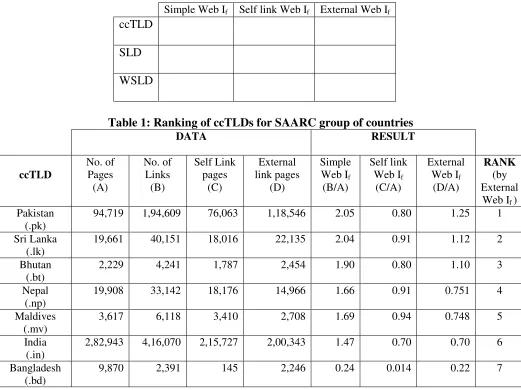
Table 1: Ranking of ccTLDs for SAARC group of countries
DATA RESULT
ccTLD No. of Pages (A)
No. of Links (B)
Self Link pages
(C)
External link pages
(D)
Simple
Web If
(B/A)
Self link
Web If
(C/A)
External Web If
(D/A)
RANK
(by External
Web If ) Pakistan
(.pk) 94,719 1,94,609 76,063 1,18,546 2.05 0.80 1.25 1
Sri Lanka
(.lk) 19,661 40,151 18,016 22,135 2.04 0.91 1.12 2
Bhutan
(.bt) 2,229 4,241 1,787 2,454 1.90 0.80 1.10 3
Nepal
(.np) 19,908 33,142 18,176 14,966 1.66 0.91 0.751 4
Maldives
(.mv) 3,617 6,118 3,410 2,708 1.69 0.94 0.748 5
India
(.in) 2,82,943 4,16,070 2,15,727 2,00,343 1.47 0.70 0.70 6
Bangladesh
In this rank list (Table 1) for ccTLDs of SAARC group of countries, Pakistan topped the list and India occupied the 6th position although the web pages available under .in ccTLD and number of link pages to
ccTLD .in is much higher than other countries. This unexpected result is due to the fact that higher number of web pages generated comparatively lower number of link pages.
In the rank list of SLDs (Table 2), the SLD ernet.in occupied the top position in spite of the fact that nic.in includes higher number of web pages and also generated higher number of links. The Simple Web If of ac.in
domain is higher than nic.in domain but it goes to the bottom most position because of lower External Web If in compare with nic.in domain.
Table 2: Ranking of SLDs related to education & research and registered under ccTLD .in
DATA RESULT
SLD No. of Pages
(A) No. of Links (B) Self Link pages (C) External link pages (D) Simple
Web If
(B/A)
Self link
Web If
(C/A)
External Web If
(D/A)
RANK
(by External
Web If )
ernet.in 21,815 37,053 15,771 21,282 1.69 0.72 0.97 1
res.in 8,500 13,604 6,496 7,108 1.60 0.76 0.83 2
nic.in 1,18,108 1,48,992 89,749 59,243 1.26 0.75 0.50 3
ac.in 36,612 47,422 29,213 18,209 1.29 0.79 0.49 4
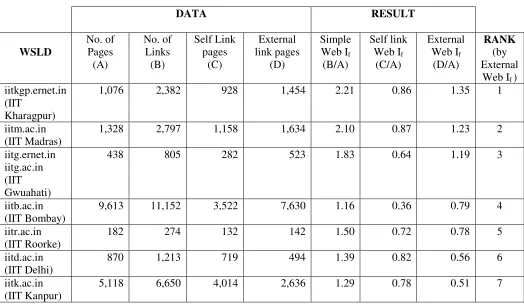
Table 3: Ranking of IITs
DATA RESULT
WSLD No. of Pages (A) No. of Links (B) Self Link pages (C) External link pages (D) Simple
Web If
(B/A)
Self link
Web If
(C/A)
External Web If
(D/A)
RANK
(by External
Web If ) iitkgp.ernet.in
(IIT
Kharagpur)
1,076 2,382 928 1,454 2.21 0.86 1.35 1
iitm.ac.in
(IIT Madras) 1,328 2,797 1,158 1,634 2.10 0.87 1.23 2
iitg.ernet.in iitg.ac.in (IIT Gwuahati)
438 805 282 523 1.83 0.64 1.19 3
iitb.ac.in
(IIT Bombay) 9,613 11,152 3,522 7,630 1.16 0.36 0.79 4
iitr.ac.in
(IIT Roorke) 182 274 132 142 1.50 0.72 0.78 5
iitd.ac.in
(IIT Delhi) 870 1,213 719 494 1.39 0.82 0.56 6
iitk.ac.in
In the IIT system (Table 3), the WSLD of IIT, Kharagpur i.e. iitkgp.ernet.in occupied the top most position because of much higher External Web If in compare with other IITs. IIT, Bombay and IIT, Kanpur did not
perform well in spite of the fact that these two IITs contributed higher number of web pages and also received higher number of links.
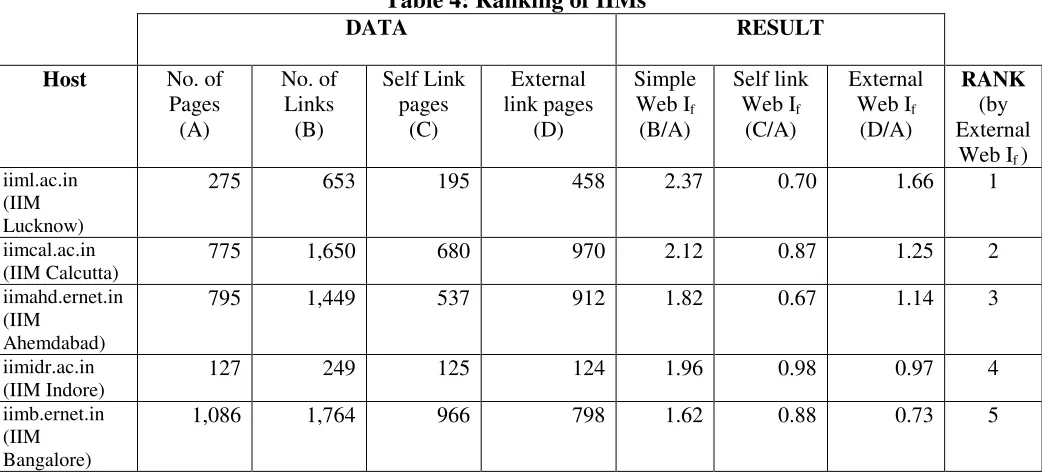
In the rank list of IIM system (Table 4), IIM, Lucknow i.e. WSLD iiml.ac.in is the topper. IIM, Calcutta occupied the 2nd position. The highest number of links is generated by IIM, Bangalore but it came down to
the bottom because those links are generated by comparatively higher number of web pages. IIM, Kozhikode (iimk.org) is excluded from this study, as it is not registered under ccTLD .in.
Table 4: Ranking of IIMs
DATA RESULT
Host No. of Pages (A) No. of Links (B) Self Link pages (C) External link pages (D) Simple
Web If
(B/A)
Self link
Web If
(C/A)
External Web If
(D/A)
RANK
(by External
Web If )
iiml.ac.in (IIM Lucknow)
275 653 195 458 2.37 0.70 1.66 1
iimcal.ac.in
(IIM Calcutta) 775 1,650 680 970 2.12 0.87 1.25 2
iimahd.ernet.in (IIM
Ahemdabad)
795 1,449 537 912 1.82 0.67 1.14 3
iimidr.ac.in
(IIM Indore) 127 249 125 124 1.96 0.98 0.97 4
iimb.ernet.in (IIM
Bangalore)
1,086 1,764 966 798 1.62 0.88 0.73 5
On the basis of data sets in Table 3 and Table 4, we can go for a comparative study of Web If (all three
levels) for IIT system and IIM system. The result is recorded in Table 5. It shows that IIM system ranked 1st
in all the three levels (i.e. Simple Web If , Self link Web If and External Web If) although IIT system
generated 5 times more links in compare with IIM system.
Table 5: Comparative Ranking of IIM System and IIT System
DATA RESULT
System No. of Pages (A) No. of Links (B) Self Link pages (C) External link pages (D) Simple
Web If
(B/A)
Self link
Web If
(C/A)
External Web If
(D/A)
RANK
(by External
Web If )
IIM System
(5 IIMs) 3,058 5,765 2,503 3,262 1.88 0.81 1.06 1
IIT System
(7 IITs) 18,625 25,273 10,755 14,513 1.35 0.57 0.77 2
7 Problems of Webometrics
of web search engines as primary data gathering instruments may create problems in conclusions of Webometric studies. The general problems as identified by Mukhopadhyay [11] may be grouped as below:
• Since the web is a dynamic environment, some variability is to be expected among searches conducted at different time. Therefore, the Web Impact Factor may also vary from time to time
• It is not possible for any search engine to include all the web pages in the database. Search engines cover only a proportion of publicly indexable web. Lawrence and Giles reported [12] that the largest coverage of a single search engine was about one-third of the estimated total size of the web
• Web search engines collect URLs by following links to and from individual web pages. Therefore, a web page which neither cites nor is cited will not be found by the search engines
• Researchers have no clear way to evaluate the accuracy of the results beyond 200 pages
• Presently only three search engines (Altavista, Hotbot, AllTheWeb) may be used for the above mentioned web-link analysis
• Search engine providers without any intimation or warning may withdraw the facilities of special keywords (In fact, we are exploiting the functionalities of special keywords provided by the search engines in a way different from the main purposes of these tools)
• It is difficult to isolate all the citations to one particular web page or cluster of pages
8 Prospects of Webometrics
The hyperlink network analysis approach is based upon the assumption that hyperlinks may be the formalized bridge between hyperlinking and hyperlinked Web sites' authors, serving as social symbols or signs of communication hyperlinkage among themselves. In other words, hyperlinks are considered not simply as a technological tool but as a newly emerging social and communicational channel. There is a tie through hyperlinks that connects individuals, organizations, or countries on the Web. The literature suggests how hyperlink networks may in some circumstances reflect off-line connections among social actors, and be unique to online interactions in other cases. Further, hyperlink networks among Web sites and social relations in the offline world may be seen as co-constructing each other to some extent, so that offline relationships can influence how online relationships are developed and established. In terms of the development of methods, hyperlink analysis has been able to apply social networks analysis techniques to collections of Web sites and draw conclusions based upon an assumption of actor relationships.
The shortcomings noted in the previous section are not inherent properties of the web or of the web searching tools [13,14]. We are using a tool for web-link analysis that is not specifically meant for the task. Search engines are designed for contents retrieval and not analysis of web page links. These problems are technical and could be resolved, if the search engine programmers had incentives to work on them. Anyway, the future application of Webometrics may include the electronic databases, which will contain not only published record but also large volume of unpublished data. As the data gathering mechanism is quite easy to follow by using commercial search engines, Webometrics has all the potential to be evolved as a tool for performance evaluation of any web site instantly.
9 Conclusion
methodologies in order to provide a better understanding of the complex topology, functionalities and potentials of the Web.
References
1 ALMIND (T C) and INGWERSEN (P). Informetric analysis on the www. Journal of Documentation, 53(4); 1997; 404-426
2 ROUSSEAU (R). Dailey time series of common single word searches in Altavista and Northernlght. Cybermetrics. 2(3) (Available at: http://www.cindoc.csic.es/cybermetrics/articles/v2ilp2.html) 3 NCST. Domain name structure and naming in the .in domain. Available at http://www.ncst.ernet.in (Visited on 07.08.2004)
4 CRONIN (B) and McKIM (G). Results ranking in web search engine. Online. May/June: 39-46 5 LARSON (R). Bibliometrics of the world wide web: an explanatory analysis of the intellectual structure of cyberspace. In: Hardin (S) ed. Proceedings of the 59th Annual Meeting of the ASIS. 33;1996;71-78
6 INGWERSEN (P). The calculation of web impact factors. Journal of Documentation, 54(2); 1998; 236-243
7 SEN (B K). Symbols and formulas for a few bibliometric concepts. Journal of Documentation, 55(3); 1999; 325-334
8 THELWALL (M). Web impact factors and search engine coverage. Journal of Documentation, 56(2); 2000;185-189
9 PAISLEY (W). The future of bibliometrics. In: Borgman (C I). Scholarly communications and bibliometrics.Sage. 1990: 281-299
10 Hotbot. Advanced search tutorial. Available at http://www.hotbot.com and http://www.in.altavista.com (Visited for the period 07/11/01-06/12/01)
11 MUKHOPADHYAY (P S). The calculation of web impact factors for educational institutes of India: A webometric analysis. In: Proceedings of the national conference on information management in libraries. Allied. 2002:531-539