World Maritime University World Maritime University
The Maritime Commons: Digital Repository of the World Maritime
The Maritime Commons: Digital Repository of the World Maritime
University
University
World Maritime University Dissertations Dissertations
1999
The economic implications of safety and quality management
The economic implications of safety and quality management
systems [of] the ISM Code : case study : International Ship
systems [of] the ISM Code : case study : International Ship
Management Company, Jordan
Management Company, Jordan
Hesham Abdel Fattah Al-Hamran WMU
Follow this and additional works at: https://commons.wmu.se/all_dissertations
Recommended Citation Recommended Citation
Al-Hamran, Hesham Abdel Fattah, "The economic implications of safety and quality management
systems [of] the ISM Code : case study : International Ship Management Company, Jordan" (1999). World Maritime University Dissertations. 1081.
WORLD MARITIME UNIVESITY
Malmö, Sweden
THE ECONOMIC IMPLICATIONS OF SAFETY AND
QUALITY MANAGEMENT SYSTEMS – THE ISM
CODE
Case Study: International Ship Management Company - Jordan
By
AL-HAMRAN, HESHAM ABDEL FATTAH (M.A.)
JORDAN
A dissertation submitted to the World Maritime University in partial fulfilment of the
requirements for the award of the degree of
MASTER OF SCIENCE
in
MARITIME SAFETY AND ENVIRONMENTAL PROTECTION
OPERATION
Declaration
I certify that all the material in this dissertation that is not my own work has been
identified, and that no material is included for which a degree has previously been
conferred on me.
The contents of this dissertation reflect my own personal views, and are not
necessarily endorsed by the University.
……….
………..
Supervised by:
Name: Jönsson J ÅKE
Office Associated Professor MSEP
Institution/organisation: World Maritime University
Assessor:
Name: Mr. R. Prasad
Office: Lecturer
Institution/organisation: World Maritime University
Co-assessor:
Name: Mr. Wadmark Olle
Office: Senior Survey
ACKNOWLEDGEMENTS
First and foremost, I thank the Almighty God who controls and participates in all
human endeavor and in whom I trust and believe for inspiration in all my actions.
I wish to express my deepest appreciation and gratitude to Professor Jonsson J
AKE, who as my supervisor, contributed significantly and gave me full assistant to
the compilation of this work.
Ms. Susan Wangeci-Eklow and Ms. Cecilia Denne, WMU’s library Staff, who gave all
of us their enthusiastic and ever - ready co-operation, concern and support in getting
material/information for the work. Particularly, Ms. Wangeci-Eklow who revised my
bibliography list.
I would like also to express my gratitude to all the members of the teaching and
administrative staff at WMU, whose names do not appear here, for their continuous
support and smiling corporation, which helped to make my stay in Malmo, truly
memorable.
My special thanks to Mr. P. O’Ferrall the chairman of the Lloyd’s Register of
Shipping, who provided me full scholarship for this master of Science programme at
the World Maritime University.
My special thanks to Mr. M. Massad, the Managing Director of the International Ship
Management Company, who made it possible for me to attend this course by
granting me a19th month study leave period and for his inspiration, encouragement
and support through out the period study.
My sincere thanks to Mr. Amin Issa Office Manager of the Lloyd’s Register of
Shipping - Jordan, who supported me in having this scholarship.
I would like to express my sincere gratitude to my Parents, brothers, sisters, and
in-laws, who dutifully supported me and my family in every way, and who silently prayed
Finally, for being there supportive and caring with patience and understanding, I
would like to dedicate this dissertation to my wife Maysa Abu-Safyeh, my son
Mohammed and my daughter Hanin who was born at Malmo during the study
period, who helped me in making this hard work possible.
Al-Hamran, Hesham
August 1999
ABSTRACT
Title of Dissertation: The Economic Implications of Safety and Quality
Management Systems - The ISM Code
Degree: MSc
This dissertation analysis safety and environmental demands that have progressively
fallen on shipping and puts a price on the impact of legislation during the 1998 and
beyond.
There has been a phenomenal growth in the volume of regulation being piled upon
the shipping industry. This dissertation attempts to quantify the impact of the ever
increasing avalanche of legislation on ship costs. In particular it highlights how the
current regulatory environment is effectively coming together under the umbrella of a
“quality management system”.
At its most basic the ship owner’s best defense against the current regulatory impost
may well be an efficient up and running quality assurance system. But it should be
said that a feature of the current quality scene is that significant scale economies are
possible. This may in turn add other pressures which are inducing ship owners to
merge their fleets or put them in the hands of large management companies.
Estimated increases in running costs serve to show how strongly safety and
environmental protection regulations are impacting on the running costs of ships and
how important is to bring costs under control.
The globalisation of ship management, the effects of economies in manning and
maintenance in a climate of increased competition, together with growth in the size
of ships and increasing complexity of shipping and its regulation, have also
progressively revealed gaps in the quality of human input.
This dissertation evaluate how effective in real terms the ISM Code is likely to be in
reference in my organisation “ International Ship Management Company” (I.S.M.).
shows that in the long run today’s costs will bring tomorrow’s benefits, and how a
pro-active approach needs to be adopted in the face of the regulations of the future.
KEYWORDS: Regulation, Safety, Environment, Quality, Management,
TABLE OF CONTENTS
Declaration
Acknowledgments
Abstract
Table of Contents
List of Tables
List of Figures
List of Abbreviation
1 Introduction
2 Safety and Quality Control in Shipping
2.1 Safety and environmental pollution control
2.1.1. Development
2.1.2. Legislation
2.1.2.1. Formulation and growth of legislation
2.1.2.2. Key legislation
2.1.3. Regulation and control
2.1.3.1. Flag State Control
2.1.3.2. Port State Control
2.1.3.3. Classification Societies
2.1.3.4. Insurance
2.1.3.5. Commercial constraints
2.2. Controlling quality
2.2.1. Quality assurance and its influence on shipping
2.2.2. Quality Standards ( The ISO 9000 series and ISO 14000)
3 Safety and Quality Costs in Shipping
3.1.
Costs arising at international level3.2.
Costs arising at national level3.2.1. Port state requirements
3.2.2. Flag state requirements
3.2.3. Extra cost fall upon ship owners
3.3.
Increased insurance costs3.3.1. Hull and Machinery (H&M) insurance
3.3.2. Protection & Indemnity (P&I) insurance
3.3.3. An increased burden on the ship owner
3.4. Increased Running Costs
3.4.1. Risk Assessment
3.4.2. Manning
3.4.3. Repairs and Maintenance
3.4.4. Health and Safety
3.5. The millennium bug problems
3.6. The ship manager
3.7. Other costs
3.8. Financial considerations of quality systems
3.8.1. Approaches to financial reporting of system activities
3.8.2. Quality related costs
4 The Implications Safety and Quality Control in Shipping
4.1.
The ISM Code and STCW Convention4.2.
The ISM Code and ISO 9002 / ISMA4.3.
Risk management4.4.
Using a quality system to advantage4.4.1. Quality control
4.4.2. Economies in operating costs
4.4.2.1. Manning & Training
4.4.2.2. Health
4.4.2.3. Repairs and Maintenance
4.4.2.4. Insurance
4.4.2.5. Accident prevention & Near misses
4.4.3.2. Communications and Information Technology
4.4.3.3. Millennium bug and Information back-up
4.4.4. Ship Management
5 Case study - International ship management company - Jordan
5.1. Company profile
5.2. Developing and Establishing of Safety Management System
5.3. The Role of the Consultants in Establishing the Company’s SMS
5.4. Implementing the Safety Management System
5.4.1. The I.S.M. Co. Policy
5.4.2. Company Responsibilities and Authorities
5.4.3. The Designated Person Ashore (DPA)
5.4.4. Master’s Responsibility and Authority
5.4.5. Resources and Personnel
5.4.6. Development of plans for shipboard operations
5.4.7. Emergency Preparedness
5.4.8. Reports and Analysis of Non-Conformities, Accidents
and Hazardous Occurrences
5.4.9. Maintenance of the ship and equipment
5.4.10. Documentation
5.4.11. Company Verification, Review and Evaluation
5.4.12. Certification, Verification and Control
5.5. Introducing Quality Standard ISO 9002
5.6. The ISMA Code of Ship Management
5.7. The Cost of Developing, Implementing and Monitoring
of the SMS
5.7.1. SMS Preparation cost
5.7.2. Consultant cost
5.7.3. Documentation of SMS
5.7.4. Training courses for shore based Management
5.7.5. Training courses for Crew
5.7.6. Certification of Competency
5.7.7. External audit
6.1. Conclusions
6.2. Recommendations
Bibliography
Appendices
Appendix 1 Some recent total losses and major casualties with changes in safety
and
environmental protection legislation
Appendix 2 International Ship Management Company Documentation
Appendix 2-1 Safety and Environmental policy
Appendix 2-2 Designated Person Ashore
LIST OF TABLES
Table 1 Global fleet total losses (all ship types) and lives
lost as a result
Table 2 Flags with losses above world average in 1997
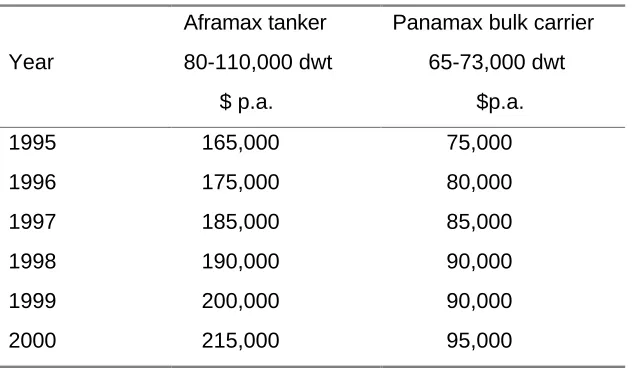
Table 3 Indicative H&M insurance cost trends-Aframax
tanker and Panamax bulk carrier
Table 4 Summary of net claims paid during the financial
years 1989 to 1997
Table 5 Indicate P&I cost trends-Aframax tanker and
Panamax bulk carrier
Table 6 Rising operating costs (annualised capital and
recurring costs)
Table 7 Rising operating costs for Panamax Bulk Carrier
Table 8 Daily operating costs
Table 9 Indicative safety and environmental protection
cost rise by ship type
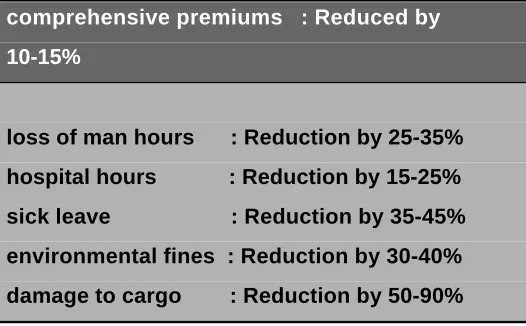
Table 10 Benefits derived from implementation of
a quality assurance scheme
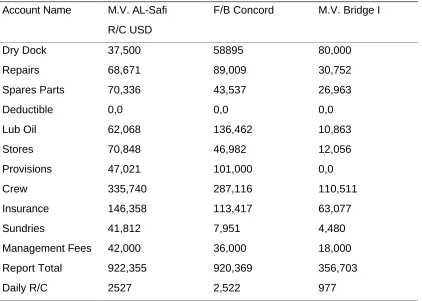
Table 11 Running costs analysis 1997
LIST OF FIGURES
Figure 1 Total losses (all ship types) and lives lost as a result
Figure 2 Daily operating costs
LIST OF ABBREVIATION
BIMCO Baltic and International Maritime Council Organisation
B/L Bill of Lading
CDG Carl Duisberg Gesellschaft
CLC International Convention on Civil Liability for Oil Pollution Damage,
1969
DOC Document of Compliance
DPA Designated Person Ashore
EC European Commission
ETS Emergency Team Set
EU European Union
FSA Formal Safety Assessment
GMDSS Global Maritime Distress Service System
HBL Hydrostatic Balance Loading
H&M Hull and Machinery
HNS International Convention on Liability and Compensation for Damage in
Connection with the Carriage of Hazardous and Noxious Substances
by Sea, 1966
HSC High Speed Craft
IACS International Association of Classification Societies
ICS International Chamber of Shipping
IGA International Group Agreement
ILO International Labor Organisation
ILU Institute of London Underwriters
IMDG International Maritime Dangerous Goods Code
IMO International Maritime Organisation
ISF International Shipping Federation
ISMA International Ship Manager Association
ISM Code International Safety Management Code
IT Information Technology
LLMC Convention on Limitation of Liability for Maritime Claims, 1976
LSA Life Saving Appliance
MARPOL International Convention for the Prevention of Pollution from Ships,
1973 as modified by the Protocol of 1978
MASSOP The Management Structures of Shipowners and Operators
MOU Memorandum Of Understanding
NCR Non-Compliance Reports
OECD Organisation for Economic Cooperation and Development
OPA Oil Pollution Act (US)
OPRC International Convention on Oil Pollution Preparedness, Response
and
Co-operation, 1990
P&I Protection and Indemnity
PMS Planned Maintenance System
PSC Port State Control
QA Quality Assurance
R/C Running Cost
R&M Repair and Maintenance
SMC Safety Management Certificate
SMM Safety Management Manual
SMS Safety Management System
SOLAS International Convention for the Safety Of Life At Sea
SOPEP Shipboard Oil Pollution Emergency Plan
STCW International Convention on Standards of Training, Certification and
Watchkeeping for Seafarers
TQM Total Quality Management
TQS Total Quality System
USCG United States Coast Guard
VLCC Very Large Crude Carrier
Chapter 1
Introduction
Safety and Quality Management Systems have become very important issues in the shipping industry. It can be seen through the performance of the company how far the management system will have effect on the operations of the company in terms of benefits.
There is a tendency to take an insular view of safety regulations and sometimes to place current moves towards a more systematic approach to safety and risk management on the top of the company policy. However, shipping is but one industry being forced down the path of quality assurance.
As industrial society has grown over the past hundred years, regulations governing safety, health and the environment, almost always responding to major safety failure experiences were imposed by government or third party involved, such as insurance underwriters or classification societies, from out side the company in a rather haphazard fashion. Moreover, a merging of quality and safety management systems started 20 years ago. This means that most companies of any today size have a quality assurance policy, which will normally embrace responsibility for insuring that mandatory requirements as well as production and quality standards are followed.
industry is now considered necessary by regulators to impose a systematic approach in form of the International Safety Management (ISM Code), perhaps supplemented by the ISO 9002 itself.
The ship owners may determine to use the ISM Code as a stepping stone to achieve higher efficiency, through Total Quality Management, within his organisation. He will therefor deliver higher standards of service to his customers, achieve economies in costs, and also prove his excellence in matters dealing with safety and environmental issues.
The development of a Safety Management System, in order to meet and comply with the ISM Code, requires financial support and in general if will have effect on the financial health of the company in the short terms. However, as we will see ahead, in the long term it will bring benefits to the shipowners in terms of reducing the running costs of the vessels.
The type of costs involved are developing, establishing, documenting and monitoring of the SMS and the costs of the external verification by the issuing of the certificates.
As we will see the impact on the company will depend on the following factors:
• The size of the company and the type of the vessels if is operating.
• The training required for shorebased and shipboard personnel to meet the different
standards.
• Hiring extra staff.
• The existence of quality assurance in the company.
The ISM Code will force certain of the smaller self managed shipowners with less resources and those who mightily or wrongly have been identified more closely with the lower end of the Market, to sub-contract their technical safety management operations to the large and arguably perhaps more efficient international ship management companies (Intertanko 1996, p.13).
In this dissertation, an attempt is made to analyse safety and environmental demands, that have fallen upon shipping and also to put a price on the legislative impact. The growth of quality systems in shipping industry is traced. The implications of safety and quality control are examined and the consequential opportunities that arise to make economies-examples are given.
Case study from the International Ship Management Co. (I.S.M.) is examined to show how the company has implemented the ISM Code and made benefits to the owners by reducing the running costs of their vessels.
This Topic, the economic implications for safety and quality management systems, was chosen because it reflects the author’s concern an ship operation. To have asafe operation of a ship, three main factors have to be maintained:
1. Ship reliability in technical terms to be analysed.
2. A ship must be manned sufficiently, safely and efficiently, having full support from shorebased management.
3. Establishing and maintaining an effective safety management system including the commitment at the very top level of the organisation.
safety and quality management system is an advantage rather than just a burden regulation. In addition, the systematic approach, if handled properly, will provide the opportunity of overall savings. This belief, indeed, influences the author’s decision in choosing this topic.
Many books and articles have been written about the implementation of the ISM Code and it’s technical implications, but not many have formally written about the economic implications as a guide to the ship owners or the operators. The material that influences this work has been obtained through different sources, such as books from the WMU library, IMO Conventions and guidelines, texts from technical seminars, conferences (IMarE, WMU/CDG), field training notes and a verity of marine periodicals, magazines, reports ( Lloyd’s list press, Drewry shipping consultants, P&I clubs, …).
Supporting information / data for the research also comes from the International Ship Management company, Internet's, lecture notes and interviews with resident and visiting professors at the WMU.
Chapter 2
Safety and quality control in shipping
2.1. Safety and environmental pollution control.
2.1.1. Development
The dangers faced by ships and their crew are basically the same as they were long time ago. However, vessels and their equipment, and the world they operate in, have altered beyond recognition, bringing changes in risk exposure along with advantages of stronger and larger ships, powered and equipped as never before.
Merchant shipping acts, aimed at safeguarding ships, personnel and cargo were introduced in major maritime nations in the mid nineteenth century and the coverage of these grew with the development of ships and shipping.
1. To provide machinery for co-operation among governments in regulation and technical matters.
2. To encourage the removal of discriminatory action and unnecessary restriction by governments affecting shipping.
3. To provide for the consideration of unfair restrictive practices.
4. To provide for the consideration of any matters concerning shipping safety of ships and its effect on the marine environment.
5. To provide for the exchange of information among governments.
Since the Convention creating IMO was adopted fifty years ago, shipping has changed more than in any similar period in history. IMO has responded by adopting and amending international treaties, codes and recommendations dealing with maritime safety, marine pollution and other subjects.
The mandatory requirements on safety and of safety equipment have bestowed great economic benefit on shipping-sometimes the threat of a new requirement has been enough. The improvements in communication equipment and other electronic navigation aids have led in turn to improvements in the economics of ship management.
2.1.2. Legislation
2.1.2.1. Formulation and growth of legislation.
Ship losses and major casualties have the main influences on the formulation of safety legislation. There are many changes in safety and environmental protection legislation was conducted during the last decades. Some recent total losses and major casualties with changes in safety and environmental protection legislation are listed in appendix 1.
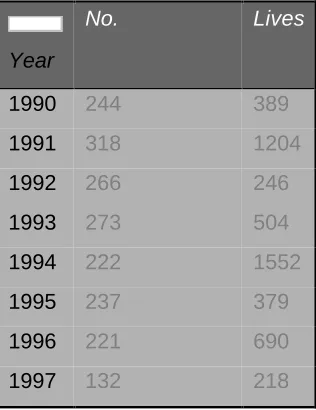
Table 1
Global fleet total losses (all ship types) and lives lost as a result
Year
No. Lives
1990 244 389
1991 318 1204
1992 266 246
1993 273 504
1994 222 1552
1995 237 379
1996 221 690
1997 132 218
Source: LR World Casualty Statistics
A succession of international conventions on safety of life at sea and on the prevention of pollution from ships, and other issues put the safety regulation of ships on an international basis and laid the foundations for the highly regulated scene which exists at the end of the twentieth century.
In recent years, although the trend of ships lost generally continues downward there have marked fluctuations from year to year in ships, gross tonnage and lives lost. Rises in the annual number of lives lost in 1991, 1994 and 1996 were largely due to passenger/cargo Ro Ro ship losses, whilst the marked rises in gross tonnage are a result of larger ship losses. (figure1)
In the past, total losses have been the main driver in the introduction of safety rules, particularly where high loss of life on passenger ships or extensive pollution from tankers has been involved. Although such quality failures will undoubtedly continue to play an important part in the regulatory scene, the tendency has, for some time been towards the adoption of an anticipatory stance following the doctrine that ”Prevention is better than cure”.
Figure1
Total losses (all ship types) and lives lost therefore
0 200 400 600 800 1000 1200 1400 1600
1990 1991 1992 1993 1994 1995 1996 1997
No.of ships
Lives
The introduction of the International Safety Management (ISM) Code on ships and adoption of the “Precautionary principle” and “Risk assessment” methods by rule makers may be taken as logical steps in the progression to a global shipping quality system- the shipping industry has been brought rather late to this situation compared with many industries ashore.
According to the EU study which published in 1996 under the title Transport Research, APAS, Maritime Transport, VII-38, Ship nationality by flag and by ownership are significant factors when considering loss statistics.
Table 2 compares loss ratios of flags above the world average. It was noted from the EU study that the large number of losses referred to Panama fleet in terms of gross tonnage. These reflect to the large number of smaller and older ships registered under that flag.
Casualties, accidents and unease resulting from the increase in volume and complexity of sea borne trade over the past 30 years has led legislators to address the following issues:
• Growth in the size of tankers, and pollution potential.
• Dangers associated with the growth in the size and changes in design of passenger
ships, particularly passenger/vehicle ferries.
• Increased traffic concentrations, particularly in coastal waters and port approaches, and the interaction of ships carrying hazardous cargoes and passengers.
• Failures to institute shipboard and shore-based systems appropriate to modern
Table2
Flags with losses above world average in 1997
Tonnage lost as a percentage of flag fleet in 1997
Ships lost 1997
World 0.144
Antigua & Barbuda 0.503 4
Belize 0.890 3
Cyprus 0.615 8
Germany 0.147 2 Honduras 0.787 6
India 0.602 2
Indonesia 0.385 3
Malta 0.224 3
Panama 0.163 11
Romania 0.287 2
Spain 0.162 1
St Vincent & Grenadines 0.398 4
Syria 0.702 2
Thailand 1.910 4
Turkey 1.655 6
USA 0.418 2
Source: ILU Casualty Statistics
• The increased probability of operation and accidental safety lapses and pollution incidents as a result of greater traffic volumes, particularly with a significant proportion of vessels under questionable management.
• Growing commercial pressures affecting upon safety in navigation, cargo handling and other operational aspects.
• Extension of navigation to previously quiet ocean and coastal areas.
• Carriage of an increasingly wide range of hazardous and toxic cargoes.
• Poor practices in the port/ship interface concerning ships carrying dry bulk, oil, chemicals, containers and dangerous/toxic cargoes.
• Failures to keep uniform high standards in ship design, shipbuilding, ship repair and
the survey of ships.
• Less tolerance of breaches of safety and environmental protection measures on the part of administrations and the public.
• Lack of standardization in safety aspects of ships and in equipment.
• Inadequate safety radio communications and electronic aids.
• Wider introduction of high-speed vessels and other advance types.
These issues have been the subjects of detailed discussion at IMO, as a result of which many internationally binding regulations have been passed into law.
2.1.2.2. Key legislation
International maritime legislation is but one sector of the huge mass of what is metaphorically called” international legislation”, whereby nations, by way of treaties or conventions agree under international law to give effect, either on their own part or that of their subjects, to such additions or changes in select areas of societal behavior or practice as they see fit to endow with legal sanction.
it relates to shipping. Other international conventions involved are STCW Convention, ISM Code, GMDSS and INMRSAT, COLREG 1972 convention, etc. The conventions are supported and supplemented by many codes, manuals, guides and other documents.
2.1.3. Regulation and control
2.1.3.1. Flag state control
Control by national administration over ships flying their flags has tended to become more tenuous with the growth of open registry and the delegation of survey work to classification societies. However, the flag state remains ultimate responsible to ensure that they establish and maintain measures for the effective application and enforcement of the IMO instruments to which they are a party.
In addition flag state is responsible for promulgating laws and regulations and for taking all other steps which may be necessary to give the applicable conventions full and complete effect so as to ensure that, from the point of view of safety of life and pollution prevention, a ship is fit for the service for which it is intended and seafarers are qualified and fit for their duties.
Flag state have effective safety organizations which take a central role in implementing safety requirements through their own staff or by delegation to the classification society surveyors. Delegates from these safety organizations make a major contribution to technical discussions on IMO.
administrations will delegate this authority to ‘ approved organization’ “. Any way administrations must be careful in their selection of approved organizations.
2.1.3.2. Port state control
Port State shall ensure the effective application of the Conventions provisions, and to be assured by control of foreign ships, calling at their ports, thereby discouraging the operation of sub standard ships. Concern at the quality of ships using their ports has led nations in Europe, the Americas, Asia-Pacific, Australia and elsewhere to introduce ship inspection procedures to ascertain standards of safety and environmental protection. These port state control measures are becoming increasingly integrated with the co-operation of IMO, and a worldwide safety net is fast developing.
According to the USCG’S, as the leading enforcement agency of the United States for commercial shipping, “ the US Coast Guard fulfills two roles. First, they are flag administration and must take responsibility for the implementation of the ISM Code for US-flag vessels ”. This responsibility is one of their highest priorities since they are directly responsible for ensuring that vessels under the US flag have implemented an effective safety management system.
Secondly, they are a port state and must act in a positive manner to ensure compliance with all applicable SOLAS and international conventions on foreign vessels that call at US ports. In the capacity they will check that foreign flag vessels calling at US ports have also implemented an effective safety management system.
3,200 ships were detained. With reference to Table 3, the most common deficiencies were found to be:
• Life saving appliance (24% of all deficiencies).
• Fire fighting appliances (17%).
• Safety in general (13%).
• Navigational equipment (12%).
Table3
Paris MOU inspection activity
1991 1992 1993 1994
Number of vessel inspections
13,955 14,379 14,783 17,294
Number of deficiencies
22,623 25,930 27,136 43,071
Ratio
deficiencies/inspection
1.6 1.8 1.8 2.5
Number of vessel detentions
448 525 588 926
As a percentage of inspections
3.2 % 3.7 % 4.0 % 5.4 %
% Individual vessels involved
4.48 % 5.20 % 5.62 % 8.23 %
Source: Paris MOU
Vessels were only detained if considered unsafe to go to sea for that voyage. The increase in detentions in 1993 was attributed to:
• Better targeting by various PSCs.
• Higher standards imposed by the PSCs.
With port state control, although SOLAS requirements are generally applied, different requirements and standards apply in different countries. The introduction of STCW 95 and ISM Code with variations in the manner in which they will be interpreted by different port states will cause added complications.
Additional statistics from the Paris memorandum are based on a concerted inspection campaign mounted in the three months following the introduction of ISM at the start of July 1998. Port state control authorities in the 18 Paris memorandum countries inspected 1,575 ships during the campaign.
A total of 81 were arrested for serious non-conformities with ISM, giving an average detention rate of 5.1%. Yet the detention rate for Bureau Veritas audited ships was 11.3%, and for Lloyds Register, audited ships 9.5%.
2.1.3.3. Classification Societies
The main purpose of classification societies was originally found to meet the need of insurance underwriters to know whether a ship was a good risk (seaworthy), a small group of surveyors being employed to inspect ships and classify them according to their condition. The first Lloyds Register of ships was published in 1764 with the purpose of listing the condition and other details of ships which might require insurance.
addition, they are certifying agent under a delegation of authority from a Maritime Administration for related requirements of international and national regulatory instruments. Further more, classification societies have in many instances taken human-related responsibility connected with the introduction of the ISM Code an STCW 95 convention
To address the problem of differing class rules leading classification societies, accounting for 90% of the world tonnage in shipping, formed the International Association of Classification Societies (IACS), which got observer status by the IMO, in 1969. In the interest of achieving its objectives of promoting the highest standards in ship safety and marine pollution prevention, IACS concentrates its efforts in the following primary areas:
• Establishment and maintenance of Unified Requirements, Recommendations and
Interpretations.
• Prompt cooperative consideration of emerging technical issues of interest or concern.
• Consultation and cooperation with the International Maritime Organization.
• Consultation with recognized marine technical groups and related governmental
organizations.
To reflect the growing importance of the Association and its influence in the world maritime industry and, to provide a focal point for coordinated activities and communications, IACS has established a Permanent Secretariat at IMO in 1992. Some measures in which IMO and IACS have cooperated closely are:
• Tightening of the Transfer of Class Agreement to halt flag hopping.
• Automatic suspension for vessels which do not complete surveys on time.
• Two yearly audits on class surveyors.
• Improving relationship between societies and port state control organizations.
• Enhanced class surveys of tankers and bulk carriers.
• Stricter survey requirements on fire prevention, particularly on passenger ships and in machinery spaces, measures to improve watertight integrity, ship stability, ballasting and ship maintenance.
• Introductions of Unified Requirements on strength, damage stability and survey requirements.
• Harmonized training for surveyors with strengthening of the IACS Quality System
towards ISO 9002 accreditation.
Outside the core 12 classification societies, which comprise the membership of IACS, are many smaller societies largely catering for smaller ships in particular parts of the world - it is virtually impossible for a classification society which does not conform to IACS requirements and procedures to play a significant part in the present - day global shipping market.
2.1.3.4. Insurance
The practice of selling parts in a ship or a trading adventure to spread risk was in vogue well before 1700 and records exist showing that insurance premiums formed part of the running cost of ships sailing in the 17th century.
By the early decades of the eighteenth century, in England at least, ship owners were taking out insurance as a matter of course - when they could get it, that is-at some times of the year in some trades underwriters were understandably reluctant to cover the risk.
their activities and able to control them more effectively than in the past are retaining more risks, either directly or through captive insurance.
In general, ship owner's insurance needs are catered for two means:
(a) Hull and Machinery ( H & M) Insurance placed with commercial Insurance and Clubs, covering Loss/Damage to ship and Collision Liabilities in which the ship owner has a direct insurable interest.
(b) Protection and Indemnity ( P & I ) cover provided by “mutual”, placed with P&I Clubs, cover Third party Liabilities arising under a contract or in tort such as loss of earnings, oil pollution claims, injury to employees and others which cannot be covered in the insurance market or are more conveniently covered by mutual insurance between ship owners.
The methods of payment for the two types of insurance are different. Fore instance H&M insurance is premium dependent, whereas the cost of P&I insurance is met by advance and supplementary “calls” for funds. In addition, both forms of insurance cost are becoming increasingly dependent upon the ongoing management of the ship in question, as well as the company s past claim record.
P&I Clubs have become more stricter in evaluating the claim records of new entrants and in giving more consideration to the condition of an owner s existing fleet. P&I managers, along with underwriters of other insurance, have had to give close consideration to what impact the ISM Code will have upon their cover - in view of its mandatory nature it will not be a question that can be ignored- although some clubs have declares that ISM compliance will not be a condition of cover.
should also include monitoring of general compliance with the code in their existing program of surveys or inspections. Nevertheless, ship owner’s groups take the view that the role of the clubs-which are after all ship owners mutual-is to provide their members with third party cover.
It therefore does nobody any good and creates potential uncertainly all round if a significant number of vessels is suddenly denied cover for reasons which to some extent are beyond their control.
It is suggested that the clubs should devise a system whereby members are required to alert them when they have not got the necessary documents so they can make this distinction between those for whom cover should be withdrawn and those who should remain covered.
2.1.3.5. Commercial constraints
Through contractual obligations such as charter party or bill of lading or any other contract, a ship is often obliged to comply with certain conditions. Sometimes these conditions are referred in the contract, sometimes they are implied in nature. For instance, a ship might be required to meet certain standards in its condition such as ship speed, cargo capacity and handling or its operation.
Or a stipulation might be made in a B/L or otherwise by shippers or consignees that cargo is to be carried and delivered in a certain time and condition, or in accordance to the IMO recommendations or other recognized code of practice. The following example will give more pictures:
• Shell and other oil majors, amongst other charters, have for years and establish procedures to check the condition, management and operating standards of chartered - in ships. These procedures anticipated and even exceeded the safety management system now demanded by ISM Code.
• In the event of loss of or damage to cargo carried on deck or to containers a carrier will face criticism or worse if the relevant IMO code has not be followed.
In short, contracts between ship owner and any other body in shipping industry such as charter, supplier, shipbuilder, ship manager, etc. make the vessel obliged to meet the conditions and requirements stated in the contract.
2.2. Controlling quality
2.2.1. Quality assurance and its influence on shipping
The term “ Quality” refers to the fitness for use of a product or service. It is achieved when a customer s stated or implied needs are satisfied.
Whilst the shipping industry has been “informally” managing the safety of its operations for many years, the ISM Code is a formalized attempt to apply a structure approach to operation and environmental safety. The International Ship Management Code is a management system based on the requirements of the International Standard ISO 9002 (1994), which is a model for quality assurance system in production, installation and servicing.
level of quality higher than necessary. Globally, quality management is taking on growing importance, basically, on the principle that prevention is better than cure.
Quality Assurance is concerned with the processes and procedures by which products or services are created. If the system can be standardized and controlled, then the results will be standardized also.
Regulations governing safety, health and the environment, mainly responding to major safety failure experiences, were imposed by government or quasi-official organization (such as insurance underwriters or classification societies). A merging of quality and management system has taken place over the past 25 years so that most companies of any size have a quality assurance department which will normally embrace responsibility for seeing that mandatory requirements as well as production and operational quality standards are followed.
There is a perception in many shipping organizations that the technical aspects of ship management, the human resources, hiring, firing and training etc., and the corporate company management, are distinct, only loosely connected and with quite different objectives. Shipping companies operate in watertight compartments with authority concentrated at the top. Quality requirements must gradually change this perception, and the resulting teamwork effects and integration can only be beneficial to the organization and the industry.
2.2.2. Quality Standards ( The ISO 9000 series and ISO 14000 )
A demonstration of quality is becoming a condition of doing business in the maritime industries and by this devising those that are competent from others. Those that can prove their competence will get work faster.
In the ISO system, standards are developed by national delegations of experts from business, government and other relevant organizations. They are chosen by the national standards institutes participating in the technical committee concerned and are required to present a consensus position based on the views of stakeholders in their country.
The ISO 9000 series of standards comprise internationally accepted formal management systems laying down principles of quality management and control. Adaptations of the principles are also to be found in marine safety organizations and shipping.
The implementation of ISO 9000 require the following:
1. Formally stating in writing how work will be proceeding through an organization.
2. Ensuring, through management and training, that the written procedures are followed and comply with the requirements.
3. Proving, through provide objective evidence, records, inspection and internal audits, that complete work has complied with the desired standard and has been accomplished in accordance with the laid down procedures.
ISO 9002 is the standard for companies providing production, installation and servicing and lays down basic requirements for the following:
• Management commitment and responsibility.
• Contract review.
• Production process control.
• Methods of inspection and prevention of quality deficiencies.
• Training.
• Maintaining the system.
The ISO 9000 series is limited and required adaptation to different type of organization.
The ISO 14000 standard is based on how to use quality assurance in defining a new relationship between business and the environment in the presence of greater scrutiny by regulatory bodies and public at large. At the beginning of the 1998, more than 2500 companies across the globe had adopted the ISO 14000.
Public companies are suffered to prove their management system and benefit business at the same time. Not all-large environmentally conscious organizations have followed the ISO 14000 line, some of them preferred to adopt other forms of total quality management. This is depending on particular business needs.
2.2.3. The impact of quality system on shipping industry
management system is crucial to provide the necessary assurance to authorities, the public and customers on a global scale.
The globalisation of shipping management, the effects of economies in manning and maintenance and the increasing complexity of shipping and its regulation have increased the awareness in the quality of human input. Although there have been continuing efforts to deal with the technical problems related to the safety and the environmental protection through the SOLAS and MARPOL Conventions and other international treaties, agreements and recommendations over the past of 40 years, control of human aspects have tended to languish.
Chapter 3
Safety and Quality Costs in shipping
3.1. Costs arising at international level
There are substantial growth in the mandatory regulations and acceleration in the rule making process in shipping industry during the twentieth century. In addition, too many regulations relating to the safety and pollution prevention were issued by the IMO in this century through its conventions, agreements, treaties and recommendations. Moreover, flag state, classification societies, P&I clubs and other bodies involved in shipping industry have produced more regulations for ship owners to maintain acceptable level of safety on board their vessels.
Due to huge amount of regulations, the last few decades have witnessed the movement of ships to flags open registry and manned internationally. Therefor, cost economies have resulted in erosion of professional standards, managerial expertise and business ethics, whilst changes in market requirements and technological advances have led to development of more valuable and complex ships.
Extra cost falling upon the ship owner in the closing years of this century to maintain acceptable level of safety and quality on both side shipboard and shore based can be shown through the following:
SOLAS Convention
• Fire protection, fire detection and fire extinction
For passenger ships, extensive upgrading measures for fire protection were instituted and coming into force after July 1997. There are requirements for accommodation spaces, fire doors, fire detection, alarm system, and automatic sprinklers, etc.
Cost: constructional, electrical and plumbing work will be required in many instances on existing tonnage which will lead to some older ships being made redundant on economic grounds. New ships might be subjected to high costs. Extra expenses will be involved in crew training and maintenance of the new requirements.
For high-speed craft, The new requirements are required careful assessment of operational costs, and benefits in design criteria is particularly important with fast ferries. Protection against fire and “permit to operate” are major objective of the Code.
There will be extra costs in raising crew expertise in operational and safety procedures to meet the requirements of new regulations.
• Constructional, stability, machinery and electrical installations
vehicle deck is possibly an alternative. In addition, Ro-Ro passenger ships must be fit a helicopter pick-up area.
Cost: An analysis of each ship’s stability, survivability and safety will be required, the outcome of which will dictate what structural and other modifications will be necessary. It may be found that an older ship cannot be modified at economic cost and scrapping is the only alternative.
Ro-Ro passenger ships built after 1 July 1999 are required to have an evacuation analysis, carried out early in the design process, aimed at identifying and eliminating possible congestion areas.
Cost: If the evacuation analysis does not meet certain criteria, evacuation and abandonment will require attention and entire structural could be changed.
Passenger ships of 130 m in length and over built after 1 July 1999 must be fitted with a helicopter landing area. The cost of fitting the helicopter landing area and providing the necessary ancillary equipment is estimated as $20-40,000.
For Bulk Carriers, New SOLAS Chapter XII will enter into force in 1 July 1999, new and existing bulk carriers must have sufficient strength to withstand flooding of any one cargo hold when carrying high density cargoes. Classification societies were accused of conducting insufficient and inadequate survey which allowed fatigued structure to continue trading without attention.
fact, there will be greater emphasis in the future on ship maintenance and survey through the enhanced survey program and perhaps other measures.
Cost: Some owners estimate that a cost of $3m will be involved in making the necessary modifications. According to BIMCO, costs will be $50,000 for a Handymax. $75,000 for a Panamax. $150,000 for Capsize. With an estimated 76% of the bulk carrier fleet affected a bill of $150-400 m will ensue.
• Life saving appliances
For passenger ships, major enhanced safety measures adopted by the 1995 conference after Estonia and Herald of Free Enterprise casualties and coming into force after July 1997, such measures are:
(a)
All ship s life rafts to be served by a marine evacuation system or by launchingappliances.
(b)
All life rafts to be provided with float free devices.(c)
Life raft boarding ramps to be fitted for people to board from the water.(d)
Life rafts to be of an improved design.(e)
At least one fast rescue boat to be provided, with two specially trained crews.(f)
Improved fast rescue boat launching/recovery devices.Other requirements will be interred into force after July 1999 and July 2000 respectively such as (passenger name and gender must be recorded for search and rescue purposes, “decision support system” on the navigating bridge,) and some changes in life-saving requirements on Ro-Ro passenger ships constructed before 1 July 1998.
particularly on short trips. There will be extra costs in raising crew expertise in operational and safety procedures to meet the requirements of new regulations. More exacting technical and maintenance requirements will lead to extra cost.
For all types of ships, SOLAS chapter III has been reviewed and formulated and entered into force from 1/7/1998. The new chapter is required an updating of technical requirements to be taken and many of them has been transferred to the (LSA Code). More maintenance to meet the technical requirements will lead to extra costs.
• Communication
All vessels covered by SOLAS must be converted to the Global Maritime Distress System (GMDSS). Governments to provide suitable shore based radio facilities. Ships are required to carry equipment in the form:
1. A VHF radio installation capable of transmitting and receiving. 2. Digital selective calling (DSC) on certain radio frequencies. 3. Satellite emergency position-indicating radio beacons (EPIRBs).
4. Navtex equipment able to automatically receive internationally maritime safety information, navigational warnings, weather information and warnings, and search and rescue.
5. Search and rescue transponders (SARTs).
6. Radio watch keeping for broadcasts of maritime safety information. (SOLAS, Ch. IV, Reg.7, 8, 9, 10, 11, 12).
some time ago might be agreed by IMO. There is still argument centering upon continuation of VHF distress watch and the carriage of a radio operator.
Cost: Possibly $1,000-20,000 to cover new equipment, but with the rapid development of radio communications and the falling cost of messaging significant improvements in operational efficiency are possible. This will affect the cost immediately.
• Safety of navigation
For Tankers,the emergency towing arrangements required to be fitted at both side ends of the ship for tankers of 20,000 dwt and above after 1 January 1999 will cost the vessel approximately $8-25,000, according to existing fittings. (SOLAS, Ch. V, Reg.15-1)
For all type of SOLAS vessels, the mandatory carriage of a shipborne voyage data recorder will cost the vessel between $5000 and $25,000 according to the extent of the data recorded.
• Cargo
For bulk carriers, there is a new requirement for loading, unloading and stowage of bulk cargoes which is listed in regulation 7 of SOLAS chapter VI and entered into force in 1st July 1998. To complying with these requirement extra costs might be raised for Bulk Carriers.
• The ISM Code
The Assembly of IMO has adopted a series of resolutions dealing with guidelines on management procedures to ensure the safest possible operation of ships and maximum attainable prevention of marine pollution. These have culminated in the International Safety Management Code (ISM Code). In 1 July 1998, the Code becomes mandatory for passenger ships, oil and chemical tankers, bulk carriers, gas carriers and cargo high-speed craft of 500gt and above. At 1 July 2002, the ISM Code becomes mandatory for dry cargo ships and mobile offshore drilling units of 500 grt and above.
Safety management objectives of the company should, inter alia:
1. Provide for safe practices in ship operation and safe working environment. 2. Establish safeguards against all identified risks.
3. Continuously improve safety-management skills of personnel ashore and aboard ships, including preparing for emergencies related both to safety and environmental protection.
The company is required to develop, implement and maintain a suitable SMS with sufficient and qualified resources and shore based support. In addition, the company should designate a person or persons ashore having direct access to the highest level of management. All procedures, check list and fleet instructions must be documented and included in the Safety Management Manual, a copy of the SMM should be kept on each vessel.
According to Mr O’ Neil, the Secretary General of IMO, publicly declared that failure to meet the deadline would have a “disastrous” impact on shipping companies.
The US Coast Guard (USCG) has stated that all foreign-flag vessels of greater than 500 gt calling at US ports must be in complied with the ISM Code and the SMS are being properly used. No special ISM Code boarding will take place. There are many similar declaration have been made by safety agencies in European countries, Hong Kong, Australia and elsewhere.
IACS has published a “white list” of ships certified as complying with the requirements of the ISM Code. The list can be downloaded from the IACS website.
In Europe the matter was further discussed at the 30th Port-state Control Meeting in St Petersburg in June 1997. The meeting concluded that ships not certified on 1 July 1998 should be detained.
Cost: Possible costs are as follows, varying widely depending upon the safety management system already in place on the ship and in the company, and upon the method of implementation of the code:
• Introduction cost: $30,000-400,000
• Annual cost: $10,000 (Costs associated with the issue and renewals of Document of Compliance and Safety Management Certificate and supporting work).
• Annual cost: $15,000 (Crew training and other costs resulting from new requirements of ISM Code and the STCW Convention).
• STCW Convention
Signature of the final act of the conference of parties to the International Convention on Standards of Training Certification and Watchkeeping for Seafarers on 7 July 1995 left less than 19 months for governments to take all action necessary to give full and complete effect to the revised Convention on 1 February 1997.
A single governments department or agency must be made responsible for administering the convention and must be given the necessary regulatory and administrative authority to ensure that all government department and agencies, education and training institutes, shipowners, ship management companies and seafarers within the party’s jurisdiction give full and complete effect to the revised convention.
Many new approaches and changes in training and assessment methodologies result from the revised STCW convention` What will these changes demand of the training institutions and how will they implement them? How can modern teaching methods, supporting instructional media and technology, assist the training and assessment processes both ashore and onboard ship? How will institutions ensure that teaching personnel have appropriate qualification and experience? These questions require answers and action by those involved in the training and assessment processes leading to the issue of marine certificates of competency.
1998 at the invitation of the late Secretary for Transportation, Arturo Enrile, in order to witness the preparations for the implementation of STCW 95. Chinese officials are confident that they are capable to achieve STCW Standards and they will monopolize the crewing market in the future.
There is a close correlation between the relevant provision in the ISM Code and the requirements of the revised STCW Convention. The procedures established as required by the ISM Code will be facilitated and carried out more effectively by personnel competent in accordance with the revised STCW Convention. Conversely, planned adherence to the responsibilities of the shipping companies within the revised Convention, in terms for instance of certification, manning, record keeping, familiarization and training, provides a framework for adherence to required ISM Code procedures.
Ship owners may find themselves put to expense in ensuring that training and certification standards are met in crew supply nations. There will be onboard training costs to enable the personnel needs of the ISM Code, SOLAS, STCW and MARPOL to be met.
Governments issuing STCW certificates will be required to submit documentary evidence of compliance with standards of the Convention to IMO. Flag states will be required to accept responsibility for checking competence of seafarers with certificates issued by another state.
Guidelines on Medical Examination will be later IMO legislation and will take place in 2002. With the granting of permission for Port States to assess the competence of seafarers, compliance with the STCW convention will be of growing importance.
The ITF hopes that in time the revised STCW Convention will be seen as one of the measures which led to a fundamental change of attitude within the marine industry and began the moves to the adoption of a safety culture.
Cost:Direct expenditure may be needed to cover company administration and training as shown in the ISM Code costs. There will also be fewer direct charges from crew supply nations and agents. In addition, Maritime Administrations will face extra cost in training their staff and surveyors to meet the STCW requirements.
• MARPOL 73/78 & OPA 90
The aims of MARPOL convention are to prevent the pollution of the marine environment by the discharge of harmful substances and other pollutants.
Extra cost in-house administrative will be required to be complied with the new requirements relating to the Intervention on the High Seas in Cases of Pollution by Substances other than Oil under the 1973 Protocol Amendments (amendments to the appended lists of substances), and the requirements regarding to the reports on incidents involving harmful substances under the Protocol I amendments.
Oil Pollution (Annex I of MARPOL 73/78 & OPA 90)
tanker and other ships of 400 tons gross tonnage and above that any discharge of oil or oily mixtures is prohibited. Thus required ports to improve their oily waste reception facilities to receive all wastage from the vessel calling their ports.
The intact stability of double hull tankers during loading and discharging of cargo is a cause of concern. New tanker designs have taken all precaution arrangements and measures for avoiding any danger during the loading and discharging operation such dangers are threatening damage to vessels and to shore facilities, with the added danger of oil pollution.
To avoid the danger it is necessary to adopt carefully planned and co-ordinate loading/discharge procedures for cargo and ballast water. On new buildings, some structural adjustments may be necessary to minimize the problem. However, new standards for intact stability criteria for double-hull tankers come into force.
Cost: Extra expense arises associated from possible structure modifications to meet new standards of environmental protection and stability, also for purchase of equipment, training, planning and administration.
When first introduced the price differential of a double hull over a single hull new building was some $10m. In addition, there are extra ongoing costs for the maintenance of void double hull spaces and in precautionary measures to ensure such spaces are kept gas free, and these may amount to $0.5m per annum.
Extra cost to cover enhanced surveys and consequential work might amount to $300-500,000 per annum, depending upon condition and previous standards of maintenance.
Additional expenses arise from contingency planning, training and safe operations, which include the following:
• Vessel response plan (OPA 90), initial cost $20,000 with annual recurring cost of $1,000. Appointment of a qualified individual (OPA 90) at a cost of $10,000 plus $1,000pd in event of a crises.
• Subscription to a 24 hour damage assessment service at a cost of $4,000 plus a recurring annual cost of $800 and $5,000pd during the incident.
• Registration with an Oil Spill Clean-up Contractor (OPA 90) at cost of $3,000.
• Shipboard Oil Pollution Emergency Plan (SOPEP) (MARPOL73/78) at cost of $8,000 plus recurring cost of $1400.
• Registration with a Salvage Contractor-optional- (OPA 90) at a cost of $1,700.
• Crew training (OPA 90 and MARPOL 73/78) annual cost per involved person
$1-2,000.
• Official staff training and back-up costs (OPA 90 and MARPOL 73/78)-annual cost per involved person $1-2,000.
Pollution by Noxious Liquids (Annex II)
Measures to ensure avoidance of pollution by ballast water containing harmful substances or organisms are required under Annex II to MARPOL 73/78.
The surge of VLCC new buildings in the early seventies means that many tankers have now reached twenty-five years of age. Subsequent regulations, including those adopted in 1993, require new tankers to be of double hull construction and existing tankers to be phased out when they reach twenty-five years of age. However, an existing ship may operate for a further five years of life by adopting an alternative and environmentally friendly operational method that offers protection equivalent to that of the double hull. For many owners Hydrostatically balanced method of loading (HBL) provides that alternative.
Extra expenditure in complying with new ballast water requirements will be involved in the administration within the company, and structural and equipment changes may be involved. Crew training, organization and safety consciousness is important issues.
Pollution by Packaged Harmful Substances (Annex III)
The International Maritime Dangerous Goods Code (IMDG Code) is an essential reference for ships carrying anything but the simplest of cargoes.
Hazardous cargo packed in containers has become a major matter of concern. Sometimes the cargo is declared wrongly on bills of lading and other documents, or it may be stowed inappropriately or near other incompatible cargo. Control at loading point, carrier and port levels varies greatly. If containers are lost at sea, it will present a danger to navigation and to those attempting to recover them. Securing of cargo in containers or any kind of carrier is an important factor in safety and there are a guidelines on cargo securing published by IMO.
Pollution by Sewage (Annex IV of MARPOL 73/78)
The Annex IV of MARPOL convention has not yet entered into force probably due to the lack of interest of its regulations for many countries. However, some countries have adopted regulations on sewage discharge in their ports and territorial waters.
Restrictions on the discharge of sewage in ports and in contiguous sea areas are becoming tighter throughout the world and ships not already fitted with an adequate system will face costs in catching up under the threat of national laws.
To control the discharge of the sewage from the vessels will be more restrictions, extra cost to cover structural changes and fitting of new equipment are expected. Proof of disposal method may be expected to become a more stringent requirement. This is already required for ships calling at US ports and some others
Capital cost for sewage treatment plant might be $100,000 with annual recurring cost of $5,000 or more, dependent upon ship’s fittings, and ports of call.
Pollution by Garbage (Annex V)
This annex requires all ships of 400gt and above and every ship certified to carry more than 15 persons must have a garbage management plan in place with written procedures for collecting, storing, processing and disposing of garbage. A garbage record book must be kept up to date.
Under the ISM Code provisions, section 2 it is required that a ship owner should establish a safety and environmental protection policy, and this policy should be implemented and maintained at all levels of the organization both, ship-based and shore-based. This introduction will make ship owner more liable.
To comply with the requirements and regulations ship owners have to find acceptable alternative to store and dispose ashore measures such as onboard incinerators and waste compression units.
Investment in equipment or machinery to dispose of garbage or compress it may be necessary (perhaps $2-10,000, or more). An approved shipboard incinerator is required, onboard garbage storage space may have to arranged. The ship crew have to separate the different types of garbage, to store it such as plastic and to dispose it such as food, record for evidence should be kept and supervised.
Air pollution (Annex VI)
The Annex covers a variety of types of emission, including ozone depleting substances volatile organic compounds and shipboard incineration, but it was the regulationsdealing with the emission of nitrogen oxides (Nox) and Sulphur Oxides (Sox) thatproved to be the mostcontentious, giving rise to a lengthy and somewhat unsatisfactory debate about the entry into force criteria. There are two tier standards in this annex, accepting a high global cap of 4.5% sulphur content in fuel oil, and the establishment of emission control areas in which fuel oil with a maximum 1.5% sulphur content will be required. For instance, in Baltic sea a 1.5% limit will apply 12 months after annex comes into force.
Diesel engines installed on or after 1 January 2000 will be required to meet specified nitrogen oxide emission limits. Ships will be required to hold a valid International Air Pollution Certificate.
To Limit Sulpher Oxide Emission extra cost will be expected. With careful attention most ships should be able to meet the global cap of 4.5% sulphur content without too much of a burden; More expensive ”cleaner” fuel must be burnt when vessel operate in an area where the maximum 1.5% sulpher requirements applies. Problems will be increased when more areas become “special sulphur oxide emission areas”.
Approximately $5-15,000 may be required for some structural changes to oil tanks and to upgrade oil separators and oil transfer machinery/equipment. There will be extra cost in burning cleaner fuel (High quality fuel).
To limit Nitrogen Oxide from vessels extra cost of new or converted engines might be expected to achieving the exhaust level required in different areas. The exhaust of nitrogen oxide is dependent upon engine design and speed. Approved exhaust cleaning system may be required to be fitted.
Other Conventions
In addition to previous regulations and requirements, there are many requirements, which is related to the marine environment, the ship owners have to comply with. Such requirements under the following conventions:
• 1969 CLC Convention
• 1974 Athens and LLMC Convention
• 1971 Fund Convention
• 1966 HNS Convention
• 1990 OPRC Convention
Extra cost will falling upon ship owners to complying with the above requirements and conventions. Such cost arising through the precautionary measures, equipment required and staffs training.
3.2. Costs arising at national level
3.2.1. Port State Requirements
In considering the impact on ship costs now and on the immediate future perhaps the most important features are the powers bestowed on port states to check the qualifications and competence of ship’s crews and on ships’ structures. We have seen that some countries have decided that vessels not complying with the ISM Code will not enter their ports. Japan, for instance, has recently passed into law a requirement that single hull Vlccs entering the Bay of Tokyo will be subject to inspection by two inspectors and two official observers.
There are many requirements, which gives the power to the port state in doing their function. Such requirements as following:
Ø
The double hull concept required by MARPOL 73/78 Annex I, Regulation 13F and13G as a safeguard against damage and other types of grounding and from collision. More than half the tankers navigating in Tokyo Bay are of Single hull-Japanese companies have now replaced all 1970 built Vlccs and are in the process of replacing 1980 built vessels, whilst many European owners are still thinking about 1970 replacement. However, more than 80% of the Japanese fleet is single hull although less than 10 years old.
Ø
Ship board Oil Pollution Emergency Plan (SOPEP) approved from the administrationis required to be carried on board vessel under MARPOL 73/78, Annex I, Reg.26 for oil tanker of 150 tons gross tonnage and above and every ship other than an oil tanker of 400 tons gross tonnage although SOPEP is required by the OPRC Convention.