RESEARCH-BASED STEM EDUCATOR PROFESSIONAL DEVELOPMENT RUBRICS FOR THE SELECTION OF HIGH-QUALITY PROFESSIONAL DEVELOPMENT: A MIXED METHODS STUDY OF TEACHER PERCEPTIONS
AND OUTCOMES
by
Angela Hemingway
A dissertation
submitted in partial fulfillment of the requirements for the degree of
Doctor of Education in Curriculum and Instruction Boise State University
BOISE STATE UNIVERSITY GRADUATE COLLEGE
DEFENSE COMMITTEE AND FINAL READING APPROVALS
of the dissertation submitted by
Angela Hemingway
Dissertation Title: Research-Based STEM Educator Professional Development Rubrics for the Selection of High-Quality Professional
Development: A Mixed Methods Study of Teacher Perceptions and Outcomes
Date of Final Oral Examination: 13 October 2017
The following individuals read and discussed the dissertation submitted by student Angela Hemingway, and they evaluated her presentation and response to questions during the final oral examination. They found that the student passed the final oral examination.
Julianne A. Wenner, Ph.D. Co-Chair, Supervisory Committee Jonathan Brendefur, Ph.D. Co-Chair, Supervisory Committee Keith W. Thiede, Ph.D. Member, Supervisory Committee Sara Hagenah, Ph.D. Member, Supervisory Committee
iv DEDICATION
v
ACKNOWLEDGEMENTS
The successful completion of this dissertation would not have been possible without the support and encouragement of my wonderful family and friends. Thank you to Ken Wareham and Crispin Gravatt who helped me organize the data tables into initial
outcomes and themes. Crispin, your support in reviewing and organizing the preliminary data was truly invaluable. Thank you to all my patient readers, from my wonderful
vi ABSTRACT
Idahoans failed to recognize approximately $240M in 2016 when over 3,800 STEM (science, technology, engineering, and math) jobs, with a median wage of $30 per hour, went unfilled. This further caused Idaho to lose $14M in state income tax receipts from these unclaimed positions (Idaho Department of Labor, 2016). To mitigate these economic losses, the Idaho STEM Action Center (STEM AC) was created to develop the STEM-skilled workforce that Idaho employers demand. High-quality, STEM-educator professional development (PD) is a critical component in ensuring students are equipped with the skills required to successfully thrive in the workforce and fill industry demands. Because of this imperative need, STEM AC has undertaken the development of tools for selecting high-quality PD via both the Change the Equation (CTEq) and Idaho-specific rubrics. Utilizing a mixed methods approach, STEM AC operated three PD opportunities for fiscal year 2017 involving over 100 Idaho educators. Through extensive data
vii
viii
TABLE OF CONTENTS
DEDICATION ... iv
ACKNOWLEDGEMENTS ...v
ABSTRACT ... vi
LIST OF TABLES ... xiv
LIST OF FIGURES ... xvi
LIST OF ABBREVIATIONS ... xviii
CHAPTER ONE: INTRODUCTION ...1
Overview of the Idaho STEM Action Center (STEM AC) ...2
CHAPTER TWO: TERMINOLOGY AND RESEARCH RELEVANT TO STEM AC FOCUS AREAS...8
Focus Area 1: Definition of STEM ...9
STEM AC Definition of STEM ...11
Focus Area 2: High-Quality STEM PD through the Lens of Adult Learning Theory ...13
PD through the Lens of Adult Learning Theory ...13
Challenges of Adult Learning ...16
Reasons to Measure Adult Learning ...17
‘High-Quality PD’ and Adult Learning Theory’s Emphasis on the Importance of Job- Embedded PD ...19
High-Quality PD Takes Time ...20
ix
Focus Area 3: Underrepresented Populations in STEM ...26
Women as an Underrepresented Population in STEM ...26
Rural Geography as an Underrepresented Population in STEM ...28
Race/Ethnicity as an Underrepresented Population in STEM ...29
Socioeconomic Status as an Underrepresented Population in STEM ...31
STEM AC’s Definition of Traditionally Underrepresented Populations ..32
Focus Area 4: College and Career STEM Pathways ...34
Major Factors that Favorably Impact STEM Pathways ...35
How Can STEM Interest Be Achieved? ...36
College and Career Pathway Selection by Students and the Role of STEM AC ...37
Focus Area 5: STEM Needs in Industry and Workforce ...38
STEM Skills Gaps...39
Strengthening STEM Pathways ...42
How Will STEM AC Address the Needs of Industry? ...43
Summary ...46
CHAPTER THREE: METHODS ...48
Research Methodology ...49
Research-Based PD Rubrics – Change the EquationTM STEMworks Rubric and Idaho-Specific Rubric ...50
The Participants ...55
Data Collection ...56
Stage 1: Pre-PD Research ...58
x
Pre-PD Survey Questions 4 – 5 ...61
Pre-PD Survey Ranking Question 6 ...61
Pre-PD Data Collection Methodology for the Focus Group ...64
The PD Opportunities Selected via the Research-based PD Rubrics for the PD Participants...66
Number of Participants in Stage 1, The Pre-PD Survey ...67
Adult Learning Theory Question 7 ...69
Teacher Grade Level Question 8 ...71
‘What Do You Hope to Gain from This PD?’ Question 9 ...71
Stage 2: Post-PD Research...72
Quality of the PD Opportunities: Questions 1 – 8 ...72
Skills and Knowledge Gained from the PD: Questions 9 – 24 ...73
Qualitative, Extended Response Items: Questions 26 – 31 ...76
CHAPTER FOUR: RESEARCH FINDINGS – RESULTS AND DISCUSSION ...78
Stage 1: Pre-PD Results ...80
The Introductory Questions: Questions 1 – 3 ...81
Terms Associated with High-Quality PD: Question 4 ...84
Terms Associated with Low-Quality PD: Question 5 ...90
Ranking Question 6 Derived from the Research-based PD Rubrics ...92
Ranking Question 6: Descriptive Statistics and Correlations ...95
Ranking Question 6: Friedman Test on Ranked Means ...96
Focus Group Discussion from Question 6 ...99
xi
Summary of Ranking Question 6 Results ...107
Knowles’ Assumptions of Adult Learners: Question 7 ...108
Descriptive Statistics for Question 7...109
Friedman Test and Wilcoxon Signed-Rank Test on Question 7 Data ...113
Kruskal-Wallis Test for Two Groups Based on Years Teaching from Question 7 ...115
Teacher Grade Level Question 8 ...118
‘What do You Hope to Gain From This PD?’ Question 9 ...118
Summary of Pre-PD Survey and Focus Group Findings ...122
Stage 2: Post-PD Results ...123
Ranking of the Quality of the PD: Questions 1 – 4 ...123
Interactions with the PD Provider: Questions 5 – 8 ...129
Darling-Hammond & Richardson (2009): Questions 9 – 12 ...131
Smith & Gillespie (2007): Questions 13 – 17 ...133
Iowa Governor’s STEM Advisory Council (2015): Questions 18 – 25 ..135
Analysis of Extended Response Questions Associated with Post-PD Survey ....139
‘Describe Challenges or Barriers, if any, you Faced in Working with your PD Provider’: Question 26 ...139
‘What did you Find Helpful During the PD and Would Recommend to Others?’: Question 27 ...140
‘How Will You Implement What you Learned From This PD into your Teaching Practices?’: Question 28...143
‘What Additional Supports do You Need to be Successful?’: Question 29...146
xii
‘Should This PD be Offered in Future Years? Please Explain Why or Why
Not?’: Question 31 ...151
Summary ...154
CHAPTER FIVE: ANSWERS TO RESEARCH QUESTIONS, LIMITATIONS, IMPLICATIONS, AND CONCLUSIONS ...155
Research Question 1: Which Characteristics of PD are Most Important to Idaho STEM Educators? ...156
Research Question 2: In What Ways Are These Characteristics Similar To/Different From the Literature On 'High-Quality STEM Educator PD'? ...163
Research Question 3: To What Extent Are STEM AC PD Opportunities, Selected Via Research-Based PD Rubrics, Determined By Idaho Educators To Be Of ‘High Quality’? ...165
Recommended Changes to the CTEq and Idaho-Specific PD Rubrics ...166
PD Rubric Elements that Evidenced No Need for Change ...170
Implementation Timeline for Utilization of Revised Rubrics ...172
Limitations ...172
Implications...174
Opportunities that Will Continue into FY18 ...179
The Advantages of a Mixed Methods Study...181
Conclusion ...182
REFERENCES ...185
APPENDIX A ...202
STEM Occupations by Subdomain (Idaho Department of Labor, 2015) ...202
APPENDIX B ...210
STEM AC Strategic Plan 2018 – 2021 ...210
xiii
Change the Equation STEM Works Design Principles Rubric ...226
APPENDIX D ...241
Idaho-Specific PD Rubric ...241
APPENDIX E ...248
Focus Group Procedures and Questions ...248
APPENDIX F...253
Pre-PD Questionnaire ...253
APPENDIX G ...256
xiv
LIST OF TABLES
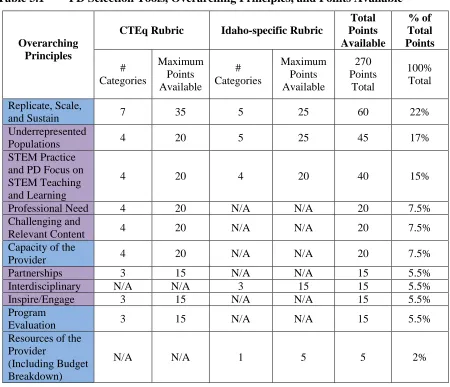
Table 3.1 PD Selection Tools, Overarching Principles, and Points Available ... 54 Table 3.2 Research-based PD Rubric Scores by Idaho Educators for the 13 Programs
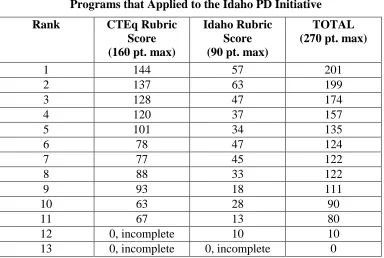
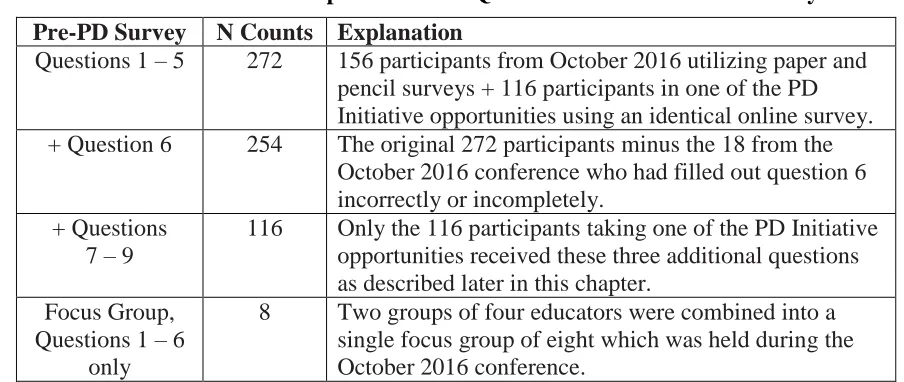
that Applied to the Idaho PD Initiative ... 57 Table 3.3 Number of Participants in Each Question from the Pre-PD Survey ... 59 Table 4.1 Number of Participants in Each Section of the Pre-PD Survey ... 80 Table 4.2 Pre-PD Themes Associated with Positive PD Experiences from the Large
Group Survey ... 84 Table 4.3 Pre-PD Themes Associated with Negative PD Experiences from Large
Group Survey ... 91 Table 4.4 Survey Means Related to Most and Least Important Characteristics of
STEM PD as Related to Question 6 from the Pre-PD Survey (n = 254) .. 93 Table 4.5 Friedman Test Results from SPSS on Ranked Means from Question 6 ... 96 Table 4.6 Ordered Means for Lowest (Most Important) to Highest (Least Important) Variables of STEM PD According to Idaho STEM Educators ... 97 Table 4.7 Wilcoxon Signed-Rank Test for Comparison of Characteristics Between98 Educator Groups ... 98 Table 4.8 Kruskal-Wallis Ranked Means and Test Statistics for Two Groups of
Educators (Teaching > 5 years, n = 57; Teaching 5+ Years, n = 197; df = 1) ... 104 Table 4.9 Likert Scale Rankings for Characteristics Associated with Knowles’
Theory of Adult Learning (n = 116) ... 109 Table 4.10 Means and Standard Deviations of Likert Scale Rankings for
xv
Table 4.11 Friedman Test for Likert Scale Ranking Variables Associated with
Knowles’ Theory of Adult Learning... 113 Table 4.12 Kruskal-Wallis Ranked Means and Test Statistics for Two Groups of
Educators in Relation to Adult Learning Theory (n = 116; Teaching > 5 years, n = 26; Teaching 5+ Years, n = 90; df = 1) ... 116 Table 4.13 Themes from the Pre-Survey PD Question “What do you hope to gain
from this PD experience?” (n = 116) ... 119 Table 4.14 Educators’ PD Quality Ranking, Aggregate and by Opportunity (Likert
Scale Ranking; n = 101) ... 124 Table 4.15 Themes and Percentage of Educators Indicating the Reason for Ranking of
Their High-Quality PD Experience (n = 81) ... 128 Table 4.16 Educators’ PD Service Provider Quality Responses (%, Aggregated, n =
101) ... 129 Table 4.17 Number of Times Themes Were Mentioned by Educators for Question 27
Related to Helpfulness of the PD ... 141 Table 4.18 Educators’ Responses to Question 28 Related to What Was Learned From the PD... 143 Table 4.19 Educators’ Responses to Question 29 Related to Additional Supports
Needed ... 147 Table 4.20 Educators’ “Yes” Responses to Question 30 Related to the Benefits of the PD to Other Educators (n = 99) ... 149 Table 4.21 Educators’ Responding “Yes” and the Themes Associated with Question
... 151 31 Related to Offering the PD Again (n = 99) ... 151 Table 5.1 New CTEq and Idaho-Specific Rubric Distribution for the Selection of
xvi
LIST OF FIGURES
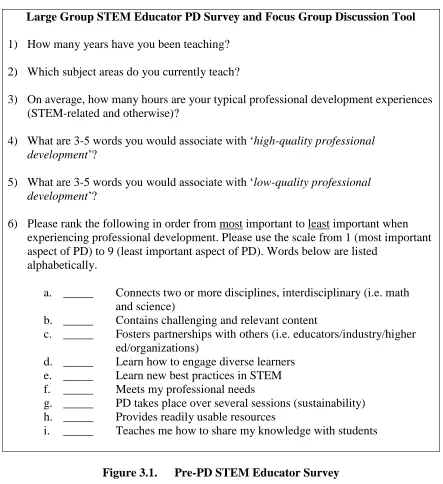
Figure 3.1. Pre-PD STEM Educator Survey ... 60 Figure 3.2. Primary Codes Derived from the Focus Group Transcript ... 65 Figure 3.3. Pre-PD Survey with Additional Knowles’ Adult Learning Theory
Questions... 69 Figure 3.4. Descriptive Coding Used for Pre-PD Question 9 ... 71 Figure 3.5. Post-PD STEM Educator Questions Focusing on Quality of the PD and
Interactions with PD Provider ... 73 Figure 3.6. Post-PD STEM Educator Survey Questions Related to Darling-Hammond & Richardson (2009)... 74 Figure 3.7. Post PD STEM Educator Survey Questions Related to Smith & Gillespie
(2007) ... 74 Figure 3.8. Post PD STEM Educator Survey Questions Related the Iowa STEM
Evaluation Report (2015 – 2016) ... 75 Figure 3.9. Post-PD STEM Educator Survey Qualitative Questions ... 76 Figure 3.10. Primary Coding Technique Used for Post-PD Survey Questions 26 – 31 77 Figure 4.1. Current Teaching Assignment as Indicated by Educators for the 2016 –
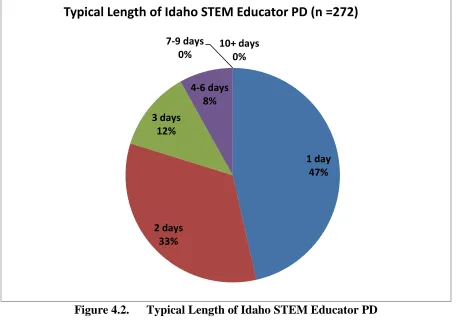
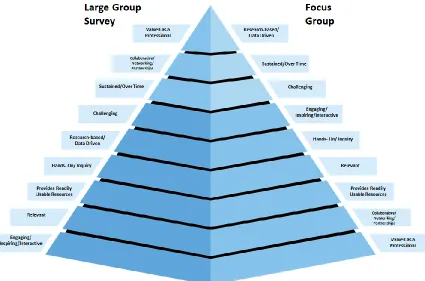
2017 School Year ... 82 Figure 4.2. Typical Length of Idaho STEM Educator PD ... 83 Figure 4.3. Weighting of Themes Derived from the Large Group Survey and the
Focus Group on High-Quality PD Characteristics (Question 4) ... 88 Figure 4.4. Large Group Survey Ranking Question (n = 254) Related to the Most and
Least Important Factors in PD ... 93 Figure 4.5. Graphic of Likert Scale Ranking for Characteristics Associated with
xvii
Figure 4.6. Wilcoxon Signed-Rank Test Results, Grouped by Significant Differences Between the Responses ... 115 Figure 4.7. Percentage of Educators Indicating Current Teaching Grade Level (n =
116) ... 118 Figure 4.8. Educators’ PD Quality Ranking Percentages, By Opportunity and
Aggregated (Likert Scale Rankings; n = 101) ... 125 Figure 4.9. Percentage of Educators in Agreement with the Darling-Hammond &
Richardson (2009) Questions (Aggregated; n = 101) ... 131 Figure 4.10. Percentage of Educators in Agreement with Smith & Gillespie (2007)
Questions (Aggregated; n = 101) ... 134 Figure 4.11. Percentage of Educators in Agreement with the Questions from the Iowa
xviii
LIST OF ABBREVIATIONS
CS Computer Science
CTE Career and Technical Education ESSA Every Student Succeeds Act
FY Fiscal Year
K-12 Kindergartner through Grade 12/Graduation
NCLB No Child Left Behind
OSBE Office of the State Board of Education
PBL Project-based Learning
PD Professional Development
PK-20 Pre-Kindergarten through Terminal Postsecondary Degree
PLC Professional Learning Community
SDE State Department of Education
SES Socioeconomic Status
STEM Science, Technology, Engineering, and Mathematics STEM AC The Idaho STEM Action Center
CHAPTER ONE: INTRODUCTION
Idahoans failed to recognize approximately $240M in 2016 as over 3,800 STEM (science, technology, engineering, and math) jobs went unfilled with a median wage of $30 per hour. In addition, $14M was lost in Idaho state income tax receipts due to these vacant positions (Idaho Department of Labor, 2014). This is a common theme nationwide and as a result, STEM is quickly becoming an essential component of PK-20 education as the workforce is demanding critical skills that can be provided through effective STEM education (Alper, Board on Higher Education and Workforce, Policy and Global Affairs, National Academies of Sciences, & Engineering and Medicine, 2015; Committee on
Improving Higher Education's Responsiveness to Regional STEM Workforce Needs, 2016). From Washington to Maine, Texas to Iowa and Utah, states are recognizing that to meet the demand within the state for a STEM-educated workforce, states must begin by providing the necessary STEM education to prepare their workforce of the future. As a result, more states are creating STEM agencies that are charged with providing and/or funding STEM educator professional development (PD) in an effort to expand their talent pipelines.
The key to a STEM-educated workforce is to provide STEM-savvy educators who can inspire students to pursue STEM education and persist into STEM careers (Kuenzi, 2008; U.S. Congress Joint Economic Committee, 2012). Guskey (2000) stated, “Never before in the history of education has greater importance been attached to the professional
turn, choose not to pursue further coursework in that subject area, and this is especially true in STEM subjects (Hiebert, Gallimore & Stigler, 2002; Webster-Wright, 2009). It is also commonly held that students can benefit directly by improving the content knowledge and pedagogical skills of educators; however, according to numerous researchers, teachers typically endure PD that is expensive, episodic, and often meaningless, which translates into the PD experience having little impact in the classroom and on their students (Darling-Hammond & Richardson, 2009; Newmann, King & Youngs, 2000; Thomas, 2010). Because educators are the key to student achievement, success, and persistence in STEM, it is of the utmost importance that corresponding educator PD is done correctly (Darling-Hammond & Richardson, 2009; Soliday, 2015). In an effort to support ‘high-quality STEM educator PD’, to improve student outcomes in STEM, and to expand Idaho’s STEM talent pipeline, the Idaho STEM Action Center was legislated into existence in July 2015 (Idaho Code §67-823).
Overview of the Idaho STEM Action Center (STEM AC) During the 2015 Idaho legislative session, a group of visionary legislators,
educational leaders, and industry stakeholders began a biweekly meeting referred to as “The STEM Caucus.” The STEM Caucus eventually crafted and guided through Idaho House Bill 302 that became law on July 1, 2015 (Idaho Code §67-823). This legislation created a new agency housed within the Executive Office of the Governor and named the Idaho STEM Action Center (STEM AC). The legislation specifies the five broad areas upon which STEM AC will concentrate:
1) Student learning and achievement (including achievement gaps and underrepresented populations);
2) Student access to STEM (including equity issues);
4) College and career STEM pathways; and, 5) Industry and workforce needs.
This law permits some flexibility for STEM AC to develop unique statewide opportunities for educators, students, communities, businesses, and industries throughout Idaho from kindergarten through career.
Decisions related to STEM AC, including legislative intent and implementation, are guided by a nine-member Board. The Board is comprised of two educational leaders from Idaho’s Office of the State Board of Education (OSBE) and the State Department of Education (SDE) and seven Idaho industry leaders, including the directors of the Idaho Department of Labor and the Idaho Department of Commerce. Other industry
representatives are chosen by the Governor and selection is based primarily on industry focus and geographic location. Currently, the industry members are Idaho National Laboratory (INL), the Micron Foundation, LCF Enterprises, Glanbia, and AlertSense/Idaho Technology Council.
With the five broad areas defined in the legislation, STEM AC Board members developed mission and vision statements. The mission of STEM AC is “Connecting STEM education and industry to ensure Idaho’s long-term economic prosperity”. The vision is to “Produce a STEM competitive workforce by implementing Idaho’s kindergarten-through-career STEM education programs aligned with industry needs.”
throughout Idaho communities and from Idaho educators and students were significant, with only 22% of the funding requests filled during FY16. In addition, Idaho businesses and industries helped highlight the importance of STEM in workforce development and economic growth. Because of both the extreme need from educators and industry encouragement, legislators allotted additional funds to support STEM education,
kindergarten through career. As a result, $2.5M was appropriated specifically for Idaho Code §67-823 to fully implement the intent of STEM AC’s original legislation. Moreover,
because of industry encouragement, the Computer Science (CS) Initiative (Idaho Code §33-1633) was successfully passed with significant bipartisan support. An additional $2M in one-time funds was specifically ear-marked to implement the dictates in this initiative. For FY18, STEM AC requested and was once again appropriated $4.5M to continue support for STEM and CS throughout Idaho. This significant increase in funding serves to illustrate the wide-spread legislative understanding that providing a STEM-capable workforce is critical in order to ensure the state is meeting the urgent employment needs of Idaho’s businesses and
industries.
educators related to their PD experiences, but then must use the data to modify existing or develop new policies and/or programs to ensure that Idaho educators truly do receive the highest-quality STEM PD. The first step in this process is to understand the research related to STEM AC legislation and specifically to clarify the term ‘high-quality STEM educator PD’. This will allow STEM AC to implement projects and programs that are aligned with legislative intent. As of FY17, Idaho had no method or tool to systematically vet and select high-quality STEM educator PD; therefore, to meet the mandates in Idaho code, the next step was to develop tools and methodologies to validate STEM PD opportunities that are selected for Idaho educators. This two-step process of literature review and validation of STEM PD tools constituted the research detailed in this study.
Chapter Two contains five major sections that describe and outline current research in each of the STEM AC focus areas including: STEM, high-quality STEM educator PD, traditionally underrepresented populations in STEM, typical pathways students take that lead to a STEM career, and industry and workforce needs in STEM throughout the U.S and within Idaho. The literature review in Chapter Two serves as a foundation for the actions of STEM AC by defining and clarifying terminology associated with STEM AC legislation.
clear, and stable messages to all its stakeholders. Therefore, prior to investigating if the research-based PD rubrics were effective tools for selecting high-quality STEM PD, it was first necessary to define these key terms to ensure legislative intent and a common language.
These common understandings will serve to promote consistency within STEM AC, between STEM AC and its Board members, and among other agencies and entities, including the legislature, local districts, educators (formal and informal), educational non-profits, and Idaho communities. The research described in Chapter Two guided STEM AC in the identification of desired outcomes and the selection of appropriate projects and programs to achieve those outcomes. Specifically, the purpose of Chapter Two was to create a common language when communicating about STEM throughout Idaho which ensured that STEM AC used consistent and appropriate language in alignment with legislative intent and
transparency to all stakeholders.
Chapter Three describes this research study in depth, including the research-based rubrics used to select STEM PD for Idaho educators in FY17. It was assumed that both research-based PD rubrics rigorously selected high-quality STEM PD for Idaho educators; however, the purpose of this research was to ascertain the practical efficacy of the rubrics to select ‘high-quality PD’ as perceived by Idaho educators who participated in one of the selected STEM AC opportunities. Specifically, this research was guided by the following questions:
1) Which characteristics of PD are most important to Idaho STEM educators? 2) In what ways are these characteristics similar to/different from the literature on
'high-quality STEM educator PD'?
The specific research-based tools used to select STEM PD opportunities for Idaho educators are described in detail in Chapter Three, along with the educators who participated in this study, the methodology, and the analyses used to answer the research questions. The process included collecting feedback from educators to determine if the PD they experienced, that was selected via the research-based PD rubrics, was of high quality and if it was
potentially worth scaling and/or sustaining. The analysis of the data collected from the pre- and post-PD surveys and the focus group is the focus of Chapter Four. Chapter Five will use the analyses from Chapter Four to draw conclusions which will answer the research
questions listed above and evaluate the efficacy of the two research-based rubrics to select high-quality PD for Idaho STEM educators.
In order to justify spending and to ensure accountability, it is essential that the
research-based PD rubrics are effective tools for selecting ‘high-quality STEM educator PD’. Allowing educators to evaluate the efficacy of the PD rubrics will provide confidence to stakeholders, including legislators, the STEM AC Board, educators, and communities, that taxpayer money is being spent wisely. This methodology will also ensure that STEM AC is meeting the goal of its legislated mission to provide high-quality STEM PD to Idaho educators.
Failure to recognize and support critical industry needs for a STEM-literate
CHAPTER TWO: TERMINOLOGY AND RESEARCH RELEVANT TO STEM AC FOCUS AREAS
Given the broad mandates outlined in Idaho Codes §67-823 and §33-1633, it is imperative that terms and concepts relevant to the major STEM AC focus areas be clarified. This chapter will discuss the variety of existing interpretations around specific STEM terms and concepts, and it will also provide the rationale by which these terms are being adopted by STEM AC in order to meet legislative intent. Specifically, this chapter combines ideas from five focus areas of literature that are of significant importance both to STEM AC and to this study in relation to high-quality STEM educator PD. Those areas are:
1) Definition of STEM
2) High-quality STEM professional development 3) Traditionally underrepresented populations in STEM
4) Typical pathways that students take which lead to STEM careers
5) Industry and workforce needs in STEM throughout the U.S. and within Idaho By creating clear, consistent messaging around the five areas listed above, in-depth focus can then be given to STEM educator PD through the lens of adult learning theory. After the five focus areas are clarified using relevant literature, the study will shift into methodology and results which are discussed in Chapters Three and Four, respectively. Chapter Five with revisit and answer the research questions using results from this study:
2) In what ways are these characteristics similar to/different from the literature on 'high-quality STEM educator PD'?
3) To what extent are STEM AC PD opportunities, selected via research-based PD rubrics, determined by Idaho educators to be of ‘high quality’?
These questions are answered by conducting pre- and post-PD surveys involving educators who participated in one of STEM AC’s research-based, rubric-selected PD opportunity in a mixed methods fashion as described in Chapter Three.
Focus Area 1: Definition of STEM
From a policy perspective, even many educational stakeholders, including the National Science Foundation, K-12 agencies, and school districts, considered STEM to be traditional disciplinary coursework, separate courses of science, mathematics, technology, and engineering, lacking an integrated approach (Breiner et al., 2012). According to Labov, Reid, and Yamamoto (2010), one of the most important modern concepts of STEM education might be the idea of an integrated STEM approach that is practical and purposeful, which connects the STEM disciplines, and is used to solve real-world problems.
Compounding the problem, these differing definitions of STEM often lead to
significant variations in STEM spending estimates and STEM job reports. For example, in a 2012 Congressional Service Report, it was estimated that federal spending and investment in STEM education programs was between $2.8 billion and $3.4 billion annually (Gonzalez & Kuenzi, 2012). The report indicated that the “differences between the inventories [values] are due, in part, to the lack of a common definition of what constitutes STEM” (p. 7). Not only are the estimated amounts of STEM spending vastly dissimilar because of differing
definitions, but the estimated number of STEM workers also varies significantly. At a 2015 workshop entitled Developing a National STEM Workforce Strategy, Kalvin Droegemeier, the vice president and general manager of Manpower’s northeast division, a company devoted to helping others find temporary and permanent employees, noted,
…there is no consensus definition of the STEM workforce and it consists of many sub-workforces. One reason for the vastly different analyses about the state of the STEM workforce is because the definition of a STEM worker is not consistent from article to article and report to report. (p. 13)
within the same state may also cause estimates to differ from one another. This is especially true when estimating the STEM workforce and employer needs. Some agencies use a definition of STEM that includes health care and social science such as psychology and economics, in addition to the more traditional disciplines of science and engineering (Corbett & Hill, 2015; Gonzalez & Kuenzi, 2012; Kuenzi, 2008; Maltese & Tai, 2011). Others use a much narrower definition that excludes social sciences and health care. These different definitions often lead to significant variations in numbers when attempting to quantify spending and job reporting (Alper, 2015; Wang, 2013).
The disparities in definitions become particularly problematic when attempting to ‘target’ STEM efforts toward specific populations. For example, a 2007 report on women in STEM showed significant gender gaps in the number of women in STEM jobs and pay equity. However, this report used a very narrow definition of STEM, excluding majors such as business (i.e. economics), health care, and social sciences (i.e. psychology) (Beede, Julian, Langdon, McKittrick, Khan, & Doms, 2011). A different study by Wang and Degol (2013) used a broader definition of STEM to include physical and biological science, medical, health, computer sciences, engineering, and mathematics, and found smaller STEM gender gaps than Beede et al. (2011).
STEM AC Definition of STEM
differentiate itself from the State Department of Education (SDE). At the SDE, science, math, English language arts/literacy (ELA), health, PE, government, arts, and social sciences are directed by individual coordinators who assist with revising standards, supporting
assessments, and providing guidance on PD related to their content area. In light of this, it is critical that STEM AC forge its own path in the world of integrated STEM PD and other STEM projects and programs. It is important that STEM AC not duplicate the efforts of the SDE which seems to view the disciplines as more segregated than integrated. STEM AC must focus primarily on projects and programs that are representative of a truly
interdisciplinary approach to STEM education and workforce preparedness.
In addition, to promote consistency between STEM AC and the Idaho Department of Labor, a clear definition of exactly which professions are encompassed in the STEM
workforce is also necessary. The Idaho Department of Labor often uses a very broad
definition of the STEM workforce. According to the Idaho Department of Labor, the STEM workforce is made up of four subdomains (Appendix A). Subdomain 1 includes life and physical science, math, engineering, and information technology occupations. Subdomain 2 includes social science occupations such as economists, psychologists, geographers, and archeologists. Subdomain 3 focuses on architecture and architects. Subdomain 4 is grounded in health care and includes doctors, dentists, nurses, and other related health care
professionals. In total, 184 occupations are defined by the Idaho Department of Labor as STEM-related and requiring STEM skills.
definition used by the Idaho Department of Labor, consistency will prevail when discussing STEM throughout Idaho.
Focus Area 2: High-Quality STEM PD through the Lens of Adult Learning Theory With the term STEM clearly defined, the term ‘high-quality STEM PD’ must next be defined; STEM AC legislation dictates that STEM AC support high-quality STEM and CS PD (Idaho Code §67-823 and §33-1633). In fact, this term is mentioned multiple times throughout the legislation, but there is no clear definition to indicate what the term ‘high-quality STEM PD’ means. Because of the ambiguity and various definitions used in journals, by vendors and PD providers, and by school districts, it is critical that STEM AC ensure a clear and transparent definition of ‘high-quality STEM PD’ for Idaho educators and other stakeholders. In addition, STEM AC has allocated significant funds to support this targeted effort throughout Idaho, making it even more important to ensure consistency. Since the focus of this research is on adult learners and adult perceptions and outcomes, this study will view high-quality STEM PD through the lens of adult learning theory. With this in mind, selected STEM educators will receive PD in a STEM-related area from a STEM AC opportunity that was selected using research-based PD rubrics and will provide feedback to STEM AC related to the quality of the PD.
PD through the Lens of Adult Learning Theory
Malcolm Knowles is known as the most prominent theorist to focus on the individual adult learner (1980). He popularized the term andragogy, defined simplistically as the art and science of teaching adults. He viewed this learning theory to be unique to adults and different from child learners. Knowles’ assumptions of adult learners include the following concepts:
3) Adults tend to learn best when learning is problem-centered and relevant.
4) Adults have a strong need to know the reasons for learning (Knowles, 1980, 1984; Knowles, Holton & Swanson, 1998).
It follows, then, that PD experiences supporting these assumptions would be perceived to be of higher quality than those experiences that do not support these assumptions. Merriam (2001b) believed that Knowles’ ideas capture the general characteristics of adult learners and that his characteristics offered some guidelines for practice in relation to adult teaching and learning. In fact, some of the most successful adult education and PD programs meet the needs of individual adult learners by focusing on greater autonomy and self-direction, as originally suggested by Knowles (Merriam & Caffarella, 1999; Merriam, 2001b). Hartree (1984) suggested perhaps Knowles’ characteristics are best practices of "what the adult learner should be like" (p. 205) and PD focused on these critical areas would most likely have an impact on the adult learner. Knowles’ assumptions have been explored by numerous researchers and appear to be valid—even for the 21st century adult learner.
Desimone (2009) contended that some of the most important applications of PD occurred when teachers returned to the classroom, applied the learned methodology, and reflected upon their own practice. This is an excellent example of educator self-direction and independence.
In the same vein as Knowles, David and Patel (1995) determined “adults enter into an educational activity with greater volume and a different quality of experience from youth; adults are themselves a rich resource for one another” (p. 358) and the ability to share these experiences can actually strengthen the PD opportunity. Smith and Gillespie (2007) reiterated the essential need for PD to account for past experiences by purposefully relating new
learning to past understandings and illustrating applicability of the new learning outside of the PD setting. Similarly, in order for adults to learn, Mezirow (1996) suggested that
transformational learning is critical. In this, adults attempt to make sense of their experiences, some of which might require adults to make monumental shifts in beliefs or attitudes, which in turn, shifts their entire perspective. In order for this shift to occur, adults must believe that the learning is relevant to their lives.
Putnam and Borko (2000) found educational research supporting the notion that high-quality PD should be active, situated, and social, which could be interpreted as problem-centered (i.e. active and social) and relevant (i.e. situated). Comparable findings have been recorded in other research studies indicating professionals learn through practical experiences and that reflection has a valuable role in adult learning (Day, 1999; Garet et al., 2001;
Lieberman & Miller, 2001). While some studies use the term “practical experience”,
Resnick (1987) proposed adults learn best when situated in an authentic activity rather than a simulated activity, resonating Knowles’ idea that adults need to have a clear understanding of why they are learning. The works of Lave (1996) and Lave and Wegner (1991) also stressed the importance of adults engaging in actual practice to truly understand why the learning is important. Finally, a recent research report by the Council of Chief State School Officers (CCSSO, 2008), detailed five critical characteristics of successful adult PD: job-embedded, results-driven, content-rich, standards-based, and school-centered. A number of these characteristics are similar to Knowles’ characteristics of adult learners in relation to relevance.
Summarizing a variety of Knowles’ assumptions including relevance, problem-centered, and reasons for learning are Smith and Gillespie’s 2007 research that indicated the most effective PD is of
…longer duration, makes a strong connection between what is learned in the PD and the teacher’s own work context, helps the teachers plan for application and to identify and strategize barriers to application, focuses on subject-matter knowledge, includes a strong emphasis on analysis and reflection, rather than just demonstrating techniques, and should include a variety of activities. (p. 218)
Challenges of Adult Learning
“how best to provide PD activities,” the system must begin to focus on “understanding more about the fundamental question of how professionals learn” (p. 705).
Another challenge described by Merriam (2008), is that adult learners are an “ever-changing mosaic, where old pieces are rearranged and new pieces added” (p. 94).
Mackeracher (1996) described adult learners as a “kaleidoscope”, a dynamic and
interconnected complex set of processes that are interwoven into every aspect of the adult life experience including learning. Because adults often bring a wealth of personal knowledge and perceptions, learning is grounded in past understandings as adult learners search for relationships and commonalities between new and past experiences (Martin & Schifter, 1991) which need to be accounted for in order to have the most effective PD.
Yet another challenge according to Elmore (2002) is that it is a “gargantuan task for teachers to apply what they have learned in an off-site workshop once back in their
classrooms and isolated from other teachers” (p. 25). Therefore, giving adult educators time to reflect upon and share their experiences with others will be an important consideration for STEM AC-supported PD opportunities.
As suggested above, how adults learn is important in relation to high-quality educator PD. However, perceptions of learning and high-quality PD may vary significantly from one educator to another. Because of this inherent variability, there will be challenges in
measuring adult learning, and because certain concepts would be difficult to capture using only quantitative techniques, thus additional qualitative techniques will also be utilized. Reasons to Measure Adult Learning
learning as associated with STEM PD. As described previously, this study hypothesized that the two research-based PD rubrics used to select high-quality STEM PD in FY17 did indeed select ‘high-quality STEM PD’. In the next step, educators participated in one of the
research-based, rubric-selected STEM PD opportunities and provided feedback that was analyzed in relation to adult learning theory and PD perceptions. Although the study of adult learning has a number of challenges, attempting to measure outcomes from learning is important in order to determine impacts on the adult learner. In fact, numerous occupations understand the imperative need for ongoing PD in order to maintain high-quality practice, and teaching is no exception (Friedman & Phillips, 2004). It is also important that the PD is effective, efficient, and evidence-based in order to improve outcomes for both the educators and their students (Garet, Porter, Desimone, Birman, & Yoon, 2001; Penz & Bassendowski, 2006).
In conclusion, Webster-Wright (2009) applauded adult learners:
Much of the research reveals most professionals as enthusiastic learners who want to improve their practice. Let us listen to their experience and work to support, not hinder, their learning. Rather than deny, seek to control or standardize the complexity and diversity of professional learning experiences, let us accept, celebrate and
develop insights from them. (p. 727)
Therefore, supporting professional development opportunities where educators are given significant support and control of their learning is extremely important. When studying the learning of adults, it is crucial that attempts are made to capture the nuances by using both qualitative and quantitative metrics. If adult learning is like a “mosaic” or a
‘High-Quality PD’ and Adult Learning Theory’s Emphasis on the Importance of Job- Embedded PD
Regarding the potential range of PD opportunities, numerous articles discuss the need for teachers to receive ‘job-embedded professional development’ (Blank, de las Alas, & Smith, 2007; Darling-Hammond & Richardson, 2009; Saxe, Gearhart, & Nasir, 2001; Wenglinsky, 2000; Yoon, Duncan, Lee, Scarloss, & Shapley, 2007). Job-embedded PD is a type of PD in which educators have time to reflect upon and improve their practice through activities such as peer observations, analysis of student work, educator work groups, and/or professional learning communities (PLCs) (Darling-Hammond & Richardson, 2009).
This job-embedded PD approach was used by Smith and Gillespie (2007) and compared to traditional workshop-focused PD. They determined the primary difference between traditional and job-embedded PD is that in traditional forms of PD, “outside experts do most of the talking and teachers do the listening”, whereas in job-embedded PD, “teachers do the talking, thinking, and learning” (p. 219). They concluded that, “if the goal is to
increase teacher knowledge, then traditional PD might work for some educators. However, if the goal is to increase student achievement, then job-embedded PD, situated in practice, is more likely to accomplish this task” (p. 215).
High-Quality PD Takes Time
Job-embedded PD is very different from single-day ‘drive-by’ PD. Single-day PD ranks low amongst the most effective methods of delivery for PD; however, this ‘one and done’, single-day approach tends to be the most common type of PD that teachers experience (Darling-Hammond & Richardson, 2009; Stein, Smith, & Silver, 1999). According to a 2014 Gates Foundation survey, 80% of educators indicate they participated primarily in workshops as the most common form of PD and that they spend an average of 20 hours per year in these workshops, even though this approach is less effective than job-embedded PD (Boston Consulting Group, 2014).
To elaborate, in a study by Yoon et al. (2007), nine different PD opportunities for educators were compared to student outcomes including student achievement. Educator PD lasting less than 14 hours showed no effect, whereas more than 14 hours showed a positive effect. However, the largest positive gains were found in PD that was between 30 to 100 hours and was spread out over a period of six to twelve months. These findings are similar to a study conducted by Supovitz and Turner (2000) that found it was only after 80 hours of PD that teachers reported using inquiry-based, hands-on teaching strategies, which had positive impacts on student outcomes, at a significantly higher rate than those with less time spent in PD.
Supovitz & Turner, 2000; Wilson, Schweingruber, & Nielsen, 2016). Unfortunately, this ‘drive-by’ method of PD is the most common method because it is relatively inexpensive compared to long-term, sustained PD involving opportunities such as mentorship, coaching, or the formation of professional learning communities (Brasiel & Martin, 2015; Darling-Hammond & Richardson, 2009; Flynn, 2013; Stotts, 2011; Wilson et al., 2016.).
The importance of on-the-job training, situated in practice, is illustrated in many professions including student teaching, apprenticeship programs, and numerous service jobs, and should be consistently incorporated into educator PD (Alper, 2015; Wilson et al., 2016). However, sustained PD is more time-consuming and/or cost intensive when compared to ‘one-and-done’ PD (Brasiel & Martin, 2015; Darling-Hammond & Richardson, 2009; Flynn, 2013; Stotts, 2011; Wilson et al., 2016). In addition to the time required for delivery of sustained PD, peer mentors/coaches are often required, necessitating the reduction of teaching loads in order for educators to serve in this capacity (Stotts, 2011; Wilson et al., 2016; Young, House, Wang, Singleton, & Klopfenstein, 2011). Consequently, administrators may not fully support this type of PD due to the intensity and/or expense involved (Darling-Hammond & Richardson, 2009).
This lack of administrative support is unfortunate because it is a critical yet often overlooked component of successful PD and must go beyond simple administrative
encouragement. According to Hernandez and Brendefur (2003), three important conditions appeared to have an impact on the quality of integrated mathematics units produced by teacher-teams: “teachers’ teaching practices, school supports, and collaborative patterns” (p. 274). Effective school supports included appropriate resources such as materials, time to reflect on one’s own practices, and time to observe other teachers’ practices. The
for teachers to receive the full gains from PD (Hernandez & Brendefur, 2003). Similarly, Supovitz and Turner (2000) reported that science educators who felt more supported by their administration often have students engage in more inquiry-based investigations than those educators who feel less supported, highlighting the importance of administrator buy-in and support.
In a synthesis of the research on educator PD, Darling-Hammond and Richardson (2009) found that successful PD:
a) “Deepens teachers' knowledge of content and how to teach it to students; b) Helps teachers understand how students learn specific content;
c) Provides opportunities for active, hands-on learning;
d) Enables teachers to acquire new knowledge, apply it to practice, and reflect on the results with colleagues;
e) Is part of a school reform effort that links curriculum, assessment, and standards to professional learning;
f) Is collaborative and collegial; and
g) Is intensive and sustained over time.” (p. 51) Conversely, from the same article, unsuccessful PD: a) “Relies on the one-shot workshop model;
b) Focuses only on training teachers in new techniques and behaviors; c) Is not related to teachers' specific contexts and curriculums;
d) Is episodic and fragmented;
e) Expects teachers to make changes in isolation and without support; and
In addition to the positive components listed above, another support found to impact the success of PD is collaboration with entities outside of the traditional school setting. Horn and Little (2010) followed a highly collaborative group of math teachers whose students consistently demonstrated significant gains in learning and advanced coursework. The educators cited external factors as being significant to their successes, namely the active participation in university-based PD, the opportunity to collaborate on university-led research projects, and strong professional networks.
To this point, all of the PD methods discussed involve face-to-face delivery.
However, this mode of delivery may be impractical for teachers in rural or remote areas. One potential solution is virtual PD including coaching. McConnell, Parker, Eberhardt, Koehler, and Lundeberg (2013) conducted a study regarding the perceived effectiveness of virtual science PD which included the use of video conferencing and message boards. The educators reported the virtual experience helped them gain new information, work more effectively in collaborative groups, and develop new professional friendships. However, the educators indicated they still preferred face-to-face PD, but sustained virtual PD certainly appears to be a viable alternative to single-day or no PD.
Definition of High-Quality STEM PD and STEM AC
of STEM is an integrated approach necessitating that PD opportunities demonstrate the integration of at least two STEM subjects.
Idaho currently uses an in-depth, collaborative approach for PD in math and ELA. At this time, eight ELA coaches are supported through the State Department of Education with legislative funding. Math specialists are also supported through university collaborations and legislative funding. Activities supported by Idaho ELA coaches and math specialists include: assisting teachers in implementing the Idaho Content Standards in Math or ELA/Literacy and associated assessments (formative, interim, and summative); serving as mentors; supporting development of new skills; applications of knowledge; and providing resources. Science coaches, however, remain non-existent in Idaho. This is not surprising, as Banilower et al. (2013) noted that only 17% of elementary and middle schools and 22% of high schools across the nation reported having access to a science coach. This study also indicated that access to coaching in general is much less common in rural schools. However, there is mounting evidence supporting the effectiveness of the science coaching model (Kuenzi, 2008; Stotts, 2011; Supovitz & Turner, 2000; Wilson et al., 2016).
Yet another significant consideration around PD is the method of delivery. Although a number of studies cited that teachers prefer the face-to-face mode of PD (Brasiel & Martin, 2015; Wilson et al., 2016), with Idaho’s geographic distribution, it will be necessary to look into virtual and blended models of delivery in order to reduce overall cost. It would be impractical to expect localized, in-depth, content-focused PD to be able to effectively and affordably support all regions of the state. To assess different PD delivery modes,
face-to-face models with virtual and blended models of educator PD, especially in the area of STEM. In addition, incentives, such as teacher stipends, may increase educator participation and completion rates, ultimately having a long-term impact on teacher practices and student outcomes, which should also be measured.
As STEM AC begins to systematically support ‘high-quality STEM educator PD,’ it will be essential to create a rubric that clearly outlines the expectations of vendor- and university-delivered opportunities for educators. Ensuring that PD is effective in the long-term may require that communities of practice be formed throughout the state as
recommended by numerous researchers (Brasiel & Martin, 2015; Darling-Hammond & Richardson, 2009; Flynn, 2013; Lave & Wenger, 1991; Stotts, 2011; Wilson et al., 2016). Communities of practice would allow educators to share what they are doing in their classrooms (both successfully and less successfully) and to interact with others (often educators who experienced similar PD) who can support them and give them advice and encouragement.
In addition, the local administration must be informed of the opportunity to ensure not only encouragement, but also effective partnerships and adequate supports. This will likely look very different from school to school, and the supports may come in the form of
resources, unique scheduling to allow teacher collaboration, or stipends for those serving as mentor teachers.
these critical elements in order to ensure that it is truly supporting effective statewide STEM PD and ensuring long-term successful outcomes for educators and students.
Focus Area 3: Underrepresented Populations in STEM
Traditionally underrepresented populations in STEM have been discussed by numerous authors with the primary focal groups including gender (women), geography (rural), minorities (including African American and/or Hispanic ethnicity) and low
socioeconomic status (often identified by free/reduced priced lunch status as defined by the federal government) (Alper, 2015; Beede et al., 2011; Cole & Esponoza, 2008; Committee on Improving Higher Education's Responsiveness to Regional STEM Workforce Needs, 2016; Gonzalez & Kuenzi, 2012; Kuenzi, 2008; Malcolm, 2010; Morganson, Jones, & Major, 2010; Stotts, 2011; U.S. Department of Education, 2012; Walton, 2014). Each group presents a unique set of challenges in relation to recruitment and retention in STEM,
kindergarten through career.
Women as an Underrepresented Population in STEM
echoed this finding that the work/family ‘imbalance’ was a major factor turning women away from STEM careers.
If these factors are true, then why should women be encouraged to pursue STEM careers? In relation to pay equity, it is estimated that women in STEM make approximately 33% more than women in non-STEM jobs (Corbett & Hill, 2015). In addition, the gender wage gap is smaller for women in STEM professions than non-STEM professions. As Beede et al. (2011) described, men consistently earn more money than women; however, in STEM jobs, women make 86 cents for each dollar men make—14% less than men, on average. In non-STEM jobs, women make approximately 21% less than men. Another interesting point from this research is that engineering, which is dominated by men in a ratio of 7:1, has the “smallest regression-adjusted wage gaps” compared to other STEM professions (p. 5). This translates into female engineers earning an average of 93 cents per dollar compared to male wages—just 7% less than men.
While it is economically beneficial for women to enter STEM fields, many women still do not pursue these pathways – particularly in the U.S. when compared to other
countries. In Malaysia, for example, women earn half of the computer science degrees while women in Indonesia earn half of the engineering degrees; however, in the U.S., women earn only 18% of the computing degrees and 19% of the engineering degrees (Corbett & Hill, 2015). Morganson et al. (2010) found this was partially due to STEM environments in the U.S. being male-dominated, very individualistic, and highly impersonal with the climate being referred to as “chilly.” For example, one Latina student described her experience in a male-dominated STEM classroom:
Droegemeier echoed this young Latina’s concerns and tried to provide some encouraging advice:
STEM is for everyone and STEM skills provide empowerment for individuals. Too often, women and students of color who may be struggling with a STEM course are encouraged to drop it and switch to something ‘easier,’ but this is exactly the wrong advice. They need to be challenged and encouraged and not treated as if they are not smart enough to get the job done. (Alper, 2015, p. 17)
How can more U.S. women be encouraged to enter STEM? Women and girls who are interested in STEM should be encouraged and supported (Beede et al., 2011). Strong,
positive female STEM role models/mentors are another factor that have been shown to increase female retention rates in STEM pathways (Beede et al., 2011; Corbett & Hill, 2015; Morganson et al., 2010; U.S. Congress Joint Economic Committee, 2012). STEM career awareness at several levels (middle school, high school, and postsecondary) was also revealed to be ‘absolutely essential’ for encouraging females to enter nontraditional STEM careers (Morganson et al., 2010). In addition, forming female study groups and taking similar classes with other females can help women navigate STEM pathways during postsecondary education (Morganson et al., 2010). Once in a STEM career, employers should be flexible with women, many of whom are not only working but are also often serving as the primary caregiver for the family (Wang & Degol, 2013).
Rural Geography as an Underrepresented Population in STEM
few opportunities for teacher collaboration and coaching. In turn, this reduces educator access to job-embedded PD, mentoring, reflection, and collaborative (content-focused) learning groups, which are more common in larger districts (Banilower et al., 2013). Finally, rural communities often face difficulties with industry interactions and mentorship due to the lack of major industries (Walton, 2014). According to Wiebe et al. (2013), “It is clear that all groups from these mostly rural, under-resourced areas could use additional support” (p. 7).
While the rural challenges are larger than STEM, there are a number of approaches that could be taken to support rural populations. Teachers could benefit from online (virtual or blended) PD, and students should be encouraged and supported when taking online STEM coursework (Wilson et al., 2016). Some rural districts lack instructional resources, including supplies for hands-on STEM labs or technology (Brasiel & Martin, 2015). Providing grants and funding to access these resources would help to close the equity and access gaps. As mentors are limited in rural areas, providing virtual mentors would connect rural areas to urban mentors (Alper, 2015).
Race/Ethnicity as an Underrepresented Population in STEM
If the goal is, as Malcom (2010) stated, to “enlarge the STEM talent pool” (p. 29), then it is not enough simply to encourage minority students to enroll in postsecondary coursework. Cultural factors, including relevance and congruity, are critically important for retention of minority populations in STEM fields and must be addressed (Cole & Esponoza, 2008). Cultural relevance involves educators working to ensure that students can relate course content to their cultural context; whereas cultural congruity includes “factors such as peer and faculty support, and co-curricular involvement,” both of which have been shown to “play a role in the retention of [minority] student population” (Cole & Espinoza, 2008, p. 286). For minority students in STEM, it is important that “faculty or staff members, in particular, serve as role models and as examples of [minority] individuals who have
successfully navigated the educational system” (Cole & Espinoza, 2008, p. 286). This echoes the research of Bonous-Hammarth (2000) that found minority students report leaving STEM because they feel there is a disconnect between their majors and the values shared by their peer groups outside of their majors. Both studies are supported by the findings from the Committee on Improving Higher Education's Responsiveness to Regional STEM Workforce Needs (2016) indicating that minority role models are an important factor for retaining minority students in STEM pathways.
Community college might be the answer to creating cultural congruity as many minority populations often attend community college on their path to a STEM career (Alper, 2015; Committee on Improving Higher Education's Responsiveness to Regional STEM Workforce Needs, 2016; Malcolm, 2010). In fact, Malcolm (2010) discovered that 61% of all Hispanic students who hold a bachelor’s degree attended community college at some point during their postsecondary education. In addition, students who were from a more
associate’s degree. It should be noted that while the number of minority STEM majors is still relatively low, more minority students are earning STEM degrees than ever before.
According to Gonzalez and Kuenzi (2012), enrollment for Hispanic/Latino, American Indian/Alaska Native, and African American students in science and engineering “grew by 65%, 55%, and 50%, respectively” (p. 2). Even so, minority populations still remain
significantly underrepresented throughout the STEM fields. From the industry perspective, as the minority population of the U.S. continues to grow, it is essential to invest in the
recruitment of minority populations into STEM fields (Alper, 2015). Socioeconomic Status as an Underrepresented Population in STEM
Research has shown that students—especially minority students—with low socioeconomic status (SES) have significantly less representation in STEM, beginning in high school, carrying through to postsecondary, and onward into STEM careers (Corbett & Hill, 2015; Wang, 2013). Why do students with low SES leave (or never enter) STEM pathways? One reason could be the lack of access to rigorous STEM coursework during K-12 education (Wang, 2013). Another reason may be the lack of awareness of potential STEM careers as students with low SES might not personally know STEM professionals (Alper, 2015; Corbett & Hill, 2015; Wang & Dregol, 2013).
failing to prepare large numbers of our young people for postsecondary education or training” (p. 864).
Once students with low SES leave high school, the financial challenges of
postsecondary education are soon recognized. A study by Kienzl and Trent (2009) found that receiving financial aid was a major factor for students with low SES entering into longer duration/higher cost STEM fields of study. Wang (2013) found that persistence after the first year of postsecondary education is critical for the retention of low SES students in STEM. This underscores the importance of schools to inform students—especially those with low SES—about financial aid opportunities that are available for postsecondary education.
How can students with low SES be encouraged to persist in a STEM pathway? In K-12, using culturally relevant, hands-on projects could lead to increased retention (Darling-Hammond & Richardson, 2009; Maltese & Tai, 2011). Holding family financial aid nights could help raise student and family awareness and generate family/peer support for STEM degrees, certificates, and career options while in postsecondary education, as well as finding supportive peer groups to help students be successful and persist in STEM pathways (Cole & Espinoza, 2008). Throughout K-12 and postsecondary, it is critically important for educators to understand how to educate and support all students, regardless of SES. This can be
accomplished through additional PD in order to promote educator understanding in relation to supporting this demographic.
STEM AC’s Definition of Traditionally Underrepresented Populations
In defining ‘traditionally underrepresented populations in STEM’, STEM AC needs to be aware of Idaho’s different demographic populations, working to ensure these
related to gender and geography will prove to be easier than race/ethnicity and SES. However, the focus of STEM AC should remain primarily on these four groups as the majority of research (illustrated previously) highlights these as being significantly
underrepresented in STEM. Should other groups be identified through STEM AC’s work, this definition would need to be updated accordingly to reflect Idaho-specific data.
Working to bolster increased participation in STEM through STEM AC activities in relation to race/ethnicity will be challenging because racial identification is often not reported outside of the formal K-12 school setting. It would be possible to require, at STEM AC-sponsored events, that local grant recipients attempt to collect aggregate counts and
percentages. For example, at a family STEM event, STEM AC could request that attendance include not only a total count, but also aggregate numbers (or percentages) of different races/ethnicities. However, this type of data would likely not be collected in a systematic manner at each site and could prove inaccurate. Census data might be a better estimator, but certain populations may (or may not) attend an event in a different ratio than census data would suggest. Even more difficult to capture is SES. It would be possible to use aggregate numbers of free/reduced lunch data reported by a school or district, but obtaining SES data could prove to be very difficult in programs that do not capture this information, such as summer camps, family STEM events, library activities, after school activities, and student competitions.
impact of STEM AC projects and programs in supporting traditionally underrepresented populations in STEM. Using rubrics to score grant applications that award additional points to educators and/or communities serving traditionally underrepresented populations in STEM may counter some of these issues and help to ensure that STEM AC can specifically impact these four focal groups.
In relation to postsecondary education, knowing that traditionally underrepresented populations—especially those from diverse races/ethnicities—often attend community college (Malcolm, 2010) is important in STEM AC’s efforts to support diversification of the Idaho STEM talent pool. Continuing to expand STEM AC’s effort to partner with
community and technical colleges to support programs focused on recruitment and retention would likely increase the number of underrepresented STEM graduates earning associate’s degrees or certificates or transferring to a university. Idaho-specific data should be collected to determine if this is a common pathway for minorities and other underrepresented STEM students in Idaho colleges and universities.
By clearly defining and effectively monitoring Idaho’s STEM target populations, including geography, gender, race/ethnicity, and socioeconomic status, STEM AC will be able to verify the effectiveness of STEM AC projects and programs, thereby more effectively measuring outcomes and impacts related to traditionally underrepresented populations in STEM.
Focus Area 4: College and Career STEM Pathways
degrees in STEM than their peers who do not indicate such an interest (Tai, Liu, Maltese, & Fan, 2006). Therefore, it is advantageous to better understand factors that impact STEM pathways and how to cultivate interest in STEM.
Major Factors that Favorably Impact STEM Pathways
According to a longitudinal data review (8th grade through college) by Maltese and Tai (2011), students who study STEM in college (community college or four-year
university), have often made their choice by high school. They concluded this choice is based on the following:
• Students’ interest in STEM;
• The perception that math and science is challenging;
• The perception that they have a strong ability in math and/or science; • Higher 8th grade math and science scores;
• Teacher enthusiasm;
• Engaging lessons that are hands-on with group discussions and few lectures; • Relevance to real-life topics with student choice;
• Discussions about potential careers in science;
• Working in groups (which revealed a positive impact on attitudes for female and minority students). (p. 881 – 885)
By 12th grade, the study found those students who indicated they planned to major in a STEM field in college were then four times more likely to actually complete a STEM degree (Maltese & Tai, 2011). This finding was supported by research from Wang and Dregol (2013) that found the intent to major in STEM was positively correlated with
in math. Conversely, students who reported that their teacher lectured more and assigned more bookwork did not persist in STEM.
The conclusion of the Maltese and Tai study (2011) summed up the importance of early STEM education: “When [our] model is pared down to include only variables
maintaining significance, it is evident that early indication of interest in STEM is associated with completion of a STEM degree” (p. 898). In fact, although fewer students from (non-Asian) minority groups completed a STEM major overall, this study suggested that “once in college, the likelihood of students earning STEM degrees is equivalent, regardless of
demographic background” (p. 899). This is critically important because it indicates the significance of early STEM education for all students; once a STEM-interested student enters postsecondary education with the intention of majoring in STEM, they often, in fact,
complete the degree—regardless of race/ethnicity or gender. How Can STEM Interest Be Achieved?
A number of studies have explored appropriate ways to achieve STEM interest with today’s 21st century students, via increasing relevance, raising STEM career awareness, and
providing mentors with backgrounds similar to the students’ in order to be more relatable to the students (Cleaves, 2005; Maltese & Tai, 2011; Rivet & Krajcik, 2007; Tai et al., 2006). By utilizing projects that involve real-world investigations of STEM concepts, students have the opportunity to make the material relevant and applicable (Rivet & Krajcik, 2007). It is crucial that math and science curricula be applicable to the students’ lives because this will maintain student interest in STEM (Matlese & Tai, 2011).