
University of New Orleans University of New Orleans
ScholarWorks@UNO
ScholarWorks@UNO
University of New Orleans Theses and
Dissertations Dissertations and Theses
Fall 12-18-2015
Landscape to Mindscape
Landscape to Mindscape
Regina S. Scully
Follow this and additional works at: https://scholarworks.uno.edu/td
Part of the Fine Arts Commons
Recommended Citation Recommended Citation
Scully, Regina S., "Landscape to Mindscape" (2015). University of New Orleans Theses and Dissertations. 2109.
https://scholarworks.uno.edu/td/2109
This Thesis is protected by copyright and/or related rights. It has been brought to you by ScholarWorks@UNO with permission from the rights-holder(s). You are free to use this Thesis in any way that is permitted by the copyright and related rights legislation that applies to your use. For other uses you need to obtain permission from the rights-holder(s) directly, unless additional rights are indicated by a Creative Commons license in the record and/or on the work itself.
Landscape to Mindscape
A Thesis
Submitted to the Graduate Faculty of the University of New Orleans
In partial fulfillment of the Requirements for the degree of
Master of Fine Arts In
Fine Arts
by
Regina Scully
B.F.A. Rhode Island School of Design, 1997
ii
ACKNOWLEDGEMENTS
I would like to thank my thesis committee—Jim Richard, Cheryl Hayes, and Tony Campbell—for
their support during the writing of my thesis. I would also like to thank Jim Richard, Doyle
Gertjejansen, Cheryl Hayes, and Christopher Saucedo for their mentorship during my three
years at UNO. In addition, I would like to extend a special thanks to my sponsor, Jim Richard, for
his belief in me from the beginning, as well as thank the entire faculty and other graduate
students, for their input and inspiration. Lastly, I would like to thank my family and friends for
iii
TABLE OF CONTENTS
List of Illustrations……….iv
Abstract……….………v
Introduction……….……..1
Recording the Urban Landscape……….….2
Landscape as Entrance………5
The Natural Landscape………8
Perspective in Landscape………..9
Process……….10
Line……….12
Color……….……….15
Paper Paintings………..17
Conclusion……….19
References………20
iv
LIST OF ILLUSTRATIONS
Figure 1: Katrina, Take 2, 2006, oil on muslin, 23 x 33 inches
Figure 2: Excavation No. 5, 2009, acrylic on panel, 36 x 48 inches
Figure 3: Entrance, 2011, acrylic on panel, 60 x 72 inches
Figure 4: Aurora, 2012, acrylic on canvas, 60 x 72 inches
Figure 5: Trade Winds, 2013, acrylic on canvas, 60 x 72 inches
Figure 6: Floating World, 2015, acrylic on canvas, 48 x 60 inches
Figure 7: Navigation 7, 2010, acrylic on wood panel, 36 x 48 inches
Figure 8: Phases of Sunlight, 2013, acrylic on canvas, 60 x 72 inches
Figure 9: Passage 23, 2012, acrylic on Stonehenge 100% cotton rag paper, 22 x 30 inches
v
ABSTRACT
In each of my paintings I try to create an individual micro-universe made up of elements
that resonate between the familiar and the unknown. I carve up space and hybridize disparate
elements, in an effort to excavate objects and spaces from our collective unconscious. By
employing different perspectives, I try to encourage an experiential view of the landscape, like
the one that exists for the viewer in the physical world, where sightlines are constantly shifting.
These landscapes become a rhythmic labyrinth to enter and travel through, wherein the viewer
experiences his or her own personal associations.
In this thesis, I will explore the painted landscape in Western and Eastern traditions and
discuss different types of landscapes as they relate to my paintings and my personal
commentary on the landscape. I will also examine my painting process and my personal
approach to fundamental elements including perspective, line, and color.
1
INTRODUCTION
In the late fifties, while still in graduate school, Hugh Everett published a paper that
showed how quantum theory predicts that a single classical reality will gradually split into
separate but simultaneously existing realms. In the eighties, Andrei Linde began to discuss
fractals in our cosmology, which occur as the universe expands. Simply put, fractals are
phenomenon in which each part has the same character as the whole. Linde called these
replicas “bubble universes,” and shortly thereafter theorists began to explain the concept of a
multiverse in which many universes exist simultaneously and increasingly.
Landscape as a term in Western art refers to the delineation of space, and as Denis
Cosgrove points out, “first emerged as a term, an idea, or better still, a way of seeing the
external world, in the fifteenth and early sixteenth centuries.”1 Western landscapes employed
linear perspective, first used in the rational practice of map-making, and at this time, the
landscape mainly related to “the exercise of power over space.”2
The traditional landscape of Eastern art, in contrast, invited a spiritual contemplation of
nature from afar. During the "Great Age of Chinese Landscape," painters employed vertically
stacked planes and a high horizon line, in order to create a sense of the vastness of the world.3
As Tsung Ping states in the early Chinese text, Introduction to Painting Landscape, “Landscapes
1 Cosgrove, “Prospect, Perspective and the Evolution of the Landscape Idea,” 46.
2 Cosgrove, “Prospect, Perspective and the Evolution of the Landscape Idea,” 45.
2
display the beauty of Tao and men delight in this.”4 While Western painters sought to
reproduce the landscape as accurately as possible, in Eastern art, accuracy in representation
involved exemplifying the inner essence of an object.5
Beyond the external world and the inner contemplation of it, there are additional kinds
of new spaces to consider in the current landscape. There is virtual space and outer space to
investigate, as well as the way computers see space and landscape in Google Dreams. Besides a
growing metaphysical understanding of other realms and universes, developments in neurology
and deeper explorations of the subconscious challenge previous ideas about landscape. As Bob
Nickas suggests in his book, Painting Abstraction, there may be “a new form of landscape: one
that attempts to capture the contours of the mental landscape, offering another kind of
mapping and other previously unknown vistas.”6
RECORDING THE URBAN LANDSCAPE
In a single moment, in a single day, human beings encounter a multitude of smaller
universes. There are multi-universes in the contemporary urban metropolises. Dense with
people, cultures, neighborhoods, discarded objects, re-appropriated architecture, and the
decay of a post-industrial society, an abundance of matter exists in a compacted space. These
different types of spaces and objects flow into each other, are stacked, fragmented, distorted
4 Turner, “Classical Chinese Landscape Painting and the Aesthetic Appreciation of Nature,”111.
5 Turner, “Classical Chinese Landscape Painting and the Aesthetic Appreciation of Nature,”111.
3
and juxtaposed in an atmosphere both seemingly chaotic and ordered. After undergraduate
school, I lived in New York, one of the largest cities in the world. For five years I absorbed
visually and mentally the amalgamation of objects, spaces, and events that collide and detach,
connect and disconnect.
During my time in New York, I witnessed the destruction of the urban landscape with
the fall of the World Trade Center on September 11th. For months the city smelled like burning
metal, and massive lights shined all night on the piles of debris while they searched for
survivors and worked to clear the area. A few years later, I experienced the destruction of New
Orleans during Hurricane Katrina. These events formed my concept of abstraction as it relates
to the representation of the object. Both disasters altered the landscapes, forcibly transforming
a once familiar, stable reality into the abstract, both physically and emotionally. With Katrina,
one looked out at a dense landscape with millions of objects from our everyday lives, broken,
swollen with water, cut into pieces and piled high.
As an artist who witnessed these disasters, I felt an obligation to record them. It was the
landscape that I needed to paint. I made a small series of paintings from photographs that I
took after the storm of the devastation. In these landscape paintings, as in Katrina, Take 2
4
Figure 1: Katrina, Take 2, 2006, oil on muslin, 23 x 33 inches
Beyond visually recording the disaster, my exploration of the urban environment
involved a deeper commentary on the amplified excess and fragmentation that characterizes
the city. Despite the dense and seemingly chaotic passages, an underlying harmony provides
balance to the atmosphere of dissonance. In essence, these paintings include a dialogue
between fragmentation and unity, and between devastation and rejuvenation.
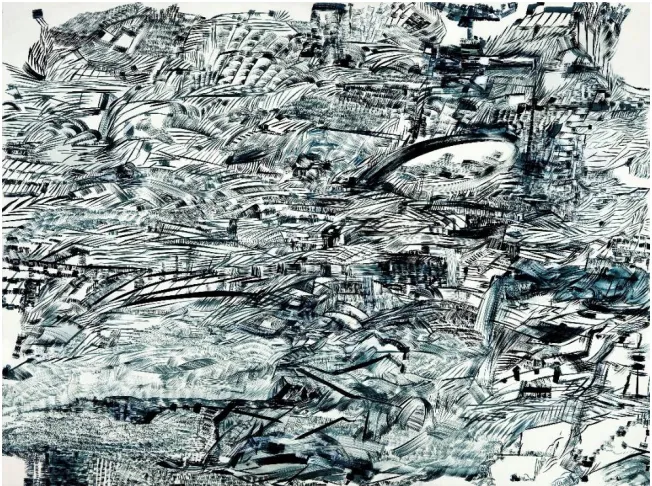
In Excavation No. 5 (Figure 2), a large arena or architectural structure implodes or
shatters into millions of tiny angled fragments. A bright artificial light shines on the turmoil, and
the surrounding areas merge into abstract patterns before fully receding into the black night
sky. Obsessive hatch marks and bundles of black vertical lines like bars on a cell window, cover
almost every inch of the surface. There is a harsh staccato rhythm to the marks suggesting
5
Figure 2: Excavation No. 5, 2009, acrylic on panel, 36 x 48 inches
LANDSCAPE AS ENTRANCE
A painted landscape can be like a window or portal through which the viewer enters a
different place and another reality. In traditional Chinese painting, a landscape was considered
great if it had the “power to send our spirits wandering” and “’take us out of ourselves.’”7 The
Chinese painter, leaving large areas of the paper or silk open and untouched, did not try to
make a complete and final statement and instead considered the landscape, “a starting point”
6
or “the opening of a door.”8 Taking a break during the day to contemplate and enter a painted
landscape, in the mind’s eye, was widely recognized as “a source of spiritual solace and
refreshment.”9
In the Western tradition, the epic paintings of Bosch and Bruegel have always pulled me
in and surrounded me. In these landscapes, different scenarios incorporating elements of
mythology, spirituality, religion, and narrative play out and mix with the natural landscape,
creating an active, fantastical and mysterious world. These paintings portray the vastness of the
world and the endless different realities happening at the same time, while also showing the
importance and detail of each individual scene.
In the physical world, the viewer experiences a landscape from multiple viewpoints. We
look around, both slowly and quickly, so that some views are sharp and some blurry, we tilt our
heads to look from different angles. We experience a higher horizon line when we sit and a
lower one when we stand. The viewpoint shifts as we do. With this approach, the painting
becomes more of a vehicle for the subconscious mind of the viewer to travel through and
experience.
8 Sullivan, An Introduction to Chinese Art, 144.
7
This methodology can be found in traditional Chinese painting and is referred to as
“view[ing] the part from the angle of totality.”10 Traditional Chinese painters intentionally
avoided perspective and shadow because it “involve[d] a view from a determined position, and
include[d] only what [could] be seen from that single point.”11
In the painting Entrance (Figure 3), loose architectural forms coincide with elements
from the natural landscape. Many different perspectives are used to convey a
multi-dimensional view of the structure, and pockets of loose narrative are positioned throughout.
Figure 3: Entrance, 2011, acrylic on panel, 60 x 72 inches
10 Sullivan, An Introduction to Chinese Art, 143.
8
THE NATURAL LANDSCAPE
While Manhattan is built on a grid and is dominated by squares and angles, New Orleans
is shaped by a winding river, and the overall design of its streets is like a spider web. As my
distance from New York grew, the right angles and triangles that had filled the urban space
started to curve and open up. The body of paintings in my exhibition titled Elemental allowed
natural elements from nature to come into the work and there were more open spaces. In
Aurora (Figure 4), a miniature Manhattan skyline is in the distance and the detritus from an
urban landscape flows down the center.
9
The atmosphere is that of a natural landscape coalescing with urban activity. Both the
natural and urban elements are represented in various greens, and punctuated with delicate
black lines and patches of white. The perspective shifts in different ways, but primarily appears
to be seen from an aerial viewpoint. There is no sky or suggestion of a horizon line, and at the
top of the painting, the terrain continues to move up and off of the canvas. There is a clear
reference to bodies of water such as lakes and tributaries, but they are painted with a pale blue
that appears a little too artificial and bright. The blue of the water is more like the color of a
bright sky, which in this painting is absent. Also significant in this piece is the merging of the
straight line with the circle, and the clear bending of the urban rectangle into curvilinear lines.
PERSPECTIVE IN LANDSCAPE
I do not consider perspective in a conscious way when making my paintings, but use
intuitive perspective where lines recede but do not converge at single points the way they do in
linear perspective. My motivation is to create the illusion of depth and distance of varying
degrees and angles and scale throughout the picture plane. Having been educated in art in the
West, I am able to call on Western traditions in an intuitive way and allow them to coalesce
with an inherent Eastern approach. Sometimes there is an architectural passage or the
suggestion of an interior, which I intuitively feel out with the brush and rework until it gains
10
The high horizon line employed in Chinese landscape painting created an illusion of
vastness. There is not an evident horizon line in my paintings, but there is often the partial
suggestion of one at the top of the painting. This also functions in my painting to give a sense of
unlimited distance across the landscape.
PROCESS
I like to look at painting as an alchemical process, archaic and secret, that breathes life
into the lifeless substance of paint. A romantic process full of ritual. I like to paint at night. I feel
a surge of energy around 5 or 6 o’clock, and it is a time when the world starts to quiet. At
twilight, the reality of the day begins to recede and the buzz of technology fades. Sometimes it
feels like a thin mystical veil settles over the studio, replacing the logic and reason. As the night
becomes deeper, so does the knowledge that most people around me are dreaming and it feels
more comfortable to take risks in the painting.
Intuition plays a large role in my process. If it feels right, then it is right; if it feels off,
then it is off. If when I approach the painting, a color jumps out at me, I use it. If a brush jumps
out and falls on the floor, I try that one first. It is a constant process of sifting through these
thoughts.
It is common for a painting to be worked on in the studio for six months to a year.
During this time, I look at it from different orientations, often painting on it while in these
11
on another piece. Sometimes it works out that I do not look at a piece for a few weeks, and I
appreciate the fresh new viewpoint this allows when I pull it back out again.
For each painting to become its own individual and unique world, it needs time to
mature and develop. It is important to begin each painting in a new and different way, so it will
have a particular personality early on. In Trade Winds (Figure 5), I used several different pieces
of wood like stamps that could be dipped in paint and printed on the canvas. Between sessions
of stamping the canvas, I went in with a tiny brush to add dimension and color. For a long time,
the dominating colors in this painting were dark navy blue, red, and white. As the color
unfolded, perspectives began to shift. The center and bottom of the painting look like they are
seen from an aerial point of view while at the top, the viewer appears to be level with an
architectural structure that could easily be climbed.
12
LINE
The definition of line is a mark that spans the distance between two points, or the path
of a moving point. The use of line is fundamental to my work. I use line to delineate space, to
create levels, to build up forms, to create structure, and as an element in itself. Repetitive
patterns of line suggest concentrated energy. These patterns also represent the molecules and
atoms that make up matter. Directional lines serve to lead the eye around the painting or
between levels. In Floating World (Figure 6), dark grey gestural lines give structure to a pale
ethereal world. Pale grey lines also swirl behind the scene suggesting movement and emerge to
the surface at times to boldly define an edge or contour. Some of the lines, especially when
painted with color, have a playful lyrical quality, which softens an area or guides the viewer’s
eye to another part of the painting. While most of my line work is freehand and intuitive, I also
use rulers and a level at times to create various structural lines.
13
The Navigation series is a collection of monochromatic paintings that investigate line,
brush work, rhythm and intuition. By removing all color, I was able to focus on the different
functions of the line by itself. These paintings did not require the slow maturing of the paintings
in color. They were not going to be layered. I wanted the brush to have one chance to make the
mark as in a drawing where erasure is impossible. With this series, as in Navigation 7 (Figure 7),
I learned to trust my intuition and make each mark once and with intention. I had to cultivate a
consistent rhythm for patterns and then know how to let the brush free to create a sweeping
line of structure.
14
In traditional Chinese painting, there is a strong connection between painting and
calligraphy. This idea of painting “is that it is a kind of calligraphy itself, insofar as both [are]
representational methods that carry a particular cognitive as well as aesthetic function.”12 In
fact, there must be “a just correspondence of the type of brush-stroke with the object
depicted.”13
Though my canvases are large, one of the main brushes I like to use is a small liner
brush. Tiny repetitive brushstrokes help dig out forms from the two-dimensional plane of the
canvas, and patterns of dots or lines give shape and volume. Giving attention to the small forms
is important because it helps to emphasize the vastness of the large canvas. A favorite book
I keep in my studio is of photos from the microscopic world. Seeing pictures of everyday objects
magnified thousands of times reveals an infinite amount of detail that makes up matter. When
broken down, everything in existence is made up of tiny lines and particles.
Van Gogh’s innovative and soulful use of line in his drawings and paintings emphasizes
and illustrates the inner quality of what he sees. Patterned lines, marks, and dots enunciate and
create volumes of objects and the spaces between them. Like other working artists after Japan
was opened to the West in 1853, Van Gogh welcomed the influence of Eastern art on his work.
By viewing and collecting Japanese prints, Van Gogh absorbed the abstracted beauty of the
bold elegant lines, flat areas of vivid color, and intuitive perspective, and incorporated these
elements into his work.
12 Turner, “Classical Chinese Landscape Painting and the Aesthetic Appreciation of Nature,”114.
15
COLOR
If the alchemical process of painting is “form-making at its most direct and most
flexible,”14 then color is the Prima Materia, a formless base of all matter and a starting point.
Through the act of painting, color is transformed into a universal language of emotional
meanings recognized and understood by the collective unconscious. At first view of the
painting, Phases of Sunlight (Figure 8), a brightly lit expanse of undulating orange seems to
pulse with activity. A closer look reveals more variations of orange as they are interspersed with
horizontal lines and vertical forms made up of different yellows, reds and magentas. It is sunny
and warm in this reality, and the bright colors radiate an uplifting energetic quality. In the
places where the oranges are splashed against the canvas, there is a feeling of abandon. To
temper the glowing heat, passages of grey and blue tones break up the brightness at different
points. Intermittent tiny dark blue shapes and lines, like fragments of ocean depth, dot the
landscape periodically, marking points of contrast. Grey-green passages, bands of turquoise,
pale pink expanses, and dark contour lines suggest sites of human activity and the existence of
other emotions maybe not quite as cheerful as the surrounding sun-filled colors.
16
17
PAPER PAINTINGS
While my large canvases unfold in detailed layers over time, the paper is always a new
point of departure for my painting. Painting on paper has been a consistent part of my process
for years. Using the same brushes and paint allows me to spontaneously switch between paper
and canvas. Sometimes a certain color combination or a specific form first appears on the paper
and is later intuitively incorporated into the painting. Other times, I consciously re-create a
section of the paper piece on the canvas. The works on paper and canvas inform each other,
while also offering separate contexts for the same materials.
Since there is no way to go back and erase, working on paper reminds me to be
completely present and to apply the paint intuitively but with focused intention. While marks
on the canvas can be quickly wiped off, the raw paper absorbs the paint instantly. The only
option for dealing with mistakes is to embrace the accident and find a way to make it work.
The two works on paper included here are 22 x 30 inches, which is a common size
currently in my studio. In the first piece from the Passage series, (Figure 9), most of the surface
is covered with large sweeping green brush strokes. Orange and red patterns and marks
punctuate the edges of the green. The whites of the unpainted paper become shapes of
negative space that jump toward the surface from behind. In the second work, Translation 18
(Figure 10), dark red dots gather and string themselves in lyrical curves across grey-colored
paper. Pale blue squares gently emerge in a few areas of the landscape to soften the edges of
18
Figure 9: Passage 23, 2012, acrylic on Stonehenge 100% cotton rag paper, 22 x 30 inches
19
CONCLUSION
Whether urban, natural, representational, or abstract, the landscape is a universally
understood and flexible construct for synthesizing multi-dimensional, futuristic domains with
the abstract realms of the heart and mind. Both grounded and ethereal by nature, the
landscape communicates both the outer material world and the inner spirit of the artist and the
viewer. In my paintings, I work to widen the “angle of totality,” so that my landscapes
encompass the primal, natural world and the global multiverse of our time, while also reflecting
20
REFERENCES
Arnheim, Rudolf. "From Chaos to Wholeness." The Journal of Aesthetics and Art Criticism, 1996, 117-120.
Cosgrove, Denis. (1984). “Prospect, Perspective and the Evolution of the Landscape
Idea.” Transactions of the Institute of British Geographers, New Series, Vol. 10, No. 1, 45-62.
Donnell-Kotrozo, Carol. "Cézanne, Cubism, and the Destination Theory of Style." Journal of Aesthetic Education, 1979, 93-108.
Hu, Dongfang. 1995. “The Philosophical Origin of the Black-white System of Chinese Painting.” International Journal of Politics, Culture, and Society 8 (3). Springer: 453–65.
Ione, Amy. 2004. "Klee and Kandinsky: Polyphonic Painting, Chromatic Chords and Synesthesia." Journal of Consciousness Studies 11, no. 3/4: 148-158.
Kahn, Wolf. 1969. “Uses of Painting Today.” Daedalus 98 (3). The MIT Press: 747–54.
Karmel, Pepe. "The Golden Age of Abstraction: Right Now." ArtNews 112, no. 4 (April 2013): 66.
Levy, Mark. Technicians of Ecstasy: Shamanism and the Modern Artist. n.p.: Bramble Books, 1993.
March, Benjamin. “A Note on Perspective in Chinese Painting.” The China Journal 7, no. 2 (August, 1927): 69-72.
Moffett, Kenworth. 1974. “Review of The Cubist Epoch.” The Art Bulletin 56 (2). College Art Association: 305–7.
Nickas, Bob. Painting Abstraction: New Elements in Abstract Painting. London: Phaidon Press Limited, 2011.
Sullivan, Michael. An introduction to Chinese Art. n.p.: Berkeley, University of California Press, 1961 [c1960], 1961.
Tuchman, Maurice, Judi Freeman, and Carel Blotkamp. The Spiritual in Art: Abstract Painting 1890-1985. n.p.: New York: Abbeville Press, 1986, 1986.
21
VITA
Regina Scully was born in Norfolk, Virginia in 1975. She received her B.F.A. in Painting from
Rhode Island School of Design in 1997. She lives in New Orleans where she currently exhibits




![Decacarbonyl 1κ3C,2κ3C,3κ4C bis[tris(3 chlorophenyl)phosphine] 1κP,2κP triangulo triruthenium(0) monohydrate](data:image/gif;base64,R0lGODlhAQABAIAAAP///wAAACH5BAEAAAAALAAAAAABAAEAAAICRAEAOw==)