University of New Orleans University of New Orleans
ScholarWorks@UNO
ScholarWorks@UNO
University of New Orleans Theses and
Dissertations Dissertations and Theses
Spring 5-19-2017
The Process That Eats Itself
The Process That Eats Itself
Brent Houzenga
University of New Orleans, [email protected]
Follow this and additional works at: https://scholarworks.uno.edu/td
Part of the Art Practice Commons
Recommended Citation Recommended Citation
Houzenga, Brent, "The Process That Eats Itself" (2017). University of New Orleans Theses and Dissertations. 2331.
https://scholarworks.uno.edu/td/2331
This Thesis is protected by copyright and/or related rights. It has been brought to you by ScholarWorks@UNO with permission from the rights-holder(s). You are free to use this Thesis in any way that is permitted by the copyright and related rights legislation that applies to your use. For other uses you need to obtain permission from the rights-holder(s) directly, unless additional rights are indicated by a Creative Commons license in the record and/or on the work itself.
The Process That Eats Itself
A Thesis
Submitted to the Graduate Faculty of the University of New Orleans
in partial fulfillment of the requirements for the degree of
Master of Fine Arts In
Fine Arts
By
Brent Edward Houzenga
B.A. Western Illinois University, 2006
ii
Table of Contents
List of Figures ... iii
Abstract ... iv
Introduction ...1
BAT JUJU ...2
The Branded Image ...6
Time Travel ... 14
Tapping The Unconscious ... 18
The Midas Moment ... 26
The Process That Eats Itself ... 33
Conclusion ... 36
References ... 37
iii
List of Illustrations
Fossil Fueled: Calling All Car ...3
BAT JUJU ...5
Toy Machine Illustrations ...6
Rancid…And Out Come The Wolves ...7
Hellcat Records Logo ...7
OBEY Logo ...8
Flower Thrower by Banksy ...8
Portrait by Barry McGee ...8
Space Invader ...8
Coming Together #1-4 ... 13
Stretched Like Spaghetti ... 14
Razor Beams ... 15
Untitled Mural by Barry McGee ... 15
Time Travel Spray ... 16
Brainwash Spray ... 16
Integrating The Shadow ... 20
Access The Excess ... 21
Left Handed Drawing #5 ... 22
Left Handed Drawing #53 ... 22
Tape Painting ... 25
Now Strip ... 25
Tape Ball ... 27
Accidental Painting ... 28
Fluid Mechanics ... 29
Used To It ... 31
Ghost Prints ... 32
Shadowgram #6 ... 34
Shadowgram #17 ... 34
iv Abstract
Chance and the found object set the stage for artworks that illustrate the clash between the everyman, popular culture and high art. The investigation of my process, surroundings and interests leads to an infinite amount of possibilities in a process that is beginning to eat itself.
1 Introduction
On a cool spring day in 2006 I found two photo albums from the 1890s in
someone’s trash, each album full of photographs, each photograph a portrait. I was
overcome by a strange feeling carrying these two books under my arms, like I wasn’t
supposed to have them. Nevertheless, I was mesmerized by the images and also
inspired.
I knew nothing about these people. There were no names and only a few dates.
What were their lives like? Who were these people? It was sad to see such beautiful
images, of such beautiful people laid to waste. I had no idea what I was going to do with
these images, but I knew I wanted to do something.
It was really magic the way it happened. At the time I was studying graphic
design and printmaking. I had already begun to mix chaos and clarity into my work,
using random scribbles as a basis for most of my work with the mindset of a graphic
designer, taming chaos if you will. My interest in the random movements of the hand
coincided with my interest in graffiti and the history of language. My random marks were
meant to mimic the most basic forms a man could make, before he knew what language
was.
My interest in found objects was also mounting due to influence from my sister,
who was painting on found things, and also from one of my professors, Terry Rathje,
who had introduced me to his assemblage work. I started to pick up found things here
and there, things that I found to be interesting. It wasn’t long before I found the photos
and what would become my canvas for the next ten years. Found objects, found photos,
2 BAT JUJU
Until one is committed, there is hesitancy, the chance to draw back-- Concerning all acts of initiative (and creation), there is one elementary truth that ignorance of which kills countless ideas and splendid plans: that the moment one definitely commits oneself, then Providence moves too. All sorts of things occur to help one that would never otherwise have occurred. A whole stream of events issues from the decision, raising in one's favor all manner of unforeseen incidents and meetings and material assistance, which no man could have dreamed would have come his way. Whatever you can do, or dream you can do, begin it. Boldness has genius, power, and magic in it. Begin it now.
Johann Wolfgang von Goethe
I came across this quote while researching the creator of Batman, Bob Kane. I
associate the occurrence of finding my photos to Batman/Bruce Wayne discovering the
batcave. He wasn’t looking for it but that’s how he found his symbol, by accidentally
falling down a well and seeing a bunch of bats. Like Bruce Wayne, I was running when I
stumbled upon two photo albums from the 1890’s. Like the bats that Bruce saw, these
photos scared me, because they said to me “You don’t have much time. One day you
will be put out to waste like us. What do you want to do with your time on earth? What is
your purpose?” That fear bred intolerance for the current state of affairs, both in the
comic book story and in my life and these photos became the symbol of my fear and of
my purpose. Like Batman, I put my symbol on everything. The difference is that
sometimes I spray my symbols onto things that might not be mine. Regardless, my
symbols are part of my uniform. I wear them on my chest in the form of T-shirts. I don’t
carry a Bat-A-Rang1 but there are always business cards and stickers in my pocket.
These portraits are in almost every one of my paintings which I use to create
3
encompassing spaces, much like the Batcave.2 If I had a boat, or a helicopter, or a
plane, you can bet I would paint them. My symbols are on the car I drive, as well as
many other people’s cars (fig. 1). Like Batman, I have partners and devoted followers. I
may not brandish weapons or beat up villains in real life, but I lead by the same
example of pure devotion.
Fig. 1. Fossil Fueled: Calling All Cars, 2015
The influence of Batman on my life and work goes back a long way. Before I
knew who Bob Kane was I discovered Batman at six years old through a movie of the
same name from 1989. That movie was the product of a young director named Tim
Burton, for whom I still have great admiration. Burton has a penchant for mixing the
macabre with the quaint, the morbid with humor. Batman was a serious movie. It
illustrated a dystopian world. Gotham City, the city in which Batman dwells, is riddled
with crime. As mentioned previously, this dissatisfaction with that state of affairs is what
4
fuels Batman’s crusade against crime. This dystopia is also linked to mine, only my
dissatisfaction with the world stems from my family, and what I was told life is supposed
to be. I come from a family of farmers and outdoorsmen who pushed me to do
something more conventional with my life, rather than pursue art. Part of what fuels my
mission is the desire to prove them wrong.
After seeing this film, I became obsessed, and for many years, even to this day, it
was Batman everything. That’s what got me into comic books, collecting, creating, and
curating. Twenty-seven years later I found a crate filled with fifty VHS tapes that brought
me back to this Bat Universe. In searching my mind for a purpose for these tapes, a
Batman tribute made perfect sense. The Batman film is the single most influential piece
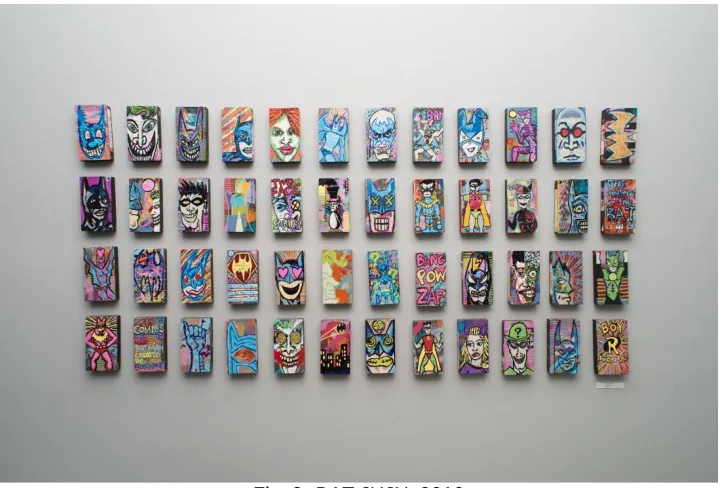
of culture to affect me and my work. The collection started out as a playful summer
project. I painted each VHS tape with a Batman related character. This was a returning
to my roots, as a lot of them came out looking how I used to draw these characters as a
kid. It was also a release because it was a fun project that let me be playful with my
5
Fig. 2. BAT JUJU, 2016
Throughout this process I felt as though I was mining my subconscious, because
using these images in this way brought up a lot of things I had not thought about or felt
in a very long time. I became so enthralled with this world that when I ran out of VHS
tapes I didn’t want to stop there. This led to an entire exhibition of paintings on paper
and canvas, assemblage, and photography.
It is in this way that BATJUJU encapsulates and illustrates nearly every facet of
my work. It featured photographs of live models as well as photographs of objects.
Through painting, photography and assemblage I mined my subconscious and time
traveled back to an earlier stage of my life. This body of work also borrowed from
different areas of my painting technique but instead of using my 19th Century
photographs, I appropriated images and costumes from the Bat Universe. It is this
all-bat-everything type of mentality, and the dissemination of that logo (the Bat Symbol),
6 The Branded Image
The branded image was reinforced in my teen years by my love for punk rock
and skateboarding culture. Each skateboard company had its own theme, and artists.
Toy Machine Skateboards was run by Ed Templeton. He made all the artwork for the
company. His artwork was the company’s brand, usually picturing some sort of cartoon
figure (Fig. 3). His artwork would also later transition into the gallery world. These days
his interest lies more in photography.
Fig. 3. Toy Machine Skateboards Illustrations by Ed Templeton
Almost every band I followed had a logo and a look to go along with their sound.
Rancid’s look is what you would think of when you think of punk rock: leather jackets,
studded belts, crazy dyed haircuts, and combat boots. Their logo was based on a
stencil which appeared on every one of their album covers (Fig 4). All of their albums
covers used high contrast imagery, usually black and white. Tim Armstrong, the band’s
front man, also ran a record label called Hellcat Records. Their logo was also high
contrast in black and white (Fig 5), and almost every album they put out followed along
with their brand of imagery and packaging. This is just one example out of dozens of
7
Fig. 4. Rancid ….And Out Come The Wolves Album Cover Fig. 4. Hellcat Records Logo
This is where my love for stencils comes from. Punk rock played an especially
huge roll in my life, musically and aesthetically. It was the pop aesthetic with a little
more grit and I think this is why when I discovered street art it instantly clicked. I hadn’t
realized it but I had been looking at stencils and tags for a long time already because of
punk rock.
Punk gave me a place to put my rebellion. It still gives me a place to put it, but
the most valuable thing punk taught me was to “Do It Yourself” (DIY). I’m from a small
town and you don’t have much choice but to DIY because there is literally no culture. I
spent many years playing in and promoting bands. Find a venue. Book the show.
Create the flyer. Disseminate the flyer. Record the album (usually in someone’s living
room). Create the album artwork. Disseminate the album. I also ran my own zine called
Build Your Own Scene. I wrote, edited, designed, sold ads, dealt with printing, and
raised money. I’ve schooled myself for a long time on how to make something out of
nothing. This is a big part of why I’m drawn so heavily to found objects and the punk
8
The street art movement was already in full swing with artists like Shepard
Fairey, Banksy, Barry McGee, and Space Invader. All of these artists had their own
brand of street art and I was really drawn to that. Shepard Fairey had the OBEY
campaign and the lineage of a punk rock perspective (Fig 5). Banksy used stencils to
tag on walls all over the world with a sort of “tongue in cheek” political twist (Fig 6).
Barry McGee drew portraits of people from his San Francisco neighborhood (Fig 7).
Space Invader installed collages of pixelated characters from the old video game of the
same name, Space Invader (Fig 8).
Fig. 5. OBEY by Shepard Fairey Fig. 6. Flower Thrower by Banksy
Fig. 7. Portrait Garage by Barry McGee Fig. 8. Space Invader by Space Invader
One thing that links these artists together, even more so than what they create, is
their mode of dissemination. The graffiti mindset of “getting up” everywhere, so that
9
art in front of people without anyone's consent, and most times, illegally. I took notes
from these artists as I’m sure they took notes from artists like Basquiat, Keith Haring
and Kenny Scharf who entered art history in much the same way, but preceded these
contemporary artists by about twenty years. I also discovered that I was already trained
for this job due to my punk rock background. There isn’t much difference between
putting show posters up everywhere and putting paintings or stickers up everywhere.
Although I take cues from Jean Michel Basquiat in the way that I paint, using
language and blocks of color to create history in layers, my imagery and means of
dissemination are taken directly from the book of Shepard Fairey. Unlike Fairey I attack
my images with fierce and energetic abstraction, my own brand of action painting. My
work is less about graphic design and more about painting in comparison with Fairey.
My work is not accompanied by any message or signage. My work doesn’t tell you what
to do in any sort of direct way, like the OBEY campaign. Besides the figure my language
is still abstract leaving it to be anonymous and I think, more powerful, because it draws
the viewer in further with more questions than answers. It is not uncommon for my
subjects to get swallowed up within this abstraction.
Fairey also discovered the power of his appropriated images of Andre the Giant
on accident. There was an anonymity to the image that made people question what it
was meant to do or say. The same can be said of the Victorian people in my paintings.
They are presented in a very Pop Art, propagandistic sort of way, which automatically
makes people think they are looking at someone who is famous. The image looks
10
portraits from this time, the viewer assumes it must be someone famous. Why would
anyone paint a picture of someone they didn’t know?
Part of my motto is that we’re all meant to shine. We all have a purpose here on
earth. These people showed me my purpose and hence became my symbols. This may
not sound subversive, but encouraging people to “shine” is probably the most
subversive thing you can do in the systems we live in. Highly enlightened people pose a
problem to the status quo. Making your own living using the tools God gave you poses a
problem. Individuals are not needed in the hive mentality. I’m not saying we don’t need
a village. I’m saying the village should recognize each individual’s purpose, like a tribe.
We used to have the blacksmith, the baker, and the candlestick maker. Now we have
job openings at the corporation or the cubicle. You shouldn’t fill an open position. You
should fulfill your position, your purpose. My purpose is this work and this message.
There is no denying the influence of Warhol in my work although I should point
out that his influence had already gone through several channels before it got to me. His
influence on the entire world, not just the art world, can be seen on so many levels. All
of the things I was just mentioning were influenced by him long before they got to me.
His influence on me existed in a very subconscious way for a long time.
There are many similarities. We are both known for using portraiture and
printmaking techniques. He also worked from photographs. We both paint our images
several different times using various methods and color palettes. The influence may be
undeniable but there are also many differences. I say, “Everyone is meant to shine.”
11
figure and a lot of his interest was in the concept of fame. He painted famous people.
He made his friends famous by painting them because he was famous himself.
My interest is more on a spiritual level. I may be using some of the same
language and giving my anonymous subjects some of the same power, but in doing so I
am hoping to elevate every man. This could be you. This could be me. We’re all not
meant to be famous, but we are all meant to shine, whether that be through painting,
astrophysics, baking, auto mechanics or carpentry.
Like the artist Margaret Kilgallen, I don’t like to choose people that everybody
knows. I like people who do small things that hit me in my heart. My found photographs
hit me that way, because there is a certain magic in those discoveries, something like a
synchronicity. Merriam Webster’s Dictionary defines synchronicity as “the coincidental
occurrence of events and especially psychic events that seem related but are not
explained by conventional mechanisms of causality”. I do not take these occurrences as
coincidence. To me, they say, you are on the right track because you are in the right
place at the right time.
Of course Warhol is not only known for his paintings. He was also a filmmaker
and a photographer just to name a few. Many of his subjects in his paintings he
photographed himself using an instant polaroid camera. This is another instance where
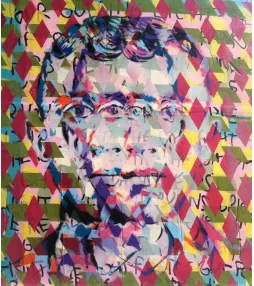
we overlap. My Coming Together series is based on a photograph that I took which is
somewhat of a departure for me. Drawing from the same inspiration and mindset that I
had been using, I set out to find a stranger who would let me photograph him or her. I
12
information, just for the photograph. In this way the subject becomes a lot like my found
subjects but instead of finding the photo, I found the actual person and took a snapshot.
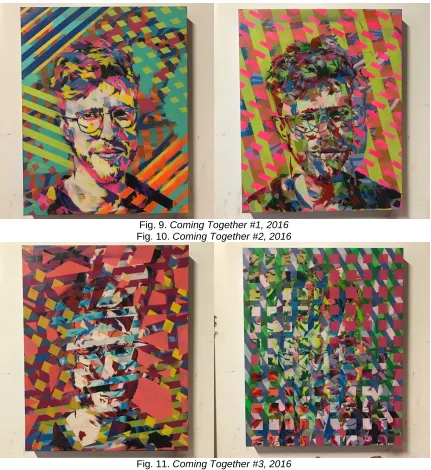
I created four paintings from this photo and these four paintings really illustrate
the evolution of my painting. The first is very much Warholian. The figure is quite visible
and defined but surrounded by chaotic lines, stripes, brush marks and bright colors (Fig
9). The second starts to pull itself apart in a clear departure from Warhol. There is a kind
of static or wobble to the figure, like a bad signal on an old television set. You start to
wonder whether the figure is being obliterated or if it is trying to pull itself back together.
With each layer I moved the stencil from side to side creating this effect (Fig 10). With
the third and fourth paintings the character is almost completely indistinguishable, save
for a few bits and pieces of the face showing through. An eyeball here, perhaps a bit of
the mouth and hair there. These two paintings were created in much the same manner
as the first two but instead I moved the stencil all over the canvas between layers, with
no attempt to keep the figure “together.” These four paintings also illustrate the
“Houzenga” brand that I’ve created, whether the figure is present or not, those familiar
with my work will undoubtedly know that it is mine, much like Warhol and Shepard
13
Fig. 9. Coming Together #1, 2016 Fig. 10. Coming Together #2, 2016
14 Time Travel
One aspect of why I keep painting these people from the 1890s is that I feel like
when I found them, somehow I traveled through time. It may only be a daydream.
Perhaps I experienced some visions. Maybe even that sounds crazy, but that is what
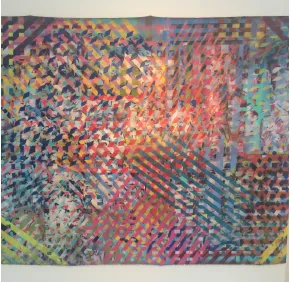
lead me to make Stretched Like Spaghetti (Fig 13). I read an article that said that if a
human were to travel through a wormhole that he or she would be stretched like
spaghetti, and pretty much obliterated. I used the same technique as the Coming
Together series where there are figures in the painting but only little bits and pieces can
be made out. Most of the painting consists of lines, patterns, and scribbles. What would
it look or feel like to travel through a wormhole? I have always had an interest in
abstracting my figures but this is what pushed it over the edge, while still remaining true
to my brand of painting.
15
Up until this point it had been very difficult for me to go completely abstract. I
found it almost impossible to paint without using my figures. My desire to go completely
abstract stemmed from thinking that perhaps my use of the figure was a crutch. Can I
paint without them? The process was not that much different than my original process.
That’s where my series called Razor Beams (Fig 14) came from. The title is a play on
words from the not so science fiction anymore Laser Beams. The paintings were
constructed in much the same layered way as my other paintings except instead of
giving treatments to the entire canvas each step was made using one stripe of color,
which cut through the plane of the canvas. The process was not much different. Each
move made at random until a clarity or balance was reached, all the while still
wondering, what does it look like to travel through time?
Fig. 14. Razor Beams, 2016
Fig. 15. Untitled mural by Barry McGee, 2014
This end of the spectrum brings my work closer to Barry McGee than it does
Shepard Fairey. Outside of his portraiture and graffiti style McGee is known for his large
16
idea of time travel did eventually lead me back to Warhol with my invention of Time
Travel Spray (Fig 16). Instead of reproducing an already existing product, like the soup
can or the Brillo box, I redesigned the spray can label for my imaginary product. Riffing
on this idea of the product and consumerism in Pop Art are not uncommon and can be
found in many of my contemporaries’ work as well. In this day and age, the spray can
has come to take the place of the soup can (Fig 17).
Fig. 16. Time Travel Spray, 2015
Fig. 17. Brainwash Spray, Mr. Brainwash, 2013
My interest in time travel stems from my discoveries in real life but it was these
discoveries that led me to Science Fiction. In much the same way that I find my
materials, I found a book by Philip K Dick called Time Out Of Joint in a pile of discarded
books. In the book, the main character starts finding things in his reality that do not
belong there. These discoveries lead the main character to realize he has been living in
a simulated reality. These objects are breaking through to him from a different time so
that he might return to the one true reality.
The similarities between this story and my own were confounding, which led me
17
religious experience, which led him to spend the rest of his life writing about it and trying
to figure it out. He had a theory about time. He believed that we were all living in 50 AD
awaiting the return of Christ. He said that we were all under a spell and that somehow in
writing this book he had broken through the veil of time and revealed the true reality.
This led him to write more than forty novels and one hundred short stories in his lifetime.
He spent the last eight years of his life writing about his experience. He wrote more than
8,000 pages which was edited and published posthumously.
I related to Time Out of Joint because I felt like maybe this is what happened to
me. Maybe these objects that I find are from another time and are left here for me to
find them, and hopefully wake me up. I don’t believe that we are living in a false reality,
but I do think it’s possible that somehow, someone is trying to send messages from the
past or the future. It is my job to put these pieces together and make sense of them. I
relate Philip K Dick's religious experience to my personal moment of clarity. His
experience gave him purpose, which he spent the rest of his life working on. I had a
similar realization when, through discovery and found objects, I found my purpose in
18 Tapping The Unconscious
Time Travel is not the only thing that lead me to create Time Travel Spray. I have
a long history of using found objects in my work, usually as my canvas and as
mentioned, found photographs as my subject. Wood, windows, cabinet doors, pillows,
plastic, anything that could be painted on might find its way into my studio. Many people
have dubbed me an eco-artist, but what of the waste that my own process creates?
Using empty spray cans as my canvas is one answer to that question. That’s
where Time Travel Spray came from but I had also been saving little interesting bits of
detritus for a while before it dawned on me what to do with them.
Besides spray cans, there are many other waste factors involved with my work. I
use a lot of tape to create some of my lines and patterns. When I cut stencils there are
parts that would usually get cut out and then tossed away. I use a ton of Xacto blades
and razors in my process. I began to save all of these things. Becoming involved in this
process of saving things from the trash also lead me to save a lot of other things, some
of them not involved in my process (guitar strings, caps to soda bottles, etc). I also
started picking up found objects I might not have picked up before (little pieces of metal,
scraps of paper, etc). All of these byproducts became the ingredients for my
assemblage work.
It comes with the territory. When you work with found objects people naturally
come out of the woodwork to give you more things to work with. In this instance a friend
of a friend brought me twenty-eight fajita trays. These are the wooden bases that a hot
fajita pan usually gets served on at a Mexican restaurant. What else could these be
19
Using some found photographs, I made photocopies of them using a Xerox
machine. When you photocopy a photocopy each image comes out a little darker, so I
did that until my image was almost black. Using four images, I made seven photocopies
of each image and these images became the backgrounds to my assemblages.
The assemblage process is not that much different than my painting process in
that setting an object down on the picture plane is a lot like making a random mark on
the canvas. I take each random mark as a beginning then react to that, trying to create
a balance to the composition. It’s a playful process which lets me take all these
interesting objects I’ve been collecting and make them into something beautiful. This
process is akin to Rauschenberg’s combines and the work of Joseph Cornell, who were
both influenced by the Dadaists and Surrealists.
Also like the Surrealists, dream work and psychology are influential on my work.
What brought me to this point, more so than the waste in my studio, or the attempt to be
an eco-artist, is something Jung called Integrating the Shadow. The Shadow may refer
to an unconscious aspect of the personality which the conscious ego does not identify in
itself. Because one tends to reject or remain ignorant of the least desirable aspects of
one's personality, the shadow is largely negative, or the entirety of the unconscious, i.e.,
everything of which a person is not fully conscious.
This is my attempt to illustrate this concept, which I had tried with a little success
a few times before in painting (Fig 18). I likened my studio detritus to the parts of my
consciousness that I may be suppressing or throwing away. By using these parts and
integrating them it is my hope that I can become more fully conscious through this
21 Fig. 19. Access The Excess, 2015
The debris in my studio is one thing that led me to Access The Excess, but it was Jung’s idea of Integrating The Shadow, and a book called The Brain That Changes
Itself, that led me to begin drawing and writing with my left hand. When you start to think about parts of yourself that go unused, the left hand is quite obvious. Up until this point I
had been right handed all my life. I shoot pool with my left hand. Other than that, it didn’t
get to be a part of much of the action.
At first it was just a playful exercise in my sketchbook. I would draw simple things
out of my head or put together some stream of consciousness type poetry. On July 10,
22
For A Year project. Every day until July 10, 2017 I will be doing a new drawing daily with my left hand (Fig 20. Fig 21).
Fig. 20. Left Handed For A Year #5, 2016 Fig. 21. Left Handed For A Year #53, 2016
The Brain That Changes Itself is about neuroplasticity. To summarize is quite difficult but basically it states that our brains are not hardwired, the way we have thought
they are for a long time. The brain is the most complex and amazing organ in our body.
The book illustrates through personal stories, many triumphs in training parts of the
brain to do jobs not originally assigned to them. For example, a man who has suffered
from a traumatic stroke is told he will never walk again. His cerebellum, the part of the
brain that controls motor function, is literally fried like a piece of circuitry, but through
hard work and training he learns to move and speak again. Take note of the word learns
because that is exactly what he had to do. When tested with brain scans it is proven
that those actions and movements, usually associated with the cerebellum, are now
23
By drawing every day with my left hand it is my hope to connect synapses that
may not have been connected before and thus helping to integrate my mind and my body. I have been painting and drawing portraits since I can remember. I know how to
construct a face on paper. So it is my hope that in using my left hand, instead of my
right, the parts of my brain that already know these things are then connected to the
parts of my brain responsible for moving my left hand. I did not have a brain scan prior
to the project and I probably won’t be having one once it is finished so I will never
actually know these results. As the process is happening daily I may also not be able to
diagnose the psychological effects discriminately. The whole project is an experiment
stemmed from these two types of thinking that will hopefully lead to results I can see.
Either way it is based on the same type of determination. I can already see that my left
handed drawings are improving. Maybe that is proof enough in itself.
The largest waste component in my work is masking tape. For a long time, I just
let it pile up in the corner of my studio. I use the tape to create stripes, patterns, and
layered dimensions in my paintings. Often I will lay the tape down, spray a color, and
then spray the stencil again. When you peel the tape away part of the image remains on
the tape while part of the image is on the canvas. Besides reusing my waste, this is
what gave me the idea for my Tape Paintings (Fig 22).
Instead of peeling the tape off of the canvas and just throwing it in a pile in the
corner, I began to pull each strip of tape up one by one and save them to be applied to
another canvas. This sort of mimics the process created by the dada movement that
was later employed and popularized by William S Burroughs and his “cut up” technique
24
that he had written, up into words or phrases and then rearrange them to make a new
piece of writing. Most times the product of this experiment was even better than the
original piece.
The first pieces of this kind aided me in creating abstract work. They are
reminiscent of my Razor Beam painting series, but instead of solid bands of color streaking across the canvas, random “bands” are accompanied not only with color but
with bits and details from the original stencil. This process led me to create another
series of pieces called Now Strip (Fig 23) where I intentionally cut up a group of existing silk screens into identically sized strips and then mixed them together randomly. Like
the works of Burroughs or the Dadaists, there is the sense that the random aspect of
this process is what gives it clarity, even though the lack of pattern could do the
opposite. The lack of pattern creates a pattern, or as Burroughs said, "When you cut
25 Fig. 22. Tape Painting, 2015
26
The Midas Moment
There is a degree of chance and happy accidents in almost all of my work, but
the Tape Ball (Fig 24) is probably the most unexpected. Its presence had been accruing for nearly three years and would continue to grow if I choose to let it. I like to reuse
things and I like to find things in my process. Occasionally, instead of realizing that
something could be useful in my process, I realize that something is already a work of
art. I don’t need to do anything else to it. This realization is what I like to call the Midas
Moment.
This is as close as I get to Duchamp’s ready-mades and his “Midas Touch”.
Where Duchamp took everyday objects and said “This is art,” I noticed that something
was being created and in this instance totally by accident. Duchamp set out to break the
barriers of the art world. I have, through my process, inadvertently broken down the
barriers to what it is that I am making. Still, I am making something. I may have the
27 Fig. 24. Tape Ball, 2017
It is exactly this type of awareness that also led to my Accidental Painting (Fig 25). I wasn’t trying to create this painting and I wasn’t expecting it. The product of this
accident turned out to be more interesting than the paintings I set out to create. I
intended to create a series of paintings on canvas which ended up being called Fluid Mechanics (Fig 26). Instead of using spray paint for my stencils and layers, I used house paint and brushes. This made my stencils moist with paint. To protect the table
that I laid my stencils on from paint, I put down a sheet of plastic. As I went through the
process of painting multiple canvases and setting down the wet stencil over and over
again, I began to see an image emerging on what used to be a blank piece of clear
28
being created. It was an "Ah-ha" moment, or as I have come to call them, a Midas Moment. I’m sure this was very similar to the one Duchamp experienced, except I
imagine his as “Ah ha! I know exactly what I’ll do!”, whereas mine was “Ah ha! Look
what I’ve already been doing!”
29 Fig. 26. Fluid Mechanics #12, 2016
Duchamp may be responsible for leading the way in 20th Century thinking about
art, but it is his close friend Man Ray who helped lead me to make my piece Used To It
(Fig 27). Like Duchamp, Man Ray was also a Dadaist and interested in the readymade.
He would photograph everyday objects and give them new names like his photograph
of an egg beater which he titled “Man” for its likeness to the male genitalia. Sometimes
he would make sculptures, paintings, or objects just to be used in a photograph. Many
of these objects do not exist anymore beyond their photographic form. In the cases in
which the object does still exist, along with the photograph, it begs the question, which
30
This brings me to my stencils. The stencil is a tool that I use to make my
paintings, but what happens to it after that? Much like my accidental painting, Used To It
came about through process. During the painting process the stencil is laid down over
wet paint several times. The result is that the back of the stencil picks up color
throughout the process. I wanted to solidify this as an art object but I was not sure what
to do. If I cast the stencil in resin or have it framed, then that is the death of the stencil. It
could not be used again. It was while looking at Man Ray’s photographs of his
ready-mades that I solved this issue. I photographed the stencil and framed it. This way I
could keep using the stencil. Not only that the but the process could continue. I can still
use the stencil to paint. Perhaps it could be photographed again as it picks up more
31 Fig. 27. Used To It, 2016
As with most printmaking techniques, stencils are made to be used more than
once. I like to work in a series with each new stencil. I spray the stencil many times on
one canvas and it is usually used on a number of canvases. It ends up being sprayed
many times. Throughout this process paint builds up in certain areas of the stencil.
Textures appear on the surface. There are pebbles and hairs that get stuck in the paint.
Some of them have footprints on them. Sometimes the paint that has built up starts to
crack. It was through noticing these occurrences that led me back into the printmaking
studio with my stencils.
By rolling each stencil as if it were a block or relief print I was able to produce
32
ever made. The figure is not as recognizable and because of the texture and color
choices they end up looking like they’ve been carved into a rock or, better yet, a
gravestone. But the stencils themselves are still not dead.
33
The Process That Eats Itself
It was my interest in Man Ray that elevated my interest in photography and
brought me to what I like to call The Process That Eats Itself. What else could I do with my stencils after I was done painting with them? Man Ray is most famous for his
photograms, which he named Ray-o-grams after himself. A photogram is made in the
dark room by placing objects on photographic paper. The paper is then exposed to light
and then developed. The objects become the stencil by blocking out the light that would
otherwise hit the paper and expose the whole thing. Instead of using objects as stencils,
I used my stencils in their place. By shooting light through the stencil and moving it
around several times, I was able to add something totally new to my body of work.
Some of them came out totally abstract. In some of them the figure is still recognizable.
Man Ray was also known for popularizing the process of solarization.
Solarization is when a photograph is exposed to light while it’s being developed in the
dark room. The result is a reversing of value, where some of the blacks in the image
turn white and some of the whites in the image turn black, also usually creating a halo
effect around the subject. This process also struck my interest and so I mixed the
process of photograms and solarization together. Like Man Ray I came up with my own
34
Fig. 29. Shadowgram #6, 2016 Fig. 30. Shadowgram #17, 2016
Most all of my stencils originate from photographs, and it was in bringing my
stencils into the photographic darkroom that The Process That Eats Itself really dawned on me. It was this realization that really peaked my interest in photography. In this way
the process that I’m involved in comes full circle and back again as illustrated in my
piece Self Portrait As Everlast (Fig 31). The piece is a photographic self-portrait that I cut directly into. The photo starts to become one of my stencils. The process is eating
itself and now it is starting to consume me as well. The result is that my process is now
35 Fig. 31. Self Portrait As Everlast (detail), 2016
36
Conclusion
By investigating the process that I am involved in I have found little answers. The
only conclusion I have come to is that I am involved in a never ending cycle, constantly
mutating and taking new shape. There is no solution because there is no problem. The
closer I look, the more that is revealed, but that revelation does not simplify. Rather, it
multiplies. Duchamp paved the way for Warhol and Dada paved the way for punk. Punk,
Pop, and Street paved the way for me. Each step in my process mimics these
influences by, in turn, influencing the next step in my evolution.
I came to grad school so that I could teach, but what I got was not only a history
lesson but also an exam. By putting my world under a microscope I was able to see all
the little bits of atoms and elements that make it up. I was also able to see more clearly
what I was already doing. Seeing clearly helped me to refine and to expand, all the
37
References
Banksy. Banksy : [Wall and Piece]. Century, 2006.
Cervi, Carmine, et al. William S. Burroughs: A Man Within: Rub out the Word. n.d.
Cornell, Joseph, and Lynda Roscoe Hartigan. Joseph Cornell: Navigating the Imagination. Salem, Mass.: Peabody Essex Museum, 2007.
Dick, Philip K. The Exegesis of Philip K. Dick. Houghton Mifflin Harcourt, 2011.
Dick, Philip K. Time out of Joint. Boston : Gregg Press, 1979, c1959., 1979. The Gregg Press science fiction series.
Fairey, Shepard, and Sarah Jaye Williams. Obey: E Pluribus Venom: The Art of Shepard Fairey. Corte Madera, CA: Gingko Press in Association with Obey Giant, 2008.
Gale, Matthew. Dada & Surrealism. London : Phaidon Press, 1997., 1997. Art & ideas. Gaskell, Ivan. "Shepard Fairey." ["Exhibit"]. Artus, no. 26, Jan. 2009, pp. 42-43.
Hopkins, David. Dada and Surrealism : A Very Short Introduction. Oxford ; New York : Oxford University Press, 2004., 2004. Very short introductions: 105.
Joseph, Branden Wayne and Robert Rauschenberg. Robert Rauschenberg. The MIT Press, 2002. October Files.
Lewisohn, Cedar. Street Art : The Graffiti Revolution. New York, NY : Abrams, 2008., 2008.
Man Ray : Photography and Its Double [. To Concide with the Exhibition, Man Ray, La Photographie À L'Envers' Held at the Galeries Nationales Du Grand Palais in Paris from April 29 - June 29, 1998 .]. King, 1998.
Marshall, Richard. Jean-Michel Basquiat. New York : Whitney Museum of American Art : Distributed by Harry N. Abrams, [c1992], 1992.
McClintock, James I. and Lawrence I. Berkove. "Jack London's Use of Carl Jung's Psychology of the Unconscious." Critical Insights: Jack London, 16 Sept. 2011, pp. 167-179.
Naumann, Francis M. and Marcel Duchamp. Marcel Duchamp: The Art of Making Art in the Age of Mechanical Reproduction. Ghent : Ludion Press ; New York:
Distributed by Harry N. Abrams, publishers, c1999., 1999.
Rauschenberg, Robert and Barbara Rose. Rauschenberg. New York : Vintage Books, 1987., 1987. Vintage contemporary artists.
Richter, Hans. Dada: Art and Anti-art. New York: McGraw-Hill, 1965.
Shea, Joseph Allen. "It's Not Where You're From, It's Where You're at." Art & Australia, vol. 48, no. 4, Winter2011, pp. 696-703.
38
Vita
Brent Houzenga is New Orleans-based painter and musician originally from
Fulton, IL. Houzenga earned his B.A. in printmaking from Western Illinois University and
will be completing his MFA at the University of New Orleans in 2017. Houzenga's art
has graced the walls of galleries in Warsaw, Chicago, Kansas City, Washington D.C.,
Portland, Los Angeles, Austin, Miami, and New Orleans. His show "Fire Department" at the Dubuque Museum of Art in Dubuque, Iowa, was exhibited beside one of America’s
most treasured artists, Grant Wood. In 2012 he was commissioned to paint a portrait for
Matthew McConaughey's personal collection.
Houzenga's work has been featured in publications such as Time Out Chicago,
Art and Art Galleries of the South, Art+Design New Orleans, as well as the Rizzoli book
Stickers: From Punk Rock to Contemporary Art. He is the subject of the independent