www.ijper.org
Developing a Learner-Centered Pharmaceutical Care
Course using a Focus Group Approach
Alessandra Rezende Mesquita1, Werlissandra Moreira de Souza2, Aline Santana Dosea3, Sabrina Cerqueira Santos3, Denise Bueno4, Angelo Roberto Antoniolli5, Wellington Barros da Silva3, Divaldo Pereira de Lyra Júnior3,*
1Department of Pharmacy, Federal University of Minas Gerais, Belo Horizonte, MG, BRAZIL. 2Department of Pharmacy, Federal University of Oeste da Bahia, Barreiras, BA, BRAZIL.
3Laboratory of Teaching and Research in Social Pharmacy (LEPFS), Department of Pharmacy, Federal University of Sergipe, São
Cristóvão, SE, BRAZIL.
4Department of Pharmacy, Federal University of Rio Grande do Sul of College of Pharmacy, Porto Alegre, BRAZIL. 5Department of Physiology, University President of Federal University of Sergipe, São Cristovão, BRAZIL.
ABSTRACT
Background: the aim of this article was to obtain the opinions of a pharmacist teachers group regarding the pharmaceutical care course model most suited to Brazil. Methods:
five teachers of pharmaceutical care courses in public Faculty of Pharmacy in Brazil were selected to participate. Participants were asked to provide their perceptions about 3 predetermined questions regarding the content that should be taught in pharmaceutical care course, skills that should be taught in the course, and learning activities that are necessary to develop the knowledge and skills that are taught. Data were subjected to a content analysis. Results: the focus group identified 5 categories related to the students’ development of professional identity: competences to pharmaceutical care; challenges to teach; instructional design; learning assessment; and barriers to the application of the teaching method. Conclusion: the report of this focus group shows that new teaching methods should be implemented to ensure effective pharmaceutical care courses.
Key words: Dontent analysis, Developing countries, Focus groups, knowledge construction,Teaching / learning strategies.
DOI: 10.5530/ijper.53.1.9
Correspondence:
Dr. Divaldo Pereira de Lyra Júnior*,
Cidade Universitária “Prof. José Aloísio Campos”, Jardim Rosa Elze, São Cristóvão, CEP: 49100-000, BRAZIL.
Phone: +55-79-2105 6319 E-mail: [email protected]
INTRODUCTION
In recent years, given increased morbidity and mortality related to drugs, increased rates of chronic diseases, and changing needs of health systems, pharmacists have been encouraged to take a more active role in health care.1-3 Consequently, pharmacists have shifted their focus towards preparing medications for patient-centered care and have expanded the range of Pharmaceutical Services.4 In 1990, the pharmaceutical care
philosophy was defined as “the responsible
provision of drug therapy for the purpose
of achieving defined outcomes that improve
a patient’s quality of life”.5 In this context, the International Pharmaceutical Federa-tion (FIP) has developed programs aimed at developing and implementing
pharmaceu-Submission Date: 26-10-2016;
Revision Date: 03-01-2017;
Accepted Date: 15-02-2017
tical care in the daily practice of a clinical pharmacist.2
To prepare pharmacy students for this expanding role, colleges and schools of Pharmacy are incorporating components of competency into their curricula.6
Com-petence is defined as a set of observable
and measurable behaviors that are reliably causally related to performance rated as good or excellent in particular work envi-ronments.7 In health care education, com-petencies are often used as an alternative to outcomes assessments, because they
may more accurately reflect a student’s or
competencies requires the presence of 5 components: knowledge; the ability to put knowledge into practice (the skills); attitudes; motivation; and resources (profes-sional competence, available physical resources, favor-able working environment and so forth).7
In this way, the clinical training requirements in the pharmaceutical profession have expanded and it has become necessary to develop new competencies related to the practice of clinical subjects, which include solv-ing problems, developsolv-ing plans of care, communicatsolv-ing effectively, thinking critically, and making decisions.10,11 It is important that educators of student pharmacists instill in them a commitment to lifelong learning, which will enable them to maintain and expand their knowl-edge and skills to better serve patients, the profession, and society as a whole.12
According to Salter et al. the fundamental purpose of Pharmacy Education is to provide students with the knowledge and skills to become pharmacists and to enable pharmacists to remain competent in the profes-sion.13 Van Der Werf et al. affirm that it is essential to teach students practical pharmacotherapy and clinical issues in a controlled setting to achieve effective learn-ing in pharmaceutical care philosophy and medica-tion therapy management (MTM) practice.14 Thereby, research on the teaching of pharmaceutical care has been undertaken in several countries;11,15-17 however, qualitative research has been less common.
A systematic review of the literature, conducted by the authors with the purpose of analyzing published stud-ies on the teaching of pharmaceutical care, found no studies of the use of active learning for pharmaceutical care education in Brazil that is the reason for the need of study like this. Thus, this paper describes the results of a focus group conducted to obtain the opinions of a pharmacist teachers group regarding the models of pharmaceutical care and Medication-Therapy Manage-ment course that are most suited to Brazil. The objec-tives of this article was to generate ideas related to the knowledge and skills necessary for Pharmacy students to engage in clinical practice and the learning strategies or teaching methods that foster these competencies.
MATERIAL AND METHODS
Considering that the goal of pharmaceutical care and MTM courses is to provide graduating students with effective competences in their chosen profession, and it is our responsibility as educators to prepare them to use their knowledge and skills in a professional setting, the goal of this focus group was to understand which skills and knowledge were felt by the teachers to be essential
for a successful MTM practice, and the teaching strate-gies that could be used to effectively teach this mate-rial. Previously published focus group methodology was followed.18,19 The study was approved by the Human Research Ethics Committee of the Federal University of Sergipe.
Subjects
Five teachers of pharmaceutical care and MTM courses in public Colleges of Pharmacy in Brazil (in 4 regions of the country) were selected to participate in the focus group. The teachers were selected based on leader-ship positions, and all were consultants of the Brazil-ian Pharmaceutical Professional Council. Each invited participant signed a term of consent that described the
project goals and notified them that the discussions
would be recorded. The teachers were free to withdraw from the focus group at any time, and they were assured
that their identity would remain confidential.
Data Collection
The focus group was conducted in October 2013 in a meeting room in the School of Pharmacy in São Cris-tovão, Sergipe, Brazil. During the 120-min session, par-ticipants were asked to provide their perceptions about how should be a model of pharmaceutical care and MTM course by answering 3 predetermined questions: What content should be taught in pharmaceutical care and MTM course?
Which skills should be taught in pharmaceutical care and MTM course?
What learning activities are necessary to develop the knowledge and skills taught in pharmaceutical care and MTM course?
The focus group questions were tested with faculty members and with the focus group participants prior to implementation.
A PhD student (ARM) acted as the moderator for the focus group, and another PhD student (WMS) acted as the assistant moderator. The moderator initiated and maintained the discussion, added questions that
fol-lowed the direction of the dialogue, and sought clarifi -cation as time permitted. The moderator was given the
the focus group session was taken and later transcribed, but the names of the teachers were not recorded with any of the responses.
Analysis
Following the focus group discussions, the moderators
met for a debriefing to share their perceptions of critical
points in the discussions and to gauge their reactions to the focus group process. The responses of the teachers were transcribed and the data were subjected to a con-tent analysis based on the method of Bardin (2006).20 To ensure the quality of the data analysis, team mem-bers independently read a sub-sample of the transcripts and met regularly to discuss the data and emerging codes, ultimately identifying and agreeing on the main themes. Coding discrepancies were limited and those that occurred were resolved through discussion.
RESULTS
Analysis of the focus group data identified 5 catego -ries relating to the students’ development of profes-sional identity: (1) clinical competencies; (2) challenges to teaching; (3) instructional design; (4) learning assess-ment; and (5) barriers to the application of the
teach-ing method. The identified codes were organized as
described below. To help convey the nature of the cat-egories, a description of each category is provided with
a corresponding table showing the subcategories and sense nuclei.
Competencies for Pharmaceutical Care
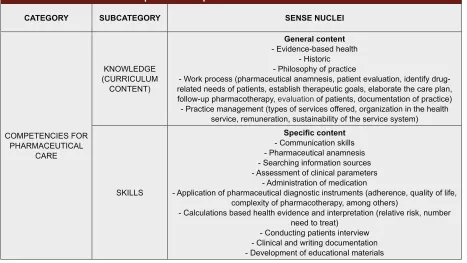
This category represents the competencies that, accord-ing to the teachers in this focus group, students should achieve in pharmaceutical care and MTM courses. These competencies were divided into 2 subcategories: knowl-edge and skills. The sense nuclei of the knowlknowl-edge sub-category contained general content that represents the base of the practice of pharmaceutical care and MTM (eliciting relevant information from the patient,
identi-fication of a patient’s drug-related needs, establishing
goals of therapy and practice management, among
oth-ers), as well as specific content that should be presented
in the course, including morbidity and mortality associ-ated with medications, chronic diseases, the most preva-lent acute diseases, mental illness, care at different stages of life, pharmacotherapy, semiology of minor disorders, dispensing medications, drug interactions and analysis of laboratory tests. Table 1 shows also the sense nuclei for the skills subcategory that were addressed during the discussion of pharmaceutical care courses.
Challenges to Teaching
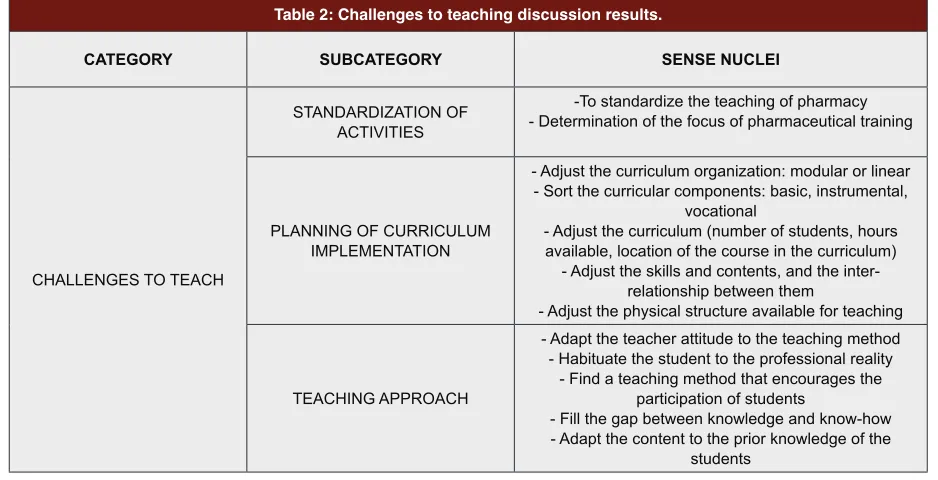
In this category, the teachers discussed the challenges involved in determining the contents and skills that will be taught as well as choosing a teaching method for the course. They discussed the need for standardization of
Table 1: Competencies for pharmaceutical care discussion results.
CATEGORY SUBCATEGORY SENSE NUCLEI
COMPETENCIES FOR PHARMACEUTICAL
CARE
KNOWLEDGE (CURRICULUM
CONTENT)
General content - Evidence-based health
- Historic - Philosophy of practice
- Work process (pharmaceutical anamnesis, patient evaluation, identify drug-related needs of patients, establish therapeutic goals, elaborate the care plan, follow-up pharmacotherapy, evaluation of patients, documentation of practice)
- Practice management (types of services offered, organization in the health service, remuneration, sustainability of the service system)
SKILLS
Specific content
- Communication skills - Pharmaceutical anamnesis - Searching information sources - Assessment of clinical parameters
- Administration of medication
- Application of pharmaceutical diagnostic instruments (adherence, quality of life, complexity of pharmacotherapy, among others)
- Calculations based health evidence and interpretation (relative risk, number need to treat)
the activities involved in the teaching of pharmacy to undergraduate students and the need to set focus on the profession. Other subcategories raised by the focus group included the adequacy of the planning structure (curricular and physical) and the teaching approach employed (Table 2).
Instructional Design
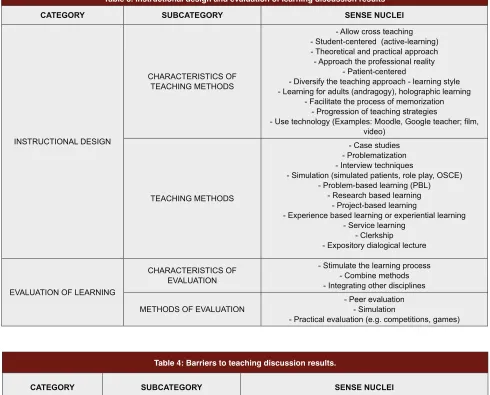
This category was divided in two subcategories: char-acteristics of the teaching methods and the methods themselves. The results of this discussion are shown in Table 3.
Learning Assessment
This category addresses the need for the learning evalu-ations to be consistent with the new teaching methods used in the pharmaceutical care and MTM course, and was divided into two subcategories: characteristics of the evaluation methods and the evaluation methods themselves (Table 3).
Barriers to the Application of the Teaching Method
Table 4 shows the results of the discussion of barri-ers to the application of the teaching method, including structural barriers and barriers associated with teachers and students.
DISCUSSION
The method chosen to know the opinion of a group of pharmaceutical teachers about which model to course most appropriate to pharmaceutical care and MTM was
focus group. The focus group approach to obtaining qualitative information assumes that individuals with experience in a given area develop opinions, knowl-edge and insights of substantial potential value to the researcher conducting the study.21 Focus groups have high internal validity (the degree to which the research-ers are actually observing what they think they are observing) and are less expensive than larger surveys.22,23 Thus, they can be used to gather opinions outside of consensus, provide detailed information on
percep-tions, clarify research findings or design and assess sub -sequent research.22-25
In this focus group, the first point addressed by teachers was the issue of the content of the course. To define
the contents of the course, the focus group compared the Pharmacy undergraduate courses with other under-graduate courses in health care, such as nursing and medicine. The main point of discussion was the need to centralize the knowledge of the course in patient care. The statements below illustrate this topic:
“Indeed we will develop clinical knowledge and skills.
Pharmaceutical care is the following: we have an
instru-ment that is the medicine, it is not our final goal, it is
our instrument. So in our care, the dimension that sets us apart from the doctor, from the nurse, is that we take care of patients in the medication use process.”
“When we look at the literature, eg, the books that were
developed on pharmaceutical care, they address these three content: the philosophy of the practice, process or model of this practice and the governance or
manage-Table 2: Challenges to teaching discussion results.
CATEGORY SUBCATEGORY SENSE NUCLEI
CHALLENGES TO TEACH
STANDARDIZATION OF ACTIVITIES
-To standardize the teaching of pharmacy - Determination of the focus of pharmaceutical training
PLANNING OF CURRICULUM IMPLEMENTATION
- Adjust the curriculum organization: modular or linear - Sort the curricular components: basic, instrumental,
vocational
- Adjust the curriculum (number of students, hours available, location of the course in the curriculum)
- Adjust the skills and contents, and the inter-relationship between them
- Adjust the physical structure available for teaching
TEACHING APPROACH
- Adapt the teacher attitude to the teaching method - Habituate the student to the professional reality
- Find a teaching method that encourages the participation of students
- Fill the gap between knowledge and know-how - Adapt the content to the prior knowledge of the
ment of the practice. As well as in the nursing process course.”
A study conducted by Kassam and Volume-Smith26
confirmed these notions, and showed that pharmaceuti -cal care required that the student have the knowledge to assume responsibility for the management of drug-related problems and to evaluate a patient’s drug therapy outcomes over time. Thus, each patient should receive counseling and a monitoring plan, and students should document the care they have provided. In addition to this general content, the focus group also addressed
specific knowledge, including knowledge of specific dis -eases, care at different life stages and pharmacotherapy. Regarding the skills that should be taught in pharmaceu-tical care course, the following statements exemplify the opinion in the focus group:
“If we think in terms of clinical skills, we have really
practical activities as patient exams, particularly vital signs . . . know how to use the database, collect infor-mation and interpret inforinfor-mation, to apply inforinfor-mation, anamnesis as an important part of clinical documenta-tion.”
Table 3. Instructional design and evaluation of learning discussion results
CATEGORY SUBCATEGORY SENSE NUCLEI
INSTRUCTIONAL DESIGN
CHARACTERISTICS OF TEACHING METHODS
- Allow cross teaching - Student-centered (active-learning) - Theoretical and practical approach - Approach the professional reality
- Patient-centered
- Diversify the teaching approach - learning style - Learning for adults (andragogy), holographic learning
- Facilitate the process of memorization - Progression of teaching strategies
- Use technology (Examples: Moodle, Google teacher; film,
video)
TEACHING METHODS
- Case studies - Problematization - Interview techniques
- Simulation (simulated patients, role play, OSCE) - Problem-based learning (PBL)
- Research based learning - Project-based learning
- Experience based learning or experiential learning - Service learning
- Clerkship - Expository dialogical lecture
EVALUATION OF LEARNING
CHARACTERISTICS OF EVALUATION
- Stimulate the learning process - Combine methods - Integrating other disciplines
METHODS OF EVALUATION - Peer evaluation- Simulation
- Practical evaluation (e.g. competitions, games)
Table 4: Barriers to teaching discussion results.
CATEGORY SUBCATEGORY SENSE NUCLEI
BARRIERS TO TEACHING
STRUCTURAL AND OF CURRICULUM
- Lack of practical classes
- Lack of physical structure (laboratories simulation)
- Insufficient credit hours
- Current curriculum guidelines - High number of students per teacher
- Lack of monitors ASSOCIATED TO TEACHERS AND
“So . . . are always those skills, I have to know how to
communicate, I have to know perform a clinical inter-view, I have to know to document, I must know to register, I must know how to write a communication, a report, an opinion to another professional. I got to know elaborate some kind of educational material to the patient and I must to have skills also management of my practice.”
Similar findings were reported by Cherenson et al.27 in which the 10 skills most important for students and practitioners in a clinical practice were evaluated. All pharmacists and pharmacy students were in agreement
that patient counseling, profile review for detecting and
resolving drug-related problems, communication with health care professionals, drug information skills, docu-mentation of interventions and monitoring of drug
therapy were important. The clinical skills identified by
participants in this study were also in line with those
identified by Kassam and Volume-Smith,26 who devel-oped and implemented a community clerkship program. It is worth mentioning that the importance of the con-nection between skills and knowledge was discussed in this focus group. Skills are part of the psychomotor domain and combine with knowledge, i.e. the cogni-tive domain, to achieve student learning.28 According to the literature, the curriculum should not be focused only on content, knowledge, but rather put the student at the center of the process and plan the results accord-ing to the knowledge, skills, behaviors, attitudes and values that should be achieved.29,30 Once outcomes are set forth, teaching and learning strategies are then devel-oped to support the achievements of the students. During the discussion of the skills to be taught, some participants highlighted characteristics that are chal-lenges to the teaching of pharmaceutical care. One example is the lack of uniformity in the Pharmacy cur-riculum in Brazil and the lack of standardization of the
egress profile. For example:
“…I think we’re at a moment where we need to decide
whether or not we want to teach pharmaceutical care to undergraduates. In my view, in one discipline is not possible to do it. We must understand the true mission of our profession, and not produce pharmacists who have learned everything, but don’t know how to do any-thing.”
Since 1990, other studies have demonstrated that phar-macists are the health care professionals most suited to provide pharmaceutical care and that skill devel-opment related to pharmaceutical care should be an important component of the Pharmacy undergradu-ate program.31-33 In other countries this concern is also perceived. As an example, in Canada, the Council for
Accreditation of Pharmacy Programs has determined that the students are trained with competencies to prac-tice pharmaceutical care.34
Another feature that should be noted is the teaching approach. The group’s opinion about how the teacher can determine the most appropriate choice of teaching method is illustrated below:
“And in the end, is what sets the creativity of the teacher,
not worth it to use a transformer method if the teacher
is authoritarian, if his profile did not combine with that
method, because sometimes it is preferable to use an expositive method, understand?”
According to Abate et al. educators and faculty in the health science disciplines often do not receive
spe-cific education or training concerning instructional
approaches, learning theories, or how to best facilitate student learning. Furthermore, these authors mentioned the lack of time as a barrier for educators to learn the educational theories and advantages/disadvantages of various instructional methods.29 In contrast, Stewart
et al. conducted a survey to identify the use of active-learning strategies by teachers and found that 87% of the 1,179 respondents reported the use of at least one active-learning strategy in their classroom activities, with problem-based learning reported most commonly (71%).35
Regarding teaching methods used in the pharmaceuti-cal care and MTM course, the group emphasized that, independent of the method chosen, some characteris-tics are important for the method to effectively achieve student learning. One of these features is the approach to the patient, which can be illustrated by the following statement:
“I think that regardless of the method chosen, how you
will transmit this content has to approach of the patient, whether, for example, working with clinical case or sim-ulate the care to the patient . . . to be not only lecture, ie
only provide content. I think this is totally flawed. How
to fail in the teaching of pharmaceutical care? Is your approach not be patient-centered.”
Others studies show that an emphasis must be placed on the processes utilized by pharmacists to communicate with individual patients in order to identify and solve their drug-related problems, which will allow students to learn how to directly apply knowledge and skills.26,36
Despite this finding, Zaremski et al.37 and Kassam et al.16 found that a large proportion of students in the United
States experienced insufficient opportunities to practice
The need to use teaching methods that are learner-cen-tered, i.e., active learning methodologies was also clear. For example:
“. . . The (WHO) World Health Organization itself says
that the major problems existing in healthcare today is the gap between knowing and doing. So, to minimize this gap, I think we need transformative educational practices. Thus, you use what you have available to gen-erate content and facilitate skills development in the most participatory way possible . . .”
“How to teach patient-centered practice in a way that is
not focused on the student? It is impractical to teach in a way that is not student-centered. So the practice model that we want to teach must necessarily be centered on the learner, on the student.”
Traditional teaching methods, such as lectures, are com-monly used in higher education and may be particularly
beneficial for topics requiring lower cognitive levels of
learning for which students are primarily recalling infor-mation or describing/explaining concepts.29 However, if achievement of outcomes requires higher levels of cognitive learning (e.g., application, analysis, synthesis), lectures alone will likely be inadequate to meet course outcomes, because lectures place students in a passive, rather than active, role. This occurs because the learn-ing depends on the relationship between numerous concepts to form the so-called semantic networks. Pro-cess that is facilitated by experimentation.29 Thus, when the learners themselves are the center of the learning process (i.e., student-centered learning), they structure, organize, and use new information gained through interactions with their environment that allow for con-struction of their own knowledge.29,38
In this sense, Van Amburgh et al.39 points out that pre-paring pharmacy students for practice in the modern healthcare system requires that we rethink pharmacy teaching methodology and go beyond the traditional lecture-based delivery of factual material to incorporate methods that allow for effective application and prob-lem solving in the classroom. In this focus group, several methods were cited that could be used in pharmaceuti-cal care course. A systematic review carried by authors, with the purpose to analyze the published studies about the teaching of pharmaceutical care found 25 studies, using different teaching methods, including problem-based learning, case studies and simulations.
Active learning has numerous advantages, including effectively bridging the gap between licensure and actual patient experience, engaging students more deeply in the process of learning by encouraging critical thinking, and fostering the development of self-directed
learn-ing. These methods benefit students and instructors
by allowing to student the practice and development of competences, and to instructors the opportunity to provide immediate feedback of students’ learning.29,39 Because of these advantages, the 2007 Accreditation Council for Pharmacy Education (ACPE) Standards and Guidelines addresses the need for active-learning techniques in every phase of pharmacy student educa-tion and in continuing professional development for pharmacists.40
In addition to the recommendation to use active-learn-ing methods, the literature recommends that educators take into consideration the learning style preferences of undergraduate pharmacy students when developing curricula and evaluating teaching approaches, especially when planning, implementing and evaluating education initiatives in order to create an effective, contemporary learning environment for their students.41 This point was addressed in the focus group as follows:
“I think anyone who wants to develop a student-cen -tered teaching approach must adopt strategies that con-sider two important factors: learning is a process, and learning is a highly individual experience. Each student has a way of learning, and this fact must be taken into
consideration. There is the influence of the collective,
there is the socialization process of learning, but the concrete experience of learning is individual. Therefore any strategy has to consider that people learn in differ-ent ways, with differdiffer-ent mechanisms and differdiffer-ent strat-egies.”
Related to the use of active teaching methods is the importance of technology. As active-learning tech-niques have been encouraged in pharmacy education, an increase in the use of technology has often followed. As noted by Oblinger,42 the expectations of students raised on the Internet and interactive games may not be achieved in colleges and universities with traditional infrastructure and learning strategies, as lectures. A vari-ety of technological tools are being used in pharmacy education, including computer-assisted instruction, web-based course development/management software, virtual patients and audio/video recordings.43,44 Several
studies evaluating specific technologies have found pos -itive results, primarily derived from user preferences.45-47 However, others studies about the incorporation of technologies and their impact in learning should be undertaken.43
information stored in memory (e.g., testing/self-test-ing) and not the encoding of information in the brain (e.g., rereading notes).48,49 Thus, methods that promote rapid initial learning is not equivalent to information long-term retention. However techniques that involve slower, more effortful learning can enhance long-term retention.12 Abate et al. affirm that testing is important because the development of student learning outcomes is the foundation to building curricula. Learning out-comes must guide the instructional design of the course and they should be derived from the educational mis-sion of the institution. 29 Thus, in Pharmacy the learning objectives should be suitable to clinical practice.
Barriers to the implementation of new teaching meth-ods in pharmaceutical care and MTM courses were dis-cussed by the focus group. Examples include the lack of resources and the number of students per teacher. According to the literature, tasks such as identifying the most appropriate assessment to use for each type of outcome and interpreting results can be daunting, because most pharmacy faculty lacks background and education/training in these areas. Thus, to development of an adequate program assessment plan are needed resources.29 Kassam and Volume-Smith26 described the limited number of preceptors who were comfortable with the practice of MTM and the lack of patient care services in community pharmacies that incorporated essential activities of pharmaceutical care as barriers to learning.
There are some limitations to our study. We conducted only one focus group, which may introduce some uncer-tainty in reaching theoretical saturation. In addition, the results from this focus group, as qualitative research, cannot be extrapolated to other situations.
CONCLUSION
This study identified skills and knowledge that are per -ceived by teachers as important in clinical pharmacy
practice, for example: identification of a patient’s
drug-related needs, establishing goals of therapy, communi-cation skills, among others. The suggestions presented in this focus group show the need to implement dif-ferent teaching methods, such as problem-based learn-ing, case studies and simulations, to enable learning for students in pharmaceutical care and MTM courses. The next step is to implement and evaluate the new program and determine whether desired learning objectives are being met.
ACKNOWLEDGMENT
We acknowledge the teachers of pharmaceutical care by contributions.
CONFLICTS OF INTEREST
The author declare no conflicts of interest.
FUNDING
The authors disclosed receipt of the following financial
support for the research, authorship, and or publication of this article: Brazilian National Council for
Techno-logical and Scientific Development (Capes; Coordina -tion of Superior Level Staff Improvement).
REFERENCES
1. Fincham JE. Global Public Health and the Academy. Am J Pharm Educ. 2006;70. https://doi.org/10.5688/aj700114.
2. International Pharmaceutical Federation (FIP). The international forum for quality assurance of pharmacy education: a global framework for
quality assurance of pharmacy education. http://www.fip.org/files/fip/
PharmacyEducation/Global%20Framework%20Final%20Draft.pdf ; 2008 Accessed June 15, 2012.
3. Hämeen-Anttila K, Saano S, Vainio K. Professional Competencies Learned Through Working on a Medication Education Project. Am J Pharm Educ. 2010;74(6):110. https://doi.org/10.5688/aj7406110. PMid: 21045952 PMCid:PMC2933019.
4. World Health Organization (WHO). Developing pharmacy practice: a focus on patient care. Geneva: WHO. 2006;87.
5. Hepler CD, Strand LM. Opportunities and responsibilities in pharmaceutical care. Am J Hosp Pharm. 1990;47(3):533-43. PMid:2316538.
6. Schellhase EM, Miller ML, Ogallo W, Pastakia SD. An Elective Pharmaceutical Care Course to Prepare Students for an Advanced Pharmacy Practice Experience in Kenya. Am J Pharm Educ. 2013;77(3):60. https://doi. org/10.5688/ajpe77360; PMid:23610478 PMCid:PMC3631735.
7. Span. Modelo de gestión por competencias del Sistema Sanitario Público de Andalucía. Sevilla, SP: Consejería de Salud. 2006;96.
8. Maitreemit P, Pongcharoensuk P, Kapol N, Armstrong EP. Pharmacist perceptions of new competency standards. Pharm Pract. 2008;6(3):113-20. https://doi.org/10.4321/s1886-36552008000300001.
9. McConnell EA. Competence vs. competency. Nurs Manag. 2001;32(5):14. https://doi.org/10.1097/00006247-200105000-00007.
10. Fisher RC. The potential for problem-based learning in pharmacy education: A clinical therapeutics course in diabetes. Am J Pharm Educ. 1994;58(2):183-9.
11. Petkova V, Dimitrova ZL. Pharmaceutical practice, pharmaceutical care and pharmacy education in Bulgaria. Pharm Educ. 2003;3(3):205-7. https://doi.or g/10.1080/1560221031000151291.
12. Hagemeier NE, Mason HL. Student pharmacists’ perceptions of testing and study strategies. Am J Pharm Educ. 2011;75(2):35. https://doi.org/10.5688/ ajpe75235.
13. Salter SM, Karia A, Sanfilippo FM, Clifford RM. Effectiveness of e-learning
in pharmacy education. Am J Pharm Educ. 2014;78(4):83. https://doi. org/10.5688/ajpe78483; PMid:24850945 PMCid:PMC4028592.
14. Van DWJJ, Dekens-Konter J, Brouwers JRBJ. A New Model for Teaching Pharmaceutical Care Services Management. Pharm Educ. 2004;4(3):1-5. https://doi.org/10.1080/15602210400013368.
asthma patient care. Med Princ Pract. 2010;19(4):305-11. https://doi. org/10.1159/000312718; PMid:20516708.
16. Kassam R, Poole G, Collins JB. Development of an instrument to assess the impact of an enhanced experiential model on pharmacy students’ learning opportunities, skills and attitudes: A retrospective comparative experimentalist study. BMC Medic Educ. 2008;8(1):17. https://doi.org/10.1186/1472-6920-8-17; PMid:18397530 PMCid:PMC2375875.
17. Strohfeldt K, Grant DT. Instructional design and assessment: A model for self-directed problem-based learning for renal therapeutics. Am J Pharm Edu. 2010;74(9):1-7. https://doi.org/10.5688/aj7409173.
18. Flick U. An introduction to qualitative research. 5 ª Ed. Berlin: Sage Publications Inc. 2014.
19. Patton MQ. Qualitative evaluation and Research Methods. 3ª Ed. London: Sage Publications Inc. 2002.
20. Bardin L. Análise de conteúdo. 70 Ed. Lisboa: PT; 2011
21. Reutzel TJ, DeFalco PG, Hogan M, Kazerooni PV. Evaluation of a pharmaceutical care education series for chain pharmacists using the focus group method. J Am Pharm Assoc. 1999;39(2):226-34. https://doi. org/10.1016/S1086-5802(16)30494-6.
22. Suda KJ, Bell GC, Franks AS. Faculty and Student Perceptions of Effective Study Strategies and Materials. Am J Pharm Educ. 2011;75(10):201. https:// doi.org/10.5688/ajpe7510201; PMid:22345720 PMCid:PMC3279044. 23. Krueger RA. Developing questions for focus groups. Focus Group Kit
3. Thousand Oaks, CA: Sage Publications Inc. 1998;1-18. https://doi. org/10.4135/9781483328126.
24. Krueger RA. Planning focus groups. Focus Group Kit 2. Thousand Oaks, Calif: Sage Publications Inc; 1998.
25. Krueger RA. Analyzing and reporting focus group results. Focus Group Kit 6. Thousand Oaks, CA: Sage Publications Inc. 1998. https://doi. org/10.4135/9781483328157.
26. Kassam R, Volume-Smith CI. Focus group methodology to develop a community pharmaceutical care clerkship program. Am J Pharm Educ. 2003;67(3):88. https://doi.org/10.5688/aj670388.
27. Cherenson RS, Bilger R, Mohr S, Wuller C. Design of a Pharmaceutical Care Laboratory: A Survey of Practitioners. Am J Pharm Edu. 2005;69(1):3. https:// doi.org/10.5688/aj690103.
28. Bloom B, Englehart M, Furst E, Hill W, Krathwohl D. Taxonomy of educational
objectives: The classification of educational goals. Handbook I: Cognitive
domain. New York, Toronto: Longmans, Green; 1956.
29. Abate MA, Stamatakis MK, Haggett RR. Excellence in Curriculum Development and Assessment. Am J Pharm Edu. 2003;67(3):89. https://doi. org/10.5688/aj670389.
30. Kern DE, Thomas PA, Howard DM, Bass EB. Curriculum Development for Medical Education: A Six Step Approach. Baltimore, MD: The Johns Hopkins University Press. 1998.
31. Foppe VMJW, Fernandez-Llimos F. What is ‘pharmaceutical care’ in 2013. Int J Clin Pharm. 2013;35:1-2. https://doi.org/10.4321/s1886-36552013000100001.
32. DeOliveira DR. Por uma formação crítico-humanista do profissional da atenção farmacêutica: Um ensaio reflexivo. Boletín Red Sudam Aten Farm.
2011;5:1.
33. Silva WB. A emergência da atenção farmacêutica: um olhar epistemológico e contribuições para o seu ensino. [doctoral thesis]. Universidade Federal de Santa Catarina. Florianópolis: Santa Catarina, Brazil. 2009.
34. Association of Faculties of Pharmacy of Canada. Educational Outcomes for First Professional Degree Programs in Pharmacy (Entry-to-Practice
Pharmacy Programs) in Canada. http://www.afpc.info/sites/default/files/
AFPC%20Educational%20Outcomes.pdf.
35. Stewart DW, Brown SD, Clavier CW, Wyatt J. Active-Learning Processes Used in US Pharmacy Education. Am J Pharm Educ. 2011;75(4):68. https:// doi.org/10.5688/ajpe75468 ; PMid:21769144.
36. Wislande N. Large group problem-based learning: A revision from traditional to pharmaceutical care-based therapeutics. Am J Pharm Edu. 1994;58(1):64-73.
37. Zaremski DG, Boyer G, Vlasses PH. A survey of advanced community
pharmacy practice experiences in the final year of the PharmD curriculum at
the US colleges and schools of pharmacy. Am J Pharm Educ. 2005;69(1):10-18.
38. DiPiro JT. Why Do We Still Lecture?. Am J Pharm Educ. 2009;73(8):137. https://doi.org/10.5688/aj7308137; PMid:20221329 PMCid:PMC2828296. 39. Van AJA, Devlin JW, Kirwin JL, Qualters DM. A Tool for Measuring Active
Learning in the Classroom. Am J Pharm Educ. 2007;71(5):85. https://doi. org/10.5688/aj710585; PMid:17998982 PMCid:PMC2064883.
40. Accreditation Council for Pharmacy Education (ACPE). Accreditation standards and guidelines for the professional program in pharmacy leading to the Doctor of Pharmacy degree. Accreditation Council for Pharmacy Education. Effective http://www.acpeaccredit.org/pdf/ACPE_Revised_ PharmD_Standards_Adopted_Jan152006.pdf. 2007.
41. Williams B, Brown T, Etherington J. Learning style preferences of undergraduate pharmacy students. Curr Pharm Teach Learn. 2013;5(2):110-9. https://doi.org/10.1016/j.cptl.2012.02013;5(2):110-9.003.
42. Oblinger D. Boomers, gen-Xers and millenials: understanding the new students. Educause Rev. 2003;38(4):37-47.
43. Jabbur-Lopes MO, Mesquita AR, Silva LMA, Almeida Neto A, Lyra JDP. Virtual Patients in Pharmacy Education. Am J Pharm Educ. 2012;76(5):92. https://doi.org/10.5688/ajpe76592; PMid:22761533 PMCid:PMC3386043. 44. Monaghan MS, Cain JJ, Malone PM, Chapman TA, Walters RW, Thompson
DC, Riedl ST. Educational technology use among us colleges and schools of pharmacy. Am J Pharm Educ. 2011;75(5):87. https://doi.org/10.5688/ ajpe75587; PMid:21829261 PMCid:PMC3142974.
45. Cook D, Levinson A, Garside S, Dupras D, Erwin P, Montori V. Internet-based learning in the health professions: A meta-analysis. JAMA. 2008;300(10):1181-96. https://doi.org/10.1001/jama.300.10.1181; PMid:18780847.
46. Davis J, Crabb S, Rogers E, Zamora J, Khan K. Computer-based teaching is as good as face to face lecture-based teaching of evidence based medicine: A randomized controlled trial. Med Teach. 2008;30(3):302-7. https://doi. org/10.1080/01421590701784349; PMid:18484458.
47. Seybert A, Kobulinsky L, McKaveney T. Human patient simulation in a pharmacotherapy course. Am J Pharm Educ. 2008;72(2):37. https://doi. org/10.5688/aj720237; PMid:18483603 PMCid:PMC2384212
48. Karpicke J, Roediger H. Repeated retrieval during learning is the key to long-term retention. J Memory and Language. 2007;57(2):151-62. https://doi. org/10.1016/j.jml.2006.09.004.
49. Kolers P, Roediger H. Procedures of mind. J Verbal Learning and Verbal Behavior. 1984;23:425-49. https://doi.org/10.1016/S0022-5371(84)90282-2.