Contents lists available at www.innovativejournal.in
Asian Journal Of Computer Science And Information Technology Journal homepage: http://www.innovativejournal.in/index.php/ajcsit
A GENRE-BASED FRAMEWORK FOR CONSTRUCTING MULTIMODAL CONTENT FOR LEARNING OBJECTS
George Vorvilas, ThanassisKaralis,
Konstantinos Ravanis*
Department of Educational Sciences and Early Childhood Education, University of Patras, Greece
ARTICLE INFO ABSTRACT
Corresponding Author:
Konstantinos Ravanis
Department of Educational Sciences and Early Childhood Education, University of Patras Rion-Patras, 26500, Greece
In the present article we propose a genre-based conceptual framework for designing content for learning objects. We review some content aggregation models in order to stress the lack of such an approach. We also consider learning objects as multimodal macrogenres. These macrogenres are constituted of content object assemblies. The successful and coherent aggregation of these content objects can be achieved through the recognition of potential rhetorical relations among them. Finally, adopting this framework, an author/teacher is supported with a repertoire of concepts that make him capable of affect and motivate students in particular ways through her intended learning materials.
©2011, JPRO, All Right Reserved.
KeyWords: Learning Objects, content objects, multimodal genres, rhetorical structure theory
THE LEARNING OBJECTS IN EDUCATION
The models of designing educational content for learning objects (LOs) are characterized by heterogeneous views with respect to the determination of the quality and the functionality of these learning objects. The definitions of learning objects provided by these models are also determined by the wider educational and social purposes that certain communities state for their re-use. Different needs of educational organizations as well as specific approaches of teachers could lead to different grades of learning objects' ways of use and adaptation.
Following Balatsoukas et al. (2008) we could make a distinction between three general aggregation levels of object-oriented educational content. In the first level various small digital items exists, called assets or raw data or media objects (e.g. audio files, text files, video or image fragments etc with no learning objective). These media objects, namely information resources, information objects, content objects etc, can create larger combinations with no specific learning objective. In the second aggregation level, learning objects are created through the combination of raw data as well as information objects. In this level a learning object according to some designers can serve more than one learning objectives, while others tend to equate it with a lesson. Finally at the third aggregation level learning objects are aggregated in larger wholes and they are used for planning lessons, modules, and courses. Certain designers however tend to consider that the term can be equated with a syllabus, even with a course or seminar. Through this heterogeneous spectrum from which the concept of learning object emerges, the co-dependence among LOs reusability and educational context is clearly stated: the bigger the content aggregation, the stronger its dependence from the context. Thus, the possibilities for its reusability are decreased. The opposite situation appears
when we descent in smaller aggregations of content (Wiley, 2002).
In the following sessions we propose a framework for constructing content for learning objects. Elsewhere we have proposed a general outline of a semiotic framework for creating and using LOs. We have argued there that learning objects and their content should be treated as multimodal representations which generate particular ideational and textual meanings and trigger pedagogical relations of power and involvement (Vorvilas et al. 2010). Supplementing that outline, we propose here a genre-based approach for the creation of content for LOs. More specifically, this approach attempts to describe the intended social/educational purposes that several content objects might fulfill, as knowledge representation units, and the ways an author/teacher can combine them to create LOs, in order to express her motives and purposes towards specific target groups of students. Thus the author/teacher could be equipped with a vocabulary that allows him to treat several content objects in terms of their broader semantic and pragmatic dimensions, regardless the learning strategy and the educational model she wants to apply. What could someone gain from this perspective is the creation of meaningful and cohesive LOs aimed to be functionally used in specific educational contexts.
state a few thoughts about the stability of the proposed entities and the concomitant reusability issue.
CONTENT OBJECT TYPES
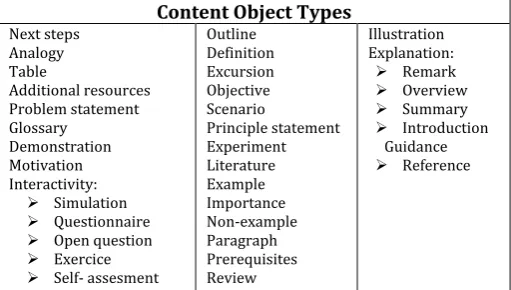
Concerning the second level (Balatsoukas et al. 2008) of object-oriented content aggregation, the mapping of various content types proposed by several models is of particular interest. Verbert and Duval (2008) offer to us such a mapping for nine models of content aggregation (Table 1).
Table 1. Mapping of content object types according to ALOCOM ontology (Verbert & Duval, 2008)
Content Object Types
Next steps Analogy Table
Additional resources Problem statement Glossary
Demonstration Motivation Interactivity:
Simulation
Questionnaire
Open question
Exercice
Self- assesment
Outline Definition Excursion Objective Scenario
Principle statement Experiment Literature Example Importance Non-example Paragraph Prerequisites Review
Illustration Explanation:
Remark
Overview
Summary
Introduction
Guidance
Reference
Models of reference: SCORM, NETg, Learnativity, NCOM, Cisco, New Economy, SLM, PaKMaS, dLCMS.
Many of these types result from the partial use of sources adopted from Horn (1998), Ballstaedt (1997) and IEEE LOM (2003). IEEE LOM is partly used by four models (PaKMaS, dLCMS, Learnativity, New Economy) and it distinguishes various learning resource types such as exercise, simulation, diagram, graph, table, narrative text, experiment, self-assessment etc. However as it has been argued this classification confuses technical characteristics of learning resources (e.g. table, graph, diagram) with the pedagogic use for which they are intended for (e.g. exercise, self-assessment, experiment) (Friesen et al. 2002). From this point Ullrich (2004) has made an effort to provide several instructional functions of learning resources through an ontology that combines elements of Instructional Design Theory and Rhetorical Structure Theory. In a similar effort Lu and Hsieh (2009) have proposed a relation metadata extension for improving SCORM Content Aggregation Model which has been designed according IEEE LOM.
Only the dLCMS model uses the classification of Ballstaedt for the knowledge representations in educational books and proposes a content organization according to several didactic types. Texts according to Ballstaedt (1997) are distinguished to: expository which describe facts and explain connections between several knowledge domains (e.g. definitions, explanations, arguments), narrative which report events, situations, motives, actions and their consequences, instructional that offer procedural knowledge to the addressee for acting, and supplementary didactic texts that motivate and support the learning process (e.g. glossaries self assessments, advanced organizers etc-see also section 3). While this classification presents an explicit orientation to a content organization based on text types it has not become very widely acceptable by content aggregation models.
Rather more popular is the content organization rooted in Horn’s Structured Writing (Cisco, PaKMaS, dLCMS, Learnativity, New Economy). Horn proposed the structuring of content for industrial and business training
according to two hundred types of information blocks such as lists, diagrams, charts, tables, prerequisites, outlines etc. These information blocks can be staged in particular sequences that create information types. Five information types are most popular and are used at the planning of learning objects: procedures, concepts, facts, processes and principles.
A procedure concerns a guided sequence of steps which someone should follow in order to bring to an end a concrete task. (E.g. the step by step instructions of treating an injured human member).
A concept concerns a set of ideas, events, symbols and objects, which are connected to each other through fundamental common attributes, but they can also be differentiated in secondary individual attributes.
A fact provides concrete and unique information based on real conditions, with the form of statements or given and concrete objects. Examples of facts are: a table of balance-sheet in Excel, a data entry form, the technical characteristics of my printer etc.
A process describes the way in which something functions. (e.g. how an enterprise achieves its specific objectives as an entity, how a unit of steel production operates, how is explained the water circle over the earth etc.).
A principle provides guidelines for action that requires critical thinking and completion of specific tasks at different circumstances. Some examples of principles are: “how do you face an aggressive customer?”, “how can you improve your communicative skills?”, “how can you increase the productivity of your department?” etc (Clark, 2007).
A concept for example can be taught through the sequence of several informational blocks: introduction, definition, example, non-example, analogy. Clark (2007) has adopted this model and enriched it with Merrill’s Component Display Theory (Merrill 1983) in order to provide meaningful instructional outcomes.
Furthermore, Clark and Lyons (2004), based on pictures taxonomies of Carney and Levin (2002) and Lohr (2003), have combined these information types with appropriate visual elements that are helpful in the realisation of specific tasks so much for conventional teaching as for e-learning. Of particular interest is the connection of these information types with concrete social purposes in the field of technical training. For example procedures are appropriate for training employees so as to fulfil specific job tasks determined by the wider strategies an organization, company or factory implements, principles are appropriate for strengthen the critical thinking of workers with respect to decision-makings during critical situations. Concepts and facts provide the employees with the required information which they need so as to achieve various tasks (Clark 2007). Horn Clark & Ballstaedt, without explicitly mention it; make actually an attempt to organize content for learning through specific discourse/ rhetorical patterns.
explain in the following sections. From this opinion, our approach has some resemblances with the classification of text types proposed by Ballstaedt.
GENRE THEORY FRAMEWORK AND EDUCATIONAL CONTENT OF THE LEARNING OBJECTS
We could define genre as a set of communication events (written or oral) that serve concrete communication goals in various social circumstances. These communication goals are recognized by the members of the wider community in which genres appear and are achieved through the particular schematic structure each genre has (Swales 1990). For example, the schematic structure of a market auction is in general the following: auctioneer's opening, investigation of object of sale, bidding, conclusion. More concretely, genres are staged goal-oriented social processes (Martin 1999) that allow the organisation of social life. These types of communicative events are constituted from obligatory and optional items that create `beginning- middle- end' structures. These structures in turn help us to serve our communication activities, functioning as `“templates” for doing communicative things' (van Leeuwen 2005, p. 128).
Within the context of secondary school, workplace and science based industry, Martin and Rose (2008) detected six main genre families: stories, text responses, arguments, reports, explanations and procedures. Also at the academic contexts Bruce (2008) has detected four similar types: reports, recounts, explanations and discussions. Reports present information in a non sequential way while recounts present information in a sequential or chronological way, explanations present information with an orientation on means and discussions focus on the organization of information in relation to choices, conclusions or outcomes. These types of genres can be combined each other and create larger and variant macrostructures. From this point we can speak of macrogenres (Martin 1994) constituted by several microgenres. For example, a science textbook is a macrogenre constituted by microgenres like: reports, procedures, explanations etc. Also a recount can be used to construct part of macrogenres like a news item or a student's assignment. We argue that these elementary educational microgenres can be used by an author/teacher to create educational content for digital macrogenres such as learning objects, and we give a brief description of these microstructures in the following paragraphs, according to their elaboration by Martin and Rose (2008).
The social/educational purpose of story genres is to help someone explore several aspects of human life through narration and they can be divided into: 1) anecdotes which present the narration of unusual events and people’s emotional reaction to them (e.g., “when I went to a football match…”); 2) exempla which describe incidents and people’s interpretation of them through moral judgment (e.g., interpreting an incident of racist behavior); 3) observations through which we comment on and respond to events that affect us deeply (e.g., commenting on an incident of sexual abuse); 4) narratives, which express a complication in the narrator’s life and its resolution (e.g., a narrative of someone’s initial rejection by his community due to racist stereotypes and his subsequent acceptance by that community); 5) personal recounts, which record a series of events that constitute a personal experience (e.g., a recount of my holiday in Paris);
6) biographical recounts, which record a sequence of events about a person (e.g. a short biography of Einstein); 7) autobiographical recounts, which record a sequence of events about myself (e.g., my years at university); 8) historical recounts, which record a sequence of episodes and circumstances concerning people and their fate (e.g., the Holocaust); and 9) historical accounts, which explain a sequence of episodes and circumstances concerning people and their fate (e.g., social factors that enabled Holocaust).
The social/educational purpose of text responses is to evaluate several texts and they can be divided into: 1) personal responses, which express one’s feelings about a text (e.g. my emotional positive or negative reaction to a book), 2) reviews, which summarize selected futures of a visual musical or literary text and evaluate them (e.g. a review of a musician’ s new CD), 3) interpretations, which illustrate the message of a text (e.g. explaining, evaluating and reaffirming the message of a particular book), and 4) critical responses, which challenge the message of a text (e.g. evaluating, deconstructing and challenging the message of a book).
The social/ educational purpose of arguments is to argue for or against on one or more points of view and they can be divided into: 1) expositions, which argue for a single position (e.g. an exposition for the reasons we should use nuclear energy technologies), 2) discussions, which argue for two or more competing positions (e.g. a discussion for the reasons we should and the reasons we should not use nuclear technologies), and challenges, which set out to demolish an established position (e.g. challenging the use of nuclear technologies in general by offering counter-arguments).
The social/educational purpose of explanations is to explain how or why a phenomenon happens. They are divided into four types: 1) sequential explanations, which consist of a sequence of causes and results that are responsible for the appearance of a certain phenomenon (e.g., an explanation of the shaping of DNA in the cellular core); 2) factorial explanations, which explain the factors that are responsible for the appearance of a phenomenon (e.g., an explanation of the factors responsible for water pollution on earth); 3) consequential explanations, which explain the consequences of a phenomenon (e.g., an explanation of the consequences of the greenhouse effect); and 4) conditional explanations, which explain the necessary relations that exist between various events which, in turn, characterize a phenomenon (e.g., an explanation of the conditions which force an object to float or to sink).
The social/educational purpose of reports is the classification and description of types of phenomena. Reports are divided into three categories: 1) descriptive report,s which describe the characteristics of a phenomenon (e.g., the description of a whale’s characteristics); 2) classifying report,s which categorize the members of a general class of concepts or phenomena (e.g., the classification of minerals); and 3) compositional reports, which describe the elements of which an entity is made (e.g., a report on the components of human blood).
which consist of a sequence of clearly stated steps towards a goal (e.g., a step-by-step process for connecting a PC to a network); 3) cooperative procedures, which involve more than one individual for the accomplishing of parallel, step-by-step tasks (e.g., a procedure for dumping a brassert washer); and 4) conditional procedures, which require the making of appropriate choices for accomplishing a task, taking into account a set of given conditions (e.g., a process of concrete steps for assessing the damage done to an electric device according to the indications presented by its parts), and 5) procedural recounts, which aim, through the use of suitable technical knowledge, at the investigation and recording of technical problems for further treatment. Usually, these take the form of technical notes, experiment/observation reports and research articles.
The possibilities of creating learning content should not be exhausted in the use of the aforementioned microgenres only. Several other educational genres can be traced and used in many educational contexts. For example, Ballstaedt's typology could be a profitable supplement of our generic approach. Of particular importance here are the types of supplementary didactic texts he proposes. These are: 1) learning objectives which orient the student to the main subject matter, promote her to selective reading or preparation for a test and provide criteria for successful learning in general, 2) advance organizers which function as a bridge that links the prior knowledge with the new learning material, 3) summaries which are posed before or after the main text and state its basic terms and points, 4) excursions which light up from another perspective the subject matter, they offer thereby additional information which promotes various linkages with the prior knowledge and thus a deeper processing from a didactical perspective, 5) glossaries which give an overview of the main terms and also provide definitions and brief explanations, 6) self-assessments that make possible for the student to assess his learning process and subject matter understanding (Ballstaedt 1997).
From a multimodal perspective instead of considering that genres in general are only transmitted through speech or print, we should better conceive them as rhetorical/discourse patterns which express themselves through the combination of several semiotic modes (e.g. image, audio, video). A procedure for example can be presented through a combination of text and still images which clarify the steps someone has to do in order to successfully complete an operation or, alternatively, through a video where a narrator explains these steps performed by a person on screen. From this point, it is rather appropriate to talk about multimodal microgenres which constitute multimodal macrogenres.
It should be proper to add here that digital genres such as webpages in general, compared to linguistic genres, do not always have a sequential organization; webpages offer a dynamic non-linear spatio-visual organization of the digital semiotic resources on screen. Nevertheless, the genre schema of a web page can be described in terms of its very typical components and their possible relations. Such a genre schema could be constituted of possible components like: top banner, left banner, top bar, top centre-right panel, bottom bars etc (Baldry & Thibault 2006). Here, we do not have a predetermined staged-like structure that could facilitate a concrete reading path someone has to follow. On the contrary in most of the cases,
it rests with the user himself to create through these components the reading path she wishes.
However, a common to some degree framework, through which both printed and digital genres are analyzed, can be established taking in to account that many digital genres do not constitute thoroughly novel genres but hybrids, which have adopted and adapted to some degree characteristics of their traditional predecessors in new social circumstances and under a different technological-material base (Bateman 2008). The digital genre of homepage for example combines traditional elements from promotional/ introductory genres (e.g. prefaces, introductions, forwords) and news paper front pages in order to serve specific communicative purposes through the new medium of WWW (Askehave & Nielsen 2005). Furthermore, beyond preserving a linear/non-linear dichotomy we should bear in mind that hypertext offer us two basic modal shifts in the reading process in general: a ‘navigating mode’ through which the user creates his own reading path in a non-linear way (e.g. through hyperlinks to several sites) and a ‘reading mode’ comprehended as the traditional sequential reading process someone follows while reading a text (Askehave & Nielsen 2005).
The adoption of genre theory for the creation of educational content for learning objects could contribute in the configuration of a conceptual framework for designing and using learning objects in terms of a multimodal discourse perspective. Adopting this framework the author/teacher would be equipped with a set of templates which allow her the creation of several microgenre types according to their stages. For example, if her intention is to describe a natural phenomenon such as the greenhouse effect, she could choose a sequential explanation template. She could also combine this type of microgenre with suitable narrative representations (Kress & van Leeuwen 2006). She should also be equipped with a vocabulary of concepts that would allow her to discern the various types of images according to their representational functions, as well as the logico-semantic relations that are created among text and image (Martinec & Salway 2005). With regard to the lexicogrammatical elements she uses (e.g. first person, imperative etc); she would also be supported with extra knowledge about the pedagogical relations of power and involvement they promote. (Dimopoulos et al. 2005).
THE ORGANIZATION OF CONTENT OBJECTS: RHETORICAL STRUCTURE THEORY PERSPECTIVES
several COs. We could say that LOs differ from COs at the following point: while COs can have specific educational purposes LOs aim to facilitate at least one learning objective (e.g. to teach a concept, a process, a procedure, a phenomenon, to accomplish a problem solving or an assessment task etc). The above content aggregation can be achieved through the logico-semantic relations of expansion and projection (and their subtypes) which can operate between genres and the stages within a genre, as well as between different semiotic modes (e.g. Lemke 2002). Complementarily to these relations we adopt Rhetorical Structure Theory (Mann & Thomson 1988) in order to combine COs through particular rhetorical relationships. The reason we adopt this theory is because rhetorical relationships can describe in great detail the particular intensions an addresser/author has to an addressee/student when she develops learning content (see appendix). Rhetorical relationships also can be classified as subtypes of expansion, that is, as relations of elaboration, extension and enhancement (e.g. Kong 2006, Stuart-Smith 2007).
4.1. The Rhetorical Structure Theory
Rhetorical Structure Theory (RST) was initially used in the field of computational linguistics for text generation, text parsing and mechanic translation (Taboada & Mann 2006) but in turn it was extended in studies concerned the generation and rhetorical organization of multimedia representations (Rocchi & Zancanaro 2003) and the analysis of multimodal documents (Bateman 2008). Furthermore, it has been used for the enhancement of LO metadata with the establishment of rhetorical relationships between LOs in order to maximize their instructional use and reusability (Ullrich 2004, Yahya & Yusoff 2008, Lu & Hsieh 2009). Also it has been used at the design of web based trainings in general, in order to support instructors intensions towards defined groups of learners (Aqqal et al. 2008), as well as to the study of discussions in asynchronous learning environments (Potter 2008).
The RST explicates the coherence of multimodal representations considering that their content is organized through symmetrical and asymmetrical relations among several nuclei and satellite elements. Nucleus is the element (e.g. picture or text) which is the most essential to the overall meaning of an item, while satellite is the element which depends on nucleus. In symmetrical relations the connected elements have equal importance, functioning independently or complementarily to each other, both of them are considered to be nuclei, thus we can also call these relations multinuclear. In asymmetrical relations we have unequal importance among the elements: one element (satellite) depends from another one with greater importance (nucleus). The asymmetrical relations are also called nucleus/satellite relations. Furthermore, Mann and Thomson (1988) divided RST relations, according to their intentional effect on the addressee, to presentational (pragmatic) relations and subject matter (semantic) relations. Presentational relations are intended to increase in the addressee some inclination to the nucleus (e.g. acceptance, belief, positive regard) while subject matter relations are intend to make the reader able to recognize the relation in question. From a systemic functional perspective subject matter and presentational relations are responsible for creating ideational, interpersonal and textual meanings (Mann &
Matthiessen 1991, Hovy et al 1992). Thus RST relations can be approved a useful tool in interpreting how several combined semiotic resources represent and organize knowledge in the form of LOs, and which kind of pedagogical relations these LOs are able to trigger among their represented content and the student (Vorvilas et al. 2010). Knowing the peculiar meanings that the semiotic resources are able to create, could orientate the choices of our learning strategies in a specific educational context. 4.2. An LO example: what is an earthquake?
In figure 1 we state a simple example of the possible rhetorical organization between COs for a specific LO. An additional distinction which we have to make here is between Nucleus Content Object (NCO) and Satellite Content Object (SCO) (for similar divisions see Ullrich 2004, Aqqal et al. 2009). This two terms represent abstract categories with respect to the rhetorical organization of the LO and they can be constituted by more than one COs.
Figure.1 Example of a learning object’s content organization
A preparation relation could exist between a satellite CO (CO1) such as an introduction and the NCO that will be presented in turn (CO2-CO4). A summary relation could also exist between a CO that summarizes (CO5) the main issues that were developed in NCO (CO2-CO4). The main subject matter of the learning content could be constituted by a NCO (CO3) such as a descriptive report that concerns the characteristics of a phenomenon (e.g. what is an earthquake?), and in turn it could be elaborated by another SCO (CO4) such as a classifying report (e.g. types of earthquakes). This NCO (CO3) could also be connected through a background relation with a descriptive report functioning as SCO (CO2) (e.g. what are plate tectonics?). Finally, the entire educational content (CO1-CO5) could constitute a SCO which is connected through enablement relation with a NCO (CO6-CO7). The last one could be composed of two listed assessment tasks (CO6, CO7) the student should fulfill (see also the appendix for a brief interpretation of those relations).
A way of establishing connections between these and several others potential COs could be done through hyperlinks which present the intended contents in different web pages or in the same webpage through pop-up windows, or alternatively several COs can be embedded within the same webpage. Possible examples of these hyperlinks could be section titles or questions like: how is this phenomenon explained? (Elaboration), what might prevent this phenomenon? (Unless), are they any disadvantages of this method? (Antithesis), are we right in asserting it? (Justify) etc (see also Lindley et al 2001).
choices an author has made in order to teach content. Nevertheless, it could provide an almost precise vocabulary about the author/teacher's intentions to the student, when she organizes her learning content through a specific learning strategy. From this point it would be worthwhile for someone to investigate at which degree/frequency specific sets of rhetorical relations may appear when we adopt specific learning strategies for teaching.
DISCUSSION
We should bear in mind that genres have not always the same degree of consistency. For example the stages of microgenres likes those described in section 3 are not so fixed. Trying always to submit our learning content in a strict way to a `perfectly staged' rhetorical pattern may be sterile. Instead of containing a fixed set of obligatory stages, genres rather select and shape their components from a common repertoire of rhetorical patterns (Askehave & Nielsen 2005). Genres ‘fluidity’ can be explained due to several reasons. First of all the categorizations and distinctions we make between several genres and their subtypes are always depended on the purposes that people have when they share and use these categories. Thus, we can categorize genres according to their content (e.g. articles, essays), their means (e.g. in writing, spoken or electronic), and their operation (e.g. Informative or persuasive etc). Furthermore, certain members of a human community can recognize and approve only the use of a restricted set of these categorizations while others, outside of this particular community may totally disagree with these categorizations. Consequently, the genre categorizations that a community has developed are not always of equal status. The same situation also is applied between the members of each one category, where the acceptance of several of its subtypes may differ considerably. Some of them are considered as more important for the purposes they carry out since they gather up the maximal number of the representative attributes their category has, in contrast with other members of the same category that share a minimum number of these attributes. Thus, these representative instances operate as prototypes, as “good examples” for the category they constitute, in contrast with other “bad examples” of the same category (Rosch 1978). These attributes that determine the protoypicality of a genre type through the family resemblance between its instances are also always depend on the human community that enacts them.
The concept of protoypicality could be applied in the case of learning objects as well. Instead of seeking the perfect definition of what could be a proper LO, that would be appropriate in every case according to some sufficient and necessary attributes, we should better speak of ‘family resemblances’ between educational digital macrogenres that allow us to categorize them as proper or improper instances of learning objects. Towards this direction an effective prototype for learning objects could probably be constituted by basic components such as: objective, content, activity, evaluation as well as from elements of supplementary content such as introductions and summaries, increasing thus the acceptance of educational digital artifacts of this family from the students (see also Plodzien et al. 2006).
The framework we propose in this article faces the great issue of reusability. Our opinion is that the probabilities of reusability increase as long as learning
objects serve a minimum number of learning objectives. Reusability also does not mean that the learning content will always be maintained immutable in the new educational context. Maybe the learning objective be slightly differentiated from its initial context of use and maybe the the new learning environment dictates changes at the rhetorical organization of COs as well as the partial modification or the total replacement for some of them. Thus instead of a picture of learning object as fixed and autonomous device subordinated to sufficient and necessary criteria for reusability, we rather conceived it as a fluid entity able to accommodate at several learning digital environments. Such a point of view presupposes an open source apprehension for the developed of e-learning materials in general (Koohang & Harman 2005).
In this article we proposed an outline of a genre-based framework of creating content for learning objects. Precursors of such an approach could be considered researchers such as Horn, Clark and Ballstaedt, whose structuring of learning materials according to text types or information types has been adopted by several content aggregation models. We conceive of content objects that constitute learning objects as multimodal macrogenres that can trigger particular ideational and interpersonal meanings. These content objects are aggregated in to cohesive wholes through specific rhetorical relations someone can implement. Thus, our statements here supplement a previous attempt we have made for creating a general semiotic framework of designing and using learning objects. Such a framework will be constituted by a coherent vocabulary that will make an author/ teacher of e-learning materials aware of the meaning potential these materials have. Thus, she will be able to implement general designing and use guidelines according to her intended purposes. In this framework learning objects should not be considered as fixed and stable entities (Vorvilas et al. 2011). In order to survive in several educational contexts, rather they should be flexible and adaptable enough.
REFERENCES
1. Askehave I. & Nielsen A.E. (2005). Digital genres: a challenge to traditional genre theory. Information Technology & People 18(2), 120-141.
2. Aqqal A. Rensing C. & Steinmetz R. (2008). Using Taxonomies to Support the Macro Design Process for the Production of Web Based Trainings. Journal of Universal Computer Science 14(10), 1763-1744.
3. Balatsoukas P. Morris A. & O’Brien A. (2008). Learning Objects Update: Review and Critical Approach to Content Aggregation. Educational Technology & Society
11(2), 119-130.
4. Baldry A. & Thibault P. (2006). Multimodal Transcription and Text Analysis. Equinox, London.
5. Ballstaedt S.-P. (1997). Wissensvermittlung die
Gestaltung von Lernmaterial. Beltz
PsychologieVerslagsUnion, Weinheim.
6. Bateman J. (2008). Analyzing Multimodal Documents: A Foundation for the Systemic Analysis of Multimodal Documents. Palgrave MacMillan, London.
7. Bruce I. (2008). Academic writing and genre: a systemic analysis. Continuum, London.
9. Clark R.C. (2007). Developing Technical Training: A Structured Approach for Developing Classroom and Computer-based Instructional Materials. Jossey-Bass Pfeiffer, San Francisco.
10.Clark R.C. & Lyons C. (2004). Graphics for Learning: Proven Guidelines for Planning, Designing, and Evaluating Visuals in Training Materials. Jossey-Bass Pfeiffer, San Francisco.
11.Dimopoulos K. Koulaïdis V. & Sklaveniti S. (2005). Towards a Framework of Socio-Linguistic Analysis of Science Textbooks: The Greek Case. Research in Science Education 35, 173-195.
12.Friesen N. Roberts A. & Fisher S. (2002). CanCore: Learning Object Metadata. Canadian Journal of Learning
and Technology 28. Available from:
http://www.cjlt.ca/index.php/cjlt/article/view/109/10 2 (Retrieved: July 29, 2011).
13.Horn R.E. (1998). Structured writing as a paradigm. In Instructional development: state of the art (eds Romiszowski, A. & Dills, C.). Educational Technology Publications, Englewood Cliffs. Available from: http://stanford.edu/~rhorn/a/topic/stwrtng_infomap/ artclStrctrdWrtngPrdigm.pdf (Retrieved: July 16, 2011). 14.Hovy E. Lavid J. Maier E. Mittal V. & Paris C. (1992).
Employing knowledge resources in a new text planning architecture. In Aspects of Automated Natural Language Generation (eds Dale R. Hovy E. Rösner D. & Stock O.), pp. 57-72. Springer, Berlin.
15.IEEE LOM (2003). WG12: Learning Object Metadata. IEEE Learning Technology Standards Committee WG 12. Available from: http:// ltsc.ieee.org/ wg12/ (Retrieved: July 9, 2011).
16.Kok K.C. (2004). Multisemiotic mediation in hypertext. In Multimodal discourse analysis: Systemic- functional perspectives (ed. O’Halloran K.), pp. 131-159. Continuum, London.
17.Kong K. (2006). A taxonomy of the discourse relations between words and visual. Information Design Journal
14(3), 207-230.
18.Koohang A. & Harman K. (2005). Open source: A metaphor for e-learning. Informing Science Journal 8, 75-86.
19.Kress G. & van Leeuwen T. (2006). Reading Images: The Grammar of Visual Design. Routledge, London.
20.Lemke J. (2002). Travels in Hypermodality. Visual Communication 1(3), 299-325.
21.Lindley C. Davis J. Nack F. & Rutledge L. (2001). The Application of Rhetorical Structure Theory to Interactive News Program Generation from Digital Archives (Technical Report No. INS-R0101). Centrum voor Wiskunde en Informatica, Amsterdam.
22.Lohr L. (2003). Creating Graphics for Learning and Performance: Lessons in Visual Literacy. Upper Saddle River, Merrill Prentice Hall, NJ.
23.Lu J.-L. & Hsieh C.-J. (2009). A relation metadata extension for SCORM Content Aggregation Model. Computer Standards & Interfaces 31, 1028–1035. 24.Mann C. & Matthiessen C. (1991). Functions of language
in two frameworks. Word 42(3), 231-249
25.Mann W.C. & Thompson S.A. (1988). Rhetorical Structure Theory: Towards a Functional Theory of Text Organization. Text 8, 243-281.
26.Martin J. R. (1994). Macro-genres: the ecology of the page. Network 21, 29-52.
27.Martin J. R. (1999). Modelling context: A crooked path of progress in contextual linguistics (Sydney SFL). In Text and Context in Functional Linguistics (ed. Ghadessy M.), pp. 25-61. Benjamins, Amsterdam.
28.Martin J.R. & Rose D. (2008). Genre Relations: Mapping culture. Equinox, London.
29.Martinec R. & Salway A. (2005). A system for image-text relations in new (and old) media. Visual Communication
4(3), 339-374.
30.Merrill M.D. (1983). Component display theory. In: Reigeluth, C.M.(eds.) Instructional design theories and models. Erlbaum Associates, Hillsdale NJ.
31.Plodzien J. Stemposz E. & Stasiecka A. (2006). An approach to the quality and reusability of metadata and specifications for e-learning objects. Online Information Review 30(3), 238-251.
32.Potter A. (2008). Interactional coherence in asynchronous learning networks: A rhetorical approach. Internet and Higher Education 11, 87-97.
33.Rocchi C. & Zancanaro M. (2003). Generation of Video Documentaries from Discourse Structures’, Proceedings of 9th European Workshop on Natural Language
Generation (EWNLG 9). Budapest, Hungary. Available from: http://peach.itc.it/papers/ewnlg2003.pdf (Retrieved: July 9, 2011).
34.Rosch E. (1978). Principles of categorisation. In Cognition and Categorisation (eds Rosch E. & Lloyd B.), pp. 27-47. Lawrence Erlbaum, Hillside NJ.
35.Stuart-Smith V. (2007). The Hierarchical Organization of Text as Conceptualized by Rhetorical Structure Theory: A Systemic Functional Perspective. Australian Journal of Linguistics 27(1), 41-61.
36.Swales J.M. (1990). Genre Analysis: English in academic and research settings.Cambridge University Press, Cambridge.
37.Taboada M. & Mann W.C. (2006). Applications of Rhetorical Structure Theory. Discourse Studies 8(4), 567-588.
38.Ullrich, C. (2004). Description of an instructional ontology and its application in web services for education. Proceeding of Workshop on Application of
Semantic Web. Available from:
http://www.carstenullrich.net/pubs/Ullrich-Instructional Ontology-ISWC-2004.pdf (Retrieved: July 9, 2011).
39.van Leeuwen T. (2005). Introducing Social Semiotics. Routledge, London & New York.
40.Verbert K. & Duval E. (2008). ALOCOM: a generic content model for learning objects. International Journal on Digital Libraries 9(1), 41-63.
41.Vorvilas G. Karalis T. & Ravanis K. (2010). Applying multimodal discourse analysis to learning objects’ user interface. Contemporary Educational Technology 1(3), 255-266.
42.Vorvilas G. Karalis T. & Ravanis K. (2010). Designing Learning Objects: A genre-based approach. Journal of Baltic Science Education 10(2), 114-126.
43.Wiley, D.A. (2002). The reusability paradox. Available from: http://rclt.usu.edu/whitepapers/paradox.html (Retrieved: July 9, 2011).
APPENDIX
Proposed rhetorical relations between content objects.
Note: All tables have been taken and modified for our purposes, from the following address:
http://www.sfu.ca/rst/01intro/definitions.html
Table 1. Some multinuclear relationships between Content Objects according to the author’s intention to the student.
Relation Constraints between Content Objects Author’s intention for the student
conjunction The CO are conjoined to form a unit Student recognizes that the linked items are conjoined Contrast Two CO are comprehended through a few/many
respects or differences
Student recognizes the comparability and the differences between the two CO
Disjunction A CO presents an alternative for other(s) CO(s) Student recognizes that the linked Cos are alternatives List Comparable CO are linked each other through a list
relation
Student recognizes the comparability of the linked Cos
Table 2. Some presentational relationships between NCOs and SCOs according to the author’s intention to the student.
Relation Constraints between Content Objects Author’s intention for the student
Antithesis NCO and SCO are in contrast due to an incompatibility. Comprehending this incompatibility increases student’s positive regard for the NCO
To increase student’s positive regard for the NCO
Background SCO increases the ability of the student to comprehend NCO
To increase student’s ability to comprehend NCO.
Enablement Student should comprehend SCO in order to be able to perform an action in NCO
To increase student’s potential ability to perform an action in NCO
Justify Student comprehends SCO in order to increase her readiness to accept writer’s right to present NCO
To increase student’s readiness to accept writers right to present NCO
Preparation SCO tends to make student more ready, interested or oriented to communicate with NCO
To make student more ready, interested or oriented to communicate with NCO
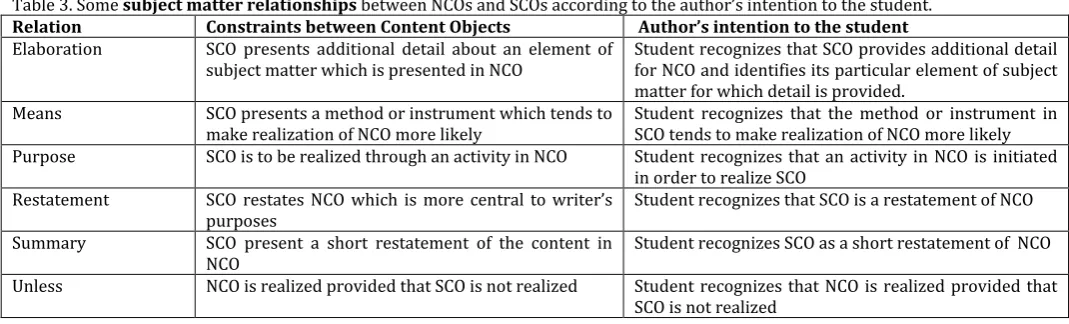
Table 3. Some subject matter relationships between NCOs and SCOs according to the author’s intention to the student.
Relation Constraints between Content Objects Author’s intention to the student
Elaboration SCO presents additional detail about an element of subject matter which is presented in NCO
Student recognizes that SCO provides additional detail for NCO and identifies its particular element of subject matter for which detail is provided.
Means SCO presents a method or instrument which tends to make realization of NCO more likely
Student recognizes that the method or instrument in SCO tends to make realization of NCO more likely Purpose SCO is to be realized through an activity in NCO Student recognizes that an activity in NCO is initiated
in order to realize SCO Restatement SCO restates NCO which is more central to writer’s
purposes
Student recognizes that SCO is a restatement of NCO
Summary SCO present a short restatement of the content in NCO
Student recognizes SCO as a short restatement of NCO