The Effects of Job involvement and Professional Commitment on Organizational
Citizenship Behaviour: (A conceptual framework).
Author’s Details:
(1)Mazin Aledeinat (Correspondence Author) (2)Mohammad Harith (3)Muhammad Shahar
(1) (2) (3)
University Malaysia Perlis
Abstract
Business today has become so competitive that most organizations strive to enhance the efficiency and effectiveness of their employees so that they can achieve excellence. . One of the ways through which these organizations can achieve this is through the behaviors of their employees. It has been noted by several researchers that organizational citizenship behavior is a workplace behavior, which is optional because when individuals engage in this kind of behavior they voluntarily do more than is, expected of them for the organization and this in turn increases their performance as well as that of the entire organization. It has been mentioned by many researchers that job involvement and professional commitment support are two factors that can significantly affect the sustainability of organizations as well as the organizational citizenship behavior while increasing the competitive advantage of the organization. Based on the fact organizations strive to support their employees as well as strengthen their commitment. In general, findings of past studies have argued that organizational citizenship behaviour is directly determined by job involvement and professional commitment. By highlighting the effects of job involvement and professional commitment on the organizational citizenship behaviour, the direct and indirect effects on employee performance are explained in this article.
Keywords: Job involvement, Professional Commitment, Organizational Citizenship Behaviour.
1. Introduction
Motivating and managing employees in an organization remains one of the major challenges faced by leaders in a highly competitive world. Thus, for the competitive advantage of an organization to be sustained, the effective management of human resources alongside their attitudes is crucial (Ibrahim, Ghani, & Embat, 2013). In this regard, job attitude is being considered by Judge and Kammeyer-Mueller (2012) as a crucial and central aspect of employee behaviour. They argue that job attitudes are very important because they have the potentials of predicting important behaviour. According to Judge and Robbins (2015), the potential advantages of employee attitude and behaviours to the individual and the organization are the driving force for the increasing interest in organizational topics related with behaviour and attitude. Hettiararchchi and Jayarathna (2014), posit that the concepts work attitude have become popular because of its relationship with different employee behaviours. Thus, an employee that is satisfied and committed is less likely to exhibit poor performance because he/she is usually highly productive as they identify with values and goals of the organization (Hettiararchchi & Jayarathna, 2014).
Basically, it is important to note that the attitudes of human resources to their work is very important and that there are so many challenges associated to these attitudes including the inability of management to deal with such work related attitudes and how they affect the behaviour and performance of employees (Emami, Alizadeh, Nazari, & Darvishi, 2012). More so, Jain et al., (2011) approve that other fields of study such as the relationship between work-related attitude and organizational citizenship behaviour can benefit from the increasing interest in organizational citizenship behavior (OCB).
organizational citizenship behaviour can be predicted by appropriate job involvement rather than role-required tasks (Somers and Birnbaum, 1998). A review of the existing literature shows that few studies that have been conducted to examine the relationship between job involvement and organizational citizenship behaviour found a positive relationship between the two variables (Chughtai, 2008; Cohen, 2006; Rotenberry & Moberg, 2007).
Professional commitment is another concept which is parallel to the concept of organizational commitment as well as the manner in which ones attitude towards his/her organization may be affected by ones professional attitude (Özdem, 2012). This implies that individuals may not be committed to their organization even if they are committed to their work (Ceylan & Bayram, 2006). It has been revealed that individuals are more willing to maintain their professional membership and go beyond the boundaries in their profession while strongly identifying with their professional goals, if they have high level of professional commitment (Chang et al., 2015).
Kannan & Pillai, (2008) confirmed that the work behavior of people could be determined by professional commitment. It has also been found that professional commitment is correlated with organizational and professional outcomes like reduced turnover, work performance and job satisfaction (Elias, 2006). Thus, individuals whose level of professional commitment is high, tend to engage more in activities that are of benefit to the organizations; this finding has been validated in a study which was carried out in health organizations (Caricati et al., 2014)
Researchers emphasized the importance of job involvement and professional commitment in the relationship between organization and employees; the manner in which work attitude and employee behaviours is affected by the relationship between employees and organization is explained using the social exchange theory. This theory provides an explanation for the mutual exchange relationships agreed upon by different parties such as employer and employee (Cook, Cheshire, Rice, & Nakagawa, 2013). The postulates that parties go into exchange relationships expecting to be rewarded while maintaining the relationship (Melián-González, 2016). According to Miles (2012) since in social exchange theory, each party possesses something valuable, which the other needs, both parties reach an agreement on what to exchange and in what quantities. However, inequalities in the employment relationship can be caused by negative imbalance in the relationship. Therefore, employees feel happy and appreciated when they are rewarded by their organizations. This makes them to give more support to their organization, feel satisfied with their jobs, and exhibit positive attitudes and behaviours.
role behaviours and in-role behaviours are the two main classifications of individual behaviours. Extra-role behaviours include behaviours like helping new colleagues, rendering assistance to colleagues with much work and promoting the organization (Dash & Pradhan, 2013). Researchers have defined organizational citizenship behaviour as behaviours that are voluntarily exhibited by employees; the performance of the individuals and that of the organization can be improved through this optional behaviour (Dash & Pradhan, 2013; Kevin, 2016; Rose, Miller, & Kacirek, 2016). Organizational citizenship behaviour can affect individual performances in negative and positive ways (Dash & Pradhan, 2013). More so, the overall performance of the organization can be impacted by organizational citizenship behaviour which influences individual behaviours (Coldwell & Callaghan, 2014; Jain, Giga, & Cooper, 2011; Van Dooren, Bouckaert, & Halligan, 2015). Some researchers have argued that the theoretical and practical aspect of organizational citizenship behaviour can provide insight on the significance of social connections within societies (Bergeron, Ostroff, Schroeder, Block, 2014; Rose, 2016).
1. Theoretical Background
1.1Job Involvement and Organizational Citizenship Behaviour
autonomy of employees at workplace increases and they are able to participate in decision making and problem-solving (Willard, 2012). Due to this autonomy and empowerment of employees, it is expected that employees will be more committed, motivated, productive and satisfied with their work. Based on the outcome of employee involvement, contemporary management has made it a basic practice to allow their employees participate in decision-making process, gain sharing and quality circles (Willard, 2012).
Tatlah, Ali & Saeed (2011), argue that when employee involvement is encouraged by organizations, there will be a downward movement of decision-making power within the organization, which leads to accountability and authority sharing in the organization. Concurrently, job involvement is regarded as a major factor which influences significant organizational and individual outcomes (Zhang, 2014). High level of involvement is a response to emotional need rather than rational need, because through job involvement employees become emotionally attached to an organization. For instance, a managerial position is very tasking, so managers often remain at work after normal working hours to get things done; this implies extreme involvement (Permarupan, Al-Mamun, & Saufi, 2013). A conclusion was made by Sofijanova and Zabijakin-Chatleska (2013) that, there is a positive correlation between effective use of employee involvement and perceived organizational performance. In the literature, job involvement has positive organizational impacts as it influences the extent to which an employee supports the goals of the organization, thereby leading to an increase in efficiency and productivity (Brown & Leigh, 1996).
Chu et al., (2005) who carried out a study in one of Taiwan’s health care institutions which is a non-western location, found that the organizational citizenship behavior of hospital nurses was influenced by antecedents such as social support, job satisfaction, procedural justices and job involvement. An understanding of the cross-cultural dimensions of organizational citizenship behavior can be enhanced through the finding of this study since it was carried out in a non-Western site in one of Taiwan’s health care institutions.
Rotenberry and Moberg (2007) posits that both forms of organizational citizenship behavior are predicted by job involvement. Findings of the study conducted by Chughtai (2008) supports this position as it revealed the there is a positive relationship between both in-role job performance and organizational citizenship behavior. However, Paillé (2010) who studied organizational citizenship behavior in workplace by examining work attitudes as organizational citizenship behavior predictors among French employees, found that organizational citizenship behavior is negatively impacted by job involvement. A study which was recently carried out by Zhang (2014), examined the correlation between job involvement and the five dimensions of organizational citizenship behavior among a group of people in the Republic of China. The findings indicated that there is a positive relationship between job involvement and all the dimensions of organizational citizenship behavior.
1.2Professional Commitment and Organizational Citizenship Behaviour
Professional commitment as defined by Morrow and Wirth (1989) is the psychological attachment and identification with one’s profession. It has been revealed that individuals are more willing to maintain their professional membership, and go beyond the boundaries in their profession while strongly identifying with their professional goals, if they have high level of professional commitment (Chang et al., 2015). It is clear that, the concept of professional commitment is related to professional identity, being patriotic to the profession, being committed to the values, objectives, norms and ethics of the profession (Sharma, Bisht, & Chopra, 2013). In recent times, the focus on professionalism has been emphasized due to the increase in technology and knowledge which has resulted into the movement toward workplace specialization. This has also resulted in the increase of the number of professionals and specialists (Singh & B. Gupta, 2015).
determined to explain the OCB perceptions of the teachers at the rate of 33% and 9%, respectively. This means that the teachers demonstrated higher level of professional commitment than organizational commitment.
Cohen and Kol (2004) showed that professionalism, and in particular when the dimension profession is used as referent, is a predictor of altruism and compliance dimensions of OCB. A recent study done by Duarte (2015) showed how organizational commitment and professional commitment are related with nurses’ OCB. Data from a sample of 420 nurses working in two hospitals were collected. The main findings are as follows: (a) organizational commitment and professional commitment contribute to the explanation of nurses’ OCB, (b) affective professional commitment, affective organizational commitment; personal sacrifice, continuance organizational commitment, and continuance professional commitment explain 28.6% of variance of OCB.
2. Model Development
According to Baran,Shanock & Miller (2012), it is of great importance to study the factors that determine the relationship between employees and the organization which makes the employees feel committed to their organization (Baran, Shanock, & Miller, 2012). A review of literature has revealed the existence of little of findings on the effect of job involvement on organizational citizenship behaviour. Zhang (2014) claimed that a few studies that have examined the relationship between job involvement and organizational citizenship behaviour showed that there is a positive relationship between job involvement and organizational citizenship behaviour (Chughtai, 2008; Rotenberry & Moberg, 2007). For instance, Munene (1995) found a positive relationship between job involvement and conscientiousness component of supervisor-rated organizational citizenship behaviour. Meanwhile, Somers and Birnbaum (1998) found a weak but significant correlation between job involvement and organizational citizenship behaviour.
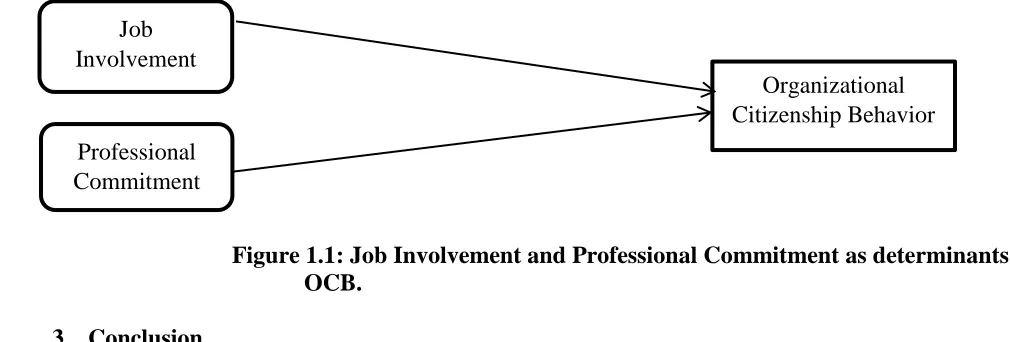
In addition, previous studies have found a correlation between professional commitment and improved attention, client service. Job involvement and technical performance (Anderson, Hair, & Todero, 2012; Duffy, Dik, & Steger, 2011; Kim & Brymer, 2011). The findings of a study carried out by Özdem (2012) revealed that compared to organizational commitment, professional commitment is more correlated with organizational citizenship behavior. Despite this finding, just little attention has been given to the relationship between professional commitment and organizational citizenship behaviour with much negligence coming from the trending paradigm in the literature of management in relation to the correlation between professional commitment and organizational citizenship behaviour (Duarte, 2015; Özdem, 2012). Therefore, this study is carried out to examine job involvement and professional commitment as a determining factor of organizational citizenship behaviour based on the recommendations of other researchers and inadequate specific studies. By examining the effect of job involvement and professional commitment on organizational citizenship behaviour, this study seeks to identify and bridge the possible gaps that might have a consequence on the current study.
Figure 1.1: Job Involvement and Professional Commitment as determinants of OCB.
3. Conclusion
Job Involvement
Professional Commitment
Based on the review of literature on job involvement, professional commitment as determinants of organizational citizenship behaviour there are scares of studies regarding the effect of job involvement and professional commitment on citizenship behaviour. The current literature highlights job involvement and professional commitment as factors that significantly influence organizational citizenship behaviour.
Previous results for (Chu et al. 2005; Chughtai, 2008; Zhang, 2014) studies confirmed that greater job involvement would generate a higher OCB. This indicates that employee involvement motivates and empowers employees to make their contribution to individual and organizational performance. In other words, employee involvement gives employees autonomy at workplace, which lets them participate in decision-making, problem solving and extra role behavior (Willard, 2012). More so, a high level of involvement is a response to emotional need rather than rational need, because through job involvement employees become emotionally attached to an organization (Permarupan, Al-Mamun, & Saufi, 2013).
On the other hand, researchers found a significant positive effect of professional commitment on organizational citizenship behavior (Caricati et al., 2014; Kannan & Pillai, 2008; Özdem, 2012). In addition, when employee committed to their profession they are more willing to display organizational citizenship behavior. For example, Duarte (2015) revealed that the development of nursing profession could be enhanced through the provision of the Code of Practice for Portuguese Nurses and the Code of Ethics for Nurses, which states the principles of this profession. Through these normative tools, nurses are able to help their colleagues while maintaining a high standard personal conduct for the dignity of the profession. Such behaviours can be regarded as the behaviour, which is referred to as organizational citizenship behaviour in the literature. Furthermore, previous study has found that there is a correlation between professional commitment and organizational and professional outcomes such as work performance (Elias, 2006).
As a result of the rapid global change, organizations are working hard to learn as well as teach their employees organizational behaviour that will help the organization adapt and thrive successfully in the global competitive marketplace which is continually changing. In this regard, it is expected that employees go beyond their roles, job descriptions and duties to enhance the overall performance of the organization. Managers of organizations are in need of such employees who can go beyond their job boundaries to ensure that the performance of the organization is excellent. This kind of behaviour displayed by employees also gives room for the development of organizational citizenship behaviour. In addition to that, understanding the principle of reciprocity guarantees the reciprocation of benefit by the other party (Yadav & Rangnekar, 2014). Hence, Settoon et al. (1996) argued that it is based on exchange relationships that employees benefit from support and resources. Similarly, organizations benefit from behaviours and attitudes of employee related to quality workplace exchanges. Therefore, this model examined this reciprocity relationship and found that individuals are driven by the principles of social exchange theory to demonstrate organizational citizenship behaviour even without being assured of any formal reward from the other party. It can therefore be concluded that this study contributes to the literature on job involvement, professional commitment and organizational citizenship behaviour. This study indicates that job involvement, professional commitment are major determinants of citizenship behaviours. Thus, organizations should give priority to employee involvement as well as enhance their professional commitment, which will in turn motivate them to be willing to perform extra roles outside their job descriptions in order to achieve the goals of the organization.
References:
i. Anderson, G., Hair, C., & Todero, C. (2012). Nurse residency programs: An evidence-based review of theory, process, and outcomes. Journal of Professional Nursing, 28(4), 203-212.
ii. Baran, B. E., Shanock, L. R., & Miller, L. R. (2012). Advancing organizational support theory into the twenty-first century world of work. Journal of Business and Psychology, 27(2), 123-147.
iv. Brown, S. P., & Leigh, T. W. (1996). A new look at psychological climate and its relationship to job involvement, effort, and performance. Journal of applied psychology, 81(4), 358.
v. Caricati, L., Sala, R. L., Marletta, G., Pelosi, G., Ampollini, M., Fabbri, A., . . . Mancini, T. (2014). Work climate, work values and professional commitment as predictors of job satisfaction in nurses. Journal of nursing management, 22(8), 984-994.
vi. Ceylan, C., & Bayram, N. (2006). MESLEKİ BAĞLILIĞIN ÖRGÜTSEL BAĞLILIK VE ÖRGÜTTEN AYRILMA
NİYETİ ÜZERİNE ETKİLERİNİN DÜZENLEYİCİ DEĞİŞKENLİ ÇOKLU REGRESYON İLE ANALİZİ. Atatürk Üniversitesi İktisadi ve İdari Bilimler Dergisi, 20(1).
vii. Chang, Liao, S.-H., Lee, Y.-J., & Lo, W.-P. (2015). Organizational commitment, knowledge sharing and organizational citizenship behaviour: the case of the Taiwanese semiconductor industry. Knowledge Management Research & Practice, 13(3), 299-310.
viii. Chughtai, A. A. (2008). Impact of job involvement on in-role job performance and organizational citizenship behaviour. Journal of Behavioral and Applied Management, 9(2), 169.
ix. Chu, Lee, Hsu, & Chen. (2005). Clarification of the Antecedents of Hospital Nurse Organizational Citizenship Behavior-An Example From a Taiwan Regional Hospital. Journal of Nursing Research, 13(4), 313-324.
x. Cohen, A. (2006). The relationship between multiple commitments and organizational citizenship behavior in Arab and Jewish culture. Journal of vocational Behavior, 69(1), 105-118.
xi. Cohen, A., & Kol, Y. (2004). Professionalism and organizational citizenship behavior: An empirical examination among Israeli nurses. Journal of Managerial Psychology, 19(4), 386-405.
xii. Cook, K. S., Cheshire, C., Rice, E. R., & Nakagawa, S. (2013). Social exchange theory Handbook of social psychology (pp. 61-88): Springer.
xiii. Coldwell, D. A. L., & Callaghan, C. W. (2014). Specific Organizational Citizenship Behaviours and Organizational Effectiveness: The Development of a Conceptual Heuristic Device. Journal for the Theory of Social Behaviour, 44(3), 347-367.
xiv. Dash, S., & Pradhan, R. K. (2013). Determinants & Consequences of Organizational Citizenship Behavior: A Theoretical Framework for Indian Manufacturing Organisations. International Journal of Business and Management Invention. 3 (1), 17-21, 2319, 8028.
xv. Duffy, R. D., Dik, B. J., & Steger, M. F. (2011). Calling and work-related outcomes: Career commitment as a mediator. Journal of vocational Behavior, 78(2), 210-218.
xvi. Duarte, M. B. (2015). Organisational and professional commitments: The influence in nurses’ organisational citizenship behaviours. Tékhne, 13(1), 2-11.
xvii. Elias, R. Z. (2006). The impact of professional commitment and anticipatory socialization on accounting students’ ethical orientation. Journal of Business Ethics, 68(1), 83-90.
xviii. Emami, M., Alizadeh, Z., Nazari, K., & Darvishi, S. (2012). Antecedents and consequences of organisational citizenship behaviour (OCB). Interdisciplinary Journal of Contemporary Research in Business, 3(9).
xix. Feldt, T., Hyvönen, K., Oja-Lipasti, T., Kinnunen, U., & Salmela-Aro, K. (2012). Do work ability and job involvement channel later personal goals in retirement? An 11-year follow-up study. International archives of occupational and environmental health, 85(5), 547-558
xx. Hettiararchchi, H., & Jayarathna, S. (2014). The effect of Employee Work Related Attitudes on Employee Job Performance: A Study of Tertiary and Vocational Education Sector in Sri Lanka.
xxi. Ibrahim, R. M., Ghani, M. A., & Embat, A. M. M. S. (2013). Organizational Citizenship Behavior among Local Government Employees in East Coast Malaysia: A Pilot Study. International Business Research, 6(6), 83.
xxii. Jain, A. K., Giga, S. I., & Cooper, C. L. (2011). Social power as a means of increasing personal and organizational effectiveness: The mediating role of organizational citizenship behavior. Journal of Management & Organization, 17(03), 412-432.
xxiii. Judge, T. A., & Kammeyer-Mueller, J. D. (2012). Job attitudes. Annual review of psychology, 63, 341-367. xxiv. Judge, T. A., & Robbins, S. P. (2015). Essentials of organizational behavior: Pearson.
xxv. Kannan, R., & Pillai, M. (2008). An examination on the professional commitment of engineering college teachers. international business management, 2(6), 218-224.
xxvii. Kim, & Brymer, R. (2011). The effects of ethical leadership on manager job satisfaction, commitment, behavioral outcomes, and firm performance. International Journal of Hospitality Management, 30(4), 1020-1026.
xxviii. Melián-González, S. (2016). An extended model of the interaction between work-related attitudes and job performance. International Journal of Productivity and Performance Management, 65(1), 42-57.
xxix. Miles, J. A. (2012). Management and organization theory: a Jossey-Bass reader (Vol. 9): John Wiley & Sons xxx. Morrow, P. C., & Wirth, R. E. (1989). Work commitment among salaried professionals. Journal of vocational
Behavior, 34(1), 40-56.
xxxi. Munene, J. C. (1995). ‘Not‐on‐seat’: An Investigation of Some Correlates of Organisational Citizenship Behaviour in Nigeria. Applied psychology, 44(2), 111-122.
xxxii. Özdem, G. (2012). The relationship between the organizational citizenship behaviors and the organizational and professional commitments of secondary school teachers. Journal of Global Strategic Management.
xxxiii. Paillé, P. (2010). Citizenship in the workplace: examining work attitudes as predictors among French employee. International Journal of Business and Management, 5(4), 53.
xxxiv. Permarupan, P. Y., Al-Mamun, A., & Saufi, R. A. (2013). Quality of work life on employees job Involvement and affective commitment between the public and private sector in Malaysia. Asian Social Science, 9(7), 268.
xxxv. Rose, K., Miller, M. T., & Kacirek, K. (2016). ORGANIZATIONAL CITIZENSHIP BEHAVIOR IN HIGHER EDUCATION: EXAMINING THE RELATIONSHIPS BETWEEN BEHAVIORS AND INSTITUTIONAL PERFORMANCE. AMERICAN ASSOCIATION OF UNIVERSITY ADMINISTRATORS, 31(1), 14-27.
xxxvi. Rotenberry, P. F., & Moberg, P. J. (2007). Assessing the impact of job involvement on performance. Management research news, 30(3), 203-215.
xxxvii. Settoon, R. P., Bennett, N., & Liden, R. C. (1996). Social exchange in organizations: Perceived organizational support, leader–member exchange, and employee reciprocity. Journal of applied psychology, 81(3), 219
xxxviii. Sharma, A., Bisht, D., & Chopra, V. (2013). Professional competence and commitment of teachers: Need of the hour. Shikshan Anveshika, 3(2), 50-55.
xxxix. Singh, N., & d Kolekar, B. (2015). MEASUREMENT OF ATTRIBUTES OF ORGANIZATIONAL CITIZENSHIP
BEHAVIOUR IN ACADEMICIANS. Journal Impact Factor, 6(3), 24-33.
xl. Sofijanova, E., & Zabijakin-Chatleska, V. (2013). Employee involvement and organizational performance: evidence from the manufacturing sector in Republic of Macedonia.
xli. Somers, M. J., & Birnbaum, D. (1998). Work-related commitment and job performance: It's also the nature of the performance that counts. Journal of Organizational Behavior, 621-634.
xlii. Tatlah, I. A., Ali, Z., & Saeed, M. (2011). Leadership behavior and organizational commitment: An empirical study of educational professionals. International Journal of Academic Research, 3(2).
xliii. Van Dooren, W., Bouckaert, G., & Halligan, J. (2015). Performance management in the public sector: Routledge. xliv. Yadav, M., & Rangnekar, S. (2014). Job Satisfaction as Mediator of Association between Role Clarity and
Organisational Citizenship Behaviour. Review of HRM, 3, 156.
xlv. Willard, B. (2012). The new sustainability advantage: seven business case benefits of a triple bottom line: New Society Publishers.