AbstrAct
Introduction Children engage in a high volume of sitting in school, particularly in the classroom. A number of strategies, such as physically active lessons (termed movement integration (MI)), have been developed to integrate physical activity into this learning environment; however, no single approach is likely to meet the needs of all pupils and teachers. This protocol outlines an implementation study of a primary school-based MI intervention: CLASS PAL (Physically Active Learning) programme. This study aims to (A) determine the degree of implementation of CLASS PAL, (B) identify processes by which teachers and schools implement CLASS PAL and (C) investigate individual (pupil and teacher) level and school-level characteristics associated with implementation of CLASS PAL.
Methods and analysis The intervention will provide teachers with a professional development workshop and a bespoke teaching resources website. The study will use a single group before-and-after design, strengthened by multiple interim measurements. Six state-funded primary schools will be recruited within Leicestershire, UK. Evaluation data will be collected prior to implementation and at four discrete time points during implementation: At measurement 0 (October 2016), school, teacher and pupil characteristics will be collected. At measurements 0 and 3 (June–July 2017), accelerometry, cognitive functioning, self-reported sitting and classroom engagement data will be collected. At measurements 1(December 2016–March 2017) and 3 , teacher interviews (also at measurement 4; September–October 2017) and pupil focus groups will be conducted, and at measurements 1 and 2 (April–May 2017), classroom observations. Implementation will be captured through website analytics and ongoing teacher completed logs.
Ethics and dissemination Ethical approval was obtained through the Loughborough University Human Participants Ethics Sub-Committee (Reference number: R16-P115). Findings will be disseminated via practitioner
and/or research journals and to relevant regional and national stakeholders through print and online media and dissemination event(s).
IntroductIon
There is now good evidence to suggest high amounts of sedentary behaviour (ie, sitting/reclining activities during waking hours requiring low energy expenditure1)
during adulthood pose a distinct risk for a range of negative health outcomes including type 2 diabetes, cardiovascular disease and all-cause mortality, even when accounting for participation in moderate-to-vigorous physical activity (MVPA).2 3 Evidence for
such associations in children is more limited; however, cross-sectional analyses have shown associations between screen-based seden-tary behaviour and lower cardiorespiratory fitness,4 increased accelerometer assessed
sedentary time and lower HDL cholesterol5
and higher fasting insulin.6
During weekdays, primary school children spend the majority of their waking hours at school, where between 50% and 70% of time is spent sitting.7–9 This has led to calls
Study design and protocol for a mixed
methods evaluation of an intervention
to reduce and break up sitting time in
primary school classrooms in the UK:
The CLASS PAL (Physically Active
Learning) Programme
Ash C Routen,1 Stuart J H Biddle,2,3 Danielle H Bodicoat,4,5 Lorraine Cale,1
Stacy Clemes,1 Charlotte L Edwardson,4,5 Cris Glazebrook,6
Deirdre M Harrington,4,5 Kamlesh Khunti,4,5 Natalie Pearson,1 Jo Salmon,7
Lauren B Sherar1
To cite: Routen AC, Biddle SJH, Bodicoat DH, et al. Study design and protocol for a mixed methods evaluation of an intervention to reduce and break up sitting time in primary school classrooms in the UK: The CLASS PAL (Physically Active Learning) Programme. BMJ Open 2017;7:e019428. doi:10.1136/ bmjopen-2017-019428
►Prepublication history for this paper is available online. To view these files please visit the journal online (http:// dx. doi. org/ 10. 1136/ bmjopen- 2017- 019428).
Received 1 September 2017 Accepted 19 September 2017
For numbered affiliations see end of article.
correspondence to Dr Lauren B Sherar; L. B. Sherar@ lboro. ac. uk
strengths and limitations of this study
► Intervention coproduced with schools and teachers. ► Evaluation over whole school year.
► Use of mixed methods to capture implementation information.
by some researchers for interventions to change the way children ‘work’ in schools.8 10 While time outside of
school has been shown to be increasingly sedentary, and more so than during school hours, schools provide easier access and maximum reach for intervention efforts.11 12
The potential for exposure to prolonged sitting in the classroom clearly presents a notable opportunity to inter-vene on children’s daily sitting behaviour by integrating physical activity into normal classroom instruction time (termed movement integration (MI)).
A number of MI interventions have been evaluated for effectiveness in recent years. These include short duration activity breaks (often referred to as ‘fitness breaks’),13 14 longer duration activity breaks that
incorpo-rate academic content15 and more comprehensive
phys-ically active academic lessons that deliver curriculum content through movement.16 17 A systematic review of
11 MI interventions showed encouraging preliminary evidence of improved daily physical activity and educa-tional outcomes.18 Other studies have also shown
reduc-tions in classroom sedentary time and small increases in MVPA.19 20 Furthermore, more recent randomised
controlled trials have shown improvements in academic achievement in some subjects (numeracy and literacy)21
,particularly for lower achieving students22 , following
participation in physically active lessons. While the review and studies cited above are encouraging and present an optimistic picture in relation to positive outcomes, there is a notable lack of evidence on how to translate these MI interventions into everyday (or routine) classroom practice.
Within the field of public health, there is rapidly growing recognition of a long history of failure to transfer or replicate evidence-based approaches, developed in controlled settings, to the complexity, diversity and dyna-mism of ‘real world’ settings.23 In response, the field of
implementation research has developed to study the ‘processes used in the implementation of initiatives as well as the contextual factors that affect these processes'.24
Often, however, attempts to study implementation are made via the use of programme theories and expected mechanisms and outcomes, or retrospective process eval-uations,25 none of which explicitly focus on studying the
processes or context of implementation from the outset. For example, process evaluations have largely focused on issues such as fidelity or programme acceptability,20
as opposed to identifying factors that contributed to, or conversely constrained, implementation of the tion. In addition, the majority of physical activity interven-tion publicainterven-tions over the past three decades have been efficacy trials, and only 3% have included implementa-tion/dissemination studies.26 The uniqueness and
impor-tance of taking an implementation research approach is that it recognises the need for a range of conceptual and methodological tools and methodologies to understand and outline the complex processes of engagement in real-world interventions from the very outset of the concep-tion of an intervenconcep-tion programme.27
An important consideration in implementation research is that of the context (setting, roles, interactions and relationships) that is being intervened on and the plasticity of the intervention (ie, the degree of flexibility possessed by a set of intervention components).25 In
relation to the aforementioned MI interventions, these have generally targeted a single type of strategy, as part of a prescribed approach (eg, 3 × active lessons for 10 weeks), thus having low plasticity.25 Within the school and
teaching context, however, to elicit sustainable changes to classroom teaching practice at population level, teachers will require a more flexible (ie, plastic) intervention approach. For example, whereby they can use MI strat-egies that fit the particular needs of their class at a given time (eg, using a brief active break to re-engage a group of students who are off-task or to transition from one subject area to another).
The CLASS PAL (Physically Active Learning) programme was based on some of the core principles from previously published Active Learning Trials, namely The Virtual Traveler28 and Transform-Us!,29 30 and
devel-oped in collaboration with a range of school stakeholders to support primary school teachers in the integration of various modes of MI as matter of routine practice. The evaluation of the programme will help to understand implementation processes and further facilitate its devel-opment as an MI intervention that is sensitive to indi-vidual school contexts and that has inherent plasticity.
Aim
The purpose of this paper is to outline the protocol for an implementation study of a primary school-based MI intervention: CLASS PAL (Physically Active Learning) programme. The objectives of this study are to: (A) deter-mine the degree of implementation of CLASS PAL, (B) identify the processes by which teachers and schools implement CLASS PAL and (C) investigate the individual (pupil and teacher) level and school level characteristics associated with implementation of CLASS PAL.
MEthods And AnAlysEs study design
CLASS PAL is a MI intervention that incorporates a 1-day continuing professional development (CPD) workshop for teachers, alongside a website with a bank of teaching resources (www. classpal. org. uk). Participating teachers will attend the workshop in October 2016, and the study will follow these teachers and their class pupils until the end of the school academic year in July 2017 and teachers alone until the start of the following academic year in September/October 2017. Implementation research needs multimethod approaches to support the consid-erable complexity of stages and processes.31 Thus, it was
on actions, inputs, resources and attitudes required for its successful implementation. Data will be collected at measurement 0 (before the CPD workshop), and then at four time points during the implementation period.
recruitment and study participants
Six state-funded primary schools from the county of Leicestershire (UK) will be recruited to participate in the evaluation. Where possible, all year five classes (children aged 9–10 years) and their teachers from each school will participate. Year 5 students were selected because when consulted in the preparatory phase of the intervention, teachers felt that children spent more time sitting as they progressed through primary school, which has also been supported in the literature.32 Year 6 students were not
considered as the pressures from standarised tests were deemed a challenge when piloting a new teaching style. If a class has mixed year groups (eg, year 5 and year 6 combined), they will still be eligible. Schools will be recruited via a face-to-face meeting with head teachers, facilitated by a Teaching School Alliancei. Recruiting
via this Alliance enabled strong working relationships to be built with schools during the pilot work for the programme33 and recruitment of a more representative
sample (approximately 85% of primary schools in Leices-tershire are part of an Allianceii, and there are around 600
Alliances nationally34). Schools will be asked to provide an
initial expression of interest, following which they will be categorised into tertiles based on the Income Deprivation Affecting Children Index,35 and then further stratified by
geographic location (eg, rural, town and fringe, urban and so on, identified via http://www. education. gov. uk/ edubase/ home. xhtml) and school size (number of pupils on roll, also identified via EduBase). A minimum of two schools will be selected from each tertile; this will include a range of schools differing in size and geographic loca-tion (ie, rural/urban). Consideraloca-tion will also be given to school’s capacity to take part in the programme; this information will be provided by the Teaching School Alliance.
Following school selection, a telephone call with the head teacher will be arranged to explain the study details further, prior to schools providing formal agreement to participate. After school recruitment, teachers and pupils will then be invited to partici-pate in the evaluation activities of the programme via a letter to parent(s)/guardian(s), parent/guardian information sheet, child information sheet and an opt-out consent form for the parent/guardian (whereby the parent/guardian only returns a signed form if they do not want their child to participate in the evaluation activities). Participating children will
i http://www.affinitytsa.co.uk; Teaching School Alliances are groups
of outstanding schools that work with others to provide high-quality training and development to new and experienced schools/school staff.
ii Personal Communication with management staff at Affinity Teaching
School Alliance.
also be asked to sign an assent form prior to the first data collection session.
Intervention
Intervention development
CLASS PAL is designed to provide primary school teachers with the training and teaching resources neces-sary to implement any kind of MI on a regular basis. This could include active routines (eg, ‘Stand up, Hand up’), activity breaks (eg, dancing to YouTube video), activity breaks incorporating academic content (eg, jumping to solve mathematical sums) or more compre-hensive physically active academic lessons (eg, physically embodying punctuation marks as teacher reads story aloud). Teachers will be advised to implement activities as a matter of everyday routine, when they see utility and as and where feasible. There will be no prescription regarding the frequency, duration or type of classroom physical activities; however, teachers will be encouraged to set personalised goals. This is designed to replicate how teachers would likely implement MI in a real-world setting.
An initial intervention concept of a professional devel-opment workshop and supporting teaching resources was developed from formative qualitative interviews and focus groups with 25 primary school teachers and 10 pupils in Leicestershire. Following this preliminary qualitative work, a coproduction development phase was conducted with a different group of seven teachers from six schools in Leicestershire between April and July 2016.33 This process was also facilitated by the
Youth Sport Trust,iii who were commissioned to aid in
supporting the resource and workshop development and delivery. During this phase, the teachers attended a programme launch at the National Centre for Sport and Exercise Medicine at Loughborough University, where they were introduced to the programme and provided with some brief training and a video lesson capture tool (www. irisconnect. co. uk). Following the launch event, teachers then tested the MI strategies, video recorded them and shared them with the research team and pilot group via a secure website, feeding back on any barriers to implementation as well as their training needs. Concurrently, two further coproduction events were held in the schools to identify barriers to implementa-tion of MI, training needs, and to support the teachers’ resource requirements.
behavioural framework
There is evidence that physical activity interventions guided by behavioural theory are more effective and sustainable than those that do not use/specify a theory.36
However, a recent systematic review of physically active lesson interventions identified the limited use
iii The Youth Sport Trust are a national school physical activity/wellbeing
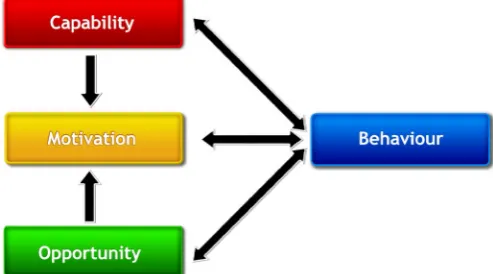
Figure 1 COM-B model of behaviour.
of underpinning behavioural theory.18 Therefore, the
‘co-production’ approach taken to develop the CLASS PAL intervention was guided by a contemporary and overarching model of behavioural theory: the COM-B model37 (shown in figure 1). The COM-B behavioural
system proposes three sources of behaviour: capability, motivation and opportunity. For CLASS PAL, the agent of change for which these sources must be targeted is the classroom teacher.
Capability is defined as ‘the individual's psychological and physical capacity to engage in the activity concerned’. It includes having the necessary knowledge and skills. Motivation is defined as ‘all brain processes that energise and direct behaviour, not just goals and conscious deci-sion-making’. It includes habitual processes, emotional responding, as well as analytical decision-making. Oppor-tunity is defined ‘as all the factors that lie outside the indi-vidual that make the behaviour possible or prompt it’.37
Psychological capability will be addressed in CLASS PAL through professional development training, providing teachers with the necessary knowledge and skills to be able to implement MI. Physical capability will be enhanced through gaining head teacher support for teachers to engage with the programme and have the freedom to alter their teaching practice (and the physical environ-ment if required). Enhancing motivation will be targeted in the teacher training workshop and through the website by providing information on the educational and health benefits of MI and by the provision of a comprehensive set of MI resources through the website. Opportunity will be addressed by ensuring that teaching resources are appropriate/adaptable to accommodate for space and class size constraints and pupils’ needs, with a practical session also included in the workshop to directly address this issue.
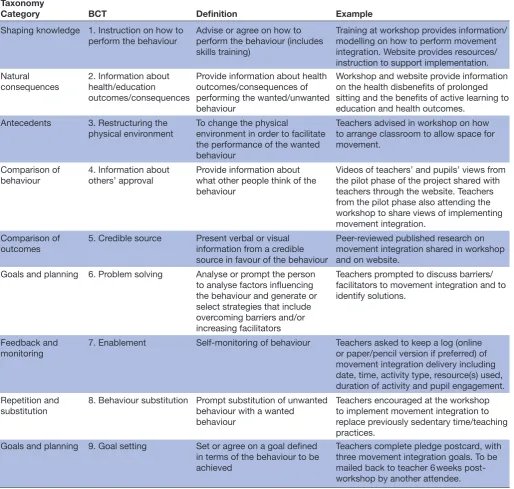
Alongside the COM-B model, taxonomies of behaviour change techniques (BCTs) have been developed to iden-tify active intervention ingredients and allow future inter-ventionists the possibility of replication.38–40 The BCT
that will be used in CLASS PAL are displayed in table 1. The BCT used were based on two prior MI interventions implemented in UK primary schools.16 28 These are
classi-fied using the Behaviour Change Taxonomy V.1.40
Professional development workshop
Following measurement 0 measurements, all partici-pating teachers will be required to attend a 1-day profes-sional development workshop that will be held in the Teaching School Alliance training facility and delivered by two former primary school teachers (Youth Sport Trust employees). Schools will be provided with an honorarium of up to £200 to contribute to supply cover to facilitate teachers’ attendance at the workshop.
The first module of the training will begin with a number of activities designed to facilitate reflection on the charac-teristics of good teaching; the second module will discuss the case for MI from a research and teaching perspective (BCTs 2 and 5; table 1); module three comprises activ-ities focused on overcoming barriers to MI3 6; module
four will include activities to build understanding of the components of a physically active classroom (ie, changes in routines, activity breaks and physically active lessons). Included in this module is an extended group task where the teachers will develop and model physically active lesson ideas mapped to concepts within the National Curriculum for England.1 8 The final workshop module
(five) will include an overview of the CLASS PAL website and a sharing, feedback and future planning/goal setting session.7 This will include writing three MI goals on a
postcard and giving it to another attendee to post back to the individual 6 weeks later.9
Email and telephone contact details of the first author (ACR) will be given to all teachers in the event that more support is required for the intervention or evaluation. All additional contact/support will be logged.
Evaluation procedures
Data collection for the evaluation will take place over 9 months in each of the participating classes. The eval-uation measures will be taken at times convenient for the class teacher, and each data collection session will last approximately 2 hours. Data will be collected on five occasions: at measurement 0 (October 2016), measure-ment 1 (December 2016–March 2017), measuremeasure-ment 2 (April–May 2017), measurement 3 (June–July 2017) and measurement 4 (September–October 2017). Teacher characteristic and school environment data will be collected at measurement 0 only. Pupil questionnaire, anthropometrics (measurement 0 only), objective phys-ical activity data and cognitive functioning data will be collected at measurement 0 and measurement 3 only. At measurement 1 and measurement 2, classroom observa-tions will be conducted, at measurements 1 and 3, pupil focus groups will be conducted and at measurements 1, 3 and 4, teacher interviews will be conducted. During the whole implementation period, teachers will also complete a self-report implementation log and website analytics will be recorded.
Evaluation framework
Table 1 Behaviour change techniques (BCTs) used in the CLASS PAL intervention Taxonomy
Category BCT Definition Example
Shaping knowledge 1. Instruction on how to
perform the behaviour Advise or agree on how to perform the behaviour (includes
skills training)
Training at workshop provides information/ modelling on how to perform movement integration. Website provides resources/ instruction to support implementation. Natural
consequences
2. Information about health/education outcomes/consequences
Provide information about health outcomes/consequences of performing the wanted/unwanted behaviour
Workshop and website provide information on the health disbenefits of prolonged sitting and the benefits of active learning to education and health outcomes.
Antecedents 3. Restructuring the
physical environment To change the physical environment in order to facilitate
the performance of the wanted behaviour
Teachers advised in workshop on how to arrange classroom to allow space for movement.
Comparison of
behaviour 4. Information about others’ approval Provide information about what other people think of the
behaviour
Videos of teachers’ and pupils’ views from the pilot phase of the project shared with teachers through the website. Teachers from the pilot phase also attending the workshop to share views of implementing movement integration.
Comparison of
outcomes 5. Credible source Present verbal or visual information from a credible
source in favour of the behaviour
Peer-reviewed published research on movement integration shared in workshop and on website.
Goals and planning 6. Problem solving Analyse or prompt the person
to analyse factors influencing the behaviour and generate or select strategies that include overcoming barriers and/or increasing facilitators
Teachers prompted to discuss barriers/ facilitators to movement integration and to identify solutions.
Feedback and
monitoring 7. Enablement Self-monitoring of behaviour Teachers asked to keep a log (online or paper/pencil version if preferred) of
movement integration delivery including date, time, activity type, resource(s) used, duration of activity and pupil engagement. Repetition and
substitution 8. Behaviour substitution Prompt substitution of unwanted behaviour with a wanted
behaviour
Teachers encouraged at the workshop to implement movement integration to replace previously sedentary time/teaching practices.
Goals and planning 9. Goal setting Set or agree on a goal defined
in terms of the behaviour to be achieved
Teachers complete pledge postcard, with three movement integration goals. To be mailed back to teacher 6 weeks post-workshop by another attendee.
meta-theories such as the Consolidated Framework for Implementation Research.41 The current evaluation
approach does not subscribe to a particular theory or framework but, as mentioned earlier, draws on the fundamental tenets of implementation research, which is the scientific study of the processes used to imple-ment policies and interventions and the contextual factors that affect these processes.24 Furthermore, the
evaluation will focus on five of the eight features of implementation, namely: fidelity of delivery, dosage received, quality, participant responsiveness and adap-tation.27 Fidelity relating to teacher implementation is
considered to be the integrity of MI delivery (ie, delivery includes physical activity in normal classroom time and
delivery is supported by resources from CLASS PAL website). Dosage refers to how much MI the teachers have delivered (ie, frequency, intensity and duration). Quality refers to how well MI is delivered by teachers (ie, engaging MI delivered with careful preparation, clear instruction, designed to overcome barriers and so on). Participant responsiveness refers to the degree to which the delivery of MI engages and/or holds the attention of the pupils. Finally, adaptation refers to the degree of modification by teachers of the CLASS PAL resources and MI principles/recommendations for the implemen-tation of MI.
to the core aims of the training, as well as the quality and dose of delivery received.
Measurements and instruments
All self-report data from the teachers and pupils will be collected via paper-based questionnaires administered in the classroom.
study objective A: to determine the degree of implementation of clAss PAl
Workshop evaluation (fidelity, dosage and quality)
At the end of the intervention workshop, delegates will complete a paper-based evaluation questionnaire including items on the quality of resources, delivery, content, perception of tutors’ knowledge, workshop duration, adequacy of training, teachers’ confidence to deliver MI and suggestions for future improvements.
Teacher log (fidelity and dosage)
Teachers will be asked to complete a log of all delivered MI during the measured implementation period (post-workshop to measurement 3). They will be given a choice to complete this via a hard copy wallpaper chart or via an online survey (www. surveymonkey. co. uk) that can be completed via smartphone, tablet or desktop computer. In addition to recording the date and time of delivery, six questions will be employed to capture information on the type of activity delivered (eg, physically active lesson), supporting resources used (eg, personally developed resource), instruction type (eg, teacher led), duration of the activity and the pupils’ movement response (eg, less than 50% of pupils were active). This will provide data on the frequency and duration (delivery) of activities, as well as the degree of participation (pupil response). These questions have been adapted from the System for Observing Student Movement in Academic Routines and Transitions.42
Direct observation: classroom on-task behaviour and physical activity (fidelity and dosage)
At measurements 1 and 2, on-task behaviour before, during and after MI will be examined using the Observing Teacher and Pupils in Classrooms tool.43 This rates
behaviour as on-task (making eye contact with teacher or task and following teacher’ instructions) or off-task. In addition, the Children’s Activity Rating Scale will be used to code the intensity of physical activity behaviour.44
This tool codes observed activities into five categories of increasing intensity: stationary, stationary with limb or trunk movements, slow movement, moderate move-ment and fast movemove-ment.44 Both observation tools will
be used concurrently during observed class periods to reduce the burden on schools and the researcher. One previously agreed lesson where the teacher is intending to implement a physically active lesson (or activity for a significant portion of the lesson) or series of active breaks will be observed. Classes will be observed (using whole time sampling), for a minimum of 10 min prelesson, during the whole lesson and for a minimum of 10 min
postlesson. Pupils will be observed (scanning from left to right of room and focusing on child in clear sight and closest to left) for 5 s in turn, before the next pupil is observed and data recorded.28 Prior to data collection, an
observer training session will be run, and one observer will collect the data. Inter-rater reliability will be calcu-lated by a second observer viewing a subsample of lessons, with acceptable reliability deemed to be 70% agreement.
Website usage (fidelity)
From Measurement 0 to Measurement 3, website usage data will be tracked using Google Analytics.45 The main
outcomes of focus will be the number, depth (ie, addi-tional further page views in the visit) and duration of unique visits to the resources page by the participating teachers (differentiated from other visitors to the site as access to the resources requires input of login details). The traffic source (ie, referral route and content expo-sure (eg, number of times a particular page served as entrance to the resource section of the website))45 will
also be documented.
study objective b: to identify the processes by which teachers and schools implement clAss PAl
Teacher interview (fidelity, dosage, quality, participant responsiveness and adaptation)
At measurements 1, 3 and 4, teachers will participate in a semistructured interview (face to face or telephone). Interviews will be used to elicit information on the processes of delivery of CLASS PAL, acceptability to the teachers, pupils’ responsiveness and barriers and facilita-tors to implementation. Interviews will last for approxi-mately 30 min and will be recorded using a digital audio recorder and transcribed verbatim.
Pupil focus group (fidelity, dosage, quality and participant responsiveness)
At measurements 1 and 3, a mixed-sex sample of year 5 pupils from each school will participate in semistruc-tured focus groups. Guidelines will be provided to teachers on the selection of pupils to ensure a range in terms of learning style/abilities and character. Questions will explore pupils’ exposure to the intervention, their level of engagement with the intervention and their perceptions of enjoyment, acceptability and dislikes and challenges to participation. Focus groups will last for approximately 40 min, allowing for the building of rapport, and will be recorded using a digital audio recorder and transcribed verbatim.
study objective c: to investigate the individual (pupil and teacher) level and school-level characteristics associated with the quantity of implementation of clAss PAl School
School environment
and sport policies and practices; participation in physical activity or sport initiatives or programmes; and accredita-tion/award schemes. These questions were adapted for the UK context from the International Study of Child-hood Obesity, Lifestyle and the Environment school administrator questionnaire.46
Classroom environment
At measurement 0, the school floor plan will be requested to ascertain the floor space available for MI in the inter-vention classrooms. Available floor space will be expressed as metres squared (m2). During lesson observations at
measurements 1 and 2, photographs/and or sketches and field notes on class layout will also be collected.
Teacher
Demographic, teaching experience and qualifications
At measurement 0, teachers will be asked to provide their name, date of birth, ethnicity, details of their teaching experience/training and qualifications (using a mixture of select response and open-ended questions). This will include, for example, four specific items on prior training in physical education, health, sport, physical activity and MI.
Self-reported physical activity and sedentary behaviour
At measurement 0 and measurement 3, teachers will report on how many days per week they do 30 min of MVPA or more using a single item.47 Weekday sedentary
behaviour will be assessed using the sitting item from the short version of the International Physical Activity Questionnaire.48
MI: current use and competence
At measurement 0 and measurement 3, teachers will report how often they integrate movement into the class-room using a series of six items from the Physical Activity Promotion in the Academic Classroom49 questionnaire. Perceived competence to deliver MI will be captured using an adapted version of the School Physical Activity Promotion Competence Questionnaire.49 The version to be used in the current study defines competence as ‘having the required skills to perform the task effectively (ie, with limited setbacks and well enough to result in desired outcomes)’. The scale uses five items (eg, ‘Create opportunities for my students to safely participate in phys-ical activity in my classroom’) with responses on an eight-point scale (eg, 0=I have no skills in this area, 1–2=I have few skills in this area, 3–4=I have some skills in this area, 5=I have enough skills in this area to be competent, 6–7=I have many skills in this area).49
Pupil
Demographic
At measurement 0, each pupil’s name, date of birth, ethnicity, eligibility for free school meals and home postcode will be collected from school records. Home postcode will be used to calculate the English Index of Multiple Deprivation (IMD).
Anthropometric
At measurement 0, pupils’ height will be measured to the nearest 0.1 cm using a freestanding portable stadiometer (Seca, Leicester, UK) and weight will be measured to the nearest 0.1 kg using electronic weighing scales (Seca 899, Seca). Repeat measurements will be performed for each variable with the second measurement required to be within 0.4 cm or 0.1 kg; otherwise, a third measurement will be taken.50 Body mass index (kg/m2) will be
calcu-lated and expressed as a centile using the British 1990 growth reference data,51 with population monitoring
body mass index cut-points applied to categorise weight status.50
Objective physical activity and sedentary time
At measurement 0 and measurement 3, pupils will be asked to wear an Actigraph accelerometer (GT3X or GT3X+) over the right hip using an elasticated waist band for seven consecutive days during waking hours. Pupils will be instructed to remove the devices when sleeping or during water-based activities to limit discomfort and potential device damage. These generations of Actigraph accelerometer display good accuracy and precision as an objective measure of physical activity and time spent sedentary.52 53
The following variables will be derived from the accel-erometer data using the Evenson intensity cut-points54:
1. Mean minutes of MVPA (school day (eg, 09:00–15:15), total day and weekday and weekend day).
2. Mean minutes of light intensity physical activity (school day, total day and weekday and weekend day). 3. Mean minutes of sedentary time (school day, total day
and weekday and weekend day).
4. Mean total volume of activity per day (counts per wear minute; school day, total day and weekday and weekend day).
Self-reported sedentary behaviour
At measurement 0 and measurement 3, self-reported weekday and weekend sedentary behaviours (outside of school) will be captured using an adapted version of the Adolescent Sedentary Activity Questionnaire.55 Pupils will
report the duration of time they engage in a variety of sedentary behaviours (eg, using the computer for fun, watching TV, sitting around with friends and so on) in their free time on a typical weekday and weekend day.
Classroom engagement
Pupils’ engagement in the classroom will be assessed at measurement 0 and measurement 3, using the pupil self-report Engagement versus Disaffection with Learning scale.56 The scale includes 27 items rated on a 4-point
Likert-type scale to measure emotional engagement, emotional disaffection, behavioural engagement and passive behavioural disaffection.56
Cognitive functioning
concentrate will be evaluated using the d2 test.57 58 The
d2, a cancellation task, consists of 14 lines each containing 48 characters and 658 total items. The task requires indi-viduals to review the contents of each line of letters and to mark all ‘d’s with two dashes’. Twenty seconds per line are allowed, and the total administration time is approx-imately 6 min.57 58 The test will be administered via paper
and pencil to the whole class simultaneously.
AnAlysEs
Descriptive statistics will be used to describe the char-acteristics of the study population. A mixed methods approach will be used to explore implementation based on a convergent parallel design in which qualitative and quantitative data will be collected in parallel, analysed separately and then merged. This will permit an appraisal of the extent to which the two data streams converge, and the combination, which will allow for a more holistic understanding of the implementation of the CLASS PAL intervention.
Study objective A: the purpose of the analysis will be to determine the quantity and quality of implementation of CLASS PAL. Descriptive analyses will be used to present the degree of implementation (obtained from logs and teacher self-report items) over time and also between subgroups. Details on the type of activity delivered, supporting resources used, instruction type, duration of the activity and the pupils’ response will be quantita-tively described using appropriate summary statistics (eg, frequency and percentage for categorical and binary vari-ables, mean and SD for normally distributed continuous variables, and median and IQR for non-normally distrib-uted continuous variables). The direct observation data will be presented to provide additional contextual infor-mation regarding on-task behaviour (before, during and after) and intensity or duration of the MI activities. The CLASS PAL website analytics will be documented over time, and comparisons with the quantity of implementa-tion will be presented.
Quality of implementation will be ascertained from interview data with teachers and pupils as described below.
Study objective B: the purpose of the analysis will be to identify the processes by which teachers and schools implement CLASS PAL. Qualitative interview data from teachers and focus group data from pupils will be tran-scribed verbatim and coded using thematic analysis59 to
determine the acceptability of CLASS PAL and MI more generally, as well as any barriers and facilitators to imple-mentation. Although the interviews will be guided by a focused set of a priori topics, codes will primarily be drawn from the data and formed inductively.
Study objective C: the purpose of the analysis will be to investigate the individual (pupil and teacher) level and school-level characteristics associated with the quantity of implementation of CLASS PAL. Quantity of implemen-tation (via the logs) will be descriptively presented using
appropriate summary statistics for different subgroups (eg, high/low school-level support for physical activity; classroom environment (small/large) and so on). More distal pupil level indicators of implementation will be ascertained through school day accelerometer data.
First, to examine if the level of MI implementation is associated with school day physical activity, a linear multi-level model will be used with school day physical activity (via accelerometer) as the outcome variable, levels to indicate the clustering of pupils within class and within schools and the repeated measurement of physical activity, and a categorical indicator for degree of MI (from logs) as the explanatory variable. Second, to examine factors associated with implementation, potential mediating (eg, perceived competence to deliver MI), moderating (eg, classroom size and classroom engagement) and a priori confounder (eg, IMD) variables will be included.
dIscussIon
This paper has outlined the protocol for a study to inves-tigate the implementation of a MI intervention (CLASS PAL) in UK primary schools. Although there are some multistrategy approaches (eg, Transform-Us!),29 30 many
previous interventions have focused on targeting a single type of strategy,19 21 60 as part of a prescribed approach,
and thus have low plasticity. CLASS PAL provides a more plastic intervention approach, whereby teachers can use MI strategies that fit the particular needs of their class at a given moment. Furthermore, reviews of MI interven-tions have identified a paucity of evidence on the level of implementation achieved and what factors contribute to successful (or otherwise) implementation.18 61 The
present study’s focus on evaluating the implementation of CLASS PAL and its influencing factors will therefore contribute towards closing a notable gap in the literature.
strengths and limitations
The strengths of this study include its pragmatic nature, the recruitment strategy to increase representation, frequency of interim measurements (three) and the mixed methods employed to garner in-depth detail on the degree of real-world implementation. Due to fiscal restraints and the desire to have a reasonable representa-tion of one age group, this evaluarepresenta-tion only included one school year group (year 5), which may limit the appli-cability of the findings across the entire primary school setting and particularly the lower years.
Ethical considerations and dissemination
to participate in the evaluation activities. This form of consent has been used in previous school-based physical activity interventions in the UK.62 Participating children
will also be asked to sign an assent form prior to the first data collection session. Participants will be identifiable only by participant number and will have the right to with-draw from the study without any negative consequences at any time. If protocol alterations are required, permis-sion will be sought from the University Human Partici-pants Ethics Sub-Committee, particiPartici-pants notified, and any amendments reported in consequent publications.
Practical implications of findings are crucial to imple-mentation research. Beyond academic conference presentation and peer-reviewed publication, the find-ings of this study will be disseminated to relevant school stakeholders through a number of regional and national avenues. These include regional Teaching School Alli-ances, regional and national print and online media, a growing social media presence (Twitter) and a 1-day symposium to be held at Loughborough University and to which all relevant stakeholder sectors and policy makers (eg, Public Health England, Ofsted and Department for Education) will be invited.
Author affiliations
1School of Sport, Exercise and Health Sciences, Loughborough University,
Loughborough, UK
2Active Living & Public Health, Institute of Sport, Exercise and Active Living (ISEAL),
Victoria University, Melbourne, Victoria, Australia
3Institute for Resilient Regions, University of Southern Queensland, Springfield,
Queensland, Australia
4Diabetes Research Centre, University of Leicester, Leicester, UK
5The Leicester Biomedical Research Centre, Leicester and Loughborough, UK
6School of Medicine, Division of Psychiatry and Applied Psychology, University of
Nottingham, Nottingham, UK
7Institute for Physical Activity and Nutrition (IPAN), School of Exercise and Nutrition
Sciences, Deakin University, Geelong, Australia
twitter @ashrouten @LaurenSherar1
Acknowledgements We are very grateful to the schools and partners (Youth Sport Trust and Affinity Teaching School Alliance) for their continual willingness to ‘co-produce’ this research. We also acknowledge support from the National Institute for Health Research (NIHR) Leicester Biomedical Research Centre, which is a partnership between University Hospitals of Leicester NHS Trust, Loughborough University and the University of Leicester; and the support of the Leicester Clinical Trials Unit.
contributors LBS, SJHB, DHB, CLE, CG, DMH, KK, JS and NP initially conceived the original study concept and design and obtained funding from the NIHR Collaboration for Leadership in Applied Health Research and Care East Midlands (CLAHRC EM). LBS and ACR wrote the first draft of the manuscript. All listed authors made substantial contributions to enhance the concept and design. All authors contributed to manuscript editing and critical comments. All authors read and approved the final manuscript.
Funding This research is funded by the NIHR Collaboration for Leadership in Applied Health Research and Care East Midlands (CLAHRC EM).
disclaimer The views expressed are those of the author(s) and not necessarily those of the NHS, the NIHR or the Department of Health.
competing interests None declared.
Ethics approval Loughborough University Human Participants Ethics Sub-Committee.
Provenance and peer review Not commissioned; peer reviewed for ethical and funding approval prior to submission.
open Access This is an Open Access article distributed in accordance with the terms of the Creative Commons Attribution (CC BY 4.0) license, which permits others to distribute, remix, adapt and build upon this work, for commercial use, provided the original work is properly cited. See: http:// creativecommons. org/ licenses/ by/ 4. 0/
© Article author(s) (or their employer(s) unless otherwise stated in the text of the article) 2017. All rights reserved. No commercial use is permitted unless otherwise expressly granted.
rEFErEncEs
1. Sedentary Behaviour Research Network. Letter to the editor: standardized use of the terms "sedentary" and "sedentary
behaviours". Appl Physiol Nutr Metab 2012;37:540–2.
2. Biswas A, Oh PI, Faulkner GE, et al. Sedentary time and its
association with risk for disease incidence, mortality, and
hospitalization in adults: a systematic review and meta-analysis. Ann
Intern Med 2015;162:123–32.
3. Wilmot EG, Edwardson CL, Achana FA, et al. Sedentary time in
adults and the association with diabetes, cardiovascular disease
and death: systematic review and meta-analysis. Diabetologia
2012;55:2895–905.
4. Mitchell JA, Pate RR, Blair SN. Screen-based sedentary behavior
and cardiorespiratory fitness from age 11 to 13. Med Sci Sports
Exerc 2012;44:1302–9.
5. Cliff DP, Jones RA, Burrows TL, et al. Volumes and bouts
of sedentary behavior and physical activity: associations
with cardiometabolic health in obese children. Obesity
2014;22:E112–E118.
6. Herrmann SD, Angadi SS. Children's physical activity and
sedentary time and cardiometabolic risk factors. Clin J Sport Med
2013;23:408–9.
7. Clemes SA, Barber SE, Bingham DD, et al. Reducing children's
classroom sitting time using sit-to-stand desks: findings from
pilot studies in UK and Australian primary schools. J Public Health
2016;38:526–33.
8. Abbott RA, Straker LM, Mathiassen SE. Patterning of
children's sedentary time at and away from school. Obesity
2013;21:E131–E133.
9. Aminian S, Hinckson EA, Stewart T. Modifying the classroom
environment to increase standing and reduce sitting. Building
Research & Information 2015;43:631–45.
10. Routen AC. Should our children be sitting comfortably in school?
BMJ 2011;343:d4273.
11. Beck J, Chard CA, Hilzendegen C, et al. In-school versus
out-of-school sedentary behavior patterns in U.S. children. BMC Obes
2016;3:34.
12. Arundell L, Ridgers ND, Veitch J, et al. 5-year changes in
afterschool physical activity and sedentary behavior. Am J Prev Med
2013;44:605–11.
13. Murtagh E, Mulvihill M, Markey O. Bizzy Break! The effect of a classroom-based activity break on in-school physical activity levels
of primary school children. Pediatr Exerc Sci 2013;25:300–7.
14. Drummy C, Murtagh EM, McKee DP, et al. The effect of a classroom
activity break on physical activity levels and adiposity in primary
school children. J Paediatr Child Health 2016;52:745–9.
15. Mahar MT, Murphy SK, Rowe DA, et al. Effects of a classroom-based
program on physical activity and on-task behavior. Med Sci Sports
Exerc 2006;38:2086–94.
16. Martin R, Murtagh EM. Preliminary findings of active
classrooms: an intervention to increase physical activity levels
of primary school children during class time. Teach Teach Educ
2015;52:113–27.
17. Donnelly JE, Greene JL, Gibson CA, et al. Physical Activity Across
the Curriculum (PAAC): a randomized controlled trial to promote physical activity and diminish overweight and obesity in elementary
school children. Prev Med 2009;49:336–41.
18. Norris E, Shelton N, Dunsmuir S, et al. Physically active lessons as
physical activity and educational interventions: a systematic review
of methods and results. Prev Med 2015;72:116–25.
19. Norris E, Shelton N, Dunsmuir S, et al. Virtual field trips as physically
active lessons for children: a pilot study. BMC Public Health
2015;15:366.
20. Riley N, Lubans DR, Morgan PJ, et al. Outcomes and process
evaluation of a programme integrating physical activity into the primary school mathematics curriculum: the EASY minds pilot
21. Mullender-Wijnsma MJ, Hartman E, de Greeff JW, et al. Physically active math and language lessons improve scademic schievement: a
cluster randomized controlled trial. Pediatrics 2016;137:e20152743.
22. Resaland GK, Aadland E, Moe VF, et al. Effects of physical activity on
school children's academic performance: The Active Smarter Kids
(ASK) cluster-randomized controlled trial. Prev Med 2016;91:322–8.
23. Glasgow RE, Emmons KM. How can we increase translation of
research into practice? Types of evidence needed. Annu Rev Public
Health 2007;28:413–33.
24. Peters DH, Tran NT, Adam T. Implementation research in health:
a practical guide. Geneva: World Health Organisation: Alliance for
Health Policy and Systems Research, 2013.
25. May CR, Johnson M, Finch T. Implementation, context and
complexity. Implement Sci 2016;11:141.
26. Milat AJ, Bauman AE, Redman S, et al. Public health research
outputs from efficacy to dissemination: a bibliometric analysis. BMC
Public Health 2011;11:934.
27. Durlak JA, DuPre EP. Implementation matters: a review of research on the influence of implementation on program outcomes and
the factors affecting implementation. Am J Community Psychol
2008;41:327–50.
28. Norris E, Dunsmuir S, Duke-Williams O, et al. Protocol for the 'Virtual Traveller' cluster-randomised controlled trial: a behaviour change intervention to increase physical activity in primary-school maths and
english lessons. BMJ Open 2016;6:e011982.
29. Carson V, Salmon J, Arundell L, et al. Examination of mid-intervention
mediating effects on objectively assessed sedentary time among
children in the Transform-Us! cluster-randomized controlled trial. Int J
Behav Nutr Phys Act 2013;10:62.
30. Salmon J, Arundell L, Hume C, et al. A cluster-randomized controlled
trial to reduce sedentary behavior and promote physical activity and
health of 8-9 year olds: the Transform-Us! study. BMC Public Health
2011;11:759.
31. Kelly B. Implementing implementation science: reviewing the quest to develop methods and frameworks for effective implementation.
Journal of Neurolofy and Psychology 2013;1:5.
32. Cooper AR, Goodman A, Page AS, et al. Objectively measured
physical activity and sedentary time in youth: the International
children's accelerometry database (ICAD). Int J Behav Nutr Phys Act
2015;12:113.
33. Routen AC, Chalkley AE, Sherar LB. Getting a GRIP (getting research into practice) on movement integration in the school classroom.
Physical Therapy Reviews 2017;16:1–8.
34. National College for Teaching and Leadership. Designated Teaching Schools - As at July 2016. 2016.
35. Department for Communities and Local Government. English indices of deprivation 2015. 2016. https://www. gov. uk/ government/ statistics/ english- indices- of- deprivation- 2015 (accessed 30 Nov 2016). 36. Michie S, Abraham C. Interventions to change health behaviours:
evidence-based or evidence-inspired? Psychol Health
2004;19:29–49.
37. Michie S, van Stralen MM, West R. The behaviour change wheel: a new method for characterising and designing behaviour change
interventions. Implement Sci 2011;6:42.
38. Michie S, Fixsen D, Grimshaw JM, et al. Specifying and reporting
complex behaviour change interventions: the need for a scientific
method. Implement Sci 2009;4:40.
39. Michie S, Hyder N, Walia A, et al. Development of a taxonomy of
behaviour change techniques used in individual behavioural support
for smoking cessation. Addict Behav 2011;36.
40. Michie S, Richardson M, Johnston M, et al. The behavior change
technique taxonomy (v1) of 93 hierarchically clustered techniques: building an international consensus for the reporting of behavior
change interventions. Ann Behav Med 2013;46:81–95.
41. Damschroder LJ, Aron DC, Keith RE, et al. Fostering implementation
of health services research findings into practice: a consolidated
framework for advancing implementation science. Implement Sci
2009;4:4.
42. Russ LB, Webster CA, Beets MW, et al. Development of the System
for Observing Student Movement in Academic Routines and
Transitions (SOSMART). Health Educ Behav 2017;44:304–15.
43. Merrett F, Wheldall K. Observing Pupils and Teachers In Classrooms
(OPTIC): a behavioural observation schedule for use in schools. Educ
Psychol 1986;6:57–70.
44. Finn KJ, Specker B. Comparison of actiwatch activity monitor and
Children's Activity Rating Scale in children. Med Sci Sports Exerc
2000;32:1794–7.
45. Crutzen R, Roosjen JL, Poelman J. Using google analytics as a process evaluation method for Internet-delivered interventions: an
example on sexual health. Health Promot Int 2013;28:36–42.
46. Katzmarzyk PT, Barreira TV, Broyles ST, et al. The International Study
of Childhood Obesity, Lifestyle and the Environment (ISCOLE):
design and methods. BMC Public Health 2013;13:900.
47. Milton K, Bull FC, Bauman A. Reliability and validity testing
of a single-item physical activity measure. Br J Sports Med
2011;45:203–8.
48. Rosenberg DE, Bull FC, Marshall AL, et al. Assessment of sedentary
behavior with the International Physical Activity Questionnaire. J
Phys Act Health 2008;5(Suppl 1):S30–S44.
49. Webster CA, Buchan H, Perreault M, et al. An exploratory study of
elementary classroom teachers’ physical activity promotion from a
social learning perspective. Journal of Teaching in Physical Education
2015;34:474–95.
50. Routen AC, Edwards MG, Upton D, et al. The impact of
school-day variation in weight and height on National Child Measurement Programme body mass index-determined weight category in Year 6
children. Child Care Health Dev 2011;37:360–7.
51. Cole TJ, Freeman JV, Preece MA. Body mass index reference curves
for the UK, 1990. Arch Dis Child 1995;73:25–9.
52. Hänggi JM, Phillips LR, Rowlands AV. Validation of the GT3X
ActiGraph in children and comparison with the GT1M ActiGraph. J
Sci Med Sport 2013;16:40–4.
53. Santos-Lozano A, Marín PJ, Torres-Luque G, et al. Technical
variability of the GT3X accelerometer. Med Eng Phys
2012;34:787–90.
54. Evenson KR, Catellier DJ, Gill K, et al. Calibration of two
objective measures of physical activity for children. J Sports Sci
2008;26:1557–65.
55. Hardy LL, Booth ML, Okely AD. The reliability of the Adolescent
Sedentary Activity Questionnaire (ASAQ). Prev Med 2007;45:71–4.
56. Skinner EA, Kindermann TA, Furrer CJ. A Motivational Perspective on Engagement and Disaffection: Conceptualization and Assessment of Children’s Behavioral and Emotional Participation in Academic
Activities in the Classroom. Educ Psychol Meas 2008.
57. Cuesta Izquierdo M, de Iscar Pérez MJ, Begega Losa MA, et al.
Psychometric properties of the d2 selective attention test in a sample
of premature and born-at-term babies. Psicothema 2007;19:706–10.
58. Bates ME, Lemay EP. The d2 Test of attention: construct validity
and extensions in scoring techniques. J Int Neuropsychol Soc
2004;10:392–400.
59. Braun V, Clarke V. Using thematic analysis in psychology. Qual Res
Psychol 2006;3:77–101.
60. Erwin HE, Abel MG, Beighle A, et al. Promoting children's health
through physically active math classes: a pilot study. Health Promot
Pract 2011;12:244–51.
61. Webster CA, Russ L, Vazou S, et al. Integrating movement in
academic classrooms: understanding, applying and advancing the
knowledge base. Obes Rev 2015;16:691–701.
62. Tymms PB, Curtis SE, Routen AC, et al. Clustered randomised
controlled trial of two education interventions designed to increase physical activity and well-being of secondary school students: the