ISSN 0975-928X
Research Article
Combining ability analysis for yield, its components and physiological
traits in rice under sodicity
G.R. Kannan* and S.K. Ganesh
Anbil Dharmalingam Agricultural College and Research Institute, Tiruchirapalli. E-mail: [email protected]
(Received:23 Jun 2015; Accepted:12 Aug 2016)
Abstract
An investigation was carried out in rice (Oryza sativa L.) in line × tester mating design utilizing five lines (ADT 43, BPT 5204, CO (R) 50, ADT 39 and I.W. Ponni) and four testers (TRY (R) 2, FL 478, CSR 23 and CO 43). The estimates of combining ability variances revealed that preponderance of non additive gene action governing all the traits under sodicity. Based on per se performance and gca effects, ADT 43, CO (R) 50, I.W. Ponni, TRY (R) 2 and FL 478 were considered as good general combiners for days to 50 per cent flowering, plant height, number of productive tillers per plant, spikelet fertility, 100 grain weight, single plant yield and Na+: K+ ratio under sodicity. I.W. Ponni × FL 478 cross whose parents were good combiners for most of the traits studied and additive and governed by additive x additive types of gene action. Hence, simple pedigree method of breeding could be employed as an ideal approach to get superior transgressive segregants in the segregating generations.
Key words
Oryza sativa, combining ability, GCA, SCA.
Introduction
Rice is the major cereal food crop of the world and serves as the primary source of staple food for more than half of the global population and will continue to occupy the pivotal place in global food and livelihood security systems (Emani et al., 2008). Rice is grown in more than 154 million hectares in the world in a wide range of ecosystems under varying temperatures and water regimes. India has the largest area under rice (45 million hectares). The population of rice consumers is increasing at a rate of 1.8 per cent annually, as well as the population growth i.e., 1.5 per cent is increasing every year. Hence, the rice requirement by the year 2025 would be about 125 MT (Kumar et al., 2009). A total of 800 million hectares of land throughout the world are salt affected either by salinity (397 million ha) or of sodicity (434 million ha). In Asia alone, 21.5 million ha of land area is thought to be salt affected (of which 12 million ha is due to saline conditions and the remaining 9.5 million ha is due to alkaline / sodic conditions). In India, approximately 7.0 million ha of agricultural land is affected by varying degrees of salt related problems of which about 3.4 million ha is under sodic soils. The problems of soil sodicity, salinity and of poor quality water are likely to increase in near future. The estimates indicate that the salt affected soils will constitute nearly 13 m ha area in the country by 2025 (CSSRI-Vision 2025). Growth and yield components of rice are severely affected by salinity (Akbar et al., 1986). Hence, there is an urgent need to develop short and / or medium duration rice varieties with sodicity tolerance coupled with high yield potential. The knowledge on combining ability analysis is useful to elucidate the nature and magnitude of gene action involved for traits of interest especially for quantitative
traits, which is important for successful development of crop varieties. Line × Tester analysis is a well established biometrical technique to study the per se performance, heterosis and to infer the underlying gene action governing for quantitative traits in many crops including rice.
In this paper an attempt has been made to assess the combining ability and to determine the nature and magnitude of gene action for yield and yield related traits to explore the best combination of F1 hybrids under sodicity condition.
Materials and methods
The experimental materials comprised 20 rice genotypes, five genotypes viz., ADT 43, BPT 5204, CO (R) 50, ADT 39 and I.W. Ponni (designated as lines) and four genotypes viz., TRY (R) 2, FL 478, CSR 23 and CO 43 (designated as testers) were utilized. The lines were planted in a paired row with 25 cm spacing between rows and a spacing of 60 cm was left to the next paired row planting on each side. These parents were crossed in a line × tester fashion (excluding reciprocals) and 20 cross combinations (F1 hybrids) were effected and the crossed seeds were collected. Single seedling was transplanted per hill following Randomized Block Design, and replicated thrice adopting a spacing of 30 cm between rows and 20 cm between plants within a row in each replication. In this study, nine biometric traits viz., days to 50 per cent flowering, plant height, number of productive tillers per plant, panicle length, number of filled grains per panicle, spikelet fertility, 100 grain weight, single plant yield and Na+: K+ ratio under sodicity condition were evaluated based on standard evaluation system (SES) in rice. Soil in the experimental field is
ISSN 0975-928X
sodic in nature with a pH around 9.50 and ESP around 24.00.
This study was conducted at Research Field of Anbil Dharmalingam Agricultural College and Research Institute, Trichy. Data were recorded on 10 randomly selected plants from parents and F1 hybrids. The gene action for grain yield its components and physiological traits and general and specific combining ability effects of parents and hybrids were assessed by using the data of all the biometrical traits that were subjected to analysis of variance appropriate for Line × Tester crossing design suggested by (Kempthrone, 1957).
Result and discussion
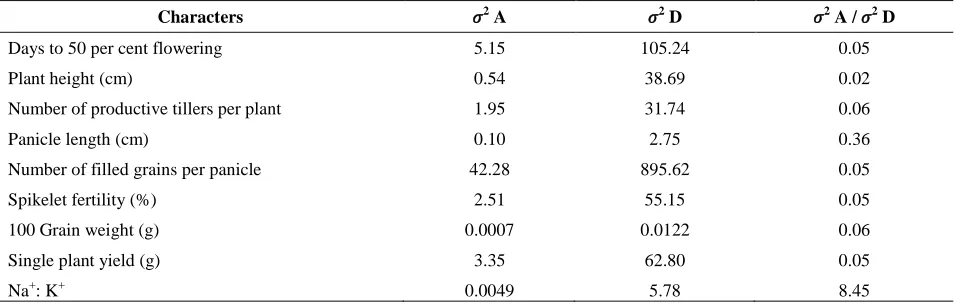
The magnitude of additive and dominance genetic variances and their relative proportions for all the traits were presented in Table 1. The ratio between additive genetic variance (𝜎2A) and dominance genetic variance (𝜎2
D) revealed that dominance genetic variance was higher in magnitude than corresponding additive genetic variance for all the nine biometric traits studied under sodicity. The parents having high per se performance would produce better offsprings and hence selection of parents based on per se should be effective.
Per se performance: Two lines viz., ADT 43 and ADT 39 and two testers viz., TRY (R) 2 and FL 478 were identified as early maturing among parents. Those parents could be utilized for developing early, mid-early and medium duration varieties suitable for kar / kuruvai (May - June) and late samba (Sep – Oct).
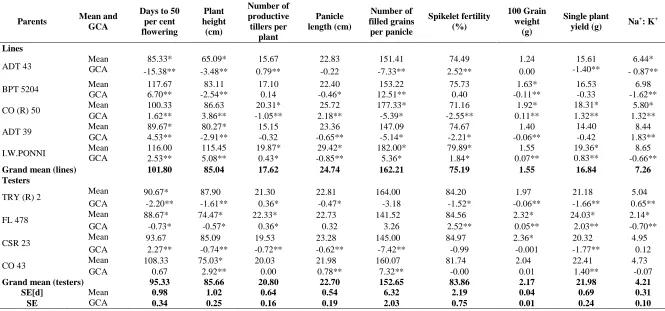
Perusal of per se performance of parents indicated that each parental genotype exhibited differential performance for the traits investigated (Table 2). Under sodicity, desirable mean performance was showed by ADT 43 for days to 50 per cent flowering, plant height and Na+: K+ ratio; CO (R) 50 for number of productive tillers per plant, number of filled grains per panicle, spikelet fertility percentage, single plant yield and Na+: K+ ratio and FL 478 for all the traits except for number of filled grains per panicle, panicle length and spikelet fertility percentage. When parents were evaluated for yield under sodicity, three parents viz., CO (R) 50, I.W. Ponni and FL 478 registered high yield over the rest of which CO (R) 50 and FL 478 exhibited better per se performance for Na+: K+ ratio along with ADT 43. Predominance of non-additive gene action for grain yield and its components was also reported by Thirumeni et al. (2000) and Singh et al. (2005). The findings was also in good agreement with earlier reports of Karthikeyan and Anbuselvam (2006). Shanthi et al. (2011) indicated the preponderance of SCA variances for all traits studied suggesting significant role of non-additive gene action which might be resulted from dominance, epistasis and interaction effects.
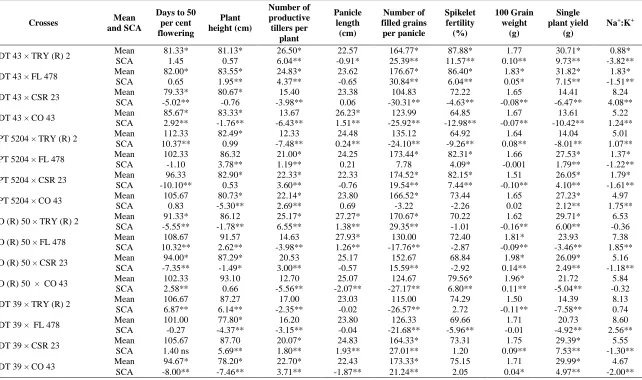
Mean performance of hybrids: For identifying promising hybrids, the phenotypic mean performance is taken into consideration from the inception of breeding programmes as being the actual and realized value. The mean performance of the resultant 20 hybrids is presented in Table 3. One of the objectives of the present study is to isolate promising medium duration (130-135 days) and mid-early (120-125 days) hybrids with their corresponding 50 per cent flowering falling between 100-105 days and 90-95 days.
Keeping this in view, nine hybrids viz., ADT 43 x TRY ( R ) 2, ADT 43 x FL 478, ADT 43 x CSR 23, ADT 43 x CO 43, CO (R) 50 x TRY ( R ) 2, CO (R) 50 x CSR 23, ADT 39 x CO 43, IW Ponni x TRY (R) 2 and IW Ponni x FL 478 were categorized as medium duration and six hybrids
viz., BPT 5204 x TRY (R) 2, BPT 5204 x FL 478, BPT 5204 x CSR 23, CO ( R) 50 x CO 43, ADT 39 x FL 478 and IW Ponni x CO 43 were classified as mid- early duration. For plant height, negative and significant or non- significant values were taken into account as regards to hybrids. In the present study, all hybrids except I.W. Ponni x CO 43 either showed negative and significant or non- significant values when compared to grand mean.
ISSN 0975-928X
General combining ability effect of parents:
General combining ability effects of parents (gca) and specific combining ability effects of hybrids (sca) for different traits are presented in Tables 2 and 3 respectively.
In the present study, estimates of combining ability indicated that three genotypes viz., ADT 43, TRY (R) 2 and FL 478 were adjudged as best general combiners for days to 50 per cent flowering. As regard to plant height, all parents except CO (R) 50, I.W. Ponni and CO 43 exhibited significant and negative gca effects. ADT 43, I.W. Ponni, TRY (R) 2 and FL 478 were found to be good combiners for number of productive tillers per plant. CO (R) 50 and CO 43 for panicle length; BPT 5204, I.W.Ponni and CO 43 for number of filled grains per panicle; ADT 43, I.W. Ponni and FL 478 for spikelet fertility and CO (R) 50, I.W Ponni and FL 478 for 100 grain weight were identified as good combiners. If additive gene action is present in self pollinated crops like rice, the breeder can effectively select at various levels of inbreeding because additive gene effects are readily transmissible from one generation to another (Gravois and Mc New, 1993).
With regard to yield under sodicity, two lines, CO (R) 50 and I.W Ponni and two testers, FL 478 and CO 43 were emerged as good combiners. When negative response for Na+: K+ ratio was taken to consideration, three lines, ADT 43, BPT 5204 and I.W. Ponni and only one tester FL 478 were found to be good combiners. As these parents were good combiners for yield attributing as well as sodicity resistant / tolerant traits, they could be exploited for development of sodicity resistant / tolerant high yielding varieties. These results were in conformity earlier findings of Geetha et al. (2006) and Shanthi
et al. (2011) under sodicity. These parents could be utilized as potential donors in the hybridization programme which might result in identification of superior segregants through transgressive breeding with favourable genes for yield, its component traits as well as sodicity resistance or tolerance.
Specific combining ability effects of hybrids:
According to Peng and Viramani (1990), sca effect is the index to determine the usefulness of a particular cross combination for exploitation of heterosis. The specific combing ability effects are due to non-additive and epistatic gene action (Sprague and Tatum 1942). The sca effects of the hybrids have also been attributed to the combination of positive favorable genes from different parents or may be due to the presence of linkage in repulsion phase (Sarsar et al., 1986).
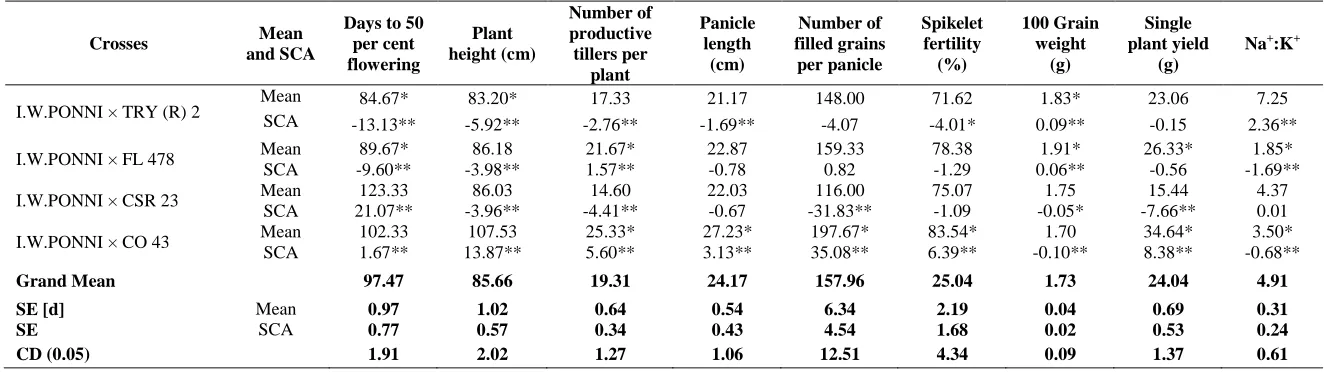
Among 20 hybrids, significant negative sca effects for days to 50 per cent flowering were observed in ADT 43 × CSR 23, BPT 5204 × CSR 23, CO (R) 50 × TRY (R) 2, CO (R) 50 × CSR 23, ADT 39 ×
CO 43, I.W. Ponni × TRY (R) 2 and I.W. Ponni × FL 478. Moreover, all hybrids possessed parents of either one good combiner or both poor combiners indicating the importance of harnessing non-additive / dominance gene action. Hence, the selection for early, mid-early and / or medium duration segregants might be postponed to later generations after obtaining homozygousity for most of the alleles. Rogbell (1995), Deepasankar et al. (2008); Kumar et al. (2010) observed similar findings for days to 50 per cent flowering in rice evaluated under sodic soils.
For plant height, nine hybrids ADT 43 × CO 43, BPT 5204 × CO 43, CO (R) 50 × TRY (R) 2, CO (R) 50 × CSR 23, ADT 39 × TRY (R) 2, ADT 39 × CO 43, I.W. Ponni × TRY (R) 2, I.W. Ponni × FL 478 and I.W. Ponni × CSR 23 recorded negative and significant sca effects. It was observed that parents of those hybrids were of either poor or good combiners or both poor combiners suggesting dominance gene action. This was further evidenced through greater estimates of SCA variances for all nine quantitative traits studied. These results were in confirmation with the findings of Thirumeni et al. (1998); Liang-jun (2006) and Kumar et al. (2010).
The measure of sca effect for number of productive tillers per plant indicated a positive and significant trend in 11 hybrids viz., ADT 43 × TRY (R) 2, ADT 43 × FL 478, BPT 5204 × FL 478, BPT 5204 × CSR 23, BPT 5204 × CO 43, CO (R) 50 × TRY (R) 2, CO (R) 50 × CSR 23, ADT 39 × CSR 23, ADT 39 × CO 43, I.W. Ponni × FL 478 and I.W. Ponni × CO 43. It was clear that the parents involved in the above crosses, were of either good or poor combiners or both poor combiners except for ADT 43 × TRY (R) 2, ADT 43 × FL 478 and I.W. Ponni × FL 478 hybrid combinations duly suggesting the preponderance of dominance gene action. In the case of good × good general combiners there are possibilities of complementary epistatic interaction acting in the direction of additive effects of the good combiners. The crosses would be utilized for yield improvement through single plant selection in segregating generations. This finding was in good accordance with earlier reports of Rogbell (1995); Karthikeyan and Anbuselvam (2006).
ISSN 0975-928X
breeding method would be bi-parental mating or reciprocal recurrent selection method. The hybrids with significant sca effects possessed parents with both poor combiners or one good and one poor combiner. Hence, bi-parental mating followed by recurrent selection method might be considered to obtain an array of desirable segregants. Similar findings were reported by Mishra (1995); Thirumeni et al. (2003) and Karthikeyan et al.
(2009).
Regarding grain parameters, eight hybrids viz., ADT 43 × TRY (R) 2, ADT 43 × FL 478, BPT 5204 × CSR 23, CO (R) 50 × TRY (R) 2, CO (R) 50 × CSR 23, ADT 39 × CSR 23, ADT 39 × CO 43 and I.W. Ponni × CO 43 for number of filled grains per panicle, six hybrids viz., ADT 43 × TRY (R) 2, ADT 43 × FL 478, BPT 5204 × FL 478, BPT 5204 × CSR 23, CO (R) 50 × CO 43 and I.W. Ponni × CO 43for spikelet fertility percentage and nine hybrids for 100 grain weight viz., ADT 43 × TRY (R) 2, ADT 43 × FL 478, BPT 5204 × TRY (R) 2, CO (R) 50 × CSR 23, CO (R) 50 × CO 43, ADT 39 × CSR 23, ADT 39 × CO 43, I.W. Ponni × TRY (R) 2 and I.W. Ponni × FL 478 registered significant and positive sca effects. There was a linear relationship between per se and sca effects in most of the above cross combinations for the traits depicting the importance of dominance gene action. The result was in good accordance with the earlier reports of Rogbell and Subbaraman (1997), Deepasankar et al. (2008) and Verma et al. (2010) under saline-sodic soils.
High and significant sca effects were recorded in 10 hybrids viz., ADT 43 × TRY (R) 2, ADT 43 × FL 478, BPT 5204 × FL 478, BPT 5204 × CSR 23, BPT 5204 × CO 43, CO (R) 50 × TRY (R) 2, CO (R) 50 × CSR 23, ADT 39 × CSR 23, ADT 39 × CO 43 and I.W. Ponni × CO 43 for single plant yield. It was obvious to note that there was a close correspondence between per se performance and
sca effects. Out of 10 hybrids, only one hybrid, I.W. Ponni × CO 43 involved both the parents with good general combining ability. In this hybrid, both additive and dominance gene action might play a key role. Hence, a modified method of recombination breeding i.e., one or two cycles of inter-mating the selected segregants followed by pedigree method of breeding might be resorted to harness both types of gene actions for the improvement of yield under sodicity. This finding was in line with earlier reports of Thirumeni et al.
(2003). Remaining hybrids possessed parents with both poor combiners or one good and one poor combiner showing the preponderance of dominance gene action. This was due to the fact that per se is the realized value and sca effect is only the estimate and is the measure of deviation of F1 from the expected value. Hence, in those crosses, postponement of selections to later generations to tag promising segregants possessing
tolerance to sodicity would be of ideal and practical method. These results were in conformity with earlier findings of Geetha et al. (2006); Karthikeyan and Anbuselvam (2006).
For Na+: K+ ratio, nine hybrids viz., ADT 43 × TRY (R) 2, ADT 43 × FL 478, BPT 5204 × FL 478, BPT 5204 × CSR 23, CO (R) 50 × CSR 23, ADT 39 × CSR 23, ADT 39 × CO 43, I.W. Ponni × FL 478 and I.W. Ponni × CO 43 registered negative and significant sca effects. It is of paramount importance to note that both per se and
sca effects were pronounced in close accordance in six hybrids viz., ADT 43 × TRY (R) 2, ADT 43 × FL 478, BPT 5204 × FL 478, BPT 5204 × CSR 23, I.W. Ponni × FL 478 and I.W. Ponni × CO 43. Among six crosses, three hybrids viz., ADT 43 × FL 478, BPT 5204 × FL 478 and I.W. Ponni × FL 478 evolved from parents of good combiners suggested the significance of additive and non- additive types of gene actions governing one of the important physiological traits, i.e., Na+: K+ ratio in those three crosses. Hence, a modified method of recombination breeding i.e., one or two cycles of inter-mating the selected segregants followed by pedigree method of breeding might be resorted to break any undesirable linkages and to accumulate favorable genes either for reduced uptake of Na+ ion or for increase in the uptake of K+ ion. Remaining six hybrids which possessed parents of both poor combiners or one good and one poor combiner may be forwarded to later generations to tag promising segregants possessing tolerance to sodicity. Thirumeni (2003), Natarajan et al. (2005) and Shanthi et al. (2011) quoted the importance of Na+: K+ ratio for sodicity resistance / tolerance.
Development of commercial hybrids in rice without employing male sterile lines is not feasible. Instead, recombination breeding has been the major avenue for rice improvement over decades. Recombination breeding is a commonly followed method in rice to get superior genotypes. The hybrids selected for recombination breeding should satisfy the criteria that they should possess non-significant sca effects with their corresponding parents entering the cross exhibiting significant gca effects. The basic idea underlying this is that the segregation of these hybrids is likely to throw more recombinants possessing favorable additive genes from parents.
ISSN 0975-928X
Assessment of yield under sodicity is of direct and significant relevance for the breeders in formulating research projects with an objective of evolution of high yielding genotypes under the target environment. Keeping it in view, the present study brought an important hybrid viz., I.W. Ponni × FL 478 whose parents were good combiners and the effect of specific combining ability was found to be non- significant. In this hybrid, since, additive and additive × additive types of gene action might play a key role, simple pedigree method of breeding could be employed as an ideal approach to get superior transgressive segregants in the segregating generations.
References
Akbar, M., Khush, G.S. and Hillerislamber, D. 1986. Genetics of salt tolerance in rice. In: Rice Genetics, Proceedings of the International Rice Genetics Symposium, IRRI, Philippines: 399-410.
CSSRI- Perspective Plan: Vision 2025. Central Soil Salinity Research Institute, Karnal, India. Deepasankar, P., Subbaraman, N. and Lakshmi
Narayanan, S. 2008. Heterosis, combining ability and gene action studies in TGMS based rice hybrids under normal and salt affected environments. Indian J. Agric. Res.,
42(3): 177 -182.
Emani, C., Y. Jiang, B. Miro, T.C. Hall and A. Kohli. 2008. Transgenic cereals and forage grasses.
In: Compendium of transgenic plants (C. Kole and T.C. Hall eds.). 1: 1-234.
Liang-jun, F. 2006. Analysis on combining ability and heritability of salt tolerance in Hybrid Rice.
J. South China Agril. Univ., ISSN: 1007-7995: 3-21.
Geetha, S., Shanthi, P., Jebaraj, S. and Naina Mohammed, S.E. 2006. Gene action of sodicity tolerance in rice. Indian J. Crop Science, 1(1-2): 201-202.
Gravois, K.A. and Mc New, R.W. 1993. Combining ability and heterosis in U.S. Southern long – grain rice. Crop Sci., 33(1): 83-86.
Karthikeyan, P. and Anbuselvam, Y. 2006. Combining ability of rice genotypes under coastal saline situation. Madras Agric. J.,93: (7-12). Karthikeyan, P., Anbuselvam, Y., Palaniraja, K. and
Elangaimannan, R. 2009. Combining ability of rice genotypes under coastal saline soils.
Electronic Journal of Plant Breeding, 1 :18-23.
Kempthorne, O. 1957. An Introduction to Genetic Statistics. John Wiley and Sons Inc., Chapman and Hall, New York, pp: 222-240. Kumar, R.M., Surekha, K., Padmavathi, C.H., Subha
Rao, L.V., Latha, P.C., Prasad, M.S., Ravindra Babu, V., Ramprasad, A.S., Rupela, O.P., Goud, V. , Muthuram, P., Somashekar, N., Ravichandran, S., Singh, S.P. and Viraktamath, B.C. 2009. Research experiences on system of rice intensification and future directions, J. Rice Res., 2:61-71. Kumar M., Kumar, K., Verma, G.P. and Verma, O.P.
2010. Combining ability analysis for yield and component traits under saline – alkali soil in rice. Oryza,47(3): 193-200.
Mishra, B. 1995. Breeding for salt tolerance in crops.
In: Annual Report of 1995. Central Soil Salinity Research Centre, Karnal.
Natarajan, S.K., Saravanan, S., Krishnakumar, S. and Dhanalakshmi, R. 2005. Interpretations on Association of Certain Quantitative Traits on Yield of Rice (Oryza sativa L.) Under Saline Environment. Research Journal of Agriculture and Biological Sciences, 1(1): 101-103.
Peng, J.Y. and Virmani, S.S. 1990. Combining ability for yield and four related traits in relation to hybrid breeding in rice. Oryza, 27: 1-10 Rogbell, E.J. 1995. Studies on genetics of salt tolerance
in rice (Oryza sativa L.) cultivars. M.Sc., Thesis, TNAU, Coimbatore.
Rogbell, J.E. and Subbaraman, N. 1997. Heterosis and combining ability analysis in rice. Crop Res.,
13(1): 143-150.
Sarsar, S.M., Patil, R.A. and Bhatede, S.S. 1986. Heterosis and combining ability in upland cotton. Indian J. Agric. Sci.,56(8): 567-573. Shanthi. P., Jebaraj, S. and Geetha, S. 2011. Study on
gene action for sodic tolerance traits in rice (Oryza sativa L.). Electronic Journal of Plant Breeding, 2(1):24-30.
Singh, R.V, Maurya, D.M., Dwivedi, J.L. and Verma, O.P. 2005. Combining ability studies and its components using CMS lines in rice. (Oryza sativa L.). Oryza, 42(4):306 – 309.
Sprague, G.F. and Tatum, L.A. 1942. General versus specific combining ability in single crosses of corn. J. Am. Soc. Agron.,34: 923-932. Thirumeni, S. 1998. Genetical studies on coastal saline
rice (Oryza sativa L.). Ph.D. Thesis, TNAU, Coimbatore.
Thirumeni. S, Subramanian, M. and Paramasivam, K. 2000. Combining ability and gene action in rice under salinity. Tropical Agricultural Research,12: 375-385.
Thirumeni, S., Subramanian, M. and Paramasivam, K. 2003. Genetics of salt tolerance in rice (Oryza sativa L). Indian J. Genet.,63(1): 75-76.
ISSN 0975-928X
Table 1. Table 1: Estimates of variance in L × T analysis
Characters 𝜎2
A 𝜎2
D 𝜎2
A / 𝜎2
D
Days to 50per cent flowering 5.15 105.24 0.05
Plant height (cm) 0.54 38.69 0.02
Number of productive tillers per plant 1.95 31.74 0.06
Panicle length (cm) 0.10 2.75 0.36
Number of filled grains per panicle 42.28 895.62 0.05
Spikelet fertility (%) 2.51 55.15 0.05
100 Grain weight (g) 0.0007 0.0122 0.06
Single plant yield (g) 3.35 62.80 0.05
ISSN 0975-928X
Table 2. Mean performance and general combining ability effects of parents for different economic traits
*, ** Significant at 5 and 1 per cent level, respectively.
Parents Mean and
GCA
Days to 50 per cent flowering
Plant height (cm)
Number of productive tillers per
plant
Panicle length (cm)
Number of filled grains
per panicle
Spikelet fertility (%)
100 Grain weight
(g)
Single plant
yield (g) Na
+
: K+
Lines
ADT 43 Mean GCA 85.33* 65.09* 15.67 22.83 151.41 74.49 1.24 15.61 6.44*
-15.38** -3.48** 0.79** -0.22 -7.33** 2.52** 0.00 -1.40** - 0.87**
BPT 5204 Mean 117.67 83.11 17.10 22.40 153.22 75.73 1.63* 16.53 6.98
GCA 6.70** -2.54** 0.14 -0.46* 12.51** 0.40 -0.11** -0.33 -1.62**
CO (R) 50 Mean 100.33 86.63 20.31* 25.72 177.33* 71.16 1.92* 18.31* 5.80*
GCA 1.62** 3.86** -1.05** 2.18** -5.39* -2.55** 0.11** 1.32** 1.32**
ADT 39 Mean 89.67* 80.27* 15.15 23.36 147.09 74.67 1.40 14.40 8.44
GCA 4.53** -2.91** -0.32 -0.65** -5.14* -2.21* -0.06** -0.42 1.83**
I.W.PONNI Mean 116.00 115.45 19.87* 29.42* 182.00* 79.89* 1.55 19.36* 8.65
GCA 2.53** 5.08** 0.43* -0.85** 5.36* 1.84* 0.07** 0.83** -0.66**
Grand mean (lines) 101.80 85.04 17.62 24.74 162.21 75.19 1.55 16.84 7.26
Testers
TRY (R) 2 Mean 90.67* 87.90 21.30 22.81 164.00 84.20 1.97 21.18 5.04
GCA -2.20** -1.61** 0.36* -0.47* -3.18 -1.52* -0.06** -1.66** 0.65**
FL 478 Mean 88.67* 74.47* 22.33* 22.73 141.52 84.56 2.32* 24.03* 2.14*
GCA -0.73* -0.57* 0.36* 0.32 3.26 2.52** 0.05** 2.03** -0.70**
CSR 23 Mean 93.67 85.09 19.53 23.28 145.00 84.97 2.36* 20.32 4.95
GCA 2.27** -0.74** -0.72** -0.62** -7.42** -0.99 -0.001 -1.77** 0.12
CO 43 Mean 108.33 75.03* 20.03 21.98 160.07 81.74 2.04 22.41 4.73
GCA 0.67 2.92** 0.00 0.78** 7.32** -0.00 0.01 1.40** -0.07
Grand mean (testers) 95.33 85.66 20.80 22.70 152.65 83.86 2.17 21.98 4.21
SE[d] Mean 0.98 1.02 0.64 0.54 6.32 2.19 0.04 0.69 0.31
ISSN 0975-928X
Table 3. Mean performance and specific combining ability effects of hybrids for sodicity tolerance
Crosses Mean
and SCA
Days to 50 per cent flowering
Plant height (cm)
Number of productive tillers per
plant
Panicle length
(cm)
Number of filled grains
per panicle
Spikelet fertility (%)
100 Grain weight
(g)
Single plant yield
(g)
Na+:K+
ADT 43 × TRY (R) 2 Mean 81.33* 81.13* 26.50* 22.57 164.77* 87.88* 1.77 30.71* 0.88*
SCA 1.45 0.57 6.04** -0.91* 25.39** 11.57** 0.10** 9.73** -3.82**
ADT 43 × FL 478 Mean 82.00* 83.55* 24.83* 23.62 176.67* 86.40* 1.83* 31.82* 1.83*
SCA 0.65 1.95** 4.37** -0.65 30.84** 6.04** 0.05* 7.15** -1.51**
ADT 43 × CSR 23 Mean 79.33* 80.67* 15.40 23.38 104.83 72.22 1.65 14.41 8.24
SCA -5.02** -0.76 -3.98** 0.06 -30.31** -4.63** -0.08** -6.47** 4.08**
ADT 43 × CO 43 Mean 85.67* 83.33* 13.67 26.23* 123.99 64.85 1.67 13.61 5.22
SCA 2.92** -1.76** -6.43** 1.51** -25.92** -12.98** -0.07** -10.42** 1.24**
BPT 5204 × TRY (R) 2 Mean 112.33 82.49* 12.33 24.48 135.12 64.92 1.64 14.04 5.01
SCA 10.37** 0.99 -7.48** 0.24** -24.10** -9.26** 0.08** -8.01** 1.07**
BPT 5204 × FL 478 Mean 102.33 86.32 21.00* 24.25 173.44* 82.31* 1.66 27.53* 1.37*
SCA -1.10 3.78** 1.19** 0.21 7.78 4.09* -0.001 1.79** -1.22**
BPT 5204 × CSR 23 Mean 96.33 82.90* 22.33* 22.33 174.52* 82.15* 1.51 26.05* 1.79*
SCA -10.10** 0.53 3.60** -0.76 19.54** 7.44** -0.10** 4.10** -1.61**
BPT 5204 × CO 43 Mean 105.67 80.73* 22.14* 23.80 166.52* 73.44 1.65 27.23* 4.97
SCA 0.83 -5.30** 2.69** 0.69 -3.22 -2.26 0.02 2.12** 1.75**
CO (R) 50 × TRY (R) 2 Mean 91.33* 86.12 25.17* 27.27* 170.67* 70.22 1.62 29.71* 6.53
SCA -5.55** -1.78** 6.55** 1.38** 29.35** -1.01 -0.16** 6.00** -0.36
CO (R) 50 × FL 478 Mean 108.67 91.57 14.63 27.93* 130.00 72.40 1.81* 23.93 7.38
SCA 10.32** 2.62** -3.98** 1.26** -17.76** -2.87 -0.09** -3.46** 1.85**
CO (R) 50 × CSR 23 Mean 94.00* 87.29* 20.53 25.17 152.67 68.84 1.98* 26.09* 5.16
SCA -7.35** -1.49* 3.00** -0.57 15.59** -2.92 0.14** 2.49** -1.18**
CO (R) 50 × CO 43 Mean 102.33 93.10 12.70 25.07 124.67 79.56* 1.96* 21.72 5.84
SCA 2.58** 0.66 -5.56** -2.07** -27.17** 6.80** 0.11** -5.04** -0.32
ADT 39 × TRY (R) 2 Mean 106.67 87.27 17.00 23.03 115.00 74.29 1.50 14.39 8.13
SCA 6.87** 6.14** -2.35** -0.02 -26.57** 2.72 -0.11** -7.58** 0.74
ADT 39 × FL 478 Mean 101.00 77.80* 16.20 23.80 126.33 69.66 1.71 20.73 8.60
SCA -0.27 -4.37** -3.15** -0.04 -21.68** -5.96** -0.01 -4.92** 2.56**
ADT 39 × CSR 23 Mean 105.67 87.70 20.07* 24.83 164.33* 73.31 1.75 29.39* 5.55
SCA 1.40 ns 5.69** 1.80** 1.93** 27.01** 1.20 0.09** 7.53** -1.30**
ADT 39 × CO 43 Mean 94.67* 78.20* 22.70* 22.43 173.33* 75.15 1.71 29.99* 4.67
SCA -8.00** -7.46** 3.71** -1.87** 21.24** 2.05 0.04* 4.97** -2.00**
ISSN 0975-928X
*, ** Significant at 5 and 1 per cent level respectively.
Table 3. Contd.,
Crosses Mean
and SCA
Days to 50 per cent flowering
Plant height (cm)
Number of productive tillers per
plant
Panicle length
(cm)
Number of filled grains
per panicle
Spikelet fertility (%)
100 Grain weight
(g)
Single plant yield
(g)
Na+:K+
I.W.PONNI × TRY (R) 2 Mean SCA 84.67* 83.20* 17.33 21.17 148.00 71.62 1.83* 23.06 7.25
-13.13** -5.92** -2.76** -1.69** -4.07 -4.01* 0.09** -0.15 2.36**
I.W.PONNI × FL 478 Mean 89.67* 86.18 21.67* 22.87 159.33 78.38 1.91* 26.33* 1.85*
SCA -9.60** -3.98** 1.57** -0.78 0.82 -1.29 0.06** -0.56 -1.69**
I.W.PONNI × CSR 23 Mean 123.33 86.03 14.60 22.03 116.00 75.07 1.75 15.44 4.37
SCA 21.07** -3.96** -4.41** -0.67 -31.83** -1.09 -0.05* -7.66** 0.01
I.W.PONNI × CO 43 Mean 102.33 107.53 25.33* 27.23* 197.67* 83.54* 1.70 34.64* 3.50*
SCA 1.67** 13.87** 5.60** 3.13** 35.08** 6.39** -0.10** 8.38** -0.68**
Grand Mean 97.47 85.66 19.31 24.17 157.96 25.04 1.73 24.04 4.91
SE [d] Mean 0.97 1.02 0.64 0.54 6.34 2.19 0.04 0.69 0.31
SE SCA 0.77 0.57 0.34 0.43 4.54 1.68 0.02 0.53 0.24