TRANS Asian Research Journals
http://www.tarj.in 1
CRITICAL CUSTOMER ANALYSIS - E BANKING
Prof. Kavitha Venkatachari*
*Faculty, IBS Mumbai, Powai, Mumbai, India. ABSTRACT
Globalization and deregulations have increased competition in the market places. The increased competition, in turn, calls for that organizations continuously increase their productivity and decrease their costs. Investments in information technology are one important means to increase productivity and decrease costs. The service industries are mostly customer driven and their survival in competitive environment largely depends on quality of the service provided by them. In this context, quality of service furnished by banks is very important and profitability of their business is closely connected to the quality of service they render. E-banking is a new delivery channel for banks in India. However, the service quality in e-banking from customer’s perspective needs thorough analysis to find out the determinants for success and growth of new channel of delivery in India so that useful guidelines for bankers can be extracted. In this study the paper aims at identifying the important parameters crucial for service quality in e-banking from customer’s perspective. The study identifies various dimensions and characteristics of service quality in e-banking and explores various aspects of customer satisfaction in relation to the traditional and e-service quality. A valid mathematical model is proposed to assess the overall e-service quality using regression analysis. The results show that customers are satisfied with quality of service on four dimensions such as reliability, accessibility, privacy/security, responsiveness and fulfilment. The statistical analysis on these dimensions concludes that banks providing internet banking facilities are reliable but have to improve a lot on user friendliness.
KEYWORDS: E-banking, Service quality, customer’s perspective, principal
component analysis.
______________________________________________________________________________ INTRODUCTION
TRANS Asian Research Journals
http://www.tarj.in 2
their businesses and the ways consumers perform their banking activities. Today e-banking has experienced phenomenal growth and has become one of the main avenues for banks to deliver their products and services (Amato- McCoy, 2005).
Dabholkar (1994) claims that when the customer is in direct contact with the technology there is greater control such as with Internet banking. Whereas, if there is an absence of direct contact, like with telephone banking (since the customers are able to press numbers only on their telephone keypad technology is not visible to them) it is assumed that there is less control perceived by the customer during this transaction.
Electronic banking (e-banking), also known as Internet banking is defined as the automated delivery of new and traditional banking products and services directly to customers through electronic, interactive communication channels (Daniel,1999; Sathye1999). E-banking includes the systems that enable individuals or businesses and financial institutions along with customersto provide access to their accounts, obtaininformation on financial products and services through a public or private network, including the internet ortransact business. Customers access e- banking services using an intelligent electronic device, such as a personal computer, automated teller machine, personal digital assistant and kiosk. Chou and Chou (2000) recognized five basic services associated with online banking: view account balances and transaction histories; paying bills; transferring funds between accounts; requesting credit card advances; and ordering checks for more faster services that can be provide by domestic and foreign bank.
E-banking reaps benefits for both banks and its customers. From the banks point of view, e-banking has helped banks in lowering operational costs by reducing physical facilities and staffing requirement, reduced waiting times in branches lead potential increase in sales performance and larger global reach (Sarel and Mamorstein, 2003). From the customers point, e-banking enables customers to perform a wide range of e-banking transactions electronically via the bank's website anytime and anywhere (Grabner- Kraeuter and Faullant, 2008). In addition, customers are no longer confined to the working hours of banks nor required to travel or wait in queues for transaction (Hamlet, 2000).
In India, in 1996, ICICI bank was the first bank which offered this delivery channel by kicking off its online services. Other private sector banks like Citibank, IndusInd Bank and in 1999, HDFC started offering internet services. In July 2001, SBI launched its services. Other public sector banks like Allahabad Bank, BOB (Bank of Baroda), Syndicate Bank and Bank of India, also rolled its services during the same period. Banks in India currently offers “Fully Transactional Websites” to their customers. The customers would conduct a variety of transactions through internet banking facility which includes: account summary, details of historical banking transactions, funds transfer, loan applications, bill payments, cheque book request, cheque status enquiry, stop cheque request, credit card payments/statements,
TRANS Asian Research Journals
http://www.tarj.in 3
E-BANKING & SERVICE QUALITY
The banking industry has followed this Internet application trend in recent years, and sometimes called "e-banking" refers to all banking transactions now completing through Internet applications. In the recent literature some key issues addressed about the e-banking include: customer acceptance and satisfaction, services rendered, privacy concerns, operational risks and profitability. Smaller community banks are more interested in the application of e-banking to gain certain competitive edges over their larger competitors. E-banking has been viewed as an advanced upgrading from previous electronic delivery systems to open many new business opportunities for the banking industry. According to a survey there was a planned $2 billion new investment in the new electronic banking technology within the banking industry (Radeki, etc.1997). Among surveyed banks at the time, about two third (66%) planned to invest in telephone banking technology, and the remaining one third (34%) already targeted e-banking options. There have been several major challenges and issues faced to the e-banking growth, the major one amongst them is the security concern.
Customers are certainly concerned of giving their bank account number online or paying an invoice through Internet. Another issue of e-business (including e-banking) is the quality of delivery service - including both delivery speed (i.e., short advance time required in ordering) and delivery reliability (i.e., delivery of items/services on time). Limited payment options available to online customers are also being complained. Additionally, customers (who are non-computer "genius" like most senior citizens) have been reluctant in their choice of doing business (including banking transactions) online and worried their unfamiliarity about the computer placing them in a disadvantageous position. It has been predicted that in long-term to be successful, e-business operations of must compete differently from traditional business counterparts which signifies that the strategic positioning decision of an e-banking operations must establish its own unique competitive priorities and "order winning criteria"- so as to geta competitive edge and sustain its customers on a regular basis.
The advance of communication and computer technology and the availability of the Internet have made it possible that one can do most banking transactions from a remote location even without stepping into a physical financial structure - i.e., the emerging of banking (the e-business application in the banking industry). E-banking is seen as a revolution progress in the banking industry. For instance, 20 years ago, 70% of all consumer financial transactions went through a bank office with brick and mortar structures. Today, less than 30% of the same consumer financial transactions run through a branch office or the lobby of a main bank office. As a result, strategic plans are formulated by the banks to fight back in winning their customers. By adopting new technology the industry believes that the banks will be able to improve customer service level and tie their customers closer to the bank. Meanwhile, the banking industry has been also looking for new methods to expand its customer base and to counteract the aggressive marketing effort of those non-traditional banking entities.
TRANS Asian Research Journals
http://www.tarj.in 4
check account history and computerize their checkbooks online. For example, some banks decided to provide Internet access to their customers and becoming the dominant provider of local Internet connection services for the local community they tried to lock in customers to their financial institution. Some banks are taking a leap forward to install advanced software so as to process all consumer loan applications on-line, a new paperless e-loan process. In this, Customers will get hard copies of all documents signed for their personal records. And the signatures will be created from images collected by special electronic signatures (e-signature). The e-banking has been growing at a rapid pace and is believed that it will help banks to increase revenue, cut costs and will give convenience to customers. Due to different motivational factors banks have placed different investments in their e-banking efforts. E-banking sector has been growing to reach a competitive level where some its new services have gained a growing popularity like e-payments and statement aggregation. This service is used to drive new business, initiate improved service quality, increase profitable cross selling opportunities and is also becoming popular customers. E-banking with the advantages of quick and easy application process, less technical issues, more options for banking customers and less deposit requirement have taken the banking industry to a new phase.
Weather all et al., (1984), who state that consumers are thought to have a positive perception of technology, since they believe technology will deliver a faster and more efficient service than that of the employee. Gummesson (1991) also lay emphasis that reliability and user-friendliness are important evaluation of technology-based services. Service quality is the extent to which a service meets customer’s needs and expectations (Lewis and Mitchell, 1990). It can be defined as the difference between customer expectations of service and the service perceived. Service quality has been recognized as the potential to strategic benefits, which leads to increase in customer retention rates and also has the tendency to enhance operational efficiency and profitability (Cronin, 2003; Rust et al., 2001; Zeithaml, 2000). Today winners are those who overcome consumer cynicism by exceeding expectation and going beyond the point of encounter. The challenging business environment in the financial service market has resulted in using alternative delivery channels, with a view to attract more customers, and encouraging loyalty (Bauer et al., 2005; Parasuraman et al., 2005). Amongst all of them the more recent delivery channel introduced is electronic banking which means the provision of information about the bank and its products via a page on the internet.
TRANS Asian Research Journals
http://www.tarj.in 5
productiveness. Since, services cannot be stored and hence they are produced and consumed simultaneously. Customers are present and can take part in the delivery process.
REVIEW OF LITERATURE
Following the boom of new technologies such as the internet and mobile phones in practice, e-banking has also been the focus of numerous academic papers Adoption, perception and usage of internet banking by consumers is one of the topics heavily examined in e-banking literature. Centeno(2004) argues that the main motivation factors for the consumers to use internet banking are speed, the convenience of remote access, 24/7availability and price incentives. Durkin, et.al.(2008)notes that the simplicity of the products offered via internet banking facilitates the adoption of internet banking. Gumussoy (2008) compare the consumer perception of internet banking and other banking channels and report that internet banking, phone banking and ATM substitute each other.Maenpaaet.al. (2008) examine the consumer perceptions of internet banking in Finland and their findings indicate that perception gets influenced by the familiarity. Guerrero, et, al.(2007) examine the usage of internet banking by Europeans and their results indicate that ownership of diverse financial products and services towards finances and trust in the internet as a banking channel influence clients usage of internet banking. Confirming other papers, Sohail and Shanugham(2003) document accessibility of internet, and resistance to change are found to be influencing Malaysia’s use of internet banking. Major factors affecting consumer a d a p t i n g t o t h i s was Perceived risk, as well as customer satisfaction of online banking services.
TRANS Asian Research Journals
http://www.tarj.in 6
2007). White and Nteli (2004) find that “security” is the most important attribute for UK internet.
HYPOTHESIS
It is indeed essential to emphasize the fact that the Indian culture is different from the countries where previous research was done. The researchers predicted that on the acceptance of online banking the familiarity and economic benefits of using the Internet has a significant impact. If the customers are not used to access internet frequently, and have no trust on Internet as a secure environment to conduct financial transactions, then it is very difficult for them to accept online banking. Therefore, the following hypotheses were adopted:
On adoption of e-banking among customers, Security and trust has significant impact. On adoption of e-banking among customers, Innovativeness has significant impact On adoption of e-banking among customers, Familiarity has significant impact. RESULTS AND DISCUSSION
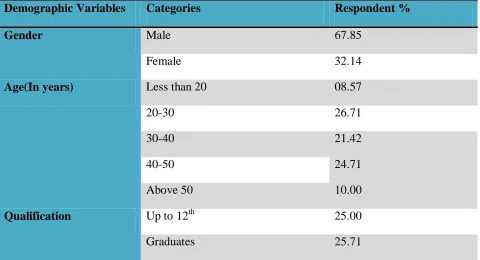
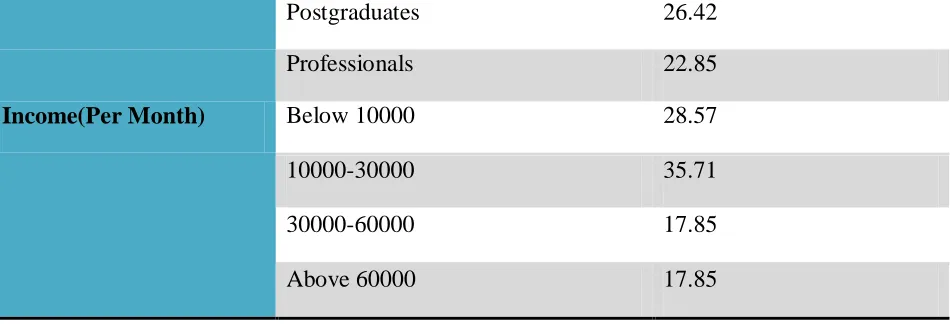
The respondents of this study were both male (67.85%) and female (32.14%).The most respondents aged (26.71%) was in the age of 20-30 years old (refer to Table 1). Many of the participants were postgraduate (26.42%) and with the income of 10000 - 30000 (35.71%). The total respondent of 140 have received and analyzed in the following way.
TABLE 1: DISTRIBUTION OF RESPONDENTS BY DEMOGRAPHIC BACKGROUND (N=140)
Demographic Variables Categories Respondent %
Gender Male 67.85
Female 32.14
Age(In years) Less than 20 08.57
20-30 26.71
30-40 21.42
40-50 24.71
Above 50 10.00
Qualification Up to 12th 25.00
TRANS Asian Research Journals
http://www.tarj.in 7
Postgraduates 26.42
Professionals 22.85
Income(Per Month) Below 10000 28.57
10000-30000 35.71
30000-60000 17.85
Above 60000 17.85
Source: Field Survey 2013 ACCEPTANCE VALUE
A factor analysis was conducted to construct data that will help to evaluate factors that influence customer’s usage of e-banking. Three factors were generated, which explained 52.39 percent of the variance. The extracted factors were then rotated using variance maximizing method (Varimax). These rotated factors with their variable constituents and factor loadings are given in table 2. These factors are labelled security and trust, innovativeness and familiarity.
TABLE 2: ACCEPTANCE VALUE OF E-BANKING
Measurement Items Security & Trust Familiarity Innovativeness
Assurance 0.809
Authenticity 0.761
Liquidity 0.713
Insurance Coverage 0.782
Clarit /Transparency 0.792
Security & less risk to use 0.831
Privacy is maintained 0.764
Bill payment 0.679
E-ticket 0.834
TRANS Asian Research Journals
http://www.tarj.in 8
One stop Banking 0.758
safe and suitable holdings 0.832
Easy to use 0.815
Quick transaction 0.824
Time saving 0.826
Extensive 0.765
No need to carry cash 0.815
Order cheque book 0.781
Apply for loans 0.751
Wide range network 0.601
Online trading 0.792
Eigen Values 4.184 3.713 1.397
Percentage of variance 37.643 7.43 5.122
Cumulative Variance 37.643 46.413 52.39
Source: Field Survey 2013
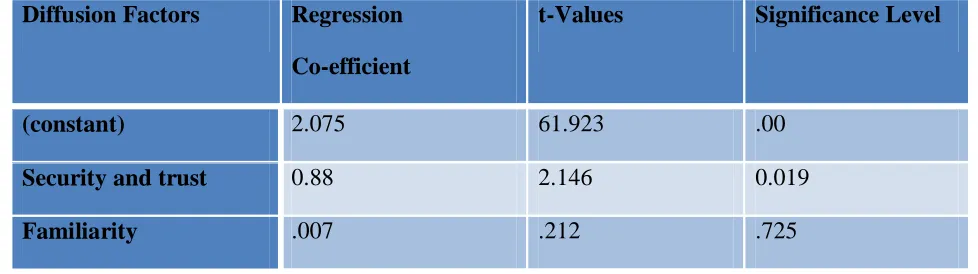
The regression analysis was conducted to reveal how different factors identified through Factor analysis affect the use of online banking. The respondent’s intention to intensify the acceptance of e-banking services was regressed on the four independent variables, namely security and trust, innovativeness, familiarity and awareness. The results are reported in table 3.
TABLE 3: REGRESSION ANALYSIS ON E-BANKING ACCEPTANCE FACTOR Diffusion Factors Regression
Co-efficient
t-Values Significance Level
(constant) 2.075 61.923 .00
Security and trust 0.88 2.146 0.019
TRANS Asian Research Journals
http://www.tarj.in 9
Innovativeness -.034 -1.021 .264
R2 .565
F ratio 86.946
Source: Field Survey 2013
The regression equation was significant at 1percent level with the F value of 86.946 and the independent variables account for 57 percent of the variance in degree of the acceptance of e-banking by the customers. Security and trust (β=0.88) and Familiarity (β=.007) were significantly positively related to the acceptance of e- banking services, while Innovativeness did not emerge as significant factors in explaining the acceptance of e- banking service by the respondents. Koufaris and Hampton-Sosa (2004) also demonstrated that perceived security control of the site strongly influenced acceptance of online banking by customers. If the customers are less concerned about unauthorized use of or illegal access to their personal and financial data by third parties, they will have greater influence on the willingness to use online banking, which in turn will lead to higher acceptance to it. Thus, banks should improve their web security features in order to enhance the customer’s acceptance. White and Nteli (2004) find that “security” is the most important attribute for UK internet banking customers. Akinci et al. (2004) find that the selection of an internet banking service provider is effected by security, reliability and privacy. Security, which involves protecting users from the risk of fraud and financial loss, has been another important issue in safe use of the internet when conducting financial transactions in Saudi Arabia (Sohail and Shaikh, 2007).
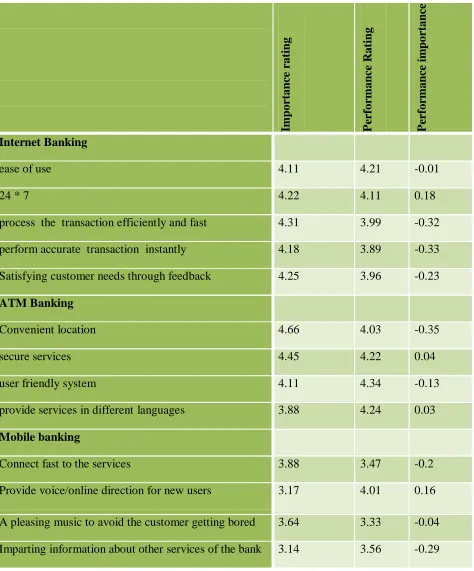
IMPORTANCE AND PERFORMANCE OF ELECTRONIC BANKING SERVICES The customers indicate that they are satisfied in the following areas “Convenient location”, “Secure services”, “User friendly”, “Provide services in different language”, “24X7”, “Provide voice/online direction for new user”.
TRANS Asian Research Journals
http://www.tarj.in 10
TABLE 4: E-BANKING SERVICE USED BY CUSTOMER
Im
p
or
tan
ce
r
at
in
g
P
er
for
m
an
ce
Rat
in
g
P
er
for
m
an
ce
im
p
or
tan
ce
Internet Banking
ease of use 4.11 4.21 -0.01
24 * 7 4.22 4.11 0.18
process the transaction efficiently and fast 4.31 3.99 -0.32
perform accurate transaction instantly 4.18 3.89 -0.33
Satisfying customer needs through feedback 4.25 3.96 -0.23 ATM Banking
Convenient location 4.66 4.03 -0.35
secure services 4.45 4.22 0.04
user friendly system 4.11 4.34 -0.13
provide services in different languages 3.88 4.24 0.03
Mobile banking
Connect fast to the services 3.88 3.47 -0.2
TRANS Asian Research Journals
http://www.tarj.in 11
CONCLUSION
In a country like India, there is need for providing better and customized services to the customers. Banks must be concerned about the attitudes of customers with regard to acceptance of online banking. The importance of security and privacy for the acceptance of internet banking has been noted in many earlier studies and it was found that people have weak understanding of internet banking, although they are aware about risk. The present study shows that customers are more reluctant to join new technologies or methods that might contain little risk. Hence, banks should design the website to address security and trust issues. The recommendations to the banks are that they have to increase the level of trust between banks website and customers. In order to achieve this, the following strategies should be applied by banks.
Banks should ensure that online banking is safe and secure for financial transaction like traditional banking.
Banks should organize seminar and conference to educate the customer regarding uses of online banking as well as security and privacy of their accounts.
Some customers are hindered by lack of computer skills. They need to be educated on basic skills required to conduct online banking.
Banks must emphasize the convenience that online banking can provide to people, such as avoiding long queue, in order to motivate them to use it.
Banks must emphasize the cost saving that online can provide to the people, such as reduce transaction cost by use of online banking.
REFERENCES
[1]Abdullateef, Mokhtar, Yusoff, (2011), “The Strategic Impact of Technology Based CRM on Call Centers’ Performance”, Journal of Internet Banking and Commerce, April 2011,Vol. 16, No.1.
[2]. Abdelzaher, T., Shin, K. G., and Bhatti, N. (2002), ``Performance Guarantees for Web Server End-Systems: A Control-Theoretical Approach,'' IEEE Transactions on Parallel and Distributed Systems, Vol. 13, No. 1.
[3]. Aladwani, A. M. (2001, P. 219), “Online banking: A field study of drivers,development challenges and expectations”,International Journal of Information Management, Vol. 21, pp. 213-325.
TRANS Asian Research Journals
http://www.tarj.in 12
[5]. Alshawi S., Themistocleous M. and Almadani R. (2004), “Integrating diverse ERP systems: a case study”, The Journal of Enterprise Information Management, Vol. 17:6, pp. 454– 462 [6]. Alsajjan, A., Bander, B. and Dennis, C. (2006), “The impact of trust on acceptance of online banking”, paper presented at European Association of Education and Research in Commercial Distribution, Brunel University, West London (June, 27030).
[7]. Anacarini, A. (2005), “Towards quality eservice in the public sector: The evolution of the web sites in the local public service sector”, Managing Service Quality, Vol. 15:1, pp. 6-23. [8]. Ariely, D. (2000) Controlling the information flow: effects on customers’ decision making and preferences, Journal of Consumer Research, 27 (September), pp. 233–248
[9]. Ashiqullah (2006), “A Relational Study on Automated Service Quality, Customer Satisfaction and Financial Performance in the Context of Bank Asia Ltd”, Summer Internship Report- submitted to Independent University, Bangladesh, Accessed on March 2011 and Available from @ http://www.sb.iub.edu.bd/internship/summer2 006/0320454.pdf
[10]. Athituv N., Neumann S. and Zviran M.(2002), “A System Development Methodology for ERP Systems”, Journal of Computer Information Systems, Spring Issue, pp. 56-67
[11]. Al-Adwani, A. M. (2001). Online banking: a field study of drivers, development challenges, and expectations. International Journal of Information Management 21, 213– 225 [12]. Al-Ghatani S. and King M. (1999). Attitudes, satisfaction and usage: factors contributing to each in the acceptance of information technology. Behaviour & Information Technology, 18 (4), 277 – 297.
[13]. Al-Somali, S. A, Gholami, R. and Clegg B. (2009). An Investigation into the acceptance of online banking in Saudi Arabia. Technovation, 29, 130-141, Elsevier Publication.
[14]. Ancarini, A. (2005). Towards quality eservice in the public sector: The evolution of web sites in the local public service sector. Managing Service Quality, 15 (1), 6-23.
[15]. Balsamo, S., Di Marco, A., Inverardi, P. and Simeoni, M.(2004), "Model-based performance prediction in software development: a survey" IEEE Transactions on Software Engineering, Vol 30, No.5, pp. 295- 310.
[16]. Barwise, P. and Farley, J.U. (2005), “The state of interactive marketing in seven countries: interactive marketing comes of age”, Journal of Interactive Marketing, vol. 19:3, pp. 67-80. [17]. Barros, A. P. and Dumas, M. (2006). The Rise of Web Service Ecosystems, IT Pro, IEEE Computer Society.
TRANS Asian Research Journals
http://www.tarj.in 13
[19]. Bauer, H. H., Hammerschmidt, M. and Falk,T. (2005), “Measuring the service quality of e-banking portals”, International Journal of Bank Marketing, Vol. 23:2, Emerald Group Publishing Limited.
[20]. Bitner, M. J., Zeithaml, V. A. and Gremler, D.D. (2010, p. 200), “Technology’s Impact on the Gaps Model of Service Quality” in Maglio, P. P. et al. (eds) Service Science: Research and Innovations in the Service Economy, Handbook of Service Science, Springer Science, Business Media, LLC. (IBM Handbook).
[21]. Bitner, M. J. and Hubbert, A. R. (1994),“Encounter satisfaction versus overall satisfaction versus quality, in Rust, R.T. and Oliver, R.L. (Eds.), Service Quality: New Directions in theory and practice, Sage,London.
[22]. Burnham, T. A., Frels, J. And Vijay, M.(2003), “Consumer Switching Costs: a Typology, Antecedents and Consequences”,Journal of the Academy of Marketing Science,Vol. 31, No.2, pp.109-126.
[23].Brady, M. K. and Cronin, J. J. Jr (2001),“Some new thoughts on conceptualizing perceived service quality: a hierarchical approach”, Journal of Marketing, Vol. 65 No.3, pp. 34-49.
[24]. Broderick, A.J. and Vachirapornpuk, S.(2002), “Service quality in internet banking: the importance of customer role”, Marketing Intelligence & Planning, Vol. 20:6, pp. 327- 35.
[25]. Bycroft, Fajak, Renda (wintercomms.com.au),Alliances, Partnerships and Mergers: Lessons for facilities managers about the three major new directions in outsourcing and
partnering Accessed on October 4, 2010 available from @
http://www.wintercomms.com.au/files/Contract%20Management%20&%20Procurement/ PeterBycrof_FajakRenda.pdf
[26]. Cox, J. and Dale, B. G. (2001), “Service Quality and e-commerce: An exploratory analysis”, Managing Service Quality, Vol. 11 No. 2, pp. 121-131