ISSN 0975-928X
Research Article
Genotype x environment interaction for fruit yield and component
characters in okra [
Abelmoschus esculentus
(L.) Moench]
Sunil Suresh Patil, Dipak T. Desai, Prashant P. Patil and Sunayan R. Patel
College of Agriculture, Navsari Agricultural University, Bharuch- 392012, Gujarat.
E-mail: [email protected]
(Received: 27 Jan 2017; Revised: 17 Aug 2017; Accepted: 25 Sep 2017)
Abstract
With prime objective of developing season/region specific as well as stable hybrids of okra [Abelmoschus esculentus (L.) Moench], the present investigation was undertaken with thirty-seven entries viz., eight parents, twenty eight F1’s and one standard check GOH-2 over four season to obtain the information on stability parameters for fruit yield per plant and its components using stability analysis. The stability analysis exhibited significant differences among genotypes (G), environments (E) and G x E interaction for all characters except variance due to environment and G x E for ascorbic acid content indicating variable response of different genotypes for various traits under varied agro-climatic conditions. The significance of G x E (linear) and pooled deviation for fruit yield per plant and its most of the related traits suggested importance of both linear and non-linear components in building up total G x E interaction. A m o n g t h e e n v i r o n m e n t s t u d i e d , E2 w a s f o u n d t o b e mo s t f a v o u r a b l e wh e r e a s E3 m o s t u n f a v o u r a b l e The parent JOL-09-8 was found to be average stable for fruit yield per plant and its attributes. Among the hybrids, eight were identified as stable over environments for fruit yield per plant and the best three among them were JOL-09-7 x JOL-09-8, JOL-09-7 x AOL-09-17 and JOL-09-7 x AOL-09-2.
Key words
Okra, stability and G x E interaction, Environments
Introduction
Vegetable crops offer higher yield, income and calories as compared to agronomical crops, hence vegetable farming has become profitable enterprise. Okra[Abelmoschus esculentus (L.) Moench] is grown in various regions of India and covers practically all agro-ecological zones. There are various genotypes of okra having varying yielding potential, adaptability to different climatic conditions, response to diseases, insects and pests. The performance of genotypes keeps changing in varying environmental conditions. The genotypic and environmental interactions are usually present under all conditions in pure lines, hybrids, synthetics or any other material used for breeding, which complicate the breeding work and forbid the progress of the crop improvement programme. (Eberhart and Russell, 1966). Thus, it is imperative to study the performance of a crop in more than one environment to identify genotypes, which give high productivity over a wide range of environments. Such genotypes will be very useful for utilizing their potentials for the development of high yielding and stable varieties/hybrids.
Materials and Methods
The experimental material for the study comprised of thirty seven entries including eight parents (JOL-09-7, JOL-09-8, AOL-09-17, AOL-08-5, AOL-09-13, AOL-09-2, JOL-55-3 and JOL-08-16), their 28 F1s derived by crossing in all possible combinations excluding reciprocals and one standard check GOH-2, was laid out in a randomized block design with three replications over four seasons viz., summer-2011 (E1), kharif
-2011 (E2), rabi-2011-12 (E3) and summer-2012 (E4) at Navsari Agricultural University, Navsari-396450 (Gujarat). Each entry was sown in a single row plot of ten plants, spaced 60 x 30 cm. All the recommended agronomic practices and plant protection measures were followed uniformly in all the four environments. Five competitive plants were randomly selected for recording the observations on different characters as mentioned in Table 1. The pooled analysis of variance over the four seasons was also done to test the interaction of genotypes and its sub-division with environments given by Comstock and Robinson (1). The statistical analysis for genotype x environment interaction and stability was carried out according to Eberhart and Russel (2) for fruit yield and its component traits in okra.
Results and Discussion
ISSN 0975-928X
environments for proper assessment, where these are to be ultimately grown for commercial purposes. Significant genotype x environment interaction in okra for plant growth characters and yield has been reported by Babariya et al. (2009), Ramya and Senthilkumar (2010), Kachhadia et al.
(2011), Srivastava et al. (2011) and Alake and Ariyo (2012).
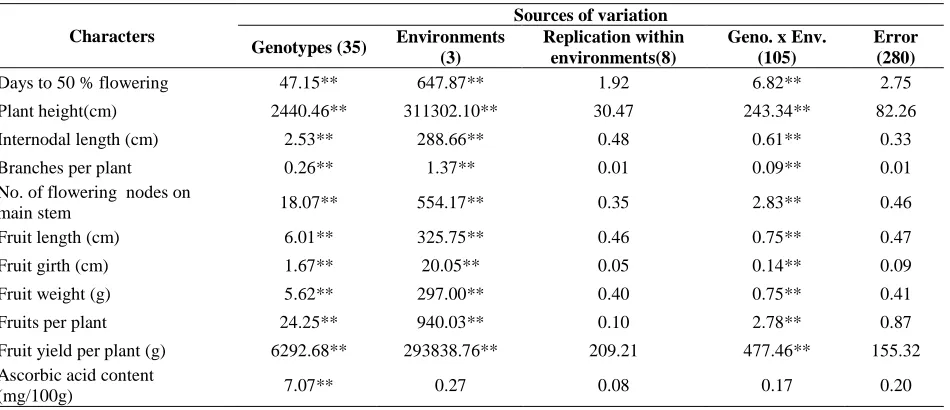
The stability analysis of variance of mean data (Table 2) revealed that the mean squares for genotypes were highly significant for all the characters indicating genetic variability among the genotypes for these characters. Similarly, the mean squares due to environments were highly significant for all the characters except for ascorbic acid content. This indicated that environments were effective in influencing the performance of the genotypes. Highly significant mean squares due to E + (G x E) were also observed for all these traits revealed that genotypes interacted significantly with the environments. While, testing the significance of mean square due to genotypes x environment interaction against pooled error, it was observed that mean square were significant for all the characters except ascorbic acid content. The mean square due to environment (linear) was significant and highly significant for all the characters when tested against pooled deviation. The co-incidence of genotype performance with environmental value was observed for plant height, internodal length, fruit length, fruit girth and fruit yield per plant as evident form significant G x E (linear) mean squares when tested against pooled deviation. The mean squares due to pooled deviation were found to be highly significant for all the traits except internodal length, fruit length, fruit girth and ascorbic acid content. On comparing relative magnitude of genotype x environment (linear) and pooled deviation from linearity (non-linear), it was found that the linear portion was considerably high for plant height, internodal length, branches per plant, no. of flowering nodes on main stem, fruit length, fruit girth, fruit weight, fruit yield per plant and ascorbic acid content, while non-linear portion was important for days to 50% flowering and fruits per plant as evidenced from larger portion of non-linear component over non-linear component. This indicated importance of both non-linear and linear portions in determining genotype x environment interactions for these attributes. These results are in agreement with those of Desai (1990b), Gondane and Lai (1993), Poshiya and Vashi (1997), Jindal et al. (2008) and Babariya et al.
(2009).
From the estimates of environmental indices (Table-3) it was observed that the characters days to 50 per cent flowering, branches per plant, no. of flowering nodes on main stem, fruit girth and fruits per plant were favoured in E1 and E2, while the
characters fruit length and fruit weight were more favoured in E2. E2 and E4 were not found favourable for internodal length and ascorbic acid content, respectively. For the character fruit yield per plant E3 was found to be the most unfavourable and E2 the most favourable. In general, the environment E2 was found to be the most favourable for fruit yield and other related traits.
According to Eberhart and Russell (1966), an ideal variety would be one that possessed high mean performance (of course greater than population mean), unit regression coefficient (bi = 1) and least deviation from regression i.e., as far as possible equal to zero (S2di = 0). However, if a variety possessed negative regression coefficient then the variety should be suitable for poor / unfavourable environments. Considering these criteria, the stability of genotypes (parents and crosses) was discussed below for all the characters under study.
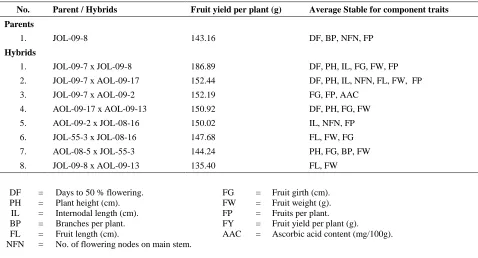
Stability parameters were worked out for 37 genotypes for eleven characters which revealed that none of the genotypes was stable for all the characters studied. Any generalization regarding stability of genotypes for the characters was not possible. Among 37 genotypes 1 parent and 8 crosses were found to be stable for fruit yield per plant owing to high mean, regression coefficient near unity and least deviation from regression (Table 4).
ISSN 0975-928X
yield per plant.The cross JOL-55-3 x JOL-08-16 (6) showed average stability for fruit length, fruit girth and fruit weight along fruit yield per plant and the cross AOL-08-5 x JOL-55-3 (7) showed average stability for plant height, branches per plant, fruit girth and fruit weight in addition to fruit yield per plant. The eighth cross JOL-09-8 x AOL-09-13 (8) showed average stability for fruit length (cm) and fruit weight (g) along with fruit yield per plant.
On the other hand four hybrids viz., JOL-09-7 x JOL-55-3, JOL-09-8 x JOL-55-3, JOL-09-8 x JOL-08-16 and AOL-09-17 x JOL-08-16 exhibited high fruit yield per plant but their regression coefficient significantly deviating from unity showing above average stability and found suitable for favourable environment. However they exhibited average stability for two or more component traits.
In general, the hybrids found stable for fruit yield also depicted stability in respect of its one or more yield component. This indicated that the stability of various component traits might be responsible for observed stability of hybrids for fruit yield. The chance for selection stable hybrids could be strengthened by selection in favour of stability in some yield component. Grafius (1956) also suggested that the stability of fruit yield might be due to the stability of various yield components.
The mean yield of each genotype depends on the particular set of environmental conditions. It is therefore, suggested that in order to identify stable genotype, actual testing over a wide range of environments including poor and good ones would be advantageous while making selection, attention should be paid to the phenotypic stability of characters directly related to fruit yield. Particularly fruits per plant, fruit length, fruit girth and fruit weight, so as to achieve maximum stability for the end product i.e., fruit yield in okra. Similar results for the above traits studied were also reported by Desai (1990b), Gondane and Lai (1993), Poshiya and Vashi (1997), Jindal et al.
(2008), Babariya et al. (2009), Kachhadia et al.
(2011), Akotkar et al. (2011) and Srivastava et al.
(2011).
References
Akotkar, P.K., De, D.K. and Ghoshdastidar, K.K. 2011. Stability analysis for fruit yield and component characters in okra (Abelmoschus esculentus (L.) Moench). In: “National Seminar on Contemporary Approaches to Crop Improvement.” Abstr.,62 : 196.
Alake, C.O. and Ariyo, O.J. 2012. Comparative analysis of genotype x environment interaction in West African okra (Abelmoschus esculentus (L.) Moench). J. of Agrc. Sci., 4(4): 135-150. Babariya, H.M., Dhaduk, L.K., Mehta, D.R., Patel, N.B.
and Poshiya, V.K. 2009. Stability analysis for
fruit yield and its attributing characters in okra [Abelmoschus esculentus (L.) Moench.]. GAU Res. J., 34(1): 20-28.
Desai, D.T. 1990. Genetic analysis of some quantitative characters in okra (Abelmoschus esculentus (L.) Moench). Unpublished Ph.D. Thesis, M.P.K.V., Rahuri.
Eberhart, S.A. and Russell, W.A. 1966. Stability parameters for comparing varieties. Crop. Sci., 6: 26-40.
Gondane, S.U. and Lai, G. 1993. Study of genotype X environment interaction in okra (Abelmoschus esculentus (L.) Moench). Ann. Plant Physiol.,
7(2): 242-246.
Grafius, J.E. 1956. Components of yield in oats, a geometrical interpretation. Agron. J., 51: 515-554.
Jindal, S.K., Arora, D. and Ghai, T.R. 2008. Stability analysis for earliness in okra (Abelmoschus esculentus L. Moench). J. Res. Punjab Agric. Univ.,45(3 & 4): 148-155
Kachhadia, V.H., Dangaria, J.H., Vachhani, J.H., Jivani, L.L. and Shekhat, H.G. 2011. Satbility analysis in okra (Abelmoschus esculentus L. Moench).
International Journal of Plant Science, 6(1): 34-39
Ramya, K. and Senthilkumar, N. 2010. Genotype x environment interaction and screening saline tolerant genotypes in okra [Abelmoschus esculentus (L.) Moench.]. International Journal of Plant Science, 5(1): 198-202
Poshiya, V.K. and Vashi, P.S. 1997. Phenotypic stability of hybrids and their parents for fruit yield in okra (Abelmoschus esculentus (L.) Moench). Indian J. Genetics,57(3): 266-268.
Srivastava, K., Aparna, J., Singh, P.K. and Kumar, S. 2011. Stability performance of okra hybrids over environments. In: “National Seminar on
ISSN 0975-928X
Table 1. Stability analysis of variance of pooled data for different traits in okra
Characters
Sources of variation Genotypes (35) Environments
(3)
Replication within environments(8)
Geno. x Env. (105)
Error (280)
Days to 50 % flowering 47.15** 647.87** 1.92 6.82** 2.75
Plant height(cm) 2440.46** 311302.10** 30.47 243.34** 82.26
Internodal length (cm) 2.53** 288.66** 0.48 0.61** 0.33
Branches per plant 0.26** 1.37** 0.01 0.09** 0.01
No. of flowering nodes on
main stem 18.07** 554.17** 0.35 2.83** 0.46
Fruit length (cm) 6.01** 325.75** 0.46 0.75** 0.47
Fruit girth (cm) 1.67** 20.05** 0.05 0.14** 0.09
Fruit weight (g) 5.62** 297.00** 0.40 0.75** 0.41
Fruits per plant 24.25** 940.03** 0.10 2.78** 0.87
Fruit yield per plant (g) 6292.68** 293838.76** 209.21 477.46** 155.32
Ascorbic acid content
(mg/100g) 7.07** 0.27 0.08 0.17 0.20
*, ** Significant at 5 % and 1 % level, respectively
Table 2. Stability analysis of variance of mean data for different traits in okra
Characters
Mean squares
Genotypes (36)
Environments + (Genotype x Environments)
Environments (Linear)
(1)
Genotype x Environments
(Linear) (108)
Pooled deviation
(74)
Pooled error (288)
Days to 50 % flowering 15.29**++ 8.35** 685.38**++ 2.24** 2.53** 0.99
Plant height(cm) 794.33**++ 2947.78** 318635.50**++ 79.34**+ 52.53** 26.96
Internodal length (cm) 0.84**++ 2.88** 299.19**++ 0.19**+ 0.12 0.11
Branches per plant 0.08**++ 0.04* 1.41**++ 0.03** 0.03** 0.00
No. of flowering nodes on
main stem 5.86**
++
6.03** 569.81**++ 0.92** 0.84** 0.15
Fruit length (cm) 1.96**++ 3.24** 332.88**++ 0.25**++ 0.14 0.16
Fruit girth (cm) 0.54**++ 0.23** 20.40**++ 0.05*+ 0.03 0.31
Fruit weight (g) 1.83**++ 2.99** 305.47**++ 0.24** 0.21** 0.14
Fruits per plant 7.86**++ 9.58** 966.05**++ 0.90** 0.89** 0.29
Fruit yield per plant (g) 2039.30**++ 2868.96** 301722.60**++ 154.93**+ 104.28** 53.64 Ascorbic acid content
(mg/100g) 2.29**
++ 0.05 0.27*+ 0.06 0.05 0.07
ISSN 0975-928X
Table 3. Estimates of environmental index for various characters under different environments.
S. No. Characters Environmental index
E1 E2 E3 E4
1 Days to 50 % flowering -0.48 -2.86 3.18 0.16
2 Plant height (cm) -12.95 77.00 -47.24 -16.81
3 Internodal length (cm) -0.29 2.33 -1.50 -0.53
4 Branches per plant 0.15 0.01 -0.11 -0.06
5 No. of flowering nodes on main stem 0.91 2.32 -3.03 -0.20
6 Fruit length (cm) -0.49 2.51 -1.48 -0.53
7 Fruit girth (cm) 0.05 0.51 -0.53 -0.03
8 Fruit weight (g) -0.12 2.15 -1.90 -0.13
9 Fruits per plant 0.95 3.12 -3.93 -0.13
10 Fruit yield per plant (g) 5.46 63.81 -63.39 -5.87
11 Ascorbic acid content (mg/100g) 0.01 0.01 0.05 -0.07
E1-Summer-2011, E2-Kharif-2011, E3-RabI-2011-12 and E4-Summer-2012
Table 4. Stable parent and hybrids identified on the basis of high mean for fruit yield per plant and component traits
No. Parent / Hybrids Fruit yield per plant (g) Average Stable for component traits Parents
1. JOL-09-8 143.16 DF, BP, NFN, FP
Hybrids
1. JOL-09-7 x JOL-09-8 186.89 DF, PH, IL, FG, FW, FP
2. JOL-09-7 x AOL-09-17 152.44 DF, PH, IL, NFN, FL, FW, FP
3. JOL-09-7 x AOL-09-2 152.19 FG, FP, AAC
4. AOL-09-17 x AOL-09-13 150.92 DF, PH, FG, FW
5. AOL-09-2 x JOL-08-16 150.02 IL, NFN, FP
6. JOL-55-3 x JOL-08-16 147.68 FL, FW, FG
7. AOL-08-5 x JOL-55-3 144.24 PH, FG, BP, FW
8. JOL-09-8 x AOL-09-13 135.40 FL, FW
DF = Days to 50 % flowering. FG = Fruit girth (cm).
PH = Plant height (cm). FW = Fruit weight (g).
IL = Internodal length (cm). FP = Fruits per plant. BP = Branches per plant. FY = Fruit yield per plant (g).