63 | P a g e
International Journal of Pharmaceutical
Development & Technology
e ISSN - 2248 - 910X
www.ijpdt.com
Print ISSN - 2248 - 9096FORMULATION AND EVALUATION OF CONTROLLED RELEASE
MATRIX TABLETS OF FINASTERIDE
Nagalaxmi V*, Mahipal Reddy L, Manikanta Kumar A, Manjunath Shetty KS
Department of Pharmaceutics, Srinivasa Pharmaceutical Institute & Centre for Research,JNTU (H) University, Burugupally (V), Vikarabad (M), R.R. District. Andhra Pradesh, India.
ABSTRACT
The aim of the present investigation was to develop oral controlled release matrix tablet formulations of Finasteride using Eudragit and Hydroxypropyl methylcellulose (HPMC) as a hydrophilic release retardant polymer and to study the influence of various formulation factors like proportion of the polymer, polymer viscosity grade, compression force, and release media on the in vitro release characteristics of the drug. The formulations were developed using dry granulation technology. The in vitro
release studies were performed using US Pharmacopoeia type 1 apparatus (basket method) in 900 mL of pH 6.8 phosphate buffer at 100 rpm. The release kinetics was analyzed using Korsmeyer–Peppas model. The release profiles found to follow Higuchi’s square root kinetics model irrespective of the polymer ratio and the viscosity grade used. The results in the present investigation confirm that the release rate of the drug from the Eudragit matrices is highly influenced by the drug/Eudragit ratio and viscosity grade of the Eudragit. Also, the effect of compression force and release media was found to be significant on the release profiles of Finasteride from Eudragit matrix tablets. The release mechanism was found to be anomalous non-Fickian diffusion in all the cases. In the present investigation, a series of controlled release formulations of Finasteride were developed with different release rates and duration so that these formulations could further is assessed from the in vivo bioavailability studies. The formulations were found to be stable and reproducible. The results of dissolution studies indicated that the formulation F9 (containing Eudragit as polymer) is the most successful of the study. On increasing polymer ratio a decrease in release rate of the drug was observed after lag time. The optimized formula F9 was best fitted formulation.
Keywords: Finasteride, HPMC, Eudragit, Direct Compression Method.
INTRODUCTION
The oral route for drug delivery is the most popular, desirable, and most preferred method for administrating therapeutically agents for systemic effects because it is a natural, convenient, and cost effective to manufacturing process. One of the most common approach used for prolonging and controlling the rate of drug release is incorporating the drug in a hydrophilic colloidal matrix such as Hydroxy propyl methyl cellulose, Hydroxy propyl cellulose, carbopols, chitosan, alginates and gelatin etc. The mechanism and kinetics of release of drugs incorporated in these polymer matrices is depends the type and amount of polymer as well as on the physico-chemical properties of drug substance. Generally the drug release from these matrices includes penetration of fluid, followed by dissolution of drug particles and diffusion through fluid filled pores [1]. The diffusion of drug through a matrix is a rate-limiting step.
With many drugs, the basic goal of therapy is to
achieve a steady-state blood level or tissue level that is therapeutically effective and non-toxic for an extended period of time. To achieve better therapeutic action various types of drug delivery systems are available, out of which modified release systems are gaining much importance because of their wide advantages over others like ease of administration, convenience and non- invasiveness. Oral route is the most commonly used route for drug administration. Although different route of administration are used for the delivery of drugs, oral route remain the preferred mode. Even for sustained release systems the oral routes of administration has been investigated the most because of flexibility in designing dosage forms [2].
Today these conventional drug delivery systems are widely used. The term drug delivery can be defined as techniques that are used to get the therapeutic agents inside the human body. Conventional drug therapy requires periodic doses of therapeutic agents. These agents are formulated to produce maximum stability, activity and
64 | P a g e
bioavailability. For most drugs, conventional methods ofdrug administration are effective, but some drugs are unstable or toxic and have narrow therapeutic ranges [3].
Finasteride is an enzyme inhibiting agent. It is used in the treatment of hyperplasia and also used as anti-baldness agent. The mechanism of action of Finasteride is based on its preferential inhibition of Type II 5a-reductase through the formation of a stable complex with the enzyme. Inhibition of Type II 5a-reductase blocks the peripheral conversion of testosterone to DHT, resulting in significant decreases in serum and tissue DHT concentrations, minimal to moderate increase in serum testosterone concentrations,
and substantial increases in prostatic testosterone
concentrations. In the present investigation Finasteride control release tablets are prepared by using excipients magnesium stearate, micro crystalline cellulose, lactose and polymers HPMC K-100M, HPMC E-5M ethyl cellulose, and Eudragit in different ratios [4-5].
Advantages
Reduced dosing frequency.
Dose reduction.
Improved patient compliance.
Reduced toxicity due to over dose.
Disadvantages
Dose dumping.
Poor In-Vitro In-vivo correlation.
Increased potential first pass clearance [6].
Aim and Objectives
The objective of this research is to prepare Controlled drug delivery of tablets consisting of excipients (1) lactose, MCC, magnesium stearate, (2) FINASTERIDE (drug), a alpha-reductase antagonist drug,(3) polymers of HPMC K100M, Eudragit, HPMC E5M, by control release technology and to evaluate their release properties. The effect of various formulations and process variables on in- vitro drug release was studied. Hence, the objectives of the present work include:
1. Drug-polymer interaction studies
2. Preparation of Finastreride tablets using different polymers in combination.
3. Evaluation of drug loaded tablets for pre formulation parameters.
4. To develop suitable formulae and procedure for the manufacture of Finastreride tablets.
5. In vitro evaluations of Finastreride tablets for the release characteristics.
6. To develop an optimized formulation.
7. Stability studies of the promising formulations. Drug Profile: Finasteride
1. Drug Name: Finasteride.
2. Mechanism of Action: The mechanism of action of Finasteride is based on its preferential inhibition of Type II 5a-reductase through the formation of a stable complex with the enzyme. Inhibition of Type II 5a-reductase blocks the peripheral conversion of testosterone to DHT, resulting in
significant decreases in serum and tissue DHT
concentrations, minimal to moderate increase in serum testosterone concentrations, and substantial increases in prostatic testosterone concentrations [7].
MATERIALS AND METHODS
All the chemicals were of laboratory grade and used as such without any further purification. Pre formulation characterization of the pure drug was performed for comparing the data with different developed formulations (F1 to F12), obtained from the analysis of formulation of Finasteride. Physical Description done as general appearance of the drug its visual identity and overall ‘elegance’ is essential, this parameter was done and it was noticed by observing the colour of the drug simply, the solubility of the drug with the standard descriptive term with solvent series was checked. Similarly melting point of the pure drug was considered for the temperature at which the vapour pressure of the drug and the liquid were found equal and exists in equilibrium [8].
PREPARATION OF FINASTERIDE CONTROL RELEASE TABLETS BY DIRECT COMPRESSION METHOD
Composition of matrix formulation
Direct compression was followed to manufacture the control release tablets of finasteride. All the polymers were selected, drug and excipients were passed through sieve no. 40 before using into formulation. Polymers selected for tablets are HPMC K-100 M, HPMC E-5 M and Eudragit. Excipients like MCC, magnesium stearate and lactose were selected for the study. Lactose is used as lubricant and micro crystalline cellulose is used as bulking agent, glidant and disintegrating agent.
Manufacturing procedure
1. Finasteride and all other ingredients were individually passed through sieve no.40.
2. All the ingredients were mixed thoroughly upto 15min.
3. The powder mixer was lubricated with magnesium
stearate.
4. The tablets are prepared by using direct compression method.
Evaluation parameters of powder blend (pre compression parameters)
Bulk density (DB)
65 | P a g e
volume was measured which is called initial bulk volume.Bulk density is expressed in gm/cc and is given by, Db = M / VO
Where, Db = Bulk density (gm/cc), M =Mass of powder (gm), VO=Bulk volume of powder (cc),
Tapped density (DT)
Ten grams of powder was introduced into a clean, dry 100mL measuring cylinder. The cylinder was then tapped 100 times from a constant height and tapped volume was read. It is expressed in gm/cc and is given by,
Dt = M / Vt
Where, Dt = Tapped density (gm/cc), M = Mass of powder (gm),
Vt= Tapped volume of powder (cc),
Angle of repose (θ)
It is defined as the maximum angle possible between the surface of pile of the powder and the horizontal plane. Fixed funnel method was used. A funnel was fixed with its tip at a given height (h), above a flat horizontal surface on which a graph paper was placed. Powder was carefully poured through a funnel till the apex of the conical pile just touches the tip of funnel. The angle of repose was then calculated using the formula,
θ = tan-1(h/r)
Where, θ = angle of repose, h = height of pile,
r = radius of the base of the pile.
Compressibility index
The compressibility index is indirectly related to relative flow rate, cohesiveness and particle size of the powder. The compressibility index of material can be estimated from the tapped and bulk density of power. % Compressibility Index = Tapped density- bulk density/ tapped density×100
Hausner’s ratio
The Hausner’s ratio is a number that is correlated to the flow ability of a powder or granular material [9-10]. It is calculated by using the following formula:
Hausner’s ratio =ρt/ρo………4
Where, ρt= tapped density, ρo = bulk density.
Post compression parameters Thickness
Control of physical dimension of the tablet such as thickness is essential for consumer acceptance and tablet uniformity. The thickness and diameter of the tablet was measured using vernier callipers. It is measured in mm.
Hardness
Hardness indicates the ability of a tablet to withstand mechanical shocks while handling. The Monsanto
hardness tester was used to determine the tablet hardness. The tablet was held between a fixed and moving jaw. Scale was adjusted to zero; load was gradually increased until the tablet fractured. The value of the load at that point gives a measure of hardness of the tablet. Hardness was expressed in Kg/cm2.Three tablets were randomly picked and hardness of the tablets was determined.
Friability
Tablet strength was tested by using Roche Friabilator. 20 tablets were weighed and placed in the friabilator and operated at for 100 revolutions (4min), taken out and were dedusted. The percentage weight loss was calculated by reweighing the tablets. The % friability was then calculated by,
F=W1 /W2×100 ………5 Where:
F = Friability,
W1= weight of the tablet before test, W2= weight of the tablet after test.
Weight variation
Ten tablets were selected randomly from each batch were weighed individually and together in a single pan balance. The average weight was noted and standard deviation calculated. The tablet passes the test if not more than two tablets fall outside the percentage limit and none of the tablet differs by more than double the percentage limit.
……….6 Where, PD = Percentage deviation,
W avg = Average weight of tablet, W initial = individual weight of tablet.
Uniformity of drug content
The drug content was performed to check the dose uniformity in the formulation. Randomly ten tablets were weighed and powdered. A quantity equivalent to 100mg of finasteride was added in to a 100mL volumetric flask and dissolved in water, shaken for 10 minutes and made up to the volume with water. After suitable dilutions the drug content was determined by UV spectrophotometer at 254 nm against blank.
In-vitro dissolution studies
66 | P a g e
RESULTS
All the evaluated parameters of the formulations showed compliance with pharmacopoeial standards. The effect of polymer loading in in-vitro drug release and the mechanism of release was studied by different mathematical models. This could be retarded or maintained by the proper choice of controlling agent in order to achieve the desired release profile. The selected formulations were subjected to stability studies as per ICH guidelines at different temperature and humidity conditions.
During the study period, pre formulation study of selected drug Finasteride was done first for physical observation, as the general appearance of the drug, its visual identity and overall ‘elegance’ is essential and it was found a white or almost white crystalline powder having slight drug smell and also found there is no leakage and crushing of the packet. The solubility of the pure drug was found maximum in 6.8 buffer. Melting point of the pure drug was found with a range between 1170c - 1500c and this range complies the USP which shows the drugs purity specification. To obtain absorbance maxima which were found at 254nm, solution was prepared as 10mg/mL using medium 6.8 buffer. To identify the active site of the selected drug Finasteride FTIR scanning was done with full range, and the Possible Structure Units (PSU) was found as Alkyl group, ketone groups, amide groups of the drug as expressed in the molecular formula of the standard drug Finasteride. The stability testing of the selected formulation F9 was carried out as per the ICH guidelines. The optimized formulation was subjected to stability studies at 400C and 75%RH for a period of one month.
The physical stability was assessed by the appearance and there was no change in colour or shape of the tablet and the chemical stability by change in the drug content as mentioned in the table, which concludes that there was no change in the physical and chemical properties of formulation. So the F9 formulation was stable at the end of one month.
Evaluation of Tablets
Control release tablets of Finasteride were developed to increase the residence time of drug at site of action, so that they can be retained for longer time and help in controlled release of drug up to 24 hrs. Different grades of HPMC-K100M, HPMC-E5M and Eudragit polymers are known to be beneficial in improving control release characteristics.
The pre-compression parameters obtained for all
formulations are tabulated in the table 4. The value of angle of repose was found to be in the range of 240.51 to 270.7. This indicates good flow property of powder blend. Carr’s index value ranges between 5.29% to 11.7%.Indicates that the powder blend have the required flow property for direct compression. The Bulk Density and Tapped Density were found to be ranged from 0.7650 to 0.0503(gm/cc) and 0.8933 to 1.0714(gm/cc) respectively, which are found to be within the prescribed limits. The Hausner’s ratio of the granules were found to be ranged from 1.02 to 1.22 Hausner’s ratio less than 1.25 have better flow properties than the higher ones (>1.25).
The tablets were prepared by direct compression method using the HPMC-K100M, HPMC-E5M and Eudragit polymers to provide sufficient drug release retardation to the tablets.
The results have shown in the table no-5.The prepared floating tablets were evaluated for thickness, hardness, friability, average weight variation, drug content, all the studies were performed in triplicates and the results were expressed in ± standard deviation.
It is observed that the tablets prepared in all the formulations were found to be pale white, smooth, convex faced circular with no visible cracks.
The thickness of tablets was measured by vernier
calipers and was found to be ranged from 1.35nm to 1.5nm and respectively.
The hardness of the tablets was measured by using Monsanto hardness tester and is found to range from 5.1 to 6 kg/cm2. The hardness of the tablets in all the formulations was found to be within prescribed limits.
The friability was measured by using Friabilator and was found to be ranged from 0.07% to 0.18%, which is an indication of satisfactory mechanical resistance of tablet.
The drug content estimation showed values in the range
of 96.1% to 98.7% which reflects good uniformity in drug content among different formulations.
The weight variation test was ranged from 146.9 to 152.1mg. The percentage weight variation was found within the IP limit of ±7.5% of the weight. All the formulations showed the values within the prescribed limits for tests like hardness, friability, weight variation, drug content which indicate that the prepared tablets are of standard quality. All the tablets were prepared by using direct compression technique.
It was observed that the increasing in the concentration
of Eudragit polymer will prolong the release rate of drug.
Table 1. List of drug-excipients utilized
S. No Chemicals Source
1 HPMC K100 Merck, India ltd, Mumbai
2 HPMC E5 Merck, India ltd, Mumbai
3 Methylcarboxy cellulose Rankem, India ltd, Mumbai
4 Eudragit Merck, India ltd, Mumbai
5 Magnesium stearate Merck, India ltd, Mumbai
67 | P a g e
Table 2. Composition of matrix formulations (drug and polymer ratios) from F1-F6
Ingredients (mg) F1(1:1) F2(1:2) F3(1:3) F4(1:1) F5(1:2) F6(1:3)
API 5 5 5 5 5 5
HPMCE5 5 10 15 - - -
HPMCK100 - - - 5 10 15
EUDRAGIT - - - -
Mg,stearate 4 4 4 4 4 4
Lactose 68 65.5 63 68 65.5 63
MCC 68 65.5 63 68 65.5 63
Total 150 150 150 150 150 150
Table 3. Composition of matrix formulations (drug and polymer ratios) from F7-F12
Ingredients (mg) F7(1:1) F8(1:2) F9(1:3) F10(1:1:1) F11(1:1:1) F12(1:1:1:1)
API 5 5 5 5 5 5
HPMCE5 - - - 5 5 5
HPMCK100 - - - 5 5
EUDRAGIT 5 10 15 5 5
Mg. Stearate 4 4 4 4 4 4
Lactose 68 65.5 63 65.5 65.5 63
MCC 68 65.5 63 65.5 65.5 63
Total 150 150 150 150 150 150
Table 4. Evaluation parameters of powder blend
Formulations repose(θ) Angle of Bulk Density(gm/cm3)
Tap Density(gm/cm3)
Carr’s
Index(%) Hausner ratio(HR)
F1 250.73 0.9929 1.0714 14.87 1.079
F2 260.83 0.9740 1.0714 12.02 1.1
F3 240.69 0.8012 0.9375 8.647 1.17
F4 250.14 0.8577 0.9375 5.897 1.093
F5 270 .7 0.7944 0.9375 9.762 1.18
F6 250.94 0.7862 0.9338 9.746 1.187
F7 260.42 0.7684 0.9375 11.043 1.22
F8 240.82 0.7650 0.9333 11.074 1.22
F9 250.43 1.0503 1.0714 9.437 1.02
F10 240.51 0.8026 0.9375 8.543 1.168
F11 270.1 0.7493 0.8933 5.871 1.192
F12 260.42 0.7898 0.9375 9.516 1.187
The tablets were evaluated for Weight variation, Thickness, Hardness and Friability to meet the Pharmacopoeial standards. Table 5. Evaluation parameters of formulations
Formulation Thickness (mm)
Hardness (kg/cm2)
Friability (%)
Average Weight Variation(mg)
Drug content (%)
F1 1.5±0.01 5.5±0.5 0.14 150±2 98.7
F2 1.4±0.02 5.4±0.6 0.09 149.4±3 96.1
F3 1.5±0.03 5.6±0.7 0.12 146.9±1.5 98.5
F4 1.3±0.01 6±0.4 0.07 150.7±1 99.1
F5 1.35±0.03 5.1±0.3 0.2 151.6±2 98.2
F6 1.38±0.04 5.4±0.5 0.07 150.1±3 96.8
F7 1.42±0.01 5.5±0.2 0.12 149.9±1 99.8
F8 1.38±0.01 5.5±0.2 0.14 152.1±2 97.5
F9 1.45±0.03 5.4±0.4 0.09 150.4±4 99.1
F10 1.43±0.01 5.3±0.3 0.18 151.4±3 96.5
F11 1.35±0.02 5.6±0.4 0.2 150.4±2 97.2
68 | P a g e
Table 6. In-vitro cumulative % release of drug from matrix tablets of Finasteride - HPMC K-100
Time(in hrs) F1%cdr F2%cdr F3%cdr
0 0 0 0
1 62.05714 55.59286 49.12857
4 80.15714 76.27857 67.22857
8 87.91429 81.45 74.98571
16 93.08571 86.62143 82.74286
20 96.96429 93.08571 89.20714
24 99.55 98.25714
Table 7. In-vitro cumulative % release of drug from matrix tablets of Finasteride- HPMC E-5
Time(in hrs) F4%cdr F5%cdr F6%cdr
0 0 0 0
1 63.35 54.3 49.12857
4 78.86429 73.69286 65.93571
8 86.62143 80.15714 71.10714
16 91.79286 84.03571 78.86429
20 95.67143 91.79286 84.03571
24 --- 98.25714 95.67143
Table 8. In-vitro cumulative % release of drug from matrix tablets of Finasteride – Eudragit
Time(in hrs) F7%cdr F8%cdr F9%cdr
0 0 0 0
1 34.90714 32.32143 32.32143
4 46.54286 45.25 43.95714
8 63.35 62.05714 60.76429
16 78.86429 78.86429 76.27857
20 84.03571 82.74286 81.45
24 95.67143 95.67143 94.37857
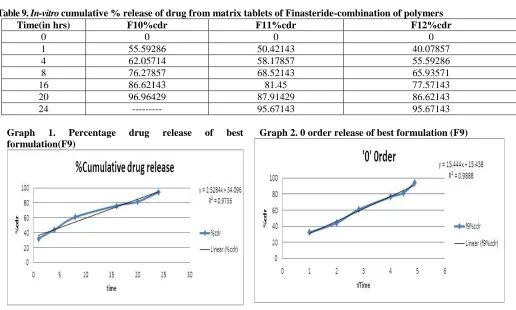
Table 9. In-vitro cumulative % release of drug from matrix tablets of Finasteride-combination of polymers
Time(in hrs) F10%cdr F11%cdr F12%cdr
0 0 0 0
1 55.59286 50.42143 40.07857
4 62.05714 58.17857 55.59286
8 76.27857 68.52143 65.93571
16 86.62143 81.45 77.57143
20 96.96429 87.91429 86.62143
24 --- 95.67143 95.67143
Graph 1. Percentage drug release of best formulation(F9)
69 | P a g e
Graph 3. 1st order release of best formulation (F9) Graph 4. Higuchi mechanism of drug release
Graph 5. Peppas mechanism of drug release
DISCUSSION
The control release tablets of Finasteride were prepared with individual and different combinations of polymers with different ratios.F1, F2, F3 are prepared, drug with HPMC E-5M with ratios of 1:1, 1:2, 1:3. F4, F5, F6 are prepared with HPMC K-100M with ratios of 1:1,1:2,1:3. F7, F8, F9 are prepared with Eudragit with ratios of 1:1, 1:2,1:3. F10 is the combination of HPMC E-5M and HPMC K-100M with the ratios of 1:1, F11 is the combination of HPMC E5m and Eudragit with the ratios of 1:1. F12 is combination of three polymers with 1:1:1 ratio. Formulations are prepared with respectively of F1, F2 &F3 failed. Because the drug was not released in controlled manner. In f4, F5, F6 lag time is not maintained and also total amount of the drug is not released until 24 hours. F10, F11, F12 are giving good results but half-life is less comparing with Eudragit polymer. Hence F10- F12 formulations are also failed. In F7 & F8 maximum amount of drug is released in 24 hours but the lag time is not maintained properly. By increasing the ratio of polymer in F9 lag time is maintained and the control release of the drug occurs, which indicates that F9 is the optimized formulation.
CONCLUSION
Control release tablets were formulated and evaluated using Finasteride as drug, HPMC-K100M,
HPMC-E5M used as polymers, by varying concentrations. All the formulations were prepared by using direct compression method, where the concentration of the drug kept constant and concentration of polymers varied. Micro crystalline cellulose is used as disintegrants and magnesium Stearate is used as lubricant respectively. All the prepared tablet formulations were found to be good without capping and chipping. It was observed that, in all the formulations as the concentration of polymer increases, the amount of drug release was found to be decreased, because the amount of drug binded in the polymer could be more. Of all the batches formulated from F1 – F12 using fixed amount of drug and different quantities of polymers, the observations are:
F9 shows better linearity compared to all other batches.
It complies with all the physicochemical parameters.
It has better flow properties compared to all the other batches.
Better In-vitro Dissolution rate compared to other
batches.
ACKNOWLEDGEMENTS
70 | P a g e
sincere thanks to my research guide Dr A. ManikantaKumar M.Pharm., Ph.D, Associate Professor,Department of
Pharmaceutical analysis, Srinivasa Pharmaceutical institute and center for research, who has provided excellent guidance, valuable advices, and shared intelligent thoughts, criticisms and inculcated discipline. I express my deep
gratitude to Dr. K.S. Manjunatha Shetty, M.pharm., ph.D, FAGE, Professor & Principal of Srinivasa Pharmaceutical Institute and Center for Research,Mr. Srinivasulu, chairman of Srinivasa Pharmaceutical institute and center for research, for his enduring support. He has been generous with providing facilities to carry out this work.
REFERENCES
1. Li VHK, Lee VHL. In., Controlled Drug Delivery: Fundamentals and Applications (Robinson JR, Lee VHL., eds.), 2nd ed.,
Marcel Dekker, New York, 1987, 4-36.
2. Lechman L, Liberman HA, Kanig JL. In., The Theory and Practice of Industrial Pharmacy, 3rd ed., Varghese Publishing House, Bombay, 1987, 430-453.
3. Notari, R., Biopharmaceutics and Clinical Pharmacokinetics, an Introduction, 3rd Ed., Marcel Dekker Inc. New York, 1980,
p152-
4. Anonymous 1. http://www.drugs.com/pro/finasteride.htmlv
5. Robinson JR. Sustained and controlled release drug delivery systems. Drugs and pharmaceutical Sciences, Marcel Dekker
New: York, NY. 6, 1978, 773.
6. Vyas SP and Khare RK. Controlled Drug Delivery Concept and Advances 1st edition, Vallabh Prakashan, New Delhi, 1, 2000, 54,155.
7. Buchi NN, Jyotheermayi D, Anusha D and Maheswari KM. Controlled release tablet formulations of carvedilol. Journal of
Chemical and Pharmaceutical Research, 4(9), 2012, 4266-4274.
8. Shefaat US, Gul MK, Syed UJ, Kifayat US, Abid H, Haroon K and Kamran AK. Development of novel diclofenac potassium controlled release tablets by wet granulation technique and the effect of co-excipients on in vitro drug release rates. Pak. J. Pharm. Sci., 25(1), 2012, 161-168.
9. Jamal AA, Nawal AR, Mowafaq MG, Alaa AA. Preparation and evaluation of orodispersible tablets of finasteride using
co-processed excipients. Int J Pharm Pharm Sci, 5(2), 613-618.
10. Rajesh KJ, Yogesh Kumar G and Rakesh KJ. Formulation development and evaluation of controlled release tablets of famotidine. International Journal of Pharmaceutical & Biological Archives, 3(4), 2012, 858-866.
11. Syed Umer J, Gul Majid K and Izhar H. Formulation development and investigation of ibuprofen controlled release tablets
with hydrophilic polymers and the effect of coexcipients on drug release patterns. Pak. J. Pharm. Sci., 25(4), 2012, 751-756. 12. Raju DB, Suresh John K and Varma MM. Formulation and evaluation of Losartan Potassium matrix tablets for oral
controlled releasev. J. Chem. Pharm. Res, 2(2), 2010, 130-135.
13. Raja ST, Palanichamy S, Shanmuganathan S, Tamilvanan S and Thanga T. Formulation and Evaluation of Theophylline Controlled Release Matrix Tablets using Guar gum. Ars Pharm, 50(4), 2009, 205-214.
14. Gurpreet A, Karan M, Inderbir S, Sandeep A. Formulation and Evaluation of Controlled Release Mucoadhesive Matrix
Tablets: Assessment of Myrrh Oleo Gum Resin as a Natural Pharmaceutical Excipient. International Journal of