The validity of single item and domain specific
sitting time questionnaires in a student population
measured under free-living conditions
T.D. Atsma
Maastricht University [email protected]Abstract
Keywords
Sedentary time questionnaires, accelerometry, activPAL, validation study, IPAQ, single item, domain specific, students
Introduction
the domain specific sedentary time questionnaires (dsSTQ) both underestimate the sedentary time compared to accelerometry and that there is little agreement between the questionnaires and accelerometry.
Material and Methods
Subjects
Twenty healthy students participated in this study. Participants had to be students, with a BMI between 18 and 25, and at least 18 years of age. Exclusion criteria were movement disabilities and diseases interfering with physical activity.
Study design
This study was an observational study comparing accelerometer and questionnaire determined sitting time for seven consecutive days under free-living conditions. The subjects wore an accelerometer (activPAL3TM, PAL Technologies, Glasgow, Scotland) on the
thigh and filled in a questionnaire about the last seven days right before attaching the accelerometer, directly after the removal and as a retest seven days after the removal of the accelerometer. Two questionnaires were used in the study, of which the first questionnaire was the Dutch translation of the International Physical Activity Questionnaire (IPAQ) in the Long Form about the last seven days, of which only the last question on the average sitting time on weekdays and on weekend days in the last 7 days was used for further analysis. In addition to the IPAQ, a domain specific sedentary time questionnaire (dsSTQ) was used. The dsSTQ split sitting time into sitting while travelling, working, watching TV, using the computer in the spare time, during activities in the spare time¸ and eating. It was asked to fill in the average daily sitting time for the last 7 days and the questions were asked for weekdays and weekend days separately.
Procedure
activities during the upcoming week. The subjects kept a log of their sleeping times for the seven measuring days with an accuracy of 10 minutes, which were used as guidance for obtaining the sleeping times from the accelerometer data. Sleeping times were logged in order to calculate the sitting/lying time while awake by subtracting the sleeping time from the total sitting time, which was obtained with the accelerometer. Seven days after the first meeting the second meeting took place. The accelerometer was removed and afterwards the subjects were asked to fill in the online questionnaire again. The subjects were reminded that within seven days they would receive an email with the re-test questionnaire. In this email it was emphasised that the questionnaire had to be filled in immediately on the day of receiving the email.
Data analysis
determined manually with the activPAL software output per day. When a break longer than 2 minutes occurred in the middle of a longer sitting period, it was measured whether the sitting time before and after the break was minimally 30 minutes. In such a case they were counted as two separate sitting events lasting longer than 30 minutes. When the break was shorter than 2 minutes, the sitting time before and after the break were counted as one event. When more breaks shorter than 2 minutes occurred in a sitting period, the break times were summed. When the sum of the break times reached 2 minutes, the sitting event stopped at the last break of the sum, and the sitting time after the last break was counted as a new sitting event. When the sitting events were less than 30 minutes, they were not counted. Sleeping was not counted as a sitting event.
Results
Subject characteristics
A total of twenty subjects (15 male, 5 female) participated in this study, with a mean age of 21±2 years, an average height of 1.78±0.09 m and an average weight of 68±8 kg, which resulted in an average BMI of 21.3±1.2.
Population average sitting times for the three measuring methods
For full week averages, the population average sitting times and the range of individual values derived from the three measuring methods were 575.7 (450.5 - 680.6), 383.4 (102.9 - 677.1), and 572.5 (263.6 - 840.7) min/day for accelerometry, IPAQ and dsSTQ respectively (table 1). Both IPAQ and dsSTQ derived sitting times had broader ranges of individual values than accelerometry determined sitting times. On the population average, sitting times on weekdays were higher than sitting times in the weekend for all three measuring methods.
Table 1: Population average sitting times of the three measuring methods
ActivPAL and IPAQ sitting time correlation and agreement
(ρ=0.346, P=0.174) and weekend averages (ρ=0.305, P=0.251). Positive biases for full week, weekday and weekend averages (175.3, 174.8 and 189.1 sitting min/day respectively) were found which were significantly different from zero (figure 1). The 95% limits of agreement for full week sitting time averages were -107.4 and 458.0 min/day as is depicted in figure 1. A linear regression (r=0.764) was performed and 95% limits of agreement are represented with the equation: Difference = 723 - 1.12 * Mean ± 1.96 * 97.0 (SDr) min/day.
Figure 1. Bland-Altman plot of the full week average sitting times measured with the activPAL and the IPAQ (IPAQ sitting time was subtracted from activPAL sitting time). Dashed lines are the 95% limits of agreement and the black line is the mean difference between the methods. The grey dashed line indicates zero difference between the methods.
ActivPAL and dsSTQ sitting time correlation and agreement
min/day for full week, weekday and weekend averages respectively (figure 2). The 95% limits of agreement for the full week average sitting time were -290.7 and 244.9 min/ day (figure 2). This is less bias than the bias of IPAQ determined sitting time compared to accelerometry. Both higher and lower estimates of sitting time have been observed for the dsSTQ compared to accelerometry, as is visible in figure 2. There seemed to be a proportional bias in the plots, and thus a linear regression (r=0.764) was performed and 95% limits of agreement are represented with the equation: 610 - 1.08 * Mean ± 1.96 * 99.19 min/day.
Figure 2. Bland-Altman plot of the full week average sitting times measured with the activPAL and the dsSTQ (dsSTQ sitting time was subtracted from activPAL sitting time). Dashed lines are the 95% limits of agreement and the black line is the mean difference between the methods. The grey dashed line indicates zero difference between the methods.
IPAQ and dsSTQ sitting time in relation to the activPAL sitting time
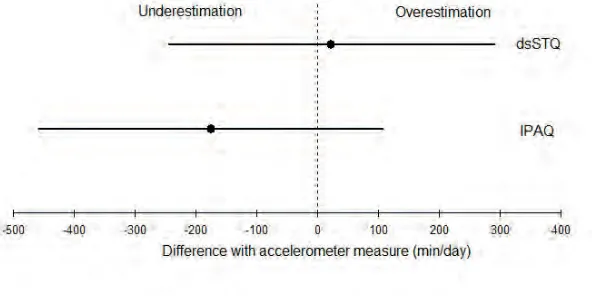
the dsSTQ insignificantly overestimates sitting time compared to accelerometry (figure 3).
Figure 3. Plot of the differences between questionnaire (dsSTQ and IPAQ) and accelerometer full week average sitting times (questionnaire - accelerometer). Dots represent the mean differences and bars the 95% limits of agreement.
ActivPAL and dsSTQ sitting events lasting 30 minutes or longer correlation and agreement
Figure 4. Bland-Altman plot of full week average sitting events lasting 30 minutes or longer measured with the activPAL and the dsSTQ (dsSTQ sitting events were subtracted from activPAL sitting events). Dashed lines are the 95% limits of agreement and the black line is the mean difference (-2.2 events) between the methods. The grey dashed line indicates zero difference between the methods.
Discussion/Conclusion
The aim of this study was to assess the validity of the IPAQ and the dsSTQ outcomes in relation to the activPAL accelerometer sitting time outcomes. It was hypothesised that the IPAQ and the dsSTQ underestimated sitting time compared to accelerometry determined sitting time and that there would be little agreement. The major findings of this study were that the IPAQ significantly underestimated and the dsSTQ insignificantly overestimated sitting time for the full week averages compared to accelerometry and that the correlations between the methods were weak to moderate.
be concluded that the used questionnaire is not a valid measurement tool for the number of sitting events lasting 30 minutes or longer compared to accelerometry. It is however unknown how accurate the used criterion measure is in measuring the length of sitting events. Some studies have validated accelerometry determined number of breaks with direct observation as criterion measure (14, 15). They found that the activPAL estimated the absolute number of breaks and the number of sitting to standing transitions precisely and accurately. However, the way the activPAL data is presented with the software gave some difficulties in the current study with determining sitting and breaking time. It was not possible to obtain the exact length of the small breaks occurring in sitting events because sitting, standing and walking times were only provided for epochs of 1 or 24 hours. Therefore the assessment of the total length of breaks in the sitting events with the activPAL was difficult and the manual determination could have led to incorrect classifications of sitting events as matching the criteria of 30 minutes or longer without at least two minutes of breaks. Future studies combining direct observation and accelerometry should be performed to validate the outcome measure of sitting events with different criteria for sitting duration and breaking time.
One of the major strengths of the current study was the continuous wearing of the accelerometers instead of shorter wear times, which have been used in most other studies. Another strength of the current study is the measurement of sedentary behavior under free-living conditions. Subjects were free to do what they wanted and did not have to write down what kind of activities they did during the week. Furthermore, the use of the activPAL instead of the often-used ActiGraph is the strength of the current study, since it is able to distinguish between standing still and sitting, which is important in measuring sedentary time. However, there were some limitations of the current study. The domain specific questionnaire used in the current study split the questions into sitting times on working days and free days. For the data analysis, it was assumed that working days were equal to weekdays, and free days were equal to weekend days, but this is not always true for students. Students often have part time jobs in addition to their education, which can also occur in the weekends. Therefore, the distinction between working days and free days could be effective for working adults, but for a student population, a distinction between weekdays and weekend would be more suitable. Future studies in student populations should thus assess the validity domain specific questionnaires with the distinction between weekdays and weekend days or the subjects need to be asked which days of the week they considered as working days and which as free days. Furthermore, the subjects in the current study were a convenience sample and were not selected to represent the student population as a whole. The majority of the subjects studied health sciences, and thus could possibly have more knowledge on the average amount spent sitting which would reflect on better estimates with the single item question compared to the estimates of more heterogeneously educated population samples. Therefore, future studies should include more heterogeneous student populations for a better validation of sitting time questionnaires in the average student population.
Role of the student
Thomas Atsma was an undergraduate student in Biomedical Science who performed a research project together with undergraduate student Tom Timmermans under supervision of Tom Melai of the Human Movement Sciences Department of Maastricht University. The topic was proposed by Hans Savelberg. The complete research was done by Atsma and Timmermans with an equal spread of practical work including designing the questionnaires, working with the subjects and processing the results. Writing was done separately with a different focus as distinction: Atsma focussed on inactivity while Timmermans focussed on activity.
Acknowlegdements
I want to thank Hans Savelberg for lending the activPALs to make this research possible. I also want to thank Tom Melai and Bernard Duvivier for their helpful comments and guidance during this research. And last but not least, I also like to thank all the participants who were willing to wear the cumbersome device through all kinds of weather conditions. Without them, this research would not have been possible.
References
1. Kohl 3rd HW, Craig CL, Lambert EV, Inoue S, Alkandari JR, Leetongin G, et al. The pandemic of physical inactivity: global action for public health. The Lancet. //;380(9838):294-305.
2. Caballero B. The global epidemic of obesity: an overview. Epidemiologic reviews. 2007;29:1-5. PubMed PMID: 17569676.
3. Wild S, Roglic G, Green A, Sicree R, King H. Global prevalence of diabetes: estimates for the year 2000 and projections for 2030. Diabetes care. 2004;27(5):1047-53.
4. Katzmarzyk PT, Gledhill N, Shephard RJ. The economic burden of physical inactivity in Canada. CMAJ : Canadian Medical Association journal = journal de l’Association medicale canadienne. 2000 Nov 28;163(11):1435-40. PubMed PMID: 11192648. Pubmed Central PMCID: 80410.
5. Prince SA, Adamo KB, Hamel ME, Hardt J, Connor Gorber S, Tremblay M. A comparison of direct versus self-report measures for assessing physical activity in adults: a systematic review. The international journal of behavioral nutrition and physical activity. 2008;5:56. PubMed PMID: 18990237. Pubmed Central PMCID: 2588639.
6. Shephard RJ. Limits to the measurement of habitual physical activity by questionnaires. British journal of sports medicine. 2003 Jun;37(3):197-206; discussion PubMed PMID: 12782543. Pubmed Central PMCID: 1724653.
7. Bland JM, Altman DG. Measuring agreement in method comparison studies. Statistical methods in medical research. 1999 Jun;8(2):135-60. PubMed PMID: 10501650.
8. Clemes SA, David BM, Zhao Y, Han X, Brown W. Validity of two self-report measures of sitting time. Journal of physical activity & health. 2012 May;9(4):533-9. PubMed PMID: 21946087.
10. Dyrstad SM, Hansen BH, Holme IM, Anderssen SA. Comparison of self-reported versus accelerometer-measured physical activity. Med Sci Sports Exerc. 2014 Jan;46(1):99-106. PubMed PMID: 23793232. 11. Wijndaele K, De Bourdeaudhuij I, Godino JG, Lynch BM, Griffin SJ, Westgate K, et al. Reliability and Validity
of a Domain-Specific Last-7-Day Sedentary Time Questionnaire. Med Sci Sports Exerc. 2014 Jan 30. PubMed PMID: 24492633.
12. Marshall AL, Miller YD, Burton NW, Brown WJ. Measuring total and domain-specific sitting: a study of reliability and validity. Med Sci Sports Exerc. 2010 Jun;42(6):1094-102. PubMed PMID: 19997030.
13. Scholes S, Coombs N, Pedisic Z, Mindell JS, Bauman A, Rowlands AV, et al. Age- and sex-specific criterion validity of the health survey for England physical activity and sedentary behavior assessment questionnaire as compared with accelerometry. American journal of epidemiology. 2014 Jun 15;179(12):1493-502. PubMed PMID: 24863551. Pubmed Central PMCID: 4051878.
14. Lyden K, Kozey-Keadle S, Staudenmayer J, Freedson P. Validity of two wearable monitors to estimate breaks from sedentary time. Med Sci Sports Exerc. 2012;44(11):2243-52.
15. Grant PM, Ryan CG, Tigbe WW, Granat MH. The validation of a novel activity monitor in the measurement of posture and motion during everyday activities. British journal of sports medicine. 2006 Dec;40(12):992-7. PubMed PMID: 16980531. Pubmed Central PMCID: 2577473.
16. Healy GN, Clark BK, Winkler EA, Gardiner PA, Brown WJ, Matthews CE. Measurement of adults’ sedentary time in population-based studies. Am J Prev Med. 2011 Aug;41(2):216-27. PubMed PMID: 21767730. Pubmed Central PMCID: 3179387.