Please cite this article as: S. M. Mirabdolazimi, G. H. Shafabakhsh, New Model for Visco-Elastic Behavior of Asphalt Mixture with Combined Effect of Stress and Temperature, International Journal of Engineering (IJE), IJE TRANSACTIONS C: Aspects Vol. 31, No. 6, (June 2018) 894-902
International Journal of Engineering
J o u r n a l H o m e p a g e : w w w . i j e . i rNew Model for Visco-Elastic Behavior of Asphalt Mixture with Combined Effect of
Stress and Temperature
S. M. Mirabdolazimia, G. H. Shafabakhsh*b
a Faculty of Engineering, University of Guilan, Rasht, I.R. Iran. b Faculty of Civil Engineering, Semnan University, Semnan, I.R. Iran.
P A P E R I N F O
Paper history:
Received 14 February 2017 Received in revised form 15 May 2017 Accepted 06 January 2018
Keywords: Creep
Visco-Elastic Model Asphalt Mixture Generalized Model Genetic Programming
A B S T R A C T
The analysis of pavements and their ingredients has always been important due to a good understanding of their behavior under different conditions; that leads to more accurate relations. Due to the extent of asphalt mixture application in the world, the assessment of different behaviors of this mix is very important from various aspects of performance and safety. Given that the asphalt mixtures are inherently very sensitive to temperature changes due to bitumen content, identification and analysis of the viscoelastic and visco-elasto-plastic behavior of the mixture is of particular importance. The scope of present research is to provide new model of viscoelastic behavior of asphalt concrete pavements with a combined effect of stress and temperature using genetic programming techniques. For this purpose, a number of dynamic creep tests under various temperatures and different stress levels were done. Beside, in this study a comparison is made between the generalized model and proposed model in estimating the visco elastic response of asphalt samples. Performance of the genetic programming model is quite satisfactory. The new proposed model will also help further researchers willing to perform similar studies, without carrying out destructive tests.
doi: 10.5829/ije.2018.31.06c.05
NOMENCLATURE
T Temperature (oC)
2
Second viscosities (MPa)
E1 First Young’s moduli (MPa) L Lime
E2 Second Young’s moduli (MPa) S siliceous
1
First viscosities (MPa) t time (s)
1. INTRODUCTION1
Mechanical characteristics of asphalt mixture can be very variable because of different aggregate type and gradation used in the mixture [1-3]. Asphalt mixtures are complex materials. Given this complex behavior, lots of attention should be paid to a correct modeling of the mixture characteristics in relation to the above parameters [4]. Asphalt mixture exhibits linear viscoelasticity at small strain [5]. However, at larger
*Corresponding Author’s Email: [email protected] (G. H. Shafabakhsh)
strain was given by the isotropic Hooke's law, visco-plastic strain was defined by the flow potential and visco-plastic parameters.The strain hardening power law was used to describe evolution of viscoplastic strain. Gonzalez et al. [12] developed a visco-plastic model in which elastic and visco-plastic strains were individually evaluated. Young’s modulus and the viscosity parameter were strain-rate dependent. Chen et al. [13] investigated mechanical behavior of brittle rock based upon the above approaches. One of the most common viscoelastic (VE) model is the generalization of the well-known Burgers model. But this model only at small strain and low temperature can be applied, and is not general enough to estimate the behavior of temperature sensitive viscoelastic materials [14]. Thus, identifying and analyzing the viscoelastic and visco-elasto-plastic behaviors of these mixtures are of particular importance by considering temperature and stress parameters. It has been attempted to present a new model based on both stress and temperature parameters to better reflect the viscoelastic properties of asphalt concrete.
2. GENERALIZED MODEL
Asphalt creep curve is commonly has three phases. Linear viscoelastic response can be described by Burgers model, and the model can properly describe the first two phases of creep, i.e. deceleration and equi-velocity [15]. In visco-elastic phase, the whole deformation is simple addition of components including elasticity, viscosity and viscoelasticity. In Burger’s model, in uniaxial stress conditions, and are the total stress. The total strain in burger’s model are respectively associated with the three components as follows:
3 2
1
(1)
3 2
1
VE (2)These three stress components can be represented by their strain components stated as following:
1 1
1
E (3)
2 .
1
2
(4)
3 .
2 3 2
3
E (5)
In the above equations, Young’s moduli are represented by E1 and E2 while viscosities are represented by1 and
2
[16]. In Equation (6), the visco-elastic constitutive relation under constant stress conditions is shown below:
0 2 2
2 1 1
)) exp( 1 ( 1 1 1 )
(
E t
E t E
t (6)
In addition, in a constant stress condition the strain response can be expressed as generalized model. As it is shown in Figure 1, generalized model contains a Maxwell model in series with a certain number of Kelvin-Voigt models shown in Equation (7):
n
i i Ti
t E
T t E t
1 0
1 1
0(1 ) 1 exp( )
)
(
(7)
As the above equations show, only at small strain and low temperature these models can be applied. It is not general enough to estimate the behavior of temperature sensitive viscoelastic materials.
3. METHODOLOGY
3. 1. Materials The continual IV scale in ASHTOO
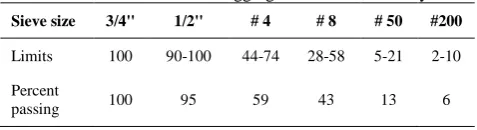
standard [17] was used for grading the aggregates in this study. Table 1 shows aggregates gradations used in this study. Also, Aggregates specifications are given in Table 2. In producing the samples, PG 64-22 and PG 58-28 bitumen of Isfahan Refinery was used. The characteristics of bitumen are summarized in Table 3.
3. 2. Sample Preparation
3. 2. 1. Dynamic Tests Plan Table 4 shows
number and type of dynamic tests. In the current article, dynamic creep tests were used to investigate the creep behavior of samples.
3. 2. 2. Marshal Test Results Considering
Marshal test results, the optimum percentage of bitumen in asphalt mixtures are list out in Table 5.
Figure 1. Generalized model [18]
TABLE 1.Gradation of aggregates used in the study
Sieve size 3/4'' 1/2'' # 4 # 8 # 50 #200
Limits 100 90-100 44-74 28-58 5-21 2-10
Percent
TABLE 2. Specifications of aggregates used in the study
Parameter Aggregate type
Silica Lime
Specific Gravity (gr/cm3) 2.643
2.691
Los Angeles abrasion (%) 26.7
21.4
Sodium sulfate soundness (%) 3.5
2.2
TABLE 3. Characteristics of PG 64-22 and PG 58-28 bitumen used in asphalt binder
Test AASHTO
Method
Specified Limit(s)
PG 64-22 PG 58-28
Lab. Result
Dynamic Shear @ Grade
Temperature, °C T 315 64 58
Absolute Viscosity at
140°F (60°C), Poises T 202 2030 915
Specific Gravity at 60°F
(15.6°C) T 228 1.039 1.035
Penetration at 77°F (25°C),
dmm T49 70 130
TABLE 4. Number and type of dynamic test Stress
levels
Temperature levels
Aggregate types
Bitumen Grades
Void (%)
100 KPa 200 KPa
300 KPa
50ºc
60ºc
Silica
lime
PG 64-22
PG 58-28 3
7
TABLE 5. Bitumen optimal percentage in asphalt containing lime and silica
Bitumen Grade Aggregate type Optimal percentage of
Bitumen
PG 64-22 Lime 5.5
PG 64-22 Silica 5.5
PG 58-28 Lime 5
PG 58-28 Silica 5
In this research, the optimum content of bitumen is first determined based on Marshall Mix Design for all different types of bitumen and aggregate. Then, in samples preparation, different compaction energies were used to achieve the desired levels of air void content.
3. 3. Dynamic Creep Test The dynamic creep test
was conducted to evaluate the creep compliance of asphalt pavements. The test was performed using Universal Testing Machine. The test was carried out according to British Standards Institute BS 226-1996.
4. RESULTS AND DISCUSSION
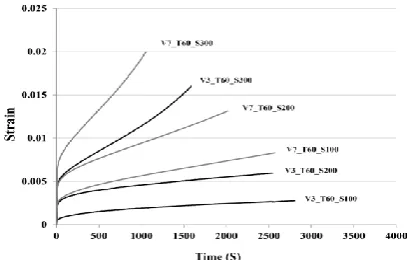
4. 1. Dynamic Creep Tests Results In Figure 2,
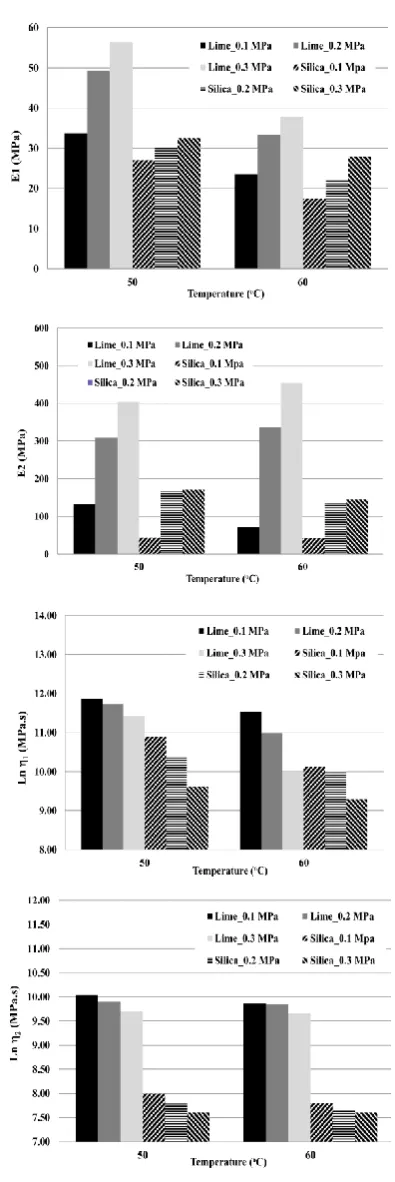
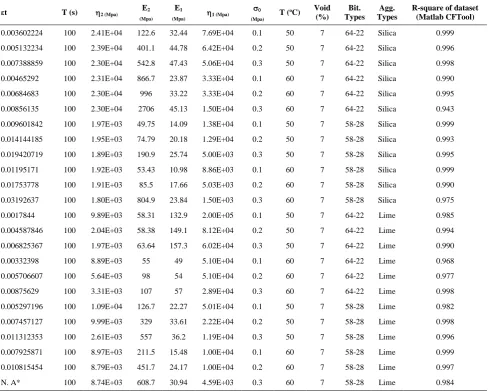
as sample the creep curves of asphalt specimens with limestone aggregates and PG 64-22 bitumen, considering variation in the applied stress and air voids levels at 60oC are provided. The Matlab software is used to analyze and evaluate the obtained experimental results. The generalized model is used to predict the creep deformation behavior of asphalt mixture at temperature of 50 and 60oC and 3 different stress levels of 100, 200, 300 KPa. For the sake of convenience, a nonlinear fitting procedure was developed through the least square technique in SPSS software and curve fitting in Matlab. Given the rational initial values, the parameters can be determined by fitting in Equation (7) [19]. The obtained data are presented in Table 6, Figures 3 and 4. In training GP model only the viscoelastic parameters of the asphalt concretesuchas
1
E, E2,
1 and 2 and stress level and temperature areused.
In Table 6 a part of the dataset used in GP model is presented in terms of aggregates and bitumen type in loading time of 100 s. Also, Figures 3 and 4 present as sample the changes in viscoelastic parameters of asphalt specimens containing 3% air voids of asphalt concrete in the manufacture of which PG 64-22 and PG 58-28 bitumen are used. As shown in Figures 3 and 4, asphalt specimens made with siliceous materials have higher thermal sensitivity than the asphalt specimens prepared by lime materials. This is due to the high initial modulus of elasticity in the specimens made with lime materials.
4. 2. Modeling with Genetic Programming
4. 2. 1. Genetic Programming Technique In
recent years a great number of advanced theoretical - empirical methods has been developed for design and modeling concrete pavements behaviours [20]. Genetic programming is a branch of evolutionary algorithms that solves problems without requiring the user.
Figure 3. Changes in viscoelastic parameters of asphalt specimens containing 3 percent void manufactured by PG 64-22 bitumen
TABLE 6. Characters of asphalt specimens with 3% air void in 50 cycles and the loading time of 100s
R-square of dataset (Matlab CFTool) Agg. Types Bit. Types Void (%) T (oC) (Mpa) 1 (Mpa) E1 (Mpa) E2 (Mpa) 2 (Mpa) T (s) εt 0.999 Silica 64-22 7 50 0.1 7.69E+04 32.44 122.6 2.41E+04 100 0.003602224 0.996 Silica 64-22 7 50 0.2 6.42E+04 44.78 401.1 2.39E+04 100 0.005132234 0.998 Silica 64-22 7 50 0.3 5.06E+04 47.43 542.8 2.30E+04 100 0.007388859 0.990 Silica 64-22 7 60 0.1 3.33E+04 23.87 866.7 2.31E+04 100 0.00465292 0.995 Silica 64-22 7 60 0.2 3.33E+04 33.22 996 2.30E+04 100 0.00684683 0.943 Silica 64-22 7 60 0.3 1.50E+04 45.13 2706 2.30E+04 100 0.00856135 0.999 Silica 58-28 7 50 0.1 1.38E+04 14.09 49.75 1.97E+03 100 0.009601842 0.993 Silica 58-28 7 50 0.2 1.29E+04 20.18 74.79 1.95E+03 100 0.014144185 0.995 Silica 58-28 7 50 0.3 5.00E+03 25.74 190.9 1.89E+03 100 0.019420719 0.999 Silica 58-28 7 60 0.1 8.86E+03 10.98 53.43 1.92E+03 100 0.01195171 0.990 Silica 58-28 7 60 0.2 5.03E+03 17.66 85.5 1.91E+03 100 0.01753778 0.975 Silica 58-28 7 60 0.3 1.50E+03 23.84 804.9 1.80E+03 100 0.03192637 0.985 Lime 64-22 7 50 0.1 2.00E+05 132.9 58.31 9.89E+03 100 0.0017844 0.994 Lime 64-22 7 50 0.2 8.12E+04 149.1 58.38 2.04E+03 100 0.004587846 0.990 Lime 64-22 7 50 0.3 6.02E+04 157.3 63.64 1.97E+03 100 0.006825367 0.968 Lime 64-22 7 60 0.1 5.10E+04 49 55 8.89E+03 100 0.00332398 0.977 Lime 64-22 7 60 0.2 5.10E+04 54 98 5.64E+03 100 0.005706607 0.998 Lime 64-22 7 60 0.3 2.89E+04 57 107 3.31E+03 100 0.00875629 0.982 Lime 58-28 7 50 0.1 5.01E+04 22.27 126.7 1.09E+04 100 0.005297196 0.998 Lime 58-28 7 50 0.2 2.22E+04 33.61 329 9.99E+03 100 0.007457127 0.996 Lime 58-28 7 50 0.3 1.19E+04 36.2 557 2.61E+03 100 0.011312353 0.999 Lime 58-28 7 60 0.1 1.00E+04 15.48 211.5 8.97E+03 100 0.007925871 0.997 Lime 58-28 7 60 0.2 1.00E+04 24.17 451.7 8.79E+03 100 0.010815454 0.984 Lime 58-28 7 60 0.3 4.59E+03 30.94 608.7 8.74E+03 100 N. A*
*N. A: lack of diagram due to reaching the maximum identified strain
The history of genetic programming dates back to the early 90's and John Koza is among those who made most effort to develop this branch [21]. One article about the use of artificial intelligence in pavement management is outlined by Sundin and Braban-Ledoux [22]. Mathematical programming and heuristic approaches are used by Chan et al. [23] for pavement maintenance management with regards to networks. Tack and Chou developed genetic algorithm using a tool that optimizes the schedule for repair of multilayer pavements [24]. Triple-phase Weibull equations for describing the damage resulted in from fatigue were used by Tsai et al. [25, 26] through the stress control fatigue test that examine the strain of fatigue. Alavi et al. [27] employed a high-precision model to predict the flow number of dense asphalt mixtures using a novel hybrid method coupling genetic programming and simulated annealing, called GP/SA.
4. 2. 2. Implementation of Genetic Programming The scope of genetic programming in this study is the automatic generation of a mathematical model that estimates the viscoelastic behavior of asphalt concrete pavement under the combined effect of stress and temperature. In implementing the GP, 70% of data are considered for training and 30% of them are for testing. Also the data related to each part are randomly selected among 560 data. Therefore, 392 data are obtained for training and 168 data were collected for testing. Figure 5 presents the results of the training data for the derived proposed model and generalized model.
Table 7 presents the results of the R-square, MSE and RMSE criteria for training data of the proposed and generalized models.
Table 8 presents the results of the R-square, MSE and RMSE criteria for test data of the proposed and generalized model. According to the results it can be observed that the proposed model has less error than generalized model. In other words, increasing the heat sensitivity of asphalt specimens, better performance was observed than the generalized model.
4. 2. 3. Genetic Programming Model Details Mathematical model obtained by the implementation of genetic programming is defined as Equation (8):
(8)
Given the conditions considered in GP to deal with division by zero, the function in t=0 is obtained according to Equation (9)
𝑥2
𝑥1×ln|𝑥3|+ 𝑥2
𝑥4 (9)
Based on Equations (8) and (9) the proposed model is written according to Equation (10).
GPModel = { 𝑥2
𝑥1×ln|𝑥3|+ 𝑥2
𝑥4,𝑡 = 0
𝑦,𝑡 > 0
(10)
In Table 9, the original name of the variables used in the GP model is presented.
As mentioned earlier, In training GP model only the viscoelastic parameters of the asphalt concretesuchas
1
E
,E
2,1
and
2
obtainable by the two first phases of the creep diagram and stress level and temperature are used.
4. 2. 4. Compare the proposed model and the
Generalized Model The results of R-square, MSE
and RMSE criteria associated with the two specimens are presented in Tables 10 and 11.
Also Figures 6 and 7 present results of the proposed model and generalized model for two specimens prepared by silica materials at temperatures of 50 and 60ºC.
TABLE 7. Results of MSE and RMSE error criteria for training data of the proposed and generalized models
R2
RMSE MSE
Model
0.977 0.0019
3.53e-6 Generalized Model
0.985 0.0014
2.16e-6 Proposed Model
TABLE 8. Results of MSE and RMSE error criteria for test data of the proposed and generalized models
R2
RMSE MSE
Model
0.973 0.0022
5.01e-5 Generalized Model
0.981 0.0015
2.27e-5 Proposed Model
TABLE 9.The name of the variable used in GP model Proposed Variable Main Variable
X1
𝑇 (℃)
X2
𝜎(𝑀𝑃𝑎)
X3
𝜂1(𝑀𝑃𝑎)
X4
𝐸1(𝑀𝑃𝑎)
X5
𝐸2(𝑀𝑃𝑎)
X6
𝜂2(𝑀𝑃𝑎)
X7
TABLE 10.Results of the error criteria of the proposed and Generalized models for two specimens prepared by Silica materials and PG 64-22 bitumen at the temperatures of 50 and 60°C
R2
RMSE MSE
Temperature Model
0.975 0.00053 2.73E-7
50 Generalized Model
0.988 0.00018 3.37E-8
50 Proposed Model
0.963 0.001
1.41E-6 60
Generalized Model
0.979 0.00043 1.85E-7
60 Proposed Model
TABLE 11. Results of the error criteria of the proposed and Generalized models for two specimens prepared by Silica materials and PG 58-28 bitumen at the temperatures of 50 and 60°C
R2
RMSE MSE
Temperature Model
0.969 0.0014 2.01E-6
50 Generalized Model
0.983 0.0003 1.36E-7
50 Proposed Model
0.957 0.003
1.06E-5 60
Generalized Model
0.976 0.00064 4.14E-7
60 Proposed Model
Figure 6. The output of the proposed and Generalized models for two specimens prepared by Silica materials and PG 64-22 bitumen at the temperatures of 50 and 60°C
Figure 7. The output of the proposed and Generalized models for two specimens prepared by Silica materials and PG 58-28 bitumen at the temperatures of 50 and 60°C
Figure 6 is related to a specimen with the properties (Void = 3, Bitumen grade= 64-22 and Aggregate Types = S). Figure 7 is related to a specimen with the properties (Void = 3, Bitumen grade= 58-28 and Aggregate Types = S). According to the results it can be observed that the proposed model has less error than the generalized model. On the other hand it can be observed that based on the higher thermal sensitivity of the asphalt specimens prepared by siliceous materials, these specimens show higher correlation with the proposed model. In other words, by increasing the heat sensitivity of the asphalt specimens, better performance is observed than the generalized model from lime to siliceous material and PG 64-22 to PG 58-28 bitumen content.
5. CONCLUSION
The aim of this study is to provide new model of viscoelastic behavior of asphalt concrete pavements with a combined effect of stress and temperature. The most important results of the study include:
The results indicate that compared with generalized model, the proposed model fits better with the experimental data at higher temperature.
Based on results it can be observed that proposed model has less error than the generalized model.
have higher correlation with the proposed model. By increasing the heat sensitivity of the asphalt specimens, better performance is observed than the generalized model from lime to siliceous material and PG 64-22 to PG 58-28 bitumen content.
For practical purposes, the most important result of this study is to underline the fact that for modeling of materials used in asphalt, GP can be used. Above all, the results of the study create a precise and effective clear formulation in pavements engineering.
6. REFERENCES
1. Buttlar, W.G. and Roque, R., "Evaluation of empirical and theoretical models to determine asphalt mixture stiffnesses at low temperatures (with discussion)", Journal of the Association of Asphalt Paving Technologists, Vol. 65, (1996), 99–141. 2. Li, G., Li, Y., Metcalf, J. and Pang, S.-S., "Elastic modulus
prediction of asphalt concrete", Journal of Materials in Civil Engineering, Vol. 11, No. 3, (1999), 236-241.
3. Zhu, H. and Nodes, J.E., "Contact based analysis of asphalt pavement with the effect of aggregate angularity", Mechanics of Materials, Vol. 32, No. 3, (2000), 193-202.
4. Arabani, M. and Ferdowsi, B., "Evaluating the semi-circular bending test for hma mixtures", International Journal of Engineering-Transactions A: Basics, Vol. 22, No. 1, (2008), 47-58.
5. Kim, Y.-R. and Little, D., "Linear viscoelastic analysis of asphalt mastics", Journal of Materials in Civil Engineering, Vol. 16, No. 2, (2004), 122-132.
6. Deshpande, V. and Cebon, D., "Uniaxial experiments on idealized asphalt mixes", Journal of Materials in Civil Engineering, Vol. 12, No. 3, (2000), 262-271.
7. Deshpande, V. and Cebon, D., "Steady-state constitutive relationship for idealised asphalt mixes", Mechanics of Materials, Vol. 31, No. 4, (1999), 271-287.
8. Bandyopadhyaya, R., Das, A. and Basu, S., "Numerical simulation of mechanical behaviour of asphalt mix",
Construction and Building Materials, Vol. 22, No. 6, (2008), 1051-1058.
9. Zhao, Y., "Permanent deformation characterization of asphalt concrete using a viscoelastoplastic model", (2002).
10. Bahuguna, S., "Permanent deformation and rate effects in asphalt concrete: Creep modeling and numerical implementation [d]", Cleveland: Department of Civil Engineering, Case Western Reserve University, (2003).
11. Kettil, P., Lenhof, B., Runesson, K. and Wiberg, N.-E., "Simulation of inelastic deformation in road structures due to cyclic mechanical and thermal loads", Computers & structures, Vol. 85, No. 1-2, (2007), 59-70.
12. González, J.M., Canet, J.M., Oller, S. and Miró, R., "A viscoplastic constitutive model with strain rate variables for asphalt mixtures—numerical simulation", Computational Materials Science, Vol. 38, No. 4, (2007), 543-560.
13. Chen, F., Sun, Z.-q., Xu, J.-c. and Zhang, J.-y., "A composite material model for investigation of micro-fracture mechanism of brittle rock subjected to uniaxial compression", Journal of Central South University of Technology, Vol. 8, No. 4, (2001), 258-262.
14. Ghasemi, M. and Marandi, S., "Laboratory studies of the effect of recycled glass powder additive on the properties of polymer modified asphalt binders", (2013).
15. Courtney, T.H., "Mechanical behavior of materials, Waveland Press, (2005).
16. Barbero, E., Time–temperature–age superposition principle for predicting long-term response of linear viscoelastic materials, in Creep and fatigue in polymer matrix composites. 2011, Elsevier.48-69.
17. Officials, T., "Aashto guide for design of pavement structures, 1993, AASHTO, Vol. 1, (1993).
18. Huang, Y.H., "Pavement analysis and design", (2004). 19. Behbahani, H., Ziari, H. and Kamboozia, N., "Evaluation of the
visco-elasto-plastic behavior of glasphalt mixtures through generalized and classic burger’s models modification",
Construction and Building Materials, Vol. 118, (2016), 36-42. 20. Arabani, M., "Evaluation of rough set theory for decision
making of rehabilitation method for concrete pavement", (2005).
21. Koza, J.R., "Genetic programming: On the programming of
computers by means of natural selection,
Cambridge,Massachusetts, The MIT Press, (1992).
22. Sundin, S. and Braban‐Ledoux, C., "Artificial intelligence–based decision support technologies in pavement management",
Computer‐Aided Civil and Infrastructure Engineering, Vol. 16, No. 2, (2001), 143-157.
23. Chan, W.T., Fwa, T. and Hoque, K.Z., "Constraint handling
methods in pavement maintenance programming",
Transportation Research Part C: Emerging Technologies, Vol. 9, No. 3, (2001), 175-190.
24. Tack, J. and J. Chou, E., "Multiyear pavement repair scheduling optimization by preconstrained genetic algorithm",
Transportation Research Record: Journal of the Transportation Research Board, 1816, (2002), 3-8.
25. Tsai, B.-W., Kannekanti, V. and Harvey, J., "Application of genetic algorithm in asphalt pavement design", Transportation Research Record: Journal of the Transportation Research Board, 1891, (2004), 112-120.
26. Tsai, B.-W., Harvey, J. and Monismith, C., "Using the three-stage weibull equation and tree-based model to characterize the mix fatigue damage process", Transportation Research Record: Journal of the Transportation Research Board, 1929, (2005), 227-237.
New Model for Visco-Elastic Behavior of Asphalt Mixture with Combined Effect of
Stress and Temperature
S. M. Mirabdolazimia, G. H. Shafabakhshb
a Faculty of Engineering, University of Guilan, Rasht, I.R. Iran. b Faculty of Civil Engineering, Semnan University, Semnan, I.R. Iran.
P A P E R I N F O
Paper history:
Received 14 February 2017 Received in revised form 15 May 2017 Accepted 6 January 2018
Keywords: Creep
Visco-elastic Model Asphalt Mixture Generalized Model Genetic Programming
هديكچ
م طيارش تحت نانآ راتفر رتهب تخانش ليلد هب هراومه اهنآ هدنهد ليکشت داوم و اه هار يزاسور ليلحت توافت
تيمها زا ب یيلاا
طباور حرط هجيتن رد و رتهب کرد ثعاب و هدوب رادروخرب قيقد
یم رت .ددرگ يسو هرتسگ هب هجوت اب لخم دربراک ع
ياه طو
تيمها زا ینميا و يدرکلمع فلتخم ياه هبنج زا طولخم نيا فلتخم ياهراتفر یبايزرا ،ايند رد تلافسآ ب
یيازس رادروخرب م ی
تارييغت هب تبسن ،يوتحم ريق ببس هب و یتاذ روط هب یتلافسآ ياه طولخم هکنيا هب هجوت اب .دشاب امد
ب رايس نتسه ساسح ،د
هرتماراپ نييعت و اه طولخم نيا کيتسلاپ وتسلاا وکسيو و کيتسلاا وکسيو راتفر یسررب و یياسانش اذل ؤم يا
نيا رد رث ر راتف
.تسا رادروخرب يا هژيو تيمها زا ،تسامد تارييغت هب هتسباو رايسب هک لدم هئارا شهوژپ نيا زا فده
ج ديد فر وکسيو رات
ور کيتسلاا امد و شنت لماع ود ره نامزمه ريثات اب اه هار یتلافسآ نتب ياه هي کينکت زا هدافتسا اب
مانرب نژ یسيون ه کيت یم
.دشاب درگ ماجنا شنت توافتم حوطس و فلتخم ياهامد تحت یکيمانيد شزخ نومزآ يدادعت ،روظنم نيا يارب ع .دي
رب هولا
دم و یمومع لدم نيب يا هسياقم شهوژپ نيا رد ،نيا ن کيتسلاا وکسيو خساپ نيمخت هنيمز رد يداهنشبپ ل
هنوم ه تلافسآ يا
.تسا شخب تياضر ًلاماک یکيتنژ یسيون همانرب لدم درکلمع .تسا هدش ماجنا ش هئارا ديدج لدم نينچمه
ناققحم ،هد
دومن دهاوخ يراي برخم ياهنومزآ ماجنا هب زاين نودب ار دنراد هباشم تاقيقحت ماجنا دصق هک يرتشيب .
doi: 10.5829/ije.2018.31.06c.05