Journal of Multidisciplinary Research in Healthcare Vol. 1, No. 2 April 2015 pp. 75–95 DOI: 10.15415/jmrh.2015.12006
A Study to Assess The Effectiveness of Structured
Teaching Programme on Knowledge Regarding
Hepatitis-B among Nursing Students in Selected
Schools of Nursing Moga, Punjab
DHIRAJ RANI
Lecturer, Lala Lajpat Rai Institute of Nursing, Ghalkalan, Moga. Punjab Email: [email protected]
Received: 10 February 2014| Revised: 22 February 2015| Accepted: 03 March 2015
Published online: April 06, 2015
The Author(s) 2015. This article is published with open access at www.chitkara.edu.in/publications
Abstract Hepatitis is worldwide major public health problem including India. According to World Health Organization fact sheet near about one-third of the world population i.e. about 2 billion person has been infected with Hepatitis B Virus infection with serological evidence of past or present infection. Out of these 2 billion people who have been infected worldwide, more than 350 million approximately 5–7% of the world’s population are having the chronic HBV infection. Health care workers are more prone for getting infected with Hepatitis-B as they are in close contact with the patients; nursing students are the future staff nurses. Therefore, a study was conducted to assess the effectiveness of Structured Teaching Programme on Knowledge regarding Hepatitis-B among nursing students In Selected Schools of Nursing Moga, Punjab. The purpose of study was to assess the knowledge and to impart the health information regarding Hepatitis B so as to prevent the disease and reduce morbidity and mortality , with the main objectives to assess and compare the pre-test and post-test knowledge, to find out the relationship between pre-test knowledge and post-test knowledge of nursing students with selected demographic variables. Quasi experimental approach and two group pre-test and post test design was used for the present study by taking 60 Nursing students which were selected by purposive sampling technique. A self structured and self reported questionnaire on knowledge assessment regarding Hepatitis B was prepared and validated by the expert’s opinion regarding the relevance of the items. Reliability of the tool was estimated by split half technique which included computing Pearson’s coefficient of correlation and thereafter by applying Spearman Brown prophecy formula, which was found to be 0.8, and the statistical validity was found to be 0.9 hence the tool was highly reliable The questionnaire was administered to the Nursing students to assess their pre test knowledge scores in both the groups. After the pre test, the structured teaching program was given to experimental group by the investigator after one day of pretest with the help of A.V aids. The time spent on structured teaching program was 45 minutes. The post test was taken of both experimental and control group after giving a gap of three day to assess the effectiveness of structured teaching programme. Data was analyzed through descriptive and inferential statistics. The study finding revealed that pre test knowledge score of nursing students was inadequate which get increased after imparting the STP. In this study the post-test mean knowledge score of experimental group was higher than the post-test mean knowledge score of control group at p < 0.05 level. This indicates that STP was effective. There was statistically significant effect of certain demographic variables on pre test and post test knowledge score of nursing students in experimental group. It was concluded that nurse plays an important role in disease prevention and promotion of health so providing continuing education programme is essential for nursing staff so as to reduce the morbidity and mortality due to Hepatitis B.
Rani, D BACKGROUND OF THE STUDY
[5] Hepatitis is major public health problem including India. It refers to the inflammation of the liver which can be caused by viruses A, B, C, D or E. These viruses can be distinguished depending on the predominant mode of transmission — water or blood. Out of these Hepatitis A and Hepatitis E are water borne while the Hepatitis B, C and D are blood borne infections. Near about 290,000 cases of acute viral hepatitis were notified under Integrated Disease Surveillance Programme of the NCDC in 2014.
[4] stated that the mode of transmission of Hepatitis B Virus is through blood and is present in high concentration in blood and various body fluids such as serum, serous exudates, saliva, semen and vaginal fluid. The most important mode of transmission in intermediate and high endemic areas believed to be perinatal transmission i.e. mother to fetus transmission while sexual transmission is the predominant route in low endemic areas.
According to [13] near about one-third of the world population i.e. about 2 billion person has been infected with Hepatitis B Virus infection with serological evidence of past or present infection. Out of these 2 billion people who have been infected worldwide, more than 350 million approximately 5–7% of the world’s population are having the chronic HBV infection. Approximately 15–40% of patients infected with HBV will develop life-threatening liver complications such as cirrhosis, liver failure and hepatocellular carcinoma resulting in 600,000 to 1.2 million deaths per year due to HBV.
[10] stated that the burden of the disease varies from country to country and the countries are classified as high, intermediate and low endemic area based on the prevalence of Hepatitis B surface antigen (HBsAg).The high endemic area has the prevalence rate of > 8% , intermediate (2–7%) or low endemic area (< 2% HBsAg positive population. .India . in South Asia region is classified as intermediate endemic area as it has prevalence rate of 2-4.7% and accounts for 10-15% of the entire pool HBV carriers globally
A Study to Assess The Effectiveness of Structured Teaching Programme on Knowledge Regarding Hepatitis-B among Nursing Students in Selected Schools of Nursing Moga, Punjab Therefore as studies show that Hepatitis B prevalence is high. Health care workers
are more prone for getting infected with Hepatitis-B as they are in close contact with the patients. Nursing students are the future staff nurses. The purpose of the general nursing program is to prepare general nurse who will function as member of the health team beginning with competencies for first level position in both hospital and community so they must be knowing each and every aspect of Hepatitis-B, so the investigator decided to assess the knowledge of Nursing students regarding Hepatitis B and to provide them teaching to upgrade their knowledge which helps them in meeting the most important role of the nurse in disease prevention and health promotion thereby reducing the mortality rate due to Hepatitis B.
REVIEW OF LITERATURE
[2] conducted a study on Do the medical, dental and nursing students of first year know about hepatitis B. The main aim of the study was to assess the knowledge about hepatitis B among the medical, dental and nursing students of first year in Subharti University, a private medical university of North India. A cross sectional institutional study approach was used for conducting the study. The total subjects studied were 250 when the student came up for hepatitis B vaccination in the Department of Community Medicine. Stastical analysis showed that overall, 83.32% of the study subjects had heard of hepatitis B. Only 42% knew that virus is a cause of hepatitis B. Awareness of mother to child transmission of hepatitis B was present in only 12% of the study subjects. Unsafe blood transfusion as a risk factor of hepatitis B was known by 35.2%, whereas, prevalence of knowledge regarding reused needles and unsafe sex as risk factors was lesser. Forty-four percent of the study subjects were not aware of vaccination against hepatitis B. There was a significant difference in the proportion of students of the different faculties about the correct knowledge about hepatitis B. The researcher concluded that the knowledge about hepatitis B was very low among the students entering in the medical, dental and nursing profession. This highlights the importance of informed and evidence based education programmes among the students of these healthcare professions.
[7] conducted a study on Knowledge and awareness of Hepatitis B infection amongst the students of Rural Dental College, Maharashtra, and total of 150 students participated. On an average, 59.23 and 40.67% had correct and incorrect knowledge about Hepatitis B infection, respectively. A total of 81.55% exhibited adequate level of awareness while 18.45% exhibited incorrect level of awareness about transmission of Hepatitis B infection.
Rani, D of 255 participants were there including, 100 dental, 100 medical, and 55 nursing interns. Statistical analysis was carried out using the Chi-square test, ANOVA test, post-hoc test and Pearson’s correlation. Result showed that although most of the interns were aware of the existence of hepatitis B and C infection, the level of awareness regarding the modes of transmission and vaccination was found to be dissatisfactory. Awareness level regarding the infection among nursing interns was statistically significantly lower than the dental and medical interns. A direct positive correlation as found between awareness score and behavior score. Researcher concluded that there is an urgent need to increase the level and quality of training among health care workers to prevent the spread of hepatitis B virus and hepatitis C virus.
[9] conducted a study on Prevention of Hepatitis B- Knowledge and Practices among Medical Interns. This survey was conducted to assess the knowledge and status of Hepatitis B vaccination among the medical students of B.J. Medical College, Ahmedabad. A total of 150 students were recruited using a non probability random sampling technique, through lottery method. A pretested structured questionnaire was administered during a 2 week period in February 2010, to collect the knowledge, attitude and practices of students regarding hepatitis B. Data was analyzed using SPSS version 16.0.Results showed that 86.7 % of the medical students had correct knowledge about Hepatitis B virus, though only 66 % of II year students knew about the virus. Majority of the medical students had correct knowledge regarding mode of transmission however, the knowledge was found to be less among II year students. Only 20% of the II year students had the correct knowledge regarding Post Exposure Prophylaxis for hepatitis B. 29.3% of the medical students were not vaccinated for Hepatitis B. The researcher concluded that there was lack of awareness among the medical students entering into the profession about Hepatitis B, its route of transmission and modes of prevention .Similarly all the students were not vaccinated against Hepatitis B, which makes them vulnerable to the disease.
A Study to Assess The Effectiveness of Structured Teaching Programme on Knowledge Regarding Hepatitis-B among Nursing Students in Selected Schools of Nursing Moga, Punjab STATEMENT OF THE PROBLEM
A Study To Assess The Effectiveness Of Structured Teaching Programme On Knowledge Regarding Hepatitis-B Among Nursing Students In Selected Schools Of Nursing Moga, Punjab.
PURPOSE OF THE STUDY
The purpose of the present study is to assess the knowledge and to impart the health information to students regarding Hepatitis B so as to prevent the disease and reduce morbidity and mortality regarding Hepatitis B.
OBJECTIVES
To assess the pre-test knowledge of nursing students regarding Hepatitis-B. 1.
To assess the post-test knowledge of nursing students regarding Hepatitis-B. 2.
To compare the pre-test and post-test knowledge of nursing students regarding 3.
Hepatitis- B.
To find out the relationship between pre-test knowledge and post-test knowledge 4.
of Nursing students regarding Hepatitis B with selected demographic variables like age in years, Gender, Educational status of father, Educational status of mother, Occupation of father, Occupation of mother, Family monthly income in rupees, Type of family, Place of residence , Source of information.
OPERATIONAL DEFINITIONS Effectiveness:
• It refers to the capacity to bring about the changes in the knowledge of GNM 2nd year students regarding Hepatitis B as evident from knowledge score
Structured teaching programme:
• It refers to the planned verbal and written instruction consisting of objectives strategies, visual aid designed to provide information regarding Hepatitis B.
Knowledge:
• It refers to the factual information regarding Hepatitis B. Hepatitis-B:
• It refers to as a form of hepatitis, a group of serious diseases that cause inflammation of the liver.
Hypothesis H1 The mean post-test knowledge score of experimental group after structured teaching programme regarding Hepatitis B will be significantly higher than the control group at p< 0.05 level of significance..
Rani, D Conceptual framework
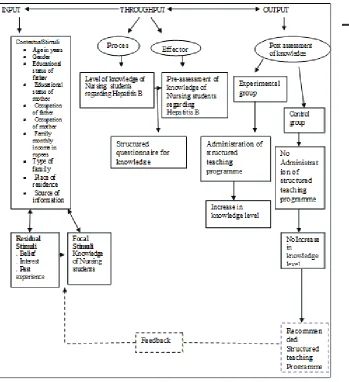
It is based on Roy’s Adaptation Model (1984). Roy used diagram to represent the adaptive system of a person. The adaptive system has input of stimuli and adaptation level, output as behavioral responses that serve as feedback and control and process known as coping mechanisms. The adaptive system has input coming from external environment as well as from the person. She identifies stimuli and adaptation level. Stimuli are conceptualized as falling into three classifications such as focal, contextual and residual
Input: These are the stimuli from external environment. The stimuli have been categorized as focal, contextual and residual. Each of these categories can include stimuli from internal and external sources.
The contextual stimuli: These are the other stimuli present in situation that contribute to the focal stimulus. In this study the contextual stimulus are all independent variables. For example age in years, Gender, Educational status of father, Educational status of mother, Occupation of father, Occupation of mother, Family monthly income in rupees, Type of family, Place of residence , Source of information.
The focal stimuli: It is a person’s most pressing internal or external stimulus. In this study the knowledge of nursing students is focal stimuli.
The residual stimuli: These are integral and external environmental factors but are not the center of a person’s attention or energy. These are the non-specific stimuli. In this study the residual stimuli are belief, interest and Past experience regarding Hepatitis B.
Throughput: Throughput makes use of person’s processes and effectors.
Processes: refers to the control mechanisms that a person uses as an adaptive system.
Effectors refer to the physiologic function, self concept, and the role function involved in adaption.
A Study to Assess The Effectiveness of Structured Teaching Programme on Knowledge Regarding Hepatitis-B among Nursing Students in Selected Schools of Nursing Moga, Punjab
Methodology: Research methodology refers to the methods that researcher use in
performing research operations. (Kothari C.R 2004) RESEARCH APPROACH AND DESIGN
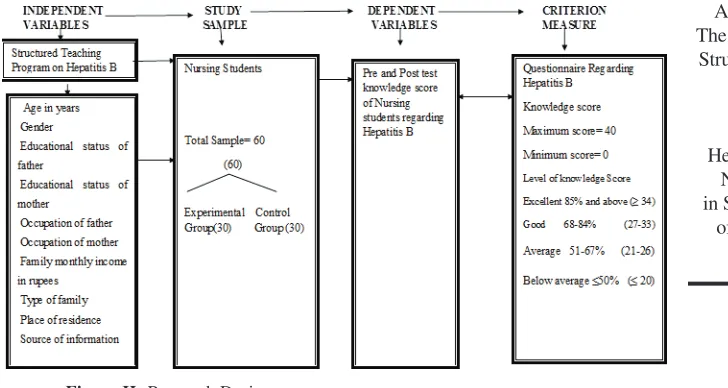
In view of nature of problem and to accomplish the objectives of study Quasi experimental approach was adopted. This approach involve manipulation but lacks at least in one of the other two properties that characterizes true experiment such as randomization. The property of randomization is missing in the present study. A non equivalent quasi-experimental design is used for the study.
Figure 1: Modified Conceptual framework based on Roy’s Adaptation Model (1984)
Rani, D Experimental group O1 X O2 Control group O1 O2
Selection and description of field for study: Setting refers to the area where the
study is conducted. This study was conducted at Dr. Shyam Lal Thapar School of Nursing Moga, Baba Mangal Singh School of Nursing Moga, and Punjab.
Sampling technique: Purposive sampling technique was used.
Selection and development of the tool
A self structured questionnaire was prepared after extensive review of literature and after consultation with guide and co-guide. It has two parts:
Part I--Sample characteristics : It includes the age in years, Gender, Educational status of father, Educational status of mother, Occupation of father, Occupation of mother, Family monthly income in rupees, type of family, Place of residence , Source of information
Part II— A Self structured Questionnaire consisting of 40 MCQs carrying maximum 40 and minimum zero score. The different areas covered under the self structured questionnaire are as follows:
S. No Question No Areas covered
1 1-9 Introduction and definition and Incubation period of Hepatitis B
2 10-15 Modes of Transmission of Hepatitis B
3 16-21 Sign and symptoms, Diagnostic evaluation
4 22-29 Treatment and Vaccination for Hepatitis B
5 30-35 Preventive measures for Hepatitis B
6 36-40 Nursing Management of Patient with Hepatitis B
Content Validity
Content Validity of the tool was confirmed by the expert’s opinion regarding the relevance of the items. The structured tool consisting of knowledge regarding Hepatitis B among Nursing students was circulated among expert from various field of specialization such as 5 from community health Nursing , 2 from medical surgical Nursing , 1 statistician. Their valuable suggestions were obtained and incorporated. The final tool was formed after doing the necessary changes
Reliability of the tool
A Study to Assess The Effectiveness of Structured Teaching Programme on Knowledge Regarding Hepatitis-B among Nursing Students in Selected Schools of Nursing Moga, Punjab
prophecy formula, which was found to be 0.8, and the statistical validity was found to be 0.9 hence the tool was highly reliable.
Structured teaching programme: It refers to the planned verbal and written
instruction consisting of objectives strategies, visual aid designed to provide information regarding Hepatitis B. The main aim of the structured teaching programme was to
Define Hepatitis-B. •
Explain the types of Hepatitis-B. •
Enlist the causes of Hepatitis-B. •
Enlist the sign and symptoms of Hepatitis-B. •
Enlist the diagnostic tests used for Hepatitis-B •
Describe the treatment of Hepatitis-B. •
Explain the Nursing management of Hepatitis-B. •
Explain the prevention of Hepatitis-B. •
Pilot study
Pilot study is a small scale version or trial run, done in preparation for major study. The Pilot study was conducted in the month of January, 2012 to ensure the reliability of the tool and feasibility of the study
Data collection procedure
Data collection was done in the month of February 2012. Prior to giving the questionnaire, the investigator gave instruction to the Nursing students and purpose of
Rani, D gathering information. They ensured that their responses will be kept confidential and used for research purpose only. The selected nursing schools Dr. Shyam Lal Thapar (experimental group) and Baba Mangal Singh School of NursingMoga (control group) were visited in the month of February, 2012. Sample of 30 students in each group was selected by purposive sampling technique after meeting preset inclusion and exclusion criteria. Firstly the personal information of all the students was taken. Pre test of both the groups was taken on different day and then STP was given to experimental group after one day of pretest. The post test was taken of both groups after giving a gap of three day to assess the effectiveness of STP.
Statistical analysis: Analysis of the data was done by using descriptive and
inferential statistics. In descriptive statistics mean, percentage and standard deviation was used for analyzing the distribution of nursing students according to their demographic characteristics. In inferential statistics Karl Pearson’s coefficient of correlation, chi-square, paired, unpaired t test and F test was used. Chi-square test was employed to compare demographic characteristics between students of experimental and control group. Paired‘t’ test was employed to compare the pre-test and post-test mean knowledge score of experimental and control group. Unpaired‘t’ test was applied to compare the mean knowledge score between students of experimental and control group. F test was used to find the effect on knowledge with selected demographic variables to find statistically significance with variables.
Results of the study were shown in the form of tables and figures. Pie and bar diagrams were used to depict the findings. The level of significance selected for study was p<0.05 level.
Organization of data analysis
The findings are organized according to the objectives of the study and presented under following sections:
Section I: Findings on sample characteristics. This part deals with description of sample characteristics in experimental and control group.
Section II: Findings related to the assessment of knowledge among nursing students regarding Hepatitis B in experimental and control group.
A Study to Assess The Effectiveness of Structured Teaching Programme on Knowledge Regarding Hepatitis-B among Nursing Students in Selected Schools of Nursing Moga, Punjab Section–I: Sample Characteristics
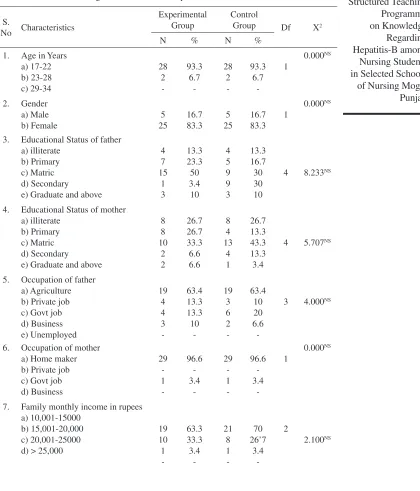
Table I: Percentage Distribution of Sample Characteristics N=60.
S.
No Characteristics
Experimental Group
Control
Group Df X2
N % N %
1. Age in Years a) 17-22 b) 23-28 c) 29-34 28 2 -93.3 6.7 -28 2 -93.3 6.7 -1 0.000NS 2. Gender a) Male b) Female 5 25 16.7 83.3 5 25 16.7 83.3 1 0.000NS
3. Educational Status of father a) illiterate
b) Primary c) Matric d) Secondary e) Graduate and above
4 7 15 1 3 13.3 23.3 50 3.4 10 4 5 9 9 3 13.3 16.7 30 30 10
4 8.233NS
4. Educational Status of mother a) illiterate
b) Primary c) Matric d) Secondary e) Graduate and above
8 8 10 2 2 26.7 26.7 33.3 6.6 6.6 8 4 13 4 1 26.7 13.3 43.3 13.3 3.4
4 5.707NS
5. Occupation of father a) Agriculture b) Private job c) Govt job d) Business e) Unemployed 19 4 4 3 -63.4 13.3 13.3 10 -19 3 6 2 -63.4 10 20 6.6
-3 4.000NS
6. Occupation of mother a) Home maker b) Private job c) Govt job d) Business 29 -1 -96.6 -3.4 -29 -1 -96.6 -3.4 -1 0.000NS
7. Family monthly income in rupees a) 10,001-15000
b) 15,001-20,000 c) 20,001-25000 d) > 25,000
Rani, D
S.
No Characteristics
Experimental Group
Control
Group Df X2
N % N %
8 Type of family a) Nuclear b) Joint
21 9
70 30
21 9
70 30
1
0.000NS
9. Place of Residence a) Urban
b) Rural
8 22
26.7 73.3
8 22
26.7 73.3
1
0.000NS
10 Source of information a) Parents and relatives b) Teachers
c) Friends and peers d) Mass media
4 26
-13.3 86.7
-4 26
-13.3 86.7
-1
0.000NS
*Significant at p<0.05 NS=Non significant
Table I for the frequency and percentage distribution of demographic variables of Nursing students in experimental and control group revealed that students were distributed into various categories according to age in years, Gender, Educational status of father, Educational status of mother, Occupation of father, Occupation of mother, Family monthly income in rupees, Type of family, Place of residence, Source of information. Matching of the students was done according to variables by using chi-square. All the variables in experimental and control group were matched except Educational status of father, Educational status of mother, Occupation of father, Family monthly income in rupees. Majority of students( 93.3%) were in the age group of 17-22 years, ( 83.3%) were females in both groups, ( 50%) in experimental and (30%) in control group had father educated up to Matric level, (33.3%) in experimental and ( 43.3% ) in control group had mother educated up to Matric level ,(63.4%) had father who had occupation of agriculture in both groups, ( 96.6%) had mother who were home-makers in both groups, ( 63.3%) in experimental and (70%) in control group belongs to the families whose family monthly income was in between rupees 10,001-15000, (70%) belongs to nuclear families in both groups, (73.3%) were belonging to rural areas in both groups, (86.7%) students had got information from teachers in both groups.
SECTION–II
Objective I: To assess the pre-test knowledge of Nursing students regarding Hepatitis-B. Objective II: To assess the post-test knowledge of Nursing students regarding Hepatitis-B.
A Study to Assess The Effectiveness of Structured Teaching Programme on Knowledge Regarding Hepatitis-B among Nursing Students in Selected Schools of Nursing Moga, Punjab
Table II: Frequency and percentage distribution of Pre and Post test Knowledge Score among Nursing students regarding Hepatitis-B in experimental and control group according to the level of Knowledge
N=60
Knowledge score
Level of Knowledge score
Experimental Group Control Group
Pre test n %
Post test n %
Pre test n %
Post test n %
Excellent ≥ 85% - 8 26.7% -
-Good 68% -84% 5 16.7 19 63 -
-Average 51%-67% 19 63.3 3 10 23 76.7 24 80
Below Average ≤ 50% 6 20 -- 7 23.3 6 20
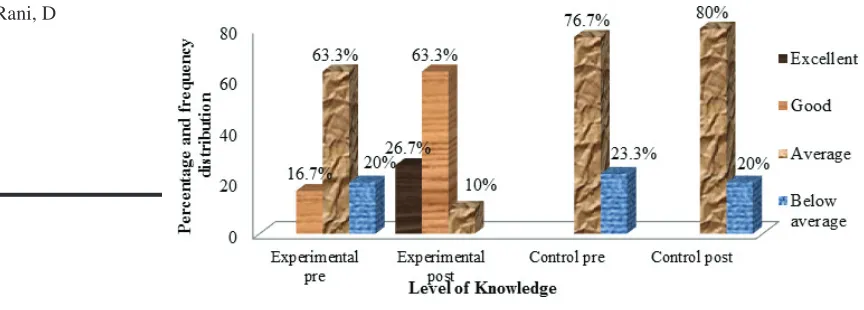
Figure I: Frequency and percentage distribution of pre and post test knowledge score among Nursing students regarding Hepatitis-B.
Table II and Figure I shows that in experimental group, majority of students (63.3%) had average ,(20%) had below average ,(16.7%) had good knowledge in pre-test. In post-test (26.7%) had excellent, 63.3% had the good, (10%) had average knowledge. But in control group (76.7%) students had average, (23.3%) had below average knowledge in pre-test. In post-test (80%) students had average, (20%) had below average knowledge.
TABLE III: Comparison of Mean Pre-test and Post test Knowledge score among Nursing
students regarding Hepatitis B in Experimental and Control Group
Knowledge score
Group Pre test Post test
n Mean SD n Mean SD df t-test
Experimental
Group 30 22.87 3.246 30 30.67 3.907 29 13.828***
Control
Group 30 22.27 2.791 30 22.63 2.619 29 1.217NS
df t-test df t-test
Rani, D
NS-Non-significant *Significant at p<0.05
***Significant at p<0.001
Figure II: Comparison of Mean Pre-test and Post test Knowledge score among Nursing
students regarding Hepatitis B in Experimental and Control Group
Table-III and figure II shows that in experimental group mean pre and post-test knowledge score was (22.87, 30.67) respectively. The difference between two was highly significant at level at p<0.001 level. In control group mean pre and post-test knowledge score was (22.27, 22.63) respectively. The difference between two was statistically non significant at p<0.05 level. The difference between mean pre- test knowledge score of students in experimental and control group was statistically non- significant at p<0.05 level. The difference between mean post test knowledge score of students in experimental and control group was statistically significant at p<0.001 level.
Hence null hypothesis i.e. H0 there will be no significant difference between mean pre-test and post-test knowledge score of experimental group after the planned structured teaching programme regarding Hepatitis-B as evident from structured questionnaire, at p< 0.05 level of significance was rejected and H1 i.e. mean post-test knowledge score of experimental group after the planned structured teaching programme regarding Hepatitis-B was significantly higher than their mean pre test knowledge at p< 0.05 level of significance was accepted. So it was concluded that the structured teaching programme regarding Hepatitis-B had impact on increasing the knowledge of nursing students.
SECTION III
A Study to Assess The Effectiveness of Structured Teaching Programme on Knowledge Regarding Hepatitis-B among Nursing Students in Selected Schools of Nursing Moga, Punjab
variables like age in years, Gender, Educational status of father, Educational status of mother, Occupation of father, Occupation of mother, Family monthly income in rupees, Type of family, Place of residence, Source of information Table IV shows
reveals the following findings:
In experimental group female had the highest mean pre-test knowledge score •
(23.52), followed by male students (19.6) respectively. The mean pre-test knowledge was statistically significant at p<0.01 level at F-ratio. In the post-test female had the highest mean post-test knowledge score (31.64), followed by male students (25.8) respectively. The mean post-test knowledge was statistically significant at p<0.001 level at F-ratio.
In experimental group the pre-test knowledge score of Nursing students whose •
mother were educated up to secondary level was higher (25.5), followed by primary level (24.12) , illiterate (22.37), matric ( 22.1) and least mean pre-test knowledge score (21) by students who had mother educated up to Graduate level respectively. The mean pre-test knowledge was statistically significant at p<0.01 level in F ratio.
In experimental group the mean pre-test knowledge score of those students was •
high whose father had the occupation of business (24.6), followed by agriculture (23.32), private job(23), least mean pre-test knowledge score (19.25) by students whose fathers were having occupation of government job respectively. The mean pre-test knowledge was statistically significant at p<0.05 level in F ratio. The mean post-test knowledge score of those students was high whose father had the occupation of business(33.6) followed by agriculture (31.37),private job(30.5) least mean pre-test knowledge score (25.25) by students whose fathers were having occupation of government job respectively .The mean post-test knowledge was statistically significant at p<0.01 level in F ratio.
In experimental group the pre-test and post-test knowledge score of those students •
Rani, D Table IV : C om pa ris on o f M ea n Pr e-te st a nd P os t t es t K no w le dg e sc or e am on g N ur si ng s tu de nt s re ga rd in g H ep at iti s B in
Experimental and Control Group according to certain demographic variables
. Experimental group Control group Pre test Post test Pre test Post test N Mean F P Mean F P n Mean F P Mean F P 1. Age in Y ears
a) 17-22 b) 23-28 c) 29-34 28 2 -22.68 25.5
-1.416
NS
0.342
30.64 31
-0.06
NS
0.49
28 2 -22.19 23.5
-1.038
NS
0.35
22.44 23.5
-0.03
NS
0.75
2. Gender a) Male b) Female 5 25 19.6 23.52 7.68** 0.01 25.8 31.64 13.85*** 0.001 5 25 22 22.32 0.02 NS 0.857 23 22.56 0.025 NS 0.824
3. Educational Status of f
ather
a) illiterate b) Primary c) Matric d) Secondary e) Graduate and abo
ve
4 7 15 1 3 24.25 23.45 22.73 26 19.33
1.446
NS
0.248
33 30 30.47 37 28S
1.52
NS
0.225
4 5 9 9 3 21.5 22.8 22 21.8 24
1.038
NS
0.407
21.25 23.6 22.22 22.33 24.33
1.174
NS
0.346
4.
Educational Status of mother
a) illiterate b) Primary c) Matric d) Secondary e) Graduate and abo
ve
8 8 10 2 2 22.37 24.12 22.10 25.5 21
4.20**
0.01
30 30.5 29.9 32 31
0.22
NS
0.34
8 4 13 4 1 22.25 22.31 22.5 21 25
0.627
NS
0.648
23 23.5 23 22.08 26
0.739
NS
A Study to Assess The Effectiveness of Structured Teaching Programme on Knowledge Regarding Hepatitis-B among Nursing Students in Selected Schools of Nursing Moga, Punjab
5. Occupation of f
ather
a)Agriculture b) Pri
vate job c)Go vt job d) Business e)Unemplo yed
19 4 4 3 -23.32 23 19.25 24.6
-3.381*
0.049
31.37 30.5 25.25 33.6
-6.028**
0.007
19 3 6 2 -22.05 21.33 23.5 22
-0.519
NS
0.673
22.84 20 23.5 22 -S
1.357
NS
0.278
6. Occupation of mother
a)Home mak er b) Pri vate job c)Go vt job d) Business
29 - 1 -23.07 - 17
-3.694
NS
0.065
30.97 - 22
-5.96*
0.021
29 - 1 -22.14 - 25
-1.909
NS
0.178
22.52 - 26
-1.753
NS
0.196
7. F
amily monthly
income in rupees a)10,001-15000 b)15,001-20,000 c)20,001-25000 d) > 25,000 19 10 1 -23.47 21.7 23
-1.263
NS
0.308
32.26 27.11 32
-7.215**
0,01
21 8 1 -22.57 21 25
-1.967
NS
0.159
23
21.25 26
-2.347
NS
0.115
8
Type of f
amily a)Nuclear b)Joint 21 9 23.9 21.89 0.65 NS 0.45 30.90 30.11 0.38 NS 0.52 21 9 22.5 21.77 0.27 NS 0.585 22.57 23 0.03 NS 0.495
9. Place of Residence
a)Urban b)Rural 8 22 22.37 23.04 1.04 NS 0,29 29.75 31 1.186 0.67 8 22 22 22.45 0.02 NS 0,45 22 22.86 0.15 NS 0.295 10 Source of information a) P
arents and relati
ves
b)T
eachers
c)Friends and peers
d)Mass media
4 26 - -22.5 22.92 -
-0.057
NS
0.813
29,5 30,85 -
-4.28*
0.05
4 26 - -21.5 22.2 - -S
0.614
NS
0.549
21.75 22.6S -
-0.623
NS
Rani, D whose mother was on government job respectively . The mean pre-test knowledge was statistically non significant at p<0.05 level in F ratio. The mean post-test knowledge was statistically significant at p<0.05 level in F ratio.
In experimental group highest mean pre and post-test knowledge score (23.47, •
32.26) was obtained by the students who belongs to family with family monthly income of 10001-15,000 rupees per month, followed by 20,001-25000 (23, 32) respectively, and least score (21.7, 27.11) was obtained by students belonging to family with monthly income of rupees 15001-20000. The mean pre-test knowledge was statistically non significant at p<0.05 level in F ratio. But the mean post-test knowledge was statistically significant at p<0.01 level in F ratio.
In experimental group students who got information from teachers had higher •
pre-test and post-test mean knowledge score (22.92, 30.85 respectively), followed by parents and relatives (22.5, 29.5 respectively). The mean pre-test knowledge was statistically non significant at p<0.05 level in F ratio. The mean post-test knowledge was statistically significant at p<0.05 level in F ratio.
So it was revealed that there was statistically significant effect of variables like gender, educational status of mother, occupation of father, occupation of mother, family monthly income in rupees and source of information on pre test and post test knowledge score of students in experimental group except age in years, educational status of father, type of family and place of residence
DISCUSSION
A Study to Assess The Effectiveness of Structured Teaching Programme on Knowledge Regarding Hepatitis-B among Nursing Students in Selected Schools of Nursing Moga, Punjab Hepatitis-B It was found that mean pre and post-test knowledge score was higher in
experimental group than in control group. These findings consistent with [14]in which participants in the internet hepatitis B educational program scored significantly higher in knowledge of hepatitis B at two and four weeks post intervention .
Conclusion: As it is well known fact that “Prevention is always better than cure”.
Hepatitis is most dreadful disease but it can also be prevented by educating the community people by taking certain precautions. Focusing on primary prevention educating nursing students would be best resource. Educating one student will educate a number of people. Keeping this in view the investigator planned and constructed a self structured questionnaire and STP which was administered to students and tested for its effectiveness in achieving the desired goal. STP was effective in increasing the knowledge as shown by higher post-test mean knowledge score of experimental group than control group at p < 0.05 level. .
Implications of the study
The findings of the study had several nursing implications which can be discussed in the following areas:
Nursing education
Medical Surgical nursing and Foundations of nursing curriculum in nursing should give emphasis on creating awareness among nursing students regarding Hepatitis B. Nursing educators can play different teaching strategies at hospital level and implement programmed instruction to enhance knowledge level and help them to develop healthy life style. Health for All demands a new set of values, involving fresh approaches and innovative responses from the entire health profession. The basis for “Health for All” Strategy is primary health care. This is the first level of contact between demands and improved skills in communication.
Nursing Service
The professional nurse must be aware of current prevalence of Hepatitis B in India, its causes, its sign and symptoms and management. The nurse should be able to educate the public regarding early identification, management and preventive aspects regarding Hepatitis-B. By creating awareness about Hepatitis B, they will avoid a huge amount of health problems. Nursing personnel have to educate not only students but public also. They should be taught about the various diagnostic techniques to detect the Hepatitis B. Nursing Administration
Rani, D Hepatitis-B. Nurse administrator has to take the initiative in organizing continuing education programme on Hepatitis-B for the nursing personnel in hospital and community setting .This will enable the nurses to update their knowledge, acquire special skill and demonstrate high quality care.
Nursing Research
There is need for extensive and intensive research in the aspect of Hepatitis B. Nursing students should actively conduct research in this field so as to become aware with latest issue, disseminate the findings of the study through conferences, seminars and publishing in nursing journals, public mass media and promote the utilization of research findings in the management of Hepatitis B.
Recommendations
Following studies can be undertaken in relation to present study
1. Similar study need to be undertaken with a large number of samples for better generalization.
2. A similar study can be conducted by seeking other variables.
3. The study can be conducted on the staff-nurses to assess the knowledge regarding Hepatitis B.
4. True Experimental research approach can be used.
5. The study can be conducted among non-nursing personnel to assess their knowledge and skills regarding practice to prevent Hepatitis B infection.
6. Setting can be changed by involving more hospitals and nursing homes.
REFERENCES
[1] Daud, S., Hashmi, N.R., and Manzoor, I.(2007). Prevention of Hepatitis B; Knowledge and practice among first year MBBS Students. Profeesional Medical Journal, 14(4), 634-638.
[2] Khan, A.M., Bansal, R., Parashar, P., Ahmad, S. (2012) Do the medical, dental and nursing students of first year know about hepatits B? A study from a university of North India,
Journal of the Pakistan Medical Association, 62(1), 25.
[3] Khan N., Sheikh A M., Khalid M M., Siddiqui SH., Merchant AA., (2010), Effect of gender and age on the knowledge, attitude and practice regarding hepatitis B and C and vaccination status of hepatitis B among medical students of Karachi, Pakistan, Journal of
the Pakistan Medical Association, 65(6), 450.
[4] Misra,B., Panda, C., Das, H.S., Nayak, K.C., Singh, S.P. (2009). Awareness about Hepatitis B viral infection in coastal Eastern India. Hepatitis-B Annual serial online, 6(1), 19-28. http://dx.doi.org/10.4103/0972-9747.76902
[5] NCDC Newsletter. 2014. 3(1) Hepatitis in India: Burden, Strategies and Plans . 3(1), [6] Nizar, N., Baloach, R., Afroz, A.M. (2007). Does clinical experience affect knowledge
regarding Hepatitis-B among male medical students at a private university. Journal of
A Study to Assess The Effectiveness of Structured Teaching Programme on Knowledge Regarding Hepatitis-B among Nursing Students in Selected Schools of Nursing Moga, Punjab
[7] Saini, R., Saini, S., and Sugandha, R.S.(2010) Knowledge and awareness of Hepatitis B infection amongst the students of Rural Dental College, Maharashtra, India. Ann Nigerian Med.
4(1), 18-20 doi: 10.4103/0331-3131.73876. http://dx.doi.org/10.4103/0331-3131.73876 [8] Setia,S., Gambhir, R.S.,Kapoor,V ., Jindal, G ., Garg,,S., (2013) Attitudes and Awareness
Regarding Hepatitis B and Hepatitis C Amongst Health-care Workers of a Tertiary Hospital in India Ann Med Health Sci Res, 3(4):551-8. doi: 10.4103/2141-9248.122105. http://dx.doi.org/10.4103/2141-9248.122105
[9] Singh A.,Jain S.,(2012) Prevention of Hepatitis B-Knowledge and Practices Among Medical Students. Indian Medical Gazette. CXLVI (2), 52.
[10] Te HS, Jensen D.M. ,(2010). Epidemiology of hepatitis B and C viruses: a global overview.
Clinics in Liver Disease, 14(1), 1-21. http://dx.doi.org/10.1016/j.cld.2009.11.009 [11] Tirounilacandin, P., Krishnaraj,S., Chakravarthy, K.(2009). Hepatitis-B infection:
Awareness among medical, dental interns in India. Annals of Tropical Medicine and
Public Health, 2(2),33-36.
[12] Varsha, S., Dhrubajyoti, B., Sarman, S. (2009). Journal of Labortary Physicians, 1(2), 41–48. http://dx.doi.org/10.4103/0974-2727.59697
[13] World Health Organization (2014). Hepatitis B. World Health Organization Fact Sheet 204 July 2014.
[14] Ya, W., Chich, H. (2009). The effect of health education through the internet on university female students’ hepatitis B knowledge and cognition. Journal of Clinical Nursing,