Quality Assessment of Seven Brands of Albendazole
Tablets Marketed in Yemen
Gamil Q. Othman
1,*1Department of clinical pharmacy and pharmacy practice, Faculty of Pharmacy, University of Science and Technology, Sana’a, Yemen
* Corresponding author:G. Q. Othman ([email protected])
ABSTRACT
Objective: To assess certain quality control parameters for seven brands of albendazole tablets obtained from different retail pharmacies.
Methods: The physicochemical properties and active ingredientsofseven randomly selectedbrands of al-bendazole tablets were assessed weight uniformity, hardness, friability, disintegration and dissolution
Results: All seven albendazole brands met the British Pharmacopeia (BP) quality control standards of weight uniformity, friability and the active ingredient content. Five brands met the BP disintegration criteri-on,whereas only two brands complied with the BP quality control parameters of the dissolution specifica-tions.
Conclusions: Out of the seven brands of albendazole (400 mg) tablets, only two fulfillthe BP quality control standards and show physicochemicalquivalence. This emphasizes the need for regular assessment of mar-keted drugs to assure equivalenceof these drugs to their innovators.
Keywords: Quality, Albendazole, disintegration, dissolution ,Tablets, Yemen
1. Introduction
One of the major health problems is parasitic infection, particularly in the third world coun-tries. Moreover, it has been recognized that there is evidence of emerging resistance to all major animal anthelmintics. One of the most effective wide-spectrum anthelmintic agents is Albendazole (1).
Selection of pharmaceutical products from several generic drug products having the same active ingredients is a matter of concern for healthcare practitioners. The first step to as-sure therapeutic equivalence of any drug product involves assuring the chemical and bi-opharmaceutical equivalence of such drug (2).In developing countries, assurance of quali-ty and interchangeabiliquali-ty of multisource drug products poses a challenge (3). Clinical re-sponse variability and batch inconsistency among generic drugs have been reported (4). For instance, such discrepancy has been demonstrated among metformin and metroni-dazole tablets (4).
Most oral dosage forms rely heavily on in vitro dissolution studies to predict their in-vivo bioavailability (6, 7). Drug dissolution testing not only plays an essential role in the monitoring of batch-to-batch consistency but also acts as a surrogate parameter for in vivo bioavailability (8). As in other developing countries, few drug quality control studies have been conducted so far in Yemen (9-13). studies reported that such drugs are often ob-tained irrespective of the quality standards. Moreover, drug quality standardization during purchasing is not implemented by non-governmental organizations in such countries (14).
The present study aimed to assess certain quality control parameters of seven brands of al-bendazole tablets obtained from different regions of Yemen. The findings of the present study can be used as a source of information to drug manufac-turers and drug regulatory authorities in the coun-try.
2. Methods
2.1. Study design
This was a comparative in-vitro study to assess a number of quality control parameters of albend-azole tablet brands locally distributed in the Yem-eni market, including weight variation, hardness, friability as well as disintegration and dissolution times of such brands.
2.2. Sample collection and identification
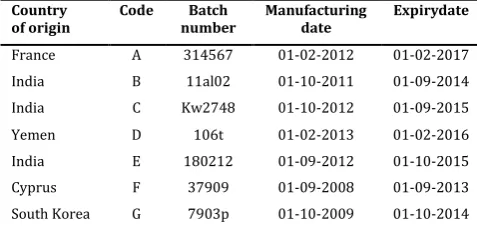
Albendazole tablets (400 mg) of seven commercial brands were conveniently purchased from phar-macies in the Yemeni market. Six brands were in the form of uncoated compressed tablets, while the seventh brand was in the form of coated tablets. All the obtained tablets were coded with the let-ters A to G (Table 1). These were stored according to manufacturers’ instructions prior to investiga-tions, and codes were removed after performing the investigations. Study samples were collected in the period from 20 February to 20 March (2013) from four Yemeni governorates; namely, Sana’a, Ibb, Marib, and Hodeidah.
2.3. Quality assessment procedures
Different analytical quality control tests for the de-velopment and manufacture of pharmaceutical formulations (15) were used for the assessment of albendazole tablet brands in the present study. These tests included:
2.3.1. Weight variation test
weight and the percentage weight variation from the mean value were obtained for each brand. Appropriate tablet hardness and friabil-ity is attributed to weight controlling within a tight range, where the percentage weight vari-ation was ensured not to exceed 5% (16). The average weight variations for all brands of al-bendazole tablets were calculated mathemati-cally using the following equations (17):
Highest weight variation = (Highest weight − Aver-age weight/AverAver-age weight) 100
Lowest weight variation = (Lowest weight − Aver-age weight/AverAver-age weight) 100
Table 1. Identity and specification of albendazole brands includ-ed in the present study*
Country
of origin Code number Batch Manufacturing date Expirydate
France A 314567 01-02-2012 01-02-2017
India B 11al02 01-10-2011 01-09-2014
India C Kw2748 01-10-2012 01-09-2015
Yemen D 106t 01-02-2013 01-02-2016
India E 180212 01-09-2012 01-10-2015
Cyprus F 37909 01-09-2008 01-09-2013
South Korea G 7903p 01-10-2009 01-10-2014
* The strength of all brands was 400 mg.
2.3.2. Hardness test
The hardness of 10 tablets selected randomly from each brand was determined using a tab-let breaking-strength tester (Germany, PHAR-MA TEST: PTB). The hardness for each tablet was recorded, and the mean hardness was cal-culated according to well-established equa-tions (18).
2.3.3. Friability test
Five albendazole tablets were dusted and weighed together before friability testing us-ing a US Pharmacopoeia (USP)-compatible fri-abilator Germany (PHARMA TEST: PTB) which was set to run for four minutes at a speed of 25 rounds per minute (rpm). After removing the tablets from the friabilator, they were
dusted and re-weighed. Friability was calculated using the following equation (16):
% Friability = (Wi – Wf) / Wi) 100 Wi= weight of tablet before friability Wf = weight of tablet after friability
Conventionally, compressed tablet weight loss was generally ensured to be less than 0.5 to 1% (17).
2.3.4. Disintegration time test
Disintegration time of uncoated tablets was de-termined using a USP disintegration tester (Elec-trolab, Mumbai, India; Model: ED-2L) in 0.1 N HCl medium at 37±1 °C according to the British Phar-macopoeia (BP) (16). For each albendazole brand, six tablets were selected and placed in separate cy-lindrical tubes in a basket rack. The time required for each tablet to disintegrate and pass out through the mesh was recorded, and the mean dis-integration time for each brand was then calculat-ed (19).
2.3.5. Dissolution time test
2.3.6. Content uniformity test
Active ingredient uniformity test of the tablets was carried out using HPLC (Shimadzu, Kyoto, Japan). Methanol and buffer in a ratio of 700:300 were used as the mobile phase. The flow rate of the mobile phase was 2ml per mi-nute, and the injection volume of the sample was 20 μl. Albendazole detection wavelength was set at 254 nm. Active ingredient chemical identification and content uniformity tests were carried out according to the BP, 2002 (35).
2.4. Data analysis
Weight uniformity, hardness, friability as well as disintegration and dissolution times of al-bendazole tablets of each brand were analyzed by calculating the mean ± standard deviation (SD) for each parameter using IBM SPSS Statis-tics version 21.0for Windows (IBM Corp., Ar-monk, NY, USA).
3. Results
3.1. Weight variation, crushing strength and
friability of albendazole brands
Table (2) shows the physicochemical proper-ties of the seven albendazole tablet brands. The mean weight ranged between 910.9 mg for brand F to 1175.7 mg for brand B, while the mean crushing strength ranged between 8.46 kilogram-force (KgF) for brand F to 23.68 KgF for brand B. On the other hand, the per-centage friability was in the range of 0.030.49 % for the tested brands.
3.2. Disintegration time, dissolution time
and content uniformity of albendazole
brands
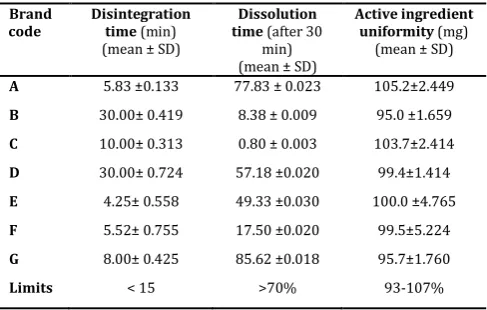
Table (3) shows that the mean disintegration time for the tested albendazole tablet brands ranged from 4.25 to 30.00 minutes, while the
mean dissolution time ranged from 0.80 to 85.62 minutes. On the other hand, albendazole content uniformity ranged from 95.0 to 105.2 grams.
Table 2. Unofficial quality control parameters for seven brands of al-bendazole tablets (400 mg) marketed in Yemen
Brand code
Weight uniformity (mg) (mean ± SD)
Crushing strength (KgF) (mean ± SD)
Friability (w/w)
(%)
A 1030.1 ± 1.9 13.9 ± 0.8 0.27
B 7711.7 ± 0.5 23.68± 1.6 0.11
C 1170.4 ± 1.2 20.5 ± 3.1 0.41
D 970.0 ± 1.4 10.18 ± 2.2 0.39
E 980.3 ± 1.6 14.04 ± 1.6 0.49
F 910.9 ± 0.8 8.46 ± 0.3 0.36
G 930.1 ± 0.8 14.02 ± 1.9 0.03
Limit ± 5 >5kg/cm2 <1%
SD, standard deviation
Table 3. Official quality control parameters forseven brands of al-bendazole tablets (400 mg) marketed in Yemen
Brand
code Disintegration time (min) (mean ± SD)
Dissolution time (after 30
min) (mean ± SD)
Active ingredient
uniformity (mg)
(mean ± SD)
A 5.83 ±0.133 77.83 ± 0.023 105.2±2.449
B 30.00± 0.419 8.38 ± 0.009 95.0 ±1.659
C 10.00± 0.313 0.80 ± 0.003 103.7±2.414
D 30.00± 0.724 57.18 ±0.020 99.4±1.414
E 4.25± 0.558 49.33 ±0.030 100.0 ±4.765
F 5.52± 0.755 17.50 ±0.020 99.5±5.224
G 8.00± 0.425 85.62 ±0.018 95.7±1.760
Limits < 15 >70% 93-107%
SD, standard deviation
4. Discussion
to manufacturers’ errors (9, 27, 22). On the contrary, these findings are not in line with previous studies from Yemen, Rwanda and Tanzania, which did not find substandard for-mulations at purchase time (12, 23).
The quality of manufactured drugs might be affected by several factors such as storage conditions, humidity, packaging materials, transportation, formulation constituents and the nature of the active ingredient that is con-sidered as the most important factor. When the strength is greater than 250 mg, the tablet weight variation meets the requirements if not more than two of the individual weights devi-ate from the average weight by more than ±5% and none of them deviates by ±10% ac-cording to the specifications outlined in the BP. The present study showed that all brands of albendazole tablets have acceptable uniformi-ty of weight because none of the brands has a percentage deviation in weight greater than 5% as specified by the BP.
Tablet hardness gives an insight as to the tablet tooling used by various manufacturers; a force of about 5 kg/cm is the minimum re-quirement for satisfactory hardness of tablets (24, 25). Generally, all the studied brands passed the hardness and friability specifica-tions of tablet dosage forms. In fact, the differ-ence in tablet sizes, such as weight, diameter and thickness, may have negative psychologi-cal impact on the clinicians and on their pa-tients since such a difference might rise up doubt about the equivalence of brands (26). Regarding the unofficial tests all albendazole brands fulfilled crushing strength/hardness specifications. The utmost hardness of 23.65 kg/cm2 was achieved by B product
Adequate hardness and friability of a tablet are necessary for consumer satisfaction (27). The USP states that a tablet friability value should be less than 1% (36).The
pre-sent study showed that the friability values for all albendazole brands were acceptable, ranging be-tween 0.03% w/w and 0.49% w/w. Tablets with the highest crushing strengths showed a low fria-bility value similar to those for ciprofloxacin brands conducted elsewhere (28).
Tablet disintegration in the gastrointestinal tract is an essential step for drug absorption and bioavailability, and subsequently therapeutic effi-cacy of medicines (29). In the present study, the brands B and D showed the longest disintegration time of 30.0 minutes. However, the brand E showed the least disintegration time of 4.25 minutes, which might be attributed to the presence of a large amount of disintegrants. According to the USP, the disintegration time of uncoated tab-lets is up to 15 minutes. Accordingly, the brands B and D exceeded the allowed time, while other brands were within the acceptable limits. It is noteworthy that the batches with longer disinte-gration times correlate with higher hardness and lower friability values. On the other hand, the brand B had the highest crushing strength and is, therefore, expected to have a longer disintegration time. This finding is in contrary with the fact that tablets with high hardness and compression force values had short disintegration times (30). How-ever, the finding of this study is similar to other studies showing that an increase in the tablet compression pressure leads to a longer disintegra-tion time (31, 32).
study showed that all brands except A and G released less than the accepted amount of their content within the time allowed. It has been described that albendazole tablets should contain not less than 93.0% and not more than 107% of the stated amount (36). The finding of the present study revealed that all albendazole brands met the standard criteria of the (36) for active ingredients. BP specifies that the po-tency of albendazole tablets should be be-tween 95.0% and 105.0%, i.e., 100.0% ±5.0%.
5. Conclusions
Only two of the seven selected albendazole brands marketed in Yemen meet the BP quali-ty standards. The two brands are physically and chemically equivalent to each other, so they can be used interchangeably during prac-tice. This study highlights the problems asso-ciated with multi-component dosage drugssuch as albendazole, where the efficacy of such drugs relies on the precise amount of the active ingredients in the tablet and their release rate.
Acknowledgments
The authors acknowledge the third group of pharmacy students at University of Science and Technology, Sa-na’a and Modern Pharma Company for their help dur-ing the performance of the study. As well as I want to thank Abdulsalam Halboup for his helping in this study
Competing interests
The authors declare that they have no competing inter-ests associated with this article.
Ethical approval
Not required.
References
1. Waller, P. J. Global perspectives on nematode parasite control in ruminant livestock: the need to adopt alterna-tives to chemotherapy, with emphasis on biological con-trol. Anim. Health Res. Rev. 2003, 4 (1), 35–43
2. Olaniyi A. Principles of drug quality assurance and pharmaceu-tical analysis. Ibadan: Mosuro Publishers; 2000.
3. Olaniyi A, Babalola C, Oladeinde F, Adegoke A, editors. To-wards better quality assurance of drugs. Proceedings of the 4th National Workshop; 2001.
4. Thomas W, Robinson J, Gennaro A. Remington. The Science and practice of pharmacy. Easton, Pennsylvania: Mack Pub-lishing Company; 2001.
5. Okeke IN, Lamikanra A. Quality and bioavailability of tetracy-cline capsules in a Nigerian semi-urban community. Int J Anti-microb Agents. 1995;5):245–50. DOI ● PubMed ● Google Scholar
6. Olaniyi A. Principles of pharmacokinetics. Essential medicinal chemistry, 3rd ed. Ibadan: Hope Publications;2005.
7. Babalola C. Bioavailability and bioequivalence (BA/BE) as-sessment. Towards Better Quality Assurance of Drugs in the 3rd Millennium. Biopharmaceutical Methods in Drug Quality Assurance. 2004;79.
8. Dressman JB, Amidon GL, Reppas C, Shah VP. Dissolution testing as a prognostic tool for oral drug absorption: immediate release dosage forms. Pharm Res 1998; 15:11–22. DOI ●
PubMed ● Google Scholar
9. Al-kershi FA, Othman GQ, Al-qadasi FA. Quality and stability of amoxicillin-potassium clavulanate drugs marketed in Yemen: influence of tropical storage conditions. JChem Pharm Res 2016; 8: 160–166Google Scholar
10. Al-Tahami K. A comparative quality study of selected locally manufactured and imported medicines in Yemeni market. Yemeni JMed Sci2010; 4: 8–5.Google Scholar
11. Abdo-Rabbo A, Bassili A, Atta H. The quality of antimalarials available in Yemen. Malar 2005; 4: 28. DOI ● PubMed ● Google Scholar
12. Othman GQ. Comparative analysis of five brands of lisinopril tablets in Yemeni market. Yemeni J M Sci2014; 8: 25.Google Scholar
13. Noman MA, Albooryhi M, Sayf AA, Kadi HO. In-vitro evaluation of captopril tablets present in Yemen markets. Res Pharm Dosage Forms Tech 2012; 4124–7.
14. Caudron JM, Ford N, Henkens M, Mace C, Kiddle-Monroe R, Pinel J. Substandard medicines in resource-poor settings: a problem that can no longer be ignored. Trop Med Int Health 2008; 13:1062–72.DOI ● PubMed ● Google Scholar
15. Nijhu RS, Akhter DT, Jhanker YM. Development and validation of UV spectrophotometric method for quantitative estimation of nitroglycerin in pharmaceutical dosage form.Int Curr Pharm J 2011; 1: 1–5.DOI ● Google Scholar
16. British Pharmacopoeia. The Stationary Office, MHRA. British Pharmacopoeial Commission. 2015; 1.
17. Kalakuntla R, Veerlapati U, Chepuri M, Raparla R. Effect of various super disintegrants on hardness, disintegration and dissolution of drug from dosage form. J Adv Sci Res 2010; 1: 15–9.Google Scholar
18. Lachman L, Lieberman HA. The theory and practice of industri-al pharmacy. New Delhi: CBS; 2009.
19. Gangwar S, Singh S, Garg G, Garg V, Sharma PK. To com-pare the disintegrating property of papaya starch and sago starch in paracetamol tablets. Int J Pharmacy Pharm Sci 2010; 2: 148–51.
20. Kishore B, Venkareswararao T, Sankar K, Rao B. Studies on dissolution rate of paracetamol tablets by using different poly-mers. JGT 2011; 2: 1–10.
21. Twagirumukiza M, Cosijns A, Pringels E, Remon JP, Vervaet C, Van Bortel L. Influence of tropical climate conditions on the quality of antihypertensive drugs from Rwandan pharmacies. Am J Trop Med Hyg2009; 81: 776–81. DOI ● PubMed ● Google Scholar
23. Kayumba P, Risha P, Shewiyo D, Msami A, Masuki G, Ameye D, et al. The quality of essential antimicrobial and antimalarial drugs marketed in Rwanda and Tanzania: in-fluence of tropical storage conditions on in vitro dissolu-tion. J Clin Pharm Therapeut 2004; 29: 331–8.DOI ● Google Scholar
24. Nithyanandan P, Hauck WW, Munoz J, Deng G, Brown W, Manning RG, et al. Dissolution variability: comparison of commercial dosage forms with US Pharmacopeia lot P prednisone reference standard tablets -- a technical note. AAPS PharmSciTech 2008; 9: 238–42.DOI ● PubMed●
Google Scholar
25. Esimone CO, Okoye FB, Onah BU, Nworu CS, Omeje EO. In vitro bioequivalence study of nine brands of ar-tesunate tablets marketed in Nigeria. J Vector Borne Dis2008; 45: 60.DOI ● PubMed
26. Okoye E, Iwuagwu M. Physicochemical equivalence of some brands of nifedipine retard tablets available in Nige-ria. Afr Biotech 2010; 9. Google Scholar
27. Beck RCR, Athayde ML, Cardoso SG. HIV/AIDS treat-ment and physicochemical quality control of medicines: evaluation of non-generic lamivudine + zidovudine tablets manufactured in Brazil. Braz J Infect Dis2007; 11: 540–3.
DOI ● PubMed ● Google Scholar
28. Mu’az J, Gazali L, Sadiq G, Tom G. Comparative in vitro
evaluation of the pharmaceutical and chemical equiva-lence of multi-source generic ciprofloxacin hydrochloride tablets around Maiduguri metropolitan area. Nigerian Pharm Sc 2009; 8
29. Nayak AK, Pal D. Comparative in vitro bioequivalence analysis of some ciprofloxacin HCl generic tablets. IJPSR 2010; 1: 51.Google Scholar
30. Onyekweli AO, Irouagwu MA, Okore VC, Nwabuebo AA. Disintegrate action of Pleurotus tubea-regium (singer: Fr) powder in. paracetamol tablets: effect of compression pressure. Afr J Pharm Res Dev 2004; 1: 42–5.
31. Iwuagwu M, Onyekweli A. The brittle fracture tendency of reworked paracetamol tablets. West Afr J Pharm 2003;17: 56–65
32. Ejiofor O, Esezobo S, Pilpel N. The plasto-elasticity and compressibility of coated powders and the tensile strengths of their tablets. Pharm Pharmacol 1986; 38: 1– 7.DOI ● PubMed ● Google Scholar
33. Voegele D. Drug release in vitro -- an aid in clinical trials. Methods FindExp ClinPharmacol 1999; 21: 55–62.DOI●
PubMed ● Google Scholar
34. Moore JW, Flanner HH. Mathematical comparison of dis-solution profiles. Pharm Tech1996; 20: 64–75. Google Scholar
35. British Pharmacopoeia. HMSO publication. London: UK. 2014:40. Available from: