Work Ability Index of Forestry Machine
Operators and some Ergonomic Aspects
of their Work
Matija Landekić, Ivan Martinić, Matija Bakarić, Mario Šporčić
Abstract – Nacrtak
This paper provides the results of an applied research of forestry machine operators related to their work ability index (WAI) and some ergonomic aspects of their everyday work.A question-naire on work environment and working ability was conducted in the year 2012 and included machinery operators employed in the state forestry company Croatian Forest Ltd. and in private forestry companies. Descriptive statistics and comparisons have been carried out re-garding work ability index and frequency response of the respondents. The first part of the results presents a) profile of respondents b) organization of operators’ work activities and their education, c) impact of tiredness and d) impact of psychological and social factors on operators’ work ability. The second part of the results presents a) work ability results in relation to de-mographic categories of respondents and b) examination of differences between work ability indexes by groups of descriptive variables. Regarding the educational aspect of the sampled machine operators, the results showed insufficient level of adequate specialized education. Higher level of mental demands required to perform the job was rated with the operators employed in private companies. Demographic parameters of the respondents negatively affect the working and functional ability of forestry machine operators, and the value of operators’ WAI decreased considerably within the groups depending on work experience in the private forestry sector.
Keywords: forestry, machine operators, work ability index, working environment
and biodiversity conservation (Kostenholtz et al. 2008), as well as social and safety standards of workers in direct production. Development of forest technology at the end of the 20th century and structural changes in forestry sector (market growth, denationalization, etc.) have led to a significant reduction in the number of employees in the state forestry sector and also to the development of new business models in some seg-ments, such as exploitation of forests, where entrepre-neurship plays a dominant role.
Forest contractors become an important link be-tween forest owners and wood industry (Šporčić 2005) in Europe and in Croatia. In the period 2000–2010, there has been a visible increase in contractors’ ser-vices in the state forests of the Republic of Croatia (RC). Contractors have a constant share of 41.83% in skidding/forwarding operations, which means that
1. Introduction –
Uvod
242 Croat. j. for. eng. 34(2013)2 the company Croatian Forests Ltd. Zagreb (in charge
for the management of state forests) extracts with its own mechanization approximately 58.17% of timber (Landekić et al. 2011b). The volume of services that private contractors provide to private forest owners in Croatia is not registered and no reliable data concern-ing these activities are available. Engagement of forest contractors and transition to contract work brings some benefits (flexibility, better financial result, better work performance due to specialization, etc.), but also defects such as insufficient investment in equipment and training, questionable professional level of work, low safety level, questionable effectiveness of workers’ health care, ineffective labor inspection (Šporčić et al. 2009) and potentially less skillful machine operators in the private sector.
The key role for ensuring competitiveness of tim-ber extraction (skidding/forwarding), but also for achieving a satisfying level of safety and efficiency in forest production, lies in work ability and working techniques used directly by forestry machine opera-tors (Martinić et al. 2011). Vaguely specified legal re-sponsibility of forest contractors and inefficiency of labor inspection leads to negligence of basic safety standards, which may result in inadequate working environment and reduced working ability of operators employed in private forestry sector. This is why in this paper the ergonomic aspects were investigated and compared of the working environment and working ability of forestry machine operators who are em-ployed by private contractors in forestry on the one side, and those employed in the state company Croa-tian Forests Ltd. Zagreb (CF Ltd.) on the other side. The working ability of operators is researched and presented through the work ability index (WAI), and the ergonomic characteristics of the working environ-ment are measured through the respondents’ answers on the training process, exposure to physical hazards (noise and vibration), impact of fatigue on work abil-ity and also on their assessment of psychological and social factors of the working environment.
2. Issues and objectives of research
Problematika i ciljevi rada
Forest work is highly dangerous and risky, and the work environment that implies working outdoors hides many hazards. The group of work operations related to timber skidding and/or forwarding is tech-nically demanding, the most expensive, and after fell-ing and cuttfell-ing to length the most risky among every-day forest operations (Ranogejec et al. 2010). Insight into the real conditions of work safety and
humaniza-tion of work activities in timber extrachumaniza-tion, in the form of ergonomic, technical and organizational solutions, is a starting point for the process of improving ergo-nomic features of the working environment and work ability of machine operators in forestry.
Satisfactory ergonomic level in terms of working environment and high working ability of forestry ma-chine operators, in compliance with safety rules for mechanized skidding, seems crucial for creating safe working conditions in order to prevent physical fa-tigue, monotony of work and work-related injuries. Analysis of ergonomic characteristics of the working environment and numerical evaluation of machine operators’ work ability in forestry is the first step in the evaluation of the current situation, which should later result in proposing the necessary measures to improve the safety system and security levels of timber extrac-tion. The main task of this research is to determine the work ability index (WAI) of machine operators em-ployed in the state and private forestry sector and to establish the ergonomic features of the working envi-ronment, as well as opportunities to improve the cur-rent situation in forestry operations.
3. Material and methods –
Materijal
i metode
Forest machine operators in Croatian forestry, em-ployed by the state-owned company Croatian Forests Ltd. as well as those employed by private forest con-tractors, are the primary object of research. Investiga-tion of ergonomic requirements of the working envi-ronment and research on work ability of machine operators engaged in timber extraction included the current theoretical understanding and views of opera-tors using the survey method. The source and model used to create a survey questionnaire were the docu-ments under the title »The Machine Operator Current Opinions and the Future Demands on Technical Ergonom-ics in Forest Machines« (Walker et al. 2001). Another relevant source refers to a document under the title
»Work Ability Index« (Tuomi et al. 1998), which was developed by the Finnish Institute of Public Health.
3.1 Survey methodand structure of
the measuring instrument – Metoda anketi-ranja i struktura mjernoga instrumenta
surveys, computer-aided telephone interviewing, etc. The answer to a particular question from the survey is valuable to the extent to which it is associated with the opinion or attitude on a topic. Questionnaires, in rela-tion to interviews, are usually viewed as a more objec-tive research tool that can produce generalizable re-sults because of large sample sizes (Oppenheim 1992).
For the investigation of the working environment ergonomics and work ability of forestry machine op-erators, the questionnaire developed by the Depart-ment of Forest Engineering at the Faculty of Forestry in Zagreb was used. The survey was conducted during the year 2012 as a part of activities on the project en-titled »Licensing and Certification for Acquiring European Standards of Safety and Quality at Forestry Work« initi-ated and financed by Croatian Forests Ltd. Before the questionnaire was distributed, all required steps and preparations had been performed with the goal to en-sure reliability and credibility of the survey.
The questionnaire consists of five structural parts, and contains 48 questions. The first structural part of the questionnaire is related to the collection of per-sonal data about respondents (gender, age, qualifica-tions, etc). The second part of the questionnaire covers the current employment and organization of machine operators’ daily work activities. The third section of the questionnaire examines the presence and develop-ment of disease and fatigue, while the fourth section is related to the impact of psychological and social fac-tors on forestry machine operafac-tors. Within the first four structural parts, questions were designed to mea-sure separate variables. The fifth part of the question-naire involves the assessment of work ability index (WAI) for forestry machine operators through 7 stan-dardized questions. In the questionnaire, the follow-ing answers to the questions were used: a) yes/no an-swer b) multiple anan-swers c) Likert scale evaluation and d) questions with open answers.
Stratified sampling method was used to divide up the population (N = 150) into two smaller non-overlap-ping sub-groups: (a) operators in CF Ltd. (N = 75) and (b) operators in private forest companies (N = 75). In each sub-group a simple random sample was done by Sample Size Calculator. During the analysis and pro-cessing of collected data, the following methods were used: statistical method, method of generalization, description and comparison. Graded, collected and summarized data for the assessment of working and functional abilities of forestry machine operators (the fifth part of the questionnaire) are expressed through the work ability index (WAI). Database for entry of collected data, systematization, verification of input accuracy and primary processing of data was made in
Microsoft Office Excel. Statistical analysis was per-formed using statistical software: Statistica 8 and SPSS 17.0 – Statistical Package for Sociological Research. Rank correlation was used to measure the relationship between variables and alternative nonparametric anal-ysis of variance (Kruskal–Wallis test) was used to test the differences between groups of variables. Based on individual observations, generalized conclusions were drawn up using the analysis of a limited number of subjects in the base sample.
3.2 Work ability index in general – Indeks radne spremnosti općenito
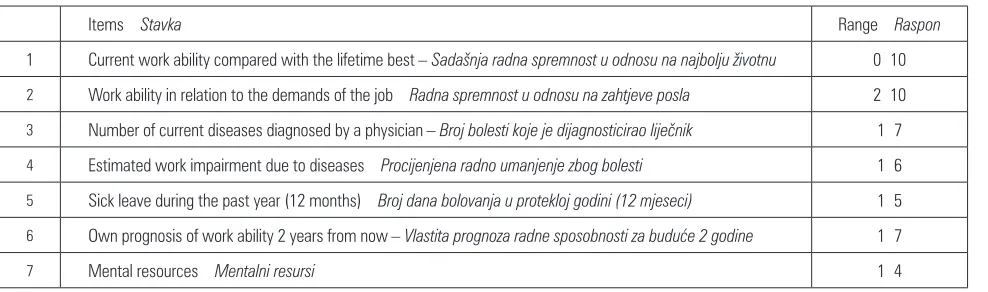
Working and functional ability cannot be objec-tively measured with a single instrument. It always requires an assessment based on data obtained from several different sources (medical examination, sur-vey, testing, etc.). Work Ability Index (WAI) is an in-strument designed for practical application, widely used by healthcare workers or health and safety em-ployees, like a help tool for determining employees working competence, as a basis for further measure-ments (Tuomi et al. 1998). WAI is a result of workers own assessment of his or her work readiness. The in-strument, developed by the Finnish Institute of Public Health, is easy and quick to use, cyclically repeatable, results are obtained quickly and can be used for mon-itoring on the level of individuals or groups (e.g. de-partment, age or professional groups, etc.). It is ap-plicable within health and safety system, where it shows how well an employee is able to perform his daily job duties. It can be used for the assessment of working and functional ability in the framework of medical examination or as a survey at the workplace. The instrument based on a questionnaire is intended for workers support: a) where it can be used at an early stage to ensure proper measures to maintain working readiness or b) it can help in determining workers who need healthcare support at work. Re-sponding to a series of seven questions (Table 1), which take into account physical and mental demands of the job, it gives the result ranging between 7 and 49 points (Table 1), which illustrates numerically the working and functional ability of each participant. This approach establishes optimal conditions to pre-vent premature reduction of work ability.
244 Croat. j. for. eng. 34(2013)2 whose work ability is excellent (44–49) should also be
informed about which work and life-style factors maintain work ability and which factors weaken it (Tuomi et al. 1998). The index can also be used to pre-dict the threat of disability in the near future.
4. Results and findings of research
Rezultati i nalazi ispitivanja
In the present study, analysis of opinions and atti-tudes of the forestry machine operators included: a) profile analysis of the respondents in the study; b) main findings of the second, third and fourth struc-tural part of the questionnaire related to the working environment of machine operators, c) values of the machine operators work ability index and comparison of WAI with demographic categories of respondents.
4.1 Profile of respondents – Profil ispitanika Forestry machine operators employed in the state and private forestry sector were selected as partici-pants in the research conducted on the ergonomic fea-tures of the working environment and work ability index. First, 75 questionnaires were delivered to for-estry machine operators employed in working units engaged in mechanization, transport and building, and also to the forest offices which have their own mechanization, within forest administration Požega, Našice, Zagreb and Karlovac, as a part of the company Croatian forests Ltd. Another 75 questionnaires were delivered to machine operators employed in private forestry sector, which were engaged in timber extrac-tion on the territory of the forest administraextrac-tion Našice, Zagreb and Sisak at the time of survey. 44.67% of forestry machine operators answered the question-naire (Table 2), which is satisfactory feedback in terms of the research.
The profile and characteristics of the operators sur-veyed in the state forestry sector, according to several criteria (gender, age group, qualifications), roughly correspond to the total number of employees working as machine operators in the company Croatian forests Ltd. Zagreb. A higher share of younger machine op-erators is visible in private forestry sector. Also, with-in the sample, difference with-in the level of machwith-ine op-erators’ education is notable. In the private sector, the operators’ education level is significantly higher than that of operators employed in Croatian forests Ltd. (Table 2).
4.2 Aspect of Working Environment of Forestry Machine Operators in Croatia– Aspekt
radnoga okoliša kod rukovatelja mehanizaci-jom u Hrvatskoj
To plan for and control environmental and ergo-nomic aspects of forestry machine operators work, it is necessary to know what impacts them and where these impacts come from. Consequently, ergonomic characteristics of the working environment are exam-ined and presented through the attitudes of the forest machinery operators concerning a) education and or-ganization of operators work activities, b) impact of tiredness and c) impact of psychological and social factors on operator work ability. Identification and ef-ficient management of environmental aspects and im-pacts should result in positive influence on employees in practice and also in significant environmental im-provements.
4.2.1 Employment, education and organization of work activities – Zaposlenost, osposobljenost i organizacija rada
For decades, training and periodically checking the qualification of forestry machine operators have been considered as the key activities for ensuring the work
Table 1 Items of the Work Ability Index (Ilmarinen 2007)
Tablica 1. Stavke indeksa radne spremnosti (Ilmarinen 2007)
Items – Stavka Range – Raspon
1 Current work ability compared with the lifetime best – Sadašnja radna spremnost u odnosu na najbolju životnu 0–10
2 Work ability in relation to the demands of the job – Radna spremnost u odnosu na zahtjeve posla 2–10
3 Number of current diseases diagnosed by a physician – Broj bolesti koje je dijagnosticirao liječnik 1–7
4 Estimated work impairment due to diseases – Procijenjena radno umanjenje zbog bolesti 1–6
5 Sick leave during the past year (12 months) – Broj dana bolovanja u protekloj godini (12 mjeseci) 1–5
6 Own prognosis of work ability 2 years from now – Vlastita prognoza radne sposobnosti za buduće 2 godine 1–7
quality and safety of operational forest work. In most European countries, regulations oblige employers to provide adequate training to each person using the working tools and machines (Medved 1998). The re-search results of professional education of operators in the sample (Table 3) show that 56.41% of operators in CF Ltd., and 33.00% of operators employed by private contractors have no adequate professional experience or specialized education. The reason why the level of education is low is the lack of formal regulations and bodies that provide certification of knowledge and skills of forestry machine operators in Croatia.
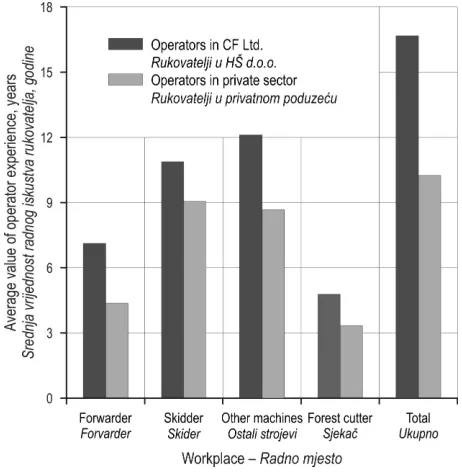
Knowledge, skill and experience in operating for-est machinery are the basic items in the operator career development. By comparing the professional experi-ence of the respondents (Fig. 1), it can be seen that operators employed by the company CF Ltd. have on average more work experience as forwarder operators, skidder operators and as forest cutters. The reason for this result is noticeably older population of respon-dents employed by the CF Ltd. (average age mean in CF Ltd = 42.33 years, and in private sector = 35.79 years) with about 1/3 higher overall professional
ex-Table 2 General information about the respondents
Tablica 2. Opći podatci o ispitanicima
Type of interviewees – Vrsta ispitanika Forestry machine operators (private and state sector)
Rukovatelji šumarskom mehanizacijom (privatni i državni sektor)
Number of respondents – Broj odgovora 67 (44.67%)
Time of research – Vrijeme ispitivanja During 2012 – Tijekom 2012. godine
Profile of interviewees – Profil anketiranih zaposlenika
Croatian Forests Ltd. Hrvatske šume d.o.o.
Private forest company Privatna šumarska tvrtka 39 (52.00%) 28 (37.33%)
N % N %
Gender Spol
Male – Muški 39 100.00 28 100.00
Female – Ženski 0 0.00 0 0.00
Age group Dobna skupina
<25 1 3.00 7 25.00
25–35 10 26.00 7 25.00
35–45 14 36.00 8 29.00
45–55 12 31.00 5 28.00
55< 2 5.00 1 4.00
Level of education
Stručna sprema
Unqualified (worker) – Nekvalificirani (radnik) 18 46.00 5 18.00 Qualified (worker) – Kvalificirani (radnik) 6 15.00 9 32.00 Secondary education – Srednja školska sprema 15 38.00 12 43.00 University degree – Visoka stručna sprema 0 0.00 2 7.00
Fig. 1 Professional experience of operators by workplace
246 Croat. j. for. eng. 34(2013)2 length method (almost always with forwarders), through stemwood, halfwood to whole tree methods.
Adequate work organization can proactively act to increase the level of performance of the forestry ma-chine operators. Research results on work techniques training for the mechanized timber extraction (Table 4) show that the operators employed by private con-tractors have a higher level of training (29.85%). Expo-sure to excessive noise and vibration in the working environment was rated with 32.14% by respondents employed in the private sector and 41.03% by respon-dents employed in CF Ltd (Table 4). The lack of per-sonal protective equipment (PPE) was rated with 32.14% by respondents employed by private contrac-tors, and 50.00% said that they do not use it every day to the full extent. On the other hand, in the company CF Ltd. only 5.13% of the respondents indicated a lack of personal protective equipment, and 43.59% said that they do not use it every day to the full extent. The occurrence of pain and discomfort (Table 4) caused by the position of the body when working was noted by 16 operators employed in CF Ltd. and 12 operators employed in the private forestry sector.
4.2.2 The impact of fatigue and development of disease among respondents – Utjecaj zamora i razvoj bolesti kod ispitanika
Tiredness and fatigue can have a significant adverse
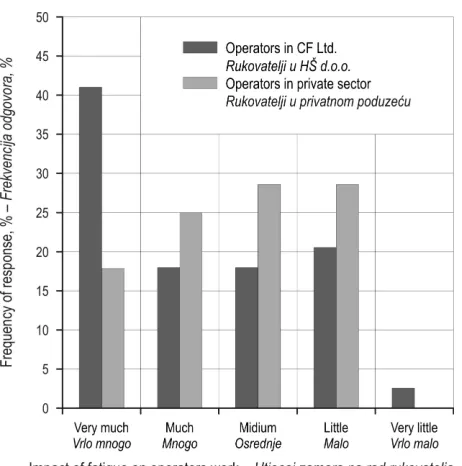
impact on organizational efficiency and productivity as well as operators’ health and safety. Assessment of the impact of physical fatigue on the quality and pro-ductivity of machine operators (Fig. 3) is valued with five answers on Likert scale. Operators employed in CF Ltd. believe that fatigue significantly (very much – 41.03%) affects the quality and productivity of the work compared to those employed by the private con-tractor (17.86%). Higher percentage of the rates »much«, »medium« and »little« is recorded by the op-erators employed in the private forestry sector (Fig. 3). Jobs with an increased risk, especially for the de-velopment of work-related diseases, require medical
Table 3 Type of education related to machine control
Tablica 3. Vrsta obrazovanja vezana uz upravljanje mehanizacijom
Offered response – Ponuđeni odgovor
Croatian Forests Ltd. Hrvatske šume d.o.o.
Private forest company Privatna šumarska tvrtka
Total Ukupno
N % N % N %
Self-educated – Samoobrazovan 22 56.41 9 33.00 31 48.00 Vocational experience – Strukovno iskustvo 9 23.08 17 63.00 25 38.00
Specialized education – Specijalističko obrazovanje 8 20.51 1 4.00 9 14.00
Fig. 2 Number and average age of machinery operated by sampled operators
Slika 2. Broj i prosječna dob mehanizacije kojom upravljaju uzorko -vani rukovatelji
cut-to-research, the symptoms of headache were noticed by 17 participants, and the appearance of symptoms of insomnia was noted by 11 participants employed by the company CF Ltd. A high proportion of respon-dents said that the symptoms of headache were as-sociated with work (Table 5). A smaller percentage of respondents employed by private contractors reported the appearance of symptoms, but they put the empha-sis on the connection between these symptoms and the daily work activities and demands at work (Table 5).
4.2.3 Impact of psychological and social factors on forestry machine operators – Utjecaj
psihološko društvenih čimbenika na ruko-vatelje šumarskom mehanizacijom
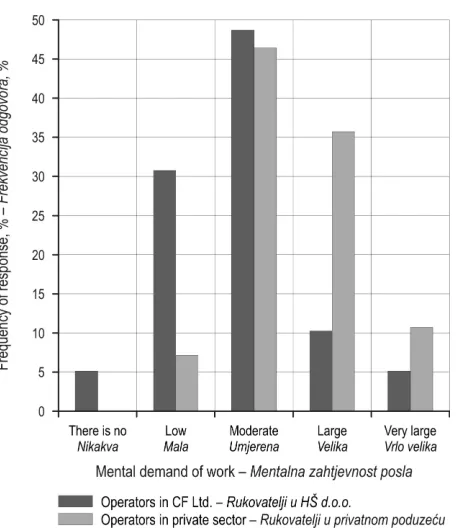
Psychological and social factors of the working en-vironment may have a direct impact on the health and safety of forest machine operators, as well as on pro-ductivity. One of the most important tasks of employ-ers is to keep the mental load and strain of employees at acceptable levels, all with the long-term goal of di-minishing the probability of occurrence and develop-ment of develop-mental stress (Landekić et al. 2011a). Accord-ing to the ratAccord-ing of mental job demands by forestry machine operators (Fig. 4), the results show a signifi-cant proportion of large and very large (46.42%) men-tal demands of the job performed by operators em-ployed in private companies in relation to the operators employed in the state–owned company CF Ltd.
The reason for the increased mental demands of the job indicated by the operators employed in a
pri-Table 4 Rating of organizational factors during work of machine operators (answer share, %)
Tablica 4. Ocjena organizacijskih čimbenika u radu rukovatelja mehanizacijom (udio odgovora, %)
Organizational factors – Organizacijski čimbenici
Croatian Forests Ltd. Hrvatske šume d.o.o.
Private forest company Privatna šumarska tvrtka
Yes – Da No – Ne Don't know
Ne znam Yes – Da No – Ne
Don't know Ne znam
Work techniques training in mechanized timber extraction
Osposobljavanje radnim tehnikama pri mehaniziranom privlačenju 48.72 38.46 12.82 78.57 14.29 7.14
Exposure to excessive noise and vibration
Izloženost prekomjernoj buci i vibracijama 41.03 25.64 33.33 32.14 39.29 28.57
All PPE provided – Osiguranost svih OZS 94.87 5.13 0.00 64.29 32.14 3.57 Ful use of PPE – Uporaba OZS u punoj mjeri 53.85 43.59 2.56 50.00 50.00 0.00
First-aid kit and fire extinguisher in the machine
Kutija prve pomoći i protupožarni aparat u stroju 97.44 2.56 0.00 85.71 14.29 0.00
Appearance of pain and discomfort caused by body position at work
Pojava boli i neugode uzrokovana položajem tijela pri radu 58.97 41.03 0.00 50.00 42.86 7.14
Fig. 3 Rating the impact of fatigue on the quality and productivity of machine operator work
Slika 3. Ocjena utjecaja zamora na vrsnoću i proizvodnost rukova -telja mehanizacijom
248 Croat. j. for. eng. 34(2013)2
Table 5 Headaches and insomnia symptoms experienced by forestry machine operators
Tablica 5. Pojava simptoma glavobolje i nesanice kod rukovatelja mehanizacijom u šumarstvu
Croatian Forests Ltd. – Hrvatske šume d.o.o. Private forest company – Privatna šumarska tvrtka Headache – Glavobolja Insomnia – Poremećaj spavanja Headache – Glavobolja Insomnia – Poremećaj spavanja
17 respondents (43.59%)
17 ispitanika (43,59 %)
11 respondents (28.21%)
11 ispitanika (28,21 %)
10 respondents (35.71%)
10 ispitanika (35,71 %)
5 respondents (17.86%)
5 ispitanika (17,86 %) Work–related
Povezano s poslom
Work–related Povezano s poslom
Work–related Povezano s poslom
Work–related Povezano s poslom Yes – Da No – Ne Yes – Da No – Ne Yes – Da No – Ne Yes – Da No – Ne
70.59% 29.41% 45.46% 54.54% 70.00% 30.00% 60.00% 40.00%
Fig. 4 Rating of job mental demands by forestry machine operators
Slika 4. Ocjena mentalne zahtjevnosti posla kod rukovatelja šumar-skom mehanizacijom
vate company (Fig. 4) can be partially linked with the results in Table 6 related to time pressure, working climate, acquiring new skills or knowledge and some other factors of the working environment explored in this paper. Relative frequency of responses related to time pressure at work is presented in Table 6. The per-centage share of responses shows a greater presence of time pressure at work for operators employed in a private company (often or always – 32.14%). Evalua-tion of acquiring new skills or knowledge (Table 6)
resulted in almost equal frequency response of forest workers employed in the private sector and in CF Ltd. Influence of the working climate within the operators’ working environment, expressed through business solidarity, working atmosphere, good relationship with superiors and colleagues, is evaluated in Table 6. The results show a higher proportion of affirmative answers (often and always) on the subject of freedom to make own decisions while working and the exis-tence of a sense of solidarity by the operators em-ployed in private companies. On the other hand, a greater proportion of affirmative answers (often or always) were recorded by operators employed in CF Ltd. regarding good working atmosphere and good relationship with superiors and colleagues (Table 6).
4.3 Work Ability Index of Forestry Machine Operators – Indeks radne spremnosti ruko-vatelja šumarskom mehanizacijom
Work ability index is a tool in the form of a ques-tionnaire used for the self-assessment of employees. Focus is put on employees and their job readiness in relation to the requirements of their current job posi-tion. It also highlights the need to adapt working con-ditions to the capacities and capabilities of employees. Mean score of the work ability index of machine op-erators, employed in Croatian forests Ltd. and in pri-vate companies, is shown in Table 7. The results of the WAI average score show a negligible difference be-tween the operators employed in the private sector and in state forestry sector. They have good work abil-ity (score 37–43), which should be kept at the existing level.
Table 6 Evaluation of some psychological and social factors of the working environment, %
Tablica 6. Procjena nekih psihološko-društvenih čimbenika radnoga okoliša, %
Questions – Pitanja
Croatian Forests Ltd. Hrvatske šume d.o.o.
Private forest company Privatna šumarska tvrtka
Never Nikad
Rarely Rijetko
Often
Često
Always Uvijek
Never Nikad
Rarely Rijetko
Often
Često
Always Uvijek Do you feel the time pressure due to the volume of work?
Osjećate li vremenski pritisak zbog opsega posla? 20.51 66.67 12.82 0.00 17.86 50.00 21.43 10.71
Do you learn new things at work?
Učite li nove stvari na poslu? 10.26 33.33 35.90 20.51 0.00 32.14 42.86 25.00
Does your job require skills?
Zahtijeva li Vaš posao vještinu? 2.56 23.08 74.36 0.00 17.86 21.43 53.57 7.14
Does your job require ingenuity?
Zahtijeva li Vaš posao domišljatost? 2.56 2.56 38.46 33.33 0.00 28.57 25.00 46.43
Do you have any freedom to decide at work?
Imate li slobodu odlučivanja u radu? 5.13 25.64 41.03 30.77 10.71 17.86 35.71 35.71
Is the atmosphere at work pleasant?
Je li atmosfera na poslu ugodna? 0.00 10.26 43.59 46.15 0.00 10.71 50.00 39.29
Is there a sense of solidarity?
Postoji li osjećaj solidarnosti? 2.56 12.82 33.33 51.28 0.00 7.14 67.86 25.00
I have a good relationship with my superiors?
Slažete li se dobro s nadređenim? 0.00 2.56 25.64 71.79 0.00 3.57 42.86 53.57
I have a good relationship with my colleagues?
Slažete li se dobro s kolegama? 0.00 0.00 17.95 82.05 0.00 3.57 46.43 50.00
Table 7 Work ability index of forestry machine operators – CF Ltd. and private contractors
Tablica 7. Indeks radne spremnosti rukovatelja šumarskom mehanizacijom – HŠ d.o.o. i privatni izvoditelji
Indicator Pokazatelj
Number of operators Broj rukovatelja
Minimum Minimum
Maximum Maksimum
Arithmetic mean
Aritmetička sredina
Standard deviation Standardna devijacija WAI (CF Ltd.)
IRS (HŠ d.o.o.) 39 24.00 49.00 38.46 5.70
WAI (private contractors)
IRS (privatni izvoditelji) 28 24.00 48.00 38.11 5.39
demographic indicators of the respondents and (b) testing the WAI difference among a group of descrip-tive variables.
4.3.1 Correlation of work ability index and demo-graphic parameters of respondents – Mjere povezanosti indeksa radne spremnosti i demografskih parametara ispitanika
This section shows testing the strength and direc-tion of respondent demographic parameters and work
ability index. Correlation and influence are reviewed with the aim of gaining a more comprehensive under-standing of the relation between the work of forestry machine operators and their functional ability (WAI) depending on work experience, age and weight of the workers. Spearman’s rank correlation coefficient was used to assess the degree and direction of the relation between the derived indicators.
250 Croat. j. for. eng. 34(2013)2 the work ability index and work experience in forestry was medium negative (r = -0.443; n = 67; p<0.01), where a higher level of work ability index was recorded with machine operators with less experience in forestry, and the calculated coefficient of determination (r² = 0.196) indicated that work experience accounted for 19.6% of the variance in the respondents answers re-garding the indicator of work and functional ability. The relation between the work ability index of ma-chine operators and the mass of respondents resulted in a small negative correlation (r = -0.2474; n = 67;
p<0.05).
4.3.2 Testing the diference of WAI between groups of descriptive variables – Ispitivanje razlika indeksa radne spremnosti prema opisnim varijablama
Using the database of respondents, differences were tested between the work ability index and se-lected descriptive variables. The following descriptive variables were used: a) age group and b) group of work experience in forestry. The homogeneity of vari-ance between groups of data was tested with Levene’s test (p>0.05), where on the basis of test significance level a further testing of WAI difference was conduct-ed with parametric and/or nonparametric techniques.
Due to inadequacy of variance homogeneity, alter-native nonparametric analysis of variance (Kruskal– Wallisov test) was used to test the difference of work ability index among three groups of respondents ac-cording to age. Also, differences in work ability index were examined between the four groups of respon-dents regarding work experience in forestry.
Table 8 Rank correlation of work ability index of machine operators and demographic parameters
Tablica 8. Korelacija ranga indeksa radne spremnosti i demografskih parametara rukovatelja mehanizacijom
Variable Varijabla
Indicator Pokazatelj
Age
Godine života
Mass Masa
Work experience in forestry Radno iskustvo u šumarstvu
Work ability index Indeks radne spremnosti
Age
Godine života
rs 1.000 0.238 0.769** –0.525**
p – 0.052 0.000 0.000
Mass Masa
rs 0.238 1.000 0.335** –0.247*
p 0.052 – 0.006 0.044
Work experience in forestry Radno iskustvo u šumarstvu
rs 0.769** 0.335** 1.000 –0.443**
p 0.000 0.006 – 0.000
Work ability index Indeks radne spremnosti
rs –0.525** –0.247* –0.443** 1.000
p 0.000 0.044 0.000 –
* Correlation is significant at the 0.05 – Korelacija je značajna na razini 0,05; ** Correlation is significant at the 0.01 – Korelacija je značajna na razini 0,01
Fig. 5 Mean value of WAI by three age groups
Slika 5. Srednja vrijednost IRS prema trima dobnim grupama
Groups by age:
Þ group 1: less than 35 years of age; Þ group 2: from 36 to 45 years of age; Þ group 3: more than 46 years of age; Groups by work experience in forestry: Þ group 1: 0–10 years of work experience; Þ group 2: 11–20 years of work experience; Þ group 3: 21–30 years of work experience; Þ group 4: 31–40 years of work experience. Testing the score values of work ability index among defined groups of respondents resulted in the following statistically significant differences (Table 9). Statistically significant difference was determined among the age groups (p<0.01), where operators with
less than 35 years of age have the highest level of work abi lity index (median – Md = 41.00) compared to their ol der colleagues (Fig. 5). Subsequent testing of the dif-fe ren ce using the Mann-Whitney U test showed that the me dian value of WAI in group 1 (<35 years) (Md = 41.00,
N = 25) was significantly different from group 3 (>46 years of age) (Md = 35.50, N = 20), U = 64.50; z = -4.255;
p = 0.000. A statistically significant difference was not con firmed between group 2 and group 1. Forestry machi ne operators with more than 46 years of age em-ploy ed in the state sector (CF Ltd) showed a significant-ly better working and functional ability in relation to ope rators working in the private forestry sector (Fig. 6).
Forestry machine operators with less than 10 years of experience in forestry had the highest level of work
Table 9 Testing the difference between WAI groups using the Kruskal–Wallis H test
Tablica 9. Ispitivanje razlika IRS između grupa pomoću Kruskal–Wallisova H-testa
Descriptive variable – Opisne varijable Chi-square Hi-kvadrat
Degrees of freedom Stupnjevi slobode
Sample size
Veličina uzorka
P-value P-vrijednost
Age of respondents – Godine života 16.897 2 67 0.000**
Work experience in forestry – Radno iskustvo u šumarstvu 14.776 3 67 0.002**
** The difference is significant at 0.01 – Razlika je značajna na razini 0,01
Fig. 6 WAI of machine operators in private and public sector by age groups
Slika 6. IRS rukovatelja mehanizacijom u privatnom i državnom
sektoru prema dobnim grupama
Fig. 7 Mean value of WAI by four groups of working experience in forestry
252 Croat. j. for. eng. 34(2013)2 measures advocated by Martinić et al. (2011), regard-ing the establishment of a national center for forestry, which would enable the implementation of the certi-fication process of machine operator training in for-estry. Also, it is necessary to develop the safety culture in the forestry sector through the development of per-sonal responsibility for the safety, use of perper-sonal pro-tective equipment and establishment of joint respon-sibility on safety including the management and employees.
Psychological and social aspects of the working environment of machine operators resulted in a high-er level of mental demands on the job with the ophigh-era- opera-tors employed in private forest companies. A higher proportion of time pressure due to the volume of work and poor working climate in the workplace of opera-tors employed in the private forestry sector goes in favor of the obtained results on mental demand. Psy-chological and social factors of the working environ-ment can influence the operators’ productivity, and therefore one of the most important tasks of employers is to keep the mental load and strain of employees at acceptable levels (Landekić et al. 2011a).
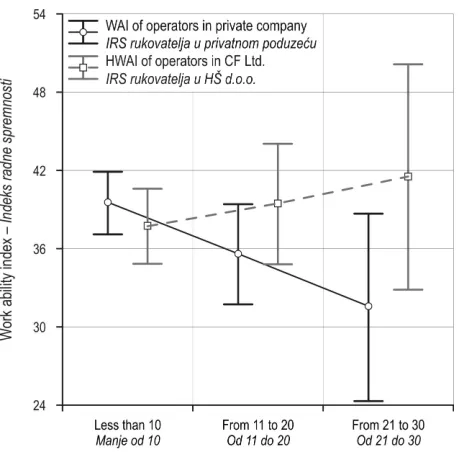
Demographic parameters of the respondents (age, work experience in forestry and weight) negatively affect the working and functional ability (WAI) of for-estry machine operators. Machine operators with less than 35 years of age and with less than 10 years of experience in forestry have the highest level of work ability index, which is significantly different (p<0.01) from the WAI in the oldest groups. Lower work abil-ity of the respondends in the oldest group, according to Ilmarinen at al. (2005), can be related to the health (symptoms) and functional capacity (physical) or work factors (mental strain) at the workplace of ma-chine operators. According to age groups, mama-chine operators working in private companies, with more than 46 years of age, have a considerably lower WAI compared to operators employed by the company CF Ltd. Also, within the groups formed by work experi-ence in forestry, a visible reduction in the level of WAI (moderate rating) is observed with operators working in private companies, which indicates the need for measures required to improve the current situation. The responses of all machine operators and the analy-sis presented in this paper represent an important contribution in the process of developing a model of security measures for the improvement of health and safety system in timber extraction through education on work ability index and responsibilities that need to be implemented in private and state forestry sector. Such approach helps to identify potential work-relat-ed health risks in order to implement appropriate
Fig. 8 WAI of machine operators in private and public sector by groups of work experience
Slika 8. IRS rukovatelja mehanizacijom u privatnom i državnom sektoru prema grupama radnoga staža
ability index (Md = 41.00) in comparison to colleagues with more years of experience (Fig. 7). Using the
Mann-Whitney U test, testing of differences showed that the median value of WAI in group 1 (<10 years of service) (Md = 41.00; N = 35) was significantly different from group 2 (Md = 37.00; n = 19) U = 196.50; z = –2.473;
p = 0.013, group 3 (Md = 33.00; N = 8) U = 65.00;
z = –2.704; p = 0.007 and group 4 (>31 years of service) (Md = 34.00; N = 4) U = 15.500; z = -2.238; p = 0.011. The research has also shown that the indicator of employ-ees work ability in the state sector slightly increases with years of service, while in the private sector it de-clines with years of service (Fig. 8).
5. Discussion and conclusions
– Rasprava
i zaključci
measures aimed at reducing the possibility of declin-ing the workdeclin-ing capacity of employees and preventdeclin-ing their early retirement. Maintenance and/or improve-ment of the working and functional ability of forestry machine operators can and needs to be carried out through periodical training during the whole working life.
6. References –
Literatura
Creative Research Systems, 1982: Sample Size Calculator. (Source: http://www.surveysystem.com /sscalc.htm#two) Čekić, Š., 1999: Osnovi metodologije i tehnologije izrade znanstvenog i stručnog djela. FSK, Sarajevo, 73.
Ilmarinen, J., Tuomi, K., Seitsamo, J., 2005: New dimensions of work ability. Proceedings of 2nd International Symposium
on Work Ability: Assessment and Promotion of Work Abil -ity, Health and Well-being of Ageing Workers. Volume 1280, Pages 1–436 (June 2005) Verona, Italy.
Ilmarinen, J., 2007: The Work Ability Indeks (WAI). Occupa -tional Medicine, 57 (Source: http://occmed.oxfordjournals. org)
International Business Machines (IBM) Corporation, 2008: Statistical Package for the Social Sciences – SPSS 17.0® soft
-ware.
Kastenholz, E., Dyduch, C., Fitzgerald, R., Hudson, B., Jaak -kola, S., Lidén, E., Monoyios, E., et all., 2008: Guide to good practice in contract labour in forestry. Report of the UNECE/ FAO Team of Specialists on Best Practices in Forest Contract -ing. Food and Agriculture Organization of the United Na -tions, Rome, 1–54.
Landekić, M., Martinić, I., Lovrić, M., Šporčić, M., 2011a: As -sessment of Stress Level of Forestry Experts with Academic Education, Coll Antropol 35(4): 1185–1191.
Landekić, M., Martinić, I., Lovrić, M., Zečić, Ž., Šporčić, M., Vusić, D., 2011b: Private Entrepreneurship in the Forestry Sector of the Republic of Croatia – Status and Perspectives. International scientific conference: Competence Develop
-ment for Forestry, Freiburg, Germany, September 26 – Octo -ber 1, 2011. (In press)
Macan, J., Kerner, I., Šetek, J., 2012: Smjernice za zdravstvene preglede zaposlenih u izdanju hrvatskog društva za medic -inu rada hrvatskog liječničkog zbora. Arh Hig Rada Tok -sikol, 63, 555–558.
Martinić, I., Landekić, M., Šporčić, M., Lovrić, M., 2011: For -estry at the EU’s Doorstep – How Much areWe Ready in the Area of Occupational Safety in Forestry?, Croatian journal of forest engineering, 32(1): 431–440.
Medved, M., 1998: Nezgode in tveganje pri poklicnem in nepoklicnem delu v gozdu. GozdV, 56(9): 379–389.
Oppenheim, A. N., 1992: Questionnaire design, interview -ing, andattitude measurement. New York City: St. Martin‘s Press.
Poršinsky, T., 2005: Djelotvornost i ekološka pogodnost for -vardera Timberjack 1710 pri izvoženju oblovine iz nizinskih šuma Hrvatske. Disertacija, Šumarski fakultet Sveučilišta u Zagrebu, Zagreb, 1–170.
Ranogajec, B., Klarić, D., Zagudajev, J., Perakić, S., Plantak, S., Pavlić, V., Koščević, V., Mundweil, V., Tomašić, Z., 2010: Upute za rad na siguran način pri privlačenju i prijevozu drveta. Hrvatske šume d.o.o. Zagreb 2010, 1–62.
StatSoft, Inc., 2007: Statistica 8® software.
Šporčić, M., 2005: Uvid u neka gledišta poduzetništva u šumarstvu Europe. Šumarski list, 129(5–6): 287–298. Šporčić, M., Martinić, I., Landekić, M., Lovrić, M., Svakidan, M., 2009: Prikaz stanja poduzetništva u šumarstvu srednje i istočne Europe. Nova mehanizacija šumarstva, 30(1): 37–46. Tuomi, K., Ilmarinen, J., Jahkola, A., Katajarinne, L., Tulkki, A., 1998: Work Ability Indeks. Finnish Institute of Occupa -tional Health, Helsinki 1998, 1–22. (Source: http://www. scribd.com/doc /52853348/Work-Abilty-Indeks-Book) Walker, M., Tobisch, R., Weise, G., 2005: The Machine Op -erator Current Opinions and the Future Demands on Techni -cal Ergonomics in Forest Machines. Institutionen för skogens produkter och marknader, Sveriges lantbruksuniversitet (SLU), 1–73.
Sažetak
Indeks radne spremnosti rukovateljâ šumarskom mehanizacijom i neki er
-gonomski aspekti njihova rada
254 Croat. j. for. eng. 34(2013)2 Prvi dio rezultata obuhvaća a) profil ispitanika (tablica 2), b) organizaciju rada rukovateljâ mehanizacijom i njihovo obrazovanje (tablica 3 i 4), c) utjecaj umora (slika 3) i d) utjecaj psiholoških i socijalnih čimbenika na radnu sposobnost rukovateljâ (slika 4). Na temelju nalaza istraživanja prikazanih u radu potvrdilo se da se u šumarskom sektoru Republike Hrvatske, kako u državnom tako i u privatnom, vrlo malo sredstava, znanja i truda ulaže u ospo -sobljavanje, sigurnost i zdravlje radnika. Prevladavaju nekvalificirani radnici (tablica 3) koji upravljaju vrlo skupim strojevima bez osnovnoga strukovnoga i specijalističkoga obrazovanja. Razlog je tomu nepostojanje zakonskih instru -menata u smislu obvezne certifikacije znanja i vještina za rukovatelje šumarskom mehanizacijom u RH, a posljedično i manjak organizacije pratećega sustava certifikacije. Također, rezultati istraživanja pokazuju da zaposlenici nisu obrazovani kako izvoditi radove uza što manje fizičkoga i psihičkoga opterećenja (slika 3 i 4), te kako postići opti -malnu dinamiku dnevnoga rada u pogledu održavanja tjelesne kondicije, koncentracije i dr. Radnicima koji upravljaju šumarskim strojevima u većini slučajeva osigurana su propisana osobna zaštitna sredstva, ali većina ih se ne koristi njima ili se koriste njima na neispravan način (tablica 4). Drugi dio rezultata vezan uz numeričko vrednovanje radne spremnosti rukovateljâ obuhvaća a) odnos radne spremnosti rukovateljâ prema demografskim kategorijama ispitan -ika (tablica 7 i 8) i b) pregled razl-ika između indeksa radne spremnosti prema odabranim opisnim varijablama (sl-ika 5, 6, 7 i 8). Ključni parametri ispitanika (godine života, radno iskustvo u šumarstvu, masa ispitanika) negativno utječu na radnu i funkcionalnu spremnost (IRS) rukovateljâ šumarskom mehanizacijom (tablica 8). Rukovatelji mehanizacijom zaposleni u privatnom sektoru s više od 46 godina života imaju zamjetno niži IRS u usporedbi s rukovateljima zaposlenim u HŠ d.o.o. (slika 5 i 6). Također, unutar grupa prema radnomu iskustvu vidljivo je sman -jenje vrijednosti IRS (srednje bodovano) te su potrebne mjere za unapređenje postojećega stanja (slika 7 i 8).
Zaključno, na temelju rezultata dani su prijedlozi za unapređenje istraživanih čimbenika radne spremnosti ru -kovateljâ šumarskom mehanizacijom. Kao nužna mjera poboljšanja potreban je cjelovit i kvalitetan postupak osposo -bljavanja kojim će se rukovatelji šumarskom mehanizacijom upoznati s opasnostima i štetnostima u procesu privlačenja drveta, s vrstama i razinom opterećenja pri radu te osposobiti za rad uporabom sigurnoga načina rada i optimalne radne tehnike. Samo korektni radni postupci povezani sa zadovoljavajućom razinom radne sposobnosti mogu preduhi -triti nastanak tjelesnih ozljeda i zdravstvenih tegoba rukovateljâ. U nastojanju da se riješe slabosti državnoga sustava obuke radnika, hrvatsko se šumarstvo treba ugledati na primjere dobre prakse iz zemalja u europskom okruženju, a prema modelu Martinića i suradnika (2011) sa središnjom ulogom nacionalnoga centra za šumarstvo rada koji bi po svom osnutku trebao biti središte sustava za provedbu procesa certificiranja rukovatelja mehanizacijom u šumarstvu
Ključne riječi: šumarstvo, rukovatelji mehanizacijom, indeks radne spremnosti, radni okoliš
Received (Primljeno): March 13, 2013 Accepted (Prihvaćeno): September 11, 2013
Authors’ address – Adresa autora:
Matija Landekić, MSc. e-mail: [email protected] Prof. Ivan Martinić, PhD. e-mail: [email protected] Matija Bakarić, MSc.
e-mail: [email protected] Asst. Prof. Mario Šporčić, PhD.* e-mail: [email protected]
Forestry Faculty of Zagreb University Department of Forest Engineering Svetošimunska 25
HR – 10 000 Zagreb CROATIA