167 International Journal of Transportation Engineering, Vol. 5/ No. 2/ Autumn 2017
Modeling Driver’s Hazard Perception using Driver's
Personality Characteristics
Morteza Asadamraji1 , Mahmood Saffarzadeh2, Mahshid Mirzaee Tayeghani,3
Received: 21. 09. 2016 accepted: 21.05. 2017
Abstract
Increasing vehicle popularity and, in the meantime, traffic accidents, is one of the most important death factors these days. Many policies have been implemented to decrease accident injuries and damages, and to increase safety. Between three effective factors in accidents, including human, vehicle, and road, human factor is known as the most important one. Human behavior during driving is derived from personality characteristics which cognition of them can lead to determine their effects. The ability to detect hazardous situations on roads is mentioned as “driver hazard perception” which can cause more caution and, consequently, less accidents. In previous studies to investigate the hazard perception according to their cognitive properties drivers, usually descriptive statistics were used. But in this study, for the first time assuming that there is a relationship between personality characteristics and people’s hazard perception, the relationship is surveyed. In this way, 380 persons, having driving license, are surveyed using five factor personality features questionnaire (NEO), Trail making test in order to measure attention and concentration, and hazard perception tests for the first time. The obtained information from questionnaire and tests is analyzed using STATA. Then, linear regression model, including hazard perception parameter (as dependent variable) and personality characteristics, attention, and concentration parameters (as independent variables), is presented. In linear regression model, coefficient of determination is equal to 0.704 and p-value of some Coefficients are in significant intervals. These show that chosen independent variables explain and predict driver's hazard perception in an acceptable level. Also results show that personality characteristics like: Expectation, Fear of the future, extraversion, flexibility, conscientiousness, attention and concentration have meaningful relations and can be used for driver hazard perception prediction. An important application of this research to add psychology factors and hazard perception test in the process of certification driving test.
Keywords: Personality characteristics, driving behavior, hazard perception tests, NEO questionnaire
Corresponding author E-mail: [email protected]
1 Ph.D. Candidate, Department of Civil and Environmental Engineering, Tarbiat Modares University, Tehran, Iran 2 Professor, Department of Civil and Environmental Engineering, Tarbiat Modares University, Tehran, Iran 3 MSc Student, Department of Civil Engineering, Science and Research Branch, Islamic Azad University,
Modeling Driver’s Hazard Perception using Driver's Personality Characteristics
International Journal of Transportation Engineering, 168 Vol. 5/ No. 2/ Autumn 2017
1. Introduction
Motor vehicles’ accidents considered as one of important injuries, disabilities, and death factors [World health statistics 2010]. Traffic incidents are events which are occurred because of incorrect human performance and aggressive behavior. So during years, psychologists have focused on determining aggressive behavior and have surveyed different demographic variables and obtained various findings. Later, scholars changed their concentration to determine
personality characteristics which lead to
aggressive behavior [Klauer et al.
2014].Personality characteristics can affect risky driving behavior and persons' perception of health
and hazard. It seem major personality
characteristics including Expectation, Fear of the
future1, Extraversion, Flexibility and openness,
Agreeableness, and Conscientiousness have
direct relation with hazard perception.
Extroverted people have high sociability and show more aggressive behavior in order to
approach their desirable arousal1 level. It is
because excitement-seeking, conspicuous, and audacity behavior are part of extroverted people features. Also, risky behaviors like high speed driving, tailgating, and running the yellow light have relation with some traits like anxious, aggression and anger, negative emotions, emotional instability, and other related aspects of
neuroticism personality characteristics
[Berdoulat, Vavassori and Sastre, 2013]. Moreover, among three main traffic safety factors (human, road, and vehicle), human factor is an effective parameter, so lack of driver attention is the reason of large part of accidents [Naser Alavi et al. 2013].
Various factors’ contribution in accidents, according to Highway Safety Manual (HSM), are
as following: Human 58%, Road and
environment 3%, vehicle 2%, common between Human and Road and environment 26%, common between road and environment and vehicle 1%, common between human and vehicle 6%, and common between 3 factors 4% [Jalayer et al. 2015].
Human factor contribution, whether separately or common with other factors, is significantly high, 94%. Also, role of interaction between road and human behavior is 26%. According to recent statistics of police (2016) 92 % of accidents in urban roads of Iran depends on human factor separately or common with other factors such as lack of attention to front, violation of the safe speed and etc. Totally, minor anti-social behavior has relation with aggressive driving. On the other hand, aggressive driving has relation with accident. Statistics show that a specific group of people face more accidents. Personality elements can lead to specific behavior in satisfying personal needs. These needs are related to his or her psychological, biological, and social features. Surveying relation between personality, risky driving and accident involvement can represent factors which are directly related to accident occurrence. This issue needs targeted studies to find solutions for decreasing accidents and death percentage [WHO, 2010].
Due to the low level of safety indices in our country, high severity of accidents, and significant role of human factor in accident occurrence, which is caused by personality characteristics, this factor should be considered among Iranian drivers. Also, one of the accident occurrence factors, especially in young drivers, is lack of road hazard perception among drivers. Thus, it is necessary to study driving behavior, effective variables in fines and incidents, and hazard perception. Also, it could be effective in increasing safety level, decreasing accidents, and increasing driver hazard perception and reaction to hazards by offering solutions for driving culture improvement, training drivers to decrease fines, risky behavior amendment, and etc.
Morteza Asadamraji, Mahmood Saffarzadeh, Mahshid Mirzaee Tayeghani
169 International Journal of Transportation Engineering, Vol. 5/ No. 2/ Autumn 2017 well as reducing accidents. So there is some
hypothesis for this study:
Psychological characteristics of driver’s
effect on high-risk driving behavior and hazard perception.
People’s social and personality
Indicators have an impact on their performance in dangerous situations.
There is a significant relationship
between people’s personality characteristics and their hazard perception point.
In this study considering that the
questionnaire will be used, the selected sample of drivers respond to the questions, right.
In this study, the relation between driver hazard perception and personality characteristics is surveyed using hazard perception tests and
available questionnaire about identifying
personality characteristics. In addition to the dynamic hazard perception test and personality questionnaire, for the first time trail making test to measure the driver s concentration was used. It should be mentioned that, in previous studies usually the impact of age, experience, vision and cognitive characteristics were measured in driver’s hazard perception, but in this study for the first time the relationship between driver’s hazard perception and their NEO Five-Factor personality, attention and concentration is measured.
2. Literature Review
Hazard perception in traffic is the ability of recognizing a dangerous situation or a location with the potential of accident occurrence in road that doing some actions by driver is necessary in it [Sheppard et al. 2010]. In some countries, hazard perception test and training are considered one of obtaining driving license steps, as a method of increasing drivers’ sensitivity in order to decrease number of accidents [Sheppard et al. 2010]. Moreover, several surveys have been done in this field which are mentioned below.
Anstey et al. (2005) reviewed literature on cognitive, sensory, motor and physical factors associated with safe driving and crash risk in older adults with the goal of developing a model of factors enabling safe driving behavior Measures of attention, reaction time, memory, executive function, mental status, visual function, and physical function variables were associated with driving outcome measures. Self-monitoring was also identified as a factor that may moderate observed effects by influencing driving behavior. They propose that three enabling factors (cognition, sensory function and physical function/medical conditions) predict driving ability, but that accurate self-monitoring of these enabling factors is required for safe driving behavior[Anstey et al. 2005].
Machin and Sankey (2008) studied the relationship between behavior features and young drivers’ hazard perception in Australia. Their study results showed that unexperienced drivers underestimate the hazards related to a range of driving positions. In addition, behavioral indicators have meaningful effects on hazard perception. Also, in this study Structural Equation Modeling (SEM), as an evaluating tool for overall fitting of each model, showed that 39% of young driver speed variance has meaningful relation with variables such as excitement-seeking, altruism, and aversion to risk taking. Moreover, in second probability accident model, both variables (altruism and aversion to risk taking) showed average negative relations [Machin and Sankey, 2008].
Isler, Starkey and Williamson (2009) compared trained and untrained drivers in dangerous situations. Trained drivers used class or film, which both methods decreased driver reaction time and caused improvement. Also, more improvement was observed in drivers which experienced both training methods [Isler, Starkey and Williamson, 2009].
Modeling Driver’s Hazard Perception using Driver's Personality Characteristics
International Journal of Transportation Engineering, 170 Vol. 5/ No. 2/ Autumn 2017
hazard perception training [Wang, Zhang and Salvendy, 2010].
Wetton, Hill, and Horswill (2011) surveyed validation and improvement of hazard perception test to use it for driving license in Queensland, Australia. An instruction based on video test, which was effective for non-native English speakers, was used in order to evaluate drivers’ hazard perception in the first study. Second study showed that experienced drivers have faster reaction facing road hazards. In this study, there is no evidence which indicate gender and income effect on hazard perception level. The results of both studies approved the effectiveness and validity of Queensland hazard perception test (QT-HPT) for using in driving license system [Wetton, Hill and Horswill, 2011].
Borowsky et al. (2012) published a paper about drivers’ hazard perception about vulnerable road users. This paper surveyed the reaction of experienced and young unexperienced driver (in both trained and untrained cases) facing pedestrian in local and residential roads. In the test, the eye tracker was connected to drivers to identify test takers’ eye movement pattern. With the device, probability and test takers’ visual concentration time on pedestrian was measured. Then, driver’s concentration time on pedestrian was divided by total hazard occurrence time, in order to use as normalized time variable, and total concentration time on pedestrian divided by total identified hazard position was named as relative cumulative concentration time [Borowsky et al. 2012].
Gheorghiu and Havârneanu (2012) surveyed driving behavior in a Romanian young driver. In the study, Romanian version of driver behavior questionnaire was used. The results showed that young driver hazard perception about some aberrant behaviors is much less than their real risk, and so there is significant need to train these drivers about safety behaviors on roads [Gheorghiu and Havarneanu, 2012].
Crundallet al. (2012) compare drivers’ behavior using simulators and it is found that trained
people have less number of accidents; They reduce their speed sooner, and they use braking system more logical and timely [Crundall et al. 2012].
According to a study in 2014 in a military university in Taiwan, if experienced or professional drivers do hazard perception test, reaction and clicking time distribution during prediction follow normal distribution. If reaction time distribution is not normal, at first the answers will be normal and then they will be divided to 5 equal parts. Equivalent amount of the distribution for 20%, 40%, 60%, 80%, and 100% will have points of 5 to 1 respectively [Chou and Chuang, 2014].
Summala, Rajalin and Radun (2014) surveyed driving hazard perception and fines which is registered in a period of 24 years. The study compares hazard perception and registered fines among 134 drivers in 1987. Then they were asked about speed and annual travelled distance 24 years later. The results showed that two drivers categories in this period are still different from each other and offender drivers category have more and more traffic violation in their precedent, and often drive with high speed and overtake vehicles [Summala, Rajalin and Radun, 2014].
Morteza Asadamraji, Mahmood Saffarzadeh, Mahshid Mirzaee Tayeghani
171 International Journal of Transportation Engineering, Vol. 5/ No. 2/ Autumn 2017 both tasks than learner drivers. Although in both
tasks professionals scored significantly higher, Task 1 seems to be a more promising alternative for the traditional hazard perception test than Task
2 because professional drivers scored
significantly higher on overt latent hazards than learner drivers in Task 1 but not in Task 2 and experience with computer games influenced the scores in Task 2 but not in Task 1. A weakness of Task 1 was its rather low internal consistency (a = 0.69) [Vlakveld, 2014].
Boroujerdian, Karimi and Seyedabrishami (2014) surveyed Identification of Hazardous Situations using Kernel Density Estimation Method Based on Time to Collision, Case study: Left turn on Unsignalized Intersection. In this paper, time-to-collision (TTC) as a traffic conflict indicator and kernel density estimation (KDE) method have been used to make a function to identify
hazardous situations. The factors that caused
hazardous situations have been recognized using automated video analysis results and performing
safety audit [Boroujerdian, Karimi and
Seyedabrishami, 2014].
Danno and Taniguchi (2015) in their research postulated that the lack of hazard perception which is a primary cause of accidents might be determined by individual differences in cognitive traits. They used Empathizing–Systemizing (E– S) model for the cognitive traits, with Empathizing expected to correspond to ability at hazard perception and fewer accidents and/or incidents (near-accidents). On the other hand, Systemizing was not expected to contribute to them. The results showed that drivers with higher Empathy Quotient (EQ) experienced fewer accidents and incidents. The Systemizing Quotient (SQ) had no significant effect on these experiences. However, the experience of incidents by drivers with high Systemizing Quotient increased when their Empathy Quotient was low [Danno, and Taniguchi 2015].
Horswill, Hill and Wetton (2015) surveyed that if the hazard perception video test, which are used for driving license, can be used for predicting accident occurrence probability or not. The results
showed that those drivers who don't acquire required point in hazard perception test, in a one-year period, are responsible for accidents 25% more than the others. Also, they experience 17% more accidents during provisional license period and before hazard perception test in comparison to the other drivers [Horswill, Hill and Wetton, 2015].
Egea-Caparrós et al. (2016), presented results from two different hazard perception tests: the first one was a classic hazard-perception test in which participants must respond by pressing the space bar in a keyboard when they think there was a collision risk between the camera car and the vehicle ahead. In the second task they used fragments of the same scenes but in this case they were adapted to a signal detection task – a ‘yes’/‘no’ task. Here, participants must respond, when the fragment of the video scene ends, whether they think the collision risk had started yet or not. The results of this study show that drivers who had greater latencies and drivers who had very low latencies yield a very similar sensitivity mean value. They interpret that greater latencies in first hazard perception test could be due to a stricter or more conservative criterion, rather than a low sensitivity to perceptual information for collision risk. Drivers with a more conservative criterion need more evidences of danger, thus taking longer to respond [Egea-Caparrós et al. 2016].
Ventsislavova et al. (2016)had a study with aims
to obtain knowledge about the nature of the processes involved in Hazard Perception. A first
Multiple Choice Hazard Perception and
Prediction test was created to measure
Modeling Driver’s Hazard Perception using Driver's Personality Characteristics
International Journal of Transportation Engineering, 172 Vol. 5/ No. 2/ Autumn 2017
considering the answers participants provided about their degree of cautiousness, experienced drivers were more cautious than novice drivers, and non-offender drivers were more cautious than offender drivers [Ventsislavova et al. 2016].
Crundall. (2016) tested hazard prediction in isolation to assess whether this component can discriminate between novice and experienced drivers. A variant of the hazard perception test, based on the Situation Awareness Global Assessment Technique, found experienced drivers to outperform novices across three experiments suggesting that the act of predicting an imminent hazard is a crucial part of the hazard-perception process. These findings demonstrate that a measure of hazard prediction, which is less confounded by the influence of risk appraisal than simple response time measures, can still discriminate between novice and experienced drivers [Crundall, 2016].
Haghshenas et al. did a psychological study about
the relationship between personality
characteristics and driver behavior in Shiraz. Questionnaires include demographic type and Manchester driving behavior type. Variance and correlation are used, also for data analyses. Finally, it was found that there is a direct meaningful relation between nervousness index and level of mistake types and illegal actions [Hagh shenas et al. 2005].
Garousi and Azodi (2013) studied about the personality characteristics role in risky driving among offender drivers and the relation between being nervous and risky driving. The results showed that the highest average is related to normal driver category and the lowest average is related to road offender category. Also, they concluded extroversion doesn’t affect traffic violation behavior type [Garousi and Azodi 2013].
NEO and Trail making test are psychological tools which are used for personality assessment, which are relatively simple and reliable [Tombaugh 2004; Unal 2006].
3. Methodology
In this research, assuming that there is a meaningful relation between people’s personality characteristics and hazard perception, the required data is collected using questionnaire and hazard perception tests.
The sample in this study is drivers who have
category 2 (Vehicle up to 3500 kg Gross Vehicle
Weight)and 3 (Motor vehicle with a seating capacity for not more than 9 passengers and vehicle
up to 3500 kg Gross Vehicle Weight
(private))driving license, use car and van, and have driving experience.
Introductory surveys show that these people are from both offender and non-offender categories. They are also from both male and female gender and most of them are less experienced.
According to population with this specifications and Morgan table, the sample size should be 384. After determining the sample, they complete
questionnaires and tests which include
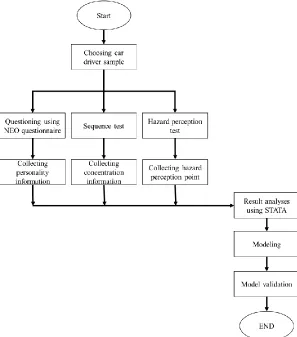
demographic and socio-economic questionnaire, NEO personality characteristics questionnaire, attention and concentration using trail making test, and video hazard perception test. Sampling is done using simple non-probabilistic method. The general process is shown in a flowchart (figure 1) below and then questionnaires and tests are introduced and discussed.
3.1 NEO Questionnaire
In this study, in order to measure drivers’ personality characteristics, NEO questionnaire short form has been used. This questionnaire is one of the newest ones for evaluating personality formation according to parameter analysis viewpoint. These days, personality test
based on NEO questionnaire is a
Morteza Asadamraji, Mahmood Saffarzadeh, Mahshid Mirzaee Tayeghani
173 International Journal of Transportation Engineering, Vol. 5/ No. 2/ Autumn 2017 Number of NEO Five-Factor Inventory
(NEO-FFI) questionnaire is 60 which it is used if test
time is constraint and general information of personality is enough.
Figure 1. Study process flowchart
On the other hand, this test is affordable from expense and time point of view, its scales has suitable validation, and correlation between scales is high. Thus, in spite of other personality tests, it has been less criticized [Garousi and Azodi 2013, Costa and McCare 1986,
Hagh-Shenas H. 2006].
3.2 Trail Making Test
Trail making test is used in order to measure drivers’ attention and concentration. The test's purposes are measuring attention, speed, mental flexibility and also visual tracking, recall, and recognition. First part of this test measures visual scanning, numerical sequence, and observation
speed. The second part is same as the former but person has to substitute numbers and letters which it is harder and more time consuming. Second part measures recognition needs including visual motor and visual spatial ability, and mental flexibility.
3.3 Hazard Perception Tests
Modeling Driver’s Hazard Perception using Driver's Personality Characteristics
International Journal of Transportation Engineering, 174 Vol. 5/ No. 2/ Autumn 2017
considered due to the hazard time. At the beginning of hazard identification, points is the highest, which is usually 5 and With Getting closer to hazard, this point reduces to 1. As long as the critical position is too late for reaction, in which case no point does accrue. In many countries, the assessment is used in the driver's license test as a hazard perception test and applicants must have obtained enough points to pass it.
Video clips of dangerous situationsare used for
testing hazard perception. Therefore, 8 hazard
perception films, containing 12 dangerous
situations are considered, which comprised 4 hazard types: pedestrian crossing, entering
vehicle from an access road, vehicle crossing in
the opposite direction, and encountering
obstacles. In order to determine drivers’ hazard perception, the time interval between displaying hazard and last proper time for braking is named as “time window” and is divided into 5 parts. The test person, sitting behind the computer, watches the hazard perception films and clicks the mouse while percept the hazard. The time is specified by the computer application with accuracy of seconds and is recorded by the interviewer. According to recorded mouse clicking time by driver, the hazard perception point in each situation can be determined. After collecting required data, analyses and modeling are done in the next step. The software usage procedure has been provided in following.
3.4 STATA Software and Usage Procedure
In this study STATA 14 is used for data analyses and modeling. Modeling needs surveyedvariables normality of distribution and
correlation. Then, regression model can be developed. In this way, STATA can facilitate the process and statistical tests are done in this software.
3.5 Modeling Procedure and Regression
Model Types
The purpose of modeling is finding out the
relation between independent and dependent
variables. Model making consists of three
steps: model selection, appropriateness test,
and confirming the final version. Also,
having data in the field of regression statistics
analysis is very important. Some statistical
software could be used for model making
such as STATA. Regression models are used
to determine the numerical relationship
between
independent
and
dependent
variables and can be a polynomial regression
equation, quadratic, exponential, logarithmic,
and etc. Multiple regression, is the process of
developing a linear equation for a dependent
variable using more independent variables by
linear
regression
analysis
(logistic
regression), and accordingly, achieve a
minimum total square. The purpose of this
model is to identify and isolate independent
variables that affect the dependent variable
and classify them according to the level of
impact. In order to perform this analysis,
there should be a linear relationship between
the dependent and independent variables, and
the dependent variable should follow normal
distribution (bell curve).
The purpose of developing a statistical model for hazard perception is finding a relationship between hazard perception point predicting
function E(𝑑)= µ and parameters related to
drivers’ personality characteristics such as
extraversion and etc. (𝑐1,𝑐2,𝑐3, …, 𝑐𝑞), which
variable “d” shows hazard perception point. Totally, for each person a set of q parameters which explain driver personality characteristics, is allocated to considered person.
Relation between expected hazard perception
point in q person’s trait parameters (𝑐1,𝑐2,𝑐3,
…, 𝑐𝑞) can be in form of a linear model like
equation 1:
Function (µ
𝑖)
= 𝛽
0+ 𝛽
1𝑐
1+ 𝛽
2𝑐
2Morteza Asadamraji, Mahmood Saffarzadeh, Mahshid Mirzaee Tayeghani
175 International Journal of Transportation Engineering, Vol. 5/ No. 2/ Autumn 2017
In this equation regression coefficients
( 𝛽0, 𝛽1, 𝛽2,…,𝛽𝑞 ) are calculated via data and
statistics. Choosing proper method for
determining regression coefficients is related to
the assumption made about 𝑑𝑖 distribution.
4. Data Analyses and Modeling
In this research, 389 samples are collected from
November 2nd, 2015. After surveying some data
is eliminated because of lack of validation, and, finally 380 samples are used. At first, 8 chosen variables are explained.
c1=Neuroticism personality characteristics
independent variable
c2=Extraversion personality characteristics
independent variable
c3= Flexibility and experience-willing
personality characteristics independent variable
c4=Agreeableness personality characteristics
independent variable
c5=Conscientiousness personality
characteristics independent variable
t1= Attention and concentration independent
variable (Trail making test 1, time)
t2= Attention and concentration independent
variable (Trail making test 2, time)
d=Hazard perception point dependent variable
In modeling process data distribution and linear regression fitness on data must be checked before developing the model, because in order to make a linear regression model, variables must be normally distributed. So, at first variables distribution curve is drawn and then is compared with normal distribution.
By comparing skewness and kurtosis
coefficients
with
normal
distribution
coefficients, the normal distribution of each
variable is tested. The collected independent
variables distributions are shown in figure 2.
According these figures, it is clear that data
and normal distribution diagrams are
acceptably coincide.
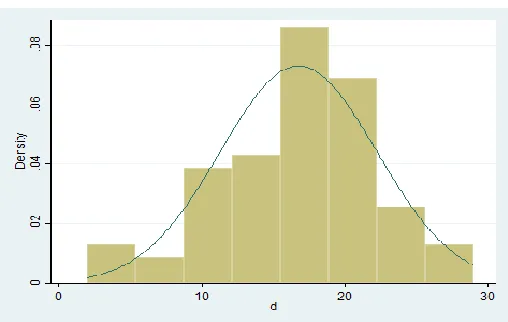
The STATA diagram outputs related to model dependent variable distribution or hazard perception point (d) is shown in figure 3. According to the diagram, data complies with normal distribution curve. Data is skewed right and its kurtosis is a bit more than normal distribution.
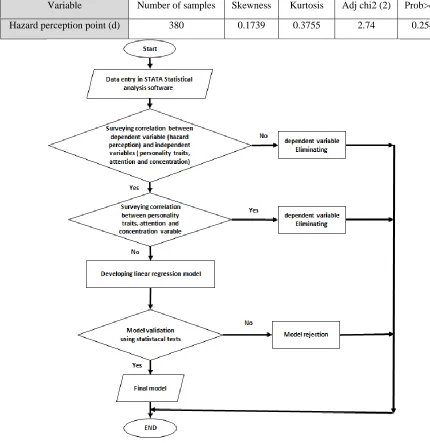
The related information to data Skewness and kurtosis is provided in Table 1.
According to table 1, skewness is 0.1739 and kurtosis is 0.3755. It is shown that hazard
perception point of dependent variable
distribution considering symmetry and the maximum point is in normal distribution range. This process is used for independent variables and as it is shown in figure 3, these variables with confidence level of 95% have normal distribution. Surveying data and according to the previous studies, considering data has normal distribution, linear regression model can be provided with suitable fitness for dependent and independent variables. Purpose of the next steps is model processing, variable's coefficient determination, and finally using statistical tests to validate model. Modeling process is shown in the flowchart of figure 4.
Figure 4 process is used to develop linear regression model using hazard perception point and personality characteristics. Various models are developed using all variables and their different combinations, in different model forms. After analyzing correlation coefficient, it is found
that correlation between personality
characteristics and driver's hazard perception point is high which indicate their suitable relationship. A model, with more suitable
meaningful coefficients including linear
regression equation using driver's hazard perception point and 5 personality characteristics, is selected as the best one. Independent variables correlations are also checked two by two; for
example, because the correlation of t1 and t2 is
high, using both variables in a model is
impossible. Thus, t2 which has higher correlation
Modeling Driver’s Hazard Perception using Driver's Personality Characteristics
International Journal of Transportation Engineering, 176 Vol. 5/ No. 2/ Autumn 2017
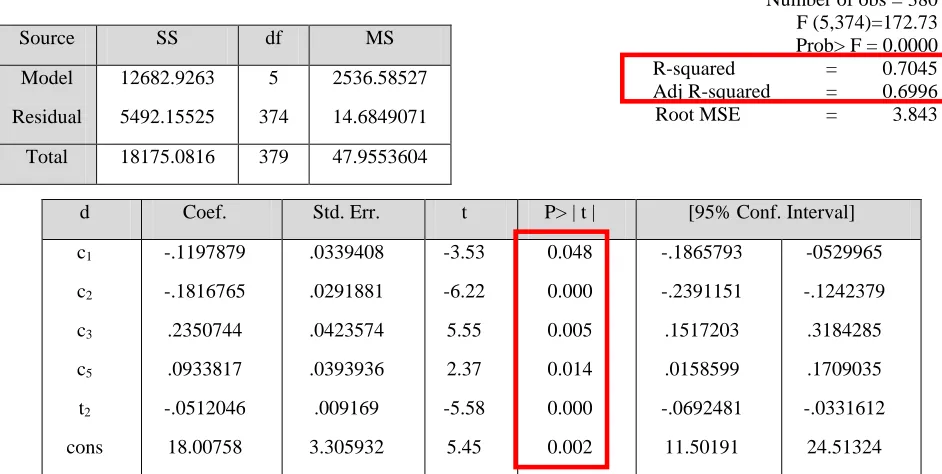
in the model. In table 2, the best model based on STATA output is shown.
Eventually, a multivariate linear regression models is provided as follow:
𝑑 = −0.119𝑐1− 0.181𝑐2
+ 0.235𝑐3 + 0.093𝑐5 − 0.051𝑡2+ 18
(2)
Personality characteristics distribution 1Personality characteristics distribution 2Personality characteristics distribution 3
Personality characteristics distribution 4Personality characteristics distribution 5Sequence personality characteristics distribution
Morteza Asadamraji, Mahmood Saffarzadeh, Mahshid Mirzaee Tayeghani
177 International Journal of Transportation Engineering, Vol. 5/ No. 2/ Autumn 2017 Figure 3. Hazard perception point distribution curve
Table 1. Software output related to variable d skewness and kurtosis
Prob>chi2 Adj chi2 (2)
Kurtosis Skewness
Number of samples Variable
0.2540 2.74
0.3755 0.1739
380 Hazard perception point (d)
Figure 4. Modeling process flowchart
4.1 Fit Index (R2)
A criteria for assessing the efficiency of the fitted model, is fit index or R2 that is used as a criterion to justify the distribution of the dependent
variable. This index represents the overall error between models and observations, and total variations in the data and therefore is considered
very suitable criteria to express the
Modeling Driver’s Hazard Perception using Driver's Personality Characteristics
International Journal of Transportation Engineering, 178 Vol. 5/ No. 2/ Autumn 2017
use of corrected correlation index in the process of modeling, can be mentioned identification of unnecessary variables entered into the model. So that slight changes in the index, as a result of entering a new variable, indicated the role of these variables is not essential.
In this regression model, R2 is equal to 0.704 and
it shows that chosen independent variables explain and predict driver's hazard perception point in an acceptable level.
Table 2. STATA model output
Number of obs = 380 F (5,374)=172.73 Prob> F = 0.0000 R-squared = 0.7045 Adj R-squared = 0.6996 Root MSE = 3.843
[95% Conf. Interval] P> | t |
t Std. Err. Coef. d -0529965 -.1242379 .3184285 .1709035 -.0331612 24.51324 -.1865793 -.2391151 .1517203 .0158599 -.0692481 11.50191 0.048 0.000 0.005 0.014 0.000 0.002 -3.53 -6.22 5.55 2.37 -5.58 5.45 .0339408 .0291881 .0423574 .0393936 .009169 3.305932 -.1197879 -.1816765 .2350744 .0933817 -.0512046 18.00758 1 c 2 c 3 c 5 c 2 t cons
4.2 Evaluation Validity of the Model
After evaluation and analysis of the effective parameters of model and identification main parameters and fit the best and most efficient regression model, should ensure the accuracy of the fitted model, because the results of the regression technique does not necessarily have the accuracy and statistical validity. Most important of these tests can be as follows:4.2.1 F Test
The first test for general inference studied model, is the F test. This test, examined the utility and efficiency of Simultaneous existence of model variables. According to the analysis of Stata in this model F statistics is equal 172.73 and it could
be found that model with reliability of 95% is
significant2.
4.2.2 t Test
In order to perform this test, model t test and t-statistics of the distribution table has been compared, if sig t be less than interest significant level in making the model, reject the null hypothesis at desired significance level, and if sig t be more than the interest significant level in making the models, the null hypothesis is confirmed. Obviously, according to this test a model at a significance level (α), which would be valid and acceptable that sig t values of all coefficients be less than the α amount.
Considering P value of the model coefficients, it could be found that the independent variables can
Morteza Asadamraji, Mahmood Saffarzadeh, Mahshid Mirzaee Tayeghani
179 International Journal of Transportation Engineering, Vol. 5/ No. 2/ Autumn 2017 predict driver's hazard perception with reliability
of 95% which shows model coefficients’ validity.
4.2.3 Durbin-Watson Test
One of the assumptions that we consider regression is independence of errors (the difference between the actual values and the
values predicted by the regression equation) from one another. Statistic value of this test is in the range of 0 to +4, if this statistic be in the range of
1.5 to 2.5 test H0 (no correlation between errors)
will be accepted. Durbin-Watson test also was
used to survey model validation and
autocorrelation in residuals. So, considering test statistic equal to 2.01, the model is acceptable.
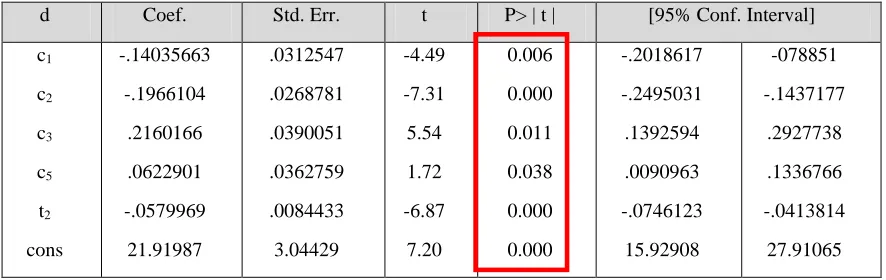
Table 3. STATA Robust Regression output
Number of obs = 380 F (5,374) = 212.89 Prob> F = 0.0000
[95% Conf. Interval] P> | t |
t Std. Err.
Coef. d
-078851
-.1437177
.2927738
.1336766
-.0413814
27.91065 -.2018617
-.2495031
.1392594
.0090963
-.0746123
15.92908 0.006
0.000
0.011
0.038
0.000
0.000 -4.49
-7.31
5.54
1.72
-6.87
7.20 .0312547
.0268781
.0390051
.0362759
.0084433
3.04429 -.14035663
-.1966104
.2160166
.0622901
-.0579969
21.91987
1
c
2
c
3
c
5
c
2
t
cons
4.2.4 Robust Regression
A robust regression used for data analyzing, and evaluation of model. In table 3, the robust regression based on STATA output is shown. Comparing the liner regression and robust regression coefficients, and p values, determined that there is no significant difference between obtained values, so, this liner model can be reliable. Also Heteroskedasticity tests was conducted and there was no relationship between these variables and the error term. A few variables such as Static focus in first trail making test and properties in Agreeableness trait set were removed from final model because of relation with other independent variables and error term.
In addition, after making the model, we used this prediction model for 10 other people who were interviewed later, and it was observed that in 68%
of the time predicted hazard perception point came true.
5. Conclusion
Hazard perception consists of more than perceiving and recognizing hazards. It also appraising the seriousness of the hazard and knowing how to act in order to avert the hazard. There are clear indications that a lack of hazard plays an important role in the occurrence of road accidents. The research about hazard perception has mainly focused on relation between hazard
perception and age, cognitive factors, Experience
Modeling Driver’s Hazard Perception using Driver's Personality Characteristics
International Journal of Transportation Engineering, 180 Vol. 5/ No. 2/ Autumn 2017
about personality characteristics. Application of
this research to add psychology factors and hazard perception test in the Test and Training Driver’s License.
Some of the most important results are as following:
- Flexibility and Conscientiousness trait have the most positive effect and extraversion has most negative effect on drivers’ hazard perception ability. People with high conscientiousness have ability to control unpredictable situations and tendencies and have a planning behavior. They also react severely against external threats.
- Drivers Expectation has inverse relationship with driver’s hazard perception. It means increasing the number of road hazards in test and repeat them, increase the hazard perception
especially for person with stable personality3.
Fear of the future, Extraversion and emotional personality has meaningful inverse relationship with driver’s hazard perception which means that, in general, extroverted person has less hazard perception in comparison with introverted person. Introverted people have tendency to more thrill and like involvement and experience.
-Flexible people are more willing to new experience, have better compatibility with the environment, and violate the rules less.
- People with high attention and concentration score, have better perception of potential hazards and react faster.
Generally, the research findings showed that
drivers’ personality characteristics have
relationship with their hazard perception and their reaction to hazardous driving positions. Also it is possible with a closer look to teach people
according to their weak personality
characteristics. Important suggestions, which
authors provide about hazard perception and personality characteristics, are as follow:
Propose strategies to improve hazard
perception specially novice drivers.
Surveying interaction between road and
hazard perception.
Surveying relation between driving
behavior and drivers’ hazard perception point by Manchester driving behavior questionnaire.
Determining cultural and educational
strategies to improve drivers’ hazard perception.
6. Endnotes
1 Arousal is a state of heightened activity in both
our mind and body that makes us more alert
2 Fear of the future is one of factor in personality
characteristics that used in driver behavior research
3
If sig F be less than interest significance level in making the model (In this model, for a 95% confidence level sig F value must be less than 0.05
4
One of the five personality traits are stable for working ،driving، life style and etc.
7. References
Anstey, K. J., Wood, J., Lord, S. and Walker, J.
G. (2005) "Cognitive, sensory and physical
factors enabling driving safety in older adults",
Clinical Psychology Review, Vol. 25, No 1, pp. 45-65.
Berdoulat, E., Vavassori, D. and Sastre, M. T.
M. (2013) "Driving anger, emotional and
instrumental aggressiveness, and impulsiveness in the prediction of aggressive and transgressive
driving", Accident Analysis and
Prevention, Vol. 50, pp. 758-767
Boroujerdian, A. M., Karimi, A. and
Seyedabrishami, S. E. (2014) "Identification of
Hazardous Situations using Kernel Density Estimation Method Based on Time to Collision, Case study: Left turn on Unsignalized
Intersection", International Journal of
Morteza Asadamraji, Mahmood Saffarzadeh, Mahshid Mirzaee Tayeghani
181 International Journal of Transportation Engineering, Vol. 5/ No. 2/ Autumn 2017
Borowsky, A., Oron-Gilad, T. Meir, A. and
Parmet, Y. (2012) "Drivers’ perception of
vulnerable road users: A hazard perception
approach", Accident Analysis and Prevention,
Vol. 44, No. 1, pp. 160-166
Chou, W. S. and Chuang, P. C. (2014) "Design
of Drivers' Hazard Perception Context Test. In Proceedings of the Eastern Asia Society for
Transportation Studies", Vol. 3, No. 2, pp.
220-233
Costa P. T. and McCare R. R. (1986) "Cross-
sectional studies of personality in a national sample: I Development and validation of survey
measures", Psychology and Aging, Vol. 1, pp.
140- 143.
Crundall, D. (2016) "Hazard prediction
discriminates between novice and experienced
drivers", Accident Analysis and Prevention,
Vol. 86, pp. 47-58.
Crundall, D., Chapman, P., Trawley, S., Collins,
L., Van Loon, E., Andrews, B., and Underwood,
G. (2012) "Some hazards are more attractive
than others: Drivers of varying experience
respond differently to different types of hazard",
Accident Analysis and Prevention, Vol. 45, pp. 600-609
Danno, M., and Taniguchi, S. (2015) "The
analysis of drivers’ hazard detecting ability
using Empathizing–Systemizing model",
Transportation Research Part F: Traffic Psychology and Behaviour, Vol. 33, pp.106-116.
Egea-Caparrós, D. A., García-Sevilla, J.,
Pedraja, M. J., Romero-Medina, A.,
Marco-Cramer, M., and Pineda-Egea, L. (2016) "Late
detection of hazards in traffic: A matter of
response bias?", Accident Analysis and
Prevention, Vol. 94, pp. 188-197.
Garousi, B. and Azodi, V. (2013) "Personality
characteristics effect on aggressive driving",
Scientific Research Quarterly of Rahvar, Vol. 2, No. 6, pp. 11-40
Gheorghiu, A., and Havârneanu, C. (2012)
"Driving behaviour of a sample of young
Romanian drivers", Procedia-Social and
Behavioral Sciences, Vol. 33, pp. 697-701.
Hagh-Shenas H. (2006) "Five-factor personality
characteristics pattern: Guide to interpretation
and testing norms of NEO PI-R and NEO FFI",
Fars University of Medical Sciences and Health Services.
Hagh-Shenas H., Hosseini M., Jamshidi M.,
Azizi H. R. (2005) "Relation of Personality
Traits with Driving Behavior in City of
Shiraz", Hakim Research Journal.2008, Vol. 11,
No. 3, pp. 47–54
Horswill, M. S., Hill, A., and Wetton, M. (2015)
"Can a video-based hazard perception test used
for driver licensing predict crash involvement",
Accident Analysis and Prevention, Vol. 82, pp. 213-219
Isler, R. B., Starkey, N. J., and Williamson, A.
R. (2009) "Video-based road commentary
training improves hazard perception of young
drivers in a dual task", Accident Analysis and
Prevention, Vol. 41, No. 3, pp. 445-452
Jalayer, M., Gong, J., Zhou, H., and Grinter, M.
(2015) "Evaluation of remote sensing
technologies for collecting roadside feature data
to support highway safety manual
implementation", Journal of Transportation
Safety and Security,Vol. 7, No. 4, pp. 345-357
Klauer, S. G., Guo, F., Simons-Morton, B. G.,
Ouimet, M. C., Lee, S. E., and Dingus, T. A.
(2014) "Distracted driving and risk of road
crashes among novice and experienced
drivers", New England Journal of
Medicine, Vol. 370, No. 1, pp. 54-59
Machin, M. A., and Sankey, K. S. (2008)
"Relationships between young drivers’
personality characteristics, risk perceptions, and
driving behaviour" Accident Analysis and
Modeling Driver’s Hazard Perception using Driver's Personality Characteristics
International Journal of Transportation Engineering, 182 Vol. 5/ No. 2/ Autumn 2017
Naser Alavi, S., Nazari, H., Izadi, A. and
Titidezh, A., (2013) "predicting accident
numbers on rural roads based on drivers’ traffic
behavior and social status", 13th International
Conference of Traffic Engineering, Tehran
Sheppard, E., Ropar, D., Underwood, G. and
van Loon, E. (2010) "Brief report: Driving
hazard perception in autism", Journal of Autism
and Developmental Disorders, Vol. 40, No. 4, pp. 504-508
Summala, H., Rajalin, S. and Radun, I. (2014)
"Risky driving and recorded driving offences: A
24-year follow-up study", Accident Analysis
and Prevention, Vol. 73, pp. 27-33
Tombaugh, T. N. (2004) "Trail Making Test A
and B: normative data stratified by age and
education", Archives of Clinical
Neuropsychology, Vol. 19, No. 2, pp. 203-214
Ünal, A. B. (2006) "Assessment of
computer-based and self-reported hazard perception skills among drivers: the role of personality and
driving skills"
Ventsislavova, P., Gugliotta, A., Peña-Suarez,
E., Garcia-Fernandez, P., Eisman, E., Crundall,
D. and Castro, C. (2016) "What happens when
drivers face hazards on the road?", Accident
Analysis and Prevention, Vol.91, pp.43-54.
Vlakveld, W. P. (2014) "A comparative study of
two desktop hazard perception tasks suitable for mass testing in which scores are not based on
response latencies", Transportation Research
Part F: Traffic Psychology and Behaviour, Vol. 22, pp. 218-231.
Wang, Y., Zhang, W. and Salvendy, G. (2010)
"Effects of a simulation-based training
intervention on novice drivers' hazard handling performance", Traffic Injury Prevention, Vol. 11, No. 1, pp. 16-24
Wetton, M. A., Hill, A. and Horswill, M. S.
(2011) "The development and validation of a
hazard perception test for use in driver
licensing", Accident Analysis and
Prevention, Vol. 43, No. 5, pp. 1759-1770
World Health Organization (2010) "World
health statistics, 2010", World Health