Please cite this article as: H. Mokhtari, A. Noroozi, S. Molla-Alizadeh-Zavardehi, A Reliability based Modelling and Optimization of an Integrated Production and Preventive Maintenance Activities in Flowshop Scheduling Problem, International Journal of Engineering (IJE), TRANSACTIONS C: Aspects..Vol. 28, No. 12, (December 2015) 1774-1781
International Journal of Engineering
J o u r n a l H o m e p a g e : w w w . i j e . i rA Reliability based Modelling and Optimization of an Integrated Production and
Preventive Maintenance Activities in Flowshop Scheduling Problem
H. Mokhtari a, A. Noroozi b, S. Molla-Alizadeh-Zavardehic
a Department of Industrial Engineering, Faculty of Engineering, University of Kashan, Kashan, Iran b Department of Industrial Engineering, Iran University of Science and Technology, Tehran, Iran
c Department of Industrial Engineering, Islamic Azad University, Masjed Soleyman Branch, Masjed Soleyman, Iran
P A P E R I N F O
Paper history: Received 14 June 2015
Received in revised form 06 December 2015 Accepted 24 December 2015
Keywords:
Electromagnetism-Like (EM) Algorithm Reliability
Preventive Maintenance, Flow Shop
A B S T R A C T
Scheduling problems with batch processing machines (BPM) assume that machines are continuously available, and no time is needed for their preventive maintenance (PM). In this paper, we study a realistic variant of flowshop scheduling which integrates flow shop batch processing machines (FBPM) and preventive maintenance for minimizing the makespan. In order to tackle the given problem, we employ reliability concept, and develop an electromagnetism-like (EM) algorithm, as an evolutionary technique, and propose an enhanced EM algorithm, in which the EM is hybridized with a diversification mechanism, and an effective local search to enhance the efficiency of the algorithm. The proposed algorithms are evaluated by comparison against two existing well-known EMs in the literature. For this purpose, we study the behavior and investigate the impacts of the rise in problem sizes on the performance of the developed algorithm. The superiority of our EM is inferred from computational results obtained in various circumstances.
doi: 10.5829/idosi.ije.2015.28.12c.10
1. INTRODUCTION1
Reliability can be defined as the probability that a system will carry out its assigned operations satisfactorily for the specific time period when used according to the specified conditions [1-3]. The system reliability optimization plays very important role in preventing unpredicted failures in the real-world industrial applications. In this regards, maintainability and maintenance raise the system reliability. Maintainability is defined as the probability which a failed system will be renovated to its desirable operational state and maintenance is all necessary activities for keeping a system or machine in, or restoring it to, a specified or new condition. Hence, maintenance plays a key role in obtaining the desired level of reliability of a system. In some literature [4] presents two techniques to integrate production
* Corresponding Author’s Email: [email protected] (M. J.
Noroozi)
the only mixed integer formulations for the zero and infinite buffer capacity and to solve this problem, Manjeshwar et al. [6] have proposed a heuristic and SA for the case of the problem with infinite buffer capacity. Liao et al. [7] improved MILP models presented Damodaran et al. [5]. Computational results have demonstrated that the improved models are much better than the original ones. Husseinzadeh Kashan et al. [8] improved the model proposed by Damodaran et al. [5] and developed it to m machine flow shop. Their improved formulation afforded a significant reduction in the size complexity, which enables the user to obtain optimal solutions of larger problems in less execution time. They also proposed several lower bounds of the optimal makespan. The flow shop scheduling with more than two BPMs (up to 5 machines) has been recently presented by Lei et al. [9] which designed a variable neighborhood search (VNS) algorithm to solve the problem. Although, both maintenance and BPM are studied by many researchers, but, to the best of our knowledge, considering both scheduling of maintenance and production sequencing BPM simultaneously, has not been studied till now. Moreover, we can find few papers considering reliability to model maintenance aspects of scheduling problems [10-12]. Hence, this paper investigates scheduling of a flow shop with BPM (FBPM) and maintenance operations with reliability concept. Since the basic flow shop scheduling problem is NP-hard, then the proposed maintenance based flow shop is also NP-hard. To solve the problem, an Electromagnetism-like (EM) algorithm is employed which is known as a metaheuristic algorithm to tackle this NP-hard problem.
The paper is organized as follows. The next section describes the Scheduling FBPM and PM. The design of EMs and our novel EM algorithm is explained in section 3. Section 4 describes the Taguchi experimental design and section 5 compares the computational results. Finally, in section 6, conclusions are provided and some areas of further research are then presented.
2. SCHEDULING FBPM AND PM
2. 1. FBPM The FBPM is one of the most attractive problems studied in production scheduling research area. Several jobs can be simultaneously assigned in a batch processing machine provided that the total size of the batch of jobs does not exceed the machine capacity. In this problem, there is a set of n jobs ( ) that should be grouped into a number of batches ( ). The batches of jobs are then to be processed on m machines ( ) in a flowshop. Each job j has a processing time pjm and a size sj on machine m. All jobs in a batch start processing operation at the same
time, and the processing time of a batch Pbm is determined by the longest processing time of all the jobs in the batch, i.e., Pbm = max { pjm / } . Each machine m can process a batch of jobs at the same time as long as the total size of the batch does not exceed the machine capacity S.
2. 2. PM In the real-world, the objective of companies is generally to have more reliable production systems with higher availability performance. As mentioned above, maintenance increases the system reliability. Maintenance operations usually can be classified into two major categories: corrective maintenance (CM) and PM. CM corresponds to the operation carried out when a failure has already taken place. PM corresponds to performing the activities in systems before a failure or a breakdown happens, at fixed predefined intervals. Hence, with PM operations, probability of failure is minimized. One of the main advantages of PM is that the system is always in good condition, thus the risk of unexpected failures is reduced.
2. 2. 1. Policy I: PM at Fixed Predefined Time Intervals In this policy, the fixed time intervals are predefined without considering probabilistic models and PM operations are carried out exactly at these time intervals.
2. 2. 2. Policy II: Optimum Period Model for the PM Maximizing the Machines’ Availability In classical maintenance theory, an optimal PM interval for an unreliable manufacturing environment is determined by maximizing its constraint availability. In this policy optimal maintenance period is determined by considering probabilistic models and carried out according to these periods. Due to flexibility of the Weibull distribution model to determine the time to failure of equipment with variable failure rates, this model is one of the most commonly used ones. So, here we assume that the time to failure follows a Weibull probability distribution, T~W [θ,β] with β>1. This distribution depends on the two parameters called shape parameter (β) and scale parameter (θ). Let TPMop be the optimal interval between two sequential PM activities. With these assumptions, and according to Cassady and Kutanoglu, the optimal maintenance interval TPMop can be obtained as follows:
1
1
r p PMop
t t
T (1)
failure rate raises with time and therefore it may be influenced by failures due to aging or wear. This policy consists of implementing a systematic PM after a time TPM to guarantee a minimum reliability of the system from time t = 0. It is supposed that PM activities will be performed at regular intervals 0, 1, 2, 3, …, nTPM. The components are renovated in these points to the as-good-as-new state. Similar to policy II, here again we use the Weibull model, T~W[θ,β] with β>1, and the time between PM in this policy is computed by means of :
) 1 ( 1 0()
ln
t t R
TPM (2)
2. 3. Integrating FBPM Scheduling and PM In this approach, we applied two processes. In the first process, according to the sizes of jobs and capacity of machines, batches are formed first and then sequenced by using the first-first (FF) heuristic proposed.
3. THE ELECTROMAGNETISM-LIKE ALGORITHM
3. 1. The Original EM During recent years, application of evolutionary algorithms to scheduling problems has been increased outstandingly [13-17]. Since the basic flow shop scheduling problem is NP-hard, then the proposed maintenance based flow shop is also NP-hard. The EM is a new stochastic population-based heuristic optimization tool to solve the problems with bounded variables in the form of:
Min f(x) (3)
s:t: x
[L,U] (4)where [L,U] =
x R Lk xk Uk k n
n, ... , 1 ,
|
and x
1,… , xn
represent the decision variables. Uk, Lk and f(x) represent, upper and lower bounds on the kth variable (k=1,…,n) and the objective function value, respectively. This heuristic algorithm has been inspired by the real electromagnetism theory. In EM, solutions are considered as charged particles and their performance are measured by their own charges, and all these particles attract each other by the electromagnetic force, while this force leads to a global movement of all particles towards the particles with higher charges or solutions with better objective function value. This approach provides an iterative method that simulates particle interactions, and moves through a multi-dimensional search space under the influence of electromagnetic force. In the electromagnetic space, all particles affect each other; in fact, every particle attracts or repels every other particle according to its charge. The direction of particles to move in subsequent
iterations is then determined. The direction is specified by the resultant force determined with all the forces exerted on the particle by other particles. In this mechanism, the candidate solutions with better objective function values attracts other ones, while those with worse values repel; candidate solutions with the worse value repel the other population members. The amount of attraction or repulsion between two particles in the population is directly proportional to the product of their charges and inversely proportional to the distance between them. The principle behind the algorithm is that the force causes a global movement of all particles towards the solutions with higher quality solutions.
Although the EM approach has been designed for continuous optimization problems, here we adapt it to solve the discreet optimization problems. The EM approach has been recently applied to solve several combinatorial optimization problems such as set covering problem [18], project scheduling [19], nurse scheduling [20], single machine scheduling [21], flow shop [22-23], flexible flow shop [4], and job shop [24], etc. EM algorithm has the advantages of multiple search, global optimization, and faster convergence and simultaneously evaluates many points during the search space. Moreover, it has the advantage of higher accuracy and efficiency for constrained optimization problems.
3. 1. 1. Encoding Scheme and Initialization
Since EM is designed to solve the continuous optimization problems, it should be adapted to be used for the discreet ones. In addition the key to obtain a good solution using a metaheuristic algorithm depends on developing a good solution representation for the problem. The most frequently used encoding scheme for the flow shop scheduling problems is job permutation. In order to enable EM to solve the problem, random key (RK) technique is applied. The RK technique is used for solving single machine and permutation flow shop scheduling in literature. To generate a sequence by RK technique, random real numbers between zero and one are generated for each job. By ascendingly sorting the value corresponding to each job, the sequence of job is obtained. When we obtain a solution, the sequence of jobs in this work is shown through ascending sort of the value corresponding to each job. After having a permutation, we can use it to compute the objective function value of this solution. Each job has a random real number between 0 and 1, and these numbers show the relative order of the jobs. In fact, the problem variables in EM are limited between 0 and 1. For example, consider a problem with ten jobs.
12) then finds its related sequence and their objective value. This new temporary solution will replace the current solution when its objective value is better than the current solution (Algorithm 2, lines 13–16).
3. 1. 3. Total Forces Computation As mentioned before, by using the main structure of EM, the best solutions encourage other ones to converge to attractive valleys while the inferior solutions discourage the others to move toward this region. The charge qi, the
components Fji(jJ) of the total force exerted on each solution Xi and the direction of movement are obtained by adapting the equations
if f X fX i popsize j J x x q q x x X f X f if x x q q x x F i k i k k i k j i j i k i k k i i j k j popsize i k k i
j
, ..., , , 1 2 2 1 (5) where
f X f X
i popsize j JX f X f n q best i popsize k best i
i
, ..., , , exp 1 1 (6)
2 12
J j i j k j i k x x x x (7)and Xbest is the current best solution in the population.
3. 1. 4. Movement Procedure After evaluating the effects of all other solutions, each solution is moved in the direction of the force by a random step length λ, uniformly distributed between 0 and 1. The formulation proposed to calculate the new position of Xi is as follows: J j popsize i RNG F F x
x i j
i j i j i
j ( ) 1,..., , (8)
where RNGj denotes the amount of feasible movement toward zero or one. Since RKs are real numbers between zero and one, the adaptation of Equation (8) for the RKs gives the following formula:
x if F i popsize j JF F x F if x F F x x i j i j i i j i j i j i j i i j i j i
j
1,..., ,
0 0 1 (9) where
. 2 1 2
j J i
j i
F
F (10)
It is important to notice that we do not move the best solution Xbest in the current population and apply this procedure only to the others.
3. 2. The Revised EM Birbil et al. stated that the original EM may converge prematurely when the total force exerted on the particles neglect some parts of the solution space, thus the original EM an attraction– repulsion mechanism was modified to be more convergent. In the revised EM, the current population perturbed so that a perturbed point denoted by XP is considered as the farthest point from the current best point, Xbest. Calculation of the total force vector remains the same for all points except XP. The components of force exerted to the farthest point are calculated in which they are perturbed by a random number λ which is uniformly distributed between 0 and 1.
if f
X f X j J x x q q x x X f X f if x x q q x x F p k p k k p k j p j p k p k k p p j k j p j , 2 2 (11)Also in the revised EM, the direction of the total forces exerted to XP is perturbed, i. e., if parameter λ is less than parameter νϵ(0, 1), then the direction of the component force is reversed. After these modifications, Birbil et al. showed that their revised EM is so convergent.
4. EXPERIMENTAL DESIGN
4. 1. Input Data Data required for analyzing the performance of our algorithms for the batch-processing flow shop with maintenance problems includes two parts, namely, data related to the production scheduling and data related to the PM. It is necessary to deal with the fact that the data must be generated so as to ensure that a large number of possible productive configurations would be carried out on each machine. As it is known, the number of jobs n and the number of batch processing machines m in a FBPM instance clearly determine its difficulty. The first part of the required data includes (consist of) number of jobs (n), number of machines (m), range of processing times (P), size of jobs (S), and machine capacity (S).
repair takes (tr) and the number of time units of the PM (tp). These data is divided into two subparts, each of which considers one PM policy. For each configuration of n and m, β = {2, 3, 4} is defined. We assume that the duration of PM operations is uniformly distributed in a wide range of values. Because we want to consider some short maintenance actions like cleaning, tightening of bolts or lubrication and also some longer maintenance actions like replacements of parts or thorough inspections, DPM is defined as U[5, 12.5], U[5, 25] and U [5, 37.5]. That is, there are three cases where the average DPM is 50%, 100% or 150% of the processing times. In the case of policy II, tp is set at 1 and tr at 8 for all the experiments.
A small value for θ would result in very little or even no PM operations while a very large value would possibly impede performing certain processing of jobs on machines without interruptions due to the small amount of time between PM operations. It is necessary to deal with that if the time between two consecutive PM operations is less than the maximum processing time; some jobs could be never processed. On the other hand, if this time becomes very large, it is very likely no PM operations are required. Consequently, the levels of θ are chosen so as to make sure that a significant number of PM operations would be carried out in each machine and generating TPMop must be done with great care. Doing so, we need to define a new artificial variable “Bi” to estimate the workload on the batch processing machines as follows:
∑
(12)
where “Bi” is the expected number of batches on each batch processing machine. Values of θ are set according to the variable “Bi” and number of jobs. Therefore, θ =250, 290, 350, 480, 660 and 860 for n = 15, 20, 30, 50, 100 and 150, respectively. Finally, for each configuration of n, m, β, θ and DPM, there are 10 different problems, which results in a total set of experiments of 900 instances where each experiment runs six times. In this Policy III four parameters exist: θ, β, R0(t) and t.
The same configurations of β, θ and DPM as in the case of policy II are considered. Therefore, a set of 900 instances is also obtained. On the other hand, the aim of policy III is to keep a minimum level of reliability for a production period t which TPM calculated by Equation (2). Here, The aim is a 95% reliability after the production period t, thus R0(t) = 0.95. Thereupon, it is necessary to determine period t to calculate TPM by Equation (2). t can be easily obtained from the job processing times of the instances. Since processing times are generated randomly from uniform distributions between (5, 25), then, t ≈ Bi × 15. After
calculating Bi, we have t = 121, 166, 322, 466, 963 and 1492 for n = 15, 20, 30, 50, 100 and 150.
4. 2. Experimental Result In this section, we aim to investigate the performance of the algorithms. For this purpose, experiments were carried out on randomly generated instances. When the result of each algorithm has been obtained for all instances, we find the best makespan obtained for each instance by each of the three algorithms, which is named Minsol. With respect to this best makespan, we use relative percentage deviation (RPD) as performance common and straightforward measure of comparing algorithms by the formula:
where Algsols are the makespan obtained for each
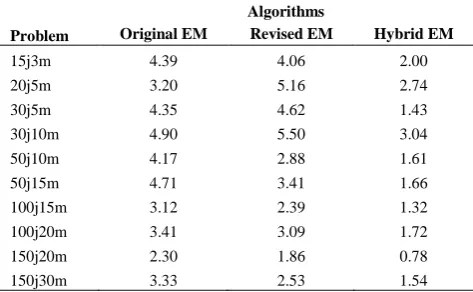
replication in a given instance. It is clear by using this measure that lower values of RPD are preferred. For each one of the n and m configurations, the results of the experiments are averaged ̅̅̅̅̅̅ and shown in Tables 1 and 2. Table 1 demonstrated ̅̅̅̅̅̅ of each algorithm in policy II. As the comparison results presented in Table 1 reveal, our suggested Hybrid EM outperforms for all instances. This table shows the high performance of Hybrid EM ( ̅̅̅̅̅̅ = 1.78%). As it could be expected, the worst performing algorithm is the Original EM ( ̅̅̅̅̅̅ = 3.79%). To evaluate the robustness of the algorithms in different situations, a means plot for the interaction between the different algorithms of different size are shown in Figure 1. Policy II is based on maximization of the availability of the machines, that is the lesser PM operations, availability is more; Contrary to this policy, policy III is based on maintaining a minimum reliability threshold after the production period; more PM operations, availability is less.
TABLE 1. Average relative percentage deviation ( ̅̅̅̅̅̅) for
the algorithms in Policy II
Algorithms
Problem Original EM Revised EM Hybrid EM
15j3m 4.39 4.06 2.00
20j5m 3.20 5.16 2.74
30j5m 4.35 4.62 1.43
30j10m 4.90 5.50 3.04
50j10m 4.17 2.88 1.61
50j15m 4.71 3.41 1.66
100j15m 3.12 2.39 1.32
100j20m 3.41 3.09 1.72
150j20m 2.30 1.86 0.78
Figure 1. Means plot for the interaction between algorithms and size of problems in Policy II
Figure 2. Means plot for the interaction between algorithms
and size of problems in Policy III
Consequently, in policy III need carrying out the PM operations much more often than in policy II. This cause to the makespan is higher than in the case of policy II.
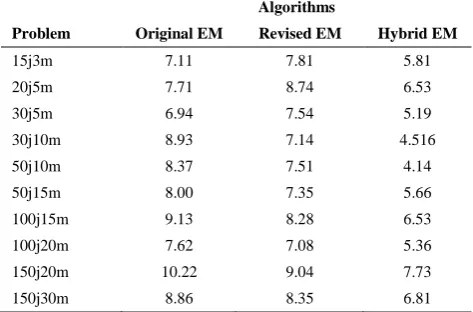
Noticeably, the mean deviations are higher than in the case of policy II. This is due to the fact that when setting R0(t)=0.95, the reliability maintained in the
machines is very high and the PM operations are carried out much more often than in policy II. From this, we conclude that the problems are much more difficult for almost all the algorithms as the frequency of the PM operations increases.
Table 2, confirms this conclusion, as well. For this policy, a means plot for the interaction between the different algorithms in different sizes are shown in Figure 2. In first three sizes of problem, Original EM moves better than the Revised EM. All other remaining relationships between algorithms is approximately similar to the case of policy II, only with higher ̅̅̅̅̅̅. For more precise analysis of the results, we performed an analysis of variance (ANOVA) for results of each policy. As can be seen, Hybrid EM statistically supersedes the other algorithms in both policies.
TABLE 2. Average relative percentage deviation ( ̅̅̅̅̅̅̅) for
the algorithms in Policy III
Algorithms
Problem Original EM Revised EM Hybrid EM
15j3m 7.11 7.81 5.81
20j5m 7.71 8.74 6.53
30j5m 6.94 7.54 5.19
30j10m 8.93 7.14 4.516
50j10m 8.37 7.51 4.14
50j15m 8.00 7.35 5.66
100j15m 9.13 8.28 6.53
100j20m 7.62 7.08 5.36
150j20m 10.22 9.04 7.73
150j30m 8.86 8.35 6.81
6. CONCLUSION
This paper considers a realistic variant of FBPM production environment which aims at considering preventive maintenance (PM) policy so as to improve the reliability of system. In this environment, BPMs are not continuously available due to PM operations, and we should decide not only about sequence of jobs to be processed on machines, but also about the best time of maintenance on machines in order to maintain the total reliability of the system. With a simple but effective procedure, PM and job operations were integrated in the FBPM. In this approach, we applied two successive processes. In the first process, batches are formed first by using a heuristic in the literature, and are then sequenced. In the second process, PM operations are embedded in BPM scheduling in a way that whenever a new batch is to be processed in each BPM, the total accumulated processing time is calculated. If there is an overlap between the process of a batch and PM operations, the process of the batch is postponed and PM operation is performed first. To find the best policy, we proposed a novel hybrid EM algorithm. To adjust the parameters of the proposed algorithms, the Taguchi parameter design method was employed. To evaluate performance of algorithms a set of test problems was employed. Computational results and comparisons demonstrated the effectiveness and robustness of Hybrid EM and its capability to improve the reliability and then prevent failure of a flow shop system with BPMs.
7. REFERENCES
1. Dhillon, B.S., “Maintainability, maintenance, and reliability for engineers”. CRC Press, (2006).
0 1 2 3 4 5 6
EM EM Modification EM Local2
3 4 5 6 7 8 9 10
2. Ram, M., and Chandna, R. “Reliability Measures Measurement Under Rule-Based Fuzzy Logic Techniques”, International
Journal of Engineering Transactions A: Basics, Vol. 28,
(2015), 1486-1492.
3. Sadjadi, S.J. Makui, A., Zangeneh, E., and Mohammadi, S.E. “Reliability Optimization For Complicated Systems with a Choice of Redundancy Strategies”, International Journal of
Engineering Transactions A: Basics, Vol. 28, (2015),
1476-1485.
4. Naderi, B., Zandieh, M. and Fatemi Ghomi, S.M.T. “Scheduling sequence-dependent setup time job shops with preventive maintenance”, International Journal of Advanced
Manufacturing Technology, Vol. 43, (2009a), 170–181.
5. Damodaran, P. and Srihari, K. “Mixed Integer Formulation to Minimize Makespan in a Flow Shop with Batch Processing Machines”, Mathematical and Computer Modeling, Vol. 40, (2004), 1465–1472.
6. Manjeshwar, P. K., Damodaran. P. and Srihari, K. “Minimizing makespan in a flow shop with two batch processing machines using simulated annealing”, Robotics and Computer–Integrated
Manufacturing, Vol. 25, (2009), 667– 679.
7. Liao, C. J. and Liao, L. M. “Improved MILP models for two-machine flowshop with batch processing machines”,
Mathematical and Computer Modelling, Vol. 48, (2008),
1254–1264.
8. Husseinzadeh Kashan, A. and Karimi, B. “An improved mixed integer linear formulation and lower bounds for minimizing makespan on a flow shop with batch processing machines”.
International Journal of Advanced Manufacturing
Technology. Vol. 40, (2009), 582–594.
9. Lei, D. and Guo, X. “Variable neighborhood search for minimizing tardiness objectives on flow shop with batch processing machines”, International Journal of Production
Research, Vol. 49, (2011), 519–529.
10. Mokhtari, H., and Mozdgir, A., Nakhai Kamalabadi, I. “A reliability/availability approach to joint production and maintenance scheduling with multiple preventive maintenance services”, International Journal of Production Research, Vol. 50, (2012a), 5906-5925.
11. Mokhtari, H., Nakhai Kamal Abadi, and I., Amin-Naseri, M.R. “Production scheduling with outsourcing scenarios: a mixed integer programming and efficient solution procedure”,
International Journal of Production Research, Vol. 50,
(2012b), 19, 5372-5395.
12. Mokhtari, H. and Dadgar, M. “Scheduling optimization of a stochastic flexible job-shop system with time-varying machine failure rate”, Computers & Operations Research, Vol. 61, (2015), 31–45.
13. Mokhtari, H., Nakhai Kamal Abadi, I., Zegordi, S.H. “Production capacity planning and scheduling in a no-wait
environment with controllable processing times: An integrated modeling approach”, Expert Systems with Applications, Vol. 38, (2011), 10, 12630-12642.
14. Amirian, H., and Sahraeian, R. “Multi-Objective Differential Evolution for the Flow Shop Scheduling Problem with a Modified Learning Effect”, ”, International Journal of
EngineeringTransactions C: Aspects, Vol. 27, (2014),
1395-1404.
15. Ghafari, E., and Sahraeian, R. “Appling Metaheuristic Algorithms on a Two Stage Hybrid Flowshop Scheduling Problem with Serial Batching”, ”, International Journal of
Engineering Transactions C: Aspects, Vol. 27, (2014),
899-910.
16. Tasouji Hassanpour, S, Amin Naseri, M.R. and Nahavandi, N. “Solving Re-entrant No-wait Flow Shop Scheduling Problem”,
”, International Journal of Engineering Transactions C:
Aspects, Vol. 28, (2015), 903-912.
17. Fattahi, P., Azizi, V., and Jabbari, M. “Lot Streaming in No-wait Multi Product Flowshop Considering Sequence Dependent Setup Times and Position Based Learning Factors”, ”,
International Journal of EngineeringTransactions A: Basics,
Vol. 28, (2015), 1031-1039.
18. Naji–Azimi, Z., Toth, P. and Galli, L. “An electromagnetism metaheuristic for the unicost set covering problem”, European
Journal of Operational Research, Vol. 205, (2010), 290–300.
19. Debels, D., De Reyck, B., Leus, R. and Vanhoucke, M., “A hybrid scatter search/electromagnetism metaheuristic for project scheduling”. European Journal of Operational Research, Vol. 169, (2006), 638–653.
20. Maenhout, B. & Vanhoucke, M. “An electromagnetism metaheuristic for the nurse scheduling problem”. Journal of
Heuristics, Vol. 13, (2007), 359–385.
21. Chang, P.C., Chen, S.H. and Fan, C.Y. “A hybrid electromagnetism-like algorithm for single machine scheduling problem”, Expert Systems with Applications, Vol. 36, (2009), 1259–1267.
22. Davoudpour, H., Hadji Molana, M. “Solving flow shop sequencing problem for deteriorating jobs by using electromagnetic algorithm”. Journal of Applied Sciences, Vol. 8, (2008), 4121–4128.
23. Naderi, B., Zandieh, M. and Fatemi Ghomi, S. M. T. “A study on integrating sequence dependent setup time flexible flow lines and preventive maintenance scheduling”, Journal of Intelligent
Manufacturing, Vol. 20, (2009b), 683–694.
A Reliability based Modelling and Optimization of an Integrated Production and
Preventive Maintenance Activities in Flowshop Scheduling Problem
H. Mokhtari a, A. Noroozi b, S. Molla-Alizadeh-Zavardehi c
a Department of Industrial Engineering, Faculty of Engineering, University of Kashan, Kashan, Iran b Department of Industrial Engineering, Iran University of Science and Technology, Tehran, Iran
c Department of Industrial Engineering, Islamic Azad University, Masjed Soleyman Branch, Masjed Soleyman, Iran
P A P E R I N F O
Paper history: Received 14 June 2015
Received in revised form 06 December 2015 Accepted 24 December 2015
Keywords:
Electromagnetism-Like (EM) Algorithm Reliability
Preventive Maintenance, Flow Shop
ديكچ ه
نامز لیاسم هتسد شزادرپ طیارش رد یدنب نامز تایبدا رد تاشرافس یا
یم ضرف یدنب نیشام هک دننک
ب اه ه رد هتسویپ تروص
یمن ظاحل هناریگشیپ تاریمعت و یرادهگن تهج ینامز و دنتسه سرتسد نامز هلاسم کی ،قیقحت نیا رد .دوش
نایرج یدنب
نامز هلاسم نآ رد هک تسا هدش هتفرگ رظن رد یعقاو طیارش رد یراک همانرب هلاسم اب یدنب
هناریگشیپ تاریمعت و یرادهگن یزیر
ب نانیمطا تیلباق میهافم ،رضاح هلاسم لح روظنم هب .دوش هنیمک راک نامز رثکادح فده ات تسا هدش هچراپکی ه
دش هتفرگ راک
متیروگلا کی و تکلا
طانغمور سی یوحن هب دش هداد دوبهب و هعسوت ،یراکتباارف متیروگلا ناونع هب اب یلصا متیروگلا ،نآ رد هک
اب هدش هداد هعسوت متیروگلا .دبای دوبهب نآ ییآراک ات دش بیکرت یلحم یوجتسج رثوم متیروگلا کی و عونت داجیا مزیناکم کی
متیروگلا ود طانغمورتکلا سی یبایزرا و هسیاقم تایبدا رد دوجوم دش
درکلمع رب هنومن لیاسم زا فلتخم داعبا رثا روظنم نیا هب .
ب فلتخم طیارش رد هک یتابساحم جیاتن ساسا نیا رب .تفرگ رارق قیقحت و یسررب دروم هدش هداد هعسوت متیروگلا ه
تسد
.دش لصاح یداهنشیپ متیروگلا یرترب ،دندمآ