BORANG PENGESAHAN STATUS TESISR
JUDUL: CHILD RIGHT BRAIN DEVELOPMENT THROUGH GAME BASED LEARNING
SESI PENGAJIAN: 2
-
200812009 Saya HASLINDA AB HALIMmengaku membenmkan tesis (PSM) ini disimpan di Perpustakan Fakulti Teknologi Maklumat dan Komunikasi dengan syarat-syarat kegunaan seperti berikut:
1. Tesis dan projek adalah hakrnilik UNIVERSITI TEKNIKAL MALAYSIA, MELAKA.
2. Perpustakaan fakulti Teknologi Maklumat dan komunikasi dibenarkan membuat salinan untuk tujuan pengajian sahaja
3. Perpustakaan Fakulti Teknologi Maklumat dan Komunikasi dibenarkan untuk membuat salinan tesis ini sebagai bahan pertukaran antaxa institusi pengajian tinggi.
4. **Sila tandakan (/)
SULIT (Mengandungi maklumat yang berdarjah keselamatan atau kepentingan Malaysia seperti yang termaktub di dalam AKTA RAHSIA RASMI 1972)
TERHAD (Mengandungi maklumat
terhad yang telah di tentukan oleh organisasilbadan di mana penyelidi kan
/
TIDAK TERHAD dijalankan)Alarnd Tetap: 1845 Jln Sempadan, Pmtg Tok Mahat, 14300 N.Teba1, S.P.S. P.Pinang
(Pn.Norazlin Mohammed)
CATATAN: **Tesis dimaksudkan sebagai Laporan Projek Sarjana Muda (PSM)
CHILD RIGHT BRAN DEVELOPMENT THROUGH GAME BASED LEARNING.
HASLINDA BINTI AB HALIM
This report is submitted in partial fulfillment of the requirements for the Bachelor of Computer Science (Media Interactive)
FACULTY OF INFORMATION AND COMMUNICATION TECHNOLOGY UNIVERSITI TEKNIKAL MALAYSIA MELAKA
DECLARATION
I hereby declare that this project report entitled
CHILD RIGHT
BRAIN
DEVELOPMENT THROUGHGAME BASED LEARNINGis written by me and is my own effort and that no part has been plagiarized
without citations.
STUDENT Date: 27 1 6 / o k
, I
(HASLINDA AB HALIM)
SUPERVISOR :
?l~p/
"c// Date: 2-7& ! c y/
-
iii
ACKNOWLEDGEMENTS
Bismillahirrahm~ahim.
First, Alhamdulillah and Thank You Allah S.W.T for give me strengths to finish my
PSM. There is a lot of experience, sweet and unhappy memories I gained in addition
to complete this project.
I would like to take this opportunity to thank my PSM supervisor, Pn. Norazlin
Mohammed for her guidance throughout the period of PSM. I am really appreciating
her assistance who giving me useful advice and all the valuable knowledge provided
in helping me to complete the documentation.
Finally, I also express my deep gratitude to my family, Eriends and those who
directly or indirectly helped me in completing this PSM documentation.
ABSTRACT
ABSTRAK
"The Adventure of Danny P.Brainy" ialah sebuah permaian pembelajaran
untuk kanak-kanak tadika bagi membantu perkembangan otak kanan mereka. Menerusi kajian ywg telah dilakukan melalui Pembelajaran Otak Kanan, ianya bukan sahaja untuk menyampaikan pernbelajaran and kemahiran tetapi juga untuk
TABLE OF CONTENTS
CHAPTER SUBJECT
ACKNOWLEDGEMENTS
ABSTRACT
ABSTRAK
TABLE OF CONTENTS
LIST OF TABLE
LIST OF
FIGURE
CHAPTER I INTRODUCTION
1.1 Project Background
1.2 Problem Statement(s)
1.3 Objectives
1.4 Scope
1.5 Project Significance
1.6 Conclusion
I
CHAPTER I1 LITERATURE REVIEW AND PROJECT METHODOLOGY
2.1 Introduction
2.2 Domain
2.3 Existing System
2.3.1 Comparison of Existing System
2.4 Project Methodology
2.4.1 ADDIE Model
2.4.2 Instructional Design
2.5 Project Requirement
PAGE
iii iv v vi
X
2.5.1 Software Requirement
2.5.2 Hardware Requirement
2.6 Conclusion
CHAPTER I1 I ANALYSIS
3.1 Current Scenario Analysis
3.2 Requirement Analysis
3.2.1 Project Requirement
3.2.2 Software Requirement
3.2.3 Hardware Requirement
3.2.4 Other Requirement
3.3 Project Schedule and Milestone
3.4 Conclusion
CHAPTER IV DESIGN
4.1 Introduction
4.2 System Architecture
4.3 Preliminary Design
4.3.1 Storyboard Design
4.3.2 Chardcter Profile
4.4 User Interface Design
4.4.1 Navigation Design
4.4.2 Inputloutput Design
4.4.3 Metaphors
4.5 Conclusion
CHAPTER V IMPLEMENTATION
5.1 Introduction
5.2 Media Creation
5.2.2 Production of Graphic
5.2.3 Production of Audio
5.2.4 Production of Animation
5.3 Media Integration
5.4 Product Configuration Management
5.4.1 Configuration Environment Setup
5.4.2 Version Control Procedure
5.5 Implementation Status
5.6 Conclusion
CHAPTER VI TESTING
6.1 Introduction
6.2 Test Plan
6.2.1 Test User
6.2.2 Test Environment
6.2.3 Test Schedule
6.2.4 Test Strategy
6.3 Test Implementation
6.3.1 Test Description
6.3.2 Test Data
6.3.3 Test Result Analysis
6.3.3 Analysis Testing
6.4 Conclusion
CHAPTER VII PROJECT CONCLUSION
7.1 Observation on Weaknesses and Strengths
7.1.1 Project Weaknesses
7.1.2 Project Strength
7.3 Contribution
7.4 Conclusion
REFERENCES
APPENDICES
LIST OF TABLES
TABLE TITLE PAGE
Definitions and terms of games
Right Brain Development Area
Bloom et al.'s Taxonomy of the Cognitive Domain
Comparison of Existing System
Modules and their Description
Technical Analysis of game based learning
Technique and sources used
Software requirement in developing the courseware
Hardware required in developing the courseware
Icons used in this project
InpuUOutput Specification for game based learning
Text production
Version Control Procedure
Implementation status /
Minimum hardware requirement for testing
Schedule of testing activity
Functionality Testing by Multimedia Expertise
Usability Testing Form for Teacher
User Acceptance Testing Form for students
Test Data for Usability Testing
Test Data for Acceptance Testing
Test Data for Understanding Testing
Result of Functionality Testing
LIST OF FIGURES
DIAGRAM TITLE PAGE
Figure 2.1
Figure 2.2
Figure 2.3
Figure 2.4
Figure 2.5
Figure 2.6
Figure 2.7
Figure 3.1
Figure 3.2
Figure 3.3
Figure 3.4
Figure 4.1
Figure 4.2
Figure 4.3
Figure 4.4
Figure 4.5
Figure 4.6
Figure 5.1
Figure 5.2
Figure 5.3
Figure 5.4
Figure 5.5
Figure 5.6
Game Based Learning Model Right and Left Brain Thinking
Pajama Sam 3
KidsPsych
Dora the Explorer
ADDIE Instructional Design Model
Game's flowchart
Pajama Sam Flow Chart
KidsPsych Flow Chart
Dora the Explorer Storyline
Game based Learning Flow Chart
System Architecture Character (Diving) Character (Spelunking/Cavqr) Character (Backpacking) Character (Formal) Navigation Design
Example of text used in the project
Production of text from book
Example of text trace from book
Production of graphic from sketch picture
Production of graphic from book
DIAGRAM TITLE
Figure 5.7 Example production of graphic
Figure 5.8 Production of voiceover audio
Figure 5.9 Production audio from the internet
Figure 5.10
Figure 5.1 1
Figure 5.12
Figure 5.13
Figure 5.14
Figure 5.15
Figure 5.16 Figure 6.1
Figure 6.2
Production process to crate text animation
Example of production of text animation.
Production process to create graphic animation
Example of production of graphic animation
Process of integration of all multimedia element
Action script to link frame to fame
Action script to load movie Result of Functionality Testing
Result of Understanding Testing
GBL
CNS PNS
LIST OF ABBREVIATION
CHAPTER I
INTRODUCTION
1.1 Project Background
The implementation of this project is to stimulate and develop child right brain through Game Based Learning (GBL). Game-Based Learning (GBL) is a learning that is facilitated by the use of games specifically for an educational purpose which is combines motivating aspects of computer games with learning. Research has shown that learning is much more effective when the student has fun. Therefore, GBL uses competitive exercises; either the students competes against each other or getting them to challenge them in order to motivate them to learn better.
However, using GBL it is not only does the integration of learning with
gaming but it also stimulates creative thinking and motivates children to learn fiom their mistakes. GBL often has a h t a s y element that engages players in a learning
I
Since right brain development is always been encourage by parents and teachers in early childhood years, this game can stimulate the usage of right brain. As we know, human brain has two very different ways of thinking which is right
brain and left brain. The right brain of the brain focuses on the visual, and processes information in an intuitive and simultaneous way, looking first at the whole picture then the details, highly organized and enjoy touching and feeling actual
objects(sensory input). While the left brain is verbal, focusing on words, symbols, numbers and processes information in an analytical and enjoy observing.
Usually, people who are more on using right brain are related to a creative thinking person. Creative thinking helps in all areas of life. Think in a creative ways can increase the creativity. Not all people have a creative thinking right after they are born. An early stage as a child is the best time to stimulate creative thinking. As children, they are not ready to learn in a heavy situation that can burden their mind
like imagine something them not familiar with and lots of thing they need to learn. There is a way to get them involved in creative thinking which is not only making f i n with playing but also can gain knowledge through GBL.
1.2 Problem Statement(s)
Computer games have become a popular childhood spare-time activity. Children nowadays like to play computer game rather than reading. Usually children waste their time playing game just for joy without gains any knowledge and that can be usehl for them. By developing GBL, children not only playing otherwise the game can effectively motivate them. Game can give innovations in creating learning environments for children that are interesting to play. Thus, children will spend more time with the program and encouraging them to use their right brain to solve the problem.
In other way round, for child 4 to 6 years they can read but not accurately know the meaning as well. They might imagine the different thing that can cause the misconceptions of the subject. Here game based learning offers a new way of learning. A computer game could get the preschool student attention for a significant time span, outside lesson time and present them with experiences based on the subject. This way the student is learning about the nature of the subject, correcting their misconceptions and not even realizes that they are learning.
Moreover, this game are develop because it is difficult to find game especially for child right brain development. Commonly, nowadays game style is for left brain developments which are game for mathematic, science and involves problem-solving using numbers. Parents usually learn how to raise a smarter child at early 6 month after their child are born. The development of child right brain is one of important brain developments that affects the way child's brain work and grow. Right brain is good in high level strategic and creative thinking.
1.3 Objective
This project is developed mainly for the use of the children in encourage them to stimulate their right brain to benefit the whole brain so the main focus throughout the early years is on the right side of the brain. According to (Prof Makoto Shichida, 2005) the right side of children brain calls the genius brain as it develops first. Children who conquer the usability of right brain may excelled in many areas including, higher IQs, bilingual and multilingual, intuitive, musical abilities, artistic talents, emotional and personality traits and photographic memory. Therefore, the objectives of this project are:
To carry a research to develop a GBL for preschool student that can helps
develop their right brain
This GBL motivate children to using their right brain and stimulate the
natural right brain abilities through the game activities which are Under the Sea, Amazon Rainforest and Chocolate Cave.
To carry a research on learning techniques to be used in the courseware
This GBL is applying a cognitive leaning theory where creative thinking as the learning approach using technique storytelling for stimulating the
idea production stage of creative thinking.
To design and develop an educational courseware prototype on helping primary school children
1.4 Scope
This game is developing for preschool student in 4 to 6 years to workouts their right brain through playing. The game is an adventure game that will have three modules which are three different places. Player can choose the place they want to discover. The places are under the sea, Chocolate cave and Amazon rainforest. Every place has different series of adventure where player assumes the role of a character in a situation about what they have to do to accomplish the mission. In addition they can learn new thing and make decisions to solve the problems that came out.
This game is using a storytelling technique that can stimulate the children to imagine. The game also has a technique role playing game which player adopt a character and collaborate with computer-controlled character to create a story. This can increase their creative thinking to choose the character and outcome of the experience playing the game. Beside, this game includes action and adventure where learner can explore the places they have chosen.
The first module which is Under the Sea, the subject matters cover in this game is colours and shape. Children can discover the under water world creatures and on the other hand they need to define the shape and colour as the key of the cage. They need to define the required shape and colours through the sea creatures.
The second module is Amazon rainforest which cover numbering that limits to twenty. This game required children to discover the best solution to find a treasure hunt. The problem encountering the usage of number where help children learn to
1.5 Project Significance
This project will give benefit to preschool student in addition can increase their creativity thinking. It also helps teachers as one of education learning for their students. This game also can be one of products that help parents raise a smarter child and adequate brain growth that increase children IQ. Completing the game successfUlly requires a variety of skill including planning, counting, identifying colours and shapes, reading maps and spelling. Game can be one of the best learning
equipment. It would be good to provide preschool student with an opportunity to find extra information for self study where playing game can motivated to learn about the content. Game based learning can offer great improvement in the effectiveness of content delivery. It can very well motivate player where the player can decide to repeat a lesson in the other hand, game maintain the engagement at the same time.
1.6 Conclusion
This chapter is an overview of what the game-based learning all about. Games are powerfbl educational tools if used appropriately. Increasingly games are being adapted for learning settings. They may have a strong motivating influence on children. This chapter determines the overall understanding of the game based learning and importance of it. Game based learning is an educational game that can help child right brain development. Playing an educational game can motivate children to learn and stimulate their creative thinking. Since children likes to play, this project is for preschool student to help them stimulate creative thinking in order to workouts their right brain. It also helping children recognize the computer
CHAPTER I1
LITERATURE REVIEW AND PROJECT METHODOLOGY
2.1 Introduction
This chapter will discuss deeper about literature review and methodology of
the project. A literature review is an evaluative report of information found in the
literature related to the area of research. It is more than the search for information.
According to researcher, literature review focused on the game based learning as the
approach. In developing effective materials of educational s o h a r e , application of
principle of learning is needed. This chapter follows research regarding the aspects of
the Cognitive Psychology in Multimedia Learning and a comparative view regarding
the subject matter.
Cognitive Psychology in Multimedia Learning theory is a process of
influence learning and how learning oicurs from a change in mental state. It focuses
on the mental structures. Cognitive can be describes the way individuals think,
perceive and remember information, or their preferred approach to using such
information to solve problems. Using cognitive learning theory, learner can easily
acquired new information when they can associate it with things they have already
learned. One of most popular cognitive learning style is creative thinking.
Methodology refers more than a simplest set of methods. It is includes
concepts that is related to a particular discipline or field of inquiry. In other words, it
is a collection of theories, concepts or ideas and comparative study of different
2.2 Domain
This section will explain regarding learning aspect through GBL for children
to develop their right brain. It is an overview of the theory behind right brain
workouts to develop listening, attention and the abilities of right brain to visualize
images and realization of those images physically. While the Cognitive Psychology
Theory in Multimedia Learning explain how it best derived as well as the multimedia
elements and a simple justification for its use in this project.
GBL is a branch of serious games that deals with applications that have
defined learning outcomes. Generally they are designed in order to balance the
subject matter with the game play and the ability of the player to retain and apply the
subject matter to the real world. Playing game is a great way of freeing up minds and
gathering new insights or idea to come in creative thinking. GBL or learns through
play is a combination motivating aspects of computer games with electronic learning
which is game and e-learning. It uses certain effective pedagogical technique to make
learning more effective.
From computer game and e-learning concept, the combination of two
concepts has become a GBL. A computer game has a well-structured beginning and
end. It is a well-known structure for interactive experience. Through this avenue of
game play, it can encourage children to become less distanced, to overcome their fear
of contact with the devices and to begin to explore the possibilities of the space.
Games often have a fantasy elemeni that engages players in a learning activity
through a storyline.
Game is an interactive, goal-oriented activity which features about problem
solving, applying ingenuity and competition. Playing game from the intellectual
challenge to the provision of multiple learning styles had an immediate part to play
in learning. In cognitive games style, playing is about to learn and delightful to play
and to share. Games have a number of advantages for learning environments.
According to Juul (2003), a game is a rule-based formal system with a
variable and quantifiable outcome, where different outcomes are assigned different
values, the player exerts effort in order to influence the outcome, the player feels
attached to the outcome, and the consequences of the activity are optional and
negotiable.
"Game
has
different terminologies being used by different groups. When games are defined as voluntary and fiee activity there is an emphasis upon usinggames for leisure purposes and to give time for relaxation or breaks between
learning. In this way, definitions are formative for supporting the use of games in
practice. An example of the myriad of definitions and terms associated with games is
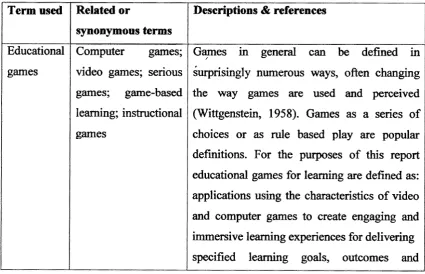
demonstrated in Table 2.1 : Definitions and terms of games, and this is why it will be
increasingly important for those engaged in producing games for learning, such as
games developers and educational content developers including tutors and trainers, to
begin to share some of the same definitions and approaches to the process of games
development and implementation, Stephen Heppell(2006)."
Table 2.1: Definitions and terms of games
Term used
Educational
games
Related or
synonymous terms Computer games;
video games; serious
games; game-based
learning; instructional
games
Descriptions & references
G ~ e s in general can be defined in
surprisingly numerous ways, often changing
the way games are used and perceived
(Wittgenstein, 1958). Games as a series of
choices or as rule based play are popular definitions. For the purposes of this report
educational games for learning are defined as:
applications using the characteristics of video
and computer games to create engaging and
immersive learning experiences for delivering
[image:24.526.63.489.458.732.2]