VOLUME NO.6(2016),ISSUE NO.01(JANUARY) ISSN 2231-5756
A Monthly Double-Blind Peer Reviewed (Refereed/Juried) Open Access International e-Journal - Included in the International Serial Directories Indexed & Listed at:
VOLUME NO.6(2016),ISSUE NO.01(JANUARY) ISSN 2231-5756
INTERNATIONAL JOURNAL OF RESEARCH IN COMMERCE, IT & MANAGEMENT
CONTENTS
Sr.
No.
TITLE & NAME OF THE AUTHOR (S)
Page
No.
1
.
KNOWLEDGE SHARING AND THE PERFORMANCE OF TEACHERS IN KENYA
DR. DANIEL AUKA & ESTHER GATHONI KIARIE
1
2
.
A CRITICAL STUDY OF CONTRIBUTION OF INFORMATION TECHNOLOGY COMPANIES IN STANDARD
OF LIVING OF IT COMPANY EXECUTIVES IN VIDARBHA REGION
ABHAY KIMMATKAR & DR. SHAKIL SATTAR
10
3
.
ROLE OF AWH IN EMPOWERING THE DISABILITIES FOR HIGHER EDUCATION
DR. RASHMIRANI AGNIHOTRI H.R & DR. K.S MALIPATIL
12
4
.
CASH MANAGEMENT IN SMALL SCALE INDUSTRIES
P. VENKATADRI REDDY & DR. HAMPANNA
18
5
.
A STUDY OF HUMAN ASSET VALUATION MODELS IN INDIAN ENTERPRISES
DR. SAMIR M. VOHRA
24
6
.
AN INTUITIVE APPROACH OF SAVINGS AND INVESTMENT PATTERNS OF SELF HELP GROUP WOMEN
M.J.CECILIA SHOBANA & DR. V. K. SOMASUNDARAM
27
7
.
FREIGHT COST OPTIMISATION IN LOGISTICS WITH REFERENCE TO AMARA RAJA BATTERIES LTD.,
TIRUPATHI
C. UMADEVI & DR. P. CHITTI BABU
31
8
.
EFFECTS OF BRAND AWARENESS, BRAND AUGMENTATION ON BRAND PURCHASE INTENTION OF
MOBILE PHONE BRANDS: EMPIRICAL ASSESSMENT FROM KENYA
JOSPHINE CHEPCHIRCHIR & MARK LETING KIPRUTO
45
9
.
MANAGEMENT OF TECHNOLOGY IN BANKS
DR. NEERU CHADHA
50
10
.
B-LOYALTY TO E-LOYALTY IN THE CONTEXT OF E-COMMERCE
P.PHANI BHASKAR & DR. D. PRASANNA KUMAR
56
11
.
CORPORATE SOCIAL RESPONSIBILITY: BEFORE AND AFTER THE NEW COMPANIES ACT
DR. BINDIYA KANSAL & SHARANJIT KAUR
61
12
.
MOTIVATIONAL FACTORS: A STUDY ON WOMEN MICRO ENTREPRENEURS IN TIRUPUR CITY
K.PRABHA KUMARI
65
13
.
KNOWLEDGE PAPER ON SKILL GAP IN BANKING SECTOR IN INDIA
DINESH TANDON
73
14
.
HOUSING LOAN SCHEME: A STUDY ON ICICI HOUSING LOAN BENEFICIARIES IN TENKASI TALUK,
TAMILNADU
A. KENNEDY
76
15
.
PER-CAPITA CONSUMPTION EXPENDITURE AND LABOUR AND CAPITAL INCOME IN INDIA
DARSHINI.J.S
80
16
.
A STUDY OF THE RELATIONSHIP BETWEEN EMOTIONAL INTELLIGENCE AND THE PERFORMANCE: A
CASE STUDY OF MELLI BANK
MEHDI ROUHOLAMINI & SOUDEH KIAIEDRONKOLA
82
17
.
MODERN TECHNOLOGY IN BANKING AND ITS IMPACT ON JOB SATISFACTION
DHARMENDER KUMAR & KAMAL JEET SINGH
87
18
.
A STUDY OF INFRASTRUCTURE AND LOGISTIC SUPPLY PROBLEMS AT AWCs: IN RURAL ICDS BLOCK
(MEHAM) HARYANA
SONIA HOODA & JYOTI SANGWAN
91
19
.
ROLE OF MANUFACTURING SECTOR IN INDIA
KIRAN DEVI
94
20
.
IMPACT OF WORK LIFE BALANCE POLICIES ON THE JOB SATISFACTION OF FEMALE SCHOOL TEACHERS:
A STUDY OF CHITTORGARH DISTRICT, RAJASTHAN
SAHDEEP CHHATRAPATI
97
VOLUME NO.6(2016),ISSUE NO.01(JANUARY) ISSN 2231-5756
CHIEF PATRON
PROF. K. K. AGGARWAL
Chairman, Malaviya National Institute of Technology, Jaipur
(An institute of National Importance & fully funded by Ministry of Human Resource Development, Government of India)
Chancellor, K. R. Mangalam University, Gurgaon
Chancellor, Lingaya’s University, Faridabad
Founder Vice-Chancellor (1998-2008), Guru Gobind Singh Indraprastha University, Delhi
Ex. Pro Vice-Chancellor, Guru Jambheshwar University, Hisar
FOUNDER PATRON
LATE SH. RAM BHAJAN AGGARWAL
Former State Minister for Home & Tourism, Government of Haryana
Former Vice-President, Dadri Education Society, Charkhi Dadri
Former President, Chinar Syntex Ltd. (Textile Mills), Bhiwani
FORMER CO-ORDINATOR
DR. S. GARG
Faculty, Shree Ram Institute of Business & Management, Urjani
ADVISORS
PROF. M. S. SENAM RAJU
Director A. C. D., School of Management Studies, I.G.N.O.U., New Delhi
PROF. M. N. SHARMA
Chairman, M.B.A., Haryana College of Technology & Management, Kaithal
PROF. S. L. MAHANDRU
Principal (Retd.), Maharaja Agrasen College, Jagadhri
EDITOR
PROF. R. K. SHARMA
Professor, Bharti Vidyapeeth University Institute of Management & Research, New Delhi
CO-EDITOR
DR. BHAVET
Faculty, Shree Ram Institute of Engineering & Technology, Urjani
EDITORIAL ADVISORY BOARD
DR. RAJESH MODI
Faculty, Yanbu Industrial College, Kingdom of Saudi Arabia
PROF. SANJIV MITTAL
University School of Management Studies, Guru Gobind Singh I. P. University, Delhi
PROF. ANIL K. SAINI
Chairperson (CRC), Guru Gobind Singh I. P. University, Delhi
DR. SAMBHAVNA
VOLUME NO.6(2016),ISSUE NO.01(JANUARY) ISSN 2231-5756
INTERNATIONAL JOURNAL OF RESEARCH IN COMMERCE, IT & MANAGEMENT
DR. MOHENDER KUMAR GUPTA
Associate Professor, P. J. L. N. Government College, Faridabad
DR. SHIVAKUMAR DEENE
Asst. Professor, Dept. of Commerce, School of Business Studies, Central University of Karnataka, Gulbarga
ASSOCIATE EDITORS
PROF. NAWAB ALI KHAN
Department of Commerce, Aligarh Muslim University, Aligarh, U.P.
PROF. ABHAY BANSAL
Head, Department of I.T., Amity School of Engineering & Technology, Amity University, Noida
PROF. A. SURYANARAYANA
Department of Business Management, Osmania University, Hyderabad
PROF. V. SELVAM
SSL, VIT University, Vellore
DR. PARDEEP AHLAWAT
Associate Professor, Institute of Management Studies & Research, Maharshi Dayanand University, Rohtak
DR. S. TABASSUM SULTANA
Associate Professor, Department of Business Management, Matrusri Institute of P.G. Studies, Hyderabad
SURJEET SINGH
Asst. Professor, Department of Computer Science, G. M. N. (P.G.) College, Ambala Cantt.
FORMER TECHNICAL ADVISOR
AMITA
Faculty, Government M. S., Mohali
FINANCIAL ADVISORS
DICKIN GOYAL
Advocate & Tax Adviser, Panchkula
NEENA
Investment Consultant, Chambaghat, Solan, Himachal Pradesh
LEGAL ADVISORS
JITENDER S. CHAHAL
Advocate, Punjab & Haryana High Court, Chandigarh U.T.
CHANDER BHUSHAN SHARMA
Advocate & Consultant, District Courts, Yamunanagar at Jagadhri
VOLUME NO.6(2016),ISSUE NO.01(JANUARY) ISSN 2231-5756
CALL FOR MANUSCRIPTS
We invite unpublished novel, original, empirical and high quality research work pertaining to recent developments & practices in the areas of Computer Science & Applications; Commerce; Business; Finance; Marketing; Human Resource Management; General Management; Banking; Economics; Tourism Administration & Management; Education; Law; Library & Information Science; Defence & Strategic Studies; Electronic Science; Corporate Governance; Industrial Relations; and emerging paradigms in allied subjects like Accounting; Accounting Information Systems; Accounting Theory & Practice; Auditing; Behavioral Accounting; Behavioral Economics; Corporate Finance; Cost Accounting; Econometrics; Economic Development; Economic History; Financial Institutions & Markets; Financial Services; Fiscal Policy; Government & Non Profit Accounting; Industrial Organization; International Economics & Trade; International Finance; Macro Economics; Micro Economics; Rural Economics; Co-operation; Demography: Development Planning; Development Studies; Applied Economics; Development Economics; Business Economics; Monetary Policy; Public Policy Economics; Real Estate; Regional Economics; Political Science; Continuing Education; Labour Welfare; Philosophy; Psychology; Sociology; Tax Accounting; Advertising & Promotion Management; Management Information Systems (MIS); Business Law; Public Responsibility & Ethics; Communication; Direct Marketing; E-Commerce; Global Business; Health Care Administration; Labour Relations & Human Resource Management; Marketing Research; Marketing Theory & Applications; Non-Profit Organizations; Office Administration/Management; Operations Research/Statistics; Organizational Behavior & Theory; Organizational Development; Production/Operations; International Relations; Human Rights & Duties; Public Administration; Population Studies; Purchasing/Materials Management; Retailing; Sales/Selling; Services; Small Business Entrepreneurship; Strategic Management Policy; Technology/Innovation; Tourism & Hospitality; Transportation Distribution; Algorithms; Artificial Intelligence; Compilers & Translation; Computer Aided Design (CAD); Computer Aided Manufacturing; Computer Graphics; Computer Organization & Architecture; Database Structures & Systems; Discrete Structures; Internet; Management Information Systems; Modeling & Simulation; Neural Systems/Neural Networks; Numerical Analysis/Scientific Computing; Object Oriented Programming; Operating Systems; Programming Languages; Robotics; Symbolic & Formal Logic; Web Design and emerging paradigms in allied subjects.
Anybody can submit the soft copy of unpublished novel; original; empirical and high quality research work/manuscriptanytime in M.S. Word format
after preparing the same as per our GUIDELINES FOR SUBMISSION; at our email address i.e. [email protected] or online by clicking the link online
submission as given on our website (FOR ONLINE SUBMISSION, CLICK HERE).
GUIDELINES FOR SUBMISSION OF MANUSCRIPT
1. COVERING LETTER FOR SUBMISSION:
DATED: _____________
THE EDITOR
IJRCM
Subject: SUBMISSION OF MANUSCRIPT IN THE AREA OF .
(e.g. Finance/Mkt./HRM/General Mgt./Engineering/Economics/Computer/IT/ Education/Psychology/Law/Math/other, please specify)
DEAR SIR/MADAM
Please find my submission of manuscript entitled ‘___________________________________________’ for possible publication in one of your journals.
I hereby affirm that the contents of this manuscript are original. Furthermore, it has neither been published elsewhere in any language fully or partly, nor is it under review for publication elsewhere.
I affirm that all the co-authors of this manuscript have seen the submitted version of the manuscript and have agreed to their inclusion of names as co-authors.
Also, if my/our manuscript is accepted, I agree to comply with the formalities as given on the website of the journal. The Journal has discretion to publish our contribution in any of its journals.
NAME OF CORRESPONDING AUTHOR :
Designation :
Institution/College/University with full address & Pin Code :
Residential address with Pin Code :
Mobile Number (s) with country ISD code :
Is WhatsApp or Viber active on your above noted Mobile Number (Yes/No) :
Landline Number (s) with country ISD code :
E-mail Address :
Alternate E-mail Address :
VOLUME NO.6(2016),ISSUE NO.01(JANUARY) ISSN 2231-5756
INTERNATIONAL JOURNAL OF RESEARCH IN COMMERCE, IT & MANAGEMENT
NOTES:
a) The whole manuscript has to be in ONE MS WORD FILE only, which will start from the covering letter, inside the manuscript. pdf.
version is liable to be rejected without any consideration.
b) The sender is required to mention the following in the SUBJECT COLUMNof the mail:
New Manuscript for Review in the area of (e.g. Finance/Marketing/HRM/General Mgt./Engineering/Economics/Computer/IT/ Education/Psychology/Law/Math/other, please specify)
c) There is no need to give any text in the body of mail, except the cases where the author wishes to give any specific message w.r.t.
to the manuscript.
d) The total size of the file containing the manuscript is expected to be below 1000 KB.
e) Abstract alone will not be considered for review and the author is required to submit the complete manuscript in the first instance.
f) The journal gives acknowledgement w.r.t. the receipt of every email within twenty four hours and in case of non-receipt of
acknowledgment from the journal, w.r.t. the submission of manuscript, within two days of submission, the corresponding author is required to demand for the same by sending a separate mail to the journal.
g) The author (s) name or details should not appear anywhere on the body of the manuscript, except the covering letter and the
cover page of the manuscript, in the manner as mentioned in the guidelines.
2. MANUSCRIPT TITLE: The title of the paper should be bold typed, centeredand fully capitalised.
3. AUTHOR NAME (S) & AFFILIATIONS: Author (s) name, designation, affiliation (s), address, mobile/landline number (s), and
email/alternate email address should be given underneath the title.
4. ACKNOWLEDGMENTS: Acknowledgements can be given to reviewers, guides, funding institutions, etc., if any.
5. ABSTRACT: Abstract should be in fully italicized text, ranging between 150 to 300 words. The abstract must be informative and explain
the background, aims, methods, results & conclusion in a SINGLE PARA. Abbreviations must be mentioned in full.
6. KEYWORDS: Abstract must be followed by a list of keywords, subject to the maximum of five. These should be arranged in alphabetic order separated by commas and full stop at the end. All words of the keywords, including the first one should be in small letters, except special words e.g. name of the Countries, abbreviations.
7. JEL CODE: Provide the appropriate Journal of Economic Literature Classification System code (s). JEL codes are available at www.aeaweb.org/econlit/jelCodes.php, however, mentioning JEL Code is not mandatory.
8. MANUSCRIPT: Manuscript must be in BRITISH ENGLISH prepared on a standard A4 size PORTRAIT SETTING PAPER. It should be free from any errors i.e. grammatical, spelling or punctuation. It must be thoroughly edited at your end.
9. HEADINGS: All the headings must be bold-faced, aligned left and fully capitalised. Leave a blank line before each heading.
10. SUB-HEADINGS: All the sub-headings must be bold-faced, aligned left and fully capitalised.
11. MAIN TEXT:
THE MAIN TEXT SHOULD FOLLOW THE FOLLOWING SEQUENCE:
INTRODUCTION
REVIEW OF LITERATURE
NEED/IMPORTANCE OF THE STUDY
STATEMENT OF THE PROBLEM
OBJECTIVES
HYPOTHESIS (ES)
RESEARCH METHODOLOGY
RESULTS & DISCUSSION
FINDINGS
RECOMMENDATIONS/SUGGESTIONS
CONCLUSIONS
LIMITATIONS
SCOPE FOR FURTHER RESEARCH
REFERENCES
APPENDIX/ANNEXURE
VOLUME NO.6(2016),ISSUE NO.01(JANUARY) ISSN 2231-5756
12. FIGURES & TABLES: These should be simple, crystal CLEAR, centered, separately numbered & self explained, and titles must be above the table/figure. Sources of data should be mentioned below the table/figure. It should be ensured that the tables/figures are referred to from the main text.
13. EQUATIONS/FORMULAE: These should be consecutively numbered in parenthesis, horizontally centered with equation/formulae number placed at the right. The equation editor provided with standard versions of Microsoft Word should be utilised. If any other equation editor is utilised, author must confirm that these equations may be viewed and edited in versions of Microsoft Office that does not have the editor.
14. ACRONYMS: These should not be used in the abstract. The use of acronyms is elsewhere is acceptable. Acronyms should be defined on its first use in each section: Reserve Bank of India (RBI). Acronyms should be redefined on first use in subsequent sections.
15. REFERENCES: The list of all references should be alphabetically arranged. The author (s) should mention only the actually utilised
references in the preparation of manuscript and they are supposed to follow Harvard Style of Referencing. Also check to make sure
that everything that you are including in the reference section is duly cited in the paper. The author (s) are supposed to follow the references as per the following:
•
All works cited in the text (including sources for tables and figures) should be listed alphabetically.•
Use (ed.) for one editor, and (ed.s) for multiple editors.•
When listing two or more works by one author, use --- (20xx), such as after Kohl (1997), use --- (2001), etc, in chronologically ascendingorder.
•
Indicate (opening and closing) page numbers for articles in journals and for chapters in books.•
The title of books and journals should be in italics. Double quotation marks are used for titles of journal articles, book chapters,dissertations, reports, working papers, unpublished material, etc.
•
For titles in a language other than English, provide an English translation in parenthesis.•
Headers, footers, endnotes and footnotes should not be used in the document. However, you can mention short notes to elucidatesome specific point, which may be placed in number orders after the references.
PLEASE USE THE FOLLOWING FOR STYLE AND PUNCTUATION IN REFERENCES:
BOOKS
•
Bowersox, Donald J., Closs, David J., (1996), "Logistical Management." Tata McGraw, Hill, New Delhi.•
Hunker, H.L. and A.J. Wright (1963), "Factors of Industrial Location in Ohio" Ohio State University, Nigeria.CONTRIBUTIONS TO BOOKS
•
Sharma T., Kwatra, G. (2008) Effectiveness of Social Advertising: A Study of Selected Campaigns, Corporate Social Responsibility, Editedby David Crowther & Nicholas Capaldi, Ashgate Research Companion to Corporate Social Responsibility, Chapter 15, pp 287-303.
JOURNAL AND OTHER ARTICLES
•
Schemenner, R.W., Huber, J.C. and Cook, R.L. (1987), "Geographic Differences and the Location of New Manufacturing Facilities,"Journal of Urban Economics, Vol. 21, No. 1, pp. 83-104.
CONFERENCE PAPERS
•
Garg, Sambhav (2011): "Business Ethics" Paper presented at the Annual International Conference for the All India ManagementAssociation, New Delhi, India, 19–23
UNPUBLISHED DISSERTATIONS
•
Kumar S. (2011): "Customer Value: A Comparative Study of Rural and Urban Customers," Thesis, Kurukshetra University, Kurukshetra.ONLINE RESOURCES
•
Always indicate the date that the source was accessed, as online resources are frequently updated or removed.WEBSITES
VOLUME NO.6(2016),ISSUE NO.01(JANUARY) ISSN 2231-5756
INTERNATIONAL JOURNAL OF RESEARCH IN COMMERCE, IT & MANAGEMENT
KNOWLEDGE SHARING AND THE PERFORMANCE OF TEACHERS IN KENYA
DR. DANIEL AUKA
DEAN
FACULTY OF COMMERCE
EGERTON UNIVERSITY
NAKURU
ESTHER GATHONI KIARIE
DIRECTOR (HUMAN RESOURCE)
DEPARTMENT OF BUSINESS ADMINISTRATION
FACULTY OF COMMERCE
EGERTON UNIVERSITY
NAKURU
ABSTRACT
The main purpose of this study is to determine the effect of knowledge sharing on the performance of employees in the Teachers Service Commission in Kenya. It investigated how knowledge sharing influenced the performance of the staff at the commission’s head quarters in Nairobi. To achieve this objective, the study employed descriptive research design on a sample of 323 employees, selected by proportional stratified sampling and simple random sampling to represent the different categories of employees in each department. Questionnaires were used to collect data. collect data. Descriptive statistics (percentages and means) and inferential statistics (step regression and Pearson correlation) were used to analyze the data. Regression analysis determined the effect of the organizational performance, Independent variables which were explicit and implicit knowledge sharing on the dependent variable which was performance of T.S.C employees. The results of the study established that knowledge sharing had a positive but weak effect on performance of employees. Implicit knowledge had more effect on performance than explicit knowledge thus rejecting the hypothesis that there is no significant relationship between knowledge sharing and performance of T.S.C employees. The study recommends organizations to put in place practices that encourage knowledge sharing. It is hoped that the study will help public organizations encourage knowledge sharing practices amongst and between employees for better service delivery and improved performance.
KEYWORDS
knowledge, knowledge sharing, implicit knowledge, explicit knowledge, organizational performance, knowledge management.
INTRODUCTION
nowledge is measured as an enterprise priceless asset (Xu et al 2006).Today’s highly competitive and expanding global economy requires knowledge management functions into their organizations (Wang et al 2006). Sharing and utilization of knowledge are essential for organizational effectiveness (Kogut and Zander 1996, Nonaka and Takeuchi 1995, Tsai 2001).So knowledge sharing and utilization is one of the most important factors in contributing to the business success.
The benefits of knowledge sharing for the organization are very prominent, when knowledge is shared , innovative product and services develop with higher quality, no duplication , customer will be better satisfied etc (Krogh, 1998). Studies of the Knowledge sharing reveal that knowledge sharing is a process of recombination and evolution of knowledge (Lee & Cole, 2003) and the globalization is favoring those organization that are able to create and share knowledge more effectively and efficiently than their competitors (Porter, 1990). So it can be said that Knowledge sharing is related to the long run performance and competiveness.
Basic reason of knowledge sharing is to make easy knowledge shift from one person to another person, to take in the knowledge from outside and then adopt it. It is very necessary for the employees to learn knowledge from experiences gathered by the colleagues in inter and intra departments, internal processes and even from the outside organizations (Madsen, Mosakowski, & Zaheer, 2003).
It is now becoming increasingly evident that people are the ultimate foundations of organizational performance as noted by Shermerhorn (2002). What they know, what they learn, and what they do with it eventually determines organizational performance. They represent an intellectual capital defined as the collective brain power or shared knowledge of a work force that can be used to create value. The ultimate elegance of the new workplace may well be its ability to combine the talents of many people, sometimes thousands of them to achieve unique and significant results. Training and development largely impart to employees the explicit type of knowledge, that is, the operational type of knowledge. This is the know what type of knowledge that can be codified and stored for others to access. Derek et al (2008) however say that most knowledge is more complex than this, it is something which resides in a person’s head and people are often unaware that they know until we come to use it. This is referred to as tacit knowledge or the ‘know how’ type of knowledge. This type of knowledge is made up of our accumulated experiences about how things are done, how problems can be solved, what works and what doesn’t and in what contexts and under what conditions. Knowledge management aims at covering both types of knowledge where employees know what to do and how to do. Newly employed employees are trained on the ‘know what’ type of knowledge and can only learn the ‘‘know how’’ either through experience or getting the same from the more experienced employees. Explicit knowledge can however be written down and shared (Derek et al 2008).
Issues such as downsizing, re-engineering, outsourcing and dejobbing are major reasons why a vast majority of individuals no longer can expect to have career long employment with a single organization. So great has been the staff turn over in some sectors, that there are often few people left within the business who really know how things are done (Derek ,2000).
Some of the most valuable knowledge within a firm is essentially hidden or tacit knowledge residing not in documents or data bases but in the experience and skill of human beings. Although many of the early forays into knowledge management centered on the use of information technology to broaden access to documents and data bases, there is now widespread agreement that much of the highest – value knowledge within an organization is un codified (Horvath A.1999) Gorry (2008) contends that knowledge sharing can help workers improve the quality of public services and successful knowledge sharing needs institutional support and encouragement. Goltschalk (2007) suggests that increases in knowledge sharing will improve resource mobilization, decision making capability, strategic ability and the ability to link implementation elements and in that the Performance of employees continues to improve through knowledge sharing. At the Teachers Service Commission, it is not clear if the various knowledge sharing practices affect performance more so when employees retire or leave the organization.TCS has not conducted any study to that effect despite the many problems facing public organizations.
STATEMENT OF THE PROBLEM
As the explicit and tacit knowledge of employees in an organization often plays decisive roles in solving problems, knowledge sharing between and among those who directly deal with various problems may have a high probability of improving performance in an organization (Yanow ,2004). Gorry (2008) argues that
VOLUME NO.6(2016),ISSUE NO.01(JANUARY) ISSN 2231-5756
knowledge sharing can help public employees improve the quality of public service. Wiig (2002) further elaborates that managing knowledge effectively can have a positive effect on the performance of public service organizations . Ideally, capturing and sharing critical knowledge should be occurring continuously among employees. However, there has been no study at the Teachers‘Service Commission (TSC) on the effect of Knowledge sharing and its performance. Therefore this study sought to establish the relationship between knowledge sharing and performance at the Teachers Service Commission.
OBJECTIVES OF THE STUDY
The study was guided by the following objectives;
1. To determine the effect of explicit knowledge sharing practices on performance
2. To establish the effect of implicit knowledge sharing practices on performance
3. To determine the effect of explicit knowledge sharing and implicit knowledge sharing on performance
HYPOTHESIS
The study tested the following hypotheses
Ho1 : There is no significant relationship between explicit knowledge sharing and performance
Ho2 : There is no significant relationship between implicit knowledge sharing and performance
Ho3: There is no significant relationship between explicit and implicit knowledge sharing and performance
LITERATURE REVIEW
KNOWLEDGE AND KNOWLEDGE SHARING
knowledge-sharing refers to “the use of knowledge databases, best practices conferences, technology, cross-functional teams, emails and social network software etc. to share self-constructed knowledge with colleagues. Knowledge has been defined as the actuality of skillful action and the potentiality of defining a situation so as to permit skillful action (Nonaka and Von Krogan ,2009). Davenport et al (1998) defines knowledge as a high – value form of information that is ready to apply to decisions and actions. Through deep conversations and brainstorming from this sharing process, one’s knowledge will become more inclusive and complete; while the synergistic effect of the accumulation of organizational knowledge assets will be developed during knowledge transfer and sharing”. According to Prat (2006), knowledge is viewed as an evolving mix of framed experience, values, contextual information, and expert insight that provides a framework for evaluating and incorporating new experiences and information”. Knowledge lies in human minds and exists only if there is a human mind to the knowing (Widen-Wulff & Suomi, 2007). Knowledge is a resource or stock in the organization (Coulson-Thomas, 2003) that exist along the organization. Knowledge is valuable, rare, not easy to substitute and difficult to imitate, making it a competitive advantage for the organization. A firm cannot have the same knowledge as the others’ because different firms have different human and knowledge resources (Kim, 2002). No organization can have a total same knowledge.
Knowledge sharing is also defined as the activities of disseminating and transferring knowledge from one person, group, or organization to another (Lee, 2001) requiring the collaboration of individuals and groups for mutual benefits ( Al-Alawi, 2005). Knowledge sharing is a process through which personal and organizational knowledge is exchanged. In the other words, knowledge sharing refers to the process by which knowledge is conveyed from one person to another, from persons to groups, or from one organization to other organization Mostly, effectiveness is depends on how well knowledge is shared between teams, individuals or units (Goodman and Darr 1998, Pentland 1995)
Depending on the degree of explicitness, there exists explicit and tacit knowledge. Nelissen (2002) elaborates that explicit knowledge refers to the knowledge that is expressed by formal techniques. It can be more readily and directly observed, captured, transferred or communicated to others (Cabrera and Cabrera, 2002). Explicit knowledge exists in the form of documents and visual materials.
In contrast, tacit or implicit knowledge which is broadly called local knowledge (Yanow ,2004) is subjective; it refers to practical know – how or intelligence on experimental learning which often is not openly expressed Hayness (2005). Tacit knowledge is knowledge embedded in individuals and is invisible to the outside observe. Explicit knowledge is the type of knowledge that can be easily documented and shaped (Choi and Lee, 2003). It can be created, written down, transferred and followed among the organizational units verbally or through computer programs, patents, diagrams and information technologies (Keskin, 2005; Choi & Lee, 2003). Tacit knowledge is what embedded in the mind (Choi & Lee, 2003), can be expressed through ability applications; is transferred in form of learning by doing and learning by watching
Nonaka (2009) argues that tacit knowledge is a source of competitive advantage for organizations and can be distinguished from explicit knowledge. It is related to the senses, experiences, intuition, unarticulated mental models or implicit rules of thumb. It is not directly expressed or captured in formal ways (Pardo, et al 2006).
Knowledge management as the process through which organizations develop, organize and share knowledge to achieve competitive advantage (Schermerhorn , 2002). Knowledge management requires the creation of sharing, learning and knowledge creation are part of the norm. this requires a special form of leadership that recognizes that intellectual capital is an invaluable asset in this stage of transformation. It is evident that people are the ultimate foundations of organizational performance (Schermerhorn, 2002). What they know, what they learn, and what they do with it, eventually determines organizational culture in which information performance. They represent an intellectual capital defined as the collective brain power or shared knowledge of a workforce that can be used to create value (Pardo et al 2006).
So knowledge sharing is most important processes of knowledge management, which slowly develop and pick up the building block of the system. It means, knowledge sharing has its relationship in long run performance and competitiveness (Rong Du et al 2007).
Knowledge sharing is often used to mean the same thing as knowledge transfer and knowledge management Kang et al (2008). Knowledge sharing is however a broader concept than simple transfer of knowledge, emphasizing the process of or social interaction for knowledge exchange as explained by Grant (1996). Gupta and Govidndarajan (2000) indicate that it is however a narrower concept than knowledge management which includes knowledge creation, transfer and sharing. Jacobson (2006) refers to knowledge sharing as an exchange of knowledge between individuals. Lindsey (2006) defines knowledge sharing as facilitating learning through sharing into usable ideas, products and processes.
Knowledge sharing is defined as an action in which employees diffuse relevant information to others across the organization (Bartol and Srioastava ,2002). Schermerhon (2002) defines knowledge management as the process through which organizations develop competitive advantage. Bock and Kim (2002) assert that knowledge sharing is considered the cornerstone of knowledge management and continue to say that unless individual knowledge is shared throughout the organization, the knowledge will have a limited impact on organizations effect.
KNOWLEDGE SHARING PRACTICES AND LEARNING COMMITMENTS
Nurturing a knowledge sharing culture and establishing the right climate for knowledge sharing is a fundamental issue for successful organizational performance that maintains competitive advantage Hsu (2008). He goes ahead to say that knowledge sharing practices are considered the facilitating factors for improving organizational performance through human capital and learning commitments. Thus knowledge sharing practices play a significant role in improving employees learning abilities, employees’ adaptability and employees’ job satisfaction.
VOLUME NO.6(2016),ISSUE NO.01(JANUARY) ISSN 2231-5756
INTERNATIONAL JOURNAL OF RESEARCH IN COMMERCE, IT & MANAGEMENT
Paulson, et al (2005) argued that when workers control their learning process the competence development is easily provoked. Work tasks are therefore executed smoothly and free of stress. However, the individual learning process is most likely voluntarily rather than compulsory. Thus the biggest challenge is fostering willingness to learn new knowledge and skills within all organizational levels to enhance competitiveness and innovativeness.
EXTRINSIC AND INTRINSIC MOTIVATION AND KNOWLEDGE SHARING
Osterloh and Frey (2000) explain that extrinsic motivation constitutes of incentives for behaving in a certain way based on t he use of a price system. Thus extrinsic motivation can be used to coordinate resources by linking employee’s monetary motive to the goal of the organization Garfield (2006) further says that individuals are said to be intrinsically motivated when they undertake an activity because it satisfies their immediate needs. Intrinsically motivated people are ideally motivated by working with self defined goals and fulfilling tasks. This type of motivation holds advantages of extrinsic motivation in organizational activities which demand creativity and learning on the side of employees Osterloh and Frey (2000).The willingness to take part in knowledge sharing is influenced by various factors according to Osterloh and Weibel (2004). these are; the degree of overlap in the transmitters and receivers knowledge bases, the degree of tacitness of the involved knowledge, the degree of complexity, failure sensitivity, perceived value by both the transmitter and the receiver and the strategic context e.g. exploration. Knowledge whether knowledge sharing takes place in an organization depends to a great extent on individual organizational members, motivation to share or not the knowledge they possess.
CREATING A KNOWLEDGE SHARING CULTURE WITHIN THE ORGANIZATION
Bartol and Srioastava (2002) argue that creating a Knowledge Sharing Culture is about making knowledge sharing the norm. Sharing knowledge is not just sharing information. The purpose of knowledge sharing is to help a whole organization to reach its business goals. It is not sharing for only the benefit of one department. Sharing knowledge is as significant as learning to make knowledge productive. It calls for a change in culture. Prat (2006). The company which wants to create a knowledge sharing culture needs to encourage it staffs to work together more effectively, to collaborate and to share in order to make organizational knowledge more productive. However, Direct and indirect rewards must be put in place to encourage knowledge sharing. Knowledge workers might be financially or admirably rewarded for contributing to knowledge work. However, it might not be true in all cases because it is not possible to make people share their knowledge by only rewarding them. Some employees are motivated by more than just money such as more experiences and knowledge they can gain by themselves during doing knowledge work. Hence it needs to ensure that appropriate rewards are in place (Derek et al 2008).-
Hsu (2008) explains that knowledge sharing behavior can be encouraged when the employees realize that knowledge-sharing is valuable for them. Sharing knowledge helps employee do their jobs more effectively. Moreover, it helps them keep their jobs; helps them in their personal development and career progression; rewards them for getting things done; understand what they know in the whole picture. Expertise learnt and applied in one part of the organization is not leveraged in another continuous innovation process will sustain the competitive advantage in most companies. Knowledge management has to address three key activities: motivating people to share information, developing a system for managing and storing information and motivating people to use the knowledge available to them (Hsu, 2008).
Schermerhorn (2002) indicates that team working is a key factor to not only create knowledge, but also to share knowledge. Team work helps in the creation of knowledge with mutual understanding of deep tacit knowledge based on shared experience together for a long time. Teams are important since they are the microcosms of the organization and the place where different views and perspectives come together and share experiences. Prat (2006) explains that coaching involves more experienced employees in the organization guiding new or less experienced employees through discussions and positive feedback. Managers refer to practical job experiences to develop the critical skills and competencies that the employee needs, and they provide job related opportunities for practice. The managers identify potential role models to employees and explain how high achievers perform so well. Garfield (2006) says that mentoring involves having employee trained on the job and the senior and more experienced employees mentor the newly recruited employees or those earmarked for promotion. Job mentoring is a potent strategy for enabling smooth succession in the office as the older workers gradually leaves the organization. Mentorship is about passing down the wealth of experience by the veteran worker to the younger staff. Mentorship is said to jump start career by enabling the budding staff members to
succeed their seniors with great ease and confidence. The beneficiary is not only the young worker, but also the company through unfelt transition,(Garfield 2006)
Knowledge management has been defined as the process through which organizations develop, organize and share knowledge to achieve competitive advantage. After any staff turnover, the expenses associated with replacing people who have left are high. This ranges from the cost of placing a recruitment advertisement, through the time spent administering and conducting the selection process to expenses required in inducting and training new employees (Armstrong 2006). Training and development largely imparts to employees the explicit type of knowledge, that is the operational type of knowledge. This is the know what type of knowledge that can be codified and stored for others to access. Derek et al, (2008) however says that most knowledge is more complex than this, it is something which resides in a persons head and we are often unaware that we know until we come to use it. This is referred to as tacit knowledge or the ‘know how’ type of knowledge. This type of knowledge is made up of our accumulated experiences about how things are done, how problems can be solved, what works and what doesn’t and in what contexts and under what conditions. Km aims at covering both types of knowledge where employees know what to do and how to do. Newly employed employees are trained on the ‘know what’ type of knowledge and can only learn the ‘‘know how’’ either through experience or getting the same from the more experienced employees. Explicit knowledge can however be written down and shared (Derek et al 2008).
INFORMAL AND FORMAL ORGANIZATIONAL COMMUNICATION STRUCTURE AND KNOWLEDGE SHARING
Schrmerhorn (2010) observes that behind every formal organizational structure, typically lies an informal structure. This is a shadow organization made up of the unofficial but often critical working relationship between organizational members. He goes ahead to say that if the organizational informal structure could be drawn, it would show who talks to who and interacts regularly with whom, regardless of their formal titles and relationships. The lines of the informal structure would cut across levels and move from side to side. They would show people meeting for coffee, in exercise groups, and in friendship cliques.Tsai et al (2007) explains that a tool known as social network analysis is one way of identifying informal structures and their embedded social relationships. Such an analysis typically asks people to identify others, whom they turn to for help most often, and with whom they communicate regularly and who energize and de-energize them. Social networks are then drawn with lines running from person to person according to frequency and type of relationship maintained. The result is an organizational map that shows how a lot of work really gets done in organizations, in contrast to the formal arrangements depicted in organization charts.
Kim and Lee (2006) describes communication as an interpersonal process of sending and receiving symbols with messages attached to them. The communication process can be viewed as a series of questions. “Who? (Sender) “Says what? (Message) “In which way?” (Channel) “to whom” (receiver) “ with what results? (Interpreted meaning). He goes ahead to say that communication is not only about sharing information or being “heard”, it often includes the intent of one party to influence or motivate the other in a desired way.
Another important factor that affects communication is office space design. Schermerhorn, (2010) says that an important but sometimes neglected part of communication involves proxemics, or the use of space. The distance between people conveys varying intentions in terms of intimacy, openness and status in interpersonal communications. According to Garfield (2006) The physical layout of non-verbal communication. Architects and consultants specializing in organizational ecology are helping executives build offices conducive to the intense communication needed in today’s more horizontal organizational designs. Cook & Funsaker (2001) elaborates that the pattern and direction of communication flows have important consequences for both tasks accomplishment and personal satisfaction. Robbins (2007) specifies the various types of communication networks in an organization. He says that in the chain network, communication flows according to the formal chain of command, both downward and upward. The wheel network represents communication flowing between a clearly identifiable and strong leader and others in a work group of team. The leader serves as a hub through whom all communication flows. Finally in the all channel network, communication flows freely among all members of a work team Robbins (2007).
ORGANIZATIONAL PERFORMANCE
VOLUME NO.6(2016),ISSUE NO.01(JANUARY) ISSN 2231-5756
specific public purposes or goals can achieve varying degree of performance or outcomes (Rat Cliffe, et al 2007).According to Kim (2005) strong positive relationships between organizational performance and individual factors such as job satisfaction, organizational commitment, public service motivation and organizational culture exist
Armstrong (2006) agrees that the promotion and development of performance management processes by HR can make an important contribution to knowledge management, by providing for behavioral expectations which are related to knowledge sharing to be defined, and ensuring that actual behaviors are reviewed and, where appropriate, rewarded by financial and non financial or non financial means. Derek et al (2008) further says that performance management reviews can help identify weaknesses and development needs in this aspect and initiate personal development plans which are designed to meet these needs. He goes ahead to say that one starting point for the process could be the cascading of corporate core values for knowledge sharing individuals, so that they understand they understand what they are expected to do to support those core values. Knowledge sharing can be included as an element of a competency framework, and the desired behavior would be spelt out and reviewed (Armstrong 2006).
ORGANIZATIONAL AND INDIVIDUAL LEARNING
Nonaka (2009) notes that organizational learning takes place when people learn collaboratively. It involves accumulating, analyzing and utilizing knowledge resources which contribute to the achievement of business objectives. Knowledge management objectives can make a major contribution to the enhancement of learning in an organization. Practices associated with creating the right environment for sharing knowledge will in particular promote organizational learning by creating a landscape of learning and development opportunities. Learning organizations transfer knowledge quickly and efficiently throughout the organization by means of formal training programs linked to implementation.
Robbins (2007) explains that organizational learning, is based on individual learning, and the significance of knowledge management and the techniques available to support it can be learnt in formal training sessions or monitoring programs designed and facilitated by the hr function. Organizing Workshops and conferences hr can play an important part in knowledge management by setting up and facilitating workshops, conferences, seminars and forums in which members exchange information and ideas, discuss what they have learnt and agree an what use can be made of the knowledge they have acquired. Apart from their value in disseminating knowledge, such gatherings can help to develop an environment in which knowledge sharing is accepted as a natural and continuing activity, Armstrong (2006).Working With I.T, Armstrong (2006) acknowledges that knowledge is neither a preserve of the IT function nor that of HR. the two functions need to work together. IT ensures that knowledge is recorded and made acceptable through means such as the intranet. HR collaborates by providing means for tacit
knowledge to collected and where feasible, codified. To Promoting the Cause,Kang, (2008) But HR can make a major contribution not only in the specific activities
referred to above, but also in generally promoting the cause of knowledge management, emphasizing to senior management at every opportunity the importance of developing a culture in which the significance of knowledge management is recognized.”
KNOWLEDGE SHARING AND PERFORMANCE
Measuring organizational performance is comparing the expected results to actual results, investigating deviations from plans, assessing individual performance and examining progress being made toward meeting the targeted objectives (Hashim, 2007). Knowledge sharing would lead to knowledge accumulation, knowledge dissemination and knowledge acquisition. While there are debates on the importance between explicit and tacit knowledge, sharing this knowledge is ultimately very crucial in the organization.
Knowledge is said to be the main sources of competitive advantage for companies, therefore more and more companies are investing in knowledge and information, making them a knowledge-intensive companies (Stewart 2000). The best part is; knowledge and information can be detached from the physical movement of goods and services.
Operating within KBE, knowledge drives profit for the organizations for capital gain and sustaining competitive advantage (Wickramansinghe, 2005). The knowledge that residing in every corner of Small and Medium Enterprises (SMEs), must be managed effectively in enhancing the organizational performance. Knowledge sharing, which is a component of knowledge management, can help improve performance. Gorry (2008) argues that knowledge sharing can help public employees improve the quality of public services.
Knowledge sharing within individuals can increase performance and competiveness (Nonaka & Takeuchi, 1995). This statement is supported by Lin (2007) and Wang (2009) that effective knowledge sharing among organizational employees is useful to increase the long term sustainable competitive advantage of the organization. Organizations can effectively manage knowledge resources when employees are willing to cooperate with colleagues to contribute knowledge to the firm. This can generate information for decision making (Kearns & Lederer, 2003). New knowledge will indirectly be formed when the previous knowledge is shared through discussion, meetings, and informal conversation (Ho, 2009; Yang, Moon & Rowley, 2009). An organization that promotes employees to contribute knowledge within groups and organizations is likely to generate new ideas and develop new business opportunities, thus facilitating innovation activities (Darroch & McNaughton, 2002).
Organizational knowledge sharing can be the backbone of organizational learning and it brings enormous benefits to an organization (Van Woerkom & Sanders, 2010). These practices have a positive relationship with organizational human capital (employee competencies), which contribute to organizational performance (Hsu, 2008). Organizational performance might be attributed either from growth, product/services, product quality, or organization effectiveness.
Schnelder (2009) argues that knowledge exists in many forms and that co-production through collaboration produces useful new ways of approaching problems, which in turn can help improve performance. In addition, Grant (1996), argues that knowledge sharing can strengthen organizational effectiveness by maximizing the utilization of shared knowledge by members in organizations. Gorry (2008) contends that knowledge sharing can help workers improve the quality of public services and successful knowledge sharing needs institutional support and encouragement. Goltschalk (2007) suggests that increases in knowledge sharing will improve resource mobilization, decision making capability, strategic ability and the ability to link implementation elements.
THEORETICAL FOUNDATION
This study was based on two theories : the knowledge based theory and knowledge conversion theory .The knowledge based theory which focuses on the importance of knowledge as an organizational resource together with the emphasis on the capability of an organization to bring out especially the tacit knowledge from individual to use as an organizational knowledge and to apply such knowledge for the development of organizational performances. In this study, the knowledge based view links the antecedents of the knowledge sharing which related to workers’ collaboration in the organization and related to the design of an organization which is contributed to the knowledge sharing.
The study was also based on knowledge conversion theory (Nonaka,1994) which stipulates that knowledge transfer is a spiral process. The manner in which task information is transferred from one employee to the other and how explicit knowledge is converted to tacit for actualization of tasks and eventually what is seen to be working can now be made explicit is very relevant to knowledge sharing .This process repeat itself as more knowledge created and acquired. Nonaka (1994) argues that there tacit knowledge can be converted to explicit knowledge and explicit knowledge can be converted to tacit knowledge. Nonaka and Takeuchi, (1995) models knowledge conversion and transfer as a spiral process, in which each type of knowledge, tacit or explicit can be converted and the process can be viewed as a continuous learning process.
Nonaka and Takeuchi, (1995) models knowledge conversion and transfer as a spiral process, in which each type of knowledge, tacit or explicit can be converted and the process can be viewed as a continuous learning process.
CONCEPTUAL FRAMEWORK
VOLUME NO.6(2016),ISSUE NO.01(JANUARY) ISSN 2231-5756
INTERNATIONAL JOURNAL OF RESEARCH IN COMMERCE, IT & MANAGEMENT
FIGURE 1
Independent variables Dependent Variable
Source: Field Data (2012)
RESULTS AND DISCUSSION
DEMOGRAPHIC CHARACTERISTICS OF THE RESPONDENTS
This section briefly describes the demographic characteristics of the sampled respondents involved in this study. Such a description is important in providing a clear understanding of the respondents included in the study. The demographic characteristics included, gender, level of education, category of employee and work experience in the organization. Table 1 illustrates the distribution of the sampled employees in accordance to their gender.
TABLE 1: DISTRIBUTION OF TSC EMPLOYEES BY GENDER
Percent Valid Percent Cumulative Percent
Male 166 51.4 51.4 51.4
Female 157 48.6 48.6 100
Total 323 100 100
Source: Field data (2015)
Majority of the sampled employees were males but the disparity between the males and the females was minimal. Males comprised 51.4 % and females comprised 48.6%. The disparity however depicts the general low levels of employment of females compared to males in professional jobs
RESPONDENTS WORK EXPERIENCE
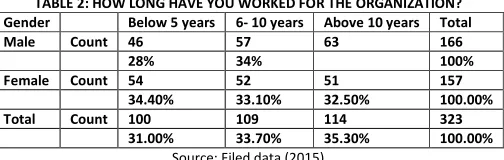
Work experience was looked at as a characteristic that could affect knowledge sharing and performance in an organization. Employees were asked to indicate how long they had worked for the organization. This captured their work experience Table 2 shows the distribution.
TABLE 2: HOW LONG HAVE YOU WORKED FOR THE ORGANIZATION?
Gender Below 5 years 6- 10 years Above 10 years Total
Male Count 46 57 63 166
28% 34% 100%
Female Count 54 52 51 157
34.40% 33.10% 32.50% 100.00%
Total Count 100 109 114 323
31.00% 33.70% 35.30% 100.00%
Source: Filed data (2015)
The table indicates 35.3% of employees have been working with the commission for more than 10 years; those who have worked between 6-10 years were 33.7% with only 31% having worked for below 5 years. This suggests a wide range of work experience. Such a wide range of work experience was critical in enhancing knowledge sharing practices. This findings were in line with Wiig (2002)who observed that the newer employees are still fresh from colleges and other organizations and are very receptive to new ideas while the older employees have the necessary hands on experience to understand the dynamics involved in the performance of tasks.
RESPONDENTS EDUCATION LEVEL
The education level of the employees was also looked at as possible characteristics that could influence knowledge sharing and performance in the organization. Education level captured the employee’s professionalism as a factor that could affect knowledge sharing and performance.
TABLE 3: WHAT IS YOUR HIGHEST EDUCATIONAL LEVEL?
Gender High School Certificate or Equivalent College Certificate Diploma Degree Masters Others Total
Male Count 33 40 52 28 13 0 166
19.90% 24.10% 31.30% 16.90% 7.80% 0.00% 100.00%
Female Count 29 31 56 21 18 2 157
18.50% 19.70% 35.70% 13.40% 11.50% 1.30% 100.00%
Total Count 62 71 108 49 31 2 323
19.20% 22.00% 33.40% 15.20% 9.60% 0.60% 100.00%
Source: Field Data (2015)
Table 3 indicates that 33.4 percent of the employees had a diploma in their respective areas. This was followed by those with a college certificate at 22 %, high school certificate or equivalent at 19.2% , those with degree were 15.2% and masters 9.6 %. This suggests that the sampled employees had sufficient qualifications to undertake their responsibilities and meet the objectives of the organization. Efficiency and effectiveness in the performance of their duties required professionalism.
Explicit Knowledge sharing
- Electronic documents
- Meetings discussions
- Training
Implicit / Tacit Knowledge Sharing
- Mentorship
- Couching
- Personal interactions
Explicit Knowledge sharing
- No. of teacher issues
handled in each department
- Individual Targets
- No. of Teachers visiting H
Correspondence time to Teachers.
Moderator Veriables
- Individual Motivation
- Policies and Rules
VOLUME NO.6(2016),ISSUE NO.01(JANUARY) ISSN 2231-5756
RESPONDENTS CATEGORY
The other individual characteristics looked at was the category of the employees as seen in table 4:
TABLE 4: CATEGORY OF EMPLOYEES
Gender Senior Level Management Middle Level Management Support Staff Total
Male Count 15 42 109 166
% 9.00% 25.30% 65.70% 100.00%
Female Count 17 36 104 157
% 10.80% 22.90% 66.20% 100.00%
Total Count 32 78 213 323
% 9.90% 24.10% 65.90% 100.00%
Source: Field Data (2015)
Table 4 indicates that 65.9% of the employees were support staff, 24.1% were in the middle level management and 9.9% were in senior level management. This suggests that majority of the employees are in the support staff category and so a lot of knowledge sharing could be taking place. These finding were in line with Kim (2005) who observed that the nature of the work handled by the support staff in an organization requires interaction between and among themselves and those in the middle and a senior level management continually.
EFFECT OF EXPLICIT KNOWLEDGE SHARING ON PERFORMANCE
The first objective sought to determine the effect of explicit knowledge sharing on performance at TSC. The objective was based on the fact that sharing explicit knowledge would be expected to result in positive performance by the employees. Several question tapped explicit knowledge sharing. The items tapped the time devoted to, degree of usefulness and access to explicit knowledge by the employees. The survey questions about the degree of usefulness and access of explicit knowledge used a 5 point likert scale; 1 = strongly agree, 2 = agree, 3 = undecided, 4 = disagree, 5 = strongly agree
TABLE 5: PERCEPTION OF EXPLICIT KNOWLEDGE SHARING
Response %
Statement SA A U D SD Mean
I find and share know-how information
and knowledge through paper or electron document 38.4 46.7 9.0 3.4 2.5 4.15
Knowledge and information know-how in paper or
electronic documents helps me handle my work 40.9 47.1 6.5 4.3 1.2 4.22
I can easily access paper or electronic document information
and knowledge that other in my department have 31.3 44.3 11.1 9.6 3.7 3.90
Source: research data 2012
The study findings in table 5 indicate that 38.4% of the respondents strongly agreed that they find and share explicit knowledge. 46.75 agree on the same, 9% were undecided, 3.4% disagreed with 2.5% strongly disagreeing. Also 40.9% strongly agreed that explicit knowledge helped them handle their work.47.15 agreed on the same.6.5% were undecided on the helpfulness of explicit knowledge to them.4.3% disagreed with 1.2% strongly disagreeing. Finally, the study findings reveal that 31.3% strongly agree that they can access explicit knowledge that others in the department have.44.3% agree on the same with 11.1% being undecided on the accessibility.9.6% disagreed that they can easily access explicit knowledge with 3.9% totally disagreeing. On the basis of the statistical means obtained (table 4.3.1) employees agree that they can access and find explicit knowledge useful in their work. table 4.3.2 represents results of explicit knowledge sharing when time spent on explicit knowledge sharing is looked at.
TABLE 6: EXPLICIT KNOWLEDGE SHARING
Mean Standard deviation Mode
Time devoted to explicit knowledge sharing 1.82 .899 1
Usefulness of explicit knowledge sharing 4.21 .873 4
Access of explicit knowledge sharing 4.02 .983 4
Source: Field Data (2015)
The study findings includes the time spent on explicit knowledge sharing, usefulness and access to explicit knowledge sharing. (The order was reversed in the analysis to present the responses more clearly). The question about the time spent on explicit knowledge sharing used a 4 point likert scale; Rarely if ever, once or twice a day, 3-5 times a day and 6 times or more(the order was not reversed). From table 6 the employees reported sharing explicit knowledge rarely. They agreed however that sharing explicit knowledge was useful in dealing their work. The staff agreed that they can easily access explicit knowledge though they use and share rarely. The employees rarely spent time on explicit knowledge sharing.
EFFECT OF IMPLICIT KNOWLEDGE SHARING ON PERFORMANCE
The second objective sought to determine the effect of implicit knowledge sharing on performance of TSC employees. This objective was based on the fact that sharing implicit knowledge would be expected to influence performance positively. Several questions tapped implicit knowledge sharing. The items tapped the times devoted to degree of usefulness and access to implicit knowledge sharing by the employees. This used a 5 point likert scale; 1 = strongly agree 2 = agree, 3 = undecided, 4 = disagree, 5 = strongly disagree (the order was reversed to present the responses more clearly). The question about the time spent on implicit knowledge sharing used a 4 point likert scale; less than once a week, once or twice a week, 4-5 times a week (almost once every day) more than times a week (more than once every day). (the order was not reversed).
TABLE 7: PERCEPTION OF IMPLICIT KNOWLEDGE Response %
Statement SA A U D SD Mean
It is helpful to share task information with Co-workers 35.0 52.9 7.1 3.4 1.2 4.17
I have ample time (chance) to share knowledge With colleagues 22.9 49.5 12.1 12.4 3.1 3.77
I can easily keep in touch with others to Communicate about
their experience knowledge and stories about work 25.1 48.3 14.9 9.3 2.5 3.84
I only share my knowledge when I think its Important 21.7 46.1 13.6 14.6 3.7 3.68
I like to work with others to develop my skills and knowledge 35.3 46.4 11.5 5.9 0.9 4.09
I learn from my colleagues in the department 36.2 44.0 10.5 8.4 0.9 4.06
My colleagues learn a lot from me within our department 30.0 48.9 13.3 7.1 0.6 4.01
Source: Field data (2012)
VOLUME NO.6(2016),ISSUE NO.01(JANUARY) ISSN 2231-5756
INTERNATIONAL JOURNAL OF RESEARCH IN COMMERCE, IT & MANAGEMENT
TABLE 8: IMPLICIT KNOWLEDGE SHARING
Mean Standard Deviation Mode
Time devolved to implicit knowledge sharing 1.72 .657 2
Usefulness of implicit knowledge sharing 4.08 .874 4
Access to implicit knowledge sharing 3.87 .984 4
Source: Field data (2012)
Results in Table 8 shows that on average the employees reported sharing implicit knowledge once or twice a week and they agreed that they had ample time to share implicit knowledge (the order was not reversed). The employees agreed that they share know-how information and knowledge through implicit means. They agreed that sharing implicit knowledge was useful in dealing with their work. The employees agreed that they can easily access implicit knowledge. This was in line with previous studies by Hsu (2008) and Jacobson (2006) which indicated that organizations with a knowledge sharing culture that encourages both formal and informal communication structures encourage employees to share knowledge that enables them to perform their work better.
EFFECT OF EXPLICIT AND IMPLICIT KNOWLEDGE SHARING ON PERFORMANCE
The third objective sought to establish the effect of both explicit and implicit knowledge sharing. This was based on the fact that knowledge is both implicit and explicit and cannot be separated on a clear line. Several questions tapped explicit and implicit knowledge sharing with the items tapping the time devoted to degree of usefulness of explicit and implicit knowledge sharing as well as reported access to explicit and implicit knowledge sharing. The survey questions about the degree of usefulness and access to explicit and implicit knowledge sharing used a 5 point likert scale; 1 = strongly agree, 4 = agree, 3 = undecided, 2 = disagree, 1 = strongly disagree. (The order of responses was reversed in order to clearly represent the results). The question about the time spent in explicit knowledge sharing used a 4 point likert scale; rarely if ever, once or twice a day, 3 – 5 times a day and 6 times or more. The question about the time spent on implicit knowledge sharing used a 4 point likert, less that once a week, once or twice a week, 4-5 times a week and more than 6 times a week. Results from table 4.3.2 and 4.4.2 show that employees share implicit knowledge more than explicit knowledge and they also find explicit knowledge more helpful than explicit knowledge. Accessibility to implicit knowledge sharing was also more than explicit knowledge sharing.
HYPOTHESES TESTING
In order to determine the effect of explicit knowledge sharing and implicit knowledge sharing on performance of Teacher’s Service Commission secretariat staff, the overall index score of various aspects of knowledge sharing were correlated with performance index. The results of correlation analysis are shown in table 8
TABLE 8: CORRELATION ANALYSIS (IMPLICIT)
Performance index Implicit knowledge index Explicit knowledge index
Performance index Pearson Correlation 1 .192(**) .141*
Sig. (2-tailed) .001 .001 .001
N 323 321 321
Implicit knowledge index Pearson Correlation .192 (**) 1 .126*
Sig. (2-tailed) .001 323. .001
N 321 .126* 321
Explicit knowledge index Pearson Correlation
Sig (2-tailed) N .141* .001 323 .001 321 1 .001 321
** Correlation is significant at the 0.001 level (2-tailed).
Ho1: There is no significant relationship between explicit knowledge sharing and performance at T.S.C.
The result showed that explicit knowledge sharing had a positive significant effect on performance (r= 0.141) as indicated in table 8 above. It can therefore be concluded that explicit knowledge sharing has a positive relationship with organizational performance. The hypothesis that there is no significant relationship between explicit knowledge sharing and performance was therefore rejected
Ho2: There is no significant relationship between implicit knowledge sharing and performance at T.S.C.
The study findings indicate that implicit knowledge sharing had a positive effect on performance at (r= 0.192) as shown on table 8 there is a positive but weak relationship between implicit knowledge sharing and performance. The hypothesis that there is no significant relationship between implicit knowledge sharing and performance was therefore not supported.
Ho3:There is no significant relationship between Explicit and implicit knowledge sharing and performance at T.S.C.
In order to determine the influence of the independent variables on the dependent variables, regression analysis was done. To achieve this, the two independent variables; explicit and implicit knowledge sharing were regressed on the overall organizational performance. A stepwise regression was done to determine the effect of knowledge sharing on performance. the results of the step regression analysis are presented below.
TABLE 9: MODEL 2 SUMMARY
Model R R Square Adjusted R Square Std. Error of the Estimate
1 .242 .059 .056 .49934
2 .301 .091 .085 .49155
Regression analysis result in model 1 indicates an r value of 0.037. R square value in model 2 was (0.059) and (0.091) which means the predictor attributes 5.9% and 9.1% variability in the domain. The evident improvement of the second model shows that the addition of implicit and explicit knowledge sharing improves the R square. When comparing the two models, including knowledge sharing improved the ability to explain by 3.8% indicating a variation in performance when
knowledge sharing is factored in.. It can be seen that there is a positive but weak relationship between knowledge sharing and performance.Thus the hypothesis
that there is no significant relationship between Explicit and implicit knowledge sharing and performance at T.S.C is rejected. The remaining larger proportion could be explained by other factors such as remuneration of employees, motivation, empowerment, resources, communication structure and leadership among others which directly affect performance. Performance is a variable that is affected by many factors within and outside the organization as observed by Armstrong (2002).
TABLE 10: REGRESSION COEFFICIENTS
Model Unstandardized Coefficients Standardized Coefficients t Sig.
B Std. Error Beta
1 (Constant) 2.254 .110 20.401 .000
Perception of implicit knowledge sharing index .186 .042 .242 4.462 .000
2 (Constant) 1.536 .240 6.390 .000
Perception of
explicit knowledge index .179 .041 .233 4.349 .000
a Dependent Variable: performance index
VOLUME NO.6(2016),ISSUE NO.01(JANUARY) ISSN 2231-5756
Regression analysis shows implicit knowledge sharing contributed more to performance (β=0.242) followed by explicit knowledge sharing at (β=0.233).
SUMMARY, CONCLUSION AND RECOMMENDATIONS
SUMMARYOn demographic characteristics of the study respondents, the findings revealed that out of the total 323 study respondents, 51.4% were males and 48.6 % were females. 35.3% of the employees had worked for the organization for more than 10 years. 33.4% of the study respondents had a diploma at education level and 65.9