A Monthly Double-Blind Peer Reviewed Refereed Open Access International e-Journal - Included in the International Serial Directories Indexed & Listed at:
Ulrich's Periodicals Directory ©, ProQuest, U.S.A., EBSCO Publishing, U.S.A., Cabell’s Directories of Publishing Opportunities, U.S.A. as well as in Open J-Gage, India [link of the same is duly available at Inflibnet of University Grants Commission (U.G.C.)]
VOLUME NO.2(2012),ISSUE NO.4(APRIL) ISSN2231-5756
CONTENTS
CONTENTS
CONTENTS
CONTENTS
Sr.No.
TITLE & NAME OF THE AUTHOR (S)
Page No.
1. REVISITING TRAINING EVALUATION
SAJEET PRADHAN & DR. RABINDRA KUMAR PRADHAN
1
2. THE INFLUENCE OF AGE ON CONSUMER ACTIVISM
DR. ANTHONY. A. IJEWERE
5
3. AN INVESTIGATION ON EMOTIONAL INTELLIGENCE OF STUDENTS WITH RESPECT TO STUDENT DEVELOPMENT MODEL AND ITS IMPLICATION ON EMOTIONAL LEARNING SYSTEM IN MALAYSIA
DR. VIMALA SANJEEVKUMAR
8
4. DETERMINANTS OF CHILD LABOUR IN AGRICULTURAL PRODUCTION IN OYO STATE-NIGERIA
AJAO, A.O
14
5. ECONOMIC VALUE ADDED VS. ACCOUNTING RESIDUAL INCOME: WHICH ONE IS A BETTER CRITERION FOR MEASUREMENT OF CREATED SHAREHOLDERS VALUE?
MOHAMADREZA ABDOLI, MOHAMADREZA SHURVARZI & AKRAM DAVOODI FAROKHAD
18
6. ACTIVISM AMONG THE NIGERIA CONSUMERS
DR. ANTHONY .A. IJEWERE
23
7. AN EVALUATIVE STUDY OF USE OF HIP HOP ARTISTS IN MOBILE TELECOMMUNICATIONS ADVERTISEMENTS: A STUDY OF AIRTEL SUBSCRIBERS IN SOUTHEASTERN NIGERIA
DR. CHINENYE NWABUEZE & EMMANUEL OKEKE
27
8. TELECOMMUNICATION, TECHNOLOGY & TRAINING (3TS) - A UNIQUE LEARNING MODEL FOR TELCOS
AJAY KR VERMA, SUDHIR WARIER & LRK KRISHNAN
34
9. FUTURE CHALLENGES OF HRM IN CORPORATIONS OF U.K. IN THE GLOBAL VILLAGE CONTEXT
DR. S. P. RATH, DR. BISWAJIT DAS, SATISH JAYARAM & SAMEER DIWANJI
44
10. PROS AND CONS OF BRAND IMAGE BUILDING THROUGH NON MASS MEDIA: A CONCEPTUAL FRAMEWORK WITH SPECIAL REFERENCE TO ORGANISED RETAIL IN INDIA
V.JYOTHIRMAI & DR. R. SIVA RAM PRASAD
47
11. FEEDBACK ON IMPLEMENTATION OF ONLINE PERFORMANCE MANAGEMENT SYSTEM - A MINI MIX MODEL
M. S. R. SESHA GIRI & P. V. SARMA
52
12. PROBLEMS AND PROSPECTS OF SALES PROMOTION IN RURAL MARKETS OF FMCG SECTOR IN INDIA
DR. S. LOURDU INITHA & DR. S. GOVINDARAJU
55
13. FUND GROUPING: A MATHEMATICAL MODEL – PUBLIC AND PRIVATE SECTOR MUTUAL FUNDS IN INDIA
DR. K. P. SIVAKUMAR & DR. S. RAJAMOHAN
60
14. TESTING STATIONARITY OF BETA AND BETA REGRESSION TENDENCIES IN INDIAN STOCK MARKET
DR. BAL KRISHAN & DR. REKHA GUPTA
65
15. AN EVALUATION OF FINANCES OF DEC OF SRI VENKATESWARA UNIVERSITY, TIRUPATI, A.P.
DR. G. VENKATACHALAM & DR. P.MOHAN REDDY
69
16. COMPLIANCE OF POLLUTION CONTROL MEASURES AMONG INDUSTRIAL UNITS OF PUDUCHERRY
S. BALAJI & DR. P. NATARAJAN
74
17. JOB SATISFACTION AMONG TEACHERS
DR. SANDHYA MEHTA
77
18. MODELING AND MEASURING PRICE DISCOVERY IN COMMODITY MARKET
DR. SUYASH N. BHATT
84
19. CORPORATE CARBON DISCLOSURE THROUGH SUSTAINABILITY REPORT - AN INDIAN EXPERIENCE
DR. HEENA SUNIL OZA
90
20. A STUDY ON CONSUMER BEHAVIOR OF MOBILE PHONES FROM UNIVERCELL STORES IN KERALA
J. RAMOLA PREMALATHA, DR. N. SUNDARAM & JIJOY JOSEPH
95
21. THE STOCHASTIC MODELLING AND RELIABILITY ANALYSIS OF A BATTERY PRODUCTION SYSTEM IN AN INDUSTRY
DR. PAWAN KUMAR & ANKUSH BHARTI
98
22. A STUDY OF IMPACT OF E LEARNING ON UNIVERSITY STUDENTS
DR. TUSHAR CHAUDHARI
103
23. EMOTIONAL INTELLIGENCE AMONG COLLEGE STUDENTS
RUKMINI S. & VIJAYA U. PATIL
106
24. BOOTSTRAPPING: STARTING A BUSINESS ON A BUDGET
SHABANA A. MEMON.
111
25. EMPLOYEE ENGAGEMENT WITH SELECTED FACTORS AT BSNL, HYDERABAD- AN EMPIRICAL STUDY
P. LAKSHMI NARAYANAMMA
115
26. MERGERS AND ACQUISITIONS IN INDIAN INFORMATION TECHNOLOGY INDUSTRY AND ITS IMPACT ON SHAREHOLDERS’ WEALTH
JAYANT KALGHATGI
118
27. PLASTIC CARD FRAUDS AND THE COUNTERMEASURES: TOWARDS A SAFER PAYMENT MECHANISM
ANUPAMA SHARMA
122
28. A STUDY ON CAUSES OF JOB STRESS IN THE IT SECTOR OF BANGALORE
SHERIL MICHAEL ALMEIDA
126
29. IMPACT OF TRADITIONAL MEDIA ON JUDICIAL OFFICERS
DR. AMIT KUMAR SINGH & MILI SINGH
129
30. CUSTOMER RELATIONSHIP BUILDING THROUGH SOCIAL NETWORKING WEBSITES
VIKRAM SINGH
133
INTERNATIONAL JOURNAL OF RESEARCH IN COMMERCE, IT & MANAGEMENT
CHIEF PATRON
CHIEF PATRON
CHIEF PATRON
CHIEF PATRON
PROF. K. K. AGGARWAL
Chancellor, Lingaya’s University, Delhi
Founder Vice-Chancellor, Guru Gobind Singh Indraprastha University, Delhi
Ex. Pro Vice-Chancellor, Guru Jambheshwar University, Hisar
PATRON
PATRON
PATRON
PATRON
SH. RAM BHAJAN AGGARWAL
Ex. State Minister for Home & Tourism, Government of Haryana
Vice-President, Dadri Education Society, Charkhi Dadri
President, Chinar Syntex Ltd. (Textile Mills), Bhiwani
CO
CO
CO
CO----ORDINATOR
ORDINATOR
ORDINATOR
ORDINATOR
AMITA
Faculty, Government M. S., Mohali
ADVISORS
ADVISORS
ADVISORS
ADVISORS
DR. PRIYA RANJAN TRIVEDI
Chancellor, The Global Open University, Nagaland
PROF. M. S. SENAM RAJU
Director A. C. D., School of Management Studies, I.G.N.O.U., New Delhi
PROF. M. N. SHARMA
Chairman, M.B.A., Haryana College of Technology & Management, Kaithal
PROF. S. L. MAHANDRU
Principal (Retd.), Maharaja Agrasen College, Jagadhri
EDITOR
EDITOR
EDITOR
EDITOR
PROF. R. K. SHARMA
Professor, Bharti Vidyapeeth University Institute of Management & Research, New Delhi
CO
CO
CO
CO----EDITOR
EDITOR
EDITOR
EDITOR
DR. BHAVET
Faculty, M. M. Institute of Management, Maharishi Markandeshwar University, Mullana, Ambala, Haryana
EDITORIAL ADVISORY BOARD
EDITORIAL ADVISORY BOARD
EDITORIAL ADVISORY BOARD
EDITORIAL ADVISORY BOARD
DR. RAJESH MODI
Faculty, Yanbu Industrial College, Kingdom of Saudi Arabia
PROF. SANJIV MITTAL
University School of Management Studies, Guru Gobind Singh I. P. University, Delhi
PROF. ANIL K. SAINI
Chairperson (CRC), Guru Gobind Singh I. P. University, Delhi
DR. SAMBHAVNA
Faculty, I.I.T.M., Delhi
DR. MOHENDER KUMAR GUPTA
VOLUME NO.2(2012),ISSUE NO.4(APRIL) ISSN2231-5756
DR. SHIVAKUMAR DEENE
Asst. Professor, Dept. of Commerce, School of Business Studies, Central University of Karnataka, Gulbarga
MOHITA
Faculty, Yamuna Institute of Engineering & Technology, Village Gadholi, P. O. Gadhola, Yamunanagar
ASSOCIATE EDITORS
ASSOCIATE EDITORS
ASSOCIATE EDITORS
ASSOCIATE EDITORS
PROF. NAWAB ALI KHAN
Department of Commerce, Aligarh Muslim University, Aligarh, U.P.
PROF. ABHAY BANSAL
Head, Department of Information Technology, Amity School of Engineering & Technology, Amity University, Noida
PROF. A. SURYANARAYANA
Department of Business Management, Osmania University, Hyderabad
DR. ASHOK KUMAR
Head, Department of Electronics, D. A. V. College (Lahore), Ambala City
DR. SAMBHAV GARG
Faculty, M. M. Institute of Management, Maharishi Markandeshwar University, Mullana, Ambala, Haryana
PROF. V. SELVAM
SSL, VIT University, Vellore
DR. PARDEEP AHLAWAT
Reader, Institute of Management Studies & Research, Maharshi Dayanand University, Rohtak
S. TABASSUM SULTANA
Associate Professor, Department of Business Management, Matrusri Institute of P.G. Studies, Hyderabad
SURJEET SINGH
Asst. Professor, Department of Computer Science, G. M. N. (P.G.) College, Ambala Cantt.
TECHNICAL ADVISOR
TECHNICAL ADVISOR
TECHNICAL ADVISOR
TECHNICAL ADVISOR
AMITA
Faculty, Government H. S., Mohali
MOHITA
Faculty, Yamuna Institute of Engineering & Technology, Village Gadholi, P. O. Gadhola, Yamunanagar
FINANCIAL ADVISORS
FINANCIAL ADVISORS
FINANCIAL ADVISORS
FINANCIAL ADVISORS
DICKIN GOYAL
Advocate & Tax Adviser, Panchkula
NEENA
Investment Consultant, Chambaghat, Solan, Himachal Pradesh
LEGAL ADVISORS
LEGAL ADVISORS
LEGAL ADVISORS
LEGAL ADVISORS
JITENDER S. CHAHAL
Advocate, Punjab & Haryana High Court, Chandigarh U.T.
CHANDER BHUSHAN SHARMA
Advocate & Consultant, District Courts, Yamunanagar at Jagadhri
SUPERINTENDENT
SUPERINTENDENT
SUPERINTENDENT
SUPERINTENDENT
SURENDER KUMAR POONIA
INTERNATIONAL JOURNAL OF RESEARCH IN COMMERCE, IT & MANAGEMENT
CALL FOR MANUSCRIPTS
CALL FOR MANUSCRIPTS
CALL FOR MANUSCRIPTS
CALL FOR MANUSCRIPTS
Weinvite unpublished novel, original, empirical and high quality research work pertaining to recent developments & practices in the area of Computer, Business, Finance, Marketing, Human Resource Management, General Management, Banking, Insurance, Corporate Governance and emerging paradigms in allied subjects like Accounting Education; Accounting Information Systems; Accounting Theory & Practice; Auditing; Behavioral Accounting; Behavioral Economics; Corporate Finance; Cost Accounting; Econometrics; Economic Development; Economic History; Financial Institutions & Markets; Financial Services; Fiscal Policy; Government & Non Profit Accounting; Industrial Organization; International Economics & Trade; International Finance; Macro Economics; Micro Economics; Monetary Policy; Portfolio & Security Analysis; Public Policy Economics; Real Estate; Regional Economics; Tax Accounting; Advertising & Promotion Management; Business Education; Management Information Systems (MIS); Business Law, Public Responsibility & Ethics; Communication; Direct Marketing; E-Commerce; Global Business; Health Care Administration; Labor Relations & Human Resource Management; Marketing Research; Marketing Theory & Applications; Non-Profit Organizations; Office Administration/Management; Operations Research/Statistics; Organizational Behavior & Theory; Organizational Development; Production/Operations; Public Administration; Purchasing/Materials Management; Retailing; Sales/Selling; Services; Small Business Entrepreneurship; Strategic Management Policy; Technology/Innovation; Tourism, Hospitality & Leisure; Transportation/Physical Distribution; Algorithms; Artificial Intelligence; Compilers & Translation; Computer Aided Design (CAD); Computer Aided Manufacturing; Computer Graphics; Computer Organization & Architecture; Database Structures & Systems; Digital Logic; Discrete Structures; Internet; Management Information Systems; Modeling & Simulation; Multimedia; Neural Systems/Neural Networks; Numerical Analysis/Scientific Computing; Object Oriented Programming; Operating Systems; Programming Languages; Robotics; Symbolic & Formal Logic and Web Design. The above mentioned tracks are only indicative, and not exhaustive.
Anybody can submit the soft copy of his/her manuscript anytime in M.S. Word format after preparing the same as per our submission guidelines duly available on our website under the heading guidelines for submission, at the email addresses: [email protected]or [email protected].
GUIDELINES FOR SUBMISSION OF MANUSCRIPT
GUIDELINES FOR SUBMISSION OF MANUSCRIPT
GUIDELINES FOR SUBMISSION OF MANUSCRIPT
GUIDELINES FOR SUBMISSION OF MANUSCRIPT
1. COVERING LETTER FOR SUBMISSION:
DATED: _____________ THE EDITOR
IJRCM
Subject: SUBMISSION OF MANUSCRIPT IN THE AREA OF .
(e.g. Finance/Marketing/HRM/General Management/Economics/Psychology/Law/Computer/IT/Engineering/Mathematics/other, please specify)
DEAR SIR/MADAM
Please find my submission of manuscript entitled ‘___________________________________________’ for possible publication in your journals.
I hereby affirm that the contents of this manuscript are original. Furthermore, it has neither been published elsewhere in any language fully or partly, nor is it under review for publication elsewhere.
I affirm that all the author (s) have seen and agreed to the submitted version of the manuscript and their inclusion of name (s) as co-author (s).
Also, if my/our manuscript is accepted, I/We agree to comply with the formalities as given on the website of the journal & you are free to publish our contribution in any of your journals.
NAME OF CORRESPONDING AUTHOR: Designation:
Affiliation with full address, contact numbers & Pin Code: Residential address with Pin Code:
Mobile Number (s): Landline Number (s): E-mail Address: Alternate E-mail Address:
NOTES:
a) The whole manuscript is required to be in ONE MS WORD FILE only (pdf. version is liable to be rejected without any consideration), which will start from
the covering letter, inside the manuscript.
b) The sender is required to mention the following in the SUBJECT COLUMN of the mail:
New Manuscript for Review in the area of (Finance/Marketing/HRM/General Management/Economics/Psychology/Law/Computer/IT/ Engineering/Mathematics/other, please specify)
c) There is no need to give any text in the body of mail, except the cases where the author wishes to give any specific message w.r.t. to the manuscript. d) The total size of the file containing the manuscript is required to be below 500 KB.
e) Abstract alone will not be considered for review, and the author is required to submit the complete manuscript in the first instance.
f) The journal gives acknowledgement w.r.t. the receipt of every email and in case of non-receipt of acknowledgment from the journal, w.r.t. the submission
of manuscript, within two days of submission, the corresponding author is required to demand for the same by sending separate mail to the journal.
2. MANUSCRIPT TITLE: The title of the paper should be in a 12 point Calibri Font. It should be bold typed, centered and fully capitalised.
3. AUTHOR NAME (S) & AFFILIATIONS: The author (s) full name, designation, affiliation (s), address, mobile/landline numbers, and email/alternate email address should be in italic & 11-point Calibri Font. It must be centered underneath the title.
VOLUME NO.2(2012),ISSUE NO.4(APRIL) ISSN2231-5756
5. KEYWORDS: Abstract must be followed by a list of keywords, subject to the maximum of five. These should be arranged in alphabetic order separated by commas and full stops at the end.
6. MANUSCRIPT: Manuscript must be in BRITISH ENGLISH prepared on a standard A4 size PORTRAIT SETTING PAPER. It must be prepared on a single space and single column with 1” margin set for top, bottom, left and right. It should be typed in 8 point Calibri Font with page numbers at the bottom and centre of every page. It should be free from grammatical, spelling and punctuation errors and must be thoroughly edited.
7. HEADINGS: All the headings should be in a 10 point Calibri Font. These must be bold-faced, aligned left and fully capitalised. Leave a blank line before each heading.
8. SUB-HEADINGS: All the sub-headings should be in a 8 point Calibri Font. These must be bold-faced, aligned left and fully capitalised.
9. MAIN TEXT: The main text should follow the following sequence:
INTRODUCTION
REVIEW OF LITERATURE
NEED/IMPORTANCE OF THE STUDY
STATEMENT OF THE PROBLEM
OBJECTIVES
HYPOTHESES
RESEARCH METHODOLOGY
RESULTS & DISCUSSION
FINDINGS
RECOMMENDATIONS/SUGGESTIONS
CONCLUSIONS
SCOPE FOR FURTHER RESEARCH
ACKNOWLEDGMENTS
REFERENCES
APPENDIX/ANNEXURE
It should be in a 8 point Calibri Font, single spaced and justified. The manuscript should preferably not exceed 5000 WORDS.
10. FIGURES &TABLES: These should be simple, crystal clear, centered, separately numbered & self explained, and titles must be above the table/figure. Sources of data should be mentioned below the table/figure. It should be ensured that the tables/figures are referred to from the main text.
11. EQUATIONS: These should be consecutively numbered in parentheses, horizontally centered with equation number placed at the right.
12. REFERENCES: The list of all references should be alphabetically arranged. The author (s) should mention only the actually utilised references in the preparation of manuscript and they are supposed to follow Harvard Style of Referencing. The author (s) are supposed to follow the references as per the following:
•
All works cited in the text (including sources for tables and figures) should be listed alphabetically.•
Use (ed.) for one editor, and (ed.s) for multiple editors.•
When listing two or more works by one author, use --- (20xx), such as after Kohl (1997), use --- (2001), etc, in chronologically ascending order.•
Indicate (opening and closing) page numbers for articles in journals and for chapters in books.•
The title of books and journals should be in italics. Double quotation marks are used for titles of journal articles, book chapters, dissertations, reports, workingpapers, unpublished material, etc.
•
For titles in a language other than English, provide an English translation in parentheses.•
The location of endnotes within the text should be indicated by superscript numbers.PLEASE USE THE FOLLOWING FOR STYLE AND PUNCTUATION IN REFERENCES: BOOKS
•
Bowersox, Donald J., Closs, David J., (1996), "Logistical Management." Tata McGraw, Hill, New Delhi.•
Hunker, H.L. and A.J. Wright (1963), "Factors of Industrial Location in Ohio" Ohio State University, Nigeria.CONTRIBUTIONS TO BOOKS
•
Sharma T., Kwatra, G. (2008) Effectiveness of Social Advertising: A Study of Selected Campaigns, Corporate Social Responsibility, Edited by David Crowther &Nicholas Capaldi, Ashgate Research Companion to Corporate Social Responsibility, Chapter 15, pp 287-303.
JOURNAL AND OTHER ARTICLES
•
Schemenner, R.W., Huber, J.C. and Cook, R.L. (1987), "Geographic Differences and the Location of New Manufacturing Facilities," Journal of Urban Economics,Vol. 21, No. 1, pp. 83-104.
CONFERENCE PAPERS
•
Garg, Sambhav (2011): "Business Ethics" Paper presented at the Annual International Conference for the All India Management Association, New Delhi, India,19–22 June.
UNPUBLISHED DISSERTATIONS AND THESES
•
Kumar S. (2011): "Customer Value: A Comparative Study of Rural and Urban Customers," Thesis, Kurukshetra University, Kurukshetra.ONLINE RESOURCES
•
Always indicate the date that the source was accessed, as online resources are frequently updated or removed.WEBSITE
INTERNATIONAL JOURNAL OF RESEARCH IN COMMERCE, IT & MANAGEMENT
A STUDY OF IMPACT OF E LEARNING ON UNIVERSITY STUDENTS
DR. TUSHAR CHAUDHARI
ASST. PROFESSOR
SETH KESARIMAL PORWAL COLLEGE
KAMPTEE
ABSTRACT
With the help of e-learning students can update their knowledge with all the latest happing of their subject. E learning avails students the option of selecting learning materials that meets their level of knowledge and interest also students can study wherever they have access to a computer and Internet. With so many advantage of e- learning it is in demand. But not many students are aware of this technology tool which has hampered their academic growth. This paper has tried to study the concept of e-learning, knowledge of studied students about e-learning. What kinds of facilities are available to university students for e- learning at their college campus. Further the attempt has been made whether E – learning depends on branch of study of students and their career plans.
KEYWORDS
Branch of Study, Career plans, E- Learning.
INTRODUCTION
echnology can help students learn more effectively and can improve their efficiency. E- Learning is the best technology tool which can improve students in all spheres of their life. Many students will already be used to accessing information via mobile phones and the web. E-learning engages younger students and can help faculties meet the needs of students’ with various varied learning styles.
E Learning is the need of hour. The university education can only give theoretical approach of various subjects. Successfully completing online or computer-based courses builds self-knowledge and self-confidence and encourages students to take responsibility for their learning. So sincere effort must be made to promote e- learning and thus try to simplify the process of e- learning as quickly and efficiently as possible.
LITERATURE REVIEW
Challenges of E- Learining by Vasaanthi Vasudev, The Hindu, Tuesday, September 18, 2001
The use of technology in education is highly positive but the caveat is to avoid falling through the looking glass. The true challenge is for education to freeze a model that captures quality and computer technology into an integrated communication system. Such a bled will zoom educational goals to dazzling heights of sublimity. If we bear the key idea in our mind that the true power of educational technology comes not from replicating things that can be done in other ways, but when required , do things that could not be done without it, we realize that most of our concerns are resolved. Technology is no doubt the revitalizing antidote for a stagnating educational system, but the ideal situation would be a judicious blend that optimizes the advantage of both the traditional and telematic educational system.
E- Learning helps Strengthen Education , by R. Rajalaksmi, Director of Software Technology Parks of India (STPI), The Hindu Wednesday, Oct 26, 2005, Namakkal
The Union Government is encouraging e-learning particularly to benefit the people in rural areas , Director of Software Technology Parks of India (STPI) R. Rajalakshmi said, she was delivering the keynote address at the inaugural of the two day International Conference on e- learning organized jointly by the PGP college of Engineering and Technology (PGPCET) and the University of West Bohmia, Chez Republic and supported by the STPI here on Tuesday. She said that the Government was keen on providing computer literacy to the rural people. Already countries such as Singapore, Japan and Indonesia were making a lot of progress in e-learning.
E-Learning in India – E- Learning Asia Day Presentation By Dr. Sanjaya Mishra (http://www.wikieducator.org/user:Missan)
In Technology – Over 20 Billion USD software exports to over 100 countries in the world- market share above 20% software development world wide- one third
of e- commerce telephone subscribers added every year. Mobile Subscribers: 233.6 million (sept 2008)- Internet Users : 42 million (3.7% only). Higher Education
in India 2006 – Central Universities: 20-State Universities: 217- Deemed to be Universities: 106 – Private Universities: 10-institutes of National importance: 13- institutes established under act: 5- colleges: 17625.
Copparapu S.H.N Murthy, Amity School of Communication, Amity University, Noida UP, India
While the conventional education system with different forms of E-learning and rigid academic instructive curriculum could not bring desired changes in specific timeframe, work at the rural level in the targeted communities and groups, a multiprongned sociological approach with sociable and flexible curriculum in e-learning programs becomes the need of hour. The impact of socializing influence of these E-e-learning programs should be properly exploited to motivate and inspire the rural target groups. The benefits of E-Learning then becomes extensive and soon integrates with the needs of lower starta of the society in order for achieving a rapid social transformation in the lives of the framers, vocational groups, artisans and small income self help groups comprising of women, girls and physically challenged people. The paper suggests a number of new generation E-Learning programs as strategies of development communication with a promise of high returns for the industry for its investment in these programs with socially relevant message and media convergence.
NEED OF STUDY
With the globalization whole world has become a small house. To days education needs to be more flexible and industry oriented. The latest tools like internet, audio – video equipments have reformulated whole education system. If student wants the competitive edge over his subordinates, he must be familiar with all the latest happening in his field and in general world. With the help of e-learning student particularly at university level can learn new values that too at very cost effective rate.
So with ever increasing importance of e- learning there is a need to motivate university students towards e- learning. This paper has made an attempt to study how university students are using e-learning and what impact it had on them.
OBJECTIVES OF THE STUDY
1) To study the concept of e-learning
2) To study the students knowledge about e –learning.
3) To find out whether the students are using e- journals and e-books.
4) To study the various tools of e –learning available for university students in selected study area.
HYPOTHESIS OF STUDY
Ho1: E learning use does not depend on the Branch of study of students. Ho2: E learning use does not depend upon career plans of the students.
VOLUME NO.2(2012),ISSUE NO.4(APRIL) ISSN2231-5756
LIMITATIONS OF STUDY
1) The study is conducted in Nagpur city.
E LEARNING
E-learning is essentially the computer and network-enabled transfer of skills and knowledge. E-learning applications and processes include Web-based learning, computer-based learning, virtual education opportunities and digital collaboration. Content is delivered via the Internet, intranet/extranet, audio or video tape, satellite TV, and CD-ROM. E-learning comprises all forms of electronically supported learning and teaching. The information and communication systems, whether networked learning or not, serve as specific media to implement the learning process. The term will still most likely be utilized to reference out-of-classroom and in-out-of-classroom educational experiences via technology, even as advances continue in regard to devices and curriculum. With e- learning Class work can be scheduled around personal and professional work. This will in turn reduce travel cost and time to and from colleges. E-learning is essentially the computer and network-enabled transfer of skills and knowledge.
DEFINITION
E-Learning is content and instructional methods delivered on a computer (whether on CDROM, the Internet, or an intranet), and designed to build knowledge and skills related to individual or organizational goals.
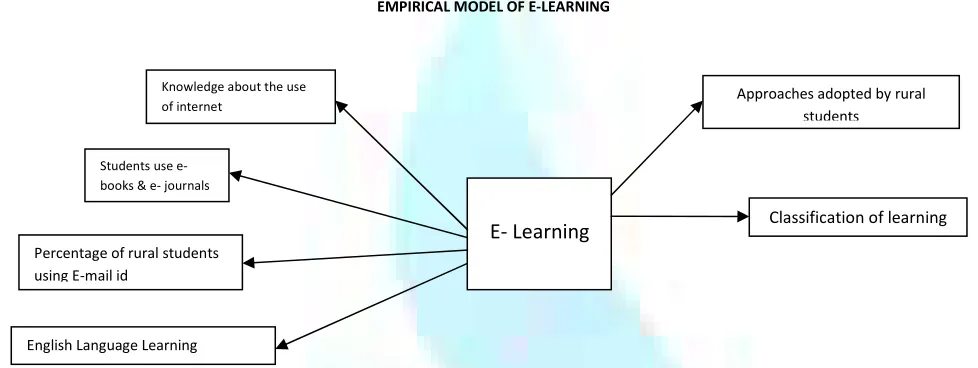
EMPIRICAL MODEL OF E-LEARNING
Source:- Eugene I. Pradeepkumar-J, Dr. N. Panchanatham , Amazing impact of E-Learning Education in rural India, Prabandhan, Indian Journal of Management, Volume 4,number 5, May 2011, p 43-49
RESEARCH METHODOLOGY
The data was collected from both the sources i.e. primary and secondary. For primary data collection non probability convenient sampling was used. The primary data was collected from 20 students each from commerce, Arts, Science and Engineering streams. All these students belong to the colleges of Nagpur city. The questionnaire was filled from these students through personal meeting, mail and by telephonic communication. The secondary data was collected from various books, news papers and online journals.
DATA ANALYSIS
The data collected were converted with suitable tables for the purpose of analysis. Whenever necessary simple averages and statistical tools like Chi-square techniques were adapted to analyses the data. Chi-Square formula is useful technique to identify the influence of dependent variables. The Formula used is 2= ∑(O-E)2/E. where o is observed frequency and E is expected frequency.
TABLE - 1: DEMOGRAPHIC CHARACTERSTICS OF RESPONDENGS
Categories Count Percentage
Class UG 63 78.75
PG 17 21.25
Use of Email id ARTS 06 30
COMMERCE 14 70
SCIENCE 17 85
ENGINEERING 18 90
Knowledge of E- learning ARTS 05 25
COMMERCE 14 70
SCIENCE 16 80
ENGINEERING 19 95
E- Learning Facilities available at College ARTS 02 10
COMMERCE 09 45
SCIENCE 14 70
ENGINEERING 18 90
Various E- learning facilities available Virtual Classroom 56 56
Audio Video Conference 32 32
Instant Messaging 02 02
Internet Facility 10 10
E- Learning
Approaches adopted by rural students
Classification of learning
Knowledge about the use of internet
Students use e- books & e- journals
Percentage of rural students using E-mail id
INTERNATIONAL JOURNAL OF RESEARCH IN COMMERCE, IT & MANAGEMENT
CALCULATIONS AND SUMMARY
Sr no Factors Degree of freedom Table Value 2 Value Result
1 Gender 02 5.99 1.44 NS
2 Branch of Study 04 9.49 10.69 S
3 Medium of instruction 03# 7.82 12.36 S
4 Career Plans 04## 9.49 25.65 S
5 Parents income 04### 9.49 11.35 S
S= significant NS= Not significant # Medium of Instruction: - English, Marathi and Hindi
##Government Jobs, Private Jobs, Entrepreneurship, not decided ### 0-10,000; 10,000-20,000; 20,000; 30,000; 30,000 and above
TESTING OF HYPOTHESIS
1) Null Hypothesis Ho1:- E learning use does not depend on the Branch of study of students:-
Analysis table shows that table value of chi square test of effect on branch of study on e learning is 9.49 while chi square value is 10.69. The table value is less than calculated value. Hence hypothesis is wrong. Therefore there is association in the given subject. Hence E learning use does depend on the Branch of study of students.
2) Null Hypothesis Ho2: E learning use does not depend upon career plans of the students.
Analysis table shows that table value of chi square test of effect on branch of study on e learning is 9.49 while chi square value is 25.65. The table value is less than calculated value. Hence hypothesis is wrong. Therefore there is association in the given subject. Hence E learning use does depend on the career plans of students.
FINDINGS
1) Knowledge about internet: - out of studied students 25% of arts students have knowledge about internet. 70% of commerce students have knowledge about internet. 80% of science students have knowledge about internet. While in engineering percentage goes to 95%.
2) E- Learning facilities available at college:- 10% of studied have agreed that they have e – learning facility available for them in college. 45% of studied commerce student have agreed that they have E- Learning facility available for them. 70% of science students have confirmed that they have e learning facility. While 90% of Engineering students have told that they are benefited from e learning facility in their college premises
3) E- Learning facilities available: - when asked to eighty students about E – learning facilities available to them 56% students told that they are having virtual class room available to them. 32% have said that audio video classroom is available to them. 2% have confirmed that instant messaging services are available to them. While 10 % have said that internet facility is available to them.
4) Students using E- mail: - 20 % of arts students were having E –mail id. 70% of Commerce students are having e mail id. 85 % of science students were having E mail ID. While the engineering students are having Max. Percentage i.e. 90 when it comes to using E- mail id for communication.
5) Out of 80 respondents 63 students are from UG courses while 17 students are from PG courses.
CONCLUSION & RECOMMENDATIONS
Nagpur is one of the developing cities of India. Being situated in central portion of India this city has emerged as new educational hub of Maharashtra after Pune and Mumbai. The city is mushroomed with all kinds of colleges and deemed universities which are trying their level best to give quality education to the students. For providing quality education to the students all the colleges are trying to adopt e learning tools. This has given them competitive edge over their competitors. The arts, commerce science colleges are seem to more reluctant in using e learning. Engineering colleges comes under technical based education. These colleges because of AICTE rules and regulations are keener to adopt e-learning tools. So similar efforts must be made by UGC also to promote e learning. Also all e learning tools are in English many students were found wanted in e learning. So effort must be made to improve English of students through e learning so that it will create interest among students and will promote e-learning. The faculties on the same side must be aware of e-learning tools. So the training workshop must be held at university level to get faculties familiar with e-learning. Lastly, some assignments based on e learning should be included in university curriculum.
REFERENCES
1. “E-Learning helps strengthen education” by Director of Software Technology Parks of India (STPI) R. Rajalakshmi said. The Hindu , Wednesday , Oct 26,
2005
2. “Rural students grasp English” by K. Subramanian. The Hindu – Saturday, April 19, 2008
3. National meet on computer education in schools – The Hindu Wednesday , Sept 08, 2004
4. Sherry, L. 1996 Issues in Distance Education? International Journal of Educational Telecommunications pp 337-365
5. Achieving learning outcomes by David Croom and Alan nelson. HRM review, Volume 2, no. 10 October 2002 page no 53-56.
6. Getting it right with e learning by Binodkumar rao & Gunmala Suri. Indian Management July 2005 page no. 61-66.
7. E – Learning: The Future of Indian Education System by Neeru Maheshwari and NV Murlidhar rao. HRM review. The ICFAI press 2004, page no. 63-67
8. The Future of e- learning by Joanne Childs. The HRM Review. The ICFAI press. February 2002, page no. 44-48.
9. Challenges of e-learning by Vasanthi Vasudev. The Hindu , Tuesday , September 8, 2201
WEBSITES
10. www.en.wikipedia.org/wiki/E-learning
11. www.elearning-india.com
12. www.about-elearning.com
13. www.e-learningconsulting.com
VOLUME NO.2(2012),ISSUE NO.4(APRIL) ISSN2231-5756
REQUEST FOR FEEDBACK
Dear Readers
At the very outset, International Journal of Research in Commerce, IT and Management (IJRCM)
acknowledges & appreciates your efforts in showing interest in our present issue under your kind perusal.
I would like to request you to supply your critical comments and suggestions about the material published
in this issue as well as on the journal as a whole, on our E-mails i.e.
or
for further improvements in the interest of research.
If you have any queries please feel free to contact us on our E-mail
.
I am sure that your feedback and deliberations would make future issues better – a result of our joint
effort.
Looking forward an appropriate consideration.
With sincere regards
Thanking you profoundly
Academically yours
Sd/-