Http://www.ijetmr.com©International Journal of Engineering Technologies and Management Research [41]
STRUCTURAL ANALYSIS OF SEMANTIC RELATIONS REGARDING
INTEGRATION AND ASSOCIATION OF SEMANTIC NETWORK IN
VOCBENCH AS AN AGRICULTURAL ONTOLOGY
Maziar Amirhosseini *1, Juhana Salim 2
*1 Agricultural Research, Education and Extension Organization (AREEO), Yaman Ave.,
Chamran Highway, Garden of Agriculture, Tehran, Iran
2 Faculty of Information Science and Technology and Centre for Collaborative Innovation,
Universiti Kebangsaan Malaysia, 43600 UKM, Bangi Selangor, Malaysia
Abstract:
The purpose of this article is to analyze semantic relations based on graph-independent structural analysis in VocBench. The mix-method of deductive and inductive approach is adapted in operating the research methodology, especially for data collection. The research data are structural domains of semantic relations in ontologies. The data resource is the authoritative agricultural ontology, VocBench, that has been originated by Food and Agricultural organization (FAO), United Nation. VocBench includes around 40000 concepts. The sample size is around 1500 concepts. Sampling technique used is the stratified random sampling. The data analysis results are employed in the SPSS and Excel software using descriptive and proportional analysis. The research results reveal that the taxonomic relations cover a wide area in VocBench. Moreover, the overloading was not seen in the usage of non-taxonomic relations. The high frequency in the usage of the semantic relations’ output might be implied the possibility of the width (i.e., exhaustivity) in semantic network in VocBench.
Keywords: Ontology Evaluation; Structural Analysis; Semantic Relations; Integration Ratio;
Relativeness Ratio; Agricultural Ontology; Vocbench.
Cite This Article:Maziar Amirhosseini, and Juhana Salim. (2019). “STRUCTURAL ANALYSIS
OF SEMANTIC RELATIONS REGARDING INTEGRATION AND ASSOCIATION OF SEMANTIC NETWORK IN VOCBENCH AS AN AGRICULTURAL ONTOLOGY.”
International Journal of Engineering Technologies and Management Research, 6(5), 41-57. DOI: https://doi.org/10.29121/ijetmr.v6.i5.2019.371.
1. Introduction
Http://www.ijetmr.com©International Journal of Engineering Technologies and Management Research [42]
is called OntoAbsolute [10] should be supported by theoretical notions [11] to precisely show a whole picture about the graph-independent structural domains. OntoAbsolute, in fact, presents a quantitative evaluation methods and measures to evaluate structural domains.
This article attempts to operate this novel branch in analyzing the graph-independent structural domains with regarding to semantic relations. The purpose of this article, in fact, is to analyze semantic relations based on graph-independent structural analysis in VocBench. The mix-method of deductive and inductive approach is adapted in operating the research methodology, especially for data collection. The data resource is the authoritative agricultural ontology which is VocBench that was originated by Food and Agricultural organization (FAO), United Nation. VocBench includes around 40000 concepts. Sample size for 40000 concepts with 95% confidence interval within plus or minus 2.5% is around 1500 concepts based on Krejcie and Morgan [12]. The sampling technique used was stratified random sampling. The data analysis results were employed in the SPSS (release 19.0) and Excel software to extract proportional and descriptive statistics.
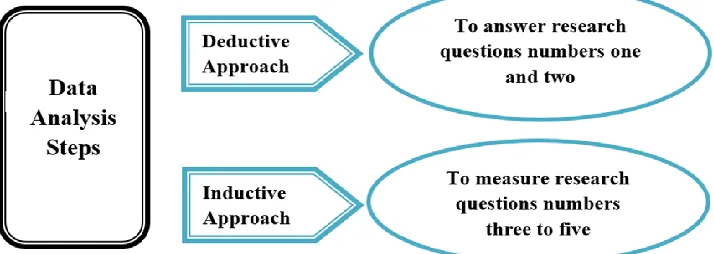
Data analysis is divided into two main steps based on our approach in research methodology, deductive and inductive approach in analyzing semantic relations in VocBench. Firstly, we began to recognize structural domains in ontologies. This recognition results in identifying research data, proposing novel indices, reaching general knowledge, answering the research questions one and two based on deductive approach. When the structural domain has been identified via our deductive approach, the second step will be started in answering research questions three to five in achieving specific and depth knowledge in identifying the domains of the various kinds of semantic relations. Consequently, data analysis has two main steps to answer the research questions in the form of the deductive approach and inductive approach in identifying graph-independent structural domains in semantic relations in VocBench.
As stated previously, the research purpose in this article is to analyze semantic relations based on graph-independent structural analysis in VocBench. This main purpose can be divided in to the following objectives:
• To understand the semantic network integration in identifying the domain of taxonomic
relations in ontologies.
• To examine the association between concepts in clarifying the domain of non-taxonomic
relations in ontologies.
• To measure the amount of the various kinds of semantic relations
• To compare between the domains of taxonomic and non-taxonomic relations’ input and
output.
• To compare between the domains of semantic relations’ input and output.
1.1.Research Questions
Http://www.ijetmr.com©International Journal of Engineering Technologies and Management Research [43]
relations through descriptive analysis based on inductive approach. The research questions are listed below:
1) What can we understand from investigating the semantic network integration in identifying
the domain of taxonomic relations in ontologies?
2) What could we recognize by examining the association between concepts in clarifying the
domain of non-taxonomic relations in ontologies?
3) What can we detect in measuring the amount of the various kinds of semantic relations?
4) What can we realize by comparing between the domains of taxonomic and non-taxonomic
relations’ input and output?
5) What can we recognize in comparing between the domains of semantic relations’ input and
output?
1.2.Ontology Evaluation Dimensions
Ontology evaluation is the imperative issue in the field of ontology engineering [13]. In this sense, we can identify three main types of approaches on issues in ontology evaluation: structural, functional, and usability issues [1]. The most of the literature on ontology evaluation have covered the function and usability of ontologies, instead of structural analysis [14]. In spite of the limited application of structural analysis in the process of ontology evaluation, the structural analysis plays a vital position in evaluating ontology structure [15, 16] to identify the structure of concepts [17] and in terms of the relationships among concepts [18] where entities are represented as nodes [19].
The structural dimensions are represented as a graph in ontology evaluation [1] based on Conceptual Graph (CG) [2] or Conceptual Graph Theory [3]. Graphs are labeled with two types of nodes that are concepts relation nodes [3]. This idea has been further developed by Sowa [20, 21] and have been more formalized by Chein and Mugnier [22] and Corbett [23, 24]. Moreover, ontology evaluators have relied on hierarchical taxonomy [25] instead of non-taxonomic relations with regards to structural analysis [26, 27]. Additionally, the requirement of a theorized method is necessary [28] to analyze structural domains. Hence, graph-dependent approach is based upon evaluating ontology structure, specifically in terms of measuring the taxonomic relations as well as the theoretical soundness required.
1.2.1. Research Gap Regarding to Structural Dimension
Subsequently, structural dimensions are limited to the analysis of ontology structure with respect to the graph-dependent approach, which rely on taxonomic relations. In this manner, there is a gap in analyzing the ontology structure. In this case, the graph representation and graph-dependent approach could not be the only approach in evaluating the structure of ontologies. Thus, there is the lack of a novel branch in structural analysis based on the graph-independent dimension. This novel branch in structural analysis which is called OntoAbsolute should be supported by theoretical notions [11] to precisely show a whole picture about the graph-independent structural domains based on deductive and inductive approach in developing multiple measures and observations. OntoAbsolute, in fact, presents a quantitative evaluation methods and measures to evaluate structural domains.
Http://www.ijetmr.com©International Journal of Engineering Technologies and Management Research [44]
1.2.2. Identification of Graph-Independent Structural Domains
There are some structural domains in ontologies which cannot be involved in the notion of graph representation. In this case, the specific approach to analyze these structural domains is called the graph-independent approach which is our dimension in this research. Graph-independent approach can be comprised of analyzing the structural domains in semantic relations. In this matter, determining the range of the semantic relations usage leads us to identify the range of the taxonomic and non-taxonomic relations. It implies that calculating the number of each semantic relation results in identifying the separate structural domains in semantic relations. In other word, the number of each semantic relation causes the identification of each specification of semantic relation. For example, the number of ‘is-a’ as a taxonomic property results in recognizing its range
in ontological semantic relations. ‘is-a’ as a taxonomic property, for example, is equal to 60, and
the number of ‘is source of’ as non-taxonomic property is equal to 40. Therefore, the domain of
taxonomic relation is (60 / (60 + 40)) = 0.6. In conclusion, this result means that our ontology has 6 taxonomic relations in every 10 taxonomic and non-taxonomic relations.
2. Research Data
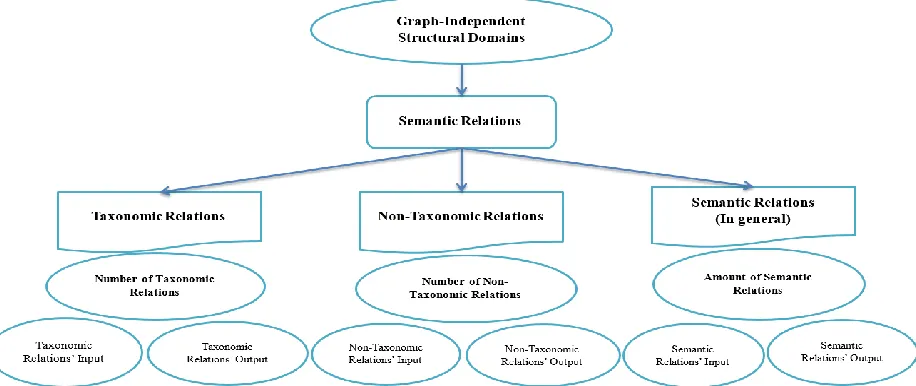
The proposed research method on evaluating structural domains that is based on the graph-independent approach should be tested in a complex ontology which covers all kinds of structural domains. In this study, the research data is selected from a complex and authoritative agricultural ontology which is VocBench. VocBench was produced in form of an ontology from AGROVOC thesaurus in 2005 [29]. VocBench, in fact, is the newest, latest version [30] and the successor of AGROVOC Concept Server Workbench (ACSW) to focus on multilingualism, collaboration and on a structured content validation & publication workflow [31]. ACSW is the re-engineered version of AGROVOC thesaurus [32, 33]. These vocabulary control tools have been originated by Food and Agricultural organization (FAO), United Nation [30]. Therefore, the data resource used is VocBench for examining our proposed method in ontology evaluation in terms of structural dimensions. The following graph demonstrates the research data in form of the graph-independent structural evaluation with regard to semantic relations.
Http://www.ijetmr.com©International Journal of Engineering Technologies and Management Research [45]
As stated previously, counting the number of semantic relations is the main way to identify the research data in the structural evaluation of semantic relations. Semantic relation data, in fact, plays a role as dependent variable or research factor in this investigation. Figure 1 demonstrates that the semantic relations data can be categorized into three major kinds which are explained in the following sentences:
2.1.Taxonomic Relations
This kind of the relations demonstrates the hierarchical relations in ontology. For instance, “Plant products” has sub-concepts like Nuts and Nuts is a sub-concept of Plants products and also Nuts
has sub-concept such as Coconuts. Taxonomic relation can be categorized into three research data which are explained as fallow:
2.1.1. Number of taxonomic Relations
This research factor can be used in determining the range of taxonomic relations to clarify the domain of hierarchical relations in an ontology.
2.1.2. Taxonomic Relations Input
This semantic relation conveys that concepts usually receive semantic relations, especially in the kind of hierarchical relations. These semantic relations play the position of taxonomic relations input in semantic network in ontologies. Coconuts, for instance, is a sub-concept of Nuts. In this case, IS_a_Sub_Concept as a semantic property plays a role as input (i.e., taxonomic input) to
Coconuts. In this case, Coconuts is linked to Nuts by a taxonomic input and lastly Nuts receives a
taxonomical input from Coconuts.
2.1.3. Taxonomic relations output
This research data play a role in sending or forwarding hierarchical relations from a generic concept to a specific one. In this case, this research factor are the kind that define a taxonomic relations output. For example, Nuts has sub_concept of Coconuts. This property (i.e., Has_Sub_Concept) is kind of semantic output which is closely related to taxonomic output for
Nuts. In this case, Nuts sends or forwards a semantic property to Coconuts. This semantic property which is “has sub_concept of” is a kind of hierarchical relation which plays a role a taxonomic output property.
2.2.Non-Taxonomic Relations
Http://www.ijetmr.com©International Journal of Engineering Technologies and Management Research [46]
2.2.1. Number of Non-Taxonomic Relations
The range of non-taxonomic relations can be identified via this research factor in clarifying the usage of associative relations in ontology.
2.2.2. Non-Taxonomic Relations Input
This semantic relation conveys that concepts usually receive semantic relations such as associative relations. As an example, the associative linkage between concepts is appearance by specific non-taxonomic properties such as “Product of”. In this case, “Nut products” has the related product like “Oil crops”. In this manner, ontology users can access to Nut product via “Product of” as a
non-taxonomic property from Oil crops which is a source concept in semantic network. Therefore,
“Product of” plays a role as a non-taxonomic input to Nut product.
2.2.3. Non-Taxonomic Relations Output
This semantic relation implies that a concept usually sends or forwards semantic relations with regard to associative relations. For example, Nuts has a product such as Nut products. In this manner, Nuts is a source concept for Nut products. Here, the related property is “Has product”
which can demonstrate the non-taxonomic relations. Accordingly, “Has product” as a property
plays a role as an output for Nuts to send and forward a semantic property to Nut products. In this case, Nuts cover a non-taxonomic output in form of a specific property such as “Has product” to link with Nut products.
2.3.Semantic Relations
This kind of the semantic relation data prepare a cumulative and comprehensive perspective about semantic relations. It means that this research data, in general, comprises of the various kinds of taxonomic and non-taxonomic relations. There are three kinds of the semantic relations in this research which are explained as fallow:
2.3.1. Semantic Relations Input
The semantic input, in fact, is the sum of the numbers of taxonomic and non-taxonomic input. This factor covers the semantic relations which concepts have received in semantic network. In this case, there is an accumulative approach in organizing a comprehensive semantic relation input to achieve precise information.
2.3.2. Semantic Relation Output
The total numbers of taxonomic and non-taxonomic relations output results in creating this research data or factor in determining the domains of hierarchical and associative relations which have the forward or sent semantic properties to the related concepts.
Http://www.ijetmr.com©International Journal of Engineering Technologies and Management Research [47]
2.3.3. Amount of Semantic Relations
This research factor includes the total numbers of taxonomic input, taxonomic output, non-taxonomic input and non-non-taxonomic output. In other word, this research data is the sum of the number of the semantic relations input and output. In this case, there is an accumulative approach in organizing a comprehensive research factor which covers all kinds of taxonomic and non-taxonomic relations to achieve precise information in clarifying the range of semantic relations in ontology. This research data, in fact, is the total number of semantic relations in ontology.
3. Data Analysis
As stated previously, this investigation relies on two main approaches, deductive and inductive. In deductive approach, we benefitted from Immanuel Kant’s knowledge theory [11] in recognizing structural analysis [34] in ontologies. This recognition results in identifying the research data, proposing novel indices and reaching general knowledge in answering the research questions number one and two through proportional analysis. The general knowledge helps us to clarify the domain of semantic relations with regard to graph-independent structural analysis based on deductive approach. When the structural domain has been identified via deductive approach, the inductive step will be started to analyze the graph-independent structural domains through answering the questions number three to five via descriptive analysis in depth to achieve the specific knowledge. This kind of knowledge can be involved in approving the results of the deductive step as well as in achieving cognitive results in evaluating the domains of the semantic relations in ontology. Consequently, data analysis has two main steps. The first step attempts to answer the research questions one and two to identify semantic relations domains based on deductive approach. The second step endeavors to measure the graph-independent structural domains through answering the research questions three to five via descriptive analysis based on inductive approach to achieve cognitive results. The following figure shows the data analysis steps in evaluating graph-independent structural domain in VocBench.
Figure 2: Recognition of research analysis steps
3.1.Deductive Approach
Http://www.ijetmr.com©International Journal of Engineering Technologies and Management Research [48]
proposed indices in the form of proportional analysis. Therefore, we will reach a general knowledge about the structural domains of semantic relations through analyzing the research questions one and two in VocBench and find the answer of our scientific guesses with regards to the relations between the research factors.
3.1.1. Analysis the Integration in Semantic Network
Identifying integration in semantic network implies on analyzing the hierarchical domain, related to the content of ontology [35]. In this matter, when the domain of hierarchical relations is recognized in ontologies, the domain of main or core subject field will be identified as well. Thus the identification of hierarchical relation and core subject field is directly related to analyzing the integration in semantic network. Integration can be measured in ontologies by a proposed formula which is Integration ratio [34]. Subsequently, the domain of taxonomic or hierarchical relations is measurable via the Integration Ratio.
The Integration ratio measures and calculates the concepts that are linked by taxonomic relations. The indicators of the Integration ratio are the total number of taxonomic relations and total number of semantic relations.
𝐼𝑅 =a b 𝑎 = 𝑡ℎ𝑒 𝑡𝑜𝑡𝑎𝑙 𝑛𝑢𝑚𝑏𝑒𝑟 𝑜𝑓 𝑡𝑎𝑥𝑜𝑛𝑜𝑚𝑖𝑐 𝑟𝑒𝑙𝑎𝑡𝑖𝑜𝑛𝑠 𝑏 = 𝑡ℎ𝑒 𝑡𝑜𝑡𝑎𝑙 𝑛𝑢𝑚𝑏𝑒𝑟 𝑜𝑓 𝑠𝑒𝑚𝑎𝑛𝑡𝑖𝑐 𝑟𝑒𝑙𝑎𝑡𝑖𝑜𝑛𝑠
The result of measuring taxonomic relations displays that the total number of taxonomic relations is equal to 5911 and the total number of semantic relations is equal to 7934 in the research population in VocBench. Thus, the domain of integration in semantic network is equal to 0.74 (i.e., 5911 / 7934 = 0.74). In other words, the domain of taxonomic relations is 74 percent in relation to the total number of the semantic relations in VocBench.
3.1.2. Examining the Association or Non-Taxonomic Relations
The associative or non-taxonomic relations covers associations between pairs of concepts which are not related hierarchically [36], but are closely related conceptually [37] and a kind of the inter-semantic relations [35]. The most important role of associative relations is the linkage between concepts in the same categories (i.e., sibling concepts) or different categories. In contrast, the overload of this relations result in an increase of valueless relationships in impairing precision without much improving recall [37]. Therefore, the amount of non-taxonomic relations usage is the important factor in ontology evaluation.
The domain of non-taxonomic relations can be measured by a proposed formula which is Relativeness Ratio. The indicators of the Relativeness ratio are the total number of non-taxonomic relations and total number of semantic relations.
Http://www.ijetmr.com©International Journal of Engineering Technologies and Management Research [49]
The analysis of the amount of taxonomic relations shows that the total number of non-taxonomic relations is equal to 2023 relationships. In attention to the total number of semantic relations which is equal 7934, the non-taxonomic domain comes to 0.25 (i.e., 2023/ 7934 = 0.25). Therefore, non-taxonomic relations cover 25 percent of the total number of semantic relations in VocBench.
3.2.Inductive Approach
The structural analyses in deductive approach had focused on proportional analysis in answering the research questions one and two to prepare general knowledge about the domains of the semantic relations in VocBench. On the contrary, the descriptive statistics in this section identify the in-depth knowledge in evaluating the structure of the various kinds of the semantic relations through answering research questions three to five. The related analyses have been derived from SPSS data, especially the frequency analysis on the structure of semantic relations in VocBench. Hence, the descriptive approach based on the inductive approach discovers the in-depth knowledge in identifying structural domains as a complement to the proportional analyses in step one of the data analysis (i.e., deductive approach in data analyzing).
3.2.1. Frequency of the Usage of the Various Kinds of Semantic Relations
In this section, we intend to present appropriate answers for the third research question in measuring the amount of the various kinds of semantic relations in VocBench. The following table demonstrates the results of semantic relations number in VocBench.
Table 1: Demonstration of the number of semantic relations in VocBench
Semantic relations The number of semantic relations
Taxonomic relations input 2032
Taxonomic relations output 3879
Non-Taxonomic relations input 987
Non-Taxonomic relations output 1036
Taxonomic relations number 5911
Non-Taxonomic relations number 2023
Semantic relation input 3019
Semantic relation output 4915
Semantic relations Input-Output 7934
Http://www.ijetmr.com©International Journal of Engineering Technologies and Management Research [50]
3.2.2. Comparison between the Amounts of Semantic Relations
The comparison between the amounts of various semantic relations has been analyzed in answering the forth research question in the following discussions. As stated previously in the section of research data, semantic relations is divided into three major groups, taxonomic, non-taxonomic and semantic relations in analyzing the structural domains in VocBench. This section focuses on determining the structural domain of taxonomic and non-taxonomic relations. Furthermore, each of these groups had been categorized into two partitions for identifying their roles as semantic input or output. Therefore, taxonomic relations consist of the taxonomic relations input and output and also non-taxonomic ones include the non-taxonomic input and output. Figure 3 displays the percentages of taxonomic and non-taxonomic relations’ inputs and output in VocBench.
Figure 3: Comparison between the numbers of semantic relations in VocBench
The above figure reveals the domains of semantic relations via counting the numbers of semantic relations in VocBench. The results observably demonstrate that the amount of taxonomic relations input is more than the others in VocBench. In this case, the domain of taxonomic output is equal to 49 percent. In addition, the numbers of taxonomic input (i.e., 26 percent) is more than each of non-taxonomic input and output, which are 12 and 13 percent respectively. In this case, we can also see that there is equivalency between the domains of taxonomic input (i.e., 26 percent) and the total amount of non-taxonomic input and output (i.e., 12 + 13= 25 percent) in another point of view. On the other hand, there is equivalency between the domains of non-taxonomic input and output. Therefore, the domain of hierarchical relations is extremely more than associative domains. This result is already approved by the outcomes of Integration and Relativeness ratios.
3.2.3. Comparison between the Domains of Semantic Relations Input and Output
Http://www.ijetmr.com©International Journal of Engineering Technologies and Management Research [51]
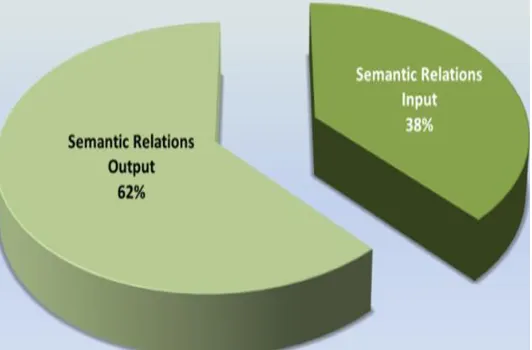
way to identify the domain of semantic output via counting the number of taxonomic and non-taxonomic output. Hence, the clarification of semantic relations domains gives us a cumulative knowledge in terms of semantic input-output domains. The domains of semantic relations input and output are presented by counting the numbers of these relations in the following figure:
Figure 4: Comparison between the domains of semantic relations input and output in VocBench
Figure 4 shows the domain of semantic relations input and output based on counting the number of these relations in VocBench. The outcomes clearly demonstrate that the domain of semantic relations output is larger than the other one. The semantic output domain, in fact is equal to 62 percent and the domain of semantic relations input covers 38 percent. Thus, when the number of semantic output is more than input, concepts have sent more semantic relations than received semantic relations.
4. Discussions
The discussions, in this section is divided into two complement sections: firstly, discusses on the findings based on the deductive approach which answers the research questions one and two, secondly, discusses on the findings based on the inductive approach in answering research questions three to five.
4.1.Deductive Approach
Http://www.ijetmr.com©International Journal of Engineering Technologies and Management Research [52]
4.1.1. Domain of Taxonomic Relations
The first research question is to identify the domain of taxonomic relations to recognize the integration in the semantic network. In other words, when the domain of taxonomic or hierarchical relations measures based on its “logically progressive sequence” [37], integration characterizes in the main or core subject fields in ontology. This integration has been done by a complex hierarchical structure and many different types of relationships among the concepts [38]. The hierarchical relations should be established between a pair of concepts when the scope of one of them falls completely within the scope of the other [39] to depict generic to specific relations [38]. These relations which play as a major factor in improving recall and precision performance shows levels of superordination (i.e., a class or whole) and subordination (i.e., members or parts) [37]. Moreover, the measure of the taxonomic relations’ usage has a direct effect on the result of integration in the semantic network [34] which is a basic feature of ontology [37]. Therefore, the amount of taxonomic relations causes the identification of integration in the main or core subject fields in ontology and that the increase of integration in ontology results in improving the performance of IR regard to recall and precision rates.
In this manner, the mentioned question is relating to the counting of the amount of hierarchical relations in ontologies. Two main factors are entailed in measuring the taxonomic domain: the total number of taxonomic relations and total number of semantic relations. Proportional technique was used for recognizing the taxonomic domain through a proposed ratio (i.e., Integration ratio). The finding reveals that taxonomic domains cover about three-quarters of semantic relations in VocBench. Consequently, the domain of taxonomic relations as a basic feature consists of a major part of semantic relations in VocBench. Thus, the integration of semantic network covers the dominant domain in ontology and this specification is supposed to increase the IR performance in VocBench.
4.1.2. Domain of Non-Taxonomic Relations
The second research question is to recognize the domain of non-taxonomic relations in clarifying the domain of associative relations between concepts. The non-taxonomic relations play a great role in preparing the associations between pairs of concepts which are not related hierarchically [39], but are closely related conceptually [37] or semantically [38]. The most important function of associative relations is the linkage between concepts of the same categories (i.e., sibling concepts) or different categories. In contrast, the overload of this relations result in increasing valueless relationships that impairs precision without improving recall [37]. Therefore, the amount of non-taxonomic relations’ usage is the important factor for recognizing the amount of association between concepts in the field of ontology evaluation.
Http://www.ijetmr.com©International Journal of Engineering Technologies and Management Research [53]
domain (i.e., Relativeness ratio). The finding reveals that taxonomic domains cover about three-quarters of all the semantic relations in VocBench. The results of data analysis demonstrated that non-taxonomic relations comprise of a quarter of semantic relations in VocBench. Therefore, a quarter of semantic relations belonged to non-taxonomic relations, that is, one of every four semantic relation is related to associative relations. This amount has not showed an overloading in the taxonomic relations and this finding is supposed to demonstrate the positive role of non-taxonomic relations in the performance of IR.
4.2.Inductive Approach
In deductive approach, we recognized graph-independent structural domains with regarding to semantic relations in VocBench. When the structural domain of semantic relations has been identified in capturing general knowledge via deductive approach, the inductive step will be started to prepare specific knowledge in identifying graph-independent structural analysis of semantic relations in detail. In this sense, this step focused on inductive approach in presenting arguments related to structural domains of the semantic relations and in the related results which were derived from answering the research questions three to five through descriptive. The main viewpoints of descriptive analysis relied on frequency of semantic relations. Therefore, the discussions based on the inductive approach will start from descriptive statistics in clarifying structural domains of semantic relations in capturing specific and in-depth knowledge as a complement for the results of the deductive approach.
The discussion in this section can divided into two main parts which are the discussions on recognizing the range of the various kinds of taxonomic and non-taxonomic relations as well as the discussions on the range of semantic relations’ input and output in VocBench.
4.2.1. Analysis on the Range of the Various Kinds of the Semantic Relations
The research findings demonstrated the comparison between the amounts of semantic relations which can be categorized into four groups; taxonomic relations’ input-output and non-taxonomic relations’ input-output and semantic relations’ input-output. The results clearly showed that the amount of taxonomic relations (i.e., includes input and output) covered three-quarter of the total semantic relations in VocBench and this finding confirmed the results of the first research question. In this case, half of the total semantic relations belonged to taxonomic outputs while taxonomic input covered a quarter of semantic relations. On the other hand, non-taxonomic input and output included a quarter of semantic relations which were divided equally between them. The results of analyzing the range of non-taxonomic relations approved the finding of the second research question. Consequently, the core or subject field which can be clarified by taxonomic relations covers a wide area in VocBench. Moreover, the overloading was not seen in the usage of non-taxonomic relations because of the amount of their usage in comparison with non-taxonomic relations.
4.2.2. Analysis on the Range of Semantic Relations Input and Output
Http://www.ijetmr.com©International Journal of Engineering Technologies and Management Research [54]
more than semantic input. When concepts, in general, send semantic relations more than they receive in an ontology, the width of ontology is more than its length. The length of concepts which can be measured by counting the number of concepts as a criterion [40] is a parameter in evaluation of specificity and exhaustivity in ontologies [41]. Exhaustivity or breadth [42] provides the potential for high recall and may loss for precision [37]. Subsequently, the amount of semant ic relations’ output might be demonstrated as the width (i.e., exhaustivity) in semantic network in VocBench.
5. Conclusion
This research proposed a new method (i.e., OntoAbsolute) in evaluating graph-independent structural domains in semantic relations in ontologies through using a mix of deductive and inductive approach. These approaches complete each other in moving from general knowledge to in-depth knowledge in identifying the domain of semantic relations in VocBench. The results of the deductive approach, in fact, reasoned for approving the results of deductive approach and acts as a complement step.
The results of frequency analysis were clearly seen that the amount of taxonomic relations based on the inductive approach covered three-quarter of the total numbers of semantic relations in VocBench. This finding confirmed the results of first research question in deductive process. Furthermore, the results of question two showed that the domain of non-taxonomic relations included a quarter of semantic relations which this finding was approved by the frequency analysis in the inductive approach. Moreover, the result of the semantic relation analysis showed that the amount of semantic output is extremely more than semantic input. This result might be conveyed the possibility of exhaustivity which results in increasing recall and decreasing precision in VocBench. Hence, the core or subject field which can be clarified by taxonomic relations covers a wide area in VocBench. Moreover, the overloading was not seen in the usage of non-taxonomic relations because of the amount of their usage in comparison with taxonomic relations. This finding is supposed to demonstrate the positive role of non-taxonomic relations in the performance of IR. The high frequency in the usage of the semantic relations’ output might be implied as the width (i.e., exhaustivity) in semantic network in VocBench. However, the identification of specificity and exhaustivity is not the purposes of this research in identifying graph-independent domains of semantic relations. This kind of evaluation can operate by operating graph-independent structural analysis in analyzing the amount of the semantic relations’ input and output in future researches.
Acknowledgements
We would like to thank the Centre for Graduate Management, Universiti Kebangsaan Malaysia (National University of Malaysia) and Agricultural Research, Education and Extension Organization (AREEO).
References
Http://www.ijetmr.com©International Journal of Engineering Technologies and Management Research [55]
[2] Sowa, J. F. Conceptual Graphs. Handbook of Knowledge Representation. edited by F. van Harmelen, V. Lifschitz and B. Porter. London: Elsevier, 2008.
[3] Corbett, D. Conceptual Graph Theory Applied to Reasoning in Ontologies, 2002. [Online] www.lsi.us.es/iberamia2002/confman/.../132-annuniuett.pdf
[4] Chah, N. OK Google, What Is Your Ontology? Or: Exploring Freebase Classification to Understand Google's Knowledge Graph, 2018. [Online] https://arxiv.org/abs/1805.03885.
[5] Wiens, V., Lohmann, S. & Auer, S. Semantic Zooming for Ontology Graph Visualizations. In Proceedings of the Knowledge Capture Conference (K-CAP’17), 2017, 4:1–4:8. ACM.
[6] Rodríguez-García, MÁ and Hoehndorf, R. Inferring Ontology Graph Structures Using OWL Reasoning. BMC Bioinformatics, 2018; 19 (1).
[7] Tamilselvam, S., Nagar, S., Mishra, A. and Kuntal Dey Graph Based Sentiment Aggregation using ConceptNet Ontology, The eight international joint conference on natural language processing
(IJCNLP), Taipei, Taiwan, 2017. [Online]
http://ijcnlp2017.org/site/page.aspx?pid=172&sid=1133&lang=en.
[8] Wang, S., Cho, H., Zhai, C., Berger, B. & Peng, J. Exploiting Ontology Graph for Predicting Sparsely Annotated Gene Function. Bioinformatics, 31, 2015, i357–i364.
[9] Kim, Y., Zerfos, P., Sheinin, V. and Greco, N. “Ranking the Importance of Ontology Concepts Using Document Summarization Techniques”, in proceedings of IEEE International Conference on BigData, 2017
[10] Amirhosseini, M. & Salim, J. OntoAbsolute as an Ontology Evaluation Methodology in Analysis of the Structural Domains in Upper, Middle and Lower Level Ontologies. STAIR'11: International Conference on Semantic Technology and Information Retrieval28th to 29th June 2011, Putrajaya, Kuala Lumpur, Malaysia. Malaysia: Institute of Electrical and Electronics Engineers, 2011, pp. 26-33.
[11] Kant, I. 1781. Critique of Pure Reason. Translated by J. M. D. Meiklejohn. Pennsylvania: The Pennsylvania State University, 2013.
[12] Krejcie, R. V., & Morgan, D. W. Determining sample size for research activities. Educational and Psychological Measurement, 30, 1970, 607-610.
[13] Bolotnikova, E. Ontology Cognitive Ergonomics Evaluation Based on Graph Topology, 2009. [Online] http://www.ht2009.org/src_submissions/ht2009_submission_184-ok.pdf
[14] Gangemi, A., Catenacci, C., Ciaramita, M. & Lehmann, J. A Theoretical Framework for Ontology Evaluation and Validation. Proceedings of SWAP, 2005.
[15] Dividino, R., Romanelli, M. & Sonntag, D. Semiotic-based Ontology Evaluation Tool S-OntoEval. Proceedings of the Sixth International Conference on Language Resources and Evaluation LREC'08. Marrakech, Morocco, 2008.
[16] Eynard, D., Matteucci, M. & Marfa, F. A Modular Framework to Learn Seed Ontologies from Test. Semi-Automatic Ontology Development: Processes And Resources. Hershey, PA: Information Science Reference, 2012.
[17] Alani, H. & Brewster, C. Ontology Ranking Based on The Analysis of Concept Structures. Proceedings of the 3rd International Conference on Knowledge Capture (K-Cap), Banff, Canada, 2005, 51–58.
[18] Assal, H., Pohl, K. and Pohl, J. The Representation of Context in Computer Software, Pre-Conference Proceedings, Focus Symposium on Knowledge Management Systems, InterSymp-2009, Baden-Baden, Germany, 4 August, 2009.
[19] Martín Chozas, Patricia. Towards a Linked Open Data Cloud of Language Resources in the Legal Domain. Thesis (Master thesis), E.T.S. de Ingenieros Informáticos, Universidad Politécnica de Madrid (UPM), 2018.
[20] Sowa, J.F. Conceptual Structures: Information Processing in Mind and Machine. Reading, Mass: Addison-Wesley, 1984.
Http://www.ijetmr.com©International Journal of Engineering Technologies and Management Research [56]
[22] Chein, M. & Mugnier, M.-L. Conceptual Graphs: Fundamental Notions. Revue d'Intelligence Artificielle. 6 (4), 1992. 365-406.
[23] Corbett, D.R. & Woodbury, R.F. Unification over Constraints in Conceptual Graphs. Proc. Seventh International Conference on Conceptual Structures. Blacksburg, Virginia, USA: Springer-Verlag, 1999.
[24] Corbett, D.R. Conceptual Graphs with Constrained Reasoning. Revue d'Intelligence Artificielle 15(1), 2001, 87-116.
[25] Polcicova, G., Návrat, P. Semantic Similarity in Content-Based Filtering. Advances in Databases and Information Systems: 6th East European Conference, ADBIS 2002. Bratislava, Slovakia: Proceedings, 2002, pp. 80-85.
[26] Obrst, L., Ashpole, B., Ceusters, W., Mani, I., Steve, R. & Smith, B. The evaluation of ontologies: Toward improved semantic interoperability. Semantic Web, Berlin: Springer, 2007, pp. 139-158.
[Online] http://wtlab.um.ac.ir/parameters
THE%20EVALUATION%20OF%20ONTOLOGIES.pdf
[27] Buggenhouta, C. V.& Ceustersb, W. A Novel View on Information Content of Concepts in a Large Ontology and a View on the Structure and the Quality of the Ontology. International Journal of Medical Informatics 74 (2-4), 2005.125-132.
[28] Gangemi, A., Catenacci, C., Ciaramita, M.& Lehmann, J. Qood grid: A Metaontology-Based Framework for Ontology Evaluation and Selection. Proceedings of Evaluation of Ontologies for the Web, 4th International EON Workshop, Located at the 15th International World Wide Web Conference WWW 2006. [Online] https://km.aifb.kit.edu/ws/eon2006/eon2006gangemietal.pdf [29] Yves, J. 2011. VocBench: Vocabulary Editing and Workflow Management. SemTech, 2011: The
Semantic technology conference, 2011. [Online]
http://semtech2011.semanticweb.com/uploads/handouts/MON_600_Jaques_3910.pdf
[30] Xian, G. & Zhao, R. A Review and Prospects on Collaborative Ontology Editing Tools. Journal of Integrative Agriculture, 11 (5), 2012, 731-740.
[31] Stellato, A. Collaborative Development of Multilingual Thesauri with Vocbench (System Description and Demonstrator). In the Semantic Web: ESWC 2015 Satellite Events, Portorož, Slovenia, May 31 – June 4, 2015, Cham: Springer International Publishing, 2015. p. 149–153. [32] Sabou, M. Methods for Selection And Integration of Reusable Components From Formal or
Informal User Specifications, Open University (OU), 2007.
http://citeseerx.ist.psu.edu/viewdoc/download?rep=rep1&type=pdf&doi=10.1.1.122.8144
[33] Soergel, D., Lauser, B., Liang, A., Fisseha, F., Keizer, J. & Katz, S. Reengineering Thesauri for New Applications: the AGROVOC Example. Journal of Digital Information 4 (4), 2004. [Online] ftp://ftp.fao.org/docrep/fao/008/af234e/af234e00.pdf
[34] Amirhosseini, M. Theoretical Base of Quantitative Evaluation of Unity in Thesaurus Terms Network: Base on Kant's Epistemology. Knowledge Organization 37 (3), 2010, 185-202.
[35] Linbo, D., Ping, Q., Lingfei, Q.and Ting, X. Research on Domain Ontology Construction Based on Thesaurus of Geographical Science, Proceedings of 2017 2nd International Conference on Automation, Mechanical Control and Computational Engineering (AMCCE 2017)
[36] International Organization for Standardization (ISO). ISO/FDIS 25964-1: Information and Documentation -Thesauri and Interoperability with other Vocabularies - Part 1: Thesauri for Information Retrieval. Geneva: International Organization for Standardization; Final Draft circulated April, 2011.
[37] Aitchison, J, Gilchrist, A & Bawden, D. Thesaurus construction and use: a practical manual. Fourth edition. London: The Association for Information Management (Aslib), 2000.
[38] National Information Standards Organization (NISO). Guidelines for the Construction, Format, and Management of Monolingual Controlled Vocabularies: ANSI/NISO Z39.19-2005, Bethesda Md., NISO Press, 2005.
Http://www.ijetmr.com©International Journal of Engineering Technologies and Management Research [57]
Interoperability with other vocabularies. Geneva: International Organization for Standardization, 2013.
[40] Fidelman, E. Metadata Quality and the Use of Hierarchical Schemes to Determine Meta Keywords: An Exploration. Master of Science. Chapel Hill, North Carolina, University of North Carolina at Chapel Hill, the School of Information and Library Science, 2006.
[41] Jamoulle, M. The Words of Prevention, Part II: Ten Terms in the Realm of Quaternary Prevention. Revista Brasileira de Medicina de Família e Comunidade. 10 (35), 2015, 1-10.
[42] Gregory, K., Groth, P. T., Cousijn, H., Scharnhorst, A., Wyatt, S. Searching Data: A Review of
Observational Data Retrieval Practices. CoRR abs/1707.06937. 2017. [Online]
http://arxiv.org/abs/1707.06937.
*Corresponding author.